Kobe, Japan (Day 2) – Osaka (2024)
As always seems to happen when we have an overnight stay, we woke up on the morning of March 3 still in Kobe harbor. Today we had scheduled an excursion to Osaka, a lengthy bus ride away, on which we left early in the morning. With a population of about 2.7 million, Osaka is the third largest city in Japan and is a major commercial and financial center for the country. It is home to important international electronics companies like Panasonic and Sharp. People have lived here for at least 2,000 years, one of the earliest settlements in Japan. Like other Japanese cities, Osaka was subject to extensive Allied bombing near the end of World War II but was successfully rebuilt after the war.
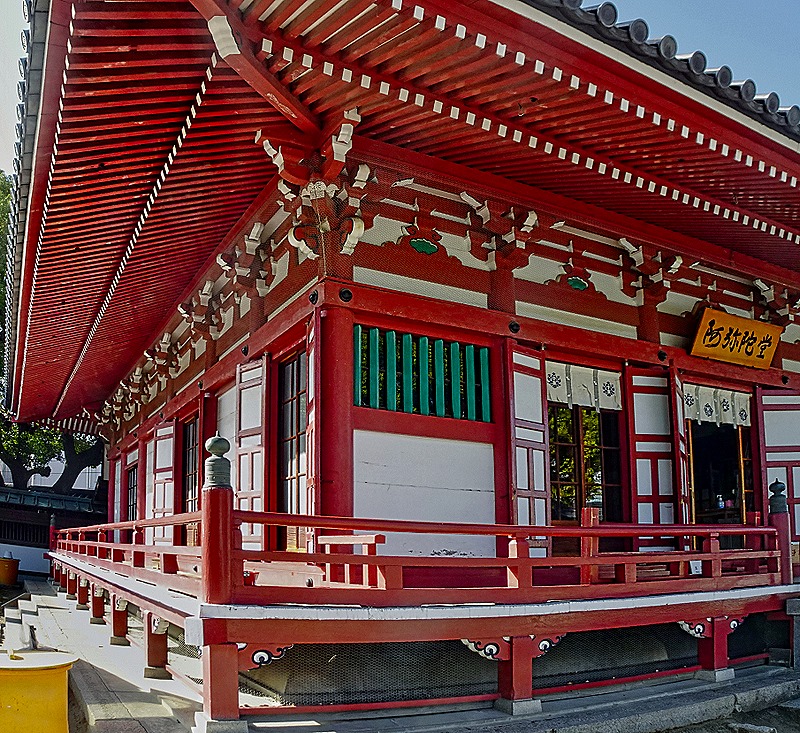
It would be difficult to plan a visit to Japan without including visits to temples and shrines. Our first visit today was to Shitenno-ji Temple, considered by many the oldest Buddhist temple in Japan. It was first built in 593 by Prince Shotoku, one of the first to promote the spread of Buddhism here. Its buildings have been destroyed many times, by both war and natural calamities, most recently by the bombing in World War II. The current reconstruction, based on archeological excavations as well as old records, was completed in 1963 and is considered to be as true as possible to its original appearance.
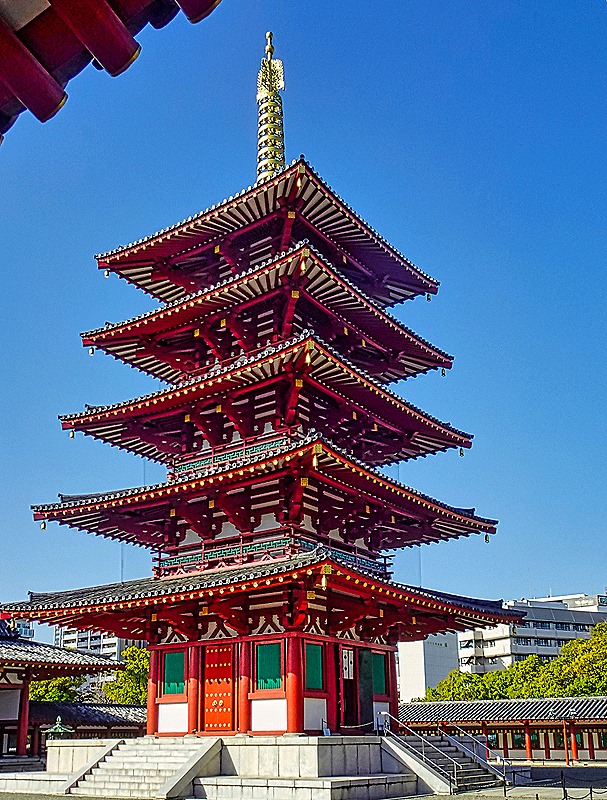
The temple’s core consists of a covered walkway around the main courtyard, with a gate on one side and a lecture hall (Kodo) on the other. In the courtyard are the Kondo (the main hall) and a five story pagoda. The predominant colors of the buildings are red and white. The buildings are aligned in a straight line – Chumon gate, pogoda, kondo, Kodo – an arrangement that came to be known as Shitennoji-style and was widely copied.
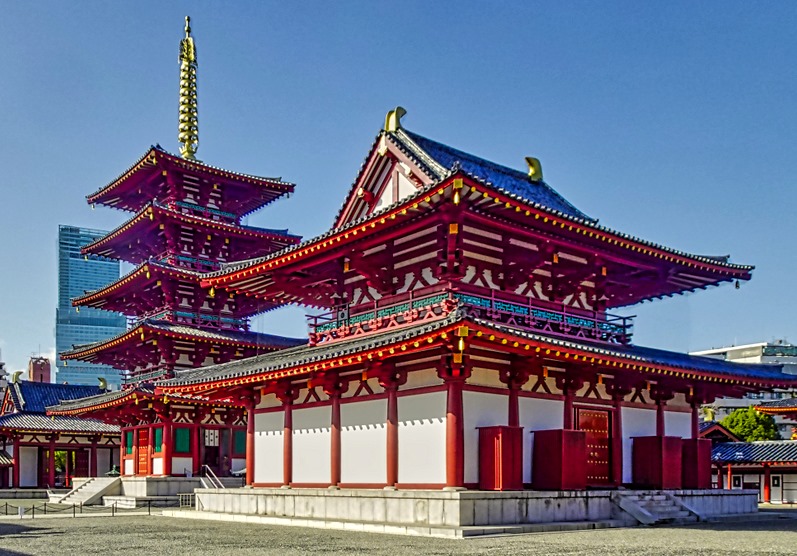

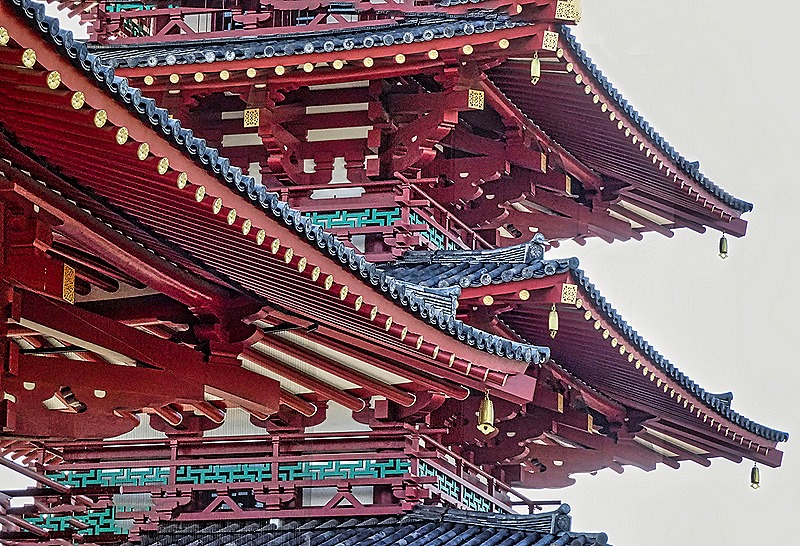
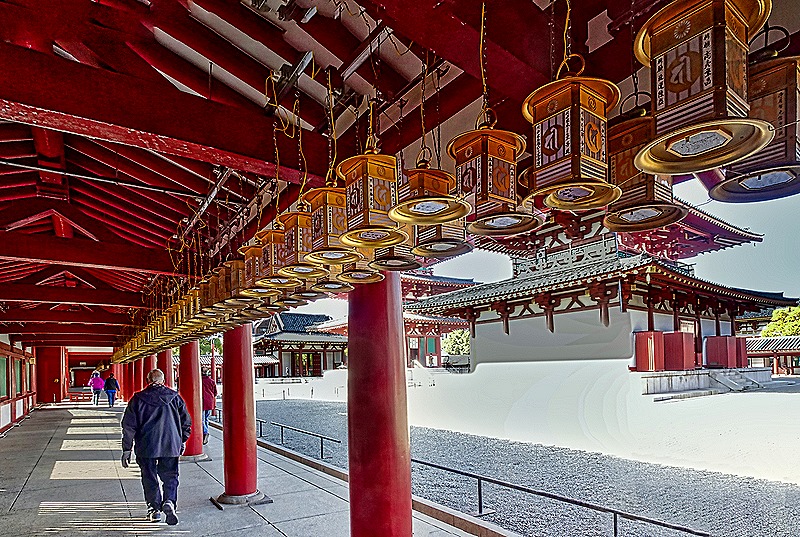
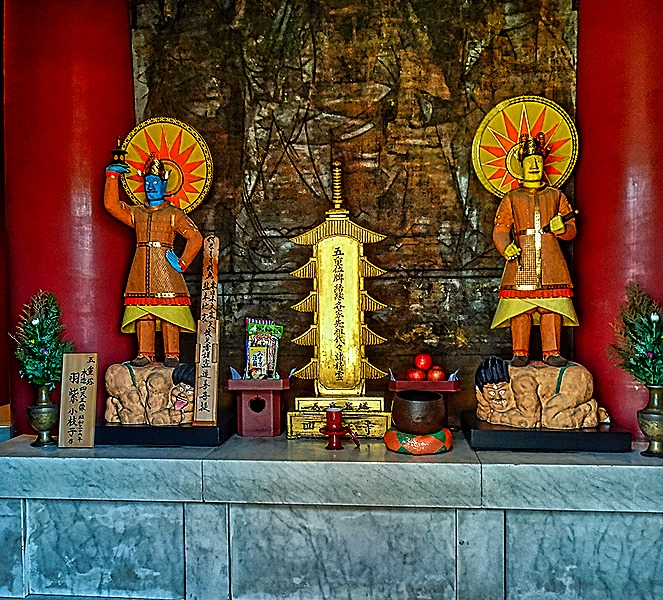
The five story pagoda is easily the most prominent building in the temple complex. Each floor reputedly contains a different set of religious artifacts. I say reputedly because, although entry was permitted if you removed your shoes, we did not climb the stairs here. Really not enough time. But Rick walked up the concrete stairs and took a photograph of the interior through the door.

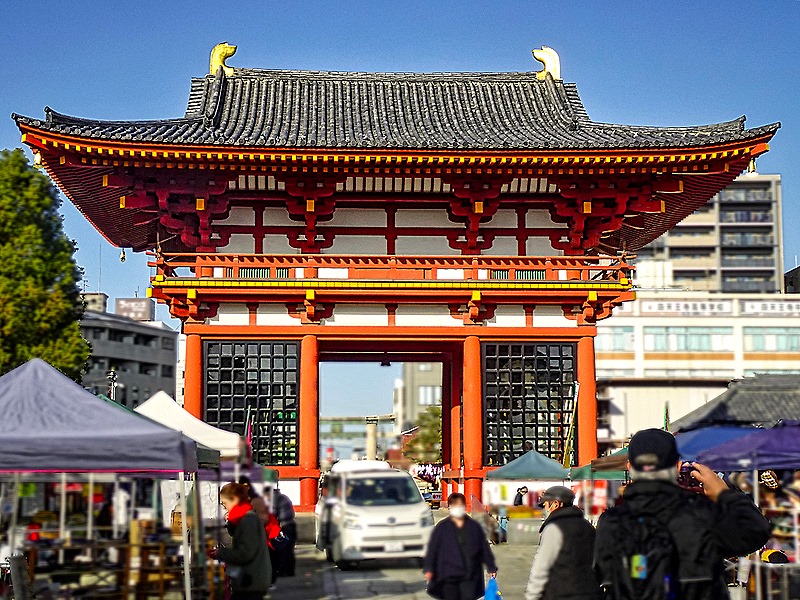
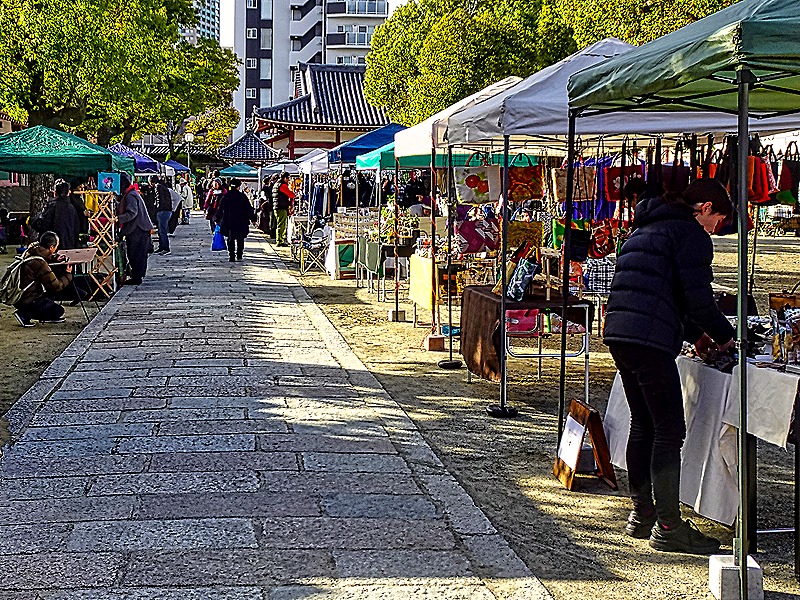
We have read that there is a market at this temple every month on the second or third weekend. But we were there on March 3 and there definitely was a lively market inside the gates, with many people selling crafts, clothing and other things from temporary looking cloth roofed kiosks held up by poles. Our guide said this occurs every Sunday. So maybe this isn’t the official big time market scheduled once a month, but it certainly occurs on Sundays (at least the Sunday when we were there).
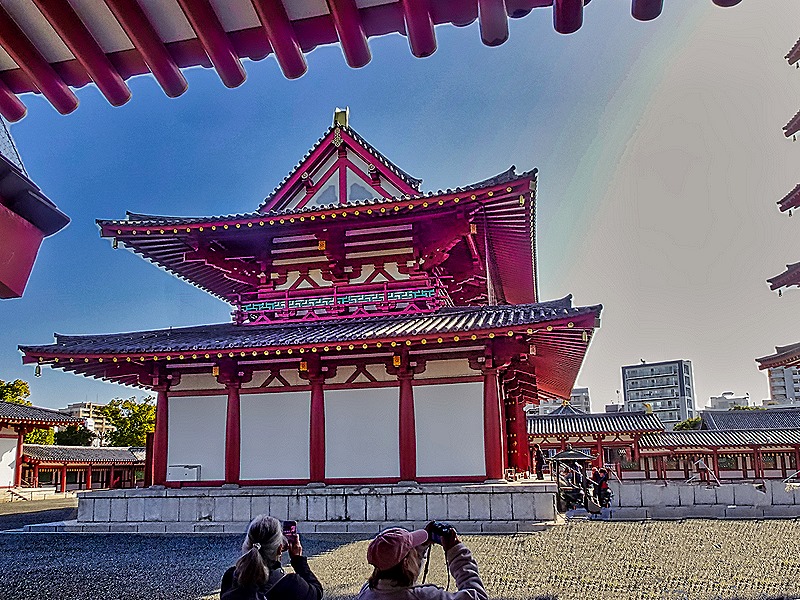
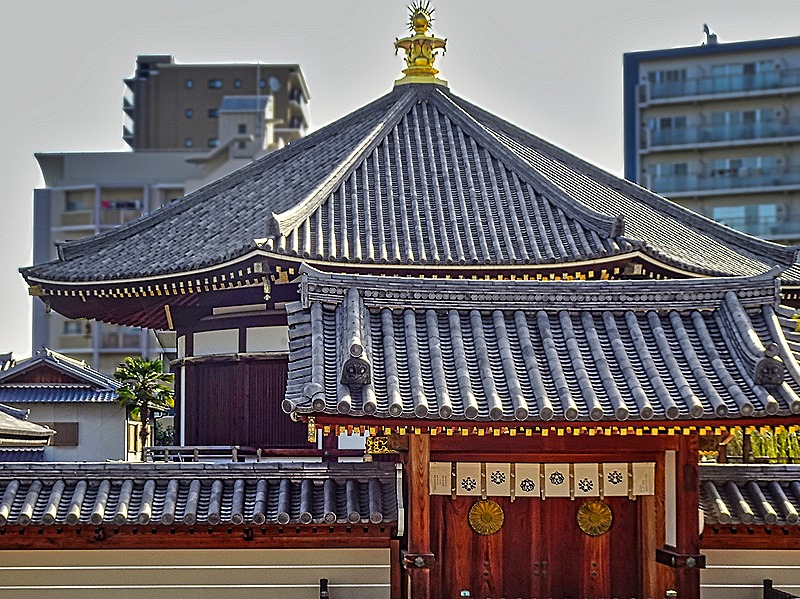
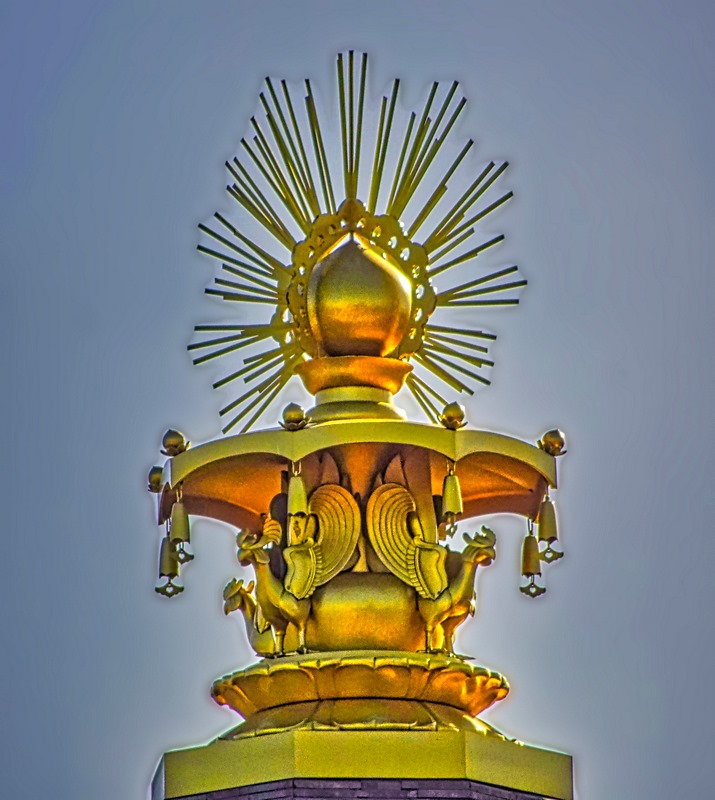
The Kondo is the main sanctuary sitting in the middle of the courtyard, but it was closed the day we were there so we didn’t see the inside. We also have pictures of two interesting buildings we can’t identify, one with a hexagon shape and a gold looking figure on the apex of the roof and another that is mostly red and white, with a surrounding porch sitting on short pillars.
Our next stop was Osaka Castle. On our way there we passed a couple in a park teaching their son how to wield a baseball bat (baseball is, of course, very big in Japan). We parked in a lot a good bit away from the castle and had a long walk, through woods and along moat walls, to get there.

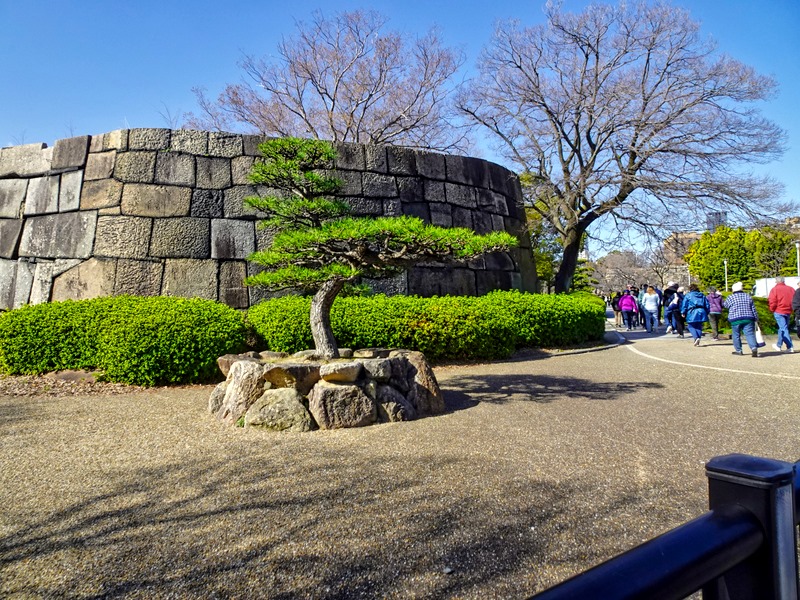

Osaka Castle was originally built in the 1580’s and 90’s by Toyotomi Hideyoshi. The Toyotomi clan were the primary rivals to the Tokugawas for the office of shogun, the military leader and actual political ruler of Japan. If you have read or watched James Clavell’s historical novel Shogun, you will recall that much of the action takes place in Osaka Castle and Toyotami is an important character (under a fictional name). In 1600 Tokugawa Ieyasu became shogun. In 1614-15, after a siege, the castle fell to the Tokugawas and while Hideyoshi had already died, both his son and his widow committed suicide, ending the Toyotomi clan. The castle was burned to the ground.
In the 1620’s the Tokugawas rebuilt the castle, burying what was left of Toyotomi’s castle and building new stone walls (still standing) and a new tower on a different spot near where the old one stood. Most of the castle’s buildings were destroyed and rebuilt several times over the centuries, most recently by Allied bombing near the end of World War II. The current version, restoring the castle largely to its Tokugawa era appearance, but with more reliable modern materials, was completed in 1997.
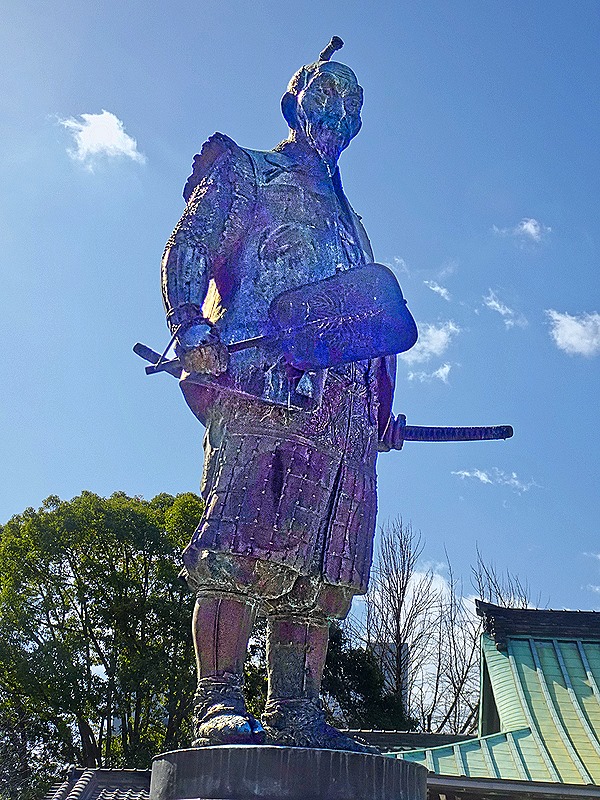
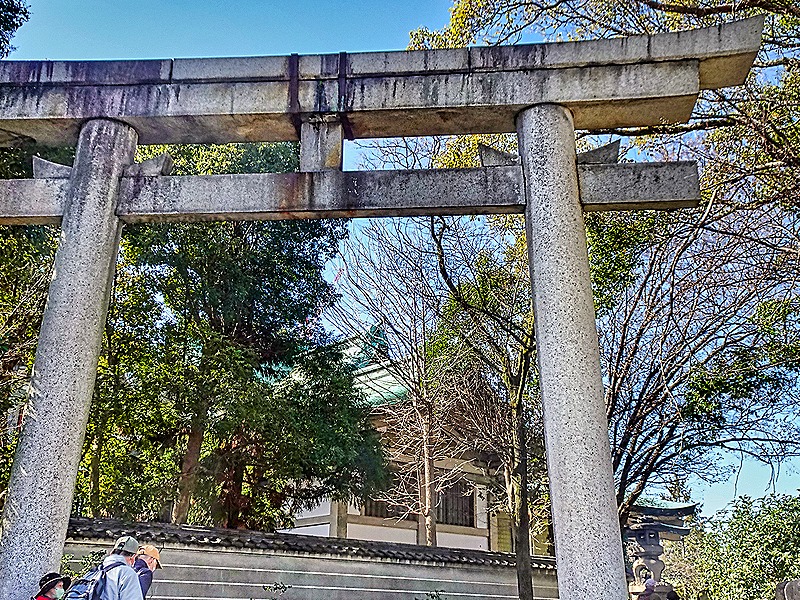
On our way to the castle we passed a small Shinto shrine called Hokoku-jinja. It was built by the Meiji emperor in 1879 to honor the Toyotomi clan. We did not go into the shrine, but we did see the torii gate at its entry and a statue of Toyotomi Hideyoshi erected in 2007, which faces the castle. He does not look warm and cuddly.
Walking around the moat we saw a white watchtower above the stone wall on the opposite side. We didn’t notice it at the time, but through the bare trees behind the watchtower the green roofs of the castle tower were just visible in the distance.

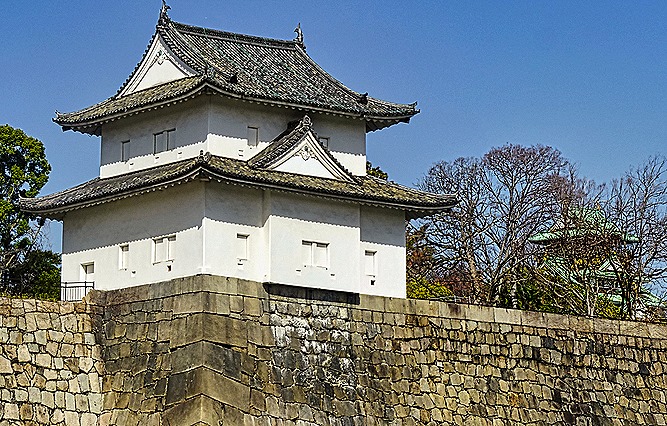
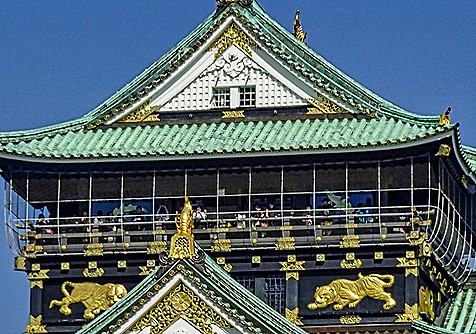
This was a weekend and it was early afternoon when we reached the castle, so the area was quite crowded. The castle is white with green roofs and decorated in gold. It is five stories tall from the outside, but 8 stories on the inside. We had to wait in a long line for quite a while to gain admittance.
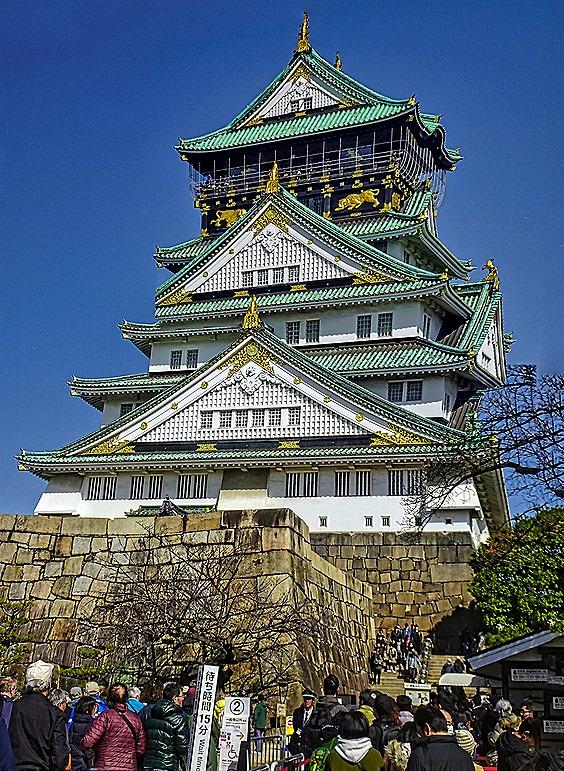

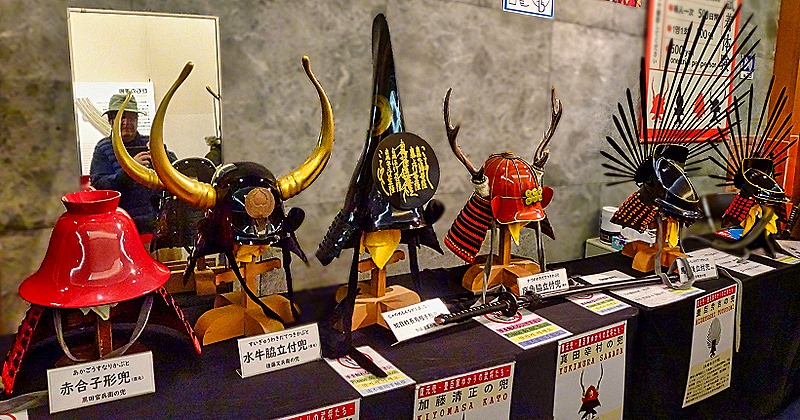
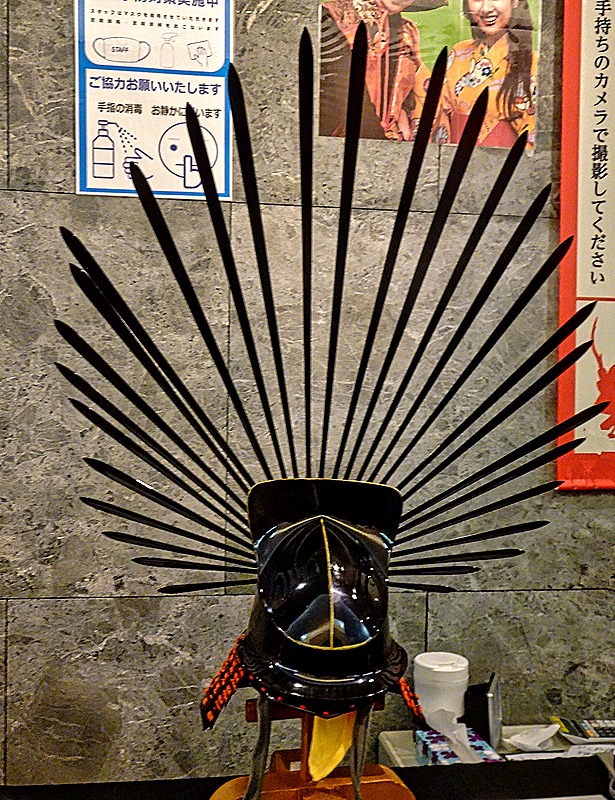
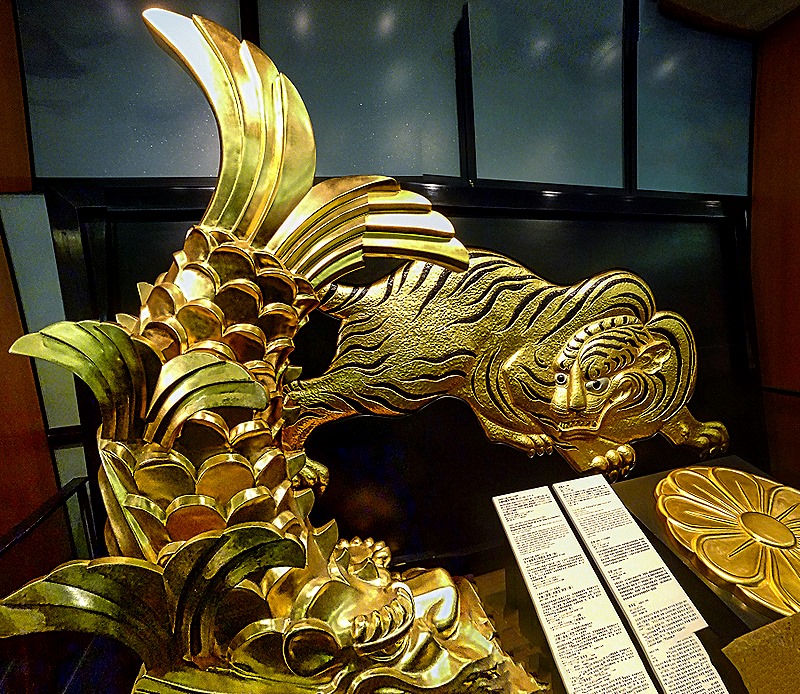
There is an elevator inside (as mentioned, this is a modern concrete replica, not the original wooden castle), and the easiest way to see the castle inside would be to take the elevator to the top and walk down the 8 flights of stairs. But the elevator is slow and so many people want (or need) to use it that the wait is substantial and we didn’t really have extra time to waste standing in line. So we walked up the 8 flights of stairs. The castle today is really a museum with exhibits on each floor. Here is an exhibit of ancient Japanese war helmets on one floor, one of which was marked as having belonged to Toyotomi Hideyoshi. For a fee you could don one of these helmets along with some armor to have your picture taken. Also on exhibit was a life size example of the golden dolphin and crouching tigers that adorn the outside of the castle. There were many more interesting exhibits, including large paintings, that were difficult to examine because of the crowds in front of them.
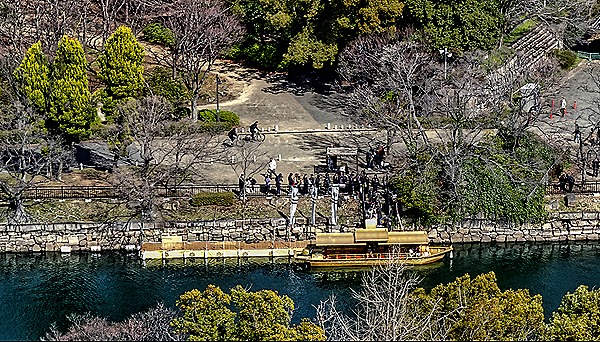
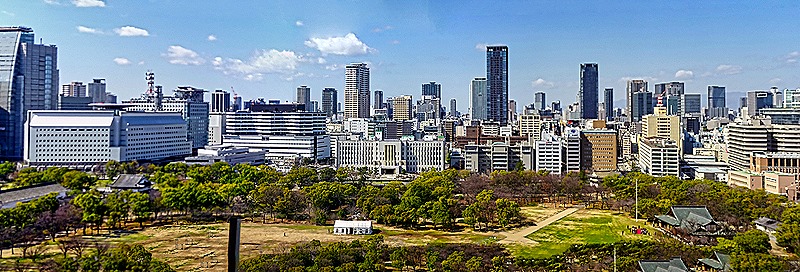
In the end we reached the top floor, which had viewing windows all around with fabulous views of the surrounding area and the gold dolphins adorning the the top of the roof just below. The entire area was screened in and you could see the screens from the ground outside. We looked down on the moat where visitors could ride in a boat (a moat boat?). In one direction was a cityscape of skyscrapers and in front of the castle we looked down on the grounds of the entry area. The view was worth the walk up the stairs.

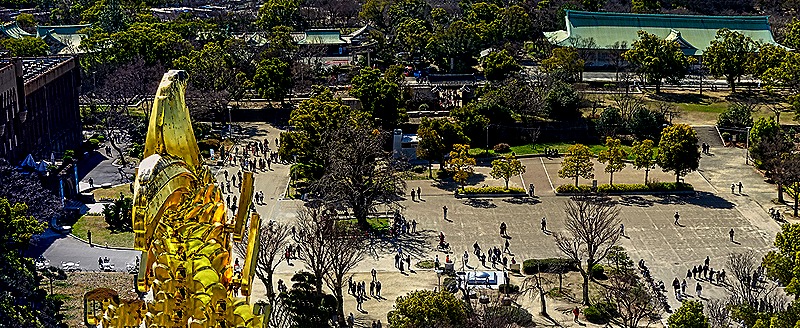
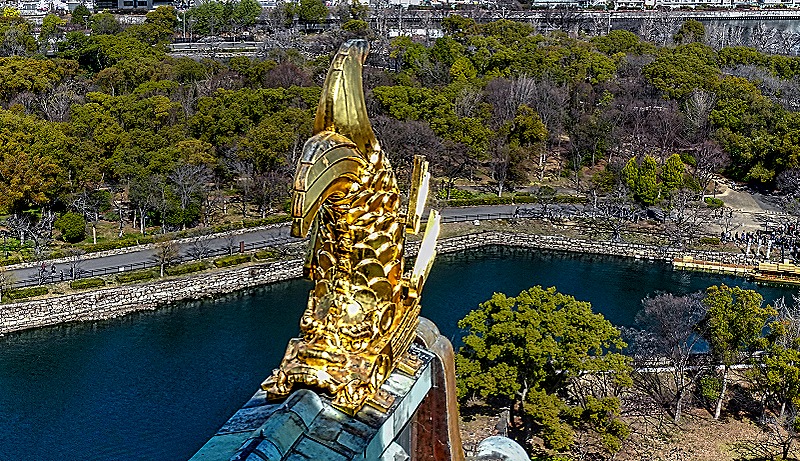
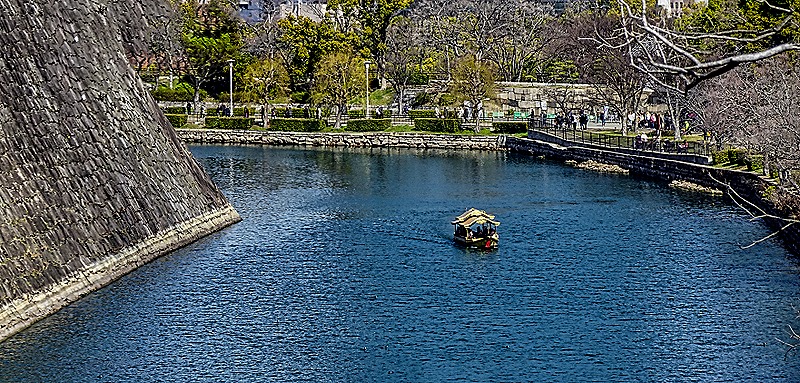
We returned to the ground floor down the stairway (there are separate up and down stairwells, which undoubtedly helps the traffic flow). As we walked back to the bus we had a last view of the castle with its nicely landscaped grounds and also another view of the moat boat, this time sailing down the moat. We ate lunch at a nice hotel, happily a sit down meal rather than a buffet line, where the Japanese food was interesting, tasty and beautifully presented.


After lunch we were dropped off at the beginning of a district called Dotonbori (or Doutonbori) and told to meet back there in an hour or so. This neighborhood began in 1612 with the building of a canal on what was then the southern edge of Osaka. The canal was completed in 1615, after a delay caused by the Siege of Osaka. It was named after one of its designers, Nariyasu Doton, who had died fighting for the Toyotomis during the siege. The Tokugawas designated this as Osaka’s entertainment district and by 1662 it had 11 theaters and a mechanical puppet show, along with restaurants and cafes built to serve the entertainment crowds. However, over the centuries the district declined and during World War II all but one of the remaining theaters were destroyed by bombing. In the 1960’s the canal was renovated and in the early 2000’s the streets lining the canal were redeveloped.
Today this is a bustling area with large crowds patronizing cafes, restaurants and commercial stores, many located inside a large covered mall. We walked along the canal looking, but not stopping in, a large variety of stores and restaurants.
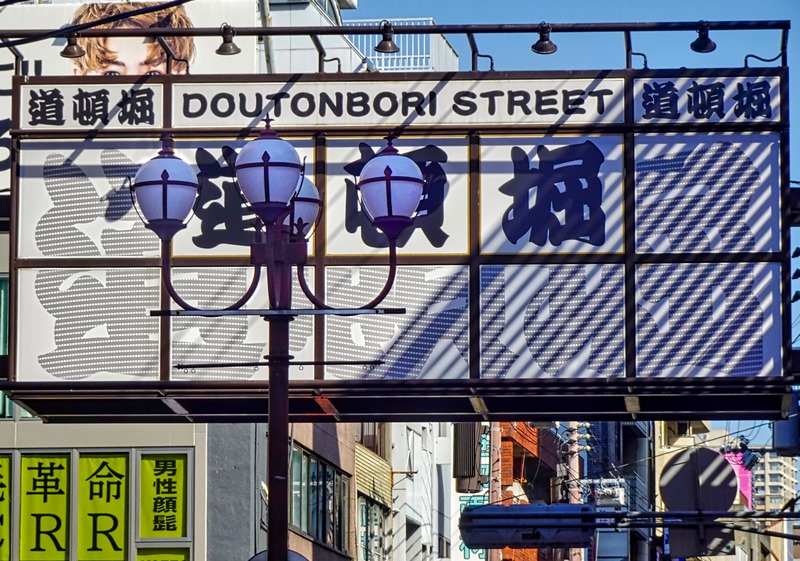
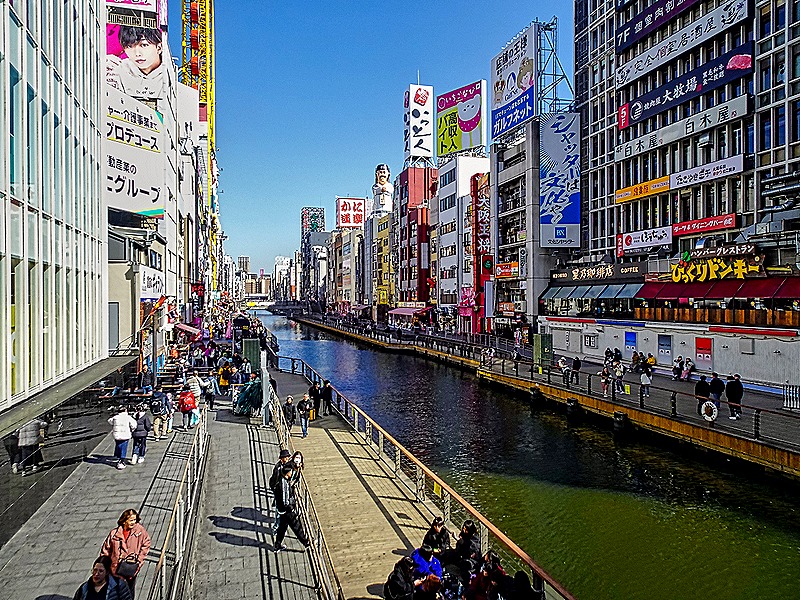
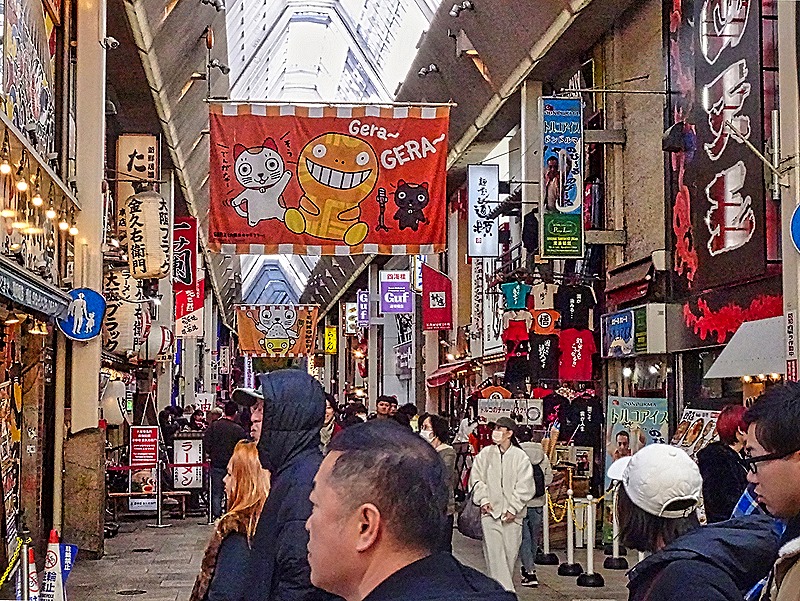

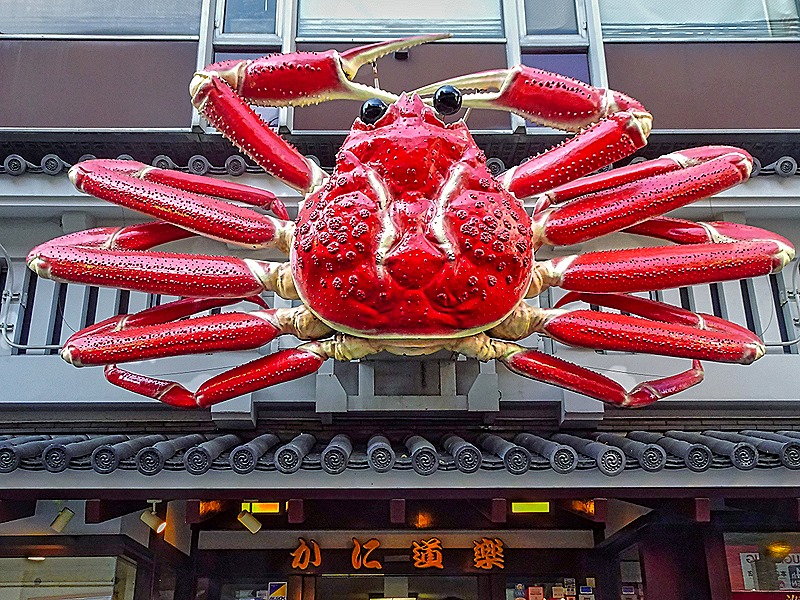
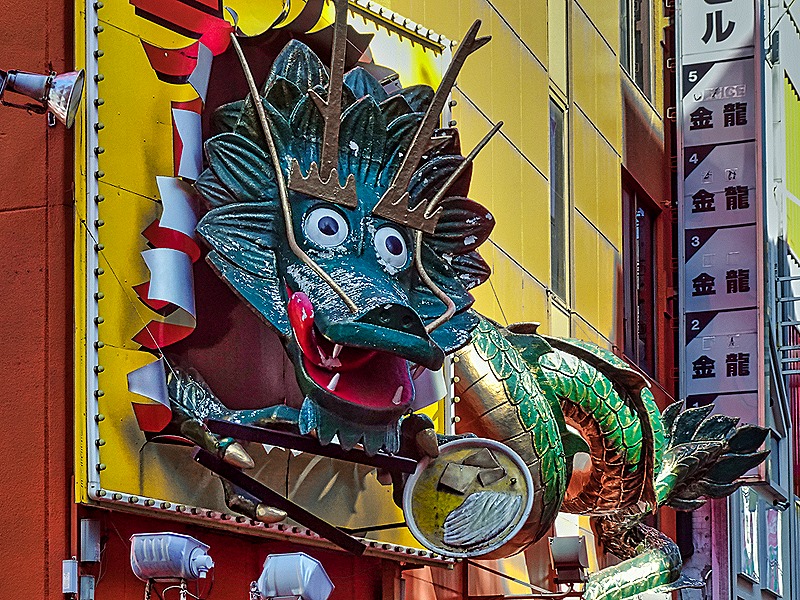
As you can see, the canal is lined with rows of commercial buildings of all types. Most notable are the colorful signs, many outsized, eye catching and even mechanical. For example the giant crab above the Kani Doraku restaurant moves all of its arms.


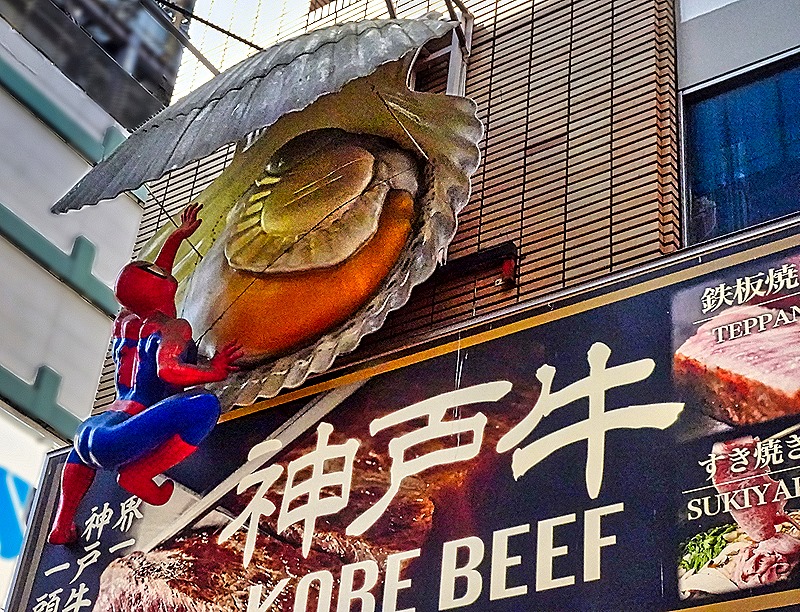
We came to a covered shopping mall, which we spent some time walking through. Lots of stores and restaurants in here too and it was really crowded.


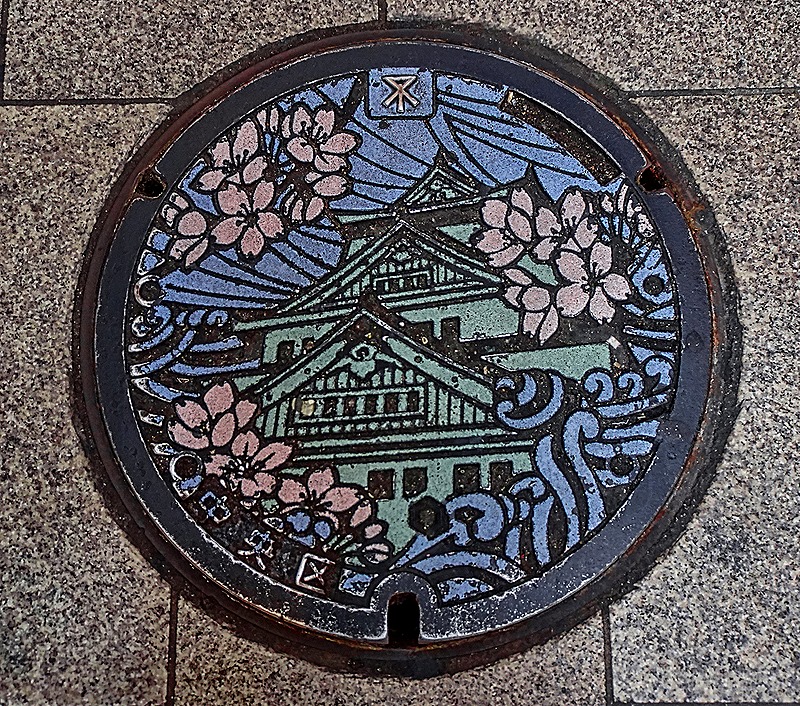
Walking back down along the canal we saw more unusual commercial signs, some very large and surely quite expensive. We also walked past street decorations, one of which was a manhole cover with the Osaka castle and cherry blossoms on it.
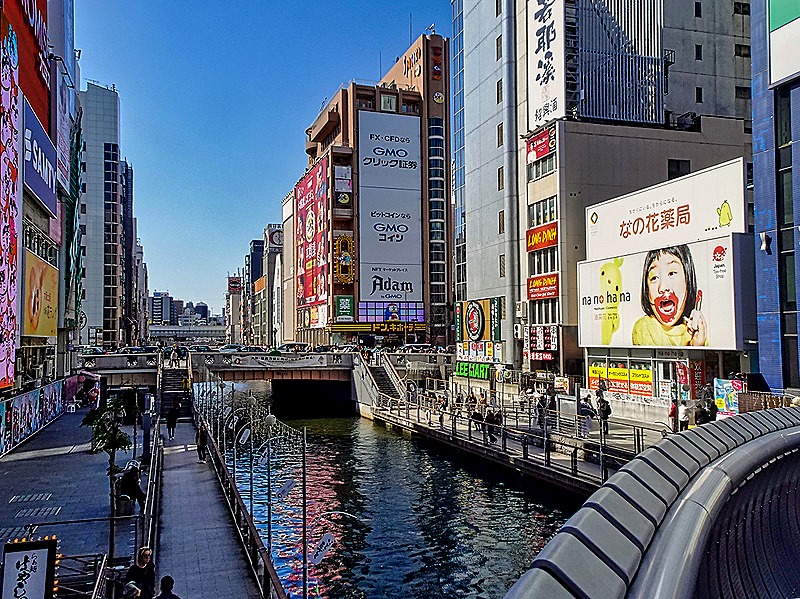
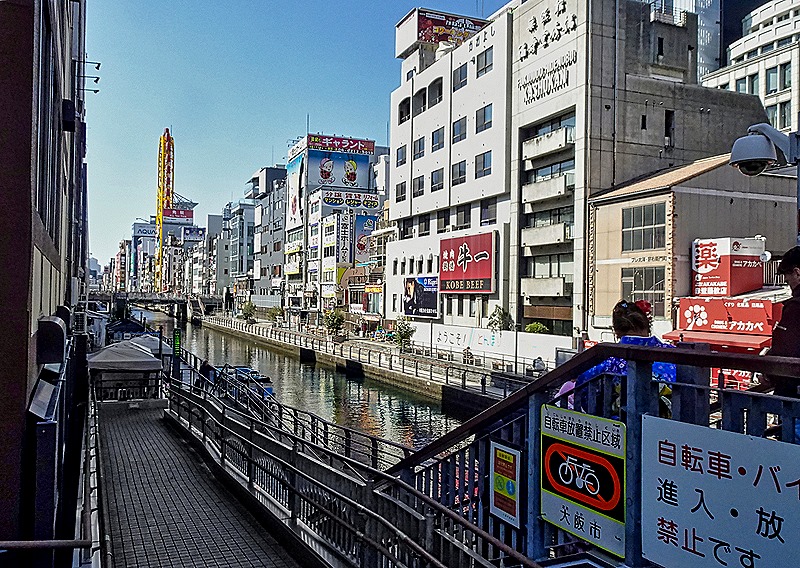
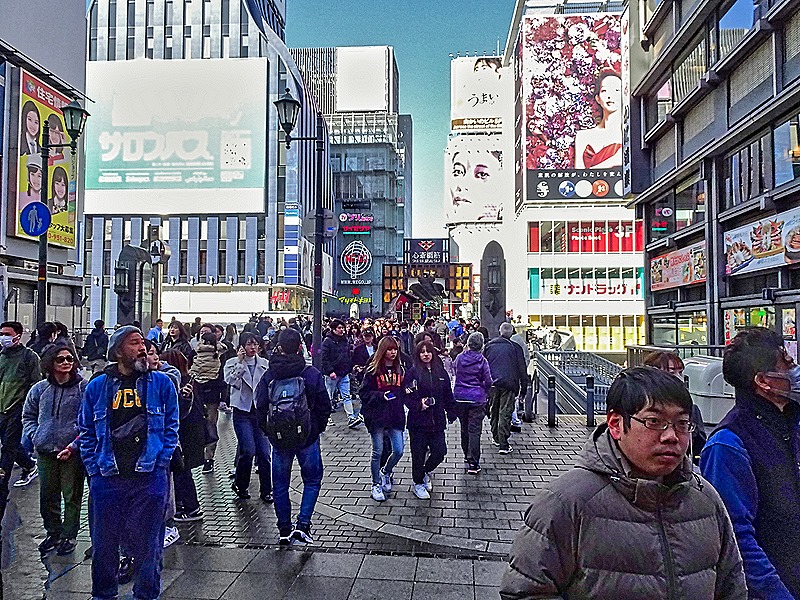
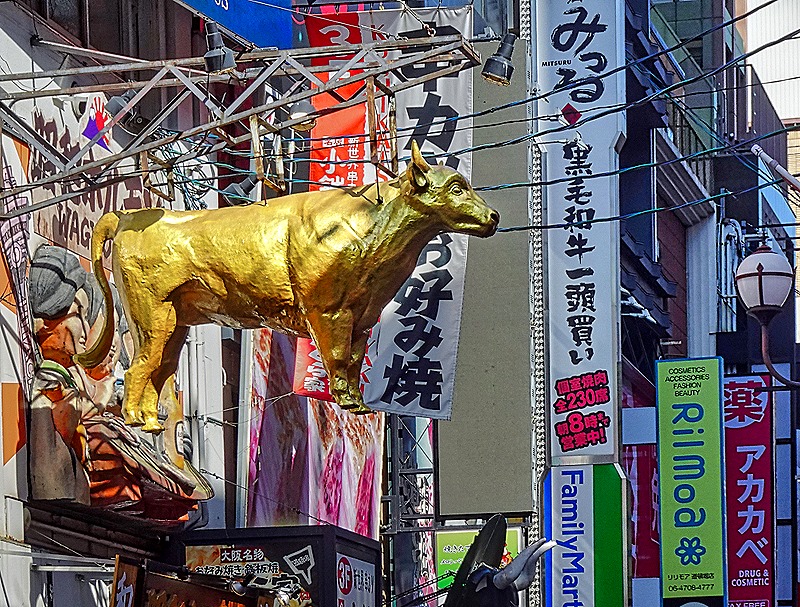
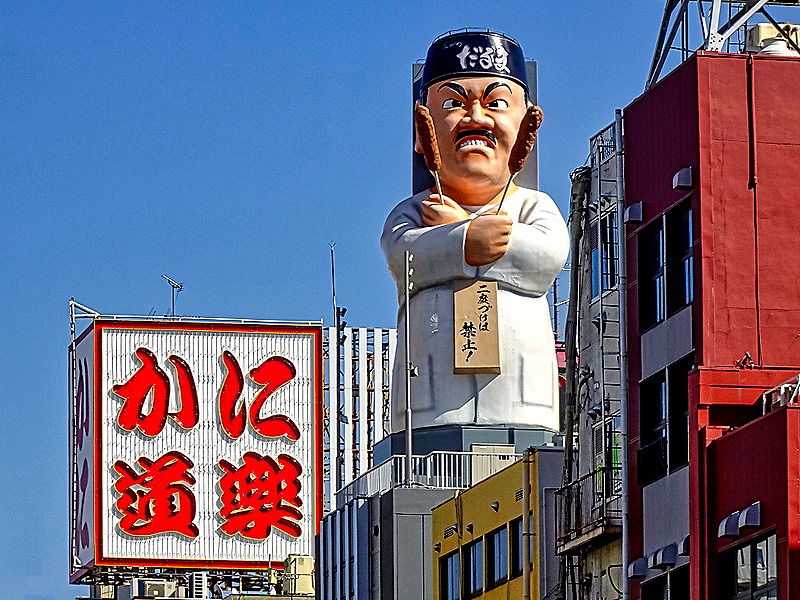
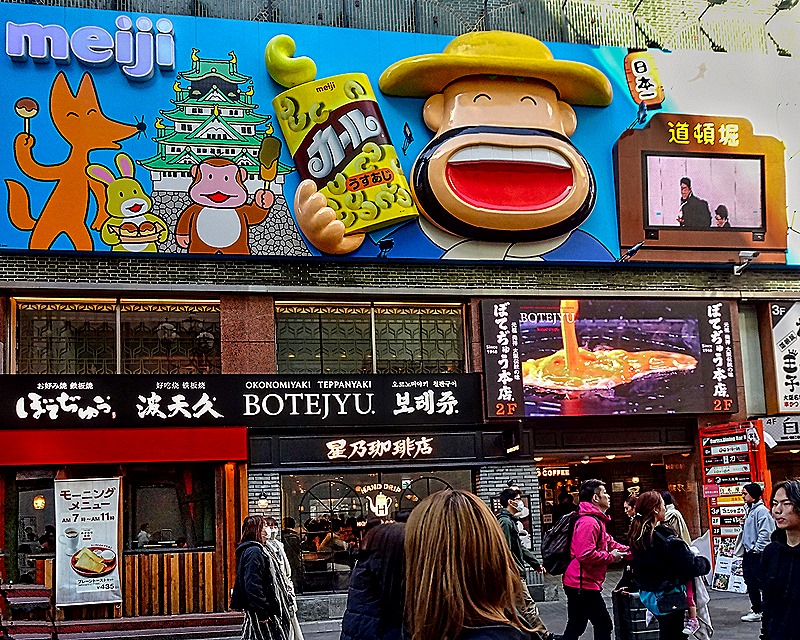
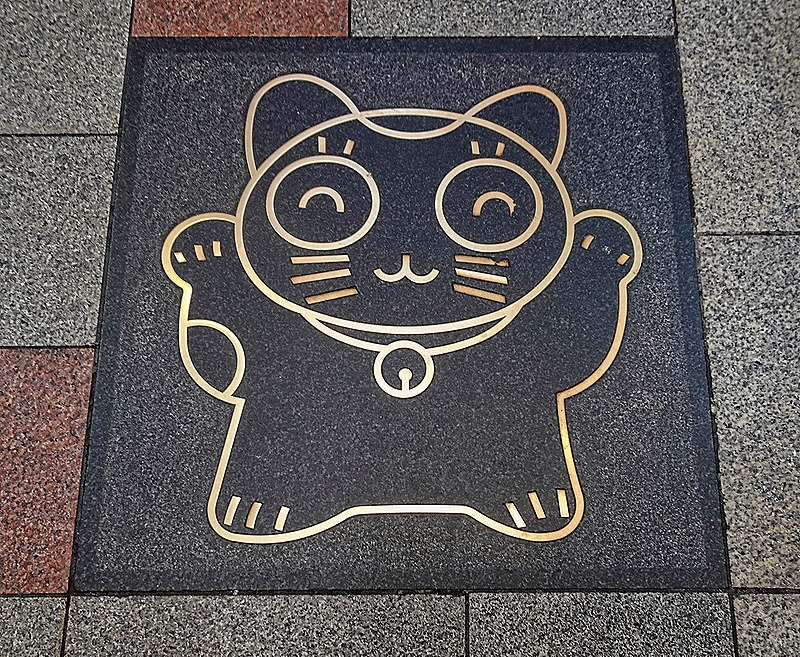
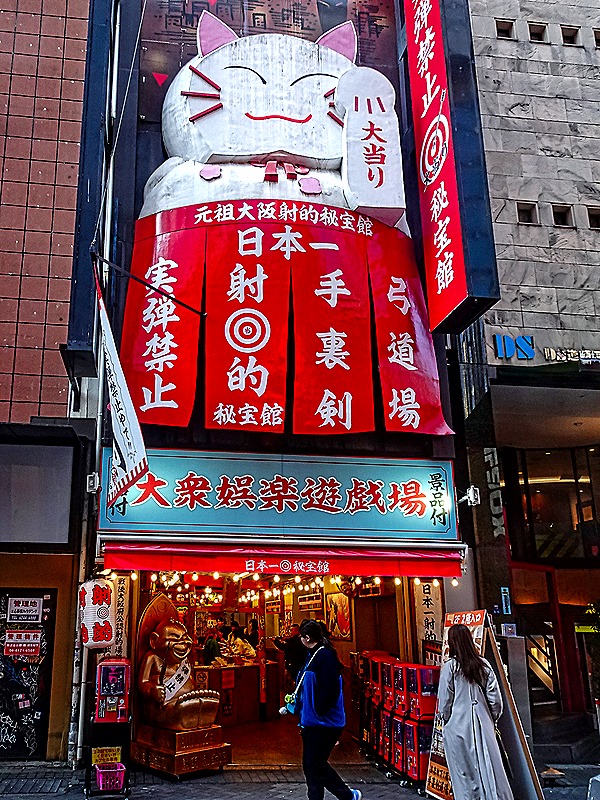
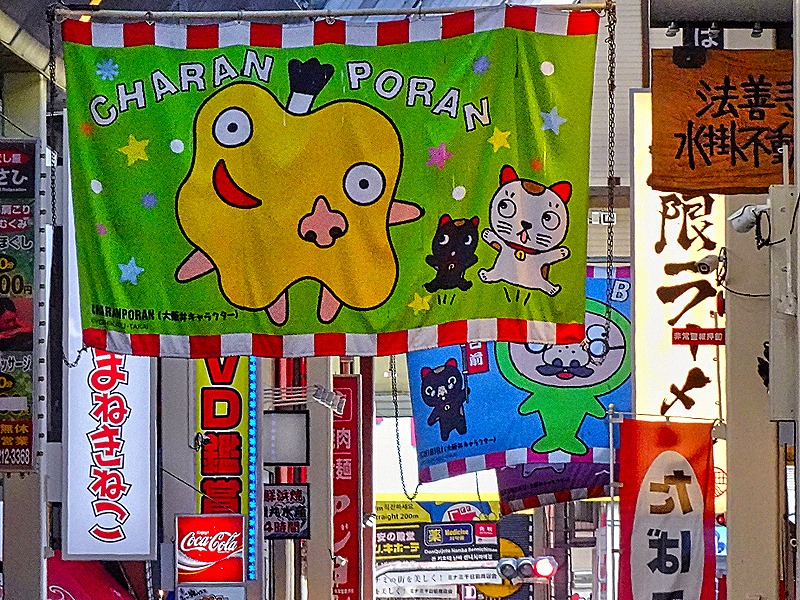
Well, this was all quite interesting in an over-the-top sort of way. We have seen this neighborhood likened to the street scenes in the movie Blade Runner and there is certainly that kind of flavor to it (although we understand that those movie scenes were actually inspired by a district in Tokyo). It must be quite exciting at night when all the neon lights are on, but of course by night time we would be at sea. Still, pretty impressive that this area attracts such crowds even in the early afternoon, although it was a weekend.
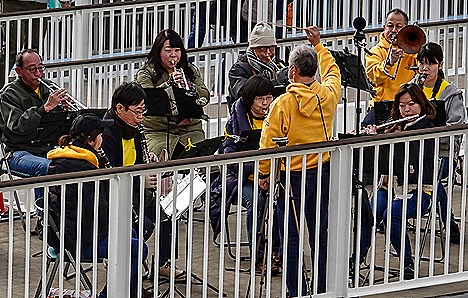
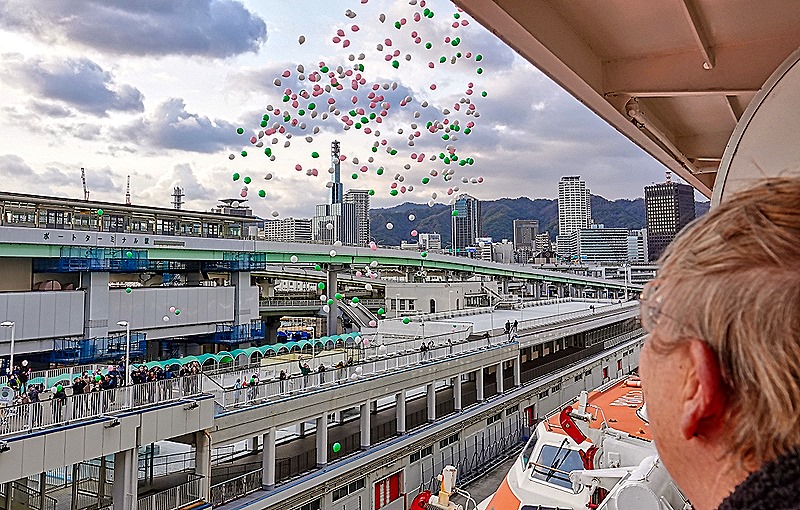
We met our bus and drove back to the port. Our veranda was perfectly situated to watch the farewell festivities mounted by Kobe on the roof of the terminal right by the ship. We were serenaded by the Kobe Hardi Wind Ensemble (which we know because it was printed on the white tuba), although only about half the musicians were actually playing wind instruments. They were a “hardi” group indeed who were bundled up against the cold but were still there playing when we left the dock. At one point pink, white and green balloons were released into the air and there was a fellow nearby waving what looked like naval signal flags, whose meaning we do not know (but we would guess something like “farewell”). Families and children were there as well, many carrying balloons. As we pulled away from the dock they struck up “Anchors Aweigh.” Much fun and a great send off.


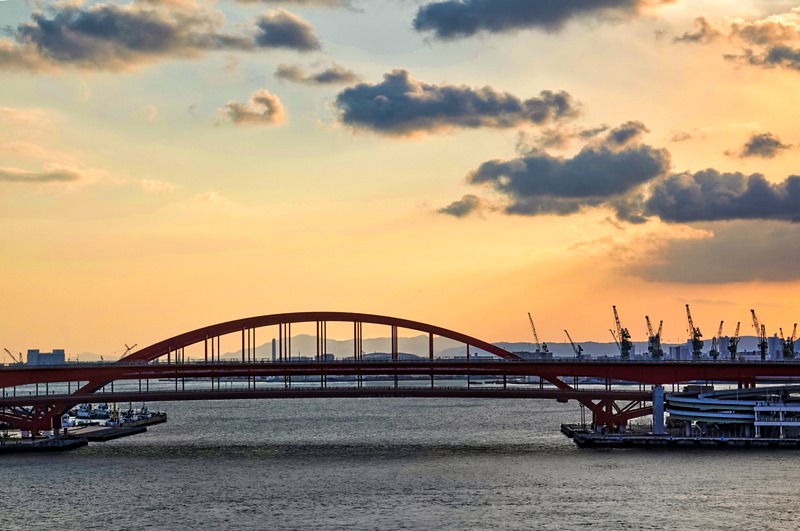
We sailed out of Kobe harbor as the sun was setting, getting a last look at the city skyline in the harbor area and passing two nice bridges before seeing a nice sunset as we reached the ocean. It had certainly been quite a full and rewarding couple of days.



Kobe, Japan (Day 1) – Kyoto (2024)
We docked at Kobe on the morning of March 2 for an overnight stay. Kobe is the 7th largest city in Japan with a population of 1.5 million and Japan’s third largest port. This area has been settled for at least 1,000 years, although the modern city was founded in 1889. Its cosmopolitan reputation dates back to 1853 when it was one of the first Japanese ports opened to trade with the West. Some 21% of the city was destroyed by Allied incendiary bombing in March of 1945, which killed close to 9,000 people, and large parts of the city were destroyed again in the Great Hanshin earthquake of January 17, 1995, which killed almost 6,500 people. If nothing else, you have probably heard of the extremely expensive gourmet Kobe beef, which comes from cattle pampered with special food and even massages.
No doubt Kobe would be an interesting city to explore and we know people who had a very good time there. But this was our first visit to Japan, we only had two days and there were two out of town cities that were higher on our to-do lists. So we signed up for long excursions for both days. On this first day we went to see some of the important sites of Kyoto, the ancient imperial capital of Japan until the 1870’s when the Meiji emperor moved to Tokyo after the Meiji Restoration. So really, just about our only view of the city of Kobe today was from the bus window as we crossed the bridge to head out of town.

As mentioned above, Kyoto was the seat of the emperor and thus the capital of Japan from 794 to 1879, more than a thousand years. In fact, Kyoto means “capital city.” Emperor Kanmu first moved the capital here from Nara because he wanted to get the Buddhist establishment out of his hair. There was unrest and violence in the city during the 15th century and again before the Meiji Restoration in the 1860’s, but on the whole it seems to have avoided the devastation of war and earthquakes seen by other cities in Japan.
One notable thing you will not read in this episode: Kyoto was not subject to Allied bombing in World War II, atomic or otherwise. It originally was at the top of the list of Japanese cities proposed as targets for the atomic bomb. But Henry Stimson, US Secretary of War, convinced President Truman to remove it. It is not clear just why he wanted Kyoto removed, possibly its importance in the cultural heritage of Japan (he had visited there at least twice, but not on his honeymoon as some suggest), or possibly because he thought its destruction would so alienate the Japanese that they would side with the Soviet Union after the war, or perhaps something else. Either way, this preserved the ancient wonders of Kyoto from destruction and, among other much more important things, made our visit to its landmarks today possible.
After about a 90 minute drive we arrived at our first stop in Kyoto, the Temple of the Golden Pavilion, called Kinkaku-ji in Japanese. Originally a private villa, it was bought by the shogun in 1397 and developed as his retirement villa. Pursuant to his wishes, when he died it was converted into a Zen Buddhist temple. The upper two stories of the three story building are entirely covered in gold leaf and are said to contain relics of the Buddha, including his ashes. Each of the three stories was designed in a different architectural style. Situated over the edge of a large reflecting pond in a woods, the Pavilion makes a rather spectacular sight when the sun is shining, and many consider it one of the most beautiful buildings in the world. After receiving our entry tickets (there was a bit of a crowd) we walked a path through the woods to arrive near the water’s edge on the opposite side of the pond from the Pavilion.
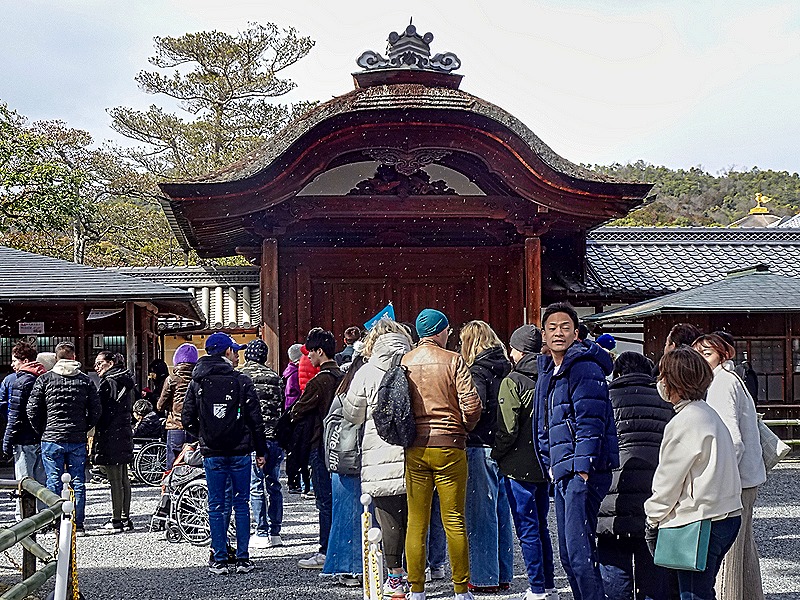


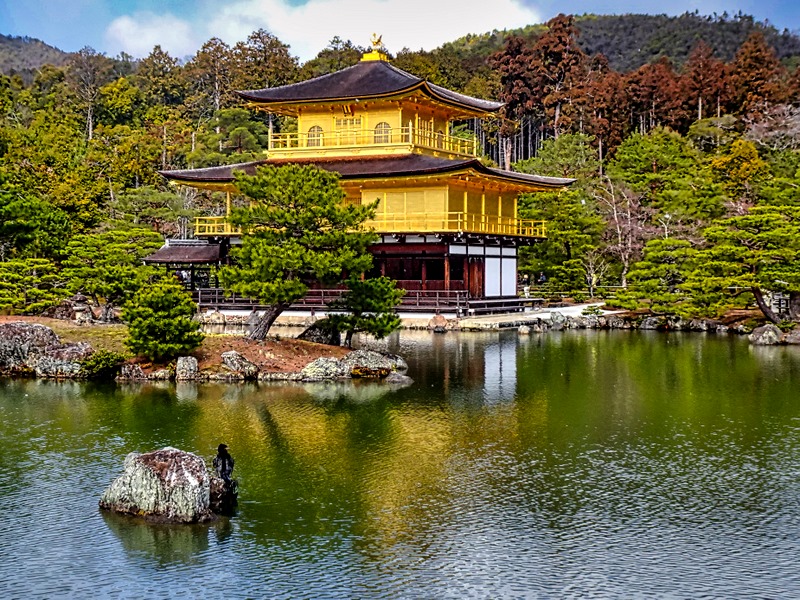

After admiring it for a while from this vantage (and after everyone got pictures) we walked around the right side of the pond toward the Pavilion. In the pond were a variety of rocky islands, carefully placed according to Zen principles. There were two birds, a black one and a gray one on two of the islands; we don’t know their species but they looked like something we had seen in Japanese paintings.


We told you earlier that Kyoto escaped the bombing in World War II so you might think the Golden Pavilion came through the war unscathed. And it did. But on July 2, 1950, the building was completely destroyed by a fire deliberately set by a young monk later found to be mentally ill (he was imprisoned but died six years later of tuberculosis). So despite surviving the war, not to mention the centuries before that, the building we see here is a recent reconstruction completed in 1955. It is supposed to be a very close copy of the original. In the 1980’s the gold leaf was replaced by a much thicker variety after it was found to be peeling off and in 2003 the roof was restored.
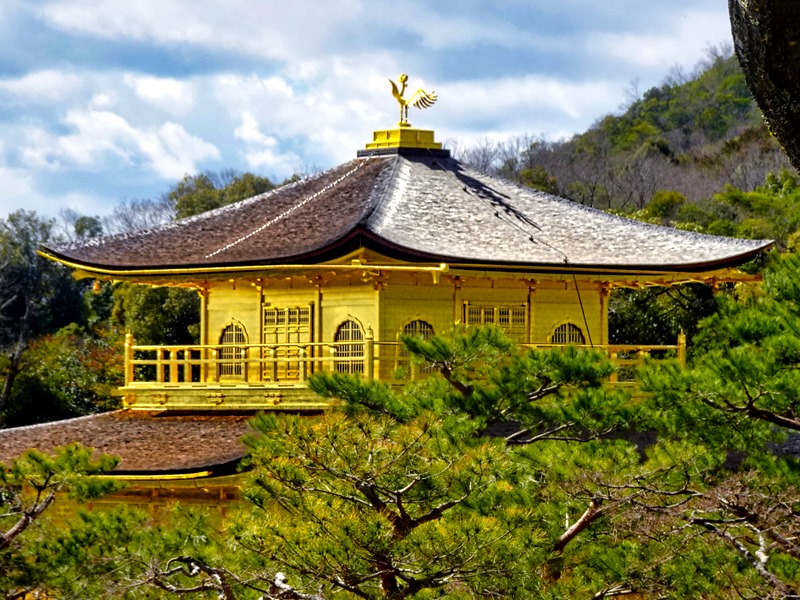
Coming around the back of the temple gave us a much closer view of its structure. Unfortunately, this was as close as we could get because there was no admittance into the building. At the apex of the temple’s roof is a distinctive bronze phoenix, which escaped the fire in 1950 because it had been removed for repairs. A wooden “fishing pier”juts out to the right with a floor high enough for small boats to pass under.


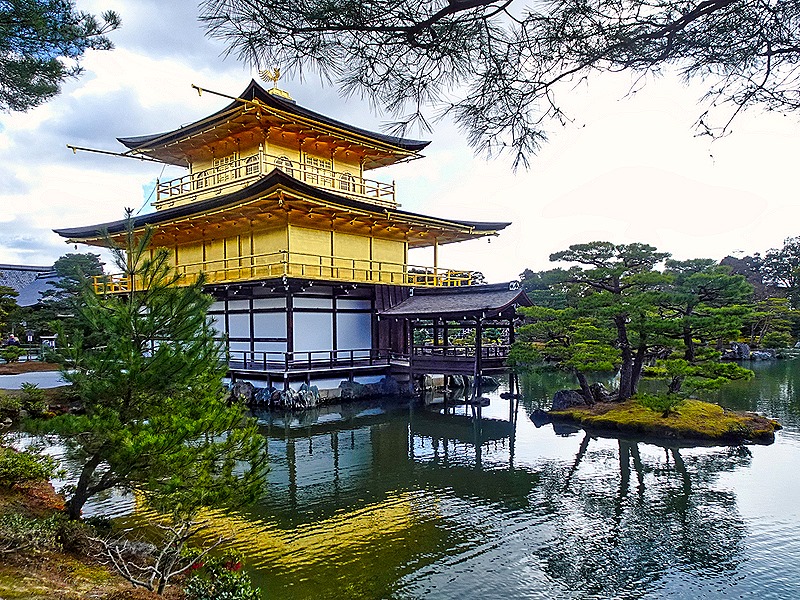
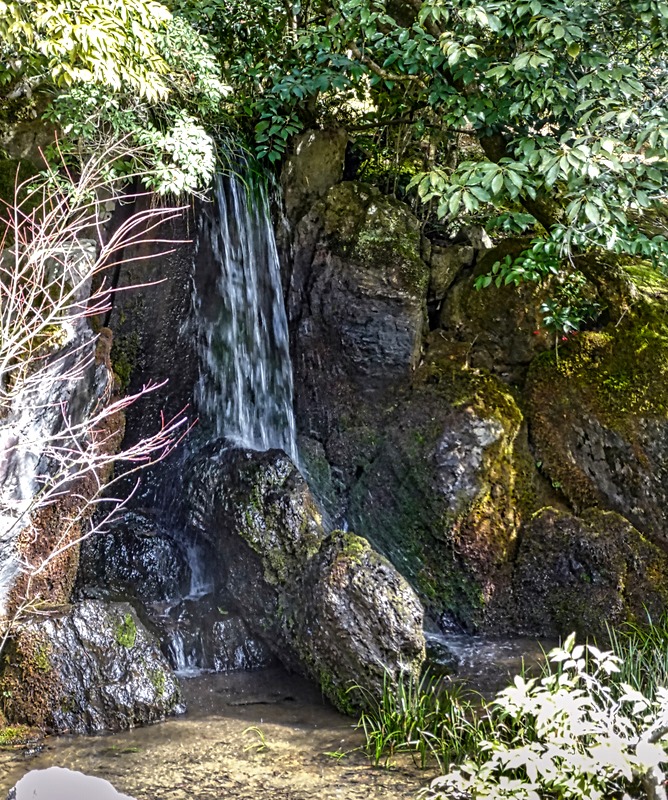
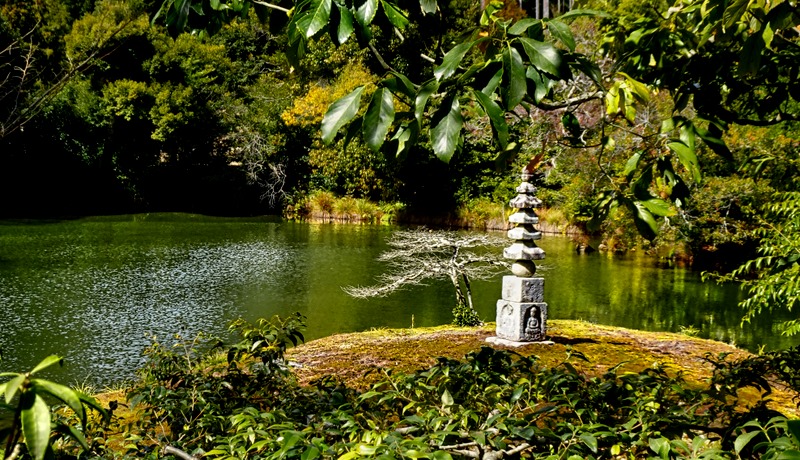
Behind the Pavilion we walked up a path that took us by some interesting spots. There is a small waterfall called Ryumon-no-Taki (Dragon’s Gate Falls). The large stone under the falling water is the Carp Stone, which is placed to look like a fish swimming up the waterfall. It represents an old Chinese legend in which a carp becomes a dragon after climbing a waterfall. We also passed some stone images called Jizo, which are supposed to be guardians of children, travelers and firefighters. People are invited to throw coins to invoke their protection. And we saw a small stone pagoda called the Hakuja-cho (White Snake Mound) sitting on an island in a woodland pond that never dries up and is therefore considered a good place to pray for rain. Looking in the opposite direction we had a nice view of the top story of the Golden Pavilion peeking over the edge of the hill.


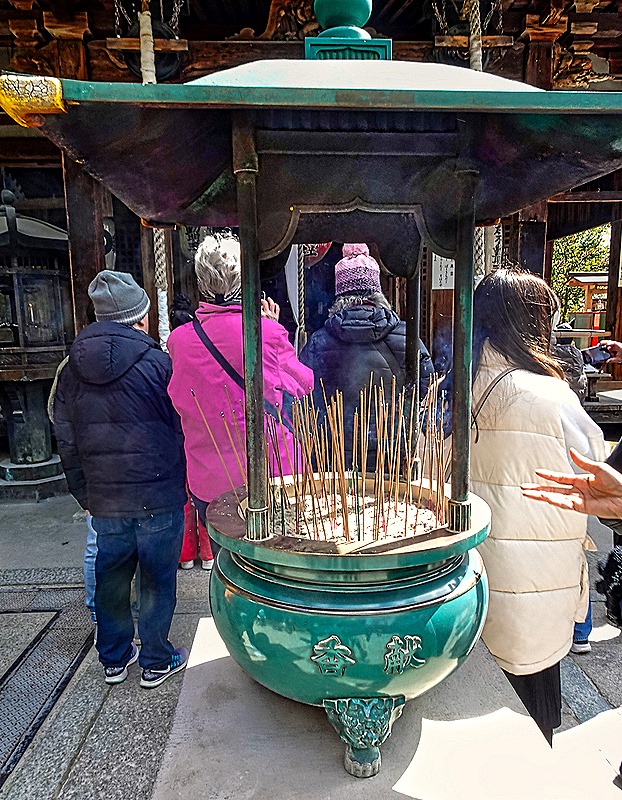
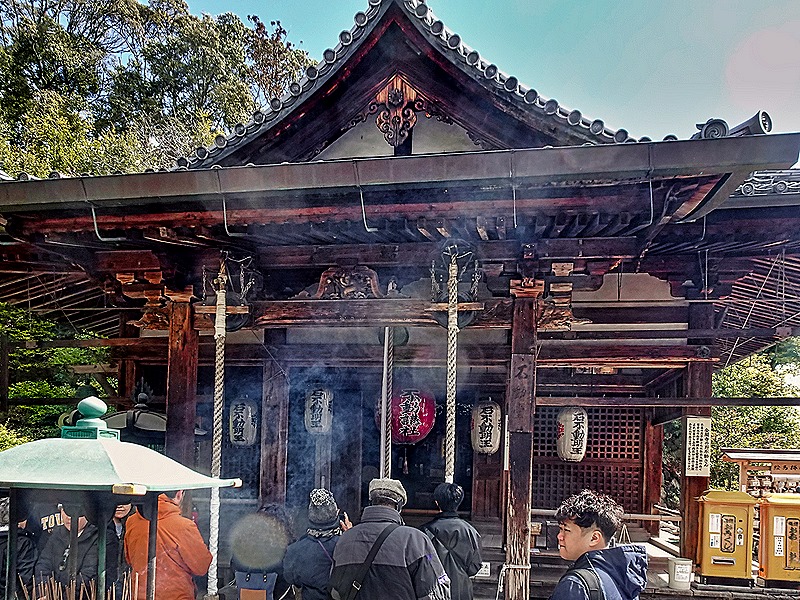
Finally we came to the Fudo-do, a Buddhist hall. Since the fire that destroyed the Golden Pavilion this has been the oldest building in the complex, the current iteration dating back to the 16th century. Inside is a statue of a protective deity that can only be viewed two days a year. In front of the Fudo-do is a large turquoise urn full of sand to hold burning incense sticks (which can be purchased nearby). When we were there it was putting out a lot of smoke.
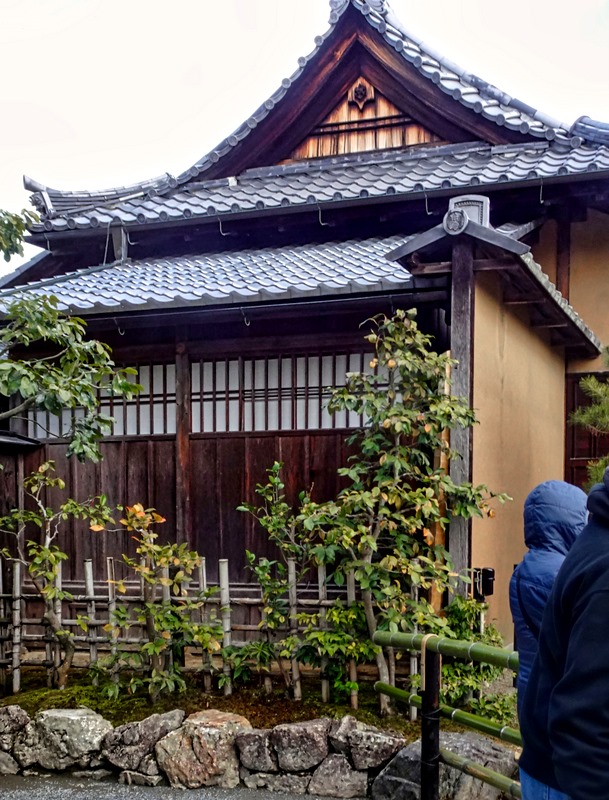
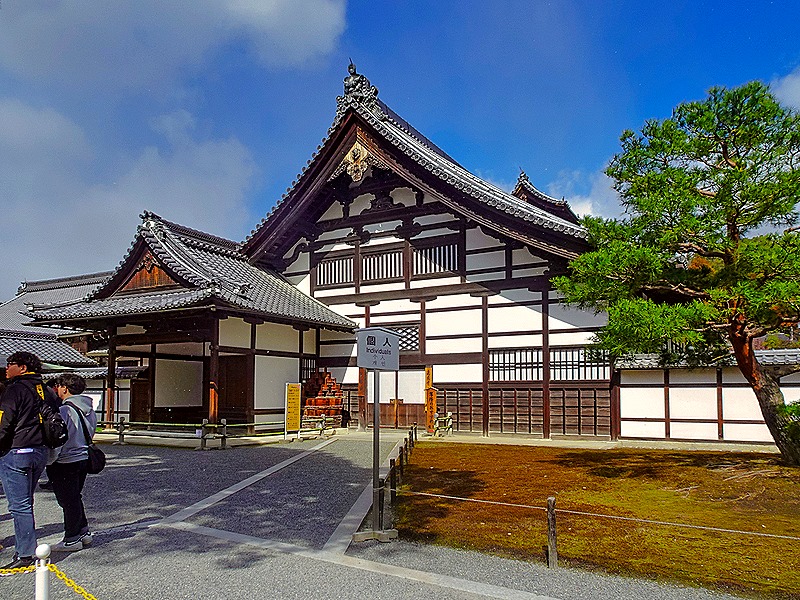
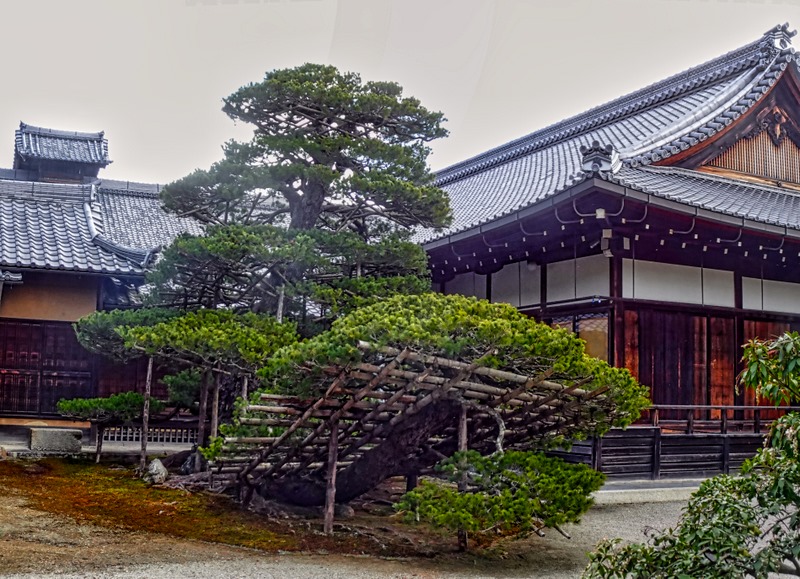
Another interesting building on the grounds was the Abbot’s House (where the temple’s abbots resided). In front of it is a 600+ year old pine tree planted by the shogun who built the Golden Pavilion. It was originally a Bonsai and has been trained to resemble a ship. The trunk growing straight up represents the mast and the large branch reaching forward, held up by a bamboo cradle, represents the bow of the ship. Some say it represents the journey the shogun hoped to take to the afterlife.

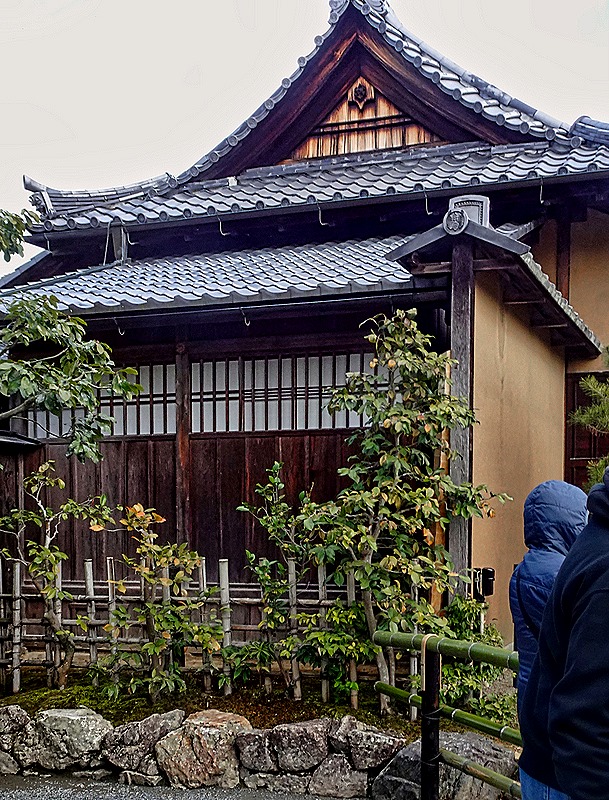
After visiting the gift shop near the exit (of course) we walked down a long path to reach the bus in the parking lot. Notice in the picture that the wall has five parallel white lines. We have read that the number of white lines indicates the importance of the temple, with five lines being the top tier.

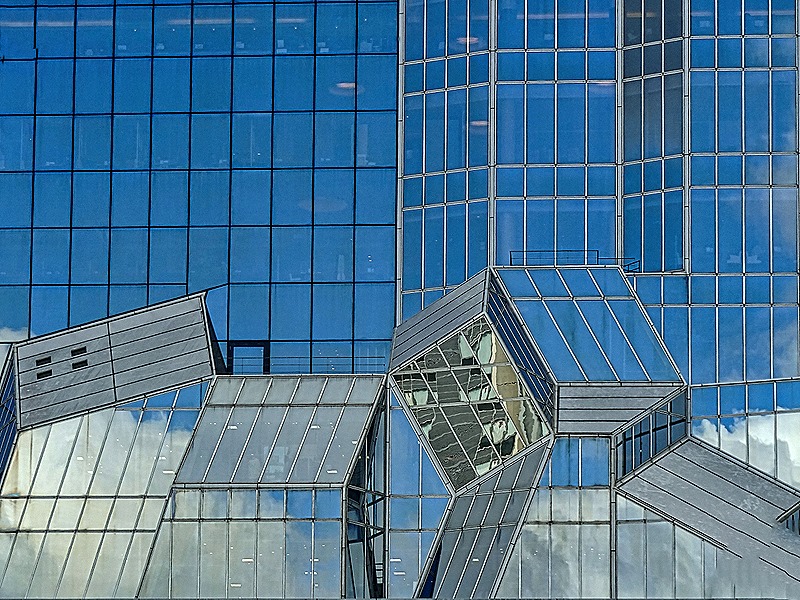
We had a buffet Japanese lunch in a hotel restaurant across the street from the very modern central train station in Kyoto. The food was good but the long buffet line was inefficient and time consuming. From our seat at the table we had a nice view of the interesting abstract facade of the train station.
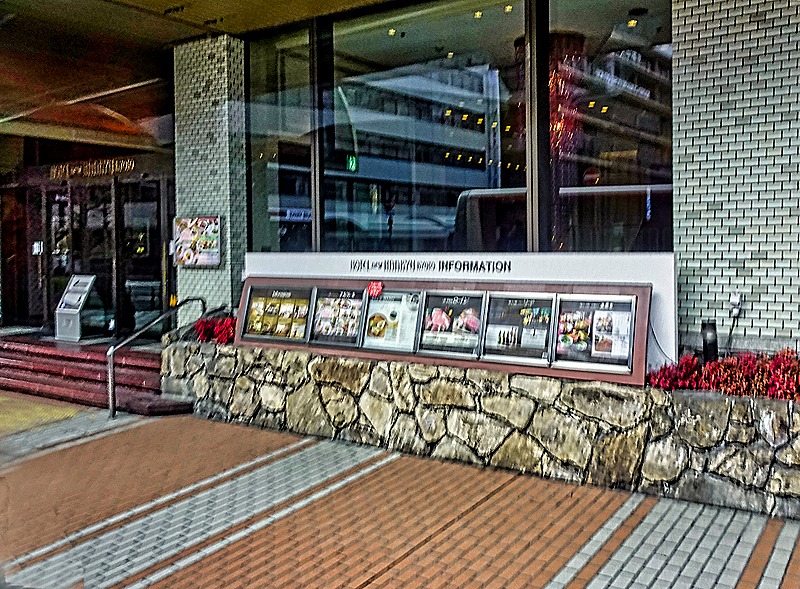


Nijo-jo is a castle in Kyoto built by the first Tokugawa shogun, which opened in 1603. It was financed by funds he forced all the daimyos (feudal lords) of Western Japan to contribute. It is surrounded by a heavy stone wall and a moat (actually two concentric sets of walls and moats). It is the only fortified castle in Japan from that period that still exists without having been destroyed and reconstructed (its tower was destroyed by lightning in 1750 but was not reconstructed). Of course Kyoto was the imperial seat at that time and the shogun lived in Edo (Tokyo), so the purpose of this castle was to serve as the shogun’s residence when he visited Kyoto (and to remind everyone who was the real power in the empire).
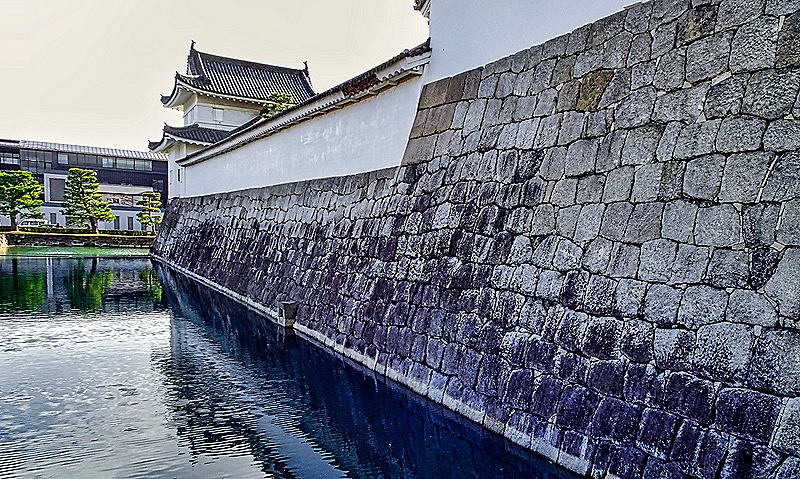
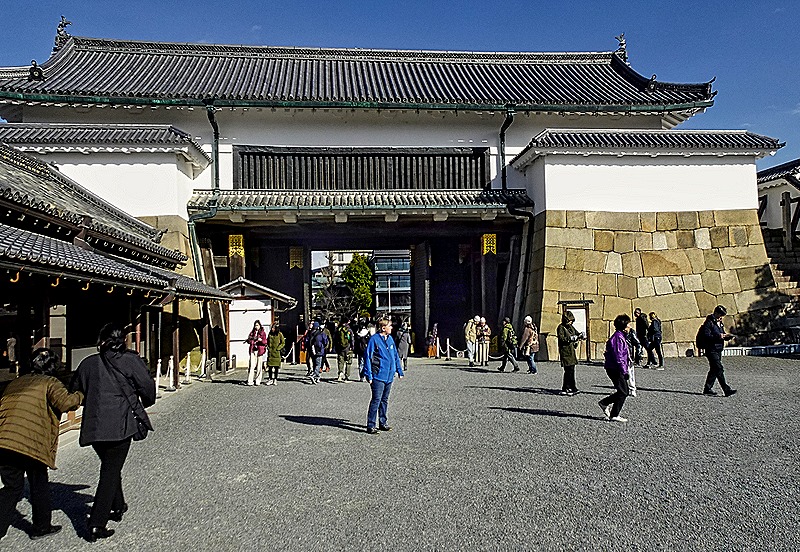
After obtaining our tickets we entered through the Higashi Ote-mon Gate, the main entrance that was probably built in 1662.
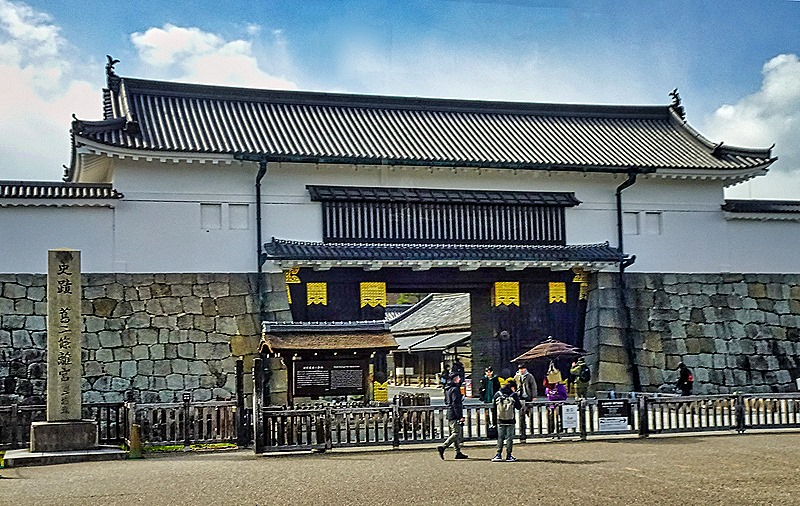
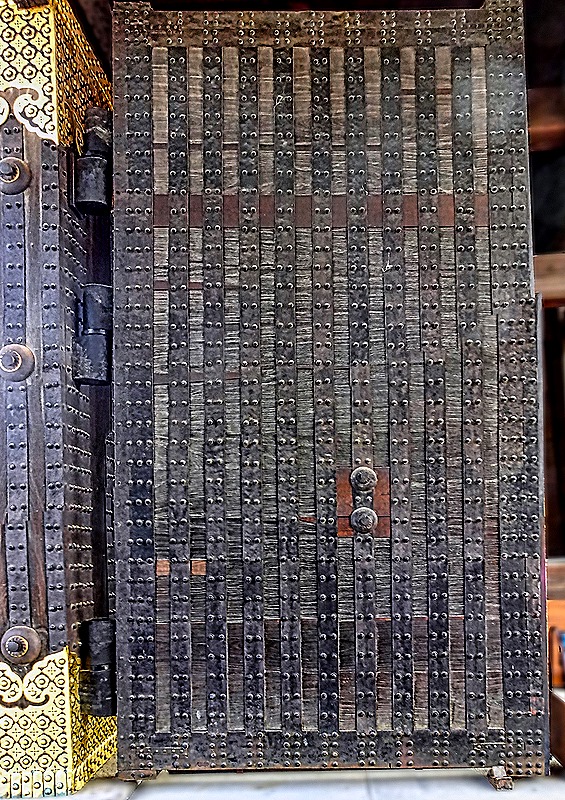
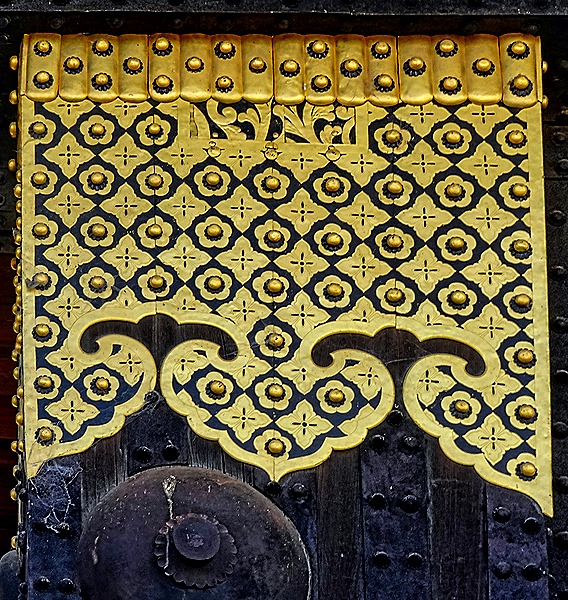
To enter the palace precinct we walked through the magnificent Kara-mon Gate. It was probably built in 1598 for another castle and moved here in 1626. The gate is very large and striking, covered in fine carvings and detailed metalwork.


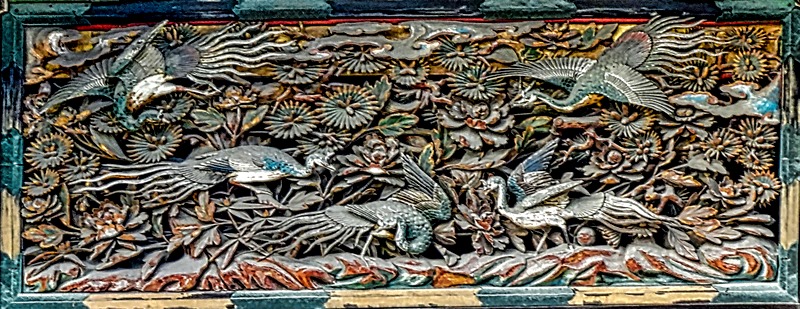
As you walk through the gate you can see the beginning of Ninomaru-goten Palace, originally the shogun’s living quarters and official reception halls. It is made up of six connected buildings with 33 rooms. The floors are covered by more than 800 tatami mats. The walls are covered by more than 3600 paintings dating to the early 17th century (actually what you see there today are very fine copies; the originals are kept in a separate painting gallery within the castle’s outer walls). We walked through the entire palace along wooden corridors that surround the rooms in the 6 buildings. The spacious rooms, intricately painted ceilings and numerous large and lively wall paintings were quite beautiful. In the room where in 1867 the last shogun announced to the nobles that he was ceding power to the emperor were a number of mannequins dressed in the colorful costumes of the time representing the nobles and the shogun. The wooden corridors are called Nightingale corridors because they make a squeaking sound when walked upon. The story that this was done purposefully to alert inhabitants to intruders is, apparently, not true (too bad, its a good story). Unfortunately we have no pictures of anything inside the palace because photography is completely forbidden there. Sad but true.

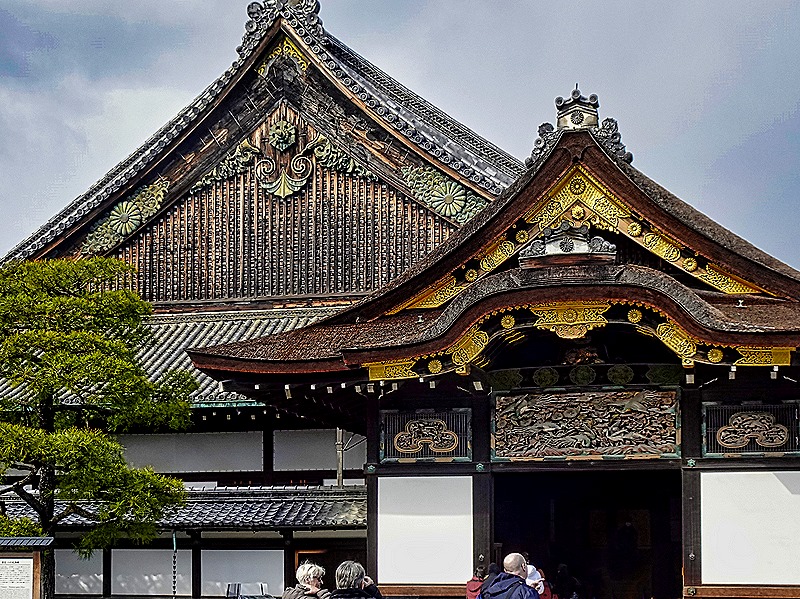
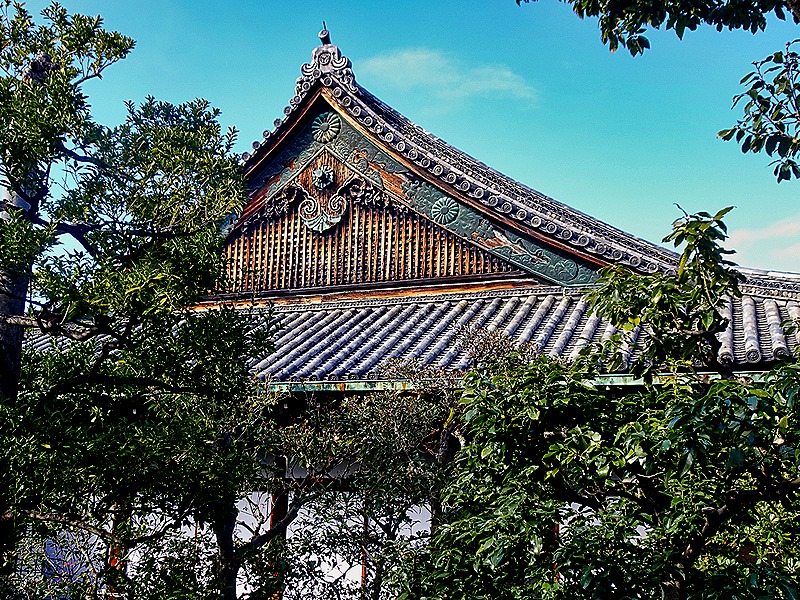
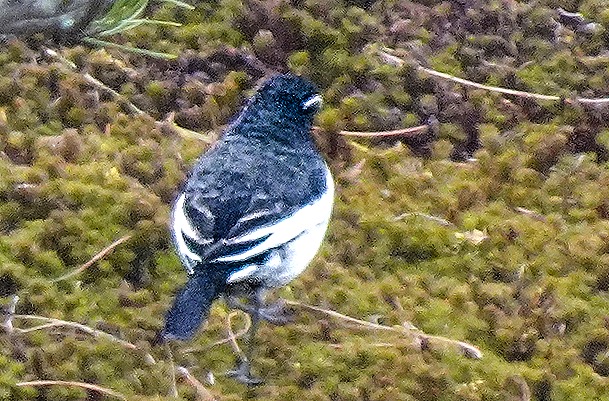
Behind the palace is the Ninomaru Garden, a leading example of a classic Zen garden. Originally built in 1603 at the same time as the palace, it was extensively redesigned in 1626 for the Emperor’s visit. There is a large pond with three islands, a large one representing paradise, and smaller crane and turtle islands representing longevity. Numerous rocks are carefully landscaped along the banks of the pond. The pond is fed by a small waterfall on the side opposite from the palace. We saw a small bird on one of the banks enjoying the garden while we were there.



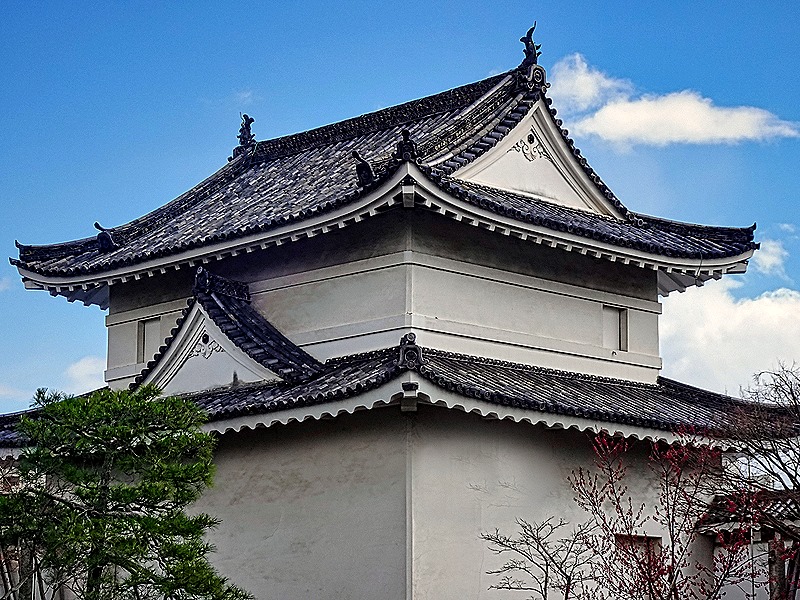
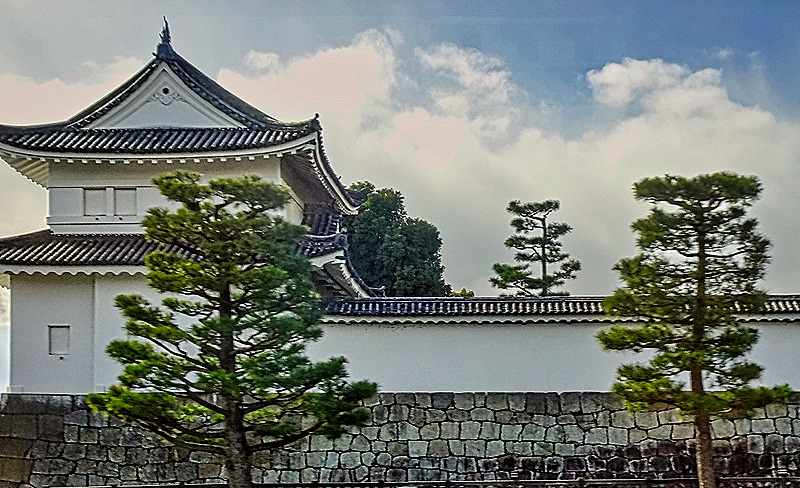
We left the way we had come, though the courtyard behind the main gate. To our right we could see the Southeast Watchtower, and that was also our last view of the castle, perched above the stone outer wall, as we headed back to the bus.
We spent the rest of the afternoon on a walking tour of the Gion district. Dating back to the 15th century, this district first developed to provide food, shelter and diversion to travelers visiting the Yasaka Shrine. It later became one of the most important geisha districts in Japan. Today it is still an important geisha district but is also one of the few areas where traditional architecture predominates.
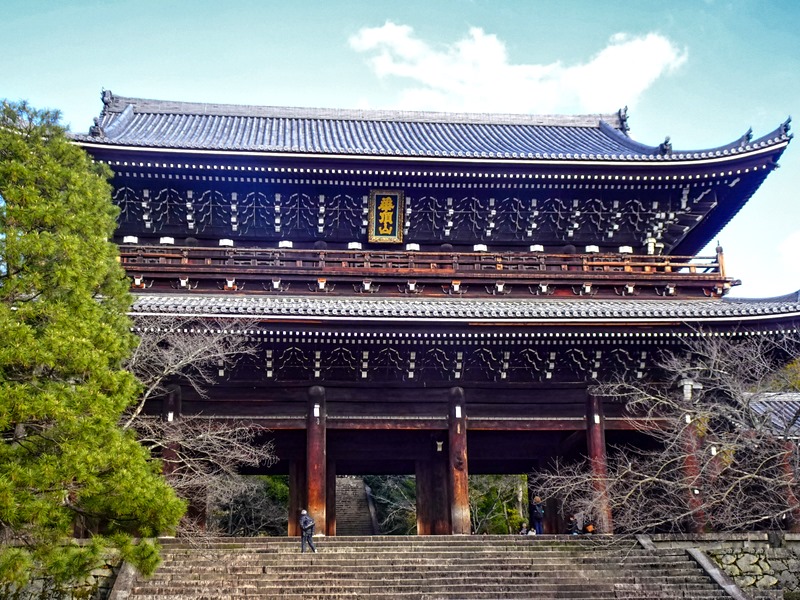
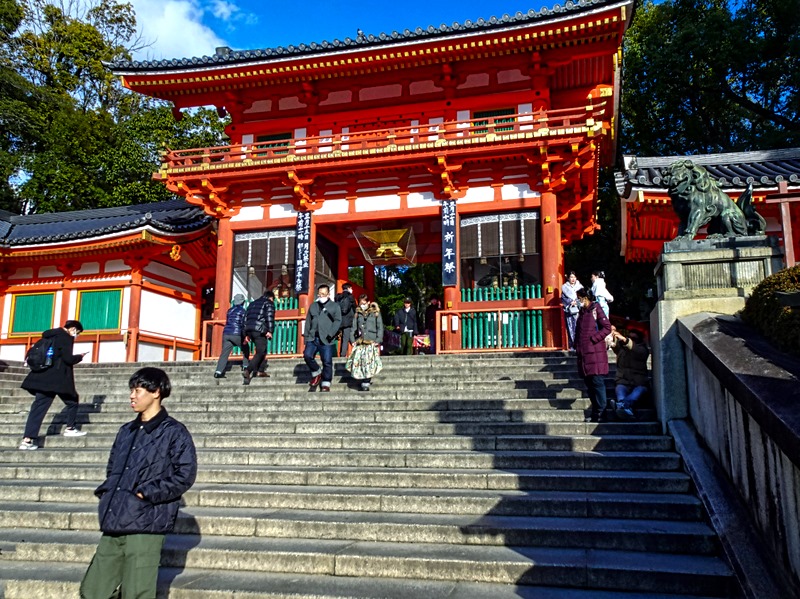
Leaving the bus we walked past two impressive religious buildings. First was a Buddhist temple called Chion-in (Monastery of Gratitude). First built in 1234, much of the temple complex burned down and was rebuilt in the mid 17th century and that rebuild survives today. The massive Sanmon gate that faces the street below was built in 1619. Second we came to the Yasaka Shrine, which serves the Gion sect of the Shinto religion. It was originally constructed in the 7th century and achieved importance with imperial support. As mentioned above, the Gion district began to serve the needs of pilgrims visiting this shrine.
We did not visit either of these buildings, merely walked past their entrances and viewed their entrance gates at the tops of tall and wide stairways. That’s too bad, but we had limited time left to see Gion and it’s impossible to spend time at all the temples and shrines in Kyoto, since there are some 1600 Buddhist temples and 400 Shinto shrines in this city.
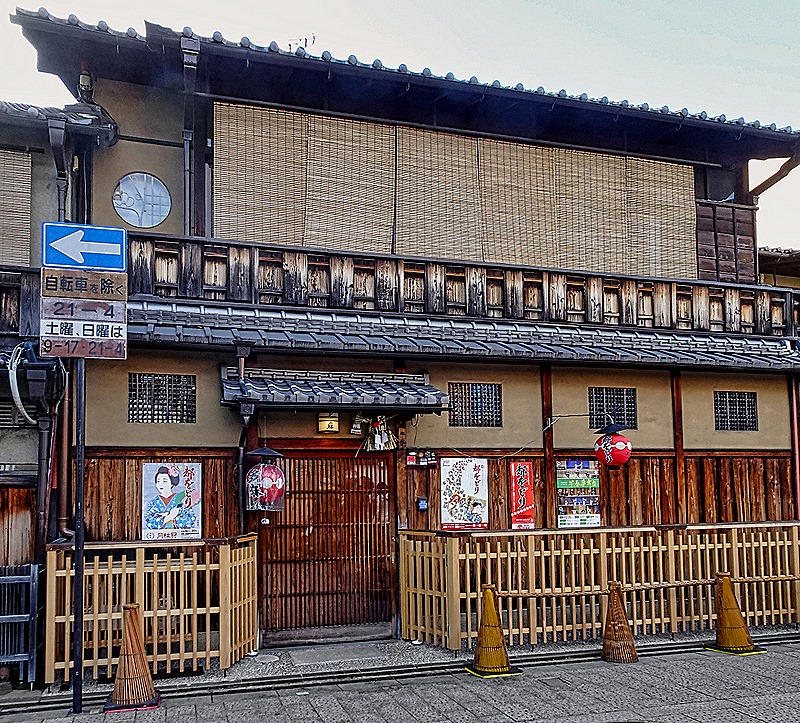
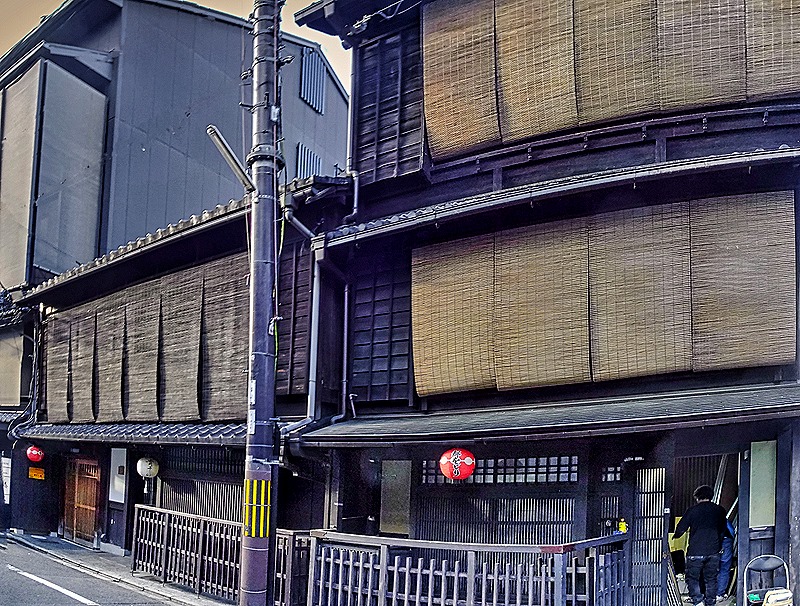
We walked down Shijo Street and turned left into the heart of Gion, with its narrow stone streets lined with vintage wood townhouses, mostly less than 3 stories tall, called Machiya. Urban buildings of this style, generally used by craftsmen and merchants with retail space lining the street and living quarters in back, have been in use in Japan for 1,000 years. They dominated in Kyoto for centuries but in recent decades have been disappearing to make room for modern buildings. They are typically about 20 feet wide along the street and about three times that in length toward the back, often including garden courtyards. We did not enter any of these buildings but walked by many of them lining the street and serving as restaurants, night clubs and shops as well as homes. We understand that each district has its own representative logo and that the red lanterns hanging in front of many of the Machiya here represent the Gion district.
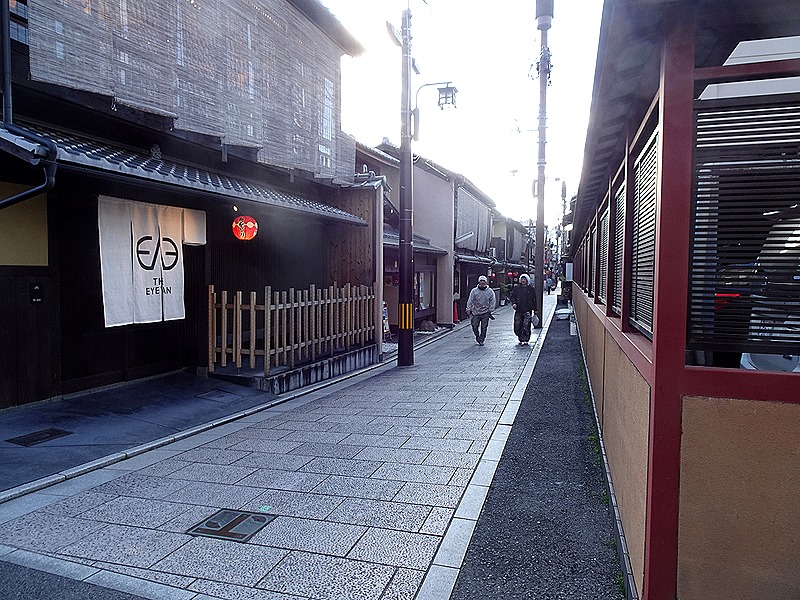
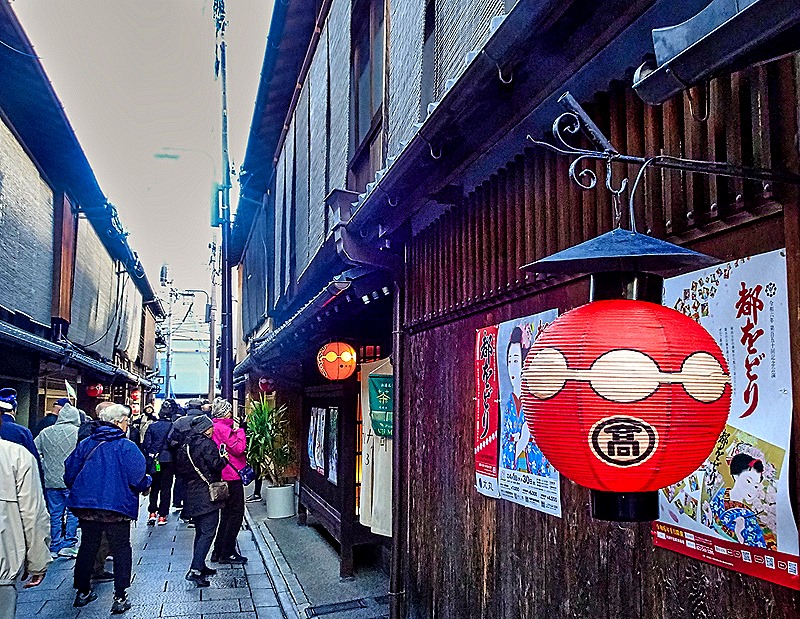
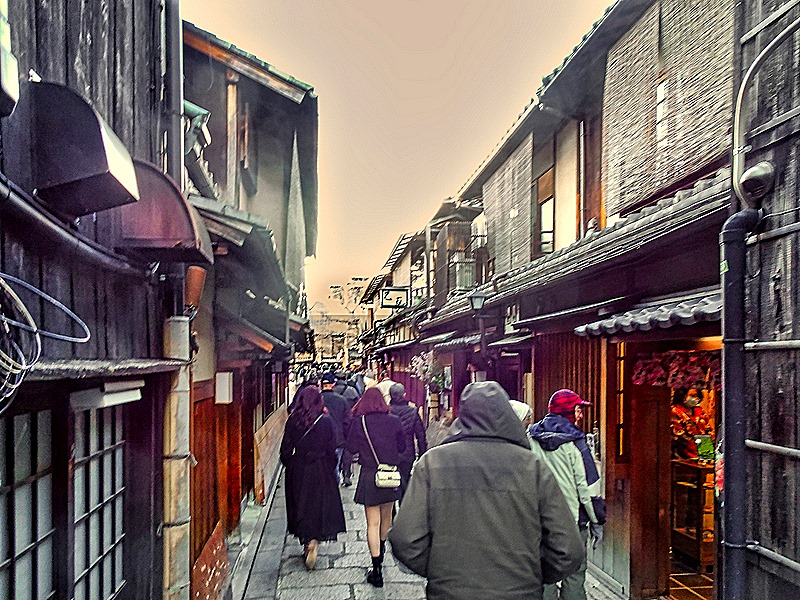
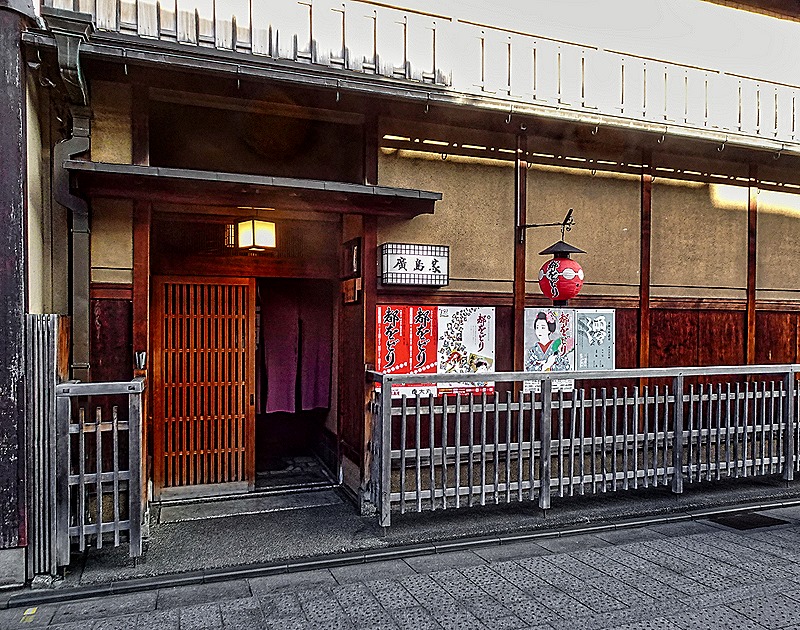
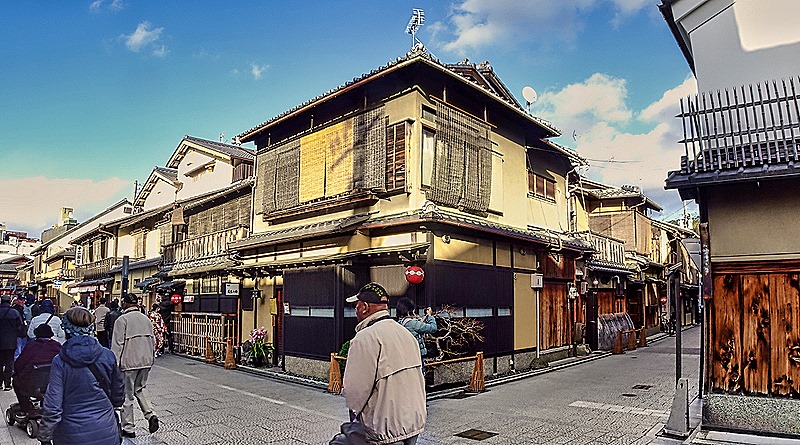
There are several notable features of the Machiya. Particularly on the second floor windows they usually have screens made of horizontal wood slats woven together with string or yarn, which can be rolled up or folded out of the way. These are called Sudare, and they let air and light in from outside while protecting from direct sun, rain, some insects and viewers on the street.

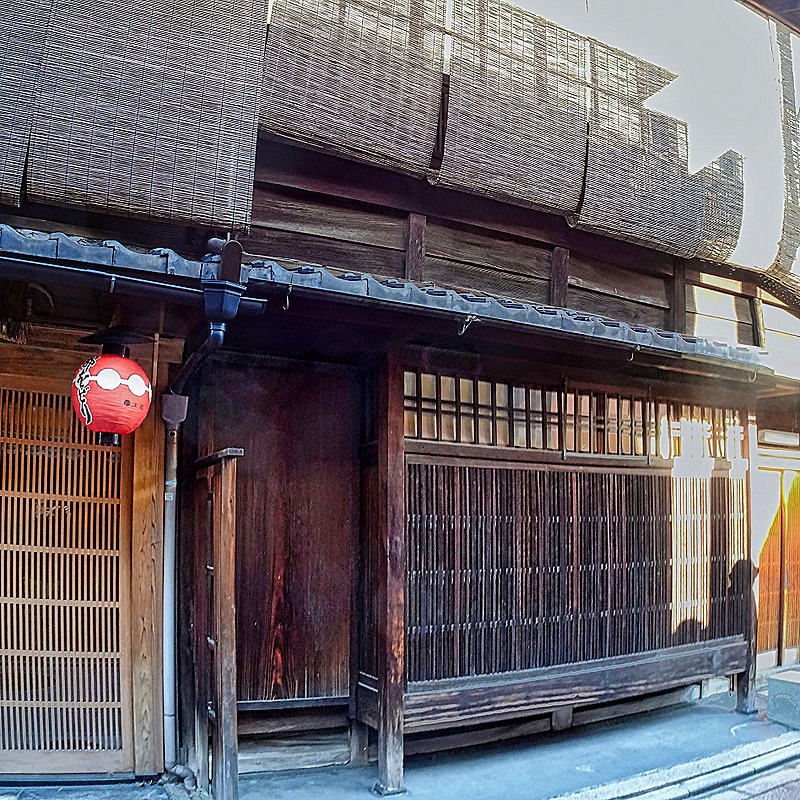
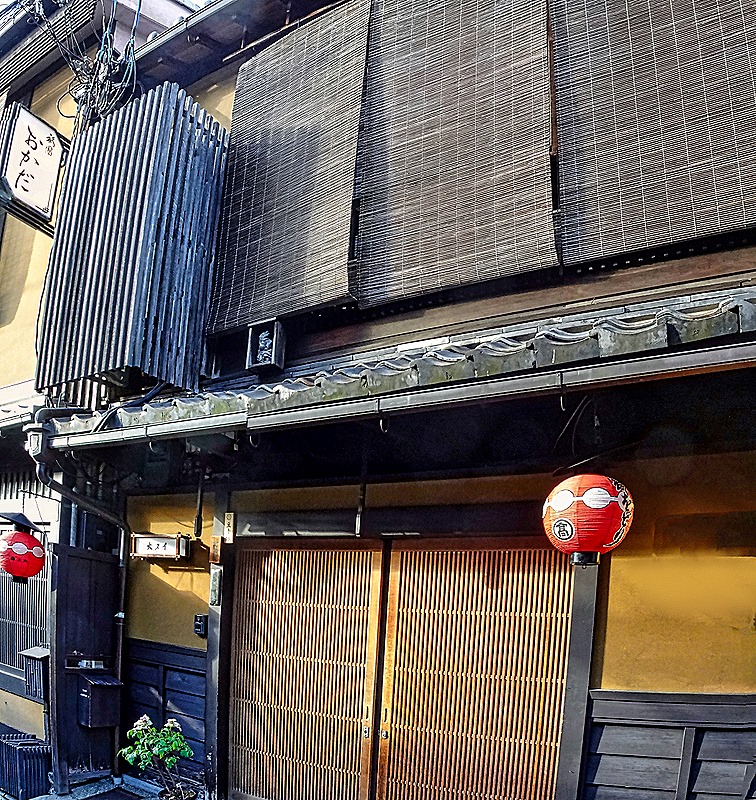
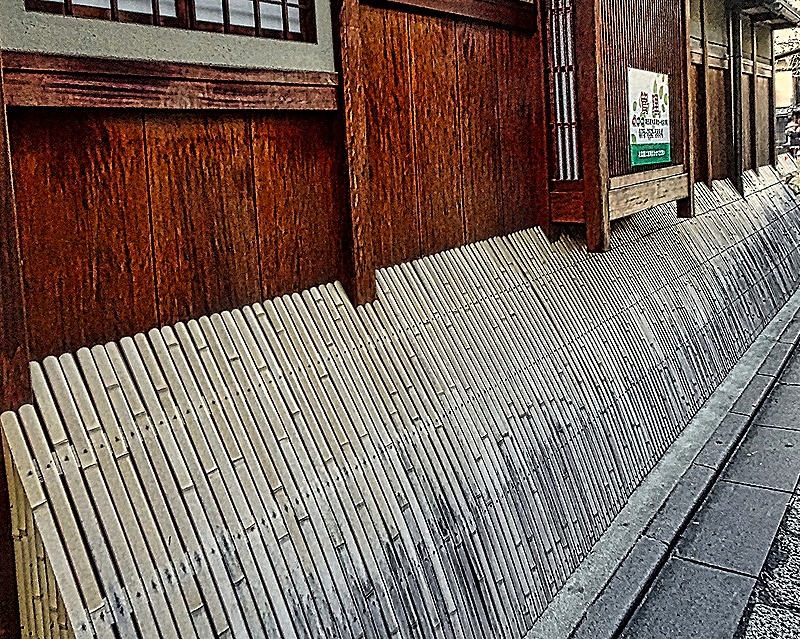
You will notice in the pictures that the sidewalks in this district are quite narrow and several of the houses depicted above have fencing barring use of the sidewalk in front of the house. Instead of fencing, many of these buildings have a sort of curved wooden skirt reaching from the front of the house to the curb. These are called inuyarai. Inu means “dog” and these skirts were probably originally used keep stray dogs from urinating on the front of the house. But they also protect the front wall from mud splashes and keep people from leaning against the house and eavesdropping on what is being said and done inside.
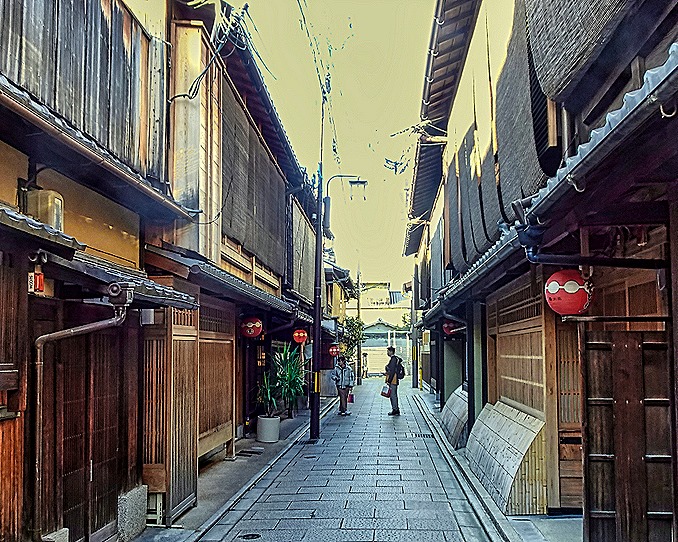
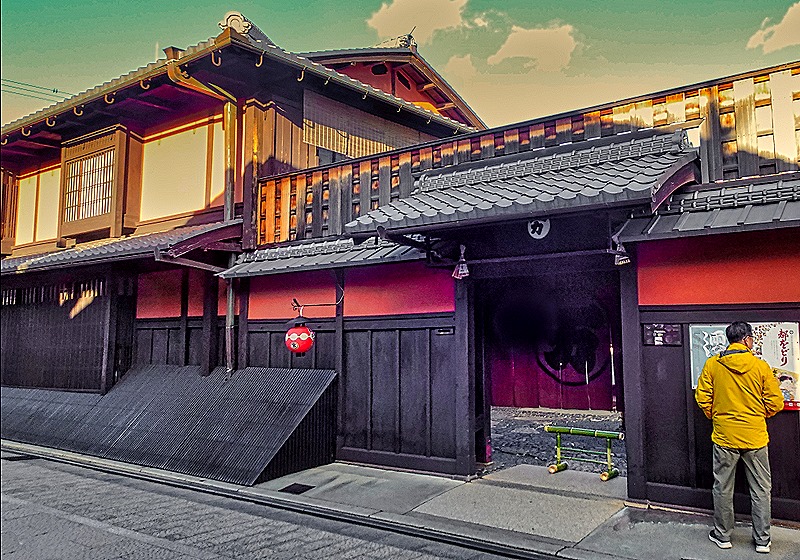
One famous building we passed is the Ichiriki Chaya (Teahouse). More than 300 years old, this has been an important building here since the beginning of the Gion district. It figures in the prominent story of the 47 ronin samurai, who were all forced to kill themselves after avenging the death of their master, and it was the scene of much of the plotting to end the shogunate in the 1860’s, which led to the Meiji Restoration. Access to the building and its geisha entertainment is strictly limited, mostly to individuals whose families have been patrons for generations.
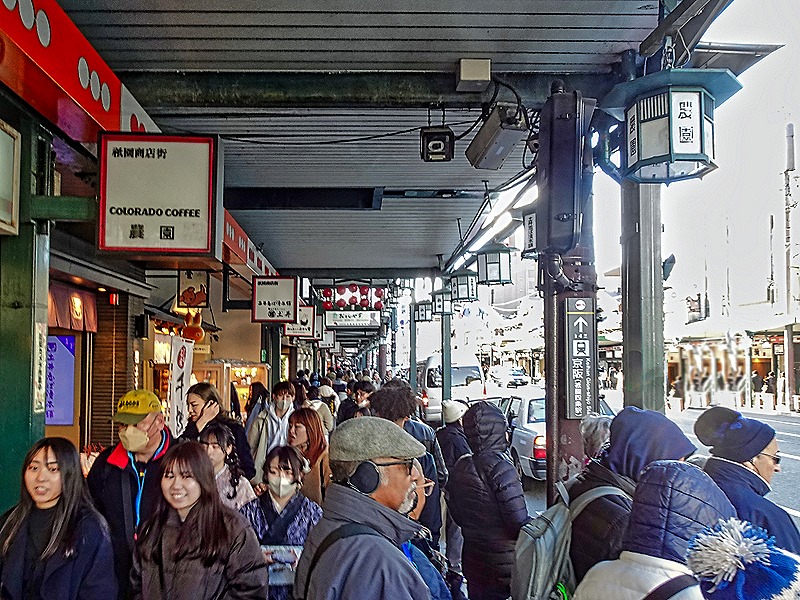
After a while we emerged for a time on what we think was Shijo street, a crowded boulevard lined with commercial establishments, such as shops and restaurants, although even here many of the buildings were of the Machiya design.
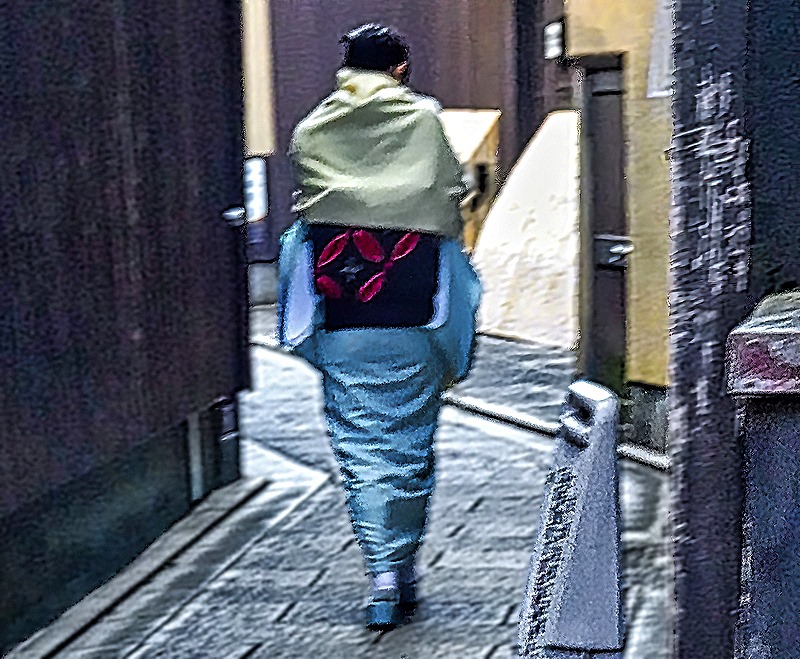
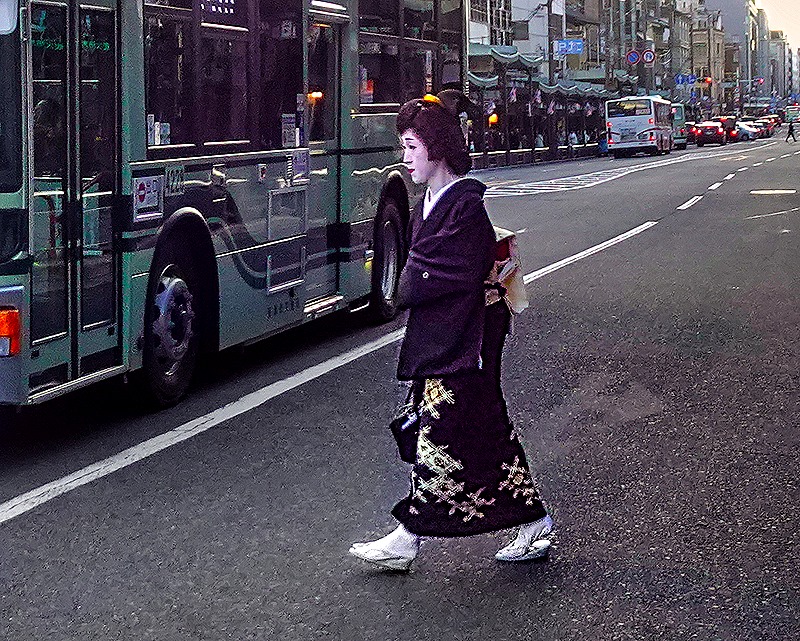
There are two types of geisha: Maiko are apprentices still learning the business, while Geiko are full fledged official geisha. It is possible to see actual geisha on the streets of Gion, but they are pretty rare. We were warned that although photography was permitted on the public streets we were using, there are private alleyways where it is forbidden. Less than a week after our visit we read that because so many tourists disregarded these rules, Kyoto had decided to completely ban them from entering the private alleyways. We hope that, despite this remarkable timing, no one on our voyage misbehaved in this way.
As we saw in Tokyo, there are also shops here that rent geisha style clothing to visitors who want their pictures taken in that guise here, but by law such rented clothing cannot be an accurate representation of geisha attire. Our guide told us that you can tell an actual geisha from a dressed up visitor despite the similar clothing because the geisha are always in a big hurry while the visitors saunter around the area, stopping for photos. Relying on that distinction we think we saw two geisha, both of whom were walking so fast it was difficult to get a photo. One of them was past us so fast we only have a picture of her back, while the other was crossing Shijo street at a distance from us.
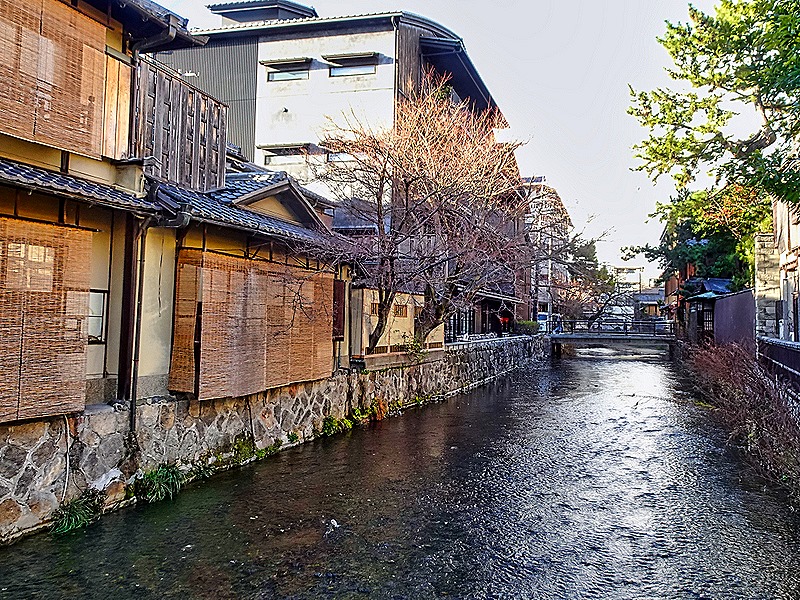
We turned right from Shijo street and walked for a while until we came to the Shirakawa River which runs along the border of the Gion district. We crossed a bridge or two from which we could see the Gion side was lined with teahouses and restaurants of the sort seen in Gion while the opposite side was a riverbank lined mostly with trees (many cherry trees we have read, although they were still in bare winter mode when we were there). We have read that the other side used to be lined with Gion style buildings as well, but they were torn down during World War II as a precaution against fires.

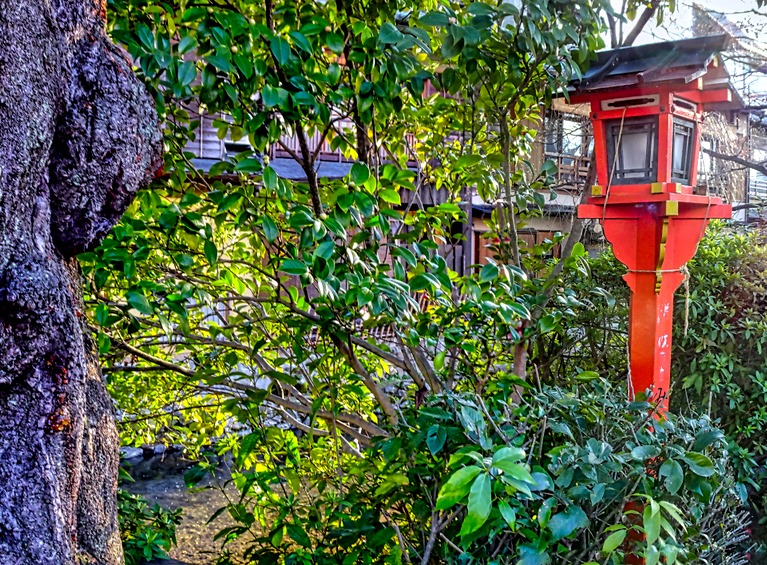
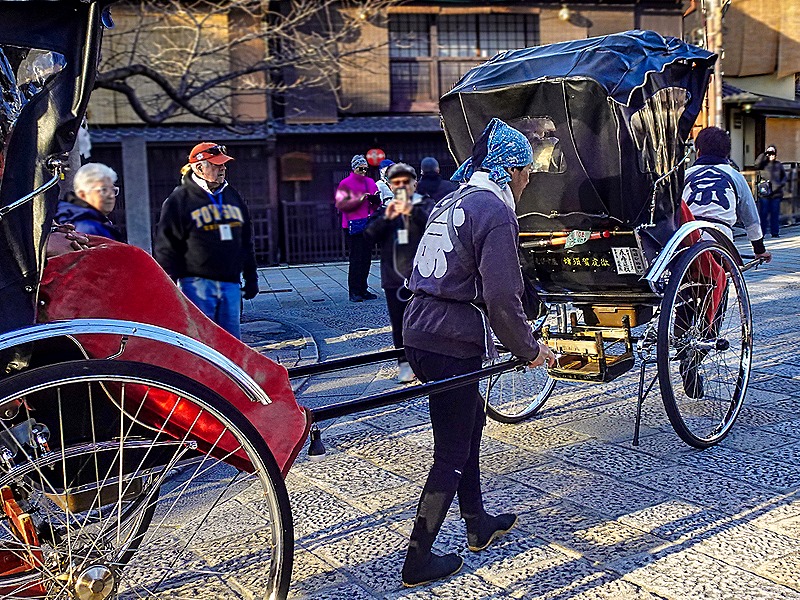
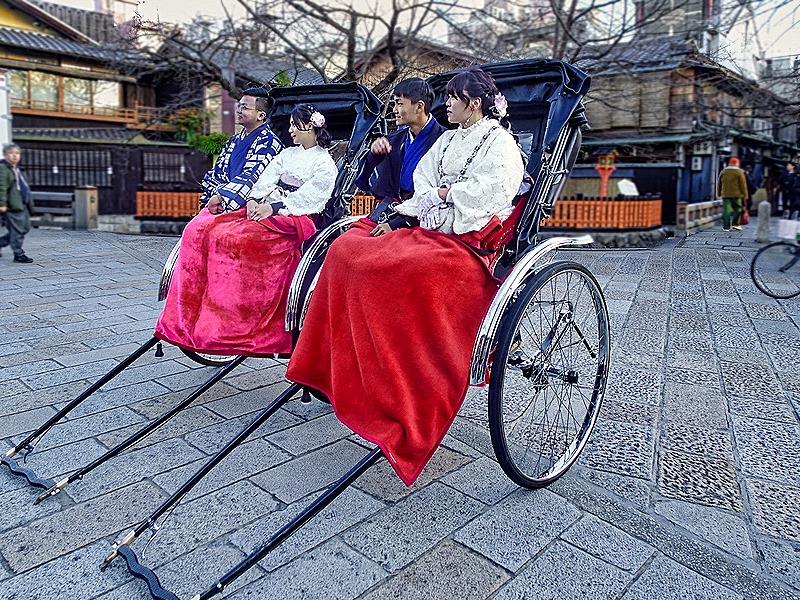
We emerged into a somewhat larger square, in the middle of which is a small red and gray Shinto shrine variably called Tatsumidaimyojin or “Inari of Gion.” Both local residents and geisha worship here. Two men walked into the square pulling metal rickshas, in each of which was a traditionally dressed couple. They stopped and put down the ricksha pulls, then took out cameras and took pictures of the two couples. It must have been some kind of special occasion for them as they posed for pictures in their fine traditional clothes in the ricksha seats.


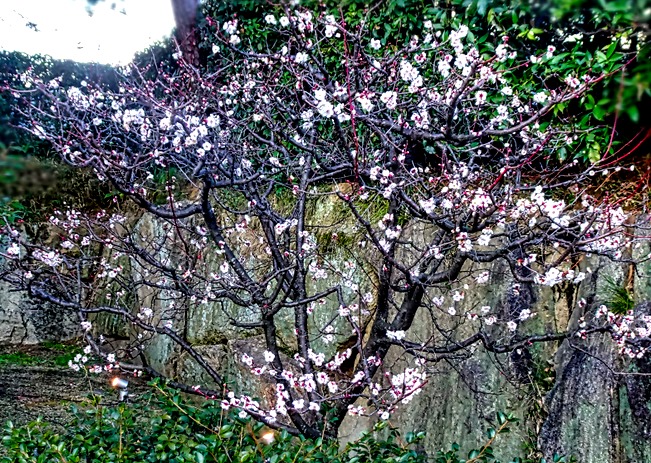
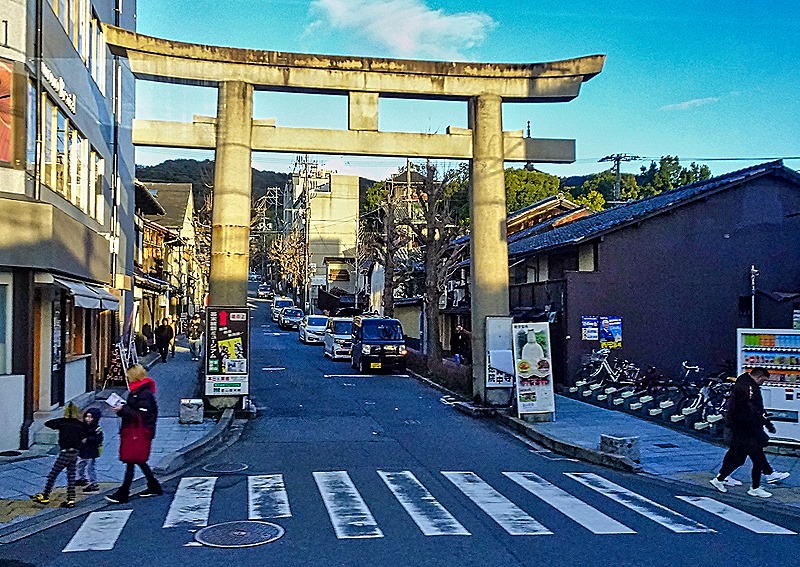
All that was left of our walking tour, and our visit to Kyoto, was the long walk back to the bus in the parking lot. We did pass some nice flora on the way and, as the bus drove through the town we passed a torii gate glowing in the lowering sun. Where there is a torii gate there is almost always a Shinto shrine nearby, although we didn’t see this one as we drove past. The sun was setting as we drove back to Kobe, where we had dinner and went to bed in anticipation of another very long and full day to come.

Tokyo (Day 2) & “Snow” Day near Omaezaki, Japan 2024
Tokyo Day 2
We awoke on February 29 still docked at the Tokyo International Cruise Terminal. This new terminal is located on Odaiba island and is much closer to downtown Tokyo than Yokohama, where cruise ships had docked before and many still do. Yokohama has, actually, been the main port for Tokyo for centuries. We had to be back on the ship by 5:30 for the sail away, which meant returning to the port in mid-afternoon to be safe. We have had the experience of having unexpected difficulty getting back to our ship in foreign ports and certainly did not want to chance that in a city as large and complicated as Tokyo. Everything we read and heard about the Tokyo subway system said that it is well marked in English and easy to navigate, but we decided that a more relaxing day closer to the port was a better choice for us.
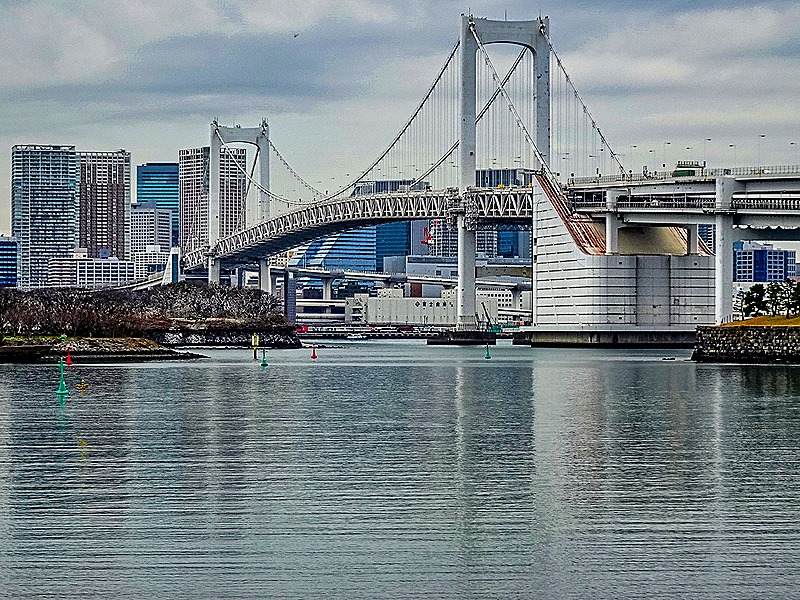
Odaiba is an artificial island in Tokyo bay, connected to the main city by the Rainbow Bridge. Its origins date back to the 1850’s after Commodore Perry’s first visit. “Daiba” means fort or battery, and the plan was to build 11 small island batteries in the bay to protect against attacks from the sea. Only 6 were finished before the project was abandoned and by the 1960’s most of the small islands had been removed and we have read that landfill was used to connect the rest to make the larger island of Odaiba. After on and off development efforts in the 1980’s and 90’s, full development of the island has occurred rapidly since the second half of the 1990’s and the island is now crowded with hotels, commercial buildings, shopping malls, museums, restaurants and entertainment venues, many with very futuristic architecture.
Although it was a bit chilly, this was a beautiful morning for a walk. A shuttle bus was available going around much of the island and, after a leisurely breakfast and the departure of most tours, we boarded the bus and rode it to the Hilton Hotel stop near the waterfront leading to the Rainbow Bridge (which opened in 1993). We walked along one of the boardwalks paralleling the water. Quite a view of Tokyo and the bridge from here.
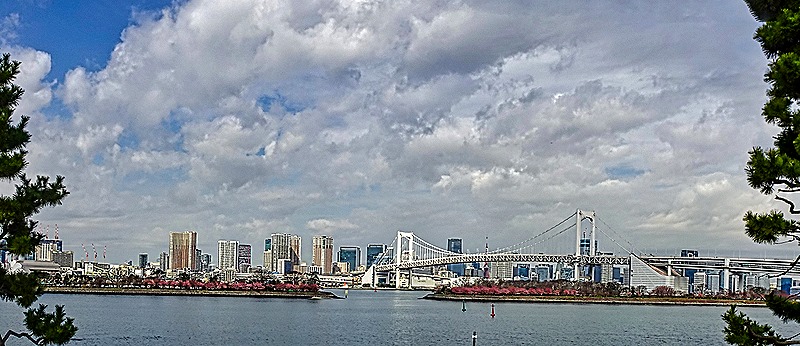
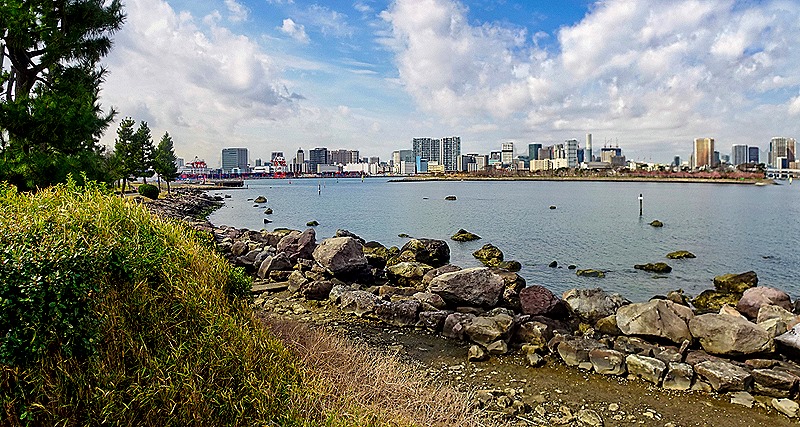
You may notice in these pictures there are two long and narrow islands in front of the Tokyo skyline. Numerous trees full of pink blossoms covered these islands when we were there. It seems we were there well before cherry blossom season, so these are most likely to be plum trees. No matter, they were quite beautiful, and we got a much closer look at some of them sitting in front of one of the malls on Odaiba.


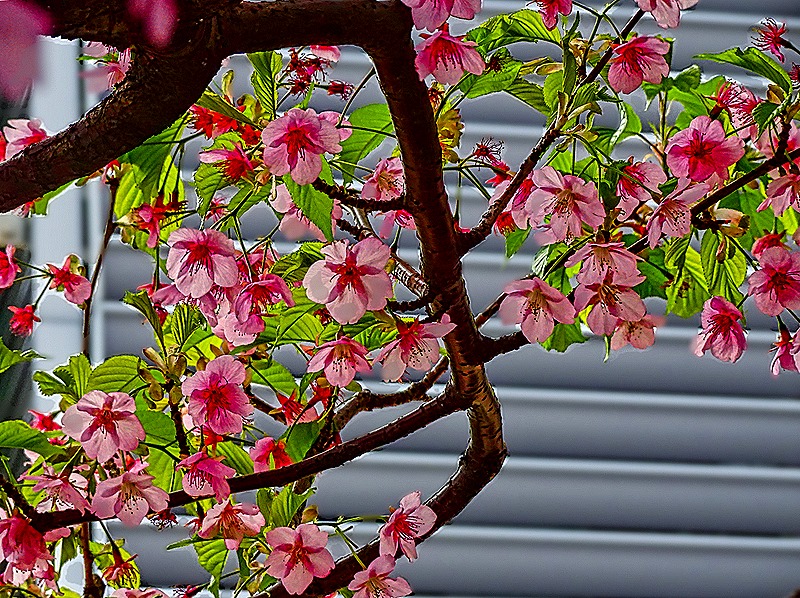
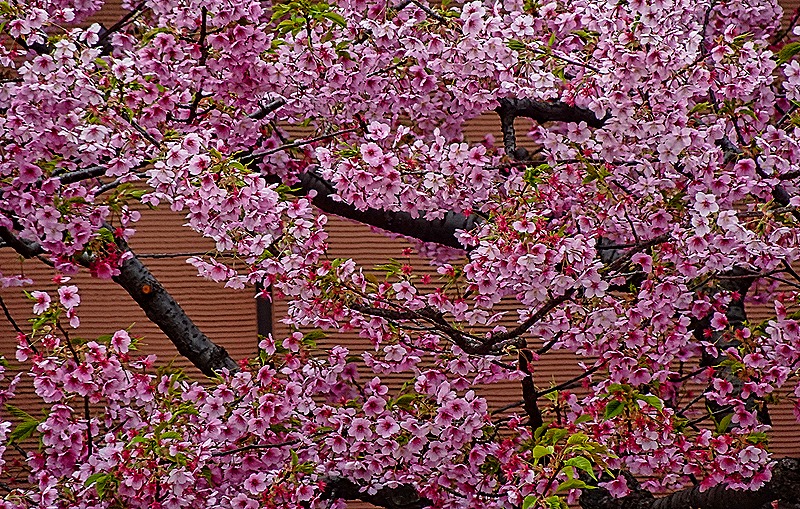
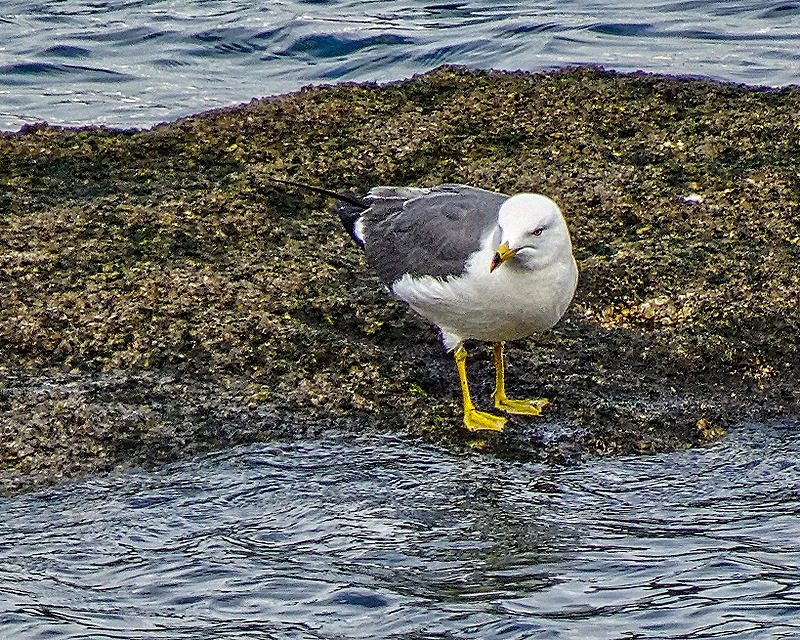
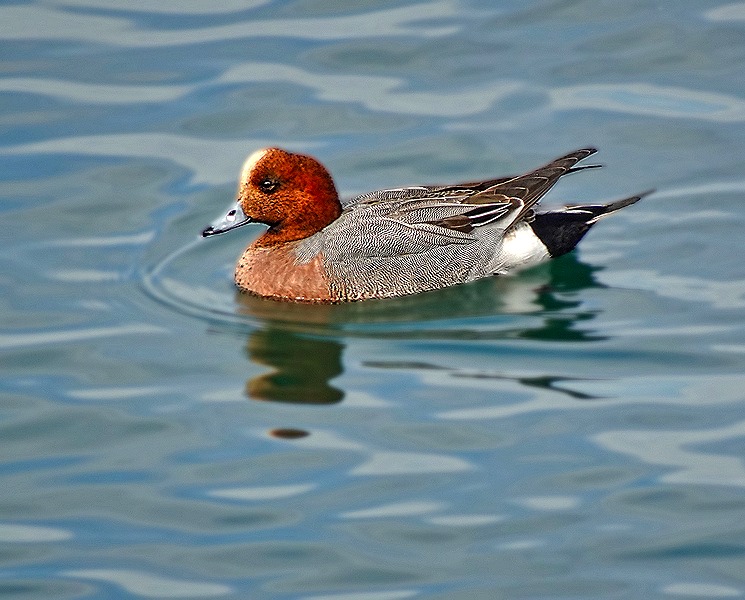
Walking along the waterfront we passed colorful flowers and a sea gull on a small sand bar in the water. There was a reddish brown headed duck swimming nearby and a park with old ship anchors and chains displayed in the sand.


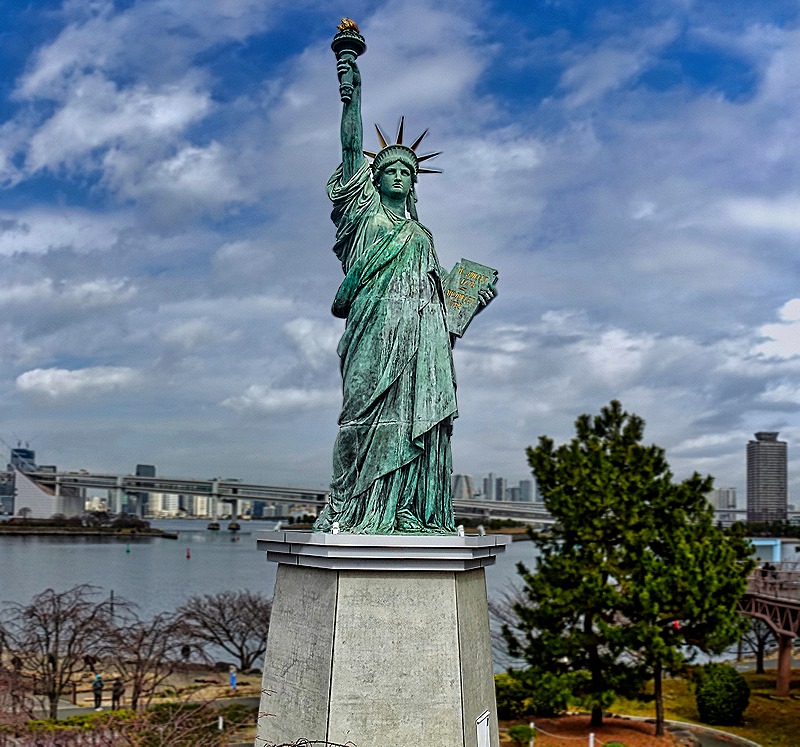
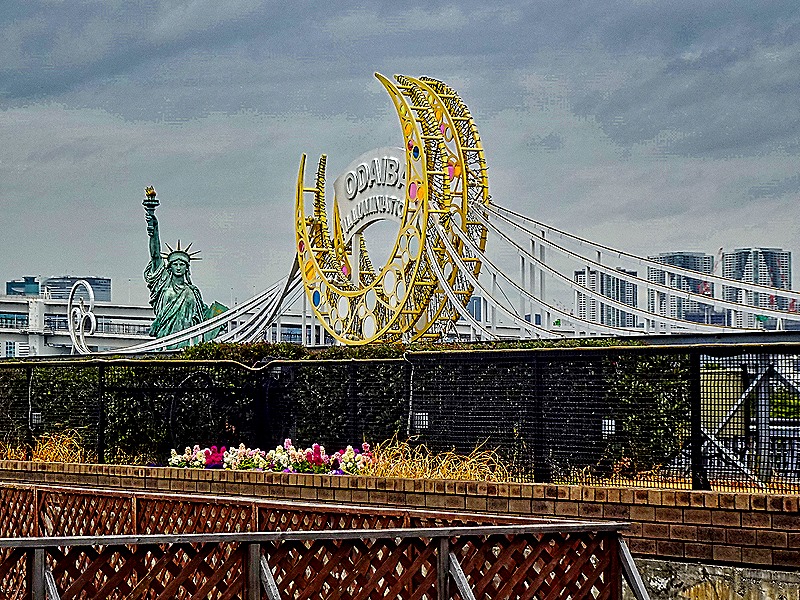
We walked through a big 80 store mall called Decks and back toward the waterfront on the boardwalk, where we saw a movie being filmed (they tried to shoo people away without much success). Then a little further we came to the Statue of Liberty. What, you thought that was in New York? Yes, but here is a 40 foot tall replica, about one seventh of the size of the original, erected here in 1998. And why stop at just one? There are also Statues of Liberty in Shimoda and Osaka. This was a tribute to Japan’s relationship with France, not the US.
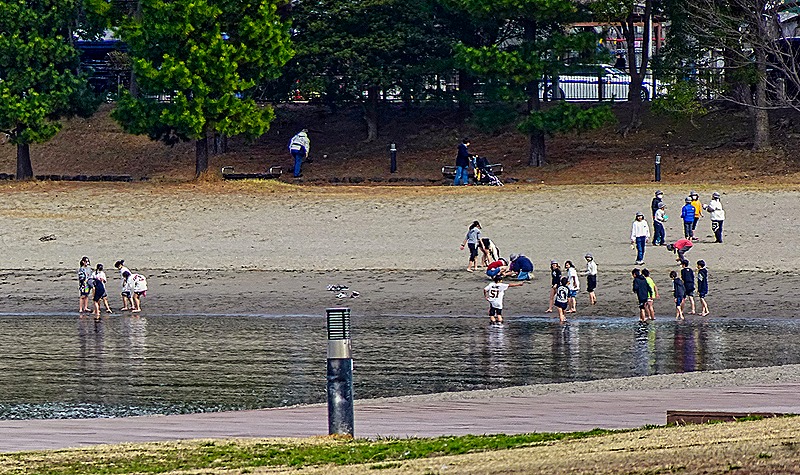
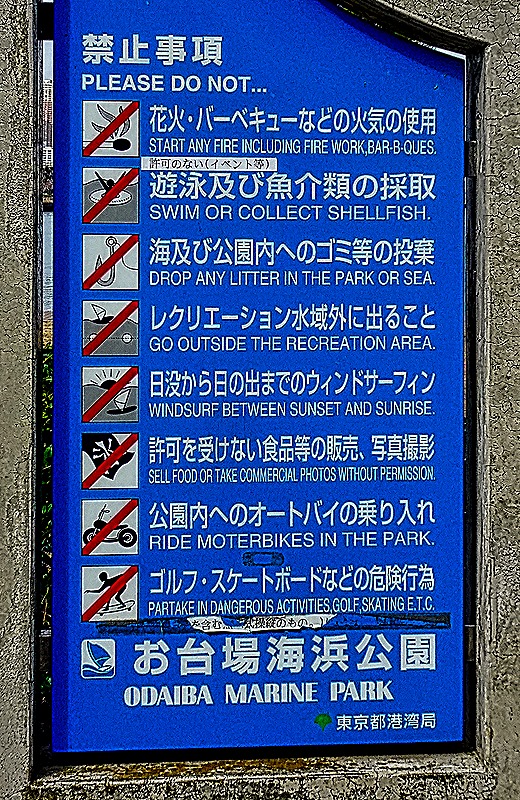
Further down the waterfront walk we came to a beach with some young people wading in the shallows. We have read that this is one of only two beaches in Tokyo not obstructed by industrial buildings, but actual swimming is not allowed. This is also a convenient place to mention vending machines, which are everywhere in Japan. You can buy a large variety of food and drink from them, cold or hot. There was a bank of them here and we also saw an even larger row of them at the Meiji Shrine in Tokyo yesterday. Near the beach a sign was posted with a long list of “do nots” . . . it made us think of Singapore.


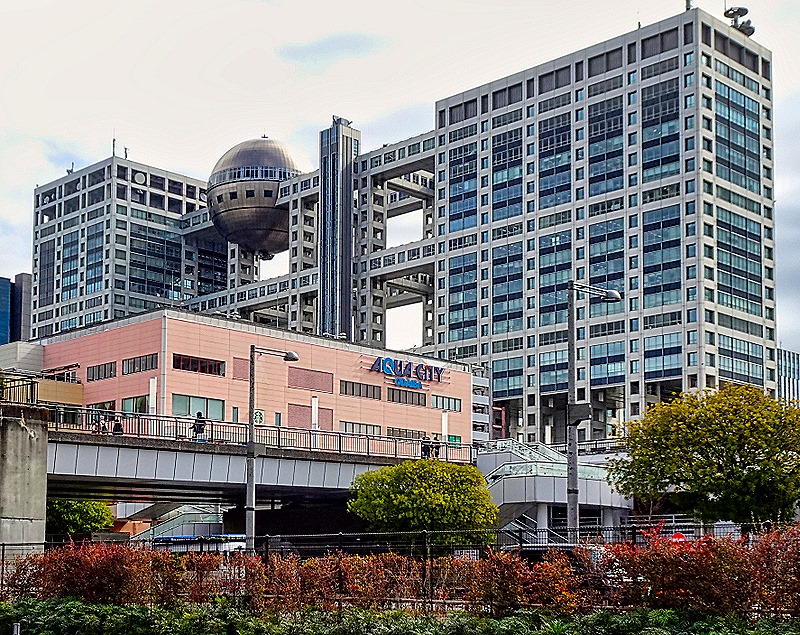
We left the waterfront and walked down a street that was a canyon among large buildings. On one side was the 27 story Fuji Broadcasting Center. It has two tall buildings, an office building and a media building, connected by three footbridges longer than either building. At the top just off center is a huge metal sphere containing an observation deck. The entire building is covered in titanium & was opened in 1996. At street level is a large transparent tube containing an escalator that goes up several stories. Nearby is the pink Aqua City, yet another shopping mall.

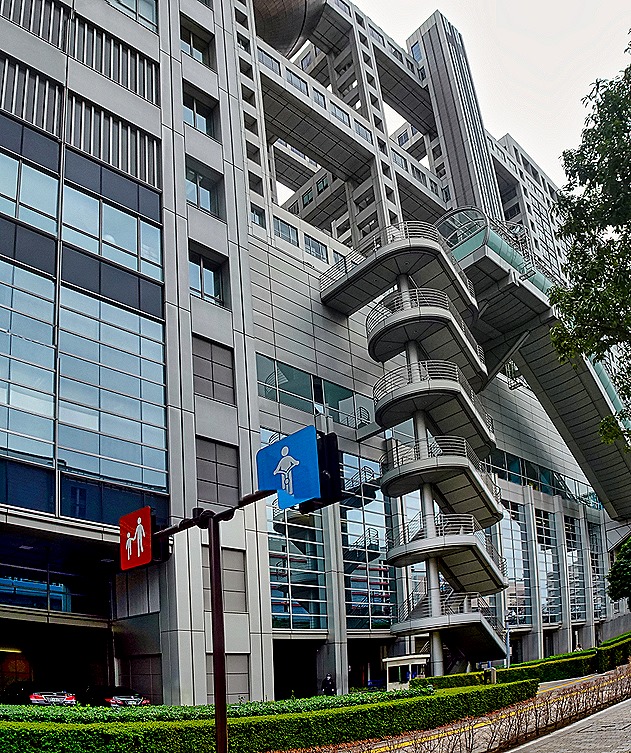

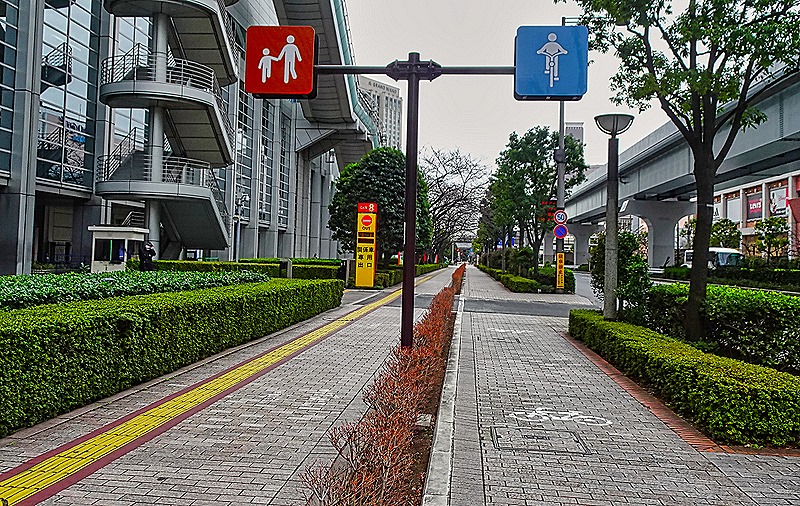
The sidewalk next to the Fuji building included an interesting safety feature. On the left is a lane for walkers and on the right is a lane for bikers, separated by a median strip planted with red flowering bushes. We were told that the narrow yellow path on the left helps blind people with canes negotiate the sidewalk better because it is paved with different shaped stones. This reminded us a little of the separate lanes for bikes and pedestrians in Amsterdam, and we saw sidewalks laid out like this in other areas of Japan as well.
We walked up through a mall (can’t remember which one) to find a large mostly brick open patio like space. There were sculptures, benches, many decorative pillars, vending machines (of course) and quite a view. Families and other groups were spending time in this pleasant space in the sky above the streets of the city.


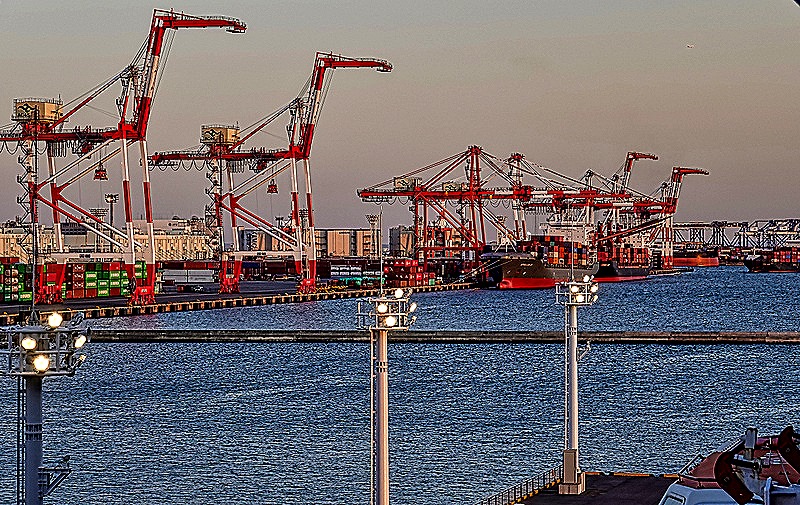
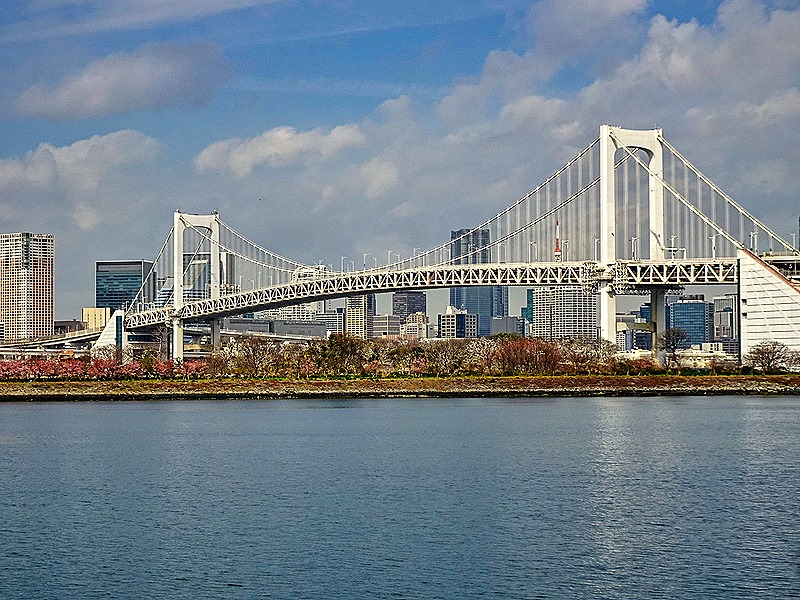
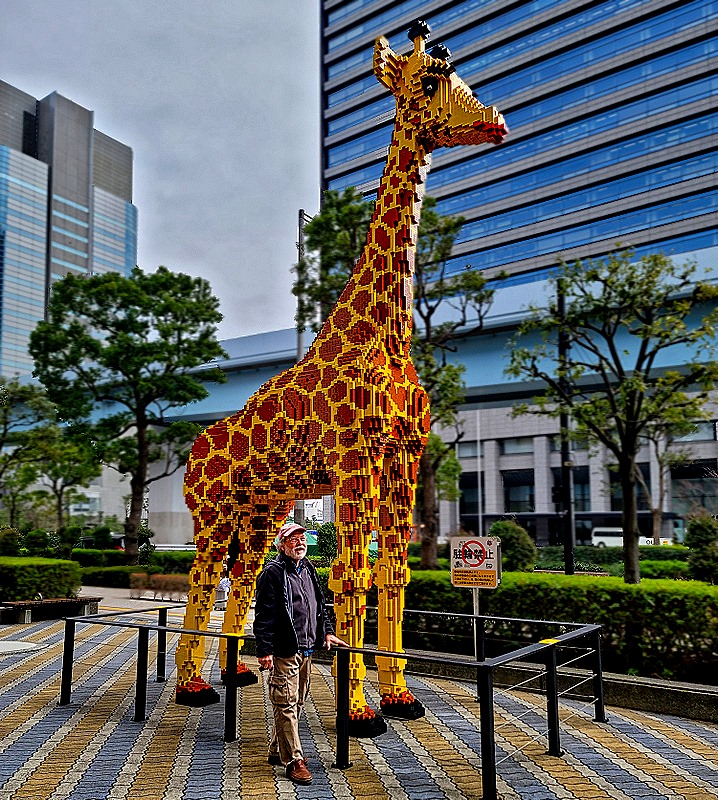
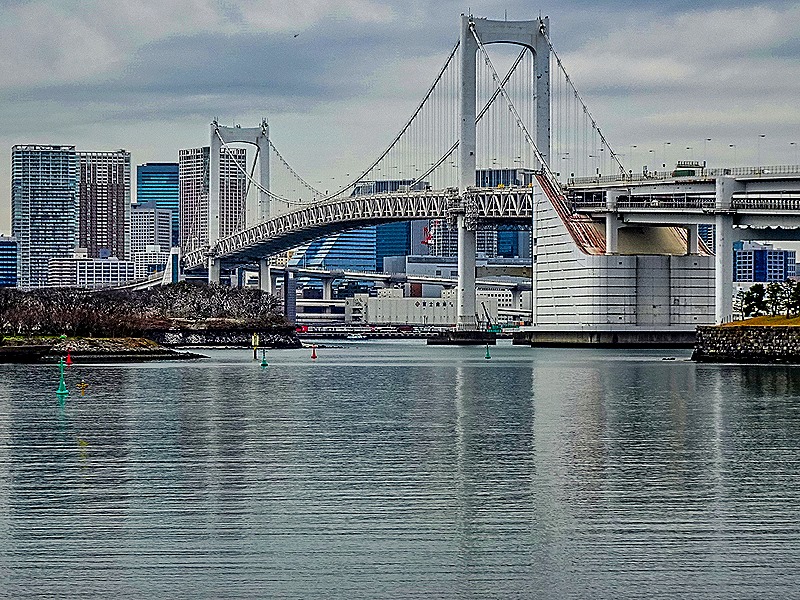
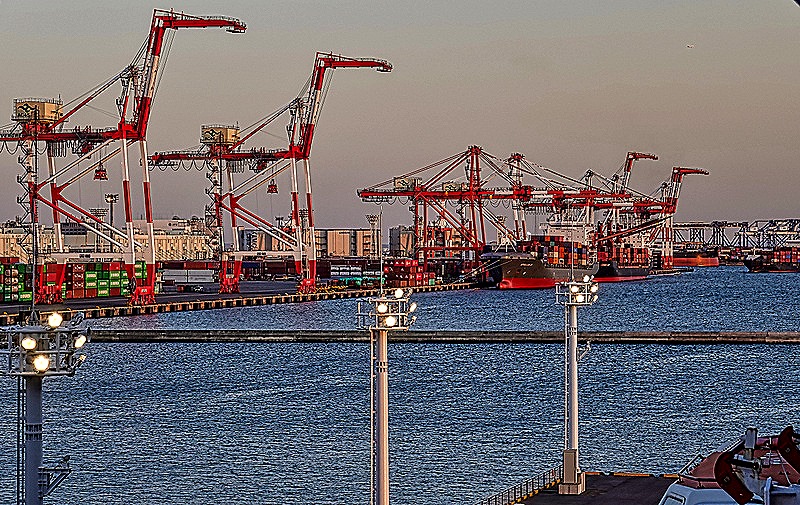
On the sidewalk in the street below we encountered a life size Lego giraffe. There is a Legoland in the Decks mall, but this was in a different location. After this it was time to go home, so we walked back to the Hilton and boarded another shuttle. We passed the Rainbow Bridge (which looks great from any angle) and, back on the ship, we had a view from our balcony of the cranes lining one side of the port looking nice in the late afternoon sun.
Sea Day Near Omaezaki
Our itinerary was supposed to take us to Omaezaki, Japan on March 1. When we researched this port we didn’t find anything we were really anxious to see, so we signed up for an excursion that would (among other places) take us to a temple on the side of a mountain that was supposed to have a great view of Mt Fuji, if we got lucky and the weather was clear. But we were given a heads up on the evening of February 29 that sea conditions around Omaezaki weren’t looking good and we might not be able to stop there. It is always disappointing to miss a scheduled port, but if one had to be missed this one would be better than most others we were scheduled to visit.
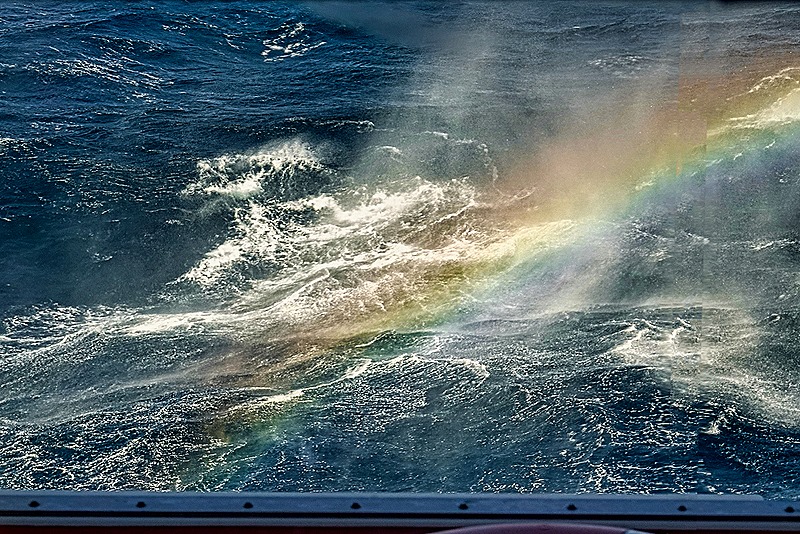
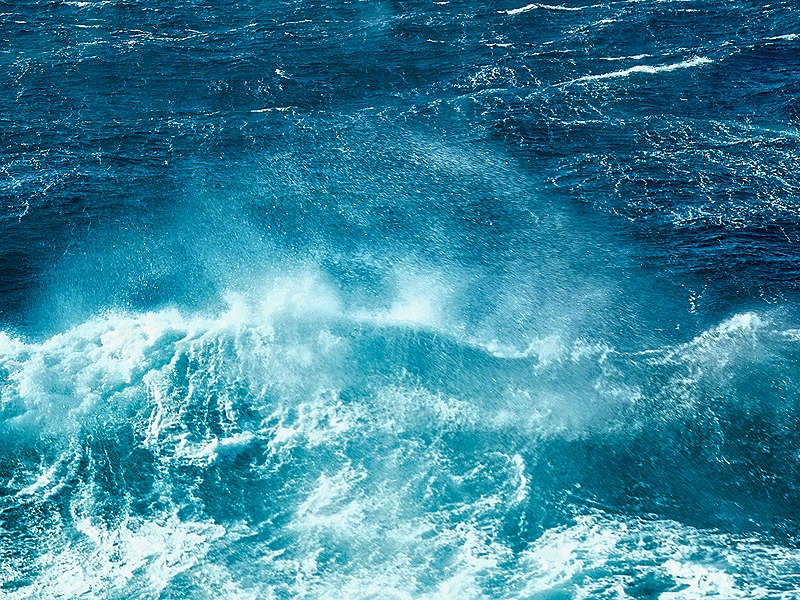
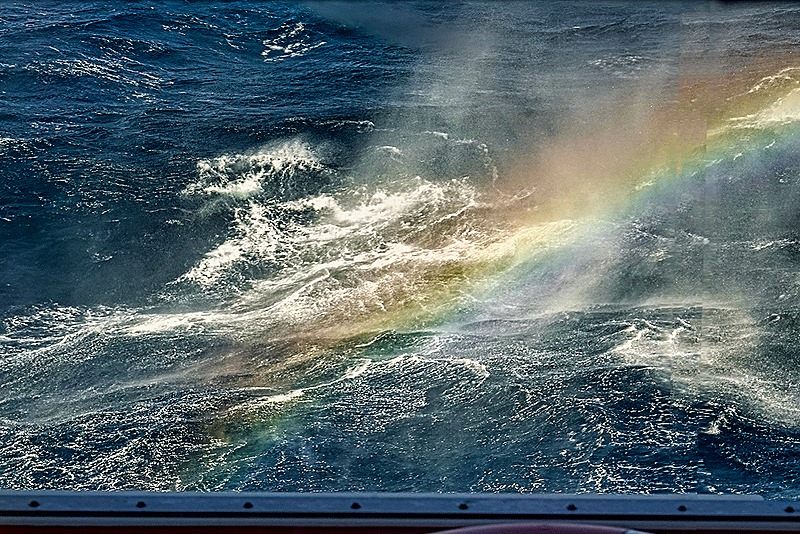
Well, as our friend Pete commented, having an unscheduled sea day added in the middle of a long series of port days is like having a snow day when you are working or in school, an unexpected opportunity to rest up and recharge your batteries. So that’s how we looked at it when, in late morning, it was announced that the sea was still too turbulent for us to stop here. Sometimes it seems to passengers that the sea isn’t really bad enough to skip a port, but not this time. The roiling of the water was enough that we could sometimes see rainbows in the mist that was thrown up by the waves, even from our deck 5 veranda.
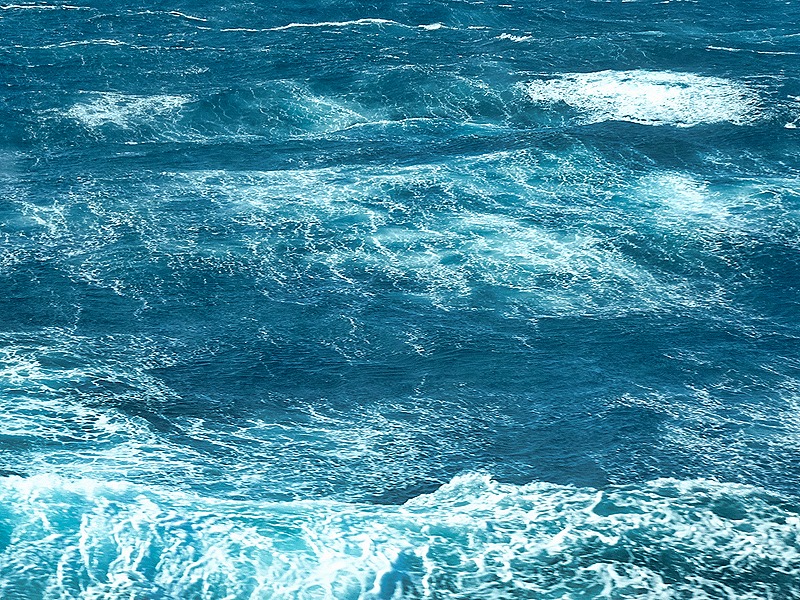
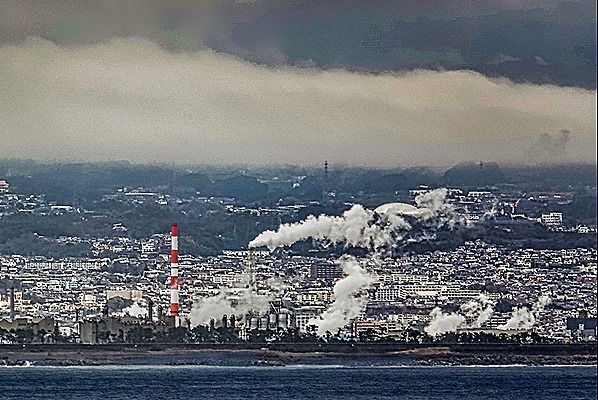
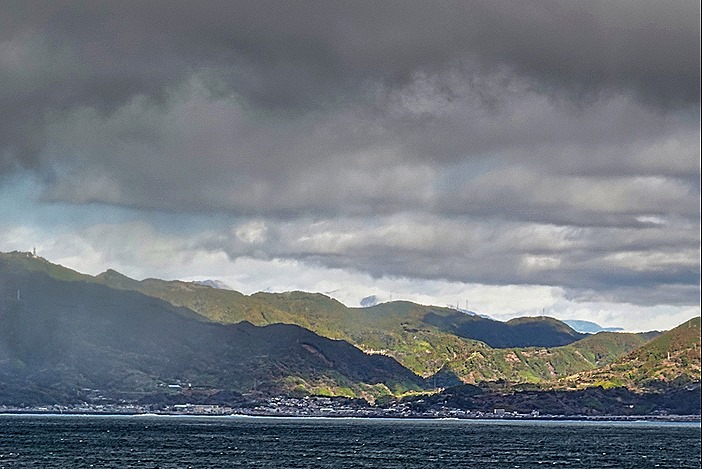
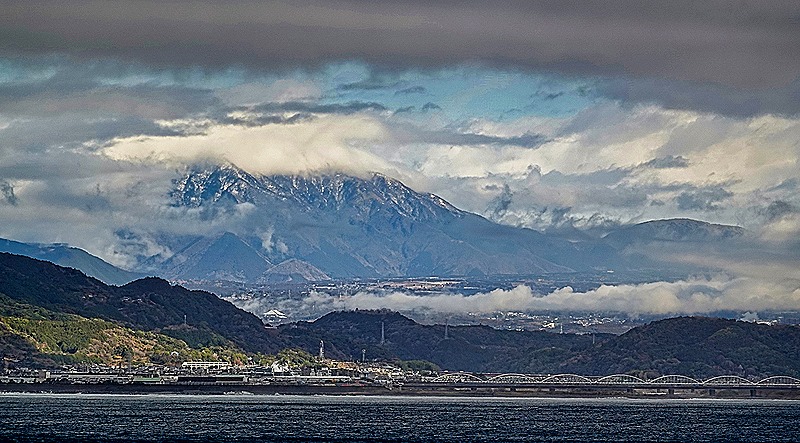
After the Captain’s announcement Rick went outside to try at least to get a picture of Omaezaki from the ship since we weren’t stopping there. He took a number of pictures along the shore, but on later inspection none of them looked like Omaezaki, whose shoreline is dominated by a white lighthouse with beaches and few other buildings near the water (according to pictures we have seen). We are pretty sure we were somewhere in Suruga Bay, but the area was too heavily overcast to identify. I think I have identified in one picture (the last one below) the Fujikawa water pipe bridge across the Fuji river near the shore of Suruga Bay, which has a series of metal arches like this. If so, Mt Fuji would be visible right behind it but hidden by the heavy cloud cover (as it apparently often is), but that would put us far from Omaezaki. So, who knows? Other shore pictures include industrial smokestacks and impressive mountains.

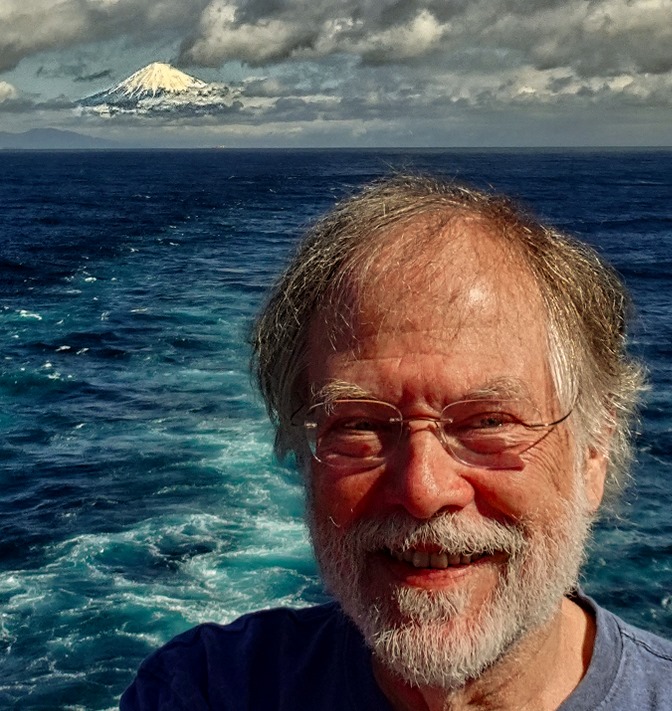
Later Kimberly (cruise director) announced that the iconic Mt Fuji was visible to the aft of the ship. This mountain is almost 12,389 ft tall, the tallest in Japan. It is a volcano, last erupting in 1704, and has a snow covered top (at least when we were there) and an almost perfect cone shape. While many people try to climb it in summer the Japanese government is trying to cut back on this by charging admission and limiting when and how many climbers are permitted. We have read that an old Japanese proverb says “a wise person will climb Mt. Fuji once in their lifetime, but only a fool would climb it twice.”
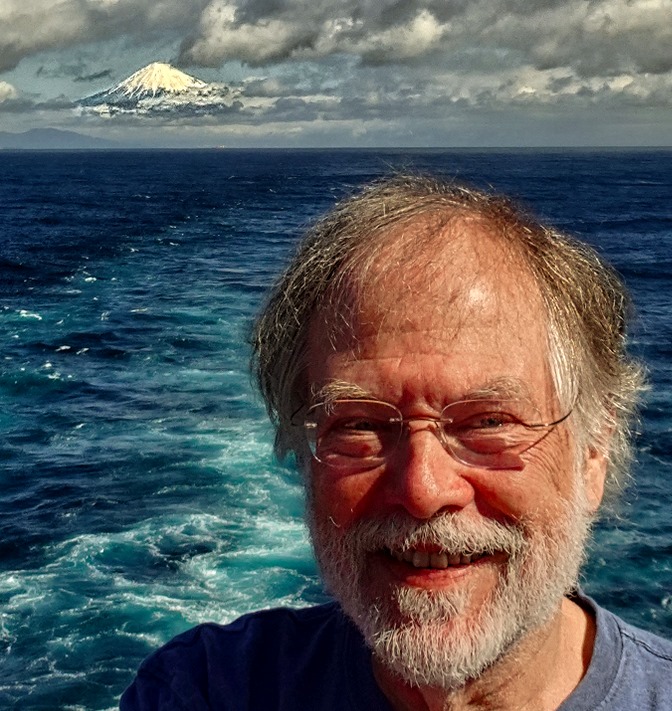
After the Captain’s announcement Rick, along with a crowd of other passengers, hurried up to the deck by the aft pool and, sure enough, there it was emerging from the clouds far in the distance. It took a while to get to the front of the crowd, but the mountain was still quite visible and, like everyone else, Rick got a picture of himself with the mountain (not a selfie, Robert took it).
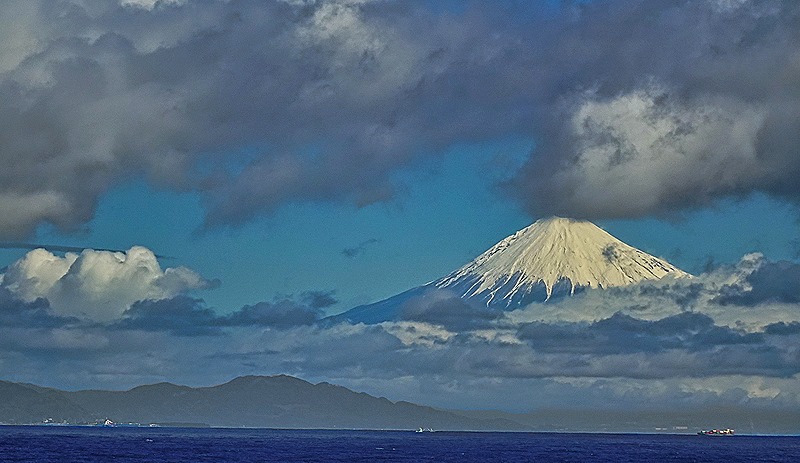
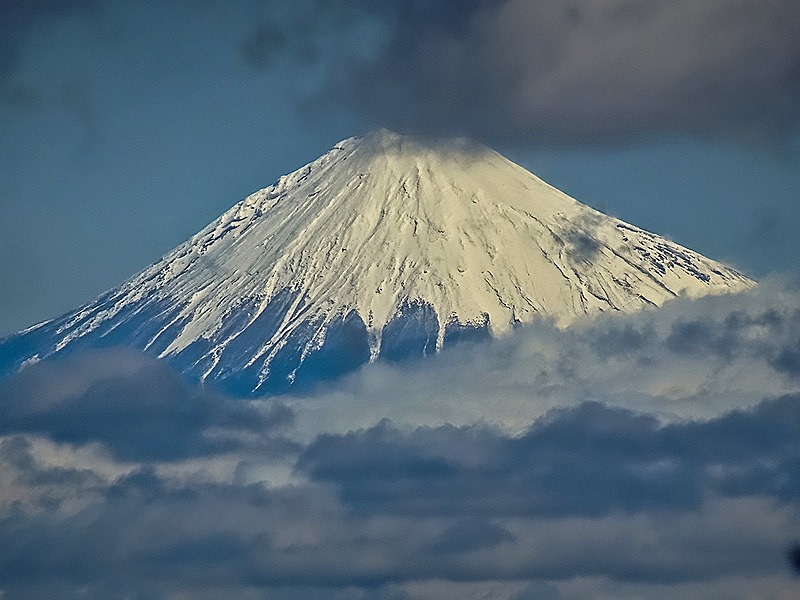
Afterwards Rick returned to the cabin and stepped out onto the veranda. The mountain was still there, more clearly visible than before. It was really quite a sight. He encountered our room stewards, busily cleaning a cabin down the hall and having no idea that this special mountain could be seen outside. If Rick hadn’t told them about it they would have missed it completely, even though they were only a few steps away from the view. The best known woodprint series by Japanese artist Hokusai is called “36 views of Mount Fuji.” We won’t go that far, but here are two more, taken from our veranda.
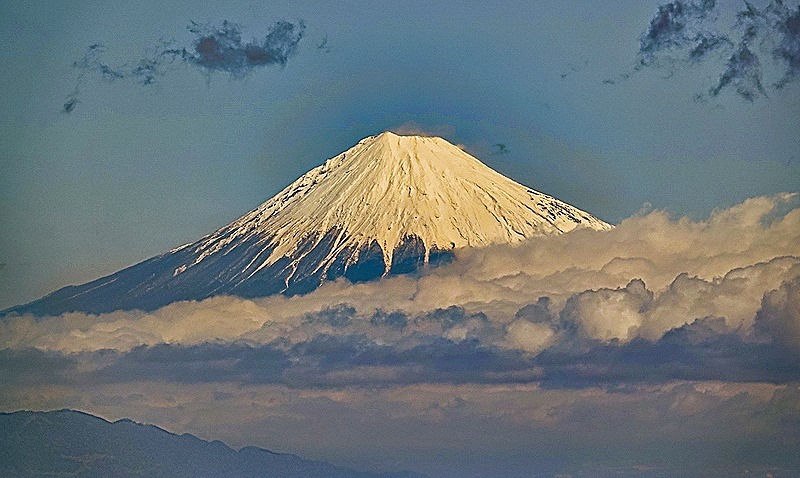
So we didn’t get to visit Omaezaki but in the end we did get to see Mt Fuji so it wasn’t a lost day. We sailed out of the bay and headed for our next port.
Tokyo, Japan (Day 1) 2024
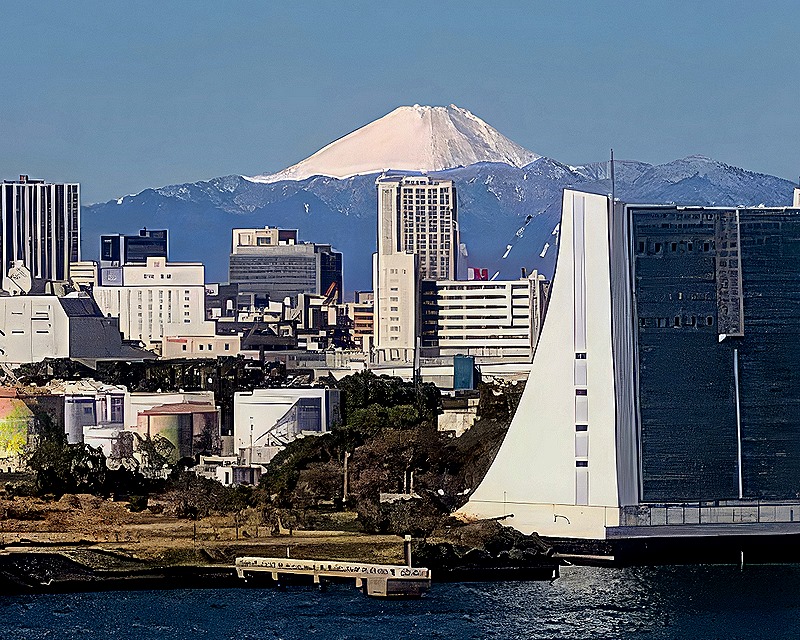
We arrived at the new cruise port in Tokyo around 8:00 AM on February 28 for a two day stay. You may have read that, although the iconic Mt Fuji is more than 60 miles away, it can be seen from Tokyo. That’s true, but not most of the time because rain or hazy weather in Tokyo or the clouds often generated by the mountain’s own weather system hide the view more often than not (and some say much more often than not). But it was a very clear morning as we approached the dock and there was a stunning view of Mt Fuji. At least there was if you were on the port side of the ship. Alas, we were on the starboard side and had no idea this was even happening until much later in the morning when the mountain was behind nearby buildings. But our friend Jean was on the port side and she shared this picture taken from her veranda (I have enlarged the portion of the photo containing the mountain).
Tokyo is really big. Most sources list it as the world’s largest city, with some 40 million people (give or take a couple million) in its metropolitan area, including Yokohama. Excluding the metropolitan area some 14 million people live within the city limits. We aren’t really clear about the differences in counting, but we have read that the United Nations uses the bigger number, so that’s good enough for us.
The city started out as a fishing village called Edo (or Yedo). If you are familiar with the book or TV series called Shogun, you probably know that while the emperor lived in Kyoto, Edo became the capital of the actual ruling government headed by the military leader called the shogun. The Tokagawa clan held this position for about 265 years until the 1860”s when the Emperor was restored to actual power in what was called the Meiji Restoration. The shogun had lived in a highly fortified compound called Edo Castle, which became the Imperial Palace when Emperor Meiji took up residence there. At about the same time the name of the city was changed from Edo to Tokyo (meaning “eastern capital”).
Tokyo’s history is characterized by a number of destructive disasters followed by energetic rebuilding and modernization. It sits on the confluence of three tectonic plates that make earthquakes a common occurrence. Great fires have consumed large parts of the city several times. In modern times Tokyo has been decimated by a great earthquake in 1923 that killed more than 100,000 people and again in 1945 by Allied incendiary bombing that by some measures was more destructive in total than the atomic bombing of Hiroshima and Nagasaki. After 1923 buildings began to be constructed with concrete that is much more resistant to earthquakes and fire than the wood widely used for building before that. After World War II Tokyo was rebuilt in a more modern way, but the many ancient buildings destroyed in the bombing were meticulously recreated using largely traditional methods but less vulnerable materials, such as copper or titanium for roofs instead of wood. Probably because almost every building in town was constructed in a hurry after 1945, the main impression we had driving through the city was of block after block of gray boxy buildings. Not all of them, of course, and we saw a good bit of very distinctive modern architecture and also distinctive reconstructions of important buildings that had been destroyed. But the gray and boxy ones seemed to predominate in most neighborhoods.
Never having been here before, we spent our first day in Tokyo on an excursion to see some of the highlights. Unsurprisingly for a city this large and crowded, the traffic seemed pretty bad to us and it took a long time to reach our first stop, the Imperial Palace. The palace is a large green area in the center of the city with a number of buildings, including the ceremonial palace and a separate living quarters for the royal family. This is where Edo Castle once sat and we understand that some ruins from the castle can still be seen on the grounds. The main buildings of the palace complex were destroyed during the Allied incendiary bombing in 1945 and rebuilt after the war.
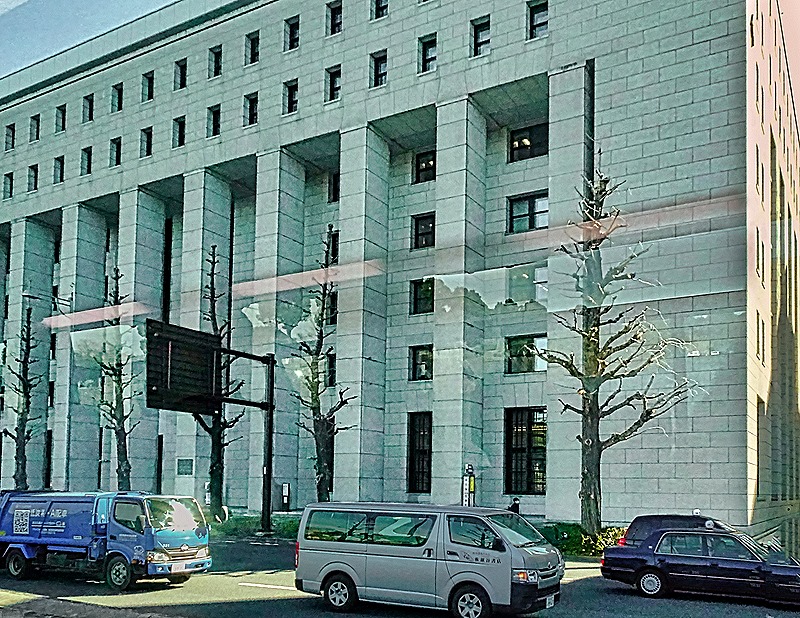
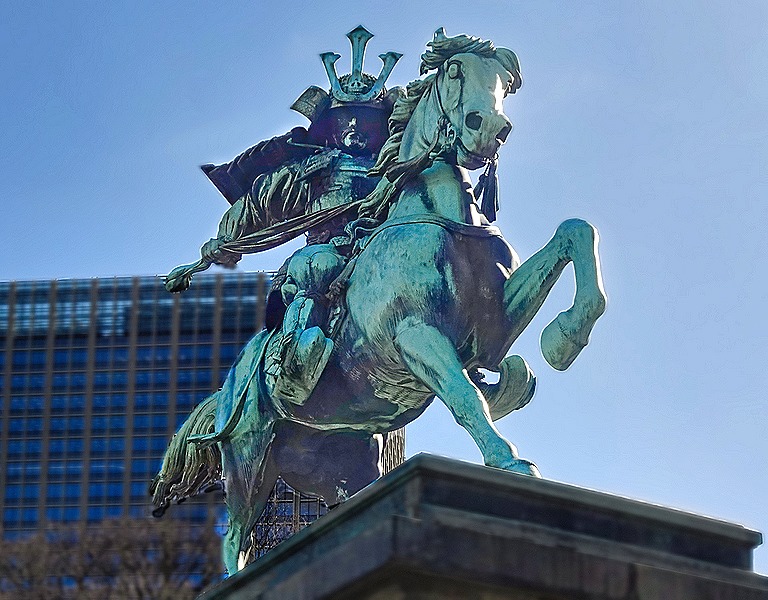
On the way we drove past the building Douglas MacArthur used as his headquarters as commander of the occupation after the war. It was built in 1933 and survived the war. We had a fairly long walk through the many carefully landscaped pine trees in Kokyo Gaien National Garden to the viewing area near the palace. We stopped to look at the bronze equestrian statue of Kusunoki Masashige, a 14th century samarai considered the ideal embodiment of loyalty, courage, and devotion to the Emperor. This statue was erected in 1900.



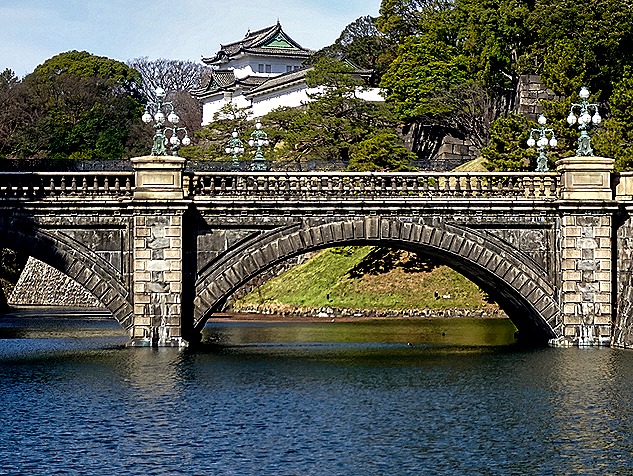
The outside spaces inside the palace grounds are open to the public for a few hours twice a year, on January 2 and the Emperor’s birthday. At other times members of the public without a reservation for a private tour (still only outside) can enter some of the peripheral gardens and also the plaza leading to the Main Gate. The latter spot is where we arrived after our walk. We walked up along a moat with heavy stone castle walls and where the moat turned left we could see the Nijubashi Bridge and an Edo era building beyond (which survived the war) called the Fashimi-yaguri Watchtower. There are actually two parallel bridges across the moat, each with unusual lamps on top of its uprights. The stone bridge in front is called the Meganebashi (Eyeglass) Bridge (because the double arches look like round glasses when reflected in the water) and the metal bridge behind it is called Nijubashi (double) Bridge. This name comes from the original two level wooden bridge built here during the Edo period which was replaced by the current steel bridge in 1964. We were able to walk up a ramp on top of the wall on the right as far as the entrance to the stone bridge.


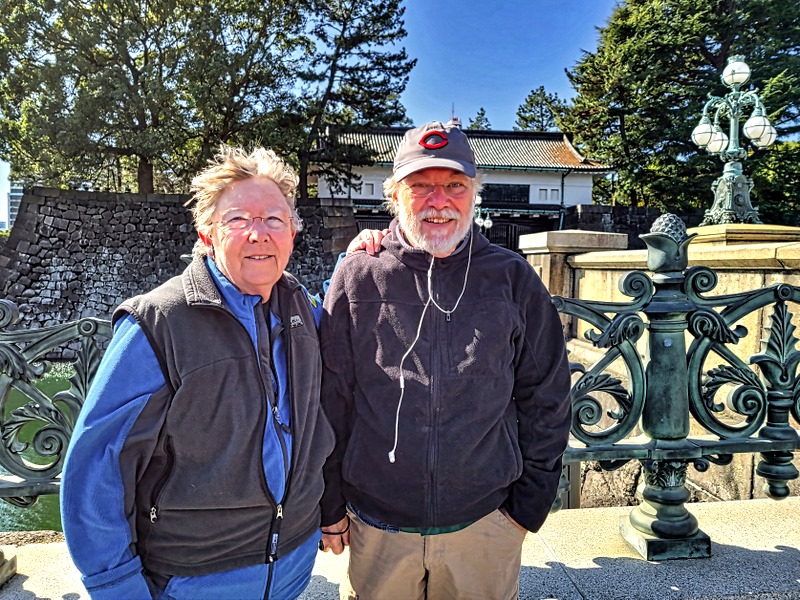
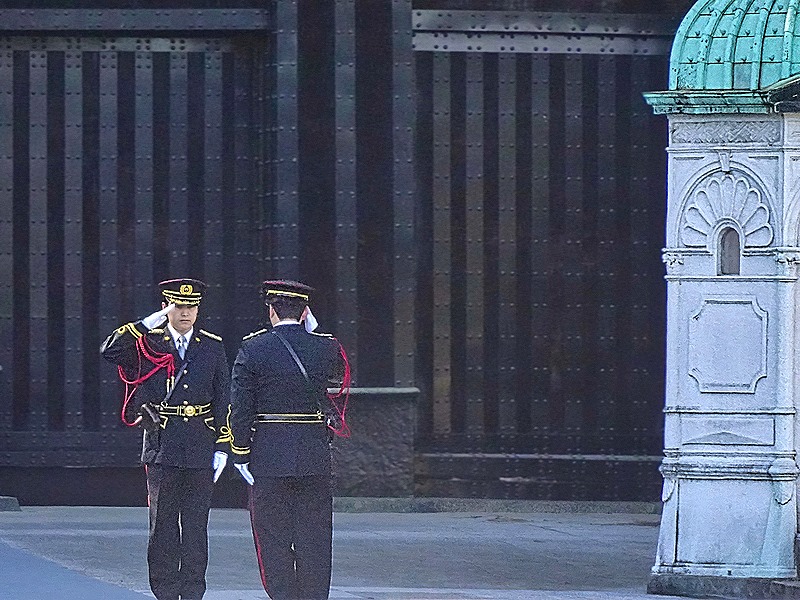
We were lucky to be there just at the right time to see the changing of the guard (actually we think our guide carefully timed our arrival). The Main Gate is located on the left side of the stone bridge and in front of it are two white guard houses with metal roofs. The guards came out, saluted each other, then went back (we didn’t notice any new guards replacing the old ones, but we could have missed that).
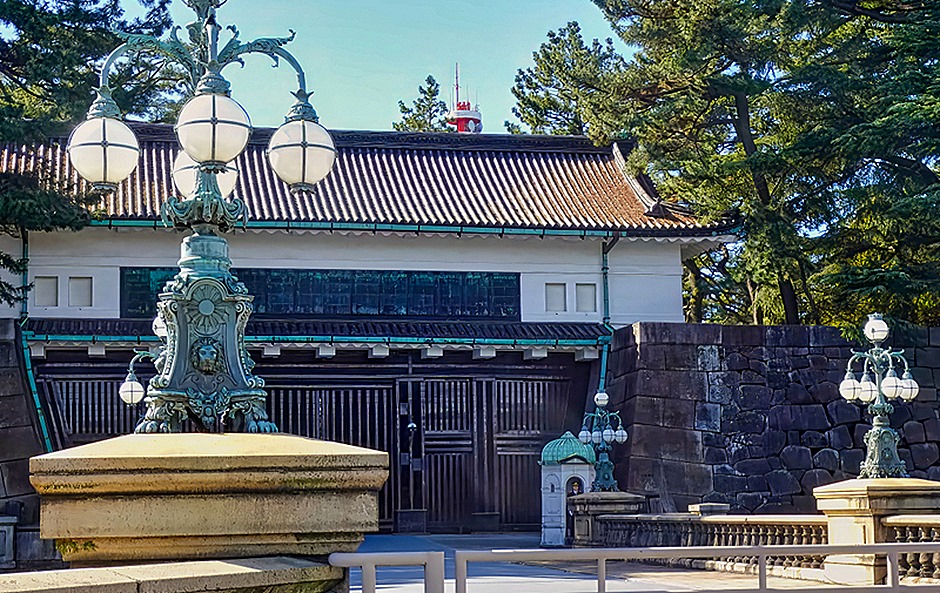
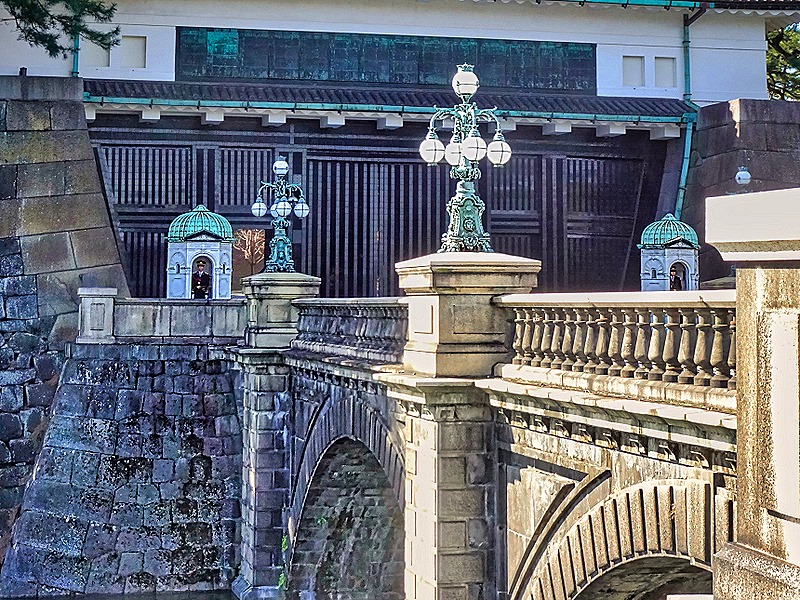


High above the moat beyond the bridges is the old Fashimi-yagura watchtower, built in the old Japanese style common in castles of the era. Quite a sight above the stone bridge in front of it. If you look closely at the second picture below on the right you should see a row of black decorative metalwork running along the top of the stone railing; this was all we could see from our viewing point of the metal bridge behind the stone bridge.

After the lengthy but pleasant walk back to our bus we drove to the Asakusa district to visit the Senso-ji Temple. First established in 645, this is the oldest Buddhist temple in Tokyo. With some 30 million visitors a year it is also, according to some, one of the two most visited religious sites in the world (we would visit the other one this afternoon). The story of its founding is that two fisherman brothers found a tiny golden statue of the Buddhist deity Kannon in their catch one day. They presented it to the headman of their village and about 17 years later the temple was opened.
As with so many important sites in Japan this temple has been destroyed and rebuilt a number of times over the centuries, most recently after it was destroyed by the Allied bombing near the end of World War II. So the current structures are not all that old (rebuilt from the 1950’s to 1970’s), but they are very impressive and accurately represent what was here before.
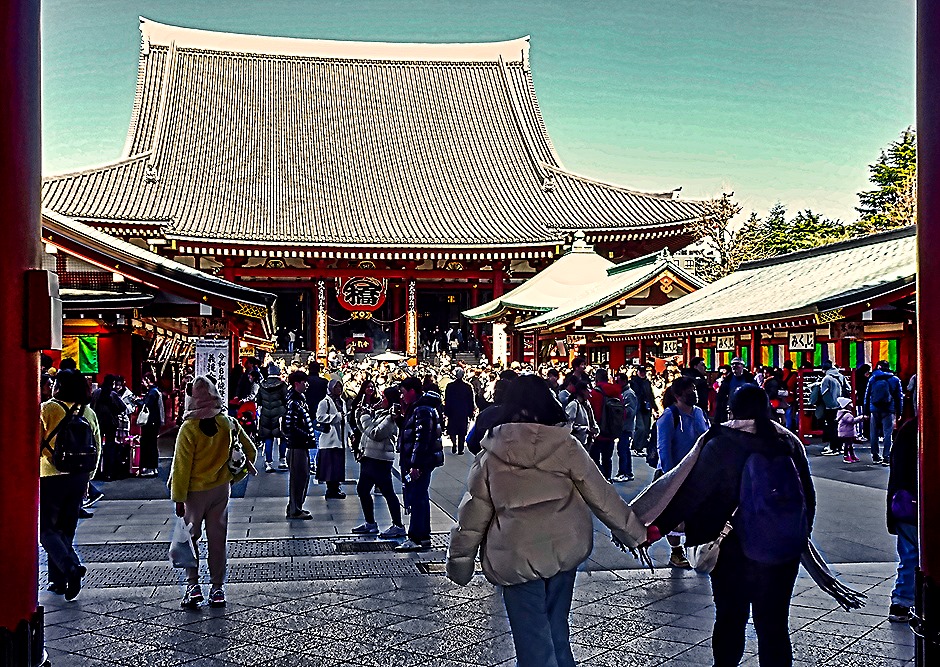
It seems that it is always a fairly long walk from where a bus can find parking to the site you want to visit, and this was no exception. When we finally reached the temple complex we entered through the Nitenmon gate and proceeded to the main temple building. This gate was created in 1619 and brought here from another religious site in 1642.


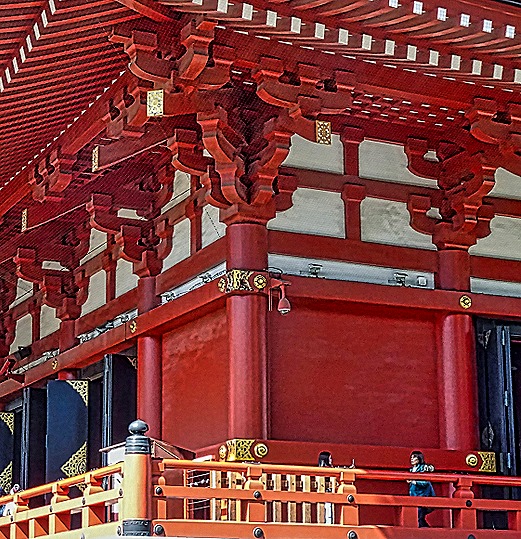
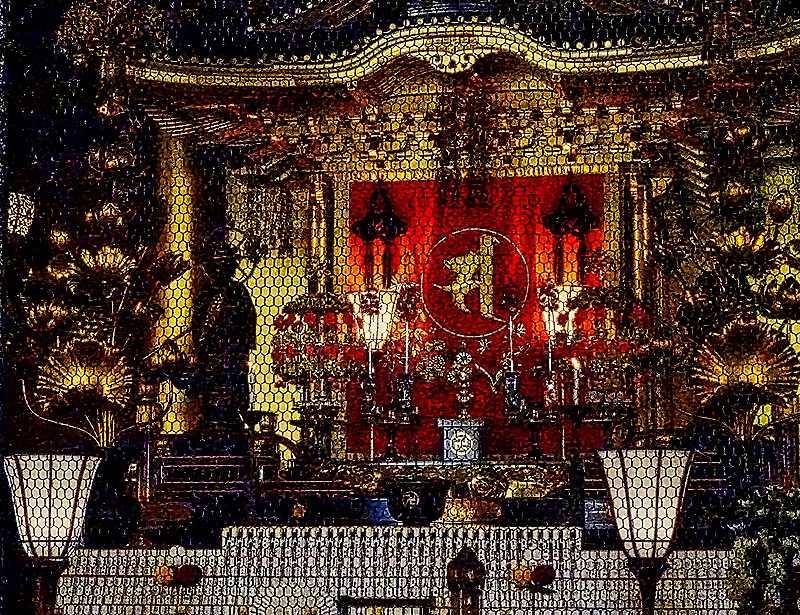
We walked through the very crowded interior of the main hall. Inside were a number of paintings and in the center a shrine-like area behind a metal screen containing many objects that must have important religious significance. It is said that the original tiny (less than 3” tall) statue of Kannon that led to the founding of the temple is still there, housed in an elaborately decorated three layer box, but no one has seen it since 645 when it was first decided that it was too sacred to be seen. We did not see this box and are not sure which building it might be in. We exited the packed hall on the other side, relieved to leave that crowd behind.


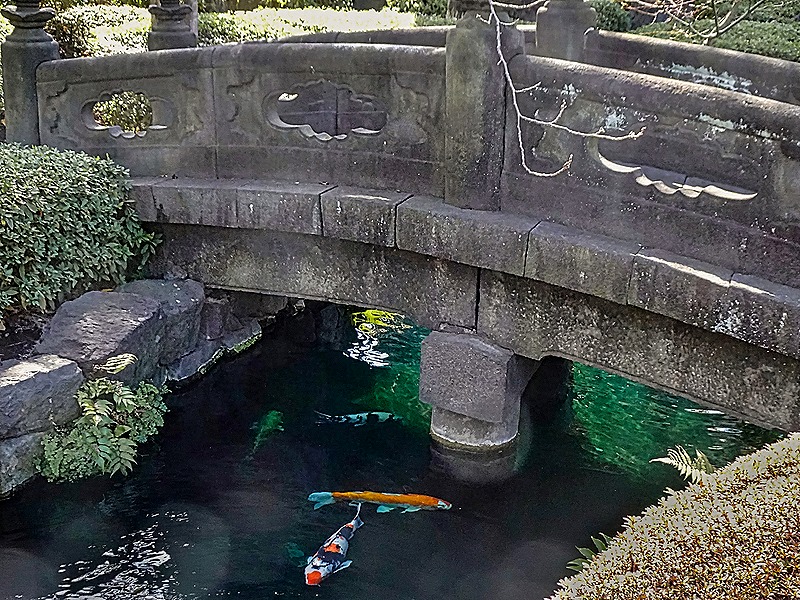
Beyond the main hall on this side was a garden area, with sculptures and a stone bridge over a koi pond. Very pleasant and picturesque.


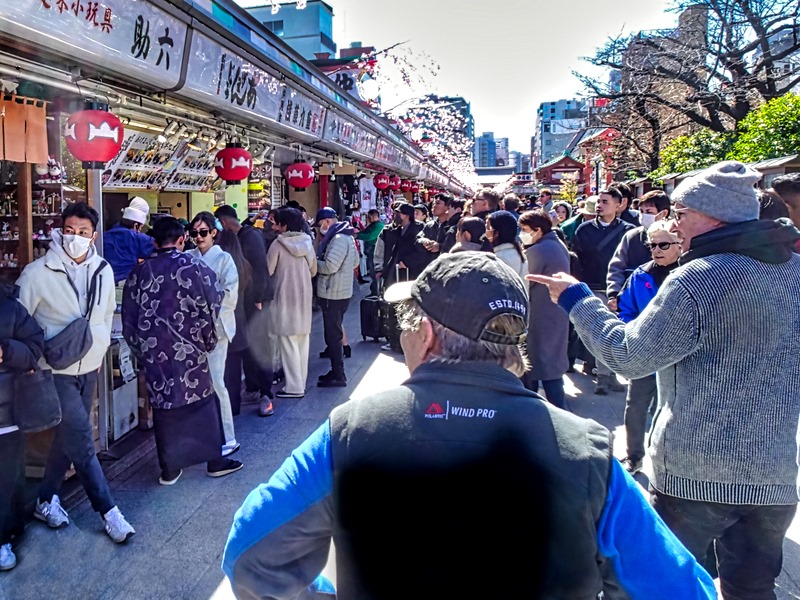
We went out through the Hōzōmon Gate to walk down Nakamise Dori, a long crowded pedestrian shopping street lined on both sides with vendors’ kiosks. It is within the temple complex, inside the largest gate. Vendors have been selling many different wares here for centuries. Above some of the shops were branches with pink blossoms (probably too early for cherries in Tokyo). Among the crowds were a number of women dressed in kimonos. We wondered who they were, but it turned out they were visitors like us (the ones pictured are from Korea). There is a popular tradition here of renting (by the hour) period costumes to feel more a participant in the activities. We saw this at a number of places throughout Japan and China, not just here.



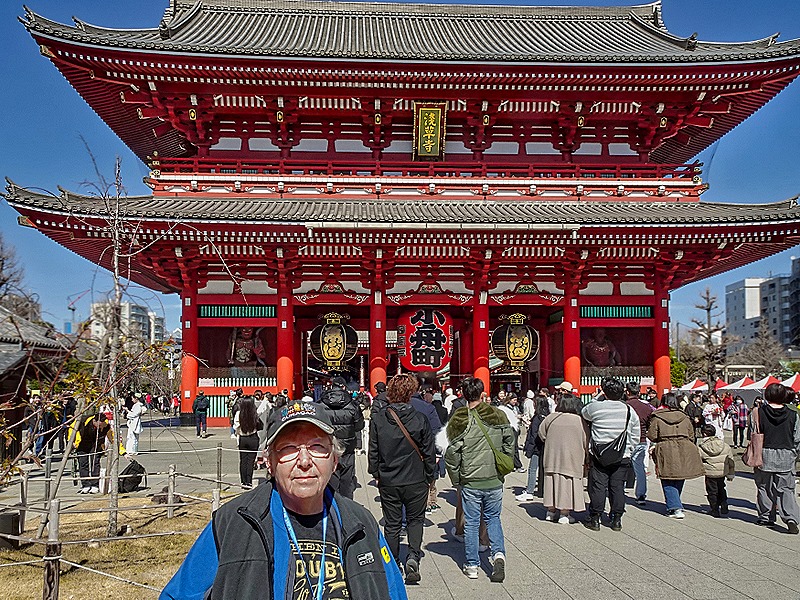
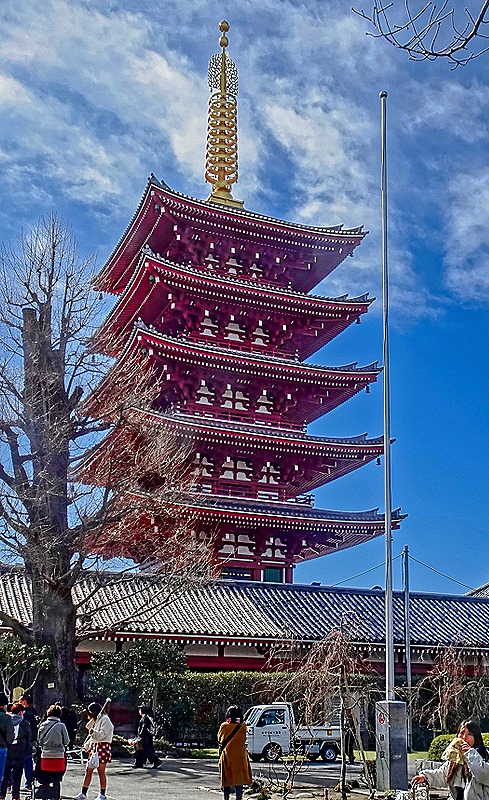
We walked back toward the temple, reentering through the Hōzōmon (Treasure House) Gate. First built in 942, the gate was burned down and reconstructed in the 1630’s, then destroyed again by the Allied bombing raids in 1945. It was rebuilt in 1964, made of steel reinforced concrete. Because it is made of fire resistant materials many of the temple’s treasures, including old sacred scriptures, are stored in the gate’s upper story. The gate is 74 feet tall and 69 feet wide. The large red lantern in the middle is more than 12 feet tall and about 6.5 feet wide. As you approach this gate you can see on the left the 5 story pagoda, at 175 feet the tallest pagoda in Tokyo and one of the tallest in Japan. Originally built in 942 it was also destroyed in the 1945 air raids and reconstructed in 1973. It is not open to the public, but is said to contain 1,000 statues and 10,000 Buddhist tablets. Ashes of the Buddha are said to be on the top floor.



Tokyo has two broadcasting towers that loom high over the rest of the city. The orange and white painted Tokyo Tower opened in 1958 and is more than 1000 feet tall. Its design was inspired by the Eiffel Tower and until 2012 it was the tallest tower in Japan. In that year the Tokyo Skytree opened, less colorful but much taller at more than 2,000 feet. Its name was chosen in a nationwide straw poll. It is the third tallest structure in the world. Today most TV broadcasting is through the new tower which is tall enough for effective digital broadcasting. We saw the Tokyo Tower from the bus on our way into town in the morning and the Skytree rose well above the rooftops in Asakusa.

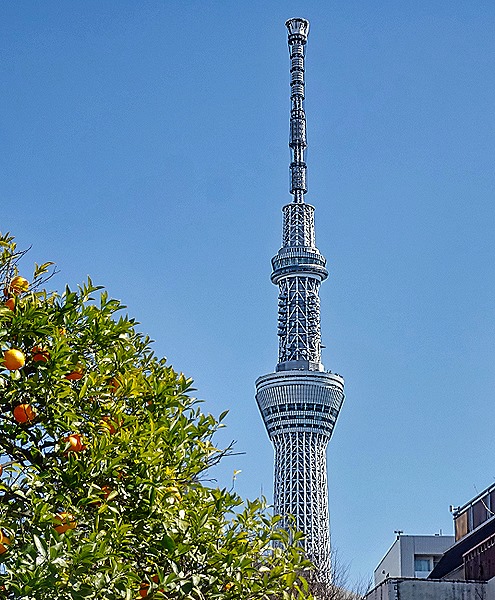
At the time scheduled for departure we went to the area where we entered the temple grounds, as we had been instructed. As often happens, however, there were a few stragglers who either didn’t get the message or were too busy to show up when everybody else did. While we waited we took one last picture with Bill & Robert near the main hall. When our excursion leaders finally rounded up everybody else we walked back to the bus and headed for lunch in a hotel.


The Meiji Restoration in the 1860’s removed the Shogun and returned effective rule to the Emperor. The Meiji emperor (whose birth name was Matsuhito) ended the Shogunate’s isolationist policies and led Japan through an era of rapid modernization until his death in 1912. Meiji-jingu, a government sponsored Shinto shrine honoring the Meiji Emperor and Empress Shoken, opened to the public in 1926. (Note: our guide helpfully explained that in Japan temples are Buddhist and shrines are Shinto.) It does not contain their graves, which are in Kyoto. The shrine was destroyed in the 1945 bombings and the current reconstruction opened in 1958. We have read that this shrine receives 30 million visitors each year.
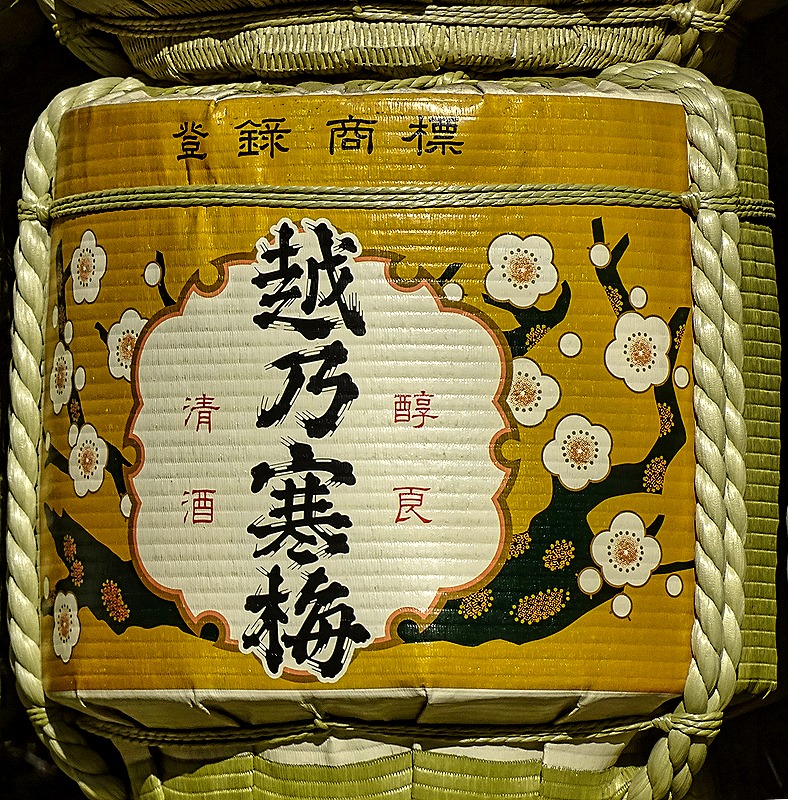
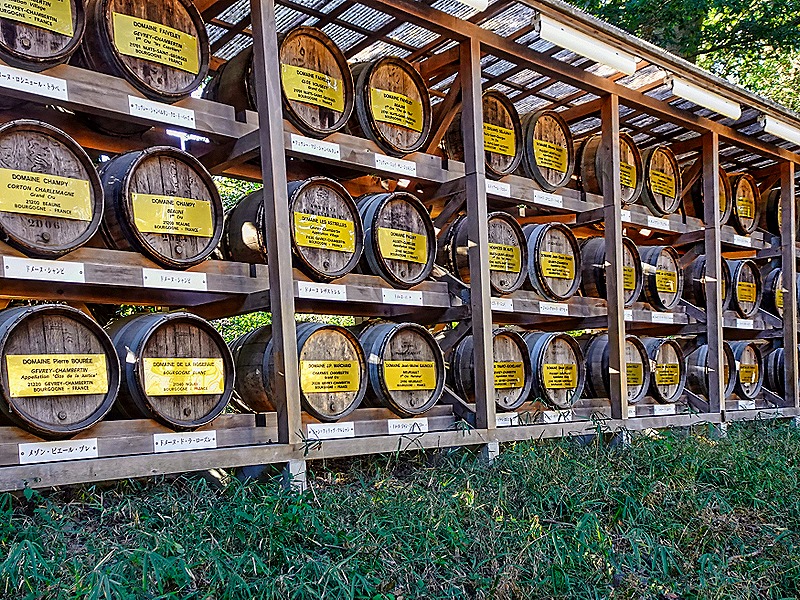
We left the bus in a parking lot in the grounds of the shrine. It was a fairly long walk on gravel paths through a forest of more than 120,000 trees to reach the shrine itself. On the way we stopped to see a wall of some 200 (empty) barrels of sake donated by all the major breweries in Japan in exchange for prayers for the breweries’ prosperity. Each barrel had the donating brewery’s name and logo painted on it. Our guide pointed out one barrel he said was from the oldest brewery in Japan. There was also a smaller wall of French wine barrels, apparently representing the Emperor’s embrace of the modern world (and perhaps he liked French wine too). At wide intervals along the path were attractive lights in a traditional Japanese pattern. Finally there was an attractive low white building whose name and function we do not know.



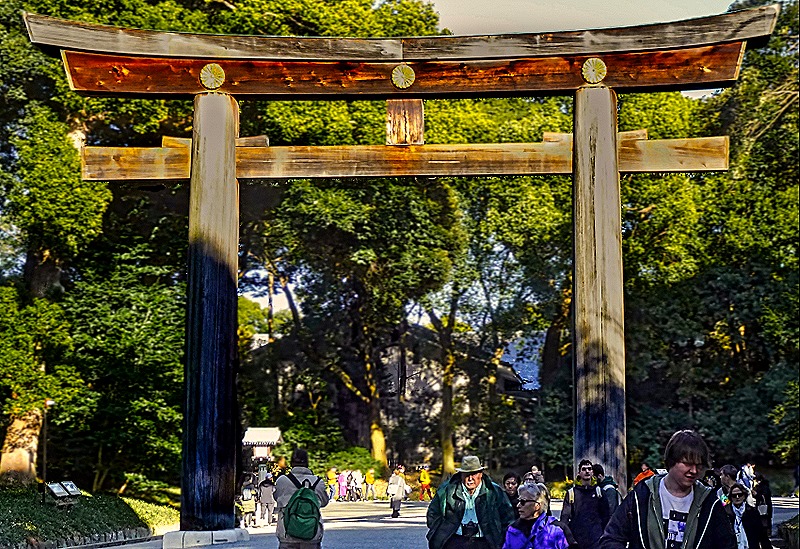
Torii gates are ubiquitous throughout Japan. There are some 90,000 Shinto shrines in the country and each one has at least one Torii gate. They are erected to mark the boundary between the sacred ground of the shrine and the profane ground outside. They are generally very graceful and simple in design, mostly just two pillars connected by one or two cross beams, sometimes with a small sign in the center between the beams. The Meiji Shrine has Torii gates in the woods at each entrance and also nearer the shrine itself. We walked through several large wooden ones to reach the shrine and there was another inside the outer gate of the shrine.
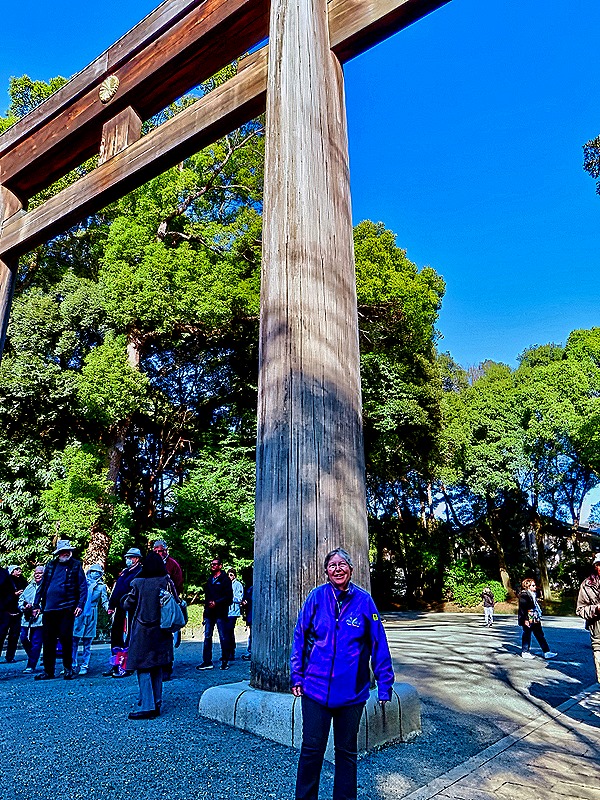

We entered the outer courtyard of the shrine through a very tall and intricately designed gate.

 At this point things became a little chaotic. One of the people on the excursion, a woman named Sue who lived in the cabin next to ours, apparently tripped on the concrete stairs leading up to the gate. The steps are a little odd, with the bottom step set maybe an inch above the pavement, difficult to see as you walk but a problem if someone inadvertently catches their cane there, as Sue did. Everything stopped and Keith, who was leading this excursion, and our guide quickly called for help. A medical team showed up pretty quickly given how far we were from the street, and they took Sue away presumably to an ambulance. She was back in her cabin on the ship that night but the next day she was evacuated home to the US. Yikes, things sure can go completely wrong really quickly. We felt pretty bad for Sue; terrible way to end a grand voyage.
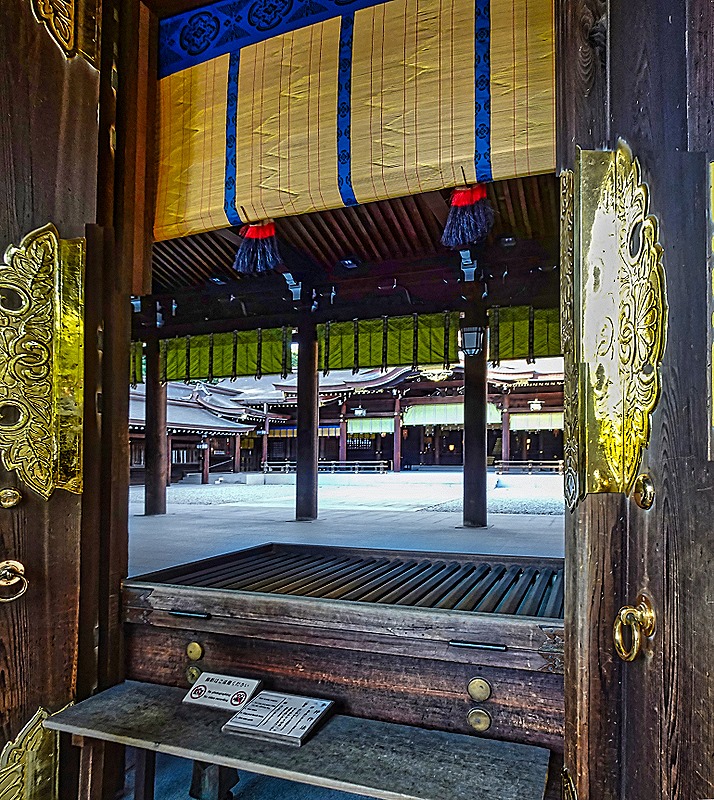
While we were waiting for the medics I walked through this into the main sanctuary, which included a courtyard with the entrance to the main shrine on the far side. To its right was a place where you could purchase a prayer paper, sign it, and hang it on a rack set up to receive them.

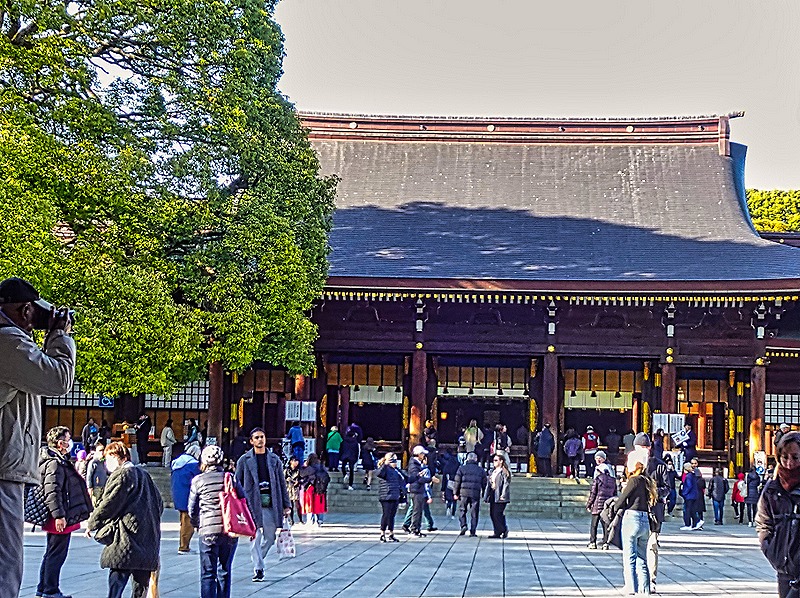
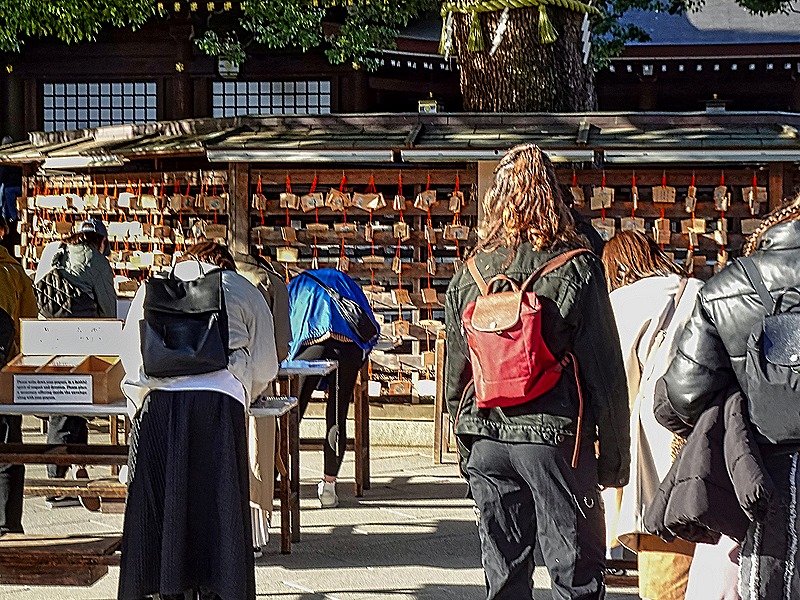
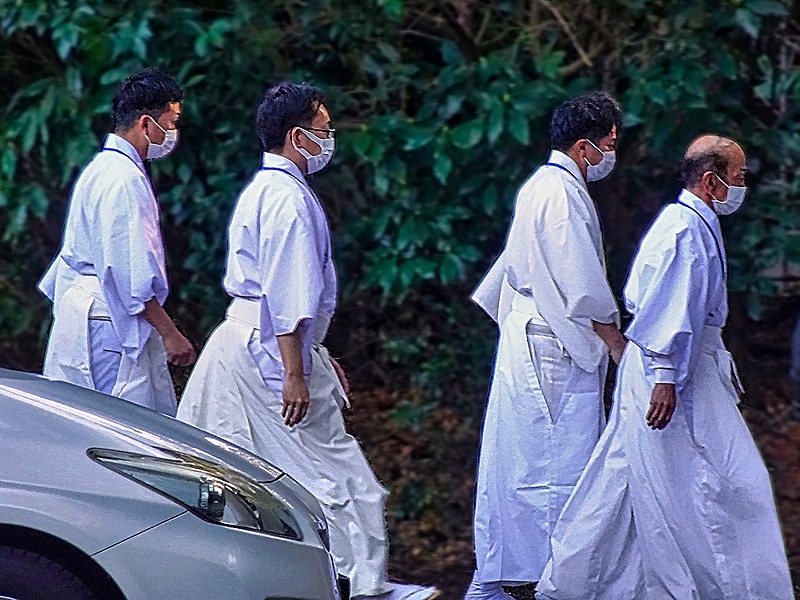
I walked up the steps of the inner shrine and, although entrance was not permitted, took a couple of pictures through a window of the courtyard within. Well it turned out that photography through the window wasn’t allowed either . . . who knew? To be fair there was a sign nearby that I hadn’t noticed. An attendant ran up and pointed the sign out, so I stopped and rather sheepishly walked away. After Sue was taken away we left the compound through the gate where we had entered it and returned to the bus. In the parking lot we saw what looked like a line of monks or priests all dressed in white heading toward the shrine.

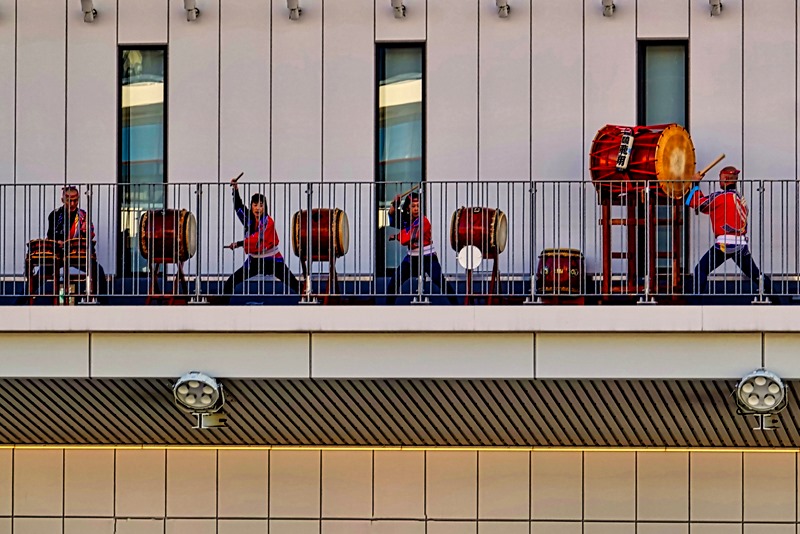
Back on the ship there were two shows that evening. First a group of drummers performed on a balcony of the cruise terminal right across from our balcony. Second a young Japanese dance group performed on the main stage, accompanied by their own drumming. This was apparently a modern take on traditional dancing and was pretty interesting.


Our overnight stay gave a chance for some night time pictures..I went up to the top deck after the show and got a nice picture of the Rainbow Bridge across which we had driven into Tokyo in the morning. It is called the Rainbow Bridge because sometimes it is lighted in multiple colors, but when we were looking it was all white. We think the red and yellow tower on the left is the Tokyo Tower.

Earlier I went to the top deck to see if there was a nice sunset. It didn’t seem all that great at first, until I moved around a bit and spotted Mt Fuji in the distance. We started this episode with Mt Fuji in the morning so it seems appropriate to end it with Mt Fuji at sunset.


 BADER JOURNAL