
Shanghai, China (Day 1) 2024
We arrived in Shanghai, our first stop in China, on the morning of March 7. Shanghai is a humongous city (25 million people, 3d largest in the world) located where the Yangtze River empties into the East China Sea. It has a long and colorful history dating back some 6,000 years. Starting out as a fishing village it became an important center for international trade in the mid-19th century, after the first Opium War, when it was one of five ports forced to open to European trade and European “concession” settlements. By the 1930’s it was a leading commercial and financial hub of Asia. Very cosmopolitan, Shanghai was a refuge for White Russians fleeing the revolution in the 1920’s and for Jews fleeing the Nazis in the 1930’s. During that period the city gained a reputation for danger and international intrigue. Indeed, since the 19th century, “shanghaied” was a term for drugging and kidnapping, stemming from the practice of filling out ship crews with abducted sailors. Shanghai was occupied by the Japanese during the second Sino-Japanese war that was a precursor of World War II, with great suffering. In 1949 it became part of the new Communist People’s Republic of China and its economy was rebuilt.
Originally we were scheduled to begin the Chinese leg of our voyage in Beijing. But obtaining a Chinese visa was somewhat challenging and it turned out that visitors who begin their visits to China in Shanghai can spend a few days there and in other coastal cities without having to get a visa. So HAL changed the itinerary a few months before we left Florida so we would start in Shanghai and end in Beijing (Tianjin). The caveat was that folks without a visa could only leave the ship on a ship sponsored tour, or one conducted by a government approved tour provider. Some folks went ahead and got a visa to visit places further inland, but we had never been to China before and wanted to spend our time in the port areas anyway. So we were happy for this change. Although some of our excursions here were conducted by our travel agency, those were treated as ship sponsored tours as well. Which was good because today we were scheduled for two of them.
We left the port early in the morning. Passing through customs was fairly slow and some people were redirected for additional scrutiny, although it seemed everybody we saw made it through eventually. For the most part Chinese customs was pretty bureaucratic and slow in all the cities we visited. It is possible for some cruise ships to sail up the river and dock downtown, but our ship was too large for that (it sure would be nice if HAL would prioritize using smaller ships for these longer journeys). So there was about an hour bus ride from our dock by the ocean to downtown Shanghai. Bus riding isn’t our favorite pastime, but there is something to be said for seeing the city streets as you drive along.
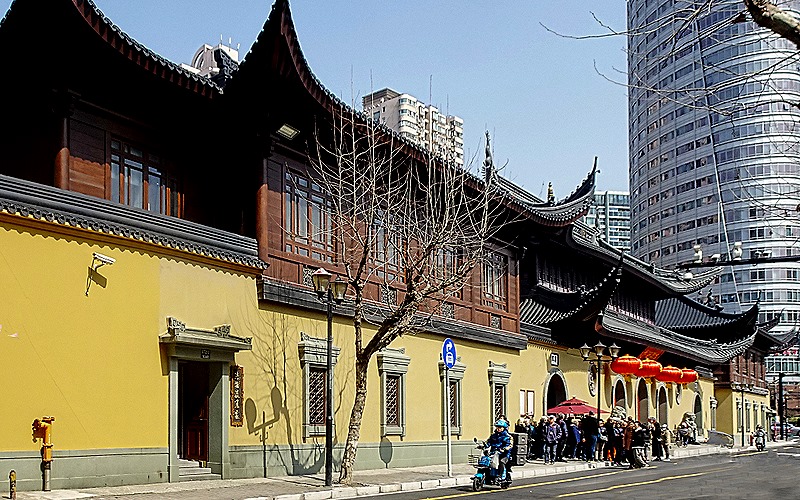
Our first stop was at the Jade Buddha Temple, opened originally in 1882 and rebuilt in the current location in 1928 after the original was destroyed during the revolution that overthrew the monarchy. As the name suggests, it was built to house two large jade Buddha statues, one reclining and one seated, that were brought here from Burma by a monk. This is an active monastery with dozens of monks on the premises, although we didn’t encounter any. The entrance is through a distinctive long yellow wall with red lanterns above it.
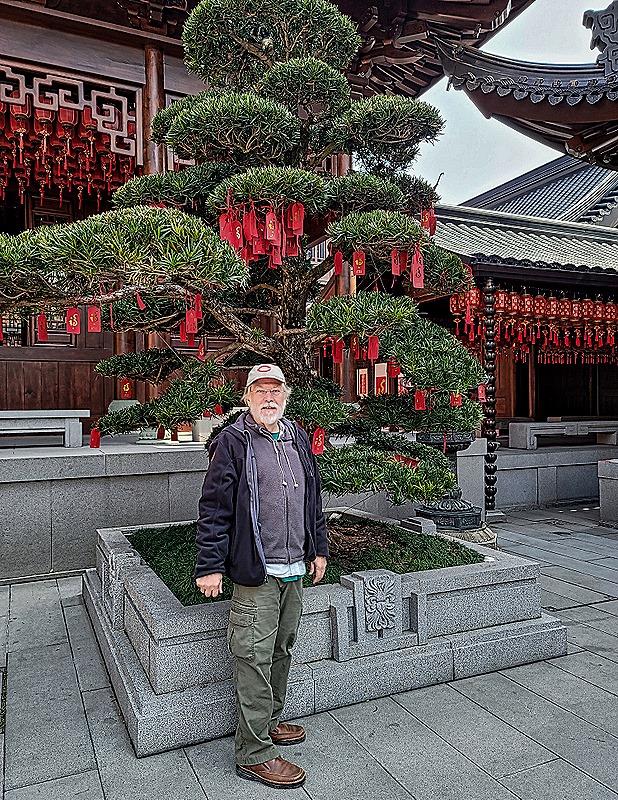
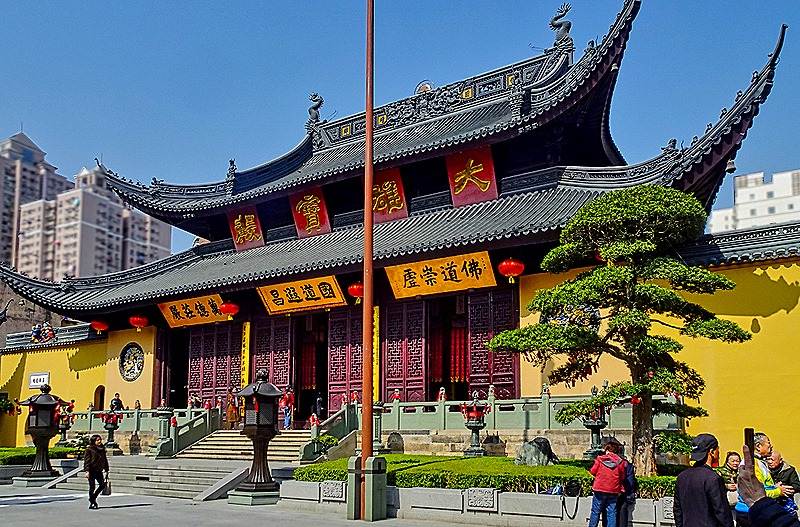
After entering we walked into a courtyard with buildings on several sides. An incense burner was at work in the middle and the eaves of the buildings were hung with red lanterns. The carefully sculptured trees in this area, trimmed to look like green clouds, were hung with red prayer tags. On the far side was the Great Hall, the main building of the complex.
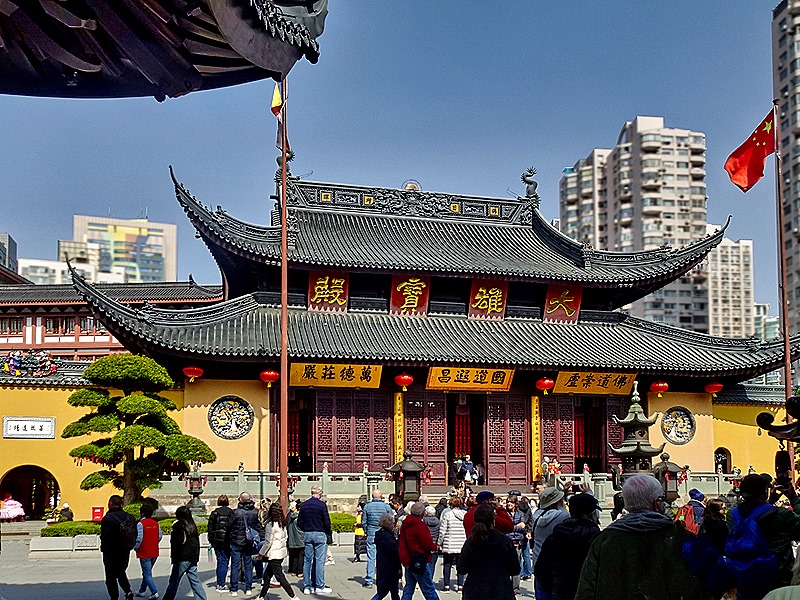
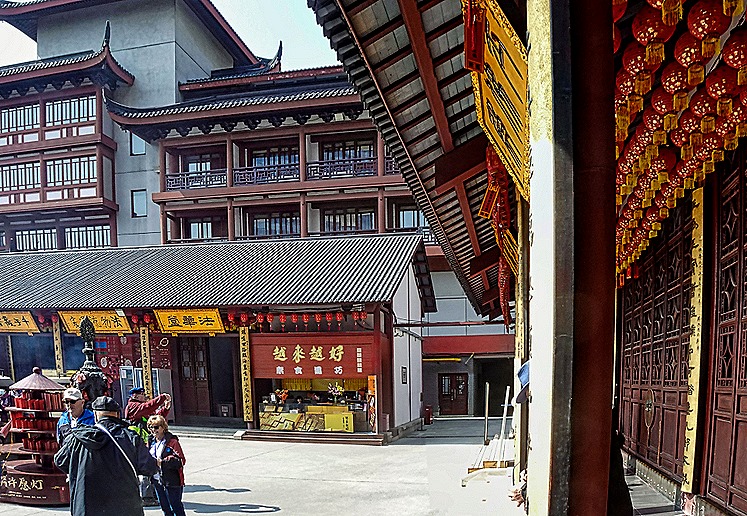

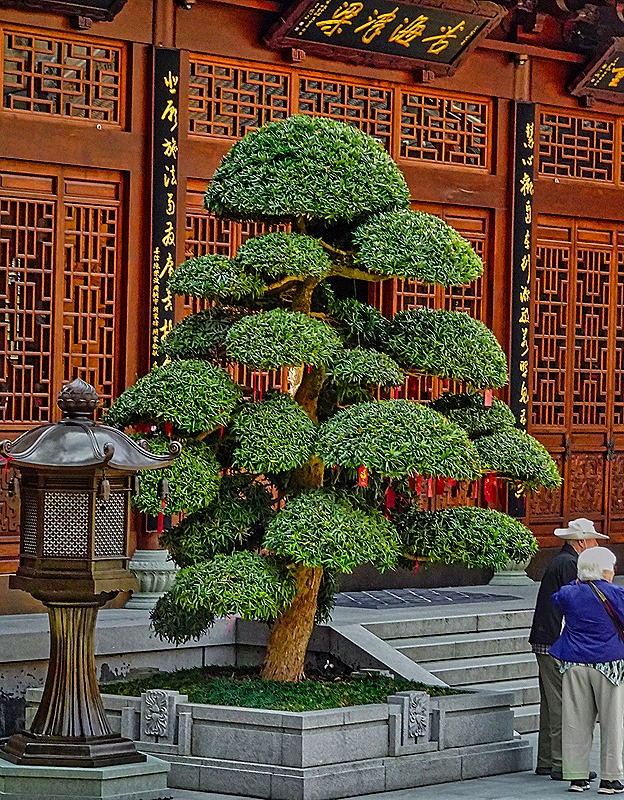
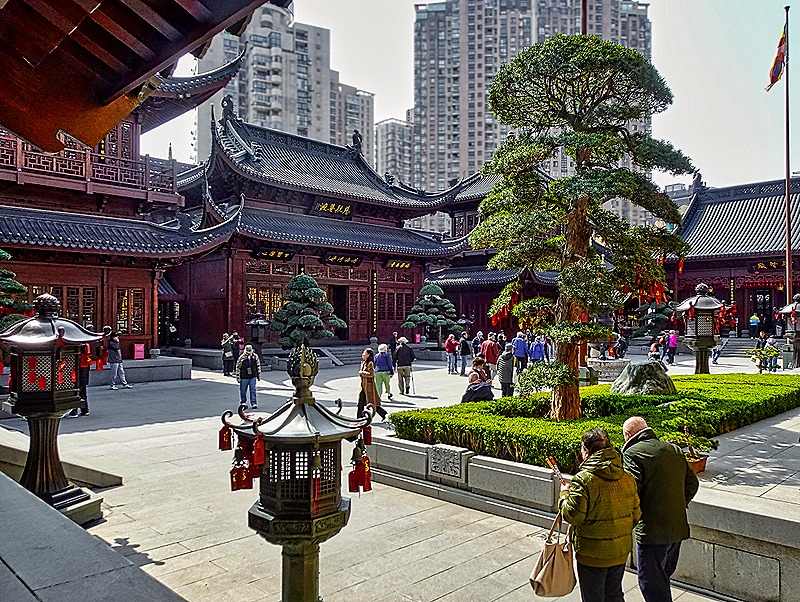
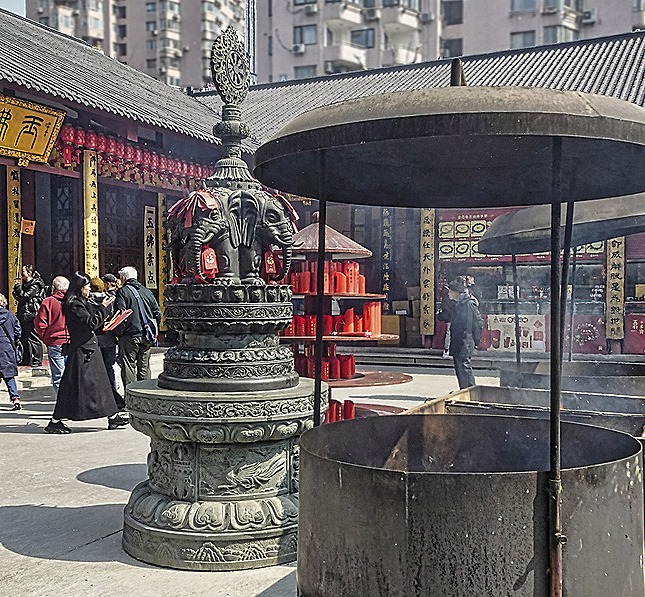

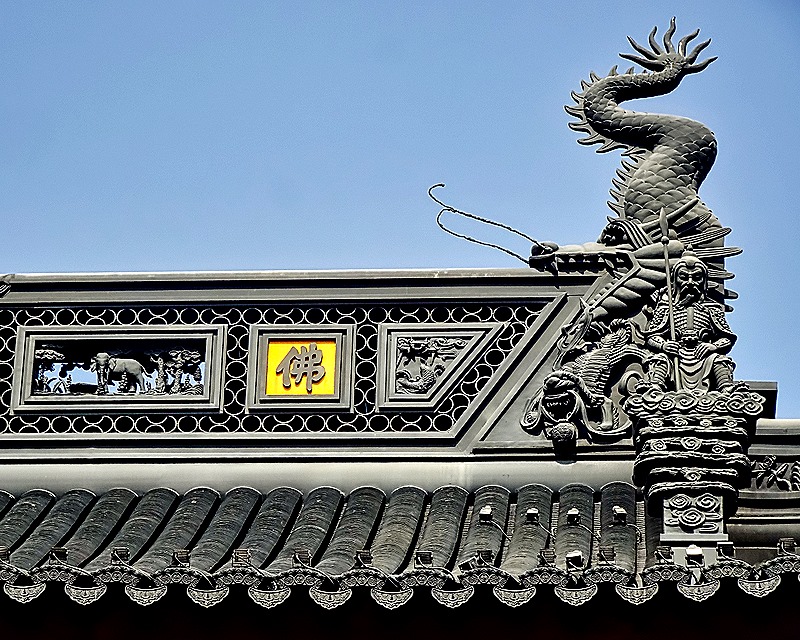
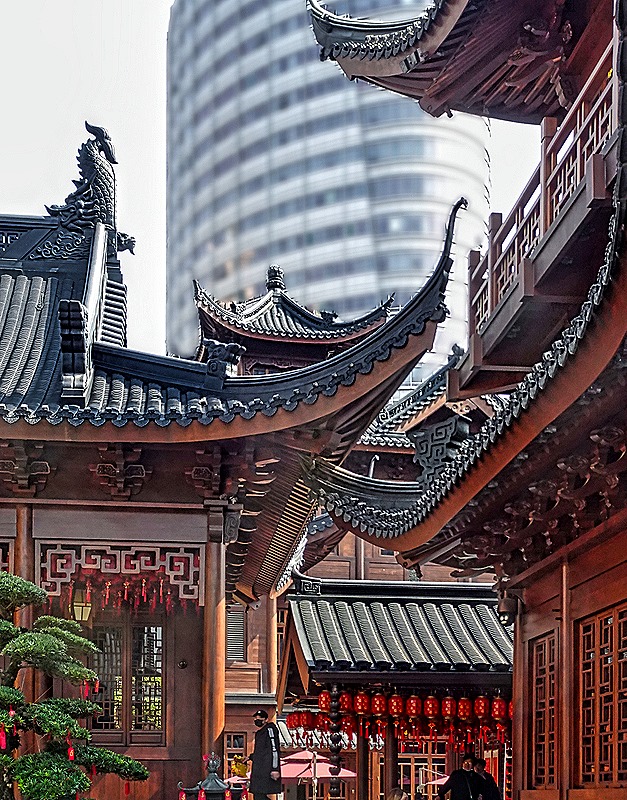
If you look closely at the first picture in the group above, you will see a sculptured relief medallion on each side of the row of doors. They are very colorful. You should also notice the sculptural details on the ends of the rooftop.

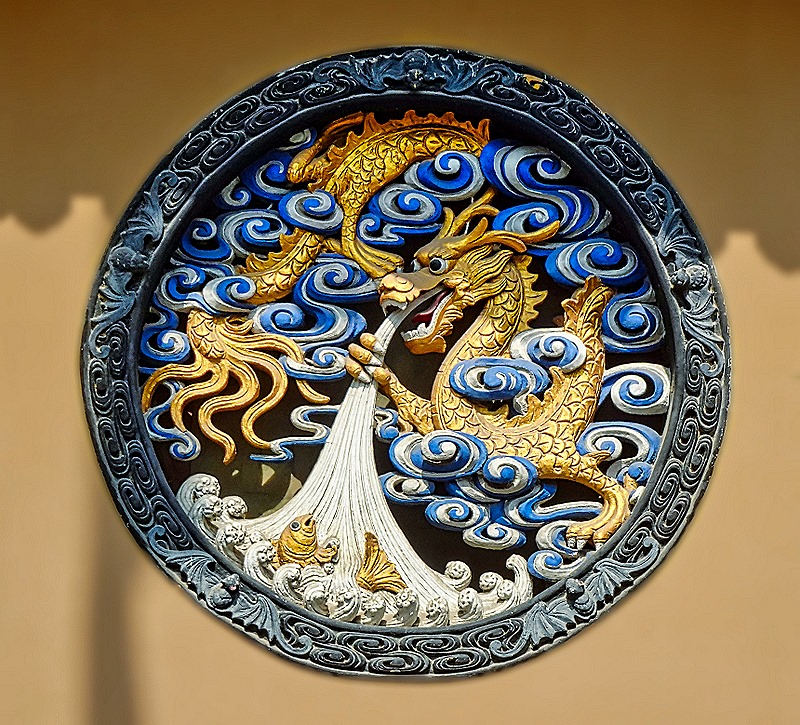
This is one of the largest temples in China, with three main halls containing some 72 chambers. We did not have time to see most of that and the guidance we received was minimal and hurried. Thinking back, we are not even sure we saw the two large jade buddha statues that were the reason the temple was built, and even if we did see one or both of them photography was prohibited.
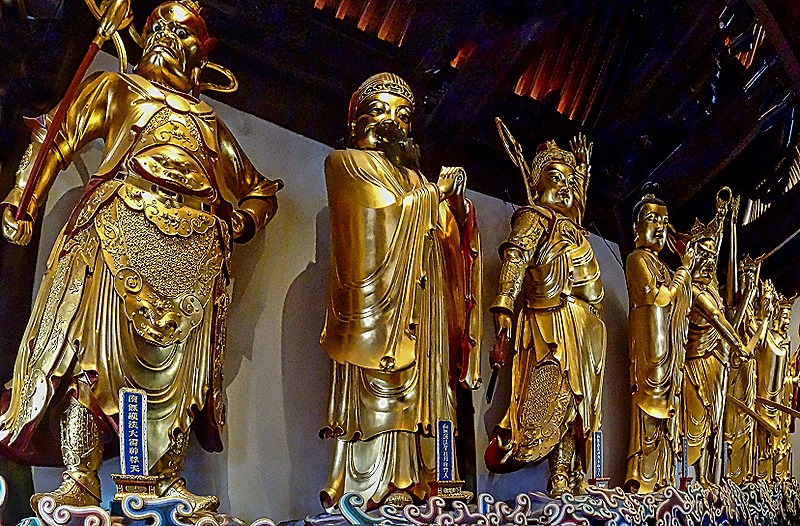
We did, however, walk through some of the notable chambers in the Great Hall. We walked through a room with three giant gold plated seated buddhas. On either side of this hall is a row of golden guardian deities, and we saw at least one row of these (we think). And there was a collection of dozens of small statues with a big one making up a single display, called “Guanyin, Sudhana and his 53 teachers.”


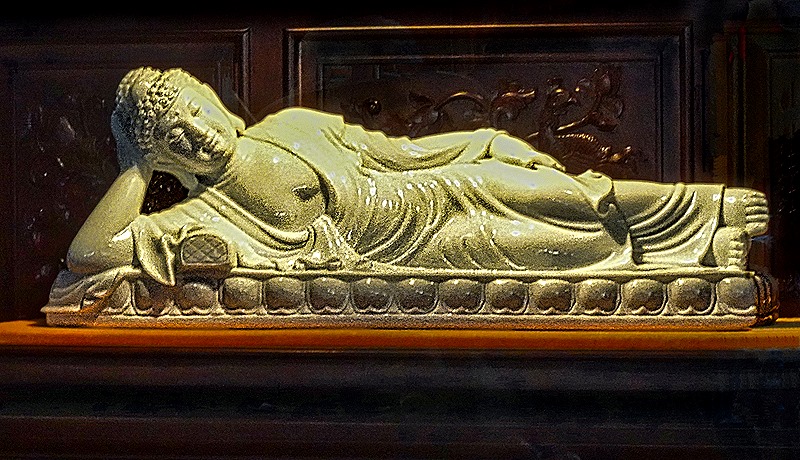
We mentioned that we have no pictures of the main sitting and reclining jade buddhas, but we did see a couple of smaller reclining buddhas in a different room (not sure which one). They were encased in glass in red and gold displays. On the left below are a photo and a closeup of the white reclining buddha (ceramic we think) and on the right is a photo and a closeup of the colored reclining buddha (jade, maybe?).



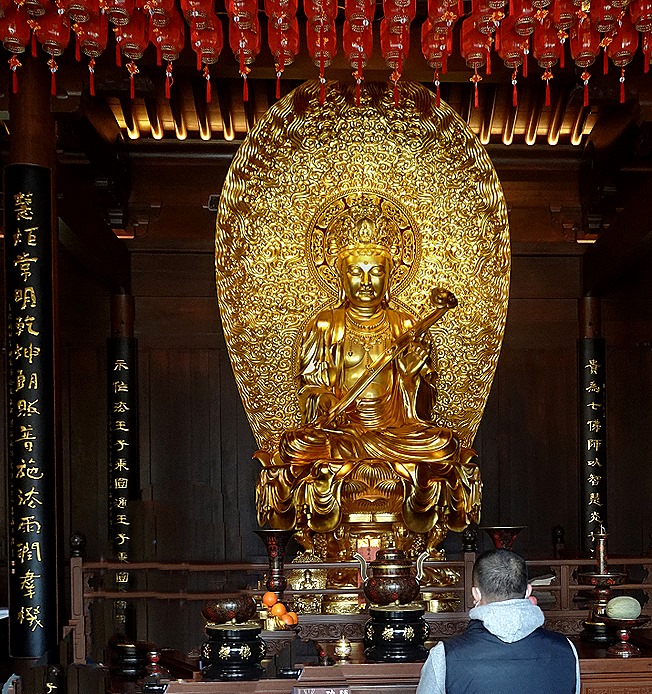
Another unidentified room contained a large plaque with a deity sculpted in relief, all shiny gold, and a room with rows of tables where people were writing, presumably prayers.

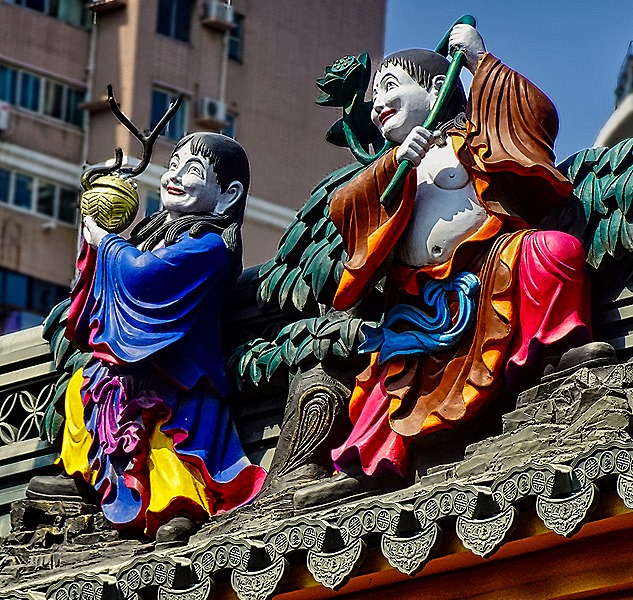
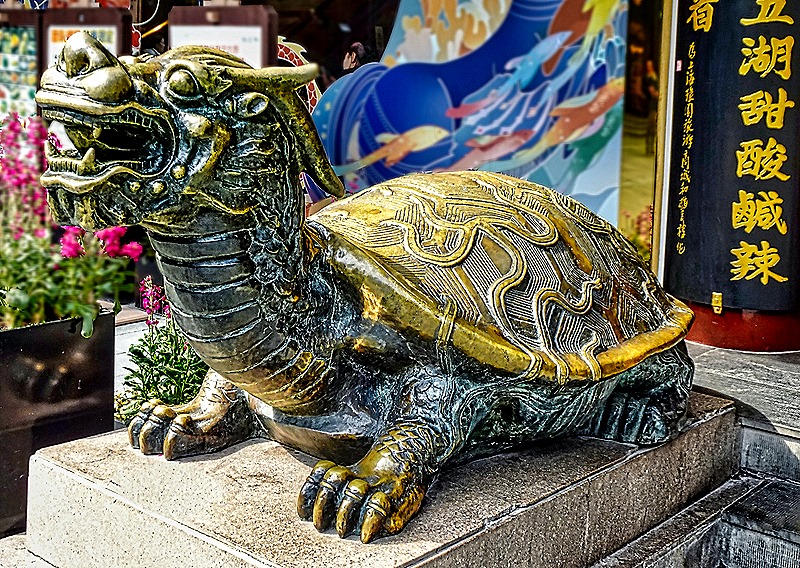
So we left the temple through the courtyard at which we began and headed for the bus (which took a while to arrive). Walking through the courtyard we passed a metal dragon urn, we saw some brightly colored sculptures on a roof and we enjoyed the patterns of the graceful upturned eaves of the roofs of the buildings.


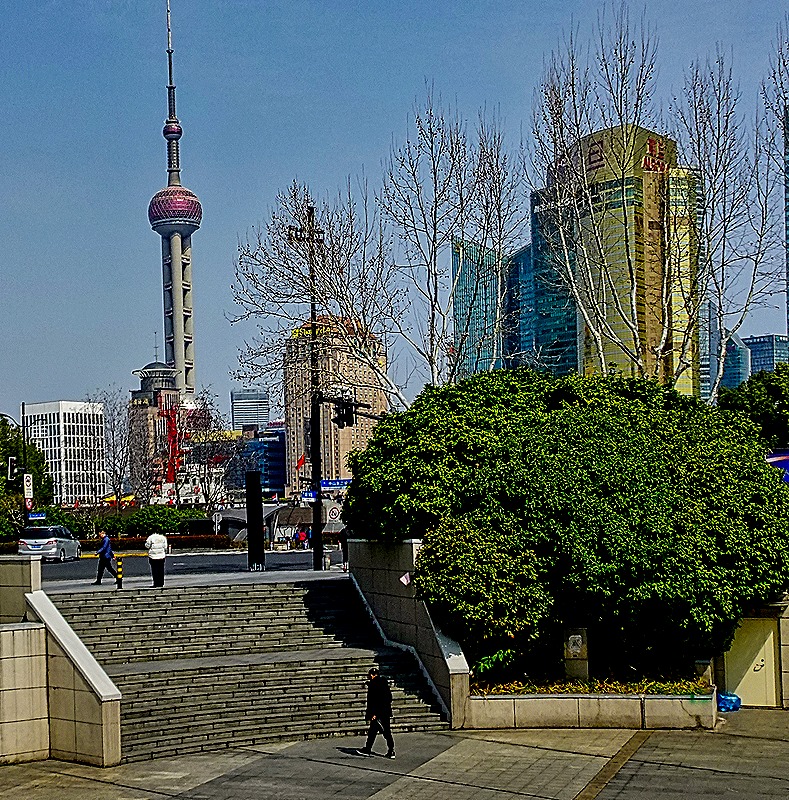
We drove to our next place to visit, the Yuyuan Gardens. On the way we saw a variety of buildings from the window and we made a brief stop to walk over to a spot with a distant view of the very tall buildings lining the opposite shore of the Huangpu River that runs through the center of the city. We thought we would have a chance to walk along the river esplanade but we stopped well short of that. The skyline of the Pudong section across the river has some of the world’s tallest buildings and has become, in the last 20 or 30 years, a recognizable emblem of Shanghai. Notable in the pictures below are the 2,000+ foot high Shanghai Tower and the 1500+ foot high Oriental Pearl Broadcasting Tower.


Yuyuan Gardens sits in the center of the old town, which was surrounded by large defensive walls that were built built in 1554 to protect from Japanese pirates (and torn down in 1912 to accommodate city expansion). The Yuyuan Garden was first built in 1559, just four years after the city walls. Pan Yunduan built the gardens to comfort his parents in their old age. But he was transferred away to be governor of Sichuan province, which delayed completion of the gardens until 1577. Over the centuries the gardens passed through several owners and were expanded, damaged and restored. In 1842 the British used it as a base during the first Opium War and during the Taiping Rebellion many of the buildings were damaged when the Small Swords Society used it as a headquarters. The gardens were damaged again in 1942 during the Japanese occupation of the city. The gardens were repaired in the 1950’s and opened to the public in 1961.
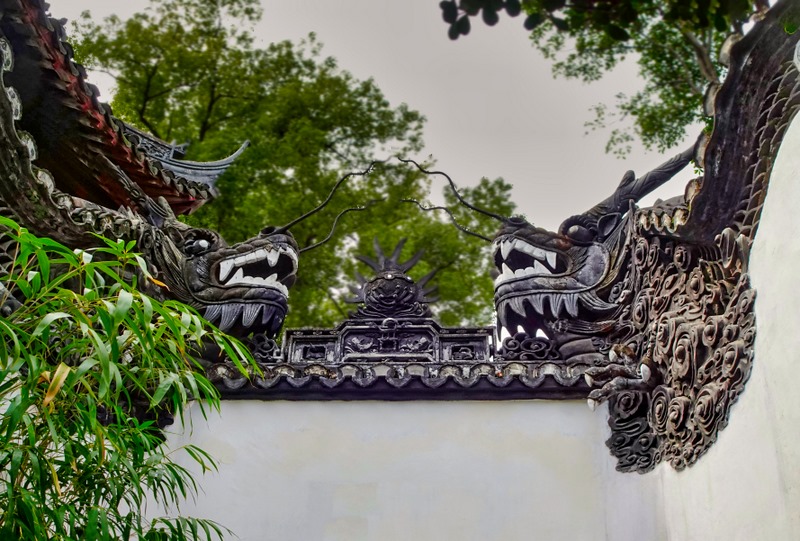
The gardens encompass five acres in six areas divided by Dragon Walls, which have undulating tops with dark tiles looking like a dragon’s tail and sculpted dragon heads at the ends. Very cool. There are passages through the walls between the separate areas, at least one of which is a moon gate.
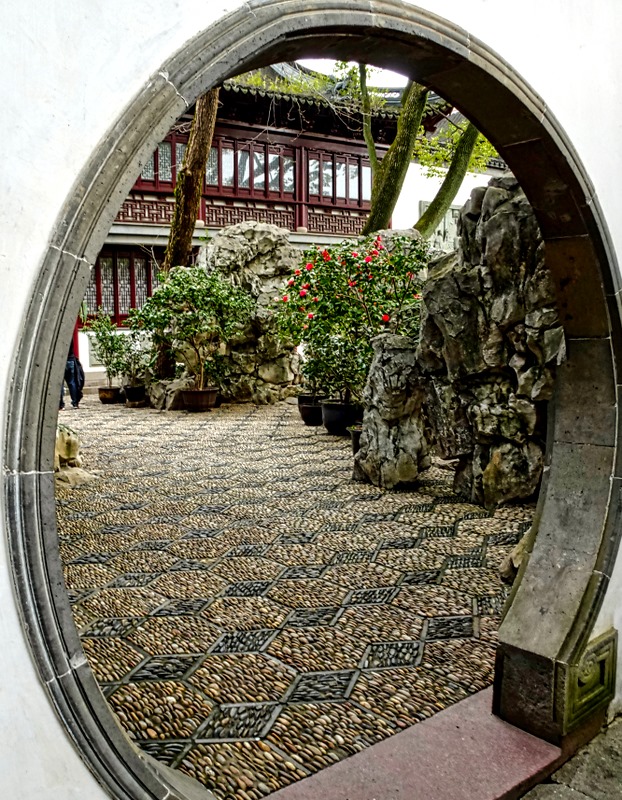

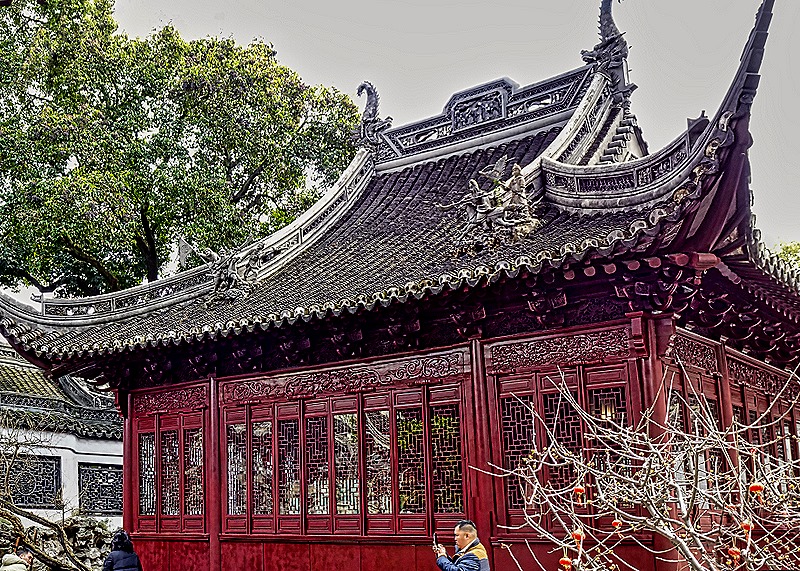
The pavilions are mostly red in traditional Chinese style with roofs curving up on the end. Many of them sit next to landscaped ponds and are connected by curving covered bridges.


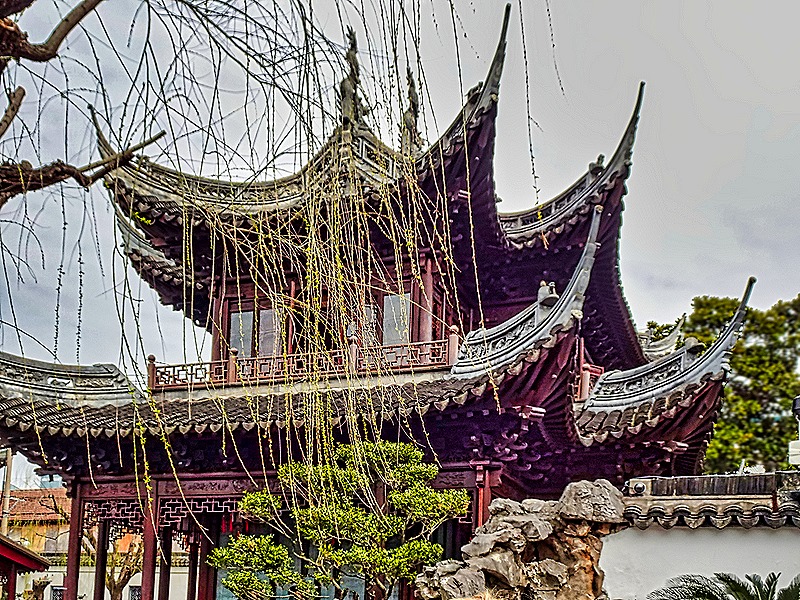
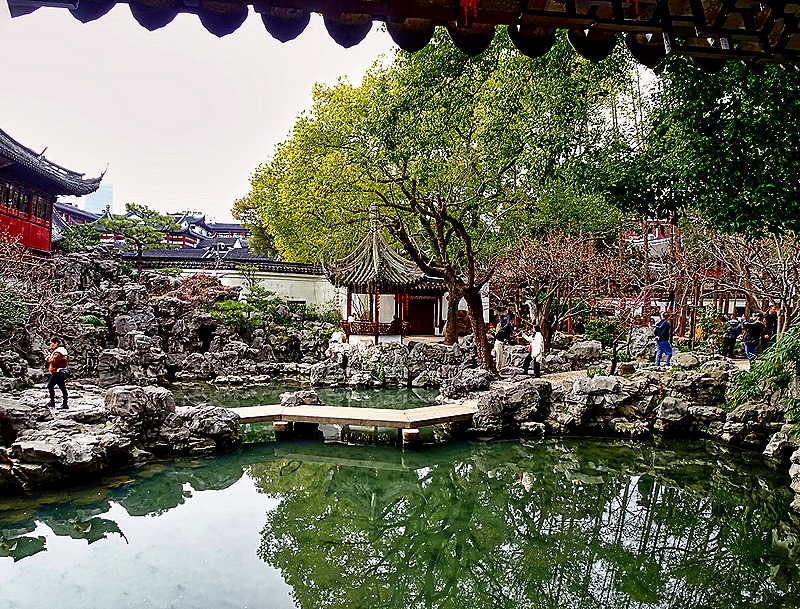
As you can see in some of the pictures above, landscaping rocks are an important feature of these gardens. Many were imported from distant lake areas and were used to build carefully designed “rockeries.” The most famous rock, considered the jewel of the gardens, is the “Exquisite Jade Rock,” around 13 feet tall and full of holes created by nature. It is said that the smoke from a burning taper placed under the rock will exit through all the holes in the rock.
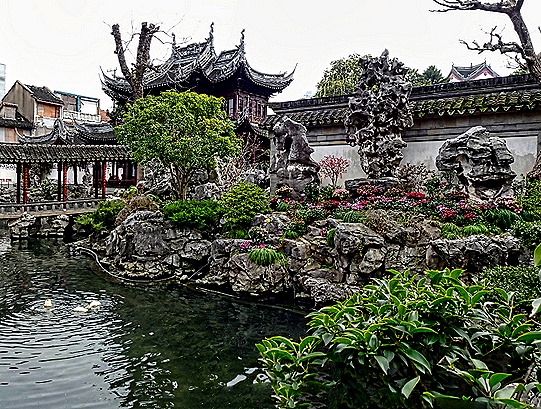

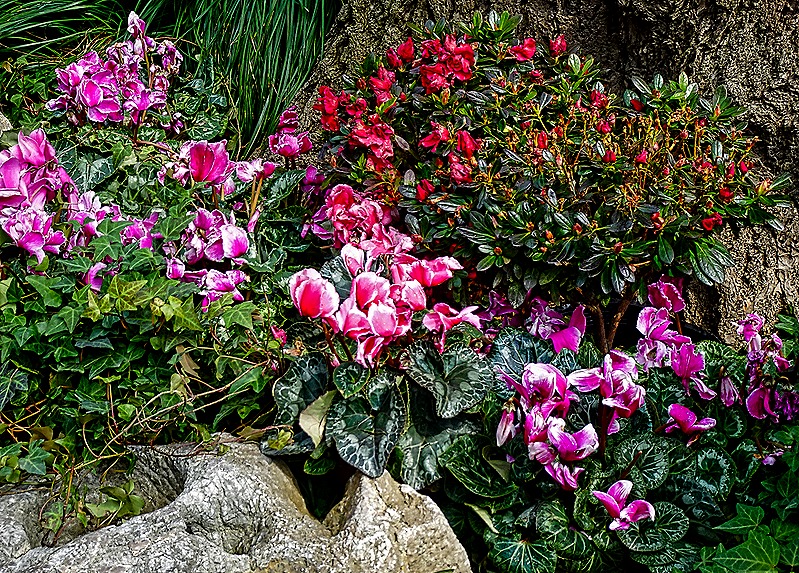
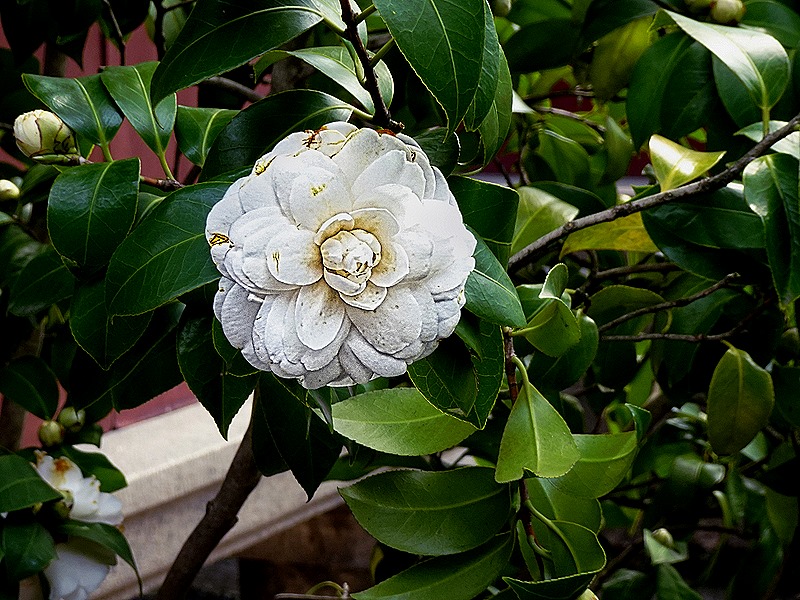
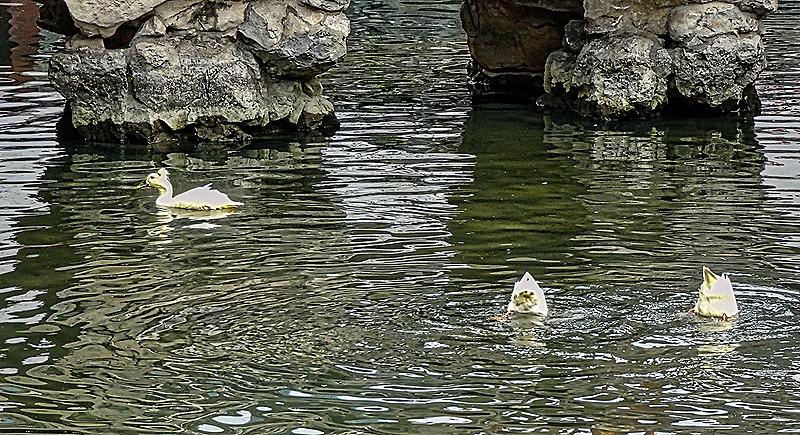
And of course this is a garden, so it had a lot of very colorful flowers, although there would probably be many more later in the Spring or Summer. White ducks were swimming in the ponds.

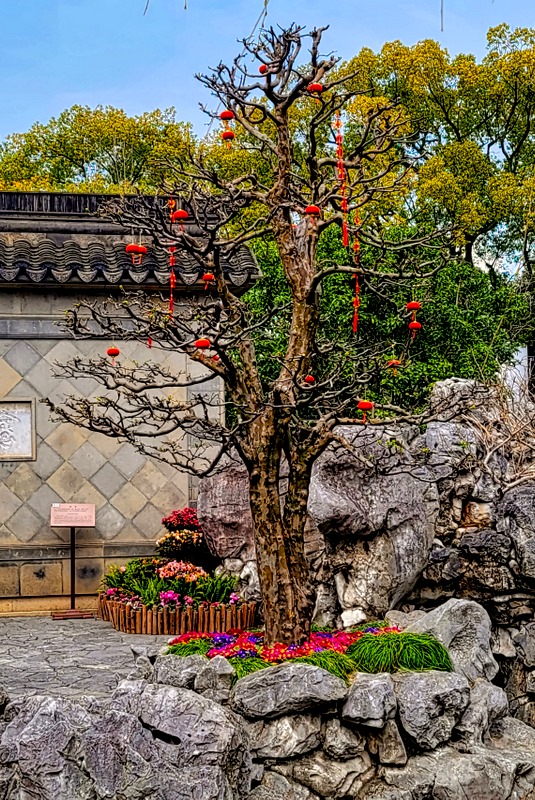


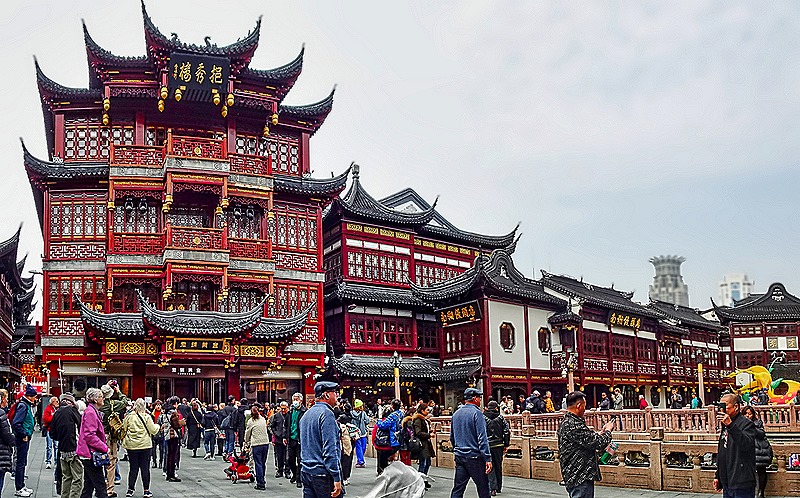
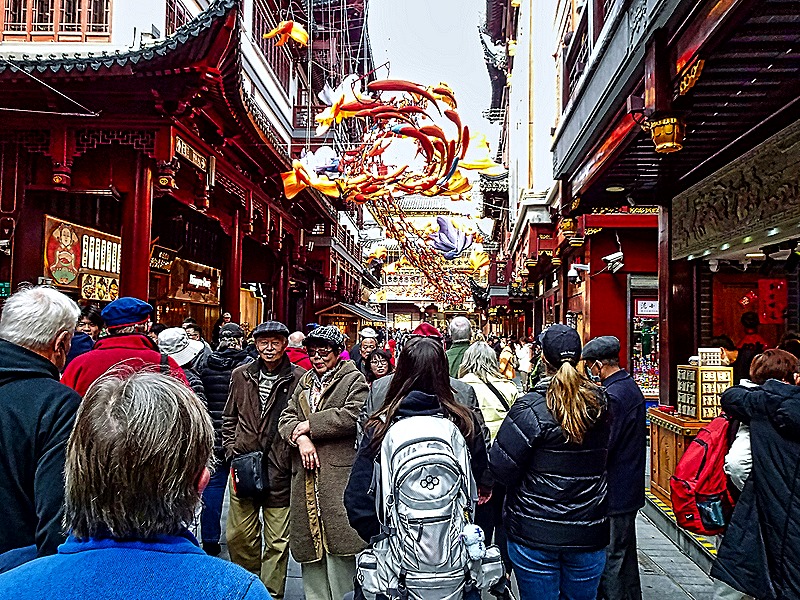
Our time was too short to see all of the gardens (at least in the opinion of our guide, who seemed pretty rushed all day). We left through a gate with stone lions on each side and proceeded to the Yuyuan Bazaar. We had been told we would have free time in the old town, which sounded good, but it turned out that the place we had free time was a huge shopping mall right next to the gardens. To be sure, it was in the old town and it had some very impressive buildings with traditional Chinese architecture. We don’t know whether these are old buildings repurposed for shopping (possible, since this was in the old city area) or new buildings designed to look like old ones; either way they were interesting to see. But still, a shopping mall was not what we were hoping for. We must have spent at least an hour there; we looked through some interesting stores but the prices were high and we didn’t see anything that called our names. We understand that these buildings are dramatically lighted at night, but we weren’t here then.


The long drive back to the port left us just enough time to eat dinner in the LIdo buffet and get ready to board another bus for our evening excursion, a boat ride on the Huangpu River lined with lighted buildings, near where we had spent the afternoon. This river is some 70 miles long and flows into the Yangtze just before it enters the ocean. It has been a commercial backbone of the city for centuries, reputedly assisted by some engineering during the 16th century that enabled water from a lake to flow into the river near its source. This is hardly the Amazon, but it is a sizeable river: in Shanghai the river varies between 1,000 and 2,500 feet in width and averages 30 feet deep. On its west bank is Puxi (the old city) and on its east bank is Pudong.
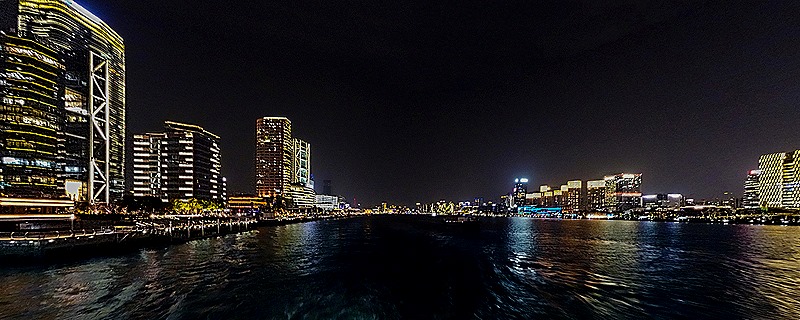
We arrived at the terminal on the west bank at about sundown and the nearby buildings were already lighted.


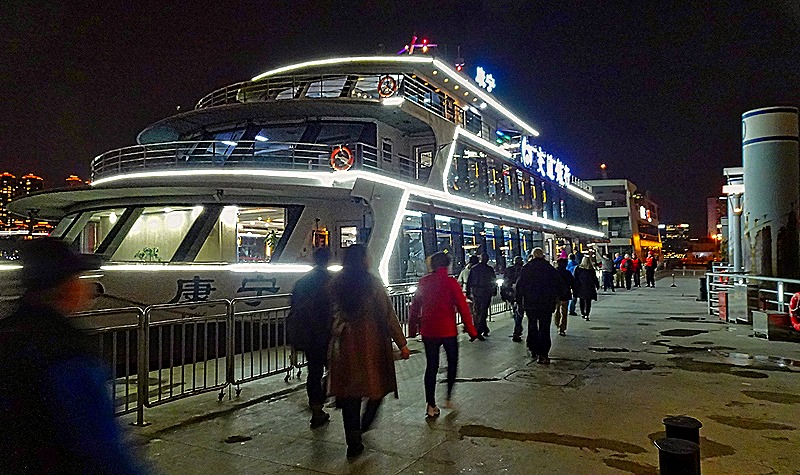
We spent a good bit of time winding through the long line for admittance to the dock. It was actually a fairly long walk, including some stairways. By the time we reached the dock the sun was down and we walked down the dock to board the boat. On a tip we went upstairs and right to the back of the boat, where we had the best view of both sides of the river during the entire cruise, which lasted close to an hour.
Along the riverfront on the west (old city) side is a mile long row mostly of 100+ year old buildings called the Bund (sounds German, but actually from a Hindi word for embankment). There is a wide concrete promenade between the buildings and the river. This was the financial center of Shanghai in the 1920’s & 30’s when Shanghai was a financial center of Asia. The architecture here is stolid European style, reflecting the power of the American and European concessions that were located behind it. In the 1950’s many of the banking institutions here moved to Hong Kong. This area was restored about 15 years ago.
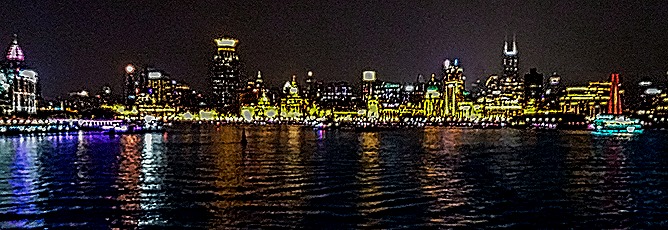
So here are some pictures (handheld from a moving boat at night, so many are not entirely clear). We will try to identify each building as best we can.
— First is a panorama of the Bund shoreline.
–The Second shows the old Hongkong & Shanghai Banking Corp (HSBC) building (built in 1923) and the Customs House (1927) (the clock and tower were built in England and copied from Big Ben).
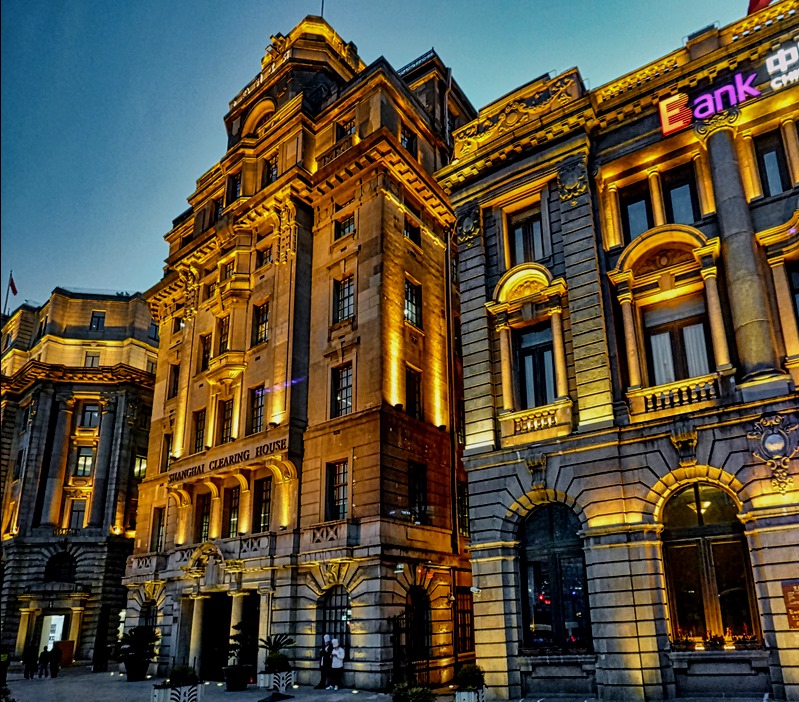
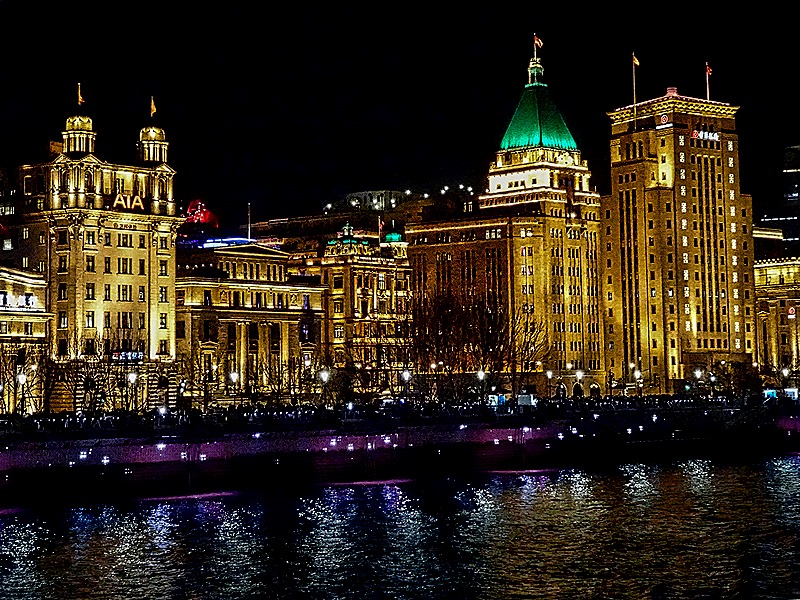
–The third picture includes (from left) the China Bank of Communications Bldg (built in 1948) now housing the Shanghai Council of Trade Unions; the Russo-Chinese Bank Bldg, now the Shanghai Gold Exchange; the Bank of Taiwan Bldg, now the China Merchants Bank; the North China Daily News Bldg, now AIA insurance; and the Chartered Bank Bldg, now home to several businesses.

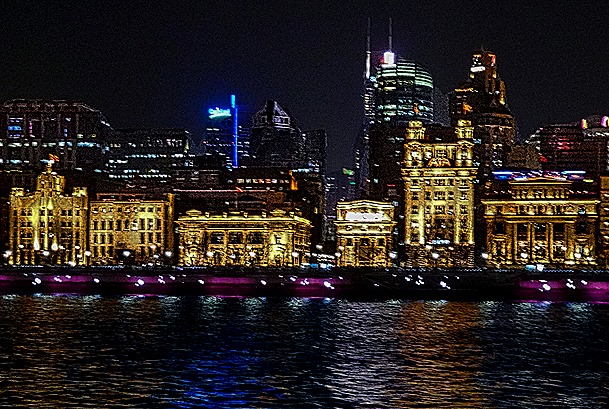
–The large building in the first picture below is the Bund Center, with its easy to see lotus flower crown brightly lit, a little way back from the riverfront. It was built in 2002 and is 659 ft tall. The building on the lower right is the Telegraph Building, in middle is the China Merchants Bank and at the lower left is the Nissin Navigation Co. Bldg (more info on these below).
–The second picture below shows it again, with a larger building in front sporting a red pyramidal roof which we haven’t been able to identify.


–The first picture below includes (from left) the North China Daily News Bldg; the Chartered Bank Bldg; the Palace Hotel, built in 1906, which was one of the best hotels in Shanghai until 1949, when it merged with the next building to form the Peace Hotel. That building, originally called Sassoon House, with its distinctive green pyramidal roof, was built by tycoon Victor Sassoon in 1929 and had a famous jazz band in its cafe (which can be seen again today). The tall rectangular building on the right is the Bank of China Bldg, built in 1937 by H.H. Kung, a rival of Sassoon’s. Its height was cut short because of Sassoon’s insistence that no other building on the Bund could be taller than his. Rivals indeed.
–The second picture below is of the Shanghai People’s Heroes Memorial Tower, built in 1993 and located in Huangpu Park. To its right you can just barely see the Waibaidu Bridge, lit red like the Memorial, crossing Suzhou Creek. Built in 1907, it was the first steel bridge in China.
–The third picture below shows (from left): the Shanghai Club (we think), built in 1910; The Nissen Bldg, built in 1925 by a Japanese shipping company; the China Merchants Bank Bldg, home to the first Chinese owned bank in China; and The Great Northern Telegraph Bldg, which in 1882 had the first telephone switch in town. In the distance on the right with the white spires is the Shimao International Plaza, which is more than 1,000 feet tall and opened in 2006.


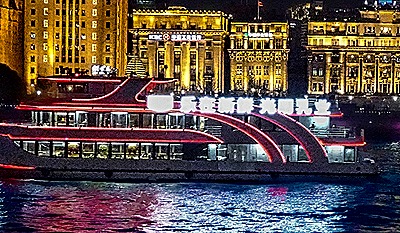
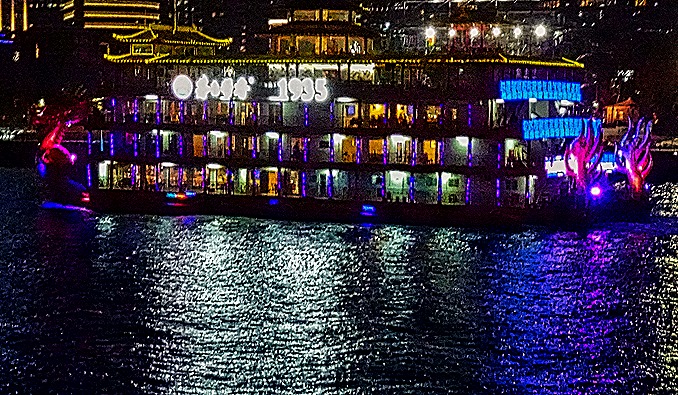
Hard to see in the dark, but there were some parks near the river, one with what looked like a brightly lighted dragon, and some other excursion boats on the river.

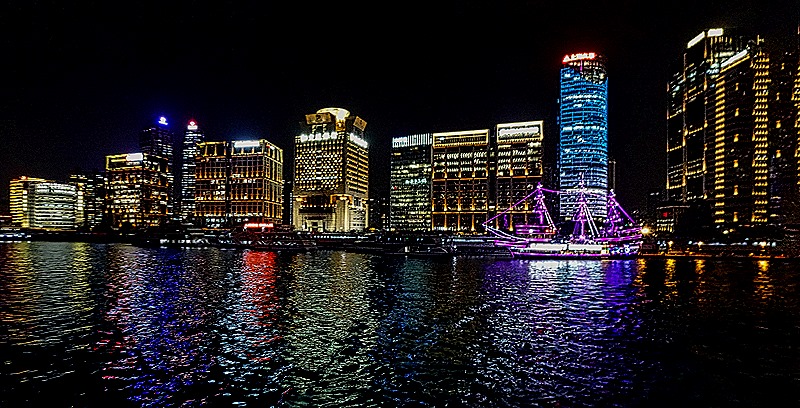
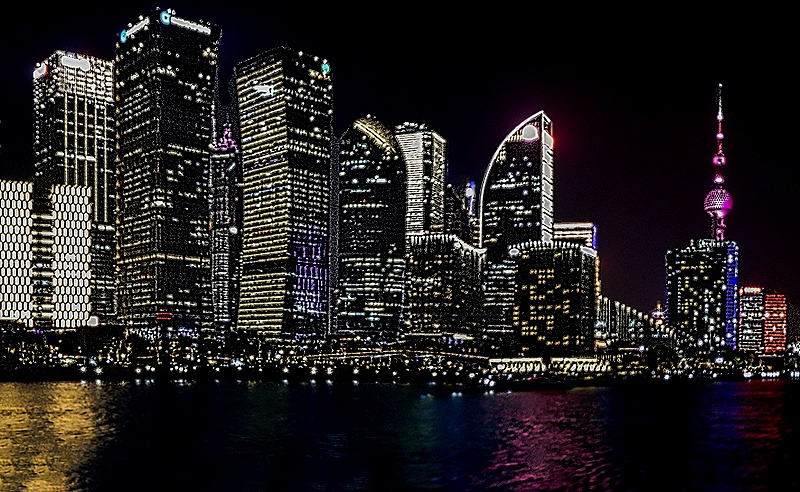
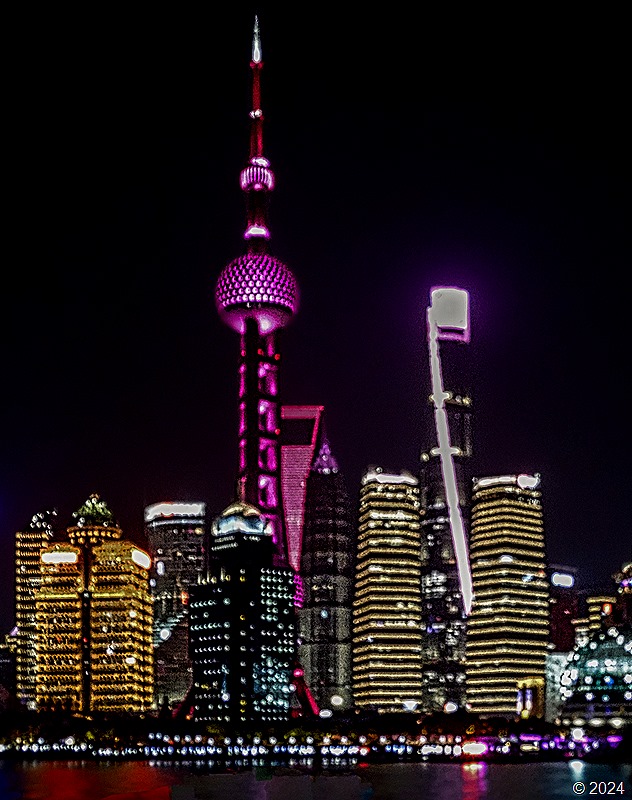
On the east bank of the Huangpu the waterfront of the Pudong New District is called Lujiazui. It occupies a peninsula where the river bends. The area was mostly farmland, warehouses, factories and commercial wharves until 1990 when China began developing it into a financial and commercial center. Today it far outshines the older and smaller buildings of the Bund across the river in both the size and modern design of the buildings along its skyline. Probably few will fail to recognize at least some of it. At night it is illuminated with brightly colored lights. While we don’t know the names of most of the Pudong buildings, we can tell you that the four tallest buildings in Shanghai, and among the tallest in the world, are there: The 1,400 foot Jin Mao Tower (1999), the 1,600 foot Shanghai World Financial Center (2007), the 2,000+ foot Shanghai Tower (2015), and the almost 1,500 foot Oriental Pearl (Broadcast) Tower (1995). They aren’t hard to spot in the pictures . . . The Shanghai Tower is obviously the tallest, the Jin Mao Tower is shaped like a very tall pagoda with a pointy roof, the World Finance Center has a large hole in the top, looking like a giant beer bottle opener, and the Oriental Pearl is made of struts and spheres. But we will name them in the picture captions (which you can see on a computer by hovering your mouse over the picture).



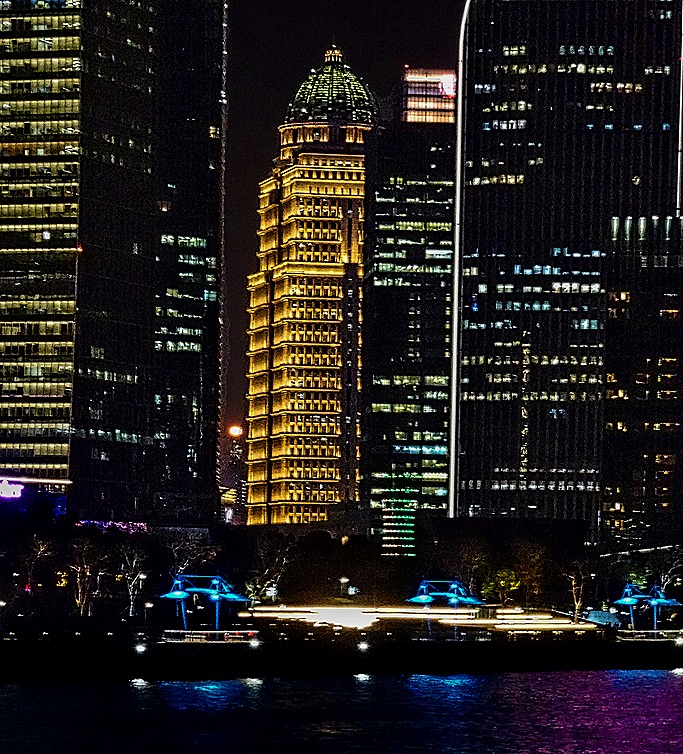
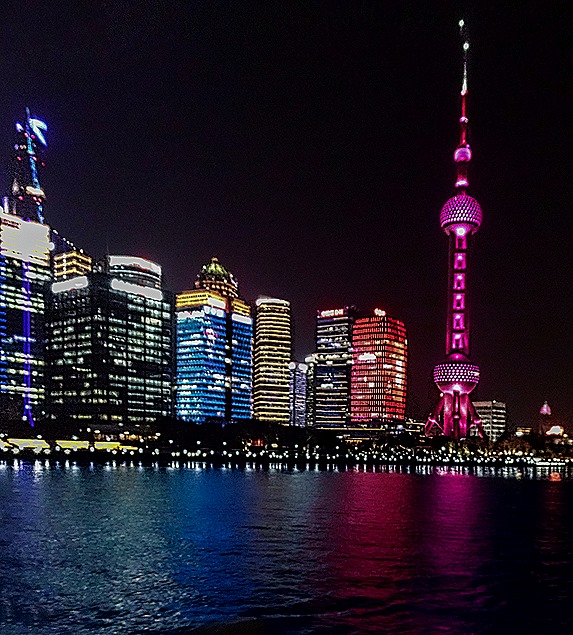
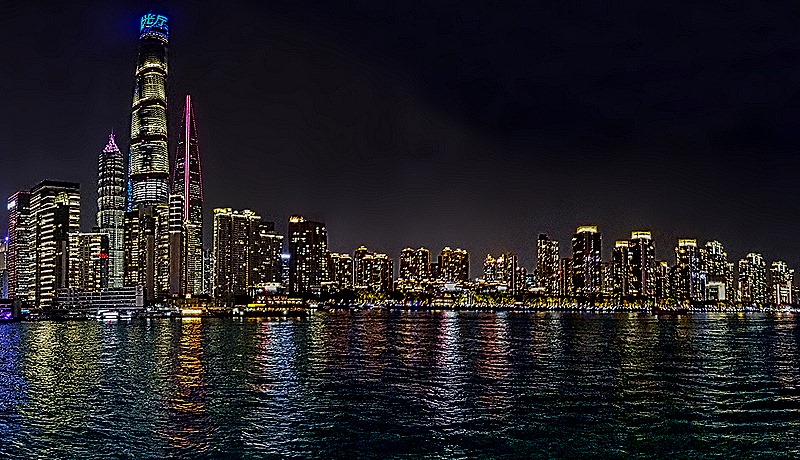
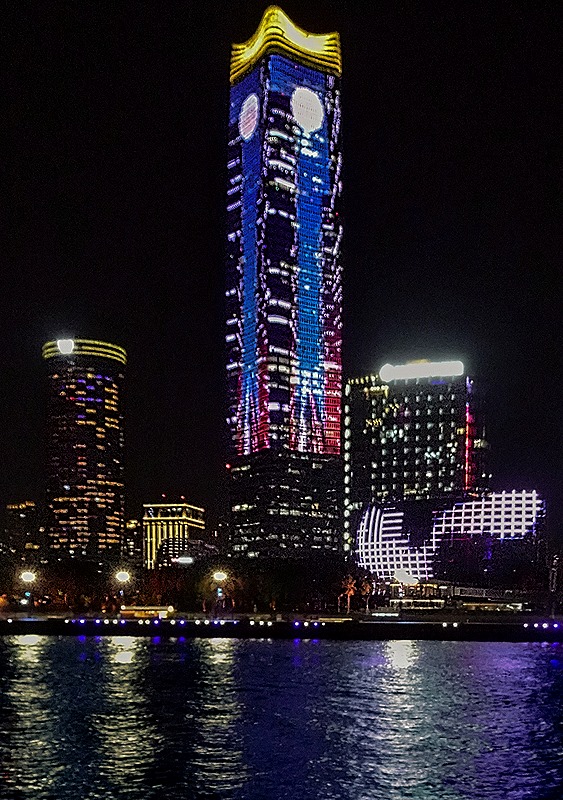
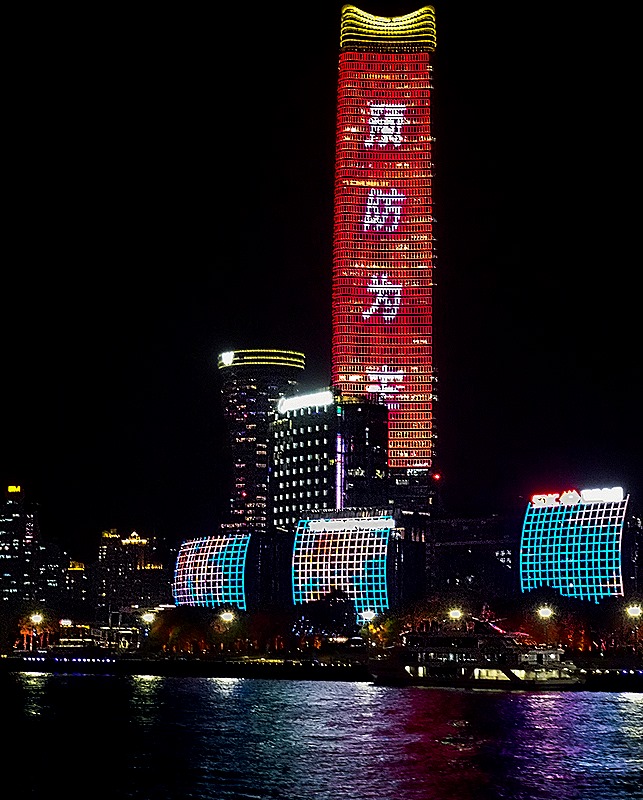
So these river banks are bright and shiny kaleidoscopes of light and color, a pretty spectacular sight as we cruised up and down the river. But that’s not all: some of them continuously change their lighting pattern as the show goes on. Below is a good example of this, the 1.000+ foot White Magnolia Plaza, which opened in 2017. It is on the Puli side of the river, slightly up river from the Bund. Here are four pictures of it showing its changing light presentations (though always with a golden roof).
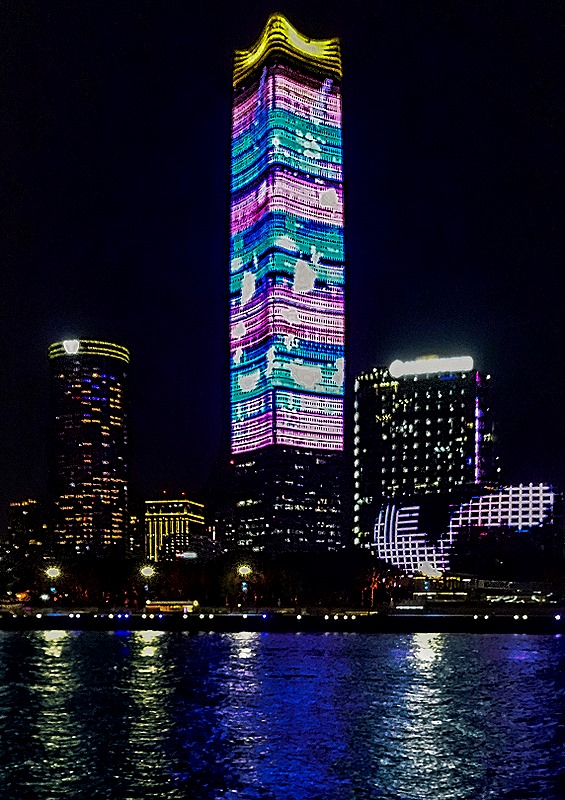

Well this was quite a lot for one day exploring Shanghai, particularly since it included 4 one hour long bus rides to and from the dock. But this is a city with quite a lot to see and we hardly scratched the surface. We drove back to the ship and went to bed, because our excursion for the second day in Shanghai leaves at 6:30 AM. Yikes!

 BADER JOURNAL