Prince Rupert, British Columbia, Canada 2025
We spent July 4, the holiday celebrating US independence, in our only non-USA port on this trip, Prince Rupert, British Columbia. Probably a good idea since the Jones Act required the ship to visit at least one foreign port and last year’s scheduled July 4 stop in Wrangel had to be cancelled because of local festivities.

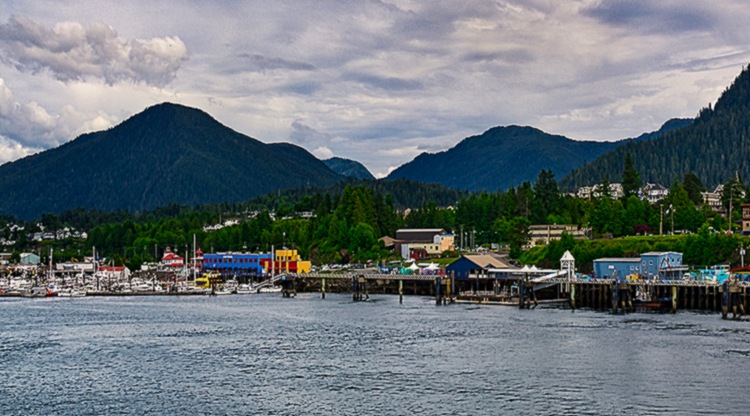
A city of a little more than 12,000 people located on Kaien Island, Prince Rupert has the third deepest ice free harbor in the world. The Tsimshian people have lived in this area for thousands of years. It was incorporated as a city in 1910 after its growth was fed by its designation as the western terminus of the Grand Trunk Pacific Railway, a transcontinental railroad. The city was named after Prince Rupert of the Rhine, a nephew of King Charles I of England; Rupert was a leading (and brutal) Cavalier general during the English civil war and the first governor of the Hudson’s Bay Company. Fishing is a major industry here, and for most of the 20th century Prince Rupert was considered the halibut capital of the world. As the wettest city in Canada Prince Rupert is nicknamed “City of Rainbows.” Westerdam was docked at the city’s waterfront in what is known as Cow Bay. It seems that in 1908 a dairy farmer brought a herd of cows here on a barge. The dock wasn’t prepared to receive cows at that time so he herded them into the water to swim ashore. Ever since this has been Cow Bay.
We had scheduled an excursion with our travel agency, Cruise Specialists, that would take us around town on the Olde Time Trolley Company. They just started business in 2023 and took us on an engagingly narrated tour that included a great luncheon. Their trolleys are really red buses and we boarded one after walking ashore from the ship.


Our first stop was at the Kwinitsa Station Railway Museum. Built in 1911, this was one of many identical stations built along the Grand Trunk Pacific Railway (which was taken over by the government in 1919). This is one of only four still in existence and it now houses a railway museum (we saw it only from the bus window). It was moved about 40 miles from Kwinitsa to Prince Rupert in the 1980’s on a barge. Nearby is an interesting sculpture of a whale with a calf.


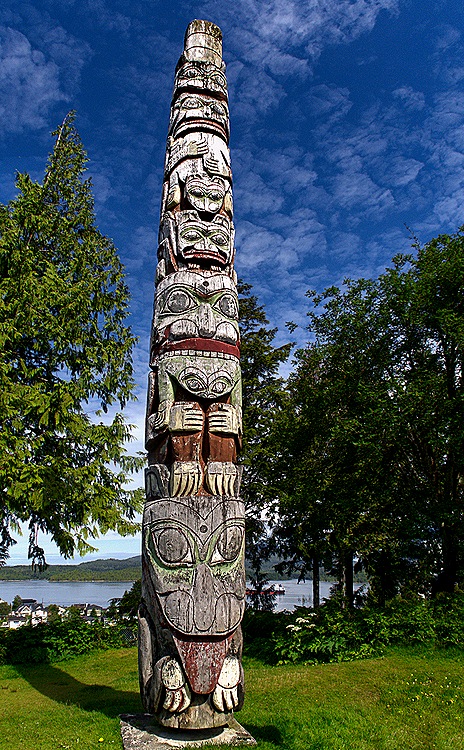
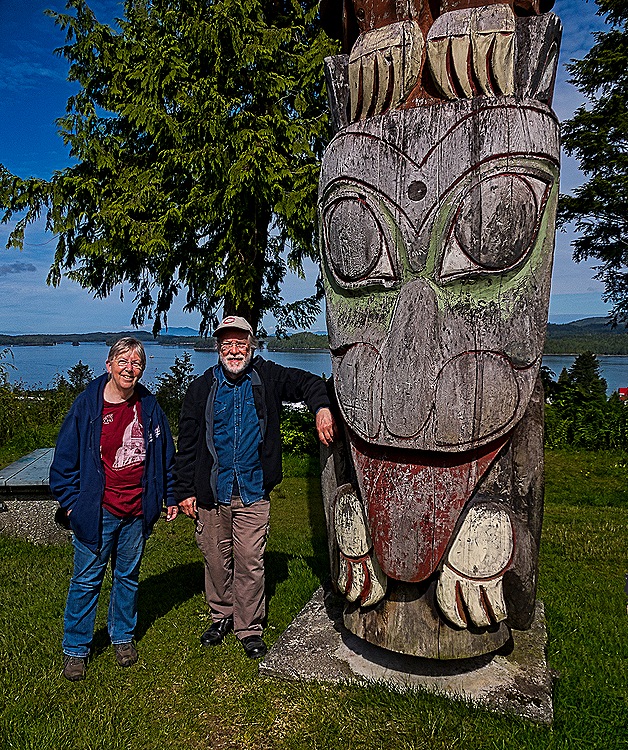
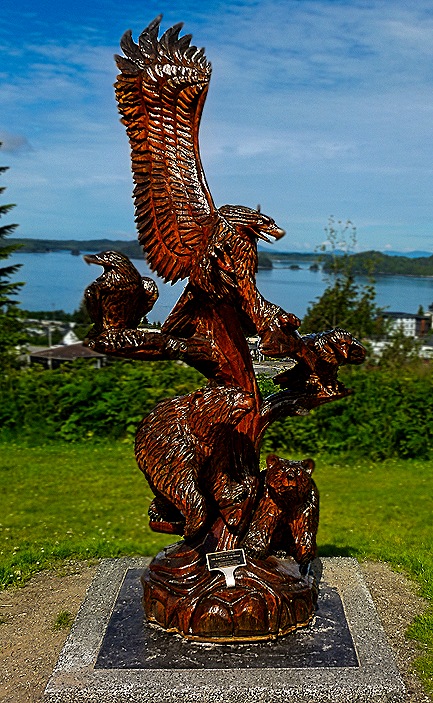
You can see in the first picture at the top that the city rises fairly steeply from the waterfront onto a hill. We drove up there and through Roosevelt Park, an area named for President Franklin Roosevelt because of all the aid the Americans provided here during World War II, when Prince Rupert was an important transportation hub for the defense of Alaska. The park was on the edge of a hill overlooking Prince Rupert. Its centerpiece was a totem pole that we understand is a replica of one that came from an old Haida village called Yan on Queen Charlotte Islands. It is called the Grizzly Bear Pole. It is quite tall . . . we were not as tall at the bottom figure’s eyes. A large sculpture in this park was called “The Survival of the Fittest.”

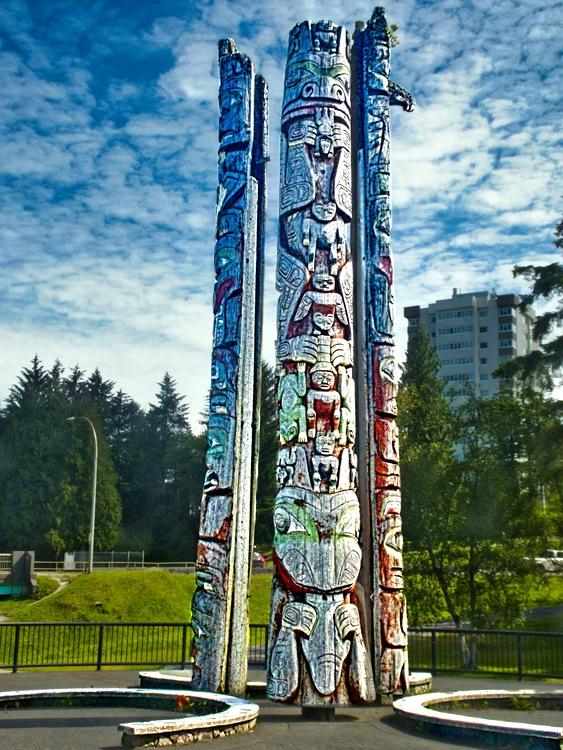
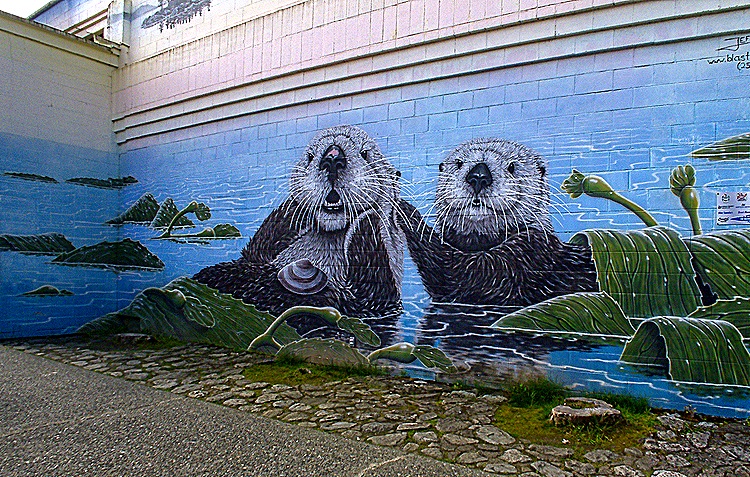
We descended the hill and drove to the Jim Ciccone Civic Centre, a sports and recreation center that opened in 1971. Its outside walls are decorated with murals, including a couple showing very large (and cuddly, of course) sea otters, which were painted around 2014. In front of the building was a group of three Haida style totem poles placed back to back to back (actually copies of older poles). Apparently there is resentment about Haida totem poles being displayed in what is traditional Tsimshian territory, and a couple of months after our visit an agreement was reached to replace these totem poles with a single Tsimshian pole. On our way to the civic center we drove by the all white art deco City Hall, built in 1938. A park next to the city hall contained two totem poles and a statue of Charles Melville Hays, a railroad magnate who was a founder of the city and died in 1912 aboard the Titanic.


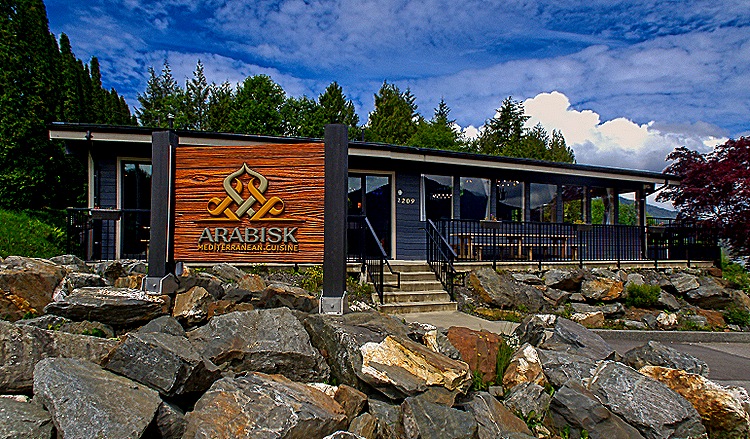
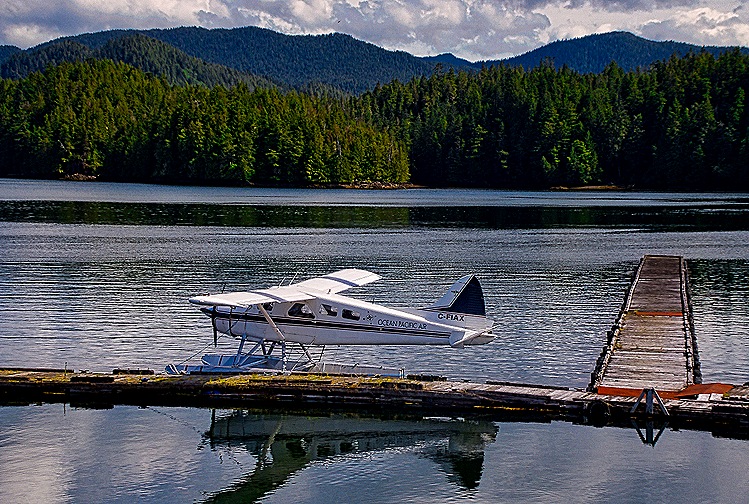
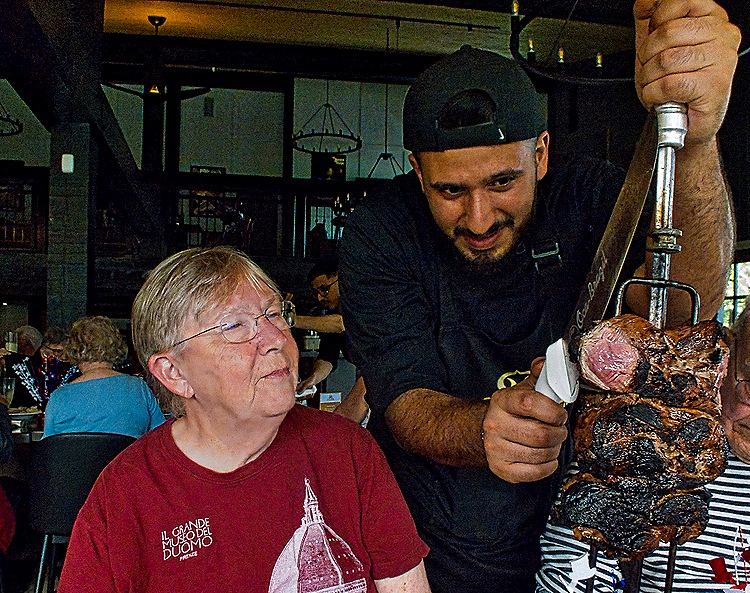
We visited Seal Cove, a smaller harbor around the corner of the island from where our ship was docked. There is a sea aerodrome located there and a seaplane was parked by its dock. We walked to the Arabisk Mediterranean Restaurant, where we had lunch. It was quite a restaurant, owned and operated by a family of Lebanese origin. If you have been to a Brazilian steakhouse you know how this works. There was a long table with salads and mezze, then after you sat down the waiters came around with a variety of meats (beef, lamb, pork, chicken) skewered on swords, from which they would slice some for you. And they keep coming back until you say “No more!” One of the best meals we have had on a cruise ship excursion.


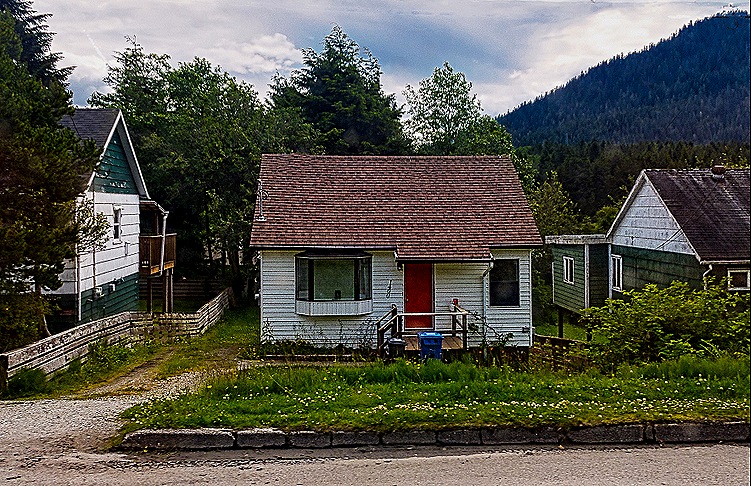
After lunch we drove through a neighborhood of tiny houses built during World War II for the influx of soldiers and war workers. Some 73,000 US soldiers were stationed here during the war years. We doubt they expected at that time that this emergency housing would still be in use more than 80 years later.

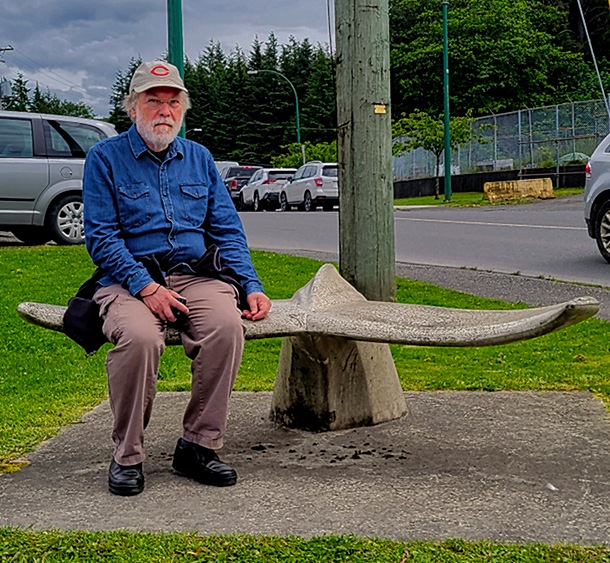
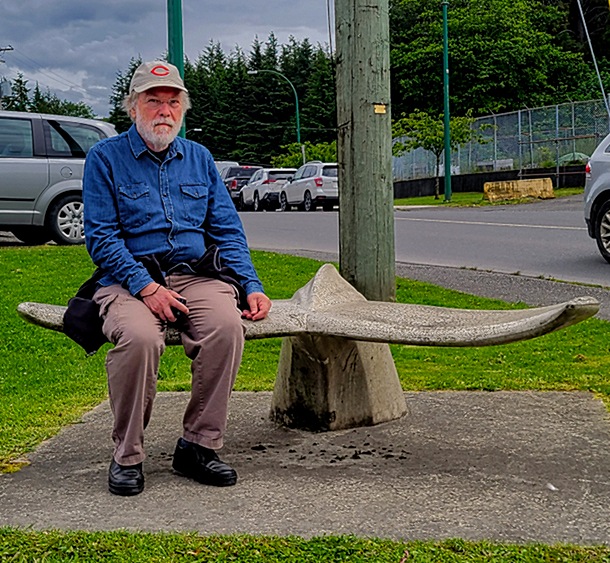
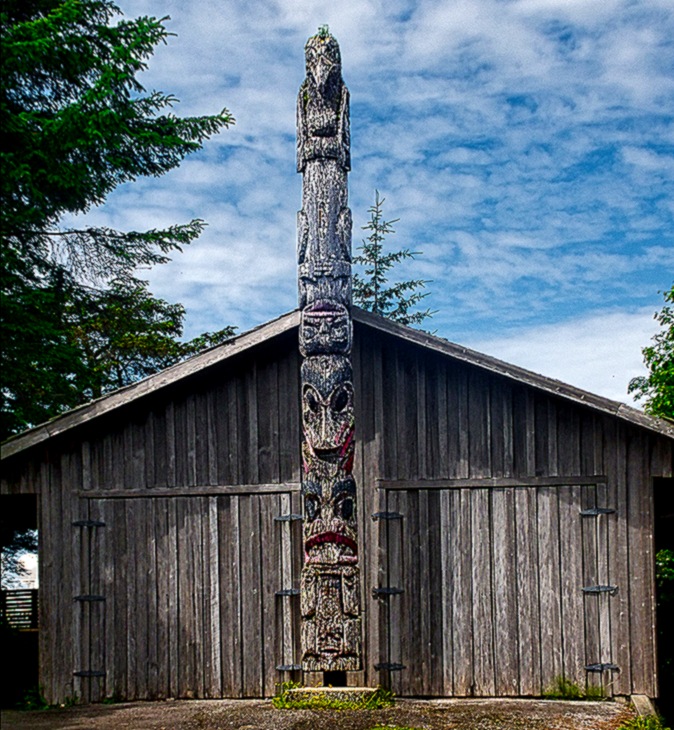
The excursion ended back at the dock but it was early yet so we decided to continue on foot. It turned out that most of the walking was uphill and there was quite a bit of construction to circumvent. Combined with our unusually large lunch, this made the going a bit challenging. But we persevered. Walking up the hill we visited the Icehouse Cooperative Gallery selling local arts and crafts. In a small park next to it was a concrete bench sculpted in the shape of a whale’s tail, one of several such benches in the waterfront area. We also walked past what looked like a weather beaten wood garage with an apparently old totem pole in front.
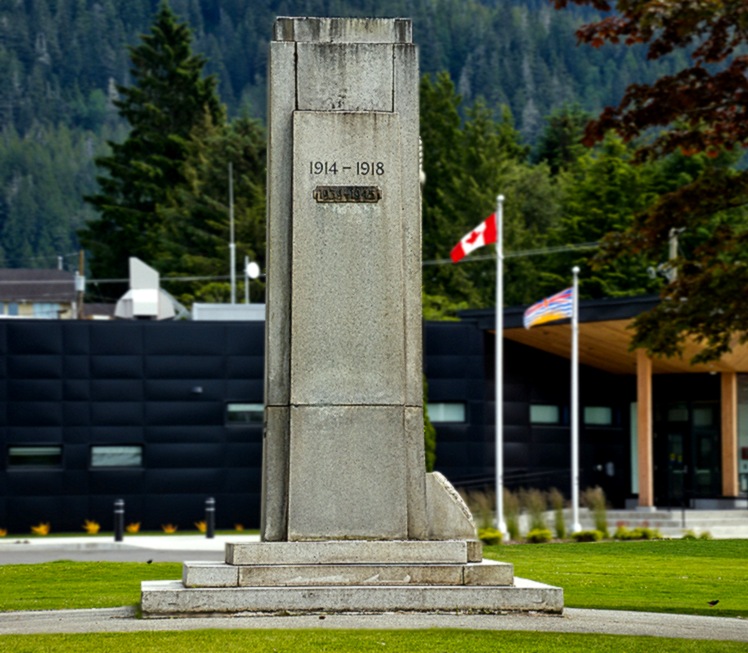
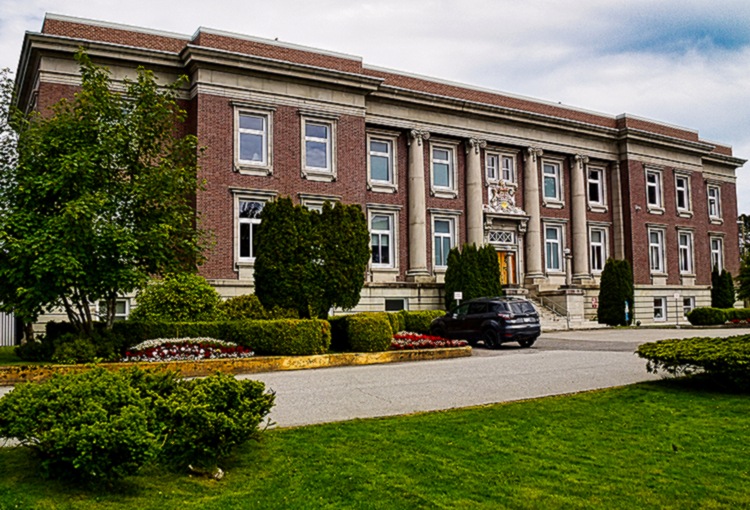
The Prince Rupert courthouse, built in 1922, is a red brick neo-classical building with four tall decorative pillars in front. Not too far away is the Cenotaph, a war memorial. It was put up in 1929 to memorialize those who died in World War I and after World War II a dark plaque was added with the dates of that war. This picture is of the back, as seen from the courthouse, but on the front is a relief of a sword and a wreath. We have seen similar cenotaphs in other countries in the British Commonwealth, such as Australia and New Zealand.

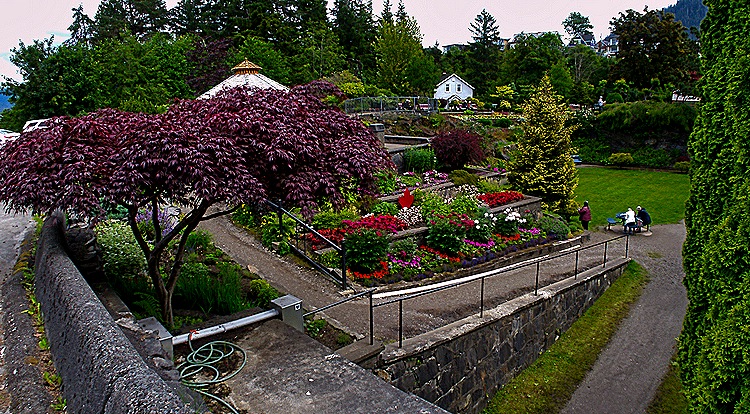
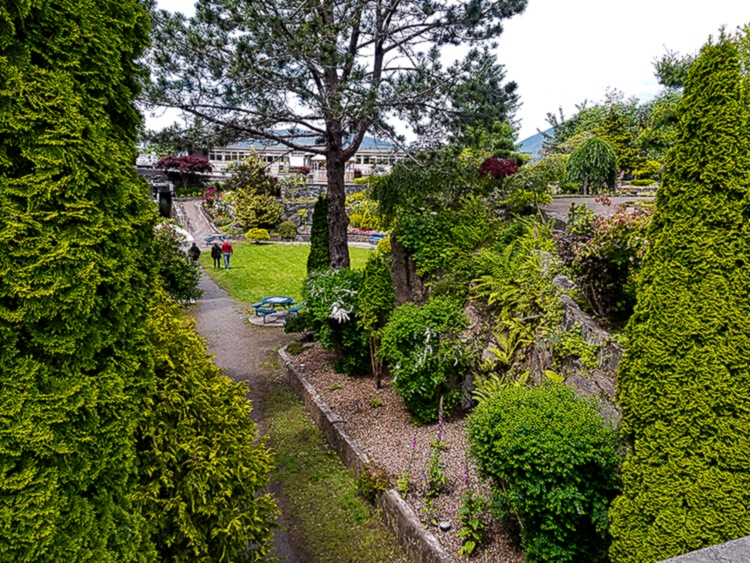
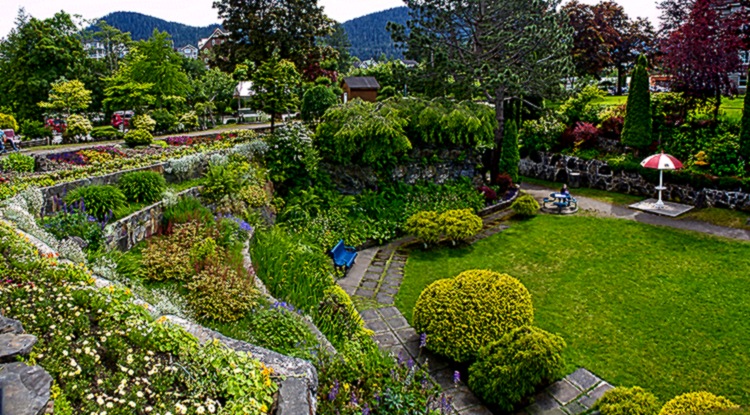
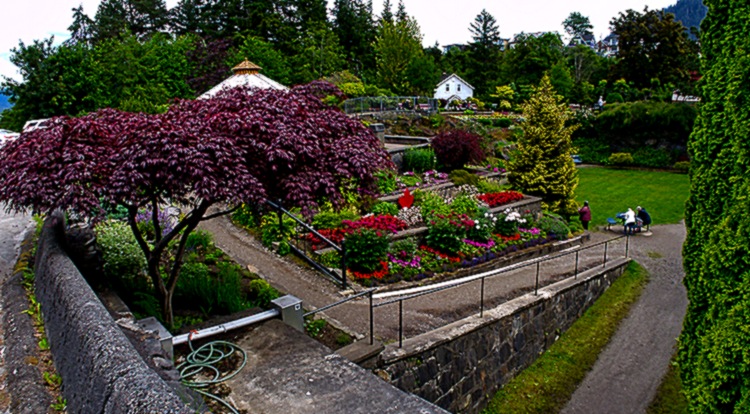
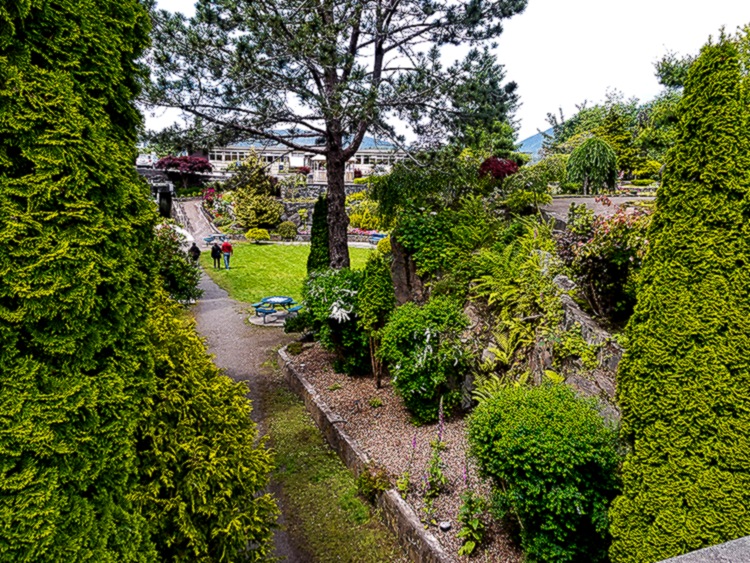
Near the courthouse is the Prince Rupert Sunken Gardens, built down the sides of a large gully-like space. This space originated in the 1920’s as the intended location of the courthouse, which was ultimately built nearby, and during World War II it was used as an ammunition bunker. For at least the last 20 years the gardens have been maintained by community volunteers who plant new flowers every spring. The bottom layer includes benches, chess tables and electrical outlets to help people enjoy this bright and attractive area.



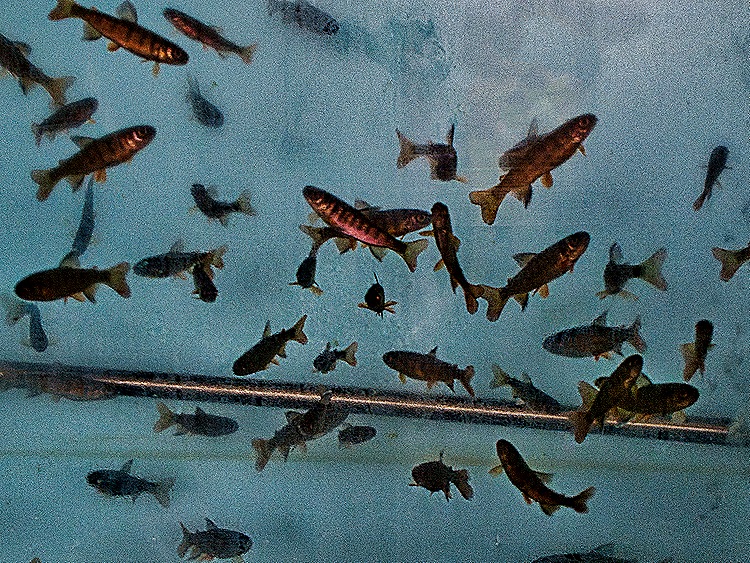
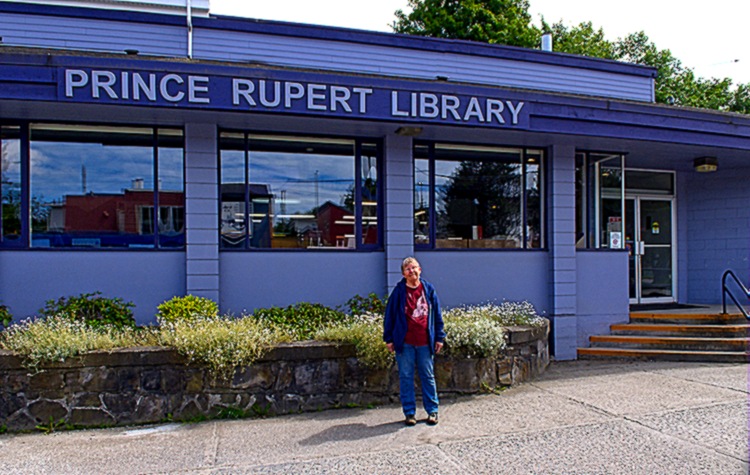
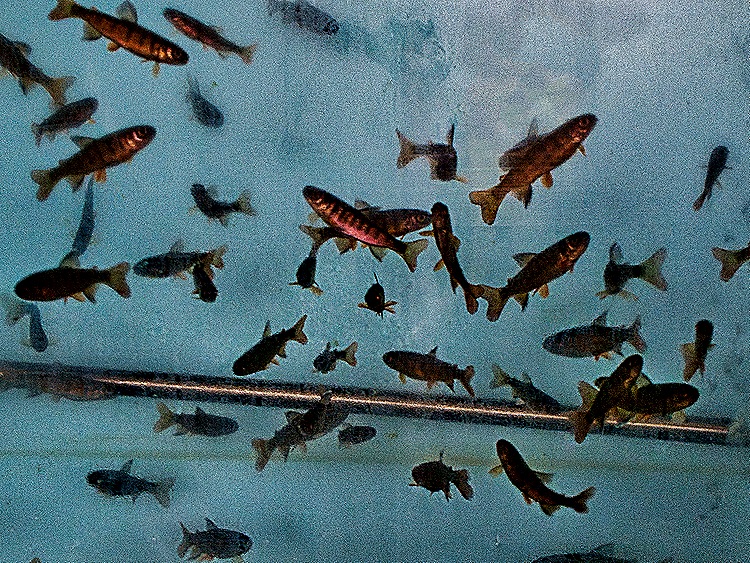
It was several blocks from here to the library. The Prince Rupert Library was founded in 1913 in a small wooden building heated by a wood stove. It moved several times but was destroyed by fire in 1968. The present library building opened in 1971. It is a nice roomy library with many displays including quilts showing local scenes and the skull of an orca calf that died near here in 2018. There was also a salmon nursery (an aquarium with many baby salmons) that was a school project and a Pride Month display (quite appropriate for the “City of Rainbows”).




Walking back toward the port we passed the Mountie headquarters. Then we visited Pacific Mariners Memorial Park, located just uphill and across the street from the port. Among other things we saw a statue honoring Prince Rupert fishermen and nice flower gardens.
Perhaps most interesting here was the Kazu Maru Memorial, consisting of a green and white boat inside a Japanese style housing. The story is that in 1985 a Japanese fisherman left for a day of fishing on the Kazu Maru and never returned, but a year and a half later the boat was found adrift near Prince Rupert. It turned out to be from Prince Rupert’s sister city Owase, Japan. Local people restored the boat and placed it in its current home; the Japanese fisherman’s family attended the opening and dedicated the memorial to all those who have lost their lives in the Pacific Ocean.



So that was it for this last port of call on our Alaska voyage. We had seen quite a lot and visited many far flung places in just under a month as we left Prince Rupert and headed back to Seattle. We visited with family in Seattle, spent a few more days with Barb & Brian in Portland, spent a couple of nights with our friend Peggy in eastern Washington State, then drove back across the continent, stopping for barbecue in Kansas City and visiting Rick’s oldest friend Jim & his wife Kathy in Dayton, Ohio. Somehow the driving trip home seemed longer than the trip west at the beginning of this adventure, perhaps because of the sense of anticipation at the beginning and the weariness at the end. Well worth the effort for all we saw and did on this voyage though.
As we sail away from port for the last time we will leave you with a final view of Prince Rupert from the water, nestled among the mountains.


 BADER JOURNAL