Antalya, Turkey
Welcome to Turkey.

Our next three ports are all resorts in the “Turquoise Coast” area of Turkey. The area is called that because of the color of the water in this part of the Mediterranean. Actually, the word “turquoise” is derived from “Turkey,” and we saw a lot of turquoise jewelry here.


Our first stop, on April 12, was Antalya. It was a beautiful day (really, the best weather we had had so far) & this city far exceeded our expectations. Antalya was founded in the 2d Century BC by a King of Pergamon called Attalus II, who named it “Attaleia.” It later came under Roman & Byzantine control until finally becoming part of the Turkish empire in the 14th Century.
It is no wonder this is a vacationer’s haven, for it is quite beautiful. Antalya is located on a curved bay surrounded by mountains. Our ship was docked at one end of this bay & the old town of Antalya, called Kaleici, is at the other end. It was way too far to walk, so it was fortunate that the ship provided a shuttle bus. Around the docking area the mountains were quite impressive.


I will show you the prime sights in town, but really the best part was just walking around the enjoyable old city section of town. Here is a picture of it taken from the ship later as we sailed away.

The first landmark was the Yivli Minare, or Fluted Minaret, dating from the 13th Century. Once decorated with turquoise tiles, it is visible everywhere in the old town. The mosque attached to it is still in use & has a roof of domes covered in tiles, the like of which we have not seen elsewhere.


We came to Hadrian’s Gate, the only remaining gate to the city, which was built in honor of Emperor Hadrian’s visit to the city in 130 AD. It had been inside the Turkish wall of the city until being uncovered & restored in the 1950’s. The tower on the left is Roman while the one on the right was built by the Turks in 1260.


After passing through the gate we strolled through the old town, enjoying the shops & the colors & the friendly people, and the absence of crowds.


We also saw the Kesik Minare (Broken Minaret), which was damaged by fire in the 1850’s. The ruins next to it have been a Greek temple, a church & a mosque.


After that we decided to walk to Antalya’s Archeological Museum. This was a pretty long walk, but it was a beautiful day & we still had plenty of time. Among other things on the way we saw a nice fountain with bird statues & an equestrian statue of the Seljuk Turkish Sultan who conquered Antalya in 1207. We have a lot of equestrian statues in Washington but most of them are pretty static, just a guy sitting on a horse. This one was interesting because it was so much more dynamic.


Outside the Archeological Museum we saw some pretty wisteria and encountered an odd bird, perhaps a peahen?


The museum was fabulous. We were very glad we made the effort to find it, but disappointed that our time there was so inadequate to see the collection. Most of the items came from nearby sites. This part of Anatolia was (if I remember correctly) part of the Greek Ionian League, so there were several prominent cities in the area, most notably Pergamon. The museum was divided into separate rooms by type of item. I will show you a few of the things that appealed to me in each room. The first room we visited was for statuary, but on the way there was an exhibit about how ancient burial sites appear.


Next we saw the mosaics room, containing mosaics recovered from Anatolia (mostly Perge & Pergamon, I think). This was our first real taste of ancient mosaics with pictures, and this whetted our appetites for more (we will see many more in future episodes). Photos were very difficult because of the way the lighting in the room reflected off the tiles, but this will give you an idea.


We saw a stone table with a game board carved into it. The exhibit says that no one has figured out how this game was played. On the wall was a picture from a vase of Greek warriors playing a board game.


Next we entered the fabulous room of sarcophagi. “Sarcophagus” in ancient greek means “flesh eating predator.” There were quite a few of them at the museum, most elaborately decorated with reliefs & even statuary (mostly of the occupants reclining atop the sarcophagus). Each sarcophagus was intricately carved from a single block of stone, and the lid was from another.


In this room there was also a sarcophagus for a dog named Stephanos. He must have been well loved for someone to spring for a sarcophagus, even a pretty plain one, since these must have been pretty expensive. There was a translation of the inscription.


Our time was running out & we didn’t want to miss the ship, so we pretty much raced through the rest on the way back to the entrance. We saw quickly some rugs that must be antiques & a featured larger than lifesize statue of Herakles (Hercules) that is said to be the finest Roman copy of a famous Greek statue in existence (copying Greek art was one of the things the Romans did best). It was pretty impressive in person.


We made it back to the ship in plenty of time, where we encountered some more fruit art before sailing away. Then, as the sun sank behind those beautiful mountains, we headed for our second resort on the Turquoise coast, Marmaris.


Israel (Day 2): Jerusalem to Haifa
We woke up in our Jerusalem hotel room with the hope that the wind would be gone & the sun out. No such luck. After breakfast we returned to the overlook point on the Mount of Olives & it was gray & drizzling. But the wind was mostly gone & with the light the view was much better. There was a guy there selling camel rides, but with the wetness he parked the camel under a tree next to our bus.


The old city of Jerusalem is surrounded by city walls, most of which were built by our old friend Suleiman (also spelled Suleyman) the Magnificent. The walls, of course, have gates, two of which could be seen from our perch on the Mount of Olives. The Lion Gate is named for the lion reliefs on either side of the opening (look closely just to the right of the upper portion above the opening). It was prophesized that the Messiah would enter Jerusalem through the Golden Gate, so the Turks sealed that gate so no one could go through it, and it is still sealed. Our guide was of the opinion that this could be corrected one day, but it seems to me that a sealed gate would not be much of a problem for the Messiah to take care of himself (or herself?).


The hillsides on the Jerusalem side & on the Mount of Olives are covered with tombs almost as far as the eye can see, many dating back to the time of the Second Temple (the time of Jesus). The story is that when Judgment Day arrives the folks buried in this area are supposed to be the first ones resurrected, so all of these people are trying to be first in line. While there is a vast number of Jewish tombs here, there are also Christian & Moslem cemeteries in this area.


We next visited the Garden of Gethsemene & the beautiful Church of All Nations that sits there. Some of the olive trees here are about 1000 years old, but none are older than that because the Crusaders cut down all the trees around Jerusalem to build siege fortifications. The Turks later cut down most of the rest of the trees in what is now Israel, partly to build railroads, and the Israelis have been planting trees for decades to try to reverse this process (I remember contributing money for trees in Israel in religious school in the 1950’s).


The church is not very old, but it has a number of striking mosaics on the walls & ceilings. The ceiling is divided into sections, each of which has a decoration reflecting one of the nations that contributed to its building. The American section features a “Jerusalem Cross,” which is characterized by a large cross with a small cross in each of its quadrants. The centerpiece of the church is the rock on which Jesus is supposed to have sat and prayed prior to his arrest. It surrounded by a wrought iron sculpture representing the crown of thorns with birds.


After leaving the Mount of Olives we drove to Bethlehem. It is close enough to Jerusalem that in this country we would probably consider it a suburb, but it is in the Palestinian Authority, so there were obstacles. To get there we had to pass through the Israeli security wall & there were guards on both sides who had to clear us. Israeli guides are not allowed to work in the Palestinian territory so we had to pick up a Palestinian guide when we crossed the border (he was very good & not at all hostile to Israel). Actually, Israeli guides (like other Israelis) are not normally allowed to enter the Palestinian territory, so they have to wait at the checkpoint for their tours to return to Israeli territory. But the Palestinian group that was working with our guide organization had arranged for our guide to accompany us in Bethlehem, although she was not allowed to talk about it while we were there. She was pretty happy about this since she hadn’t been to Bethlehem in some years, so we were happy for her too since we liked her quite a bit. She was greeted by several people she knew in Bethlehem whom she hadn’t seen for a long time. Before going to the Church of the Nativity we spent some time in a Palestinian gift shop owned by the guy who arranged our Bethlehem tour (& they did a very good job of that). It had a lot of expensive olive wood carvings (mostly religious themes), which we were told is a dying art. There was a lot of other mostly religious stuff to buy, some very expensive & some pretty cheap. They served us tea & were not very aggressive, so it was OK considering it was essentially the price for arranging the Bethlehem tour.


We were in Bethlehem, of course, to visit the Church of the Nativity, built over a cavern where it is said that Jesus was born. We are pretty skeptical about whether the builders of this church really knew where Jesus was born. St. Helena, who was the mother of Emperor Constantine, who first legalized Christianity in the Roman Empire, came to Jerusalem determined to locate the sites mentioned in the Gospels and claimed she did so. She built the first church here and also the first Church of the Holy Sepulcher, which contains the precise spot where Jesus was crucified & the tomb where he was initially buried (not to mention the tomb of Adam). She undoubtedly consulted the locals & asked around about local traditions about these places, but this was almost 400 years after the fact. Imagine someone coming to your town & asking about things that happened there in the 17th century, and not official things included in public records but things that happened to a small group unwelcome in majority society there. I don’t doubt the symbolic importance of these sites or their religious significance, and I am sure that these locations represent the best guess that could be made at the time, but their historical accuracy wouldn’t satisfy modern scientific standards.
Anyway, this church was very interesting. The old church is Greek Orthodox & attached to it is a Catholic church of more recent vintage. The Catholic church is where the worldwide broadcast of the Christmas eve mass originates. The Greek Orthodox church has paintings & mosaics on the walls and, under the current floor, a Roman era mosaic floor.


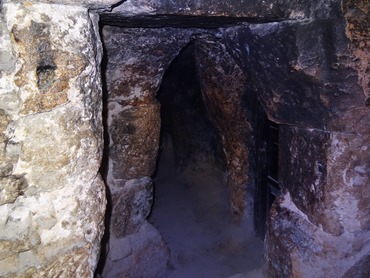
Each of these churches has a cavern under it (and I think they are connected, part of a single system of caves, but I’m not sure). Under the original Greek Orthodox church is the cavern with a marker of the spot where Jesus is supposed to have been born. Under the Catholic church is the cavern where St. Jerome lived when he wrote the first Vulgate Bible. The line for the first cavern is often 2 or 3 hours long, so we went into the other one. Our guide said that caverns like this were often used at that time for stables & guest quarters, and that the translators of the Gospels chose to use the words “stable” and “inn” because they would be more familiar to Europeans even though the original text could also have been translated as caverns. He said the cavern we visited would have been the “inn” where most of the guests stayed during the census, and that the other part where the overflow were housed was probably normally used for animals. I don’t know if that’s right or not, but as you can see below these locations are really underground caves, not what we would call an inn or a stable today.


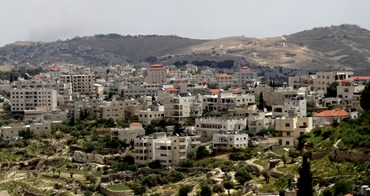
After emerging from the cavern we visited a courtyard where the Kings of the Crusader state of Jerusalem were crowned, in the center of which was a sculpture of Saint Jerome, then drove back to Jerusalem for lunch and a walking tour of the old town. So, here are a few pictures to show what the town of Bethlehem looks like.


Back in Jerusalem we abandoned the bus for a walking tour. The first place we visited was a building designated as the location of the Last Supper (only the location, not the building). This was outside the walls of the old city on (I believe) Mount Zion (which is really more of a hill than a mountain). When we entered this room, very crowded with tourists (as was Jerusalem in general, and the Church of the Nativity too for that matter) there was a group singing hymns. On the way there we saw the impressive Church of the Ascension, built (along with the Augusta Victoria hospital) by Kaiser Wilhelm II after his visit to Jerusalem around 1900.


We entered Jerusalem through the Zion Gate (named for the “mountain”) & had a very good lunch in the Armenian Quarter near a gift shop selling religious ceramics. We then walked through the Armenian Quarter to the Jewish Quarter. Old town Jerusalem has four quarters (which will not surprise anyone familiar with mathematics), named for the population distribution in the 19th century. There are Muslim & Christian Quarters as well.


We walked by the Roman Cardo, which was a shopping street in Roman times. It is on a level much lower than the street on which we were walking. We also saw the location of the hospital that was the original headquarters of the Knights of St. John, who we encountered in Malta.


We walked past the open market area to the Church of the Holy Sepulcher. The first church on this location was built by St. Helena, mother of Emperor Constantine who legalized Christianity, in the 4th Century. It was later pretty much destroyed but rebuilt by the Crusaders in the 11th Century.


This church contains what St. Helena concluded is the site of the crucifixion, the tomb in which Jesus was initially interred, the last five Stations of the Cross and the tomb of Adam. At one time it also contained the tombs of the Kings of the Crusader kingdom of Jerusalem, but those were destroyed centuries ago under Muslim rule. This church has a long history of strife among the various Christian groups competing for control, to the extent of monks killing each other in pitched battles. But an uneasy settlement was negotiated by the Turks under which the Greek Orthodox oversee most of the Church with areas set aside for Catholics, Armenians, Copts, etc. within the Church. Under the settlement nothing can be changed anywhere in the church without the unanimous agreement of all seven (I think) religions, with the result that nothing has been changed. This standoff has led to some odd things: for example, one chapel (I think it was Armenian) was damaged by fire, but they have not been able to repair it for lack of unanimous consent. And even odder, there was a ladder on the outside of the second floor at the time of the settlement, so there has been one maintained there ever since (replaced a couple of times, but never removed). Sultan Suleiman entrusted the keys to this church to two Muslim families in Jerusalem who hold the keys to this day. It is a matter of great prestige for them; one family opens the church in the morning & the other locks the church at night after the Greek Orthodox monks have secured the doors.


Inside the church are some impressive mosaics, particularly in the dome (above) & a very long one depicting the crucifixion & the interment of Jesus, all of which reputedly took place inside this church. Just inside the front door is the stone on which Jesus’s body is said to have been laid out before interment, & there was a line of people to touch this stone. Actually, every part of the Church was crowded, mostly with tourists and pilgrims I would assume.


In the next room is a small building (fairly new) that contains the Holy Sepulcher. The line is very long & very slow, since they only allow a few people in at one time & there is no limit on how long you can stay. We did not have enough time to go in there, but we did see an Armenian shrine adjacent to it that the Armenians say is where Jesus’s head was placed in the interment. We were told that there were 25 or 30 tombs here in the 4th Century but after St. Helena selected this one as having been Jesus’s they destroyed the rest. There is one left, in an adjacent room, which is really a cave that you can walk into; I assume most of the crypts in this area originally were similar caves that could be sealed by rolling a large stone in front.


Climbing a flight of steep stairs took us to the site of the Crucifixion on what was once a hill called Golgotha (or Calvary, of course). The spot is covered by what is in essence a large table that is open on one side, & there was a long line to crawl in there to pray. There were some nice paintings on the walls and archways in this area as well. Directly underneath is a spot designated as the tomb of Adam, which is basically a window on the rock which is split in accord with the story (we were told) that the earth split at the moment Jesus died.


So that was the Church of the Holy Sepulcher, which has seen so much history and is so full of religious significance. Mark Twain had a few choice observations about this church & the plethora of religious sites housed in this one building, but I am not going to repeat them here. We next walked to the Western Wall which, as I have mentioned was built as a retaining wall to support the Second Temple when Herod expanded it (on the way our guide pointed out a sign on a house indicating that the occupant had competed the Hajj, a pilgrimage to Mecca, which is a very prestigious thing). This wall is all that is left of the Second Temple and it is a very holy site to Jews, who come here to pray & insert written prayers into the masonry cracks. Jews are not permitted to pray on top of the Temple Mount, which is under the control of Muslims, who have built two of their most important mosques on this site: The Dome of the Rock, with its distinctive gold dome, contains the rock on which Abraham is supposed to have started to sacrifice his son Isaac, and the Al Aqsa Mosque, which is where Mohammed is supposed to have ascended to heaven during his lifetime. Sometimes non-Muslims are barred from ascending the Temple Mount & sometimes they are allowed to do so, although they cannot enter the mosques, but at no time is it permissible for non-Muslims to pray on the Temple Mount or even to carry a bible up there. Anyway, both mosques are clearly visible from below the Western Wall.


The Western Wall is divided in two parts: the larger area for men & a smaller one for women. Because of this segregation Mary & I could not approach the Wall together. Men must wear head coverings to approach the Wall, & white yarmulkes are available for free (& to keep). Women are restricted at the Wall, apparently they cannot wear prayer shawls or engaged in organized prayer. Some women were arrested for disturbing the peace a few days before our visit when they broke these rules, but a Magistrate threw out the charges saying that this behavior was not unlawful.


There is an intense ongoing cultural conflict in Israel & especially in Jerusalem between the ultra orthodox Jews and the more secular Jews. The ultra orthodox (like the orthodox of other religions) would like to impose their strict rules of dress & behavior on everyone else. Women have been stoned for wandering too close to Orthodox synagogues in nonreligious dress & our guide told us she was leading a busload of tourists that was stoned when it drove too close to a synagogue. The big issue right now has to do with the exemption in Israeli law for religious scholars from the otherwise universal military service. According to our guide, when this law was enacted some 60 years ago it was thought that it would apply only to a few hundred special scholars. To qualify for the exemption one must certify that he will spend his life devoted to scholarship, foregoing employment. Today there are countless numbers of ultra orthodox Jews signing this pledge, and these people also believe they have an obligation to marry (often arranged ones) & devote themselves to maximum reproduction. The result is many thousands of families with 10 or more children living in poverty on a government dole in two room apartments. They have become a burden on the remainder of the population and are increasing in numbers so quickly that our guide believes they will constitute a majority of the population of Jerusalem before long, which would give them the political power to impose their rules on everyone in the city. So the new government seems prepared to do away with the military exemption; we will see. We saw many ultra orthodox Jews in Jerusalem, who are distinctive with big black hats & suits with white shirts. There is a special section set aside in the men’s section of the Wall where there are chairs & desks for their use.


At the exit from the Wall area is what we were told is the world’s largest mezuzah (usually a very small container of tiny prayer scrolls that many Jews affix to their door frames). We left the old city through the Dung Gate (its just what you think: this is the gate through which the refuse was taken out of the city). Then we drove to Haifa to meet the ship. Unfortunately we arrived after dark, so we didn’t get to see anything of this reputedly beautiful city, but we did see the lights of the Ba’hai Gardens that flow down the side of Mount Carmel (although I couldn’t get a picture from the moving bus). I guess we will have to save that for another trip. We sure got to see an awful lot on this trip, particularly considering it was only two days, and it was even more interesting & enlightening than we had expected. Our guides did a marvelous job of enhancing our visit to this fascinating country. So, as we head for Turkey I will leave you with some towel & fruit art.


Israel (Day 1): Ashdod to Jerusalem
On April 9 we arrived in our second country noted for political violence, Israel. Not surprisingly, Israeli security is particularly tight. Every passenger (even those not going ashore) was required to appear personally before an Israeli security person. There was no interrogation, however, and we were issued stamped landing permits fairly quickly (once things got going . . . they were late). Unlike other countries, Israel stamps a visa on a separate landing pass rather than your passport, apparently because having an Israeli stamp in your passport can make it difficult to enter other countries in the Middle East.
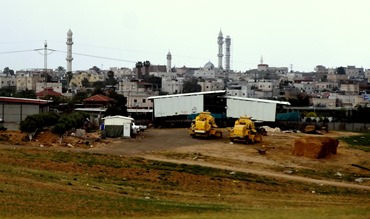
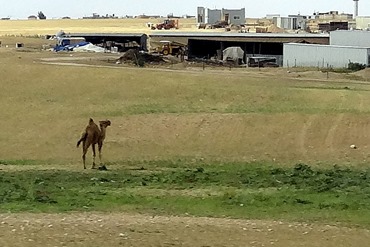
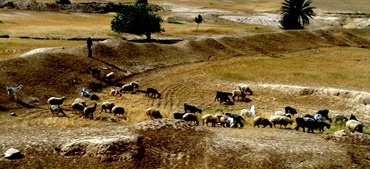
I’m not going to give any background on Israel because everyone is already pretty familiar with it, both the drama of biblical times and the strife that has characterized the modern state. Ashdod, the port closest to Jerusalem, is actually an ancient city & we are told that it has recently been renovated into a nice city to visit. But we were not here to see that. Instead we signed on for an overnight bus tour that would take us to Masada, the Dead Sea, Jerusalem & Bethlehem. It was long & exhausting (especially coming on the heels of two long and exhausting tours in Egypt and another time change in which we lost an hour), but very rewarding. So, leaving Ashdod we travelled past villages (you can tell the Muslim villages by the minarets), camels & sheep & goat herds, and into the Judean desert near the Dead Sea.


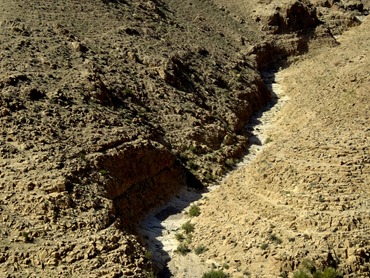
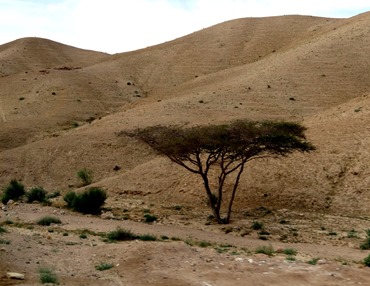
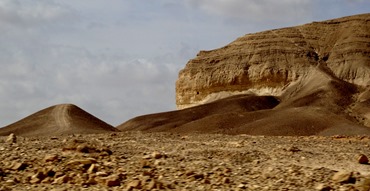
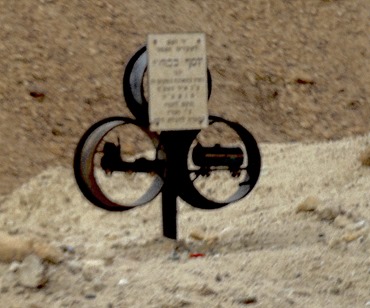

We drove north along the Dead Sea to Masada, a mountaintop stronghold built by Herod the Great that has an absolutely stunning view & a controversial history. The conventional story goes that after the Romans sacked Jerusalem & destroyed the second Temple in 70 AD in response to a Judean uprising, a remnant of the Zealot fighters took refuge with their families in this impregnable mountaintop fortress and continued to resist Roman rule. The Romans, however, built a huge ramp up the side of the mountain (using Judean slaves so that the defenders would not prevent the work by shooting down at the workers) & rolled a large siege tower with a battering ram up the ramp so that they could breach the walls and climb into the fortress. But the night before the onslaught the Judeans decided that they preferred death to slavery & all committed suicide. When the Romans entered the fortress the next day they were appalled, finding nothing but dead bodies.
Masada was the subject of a large archeological project in the 1960’s (I don’t know if any of you knew him but Chuck Colbert, one of my father’s close friends, participated in that dig). Masada was promoted as an inspiring moment of heroism by Jewish fighters & the Israeli army conducted its final inductions of soldiers at that site. That is no longer done & some modern scholars have questioned some of the facts of the traditional story, the integrity of the archeological interpretations (some of which seem to be of the “finding exactly what you were hoping for” approach), & even the character of the martyrs. First, you might wonder how we know what went on there if everyone in Masada killed themselves. In fact, the sole source for this story is a brief recounting by the Judean/Roman historian Josephus Flavius (who had initially been a Judean general in the uprising but after being captured was adopted into a Roman general’s family). He tells us that a couple of women & five children survived to tell the tale by hiding in the cistern, but it is doubtful that he ever talked to them, so his second hand (at least) story is less than fully reliable as history. The standards of ancient history writing were far from today’s, of course. For example, Josephus purports to quote a lengthy speech by the leader, Eleazer Ben-Yair, which he could not possibly have heard. Second, some scholars say that the people who holed up at Masada were not Zealots but Sicarii, named after the curved daggers they carried & used for assassinations. They were a violent fringe group who apparently killed many Jews in raids on neighboring towns. They apparently did not participate in the defense of Jerusalem since they had occupied Masada before Jerusalem fell. Only one of the deaths at Masada was actually a suicide, the rest were murders, even in Josephus’s telling. All the men first killed their wives and children, then they drew lots to decide who would kill each other, leaving only the last to commit suicide (small pieces of potter with names written on them, including Ben-Yair’s, have been found at Masada, which would seem to corroborate this part of the story). As our Israeli guide pointed out, this was a gross violation of God’s law (thou shalt not kill) which many modern Jews find less than admirable and which is not likely to have been done by Jews who were very religious. I am no expert in these things, but it seems apparent that the heroism of those who died here is more ambiguous today than it seemed a few decades ago.
In any event, this is a fascinating & beautiful place. You can easily see why King Herod (who was, whatever else you might think of him, a prolific & innovative builder) would choose to build his winter palace here, not just for its security (he was not from a Judean family & was not popular among the Jews) but for its beauty. Our pictures do not begin to capture the stunning views from this mountaintop in every direction.


In the old days the only way to get to the top was by the Snake Path, for reasons obvious in the picture below, a long & arduous climb. But today there is a cable car (thank goodness).


One thing at Masada we found refreshing was their practice of painting a bold black line between the original structures they uncovered and the restorations they did to rebuild the walls. At many archeological sites (most notably Knossos) it is difficult to tell what is original and what has been added, but here they made it clear. There are a number of small black birds that live here (I have forgotten the name); they appear very comfortable with human visitors. There are also Ibex that live here, and rarely they are spotted at the archeological site. We didn’t see one (sigh), but one of our fellow passengers was lucky enough to get a beautiful picture of one standing on a wall with the mountains behind.


There are a lot of interesting features at the Masada site. Herod’s palace included his reception room, with the remains of two pillars, and a well preserved bathroom with mosaic floor & bathtub. We also saw ancient aqueducts, one in the palace & another on the side of the mountain. The advanced aqueduct system effectively filled the cisterns on the mountain with water, and this provided the resisters at Masada with plenty of water in this desert area even after the Romans stopped the flow of water by destroying the outside aqueducts.


We saw what was left of the synagogue (converted from Herod’s stable), one of few existing from the time of the Second Temple. Another structure was the “Columbarium,” which was a roost for pigeons (used for food as well as long distance communication).


You can stand in the breach in the wall where the Romans broke through & look down on the ramps built by the Romans & their Jewish slaves, which is still easy to see. You can also see the very clear remains of the Roman encampments far below the walls.


So we left Masada, a beautiful & historically fascinating place, & drove to a resort on the Dead Sea where we had lunch. There is a British miniseries about it, creatively entitled “Masada,” starring Peter O’Toole as the Roman general Flavius Silva, for those who are interested. Much of it is fanciful, which is inevitable given the sparse historical record, but it was filmed, at least in part, at Masada (and Peter O’Toole is very good) so it is not unworthy of viewing. A final view from the walls of remarkable Masada.

As most of you probably know already, the Dead Sea (seen from Masada above) derives its name from the fact that it is so full of salt that nothing can live in it (actually, scientists have recently found bacteria that live deep in the Dead Sea, but they do not yet know how they do it). The Dead Sea is currently receding at a high rate, and will soon consist only of the deepest part in the center. Our guide told us that she used to come here when the water extended far beyond its current boundaries.
The Dead Sea today is largely a resort area. This shores of the Dead Sea are the lowest dry land on the planet, well below sea level. Both the water & air are reputed to have restorative powers. Doctors in Europe send patients with skin problems here, and people rub themselves with mud from it (which is sold in jars). The other famous thing about it is that because of the unusually high salt content it is impossible to sink; you see people floating in the waters near the resort hotel. As you can see for yourself below, I actually went into the water & did not sink at all. I also tasted the water, & believe me it is awful.


No picture, but we did see a McDonald’s at this resort. We have seen them all over, of course, but our guide told us that until relatively recently there were none in Israel. Apparently they were inhibited by the number of people here who observe Kosher dietary laws: it is impossible to make a Kosher cheeseburger (meat and dairy products cannot be served at the same time or cooked with the same utensils). There was a fast food chain in Israel called McDavid’s. But apparently McDonalds has figured it out (they just serve hamburgers & not cheeseburgers) & has driven McDavid’s out of business. I would have thought they would be unable to offer milkshakes with a hamburger either, but at this resort we had ice cream made without dairy products & it was quite good.
We drove north along the Dead Sea toward Jerusalem. One of the interesting things about this part of the world is how small it is. Places that the Bible describes as being a substantial journey apart are really close together by American standards. Driving from Jerusalem to Bethlehem, for example, is about as far (it seemed) as driving from Arlington Virginia to Washington DC. Similarly, the Jordan River (which we are told in song is “deep and wide”) is more like a creek by US standards. Anyway, the opposite side of the Dead Sea are the mountains of Jordan, & it was close enough to photograph a Jordanian Dead Sea resort or town (not sure which) across the water.


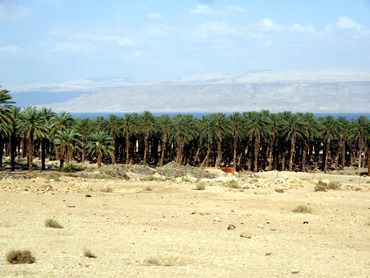
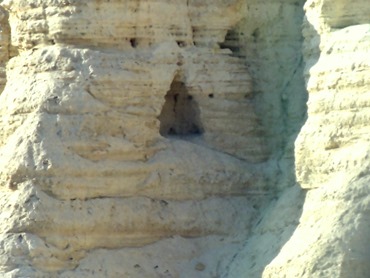
We drove past a date palm orchard (if that’s the right word), where they are experimenting with these trees because they can live on salt water. And (passing through Palestinian territory) at Qumrum we saw the cave where the first Dead Sea Scrolls were found. The story is that a Palestinian shepherd boy followed a stray goat into the cave & spotted the jars there containing the scrolls. But take a look at the cave and ask yourself whether it is likely that a goat would stray into this cave. There are quite a lot of stories in this part of the world that seem pretty dubious, at least to us. Our guide thought it more likely that they were out treasure hunting (lots of caves in this area) when they discovered the scrolls. We also passed Jericho (visible but at a distance), which I understand is considered the oldest continuously inhabited city in the world, as we drove toward Jerusalem.
Driving into Jerusalem we caught our first glimpse of the Israeli “security wall” that separates the Palestinian Authority from Israel proper. It is not a happy sight; it seems unfortunate that people feel the need to separate themselves like this. Our Israeli guide felt bad about this as well, since the separation keeps her from leading tours in Palestinian areas like she used to do, but she is hopeful that this will one day become an international border as part of a settlement between the Israelis and the Palestinians. She is more optimistic than I am.


In Jerusalem we checked into our hotel, the Crown Plaza, where we had a 16th floor room with balcony (too windy to use) that had quite a view despite the dense cloud cover as the sun set. The hotel was near the Knesset (Israeli parliament) & Supreme Court.
 .
.

After dinner at the hotel, we set out on what was supposed to be a drive around the walls of the old city & a visit to the Western Wall (also known as the Wailing Wall, a retaining wall built to support the Second Temple). But it was very cold & extremely windy & unpleasant out. We stopped on the Mount of Olives overlook to see a nighttime view of the Temple Mount (where the Temple once stood), the city walls & the Mosques that sit on the Temple Mount, but could only stay a minute or two because of the weather. There wasn’t much lighting anyway. Then we visited the outside of the Church of All Nations at Gethsemane Gardens (where Jesus prayed before his arrest). We would see all this to better effect the next day. We did drive around the walls some, but the Western Wall area was closed off, perhaps (our guide speculated) because John Kerry might have been visiting. So that was added to the itinerary for the second day, for which you will have to continue to our next installment.


‘
Port Said & Cairo, Egypt
On April 8 we docked in Port Said, a city at the Mediterranean entrance to the Suez Canal. Port Said was built in the 19th century to house the workers and administrators who built the canal, so there is nothing very old there. You may have read about this city over the last 6 months, during which it has witnessed a number of demonstrations that have resulted in dozens of deaths. The trouble started with a riot at a soccer match in which a number of people died. Then a couple of dozen people were sentenced to death for their roles in those riots, which stimulated demonstrations that turned violent. More people were killed during the demonstrations, and more people have been given death sentences. So Port Said has been very volatile and we were pretty convinced we wouldn’t make this stop. But we did, and we learned later that ours was the first cruise ship to stop here since January.
Well, there is little to see in Port Said (and Holland America was urging passengers not to go into town by themselves), so we opted for an excursion to Cairo to see the Pyramids & have lunch on a boat in the Nile river. It was another long & exhausting day (about 12 hours altogether, 3.5 hours each way on the bus) but well worth it. All the buses going to Cairo went together in a convoy, with police accompaniment (men with guns in each bus & trucks carrying men with rifles driving along side). Police protection of tourist groups has been standard in Egypt for some time (their police have a special tourist division), since an incident in the 90’s when several dozen foreign tourists were killed by terrorists. As we drove out of Port Said we passed soldiers & tanks posted at intersections, presumably to discourage any more violent demonstrations (or probably any demonstrations period).


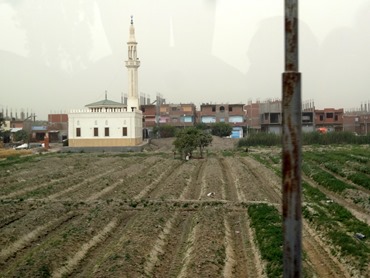
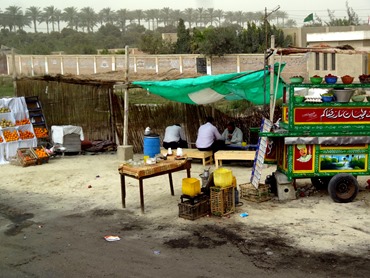
We drove south parallel to the canal to Ismailiya (another city that has had a lot of unrest), then west to Cairo. Along the canal we saw villages, vendors & irrigation canals, of which there is a sophisticated system.


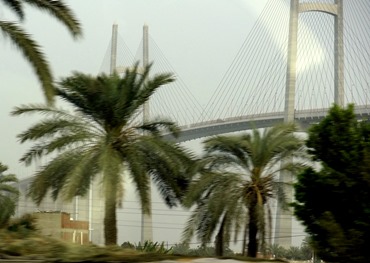
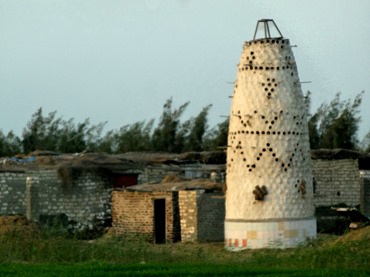
We passed the “peace bridge” (I think that’s what the guide called it) that connects most of Egypt with the Sinai Peninsula, which was financed jointly with Japan. Also interesting were the large pigeon roosts that resembled giant beehives that are kept by many farmers in this area. The Egyptians eat the pigeons (called “squab” when they appear on your plate) and they also use the pigeon guano that collects inside for fertilizer.
As I said, we were traveling on a road that paralleled the canal just a few hundred yards away, with farms and fields between. Occasionally we saw ships traversing the canal that looked like they were going through the fields because we could not actually see the canal from our vantage point. Because the land is so flat & the water levels in the Red Sea & the Mediterranean are within about 5 feet of each other, the French were able to build the Suez Canal without any locks. This made it easy for sea life in the Red Sea to migrate into the Mediterranean & thereby changed the ecology of the region. The canal is not very wide, so ships convoy south in the morning & north in the afternoon.


From Ismailiya we turned west, and the land very quickly turned to desert. More than 90% of Egypt is desert like this. We were told that the Egyptian desert is so dry (less than 2” of rain per year) that even cactus doesn’t grow in most of it.
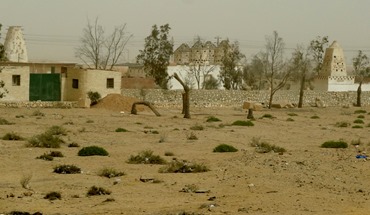
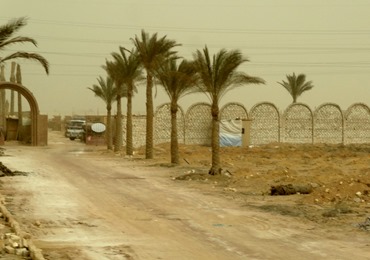

The population of Egypt has increased by several times over the last few decades, with the result that housing has become scarce & very expensive in the city. So in recent years housing developments have been going up in the desert outside Cairo, where middle class people can now afford more than a small apartment. We were told that Cairo is now the 3rd largest city in the world with some 20 million people.


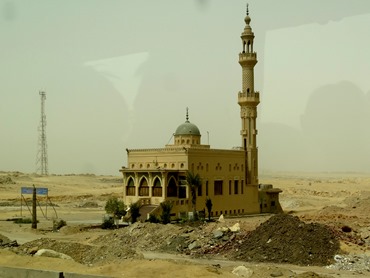
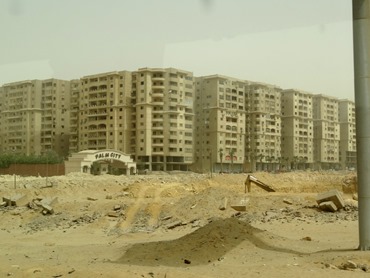
Ironically, there was a huge housing bubble in Cairo when everyone was building housing projects (that look pretty much like slums) for the expanding population with the result that it was overbuilt & contractors just stopped work in the middle of their projects. Cairo now has a large number of incomplete buildings that are nothing more than eyesores. Traditionally there has been another kind of uncompleted building, in which a family would live on one or two floors, then when the children grew up they would add floors above for their families. At one time leaving rebars sticking up from your house gave you a tax advantage because such uncompleted buildings were not subject to property tax (we saw this in Peru last year as well), but the government got wise to this & now property taxes apply once electrical service is added to a building. You will notice that these buildings all look pretty much alike, and there are huge swaths of them in the eastern part of Cairo through which we passed.


So now we came to Giza, where the Great Pyramids are. When they were built the Pyramids were on the west bank of the Nile, the opposite side from the city of Memphis. This was because the Egyptians believed that the sun died every night and was reborn in the morning, so the direction of the sunset was the place for death. For many years Giza was in the desert isolated from the city of Cairo but the city has expanded in recent years to the point where our first view of the Pyramids was while passing through nearby residential neighborhoods.


There are three large pyramids at Giza. The great pyramid of Khufu (called Cheops by the Greeks) was the largest structure in the world for many centuries and is the only one of the 7 wonders of the ancient world still standing. His son, Khafre (Khephren to the Greeks), built the second pyramid, which is smaller than Khufu’s but looks bigger because it is situated on higher land. It still has some of the outer facing of smooth stone at the top which once covered all of these pyramids but was apparently carted away at some point to build newer buildings (this is a common fate for ancient buildings in this part of the world). The third pyramid is a good bit smaller than the other two (but still pretty big). The engineering of these buildings is quite extraordinary for their time; for example, the sides of the Great Pyramid are equal in length to a tolerance of 4 centimeters!


Of course the visitor spots at the Pyramids are loaded with vendors & camel men. We were warned that they are basically crooks. One favorite ploy is to agree to let a tourist get up on a camel for a picture for a couple of dollars or a short ride for 5 dollars, then demand $50 or $100 to let them down. If you refuse they may lead the camel out into the desert where you are totally defenseless. This actually happened to a couple of men on our tour; one of them was able to negotiate the dismount price down to $5 from $100, which he paid. The other one got off (since he was back in the bus) but I don’t know how. They all crowd around you, demanding that you buy some piece of junk, or asking you to take a picture with them (after which, we were warned, they would demand compensation). It was irritating constantly having to argue with these guys (they were all guys) when you only have a short time to see the Pyramids.


So then we moved to a spot where we had a little time to get up close & personal with a pyramid. We chose Khephren’s pyramid because it was a shorter walk & looked most interesting with the stone facing still on the top part. Some of the characters in Agatha Christie’s Death On The Nile climb to the top of a pyramid, but that is not allowed any more. There is one place at Khephren’s pyramid, however, where you can climb up a couple of levels, so I did. The stones are about 4 feet high, so you have to climb just with your arms. Not easy for an old guy, but your intrepid adventurer managed it. Mark Twain says that he paid three locals to help him climb to the top of a pyramid: two of thm would pull his arms from above while the third pushed from below. He also said one of them ran down the pyramid, up another one, then back in 5 minutes on a bet, then did it again. The first story might be true, but believe me the second one is not possible!


Nearby was the Great Pyramid. You could see Cairo in the distance (Giza is high ground). Near one of the great pyramids there were three much smaller pyramids for (you guessed it) the wives. We were told that there are more than 400 pyramids in Egypt, although none of the others are this big.


Modern scholars have concluded that, contrary to popular belief, the pyramids were built by skilled volunteers rather than slaves (and certainly not by the Israelites, who came to Egypt long after they were built). Recently uncovered are a necropolis nearby for people who helped build the pyramids and a town for workers. I’m not sure whether these pictures are of those excavations or something else on the site, but for what its worth I’m including them.


Next we visited the Great Sphinx. A sphinx has the head of a man and the body of a lion, which symbolizes a combination of wisdom & strength. There are a lot of sphinxes in Egypt, but not like this one. It is not only huge but impossibly old (some think it predates the pyramids). For many centuries it was covered by sand. Originally it would have had a beard, & there is a legend (which our guide said is not true) that its nose was blown off by Napoleon’s troops taking artillery practice. Mark Twain said he saw a tourist climb out to the head of the Sphinx with a hammer & chisel to obtain a souvenir (his travelling companions seem to have taken pieces of most of the interesting sites they visited), but he was unable to chip off a piece, thus emphasizing how much this statue has survived over the centuries. Anyway, its really is interesting, and its almost impossible to take a bad picture of it, so I will burden you with several of our better ones, from all angles.


After an all too brief visit to Giza we drove to the Nile for our lunch cruise on the river. This turned out to be a very short trip up and back on a relatively uninteresting stretch of the river, on a boat full of hokey ancient Egyptian style decorations, with a buffet meal that couldn’t hold a candle to the one in Alexandria the day before. If we don’t look particularly happy in these pictures, that is why (plus the fact that we spent more time in a gift shop than we did at the Sphinx).


Notice the super tall palm tree on the side of the Nile in the next picture. Its not real: its a cell phone tower. These were all over town.


The lunch boat also provided entertainment. First a belly dancer, then a guy with a colorful getup who performed a whirling dance. He was not a whirling dervish, because they dress in white and their dance is a religious rite, while this guy was very much an entertainer. The belly dancer later posed for pictures behind diners & they tried unsuccessfully to sell those pictures to the diners.


After lunch we began the long drive back to Port Said, again in convoy with the other buses & police escort. Passing through Cairo we saw colorful fruit stands, folks sitting in cafes and a surprising variety of animals right in the city.


One thing I should mention before leaving Egypt is the way Egyptians dress. Many men (though far from a majority) dress in long robes called galabiyyas, like the shepherd above is wearing, though often in darker colors and sometimes with a small hat. We were told that, although it looks hot to us, this is actually a time tested method of keeping relatively cool. Most women wear scarves on their heads, although our guide in Alexandria told us that this is more fashion than religion. She said if she were in the United States she wouldn’t wear one; she probably doesn’t know that such scarves are now fairly common in large American cities. She told us that young women color coordinate their scarves with their more western looking clothing, and after she said that I noticed this quite a lot. So, while I’m not sure that I am entirely buying the idea that this is nothing more than fashion, I am sure it is true for many women.


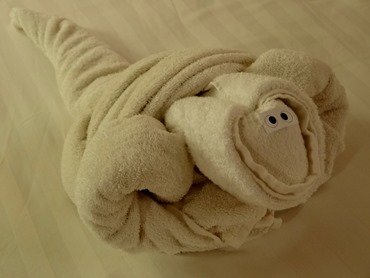
So, after the long drive your exhausted travelers arrived back at the ship. As I mentioned at the beginning, this was the first cruise ship in Port Said since January, and people were genuinely happy to see us. Many waved & smiled at us in the bus, and at no time in Egypt did we see any sign of hostility (although folks on a different tour in Alexandria said they did – must be something about them, I’m sure). The Egyptian economy is very dependent upon tourism (it is their fourth leading industry), and they are anxious that the news focus on the unrest in the country not discourage people from visiting. Anyway, our visit was enough of an occasion that there were bands there to serenade us upon arrival and before departure. But before the ship left for Israel, we had a new towel animal to accompany us.

Alexandria, Egypt
We arrived in Alexandria early on the morning of April 7. Alexandria was founded by (surprise!) Alexander the Great. It is thought that he was buried here, but archeologists have so far not been able to discover his tomb. Sounds like a job for Indiana Jones! As you may know, Alexander assigned provinces of his empire to his leading generals, & Egypt was assigned to a general named Ptolomy. The Ptolomy dynasty ruled Egypt from Alexander’s death in the last third of the 4th Century BC until it was incorporated into the Roman Empire by Augustus Caesar after he defeated Antony & Cleopatra at the battle of Action. Alexandria was one of the premiere cities of the Hellenistic world, unusually rich & cosmopolitan in its population. It had important Jewish & early Christian communities & its library was renowned as the greatest center of learning in the ancient world.
We considered it something of a triumph that we even got here, since we have been somewhat worried that all the political trouble in Egypt & Israel lately would convince Holland America to skip some or all of these ports. We actually heard a rumor after we finished all four of these ports (yes! we got to all of them) that Holland America had anticipated that we would need to cancel these stops & had made contingency plans to spend a few days in the Black Sea instead (I have no idea whether this is true; there are a lot of rumors on cruise ships). Anyway, we were very glad to get here. This was the first of four long and exhausting tour days in a row. Many passengers went to Cairo on this stop to see the Pyramids, etc., but we really wanted to see Alexandria. So, since this is a notoriously difficult city to get around on your own, we signed up for a 12 hour tour (the only one offered that visited all the places we wanted to see).
Alexandria is a city of contrasts. It has some beautiful older buildings & homes, but it also has many slums. Although it has a reputation as a sophisticated & cosmopolitan city, many of the streets are littered with trash (sometimes in huge piles). We were told that since the overthrow of the Mubarak regime two years ago the garbage men have not been paid regularly & that is why Alexandria (& Cairo & Port Said as well) is not clean. Our Alexandria guide, a young woman who has little sympathy for the Muslim Brotherhood or the Morsi government, told us that her monthly utility charge suddenly went up substantially and when she inquired about it she was told it was for trash collection, even though she still has to dispose of her own trash. As you can see, many people hang their laundry on the apartment balcony to dry; we saw this all over Alexandria & Cairo.


We also saw lots of men sitting around in cafe’s talking, drinking & smoking from large hookahs. It was Sunday, but we understand it is a common sight on any day, and we saw this in Cairo on Monday as well. If so, I don’t know how it fits in with working; maybe their wives do the working or maybe work days commonly include time for this. The hookahs are provided by the cafes (for a price) & we were told they burn a combination of tobacco, straw & molasses. This is common in Turkey as well as Egypt.


The first place we visited in Alexandria was the Catacombs. We walked down a lengthy circular staircase(original) in the ground to reach a level full of crypts (mostly holes in the wall; the bodies have long since disintegrated from moisture). There were some impressive reliefs & paintings from a couple of thousand years ago & a dining hall where friends & families bid farewell to their loved ones with a celebration of their virtues. I would show you pictures, but they don’t allow cameras inside. If you google “Alexandria catacombs” though, you should be able to find some.
Anyway, these catacombs had long been forgotten & were unknown when in 1900 a donkey fell through the ground into an underground chamber. They have been excavating ever since, but it is believed that most of the catacombs have yet to be uncovered.


I was able to get some pictures of interesting old stone works that lie around the catacomb grounds, but we were told that these were all brought here from other sites, not out of the catacombs.


Next we went to the site of Pompey’s Pillar. In fact this pillar had nothing to do with Pompey; it was built by the Emperor Diocletian and originally had a statue of him on top. I have read that the Crusaders mistakenly called it Pompey’s Pillar, and our guide said it was someone else (can’t remember who). The Roman general Pompey’s primary association with Alexandria is that he was murdered here by Cleopatra’s brother. There are sphinxes (man’s head on lion’s body) on either side of the pillar.


This pillar is unusual in that it is made of a single piece of stone, whereas most pillars are made of disk-like pieces stacked on top of each other. We were told that the pillar was made at the quarry near Luxor (I think) & then floated down the Nile. At that time there was a canal from the river to this hill, which was essentially the center of town. Also associated with that canal was the “Nile-ometer,” which measured the depth of the river by the waterline on a stairstep construction that has been excavated near the pillar. A lot of excavation was being done around this site & there were a number of large artifacts on display.


We next visited the Roman Theater of Alexandria. There was a lot to see here, and it is a very active ongoing excavation site. It seems that most of ancient Alexandria is under modern Alexandria, and so it isn’t available to archeologists. So the sites that are available are very active. This is another site near the center of ancient Alexandria. There was quite a lot to see beyond the theater, which is in remarkably good shape. On the hill above the theater a lot of artifacts were displayed, including a stone from the ancient Pharos Lighthouse (one of the 7 wonders of the ancient world) & some artifacts recovered from under the harbor, where a good part of ancient Alexandria lies. There is a plan eventually to either create a glass underwater museum for these extensive ruins, which include a good bit of the lighthouse, or to use glass-bottom boats for visitors to see them. Even today you can scuba dive among these ruins, if you are into that sort of thing.


The theater had interestingly carved pillars (or at least the remains of pillars) & sidewalk mosaics (the great granddaddies of those we have seen in Brazil, Madeira & Spain).


In addition to the theater, a Roman bathhouse & a philosophy school have been unearthed on this site. I’m not sure how they know it was a philosophy school, as opposed to, for example, computer engineering.


We next visited the Alexandria National Museum, which had a relatively small but very interesting collection of Egyptian antiquities. We saw a mummy in its case (built like a Russian doll, with one coffin inside a second inside a third) & a large head of Akhenaton (the pharaoh who adopted monotheism & was largely wiped from the records after he died and the old religion returned). There were some large sculptures of family groups (with the woman’s hand around the man’s shoulder to show that she was his support) & a lot of other interesting stuff. Unfortunately, this was another place where cameras were not allowed, so I can’t show you any of this. However, cameras could be used outside & the museum building itself is an interesting old villa for a wealthy family; this is the house in which Omar Sharif grew up. There were some unidentified artifacts on the grounds outside as well.


We had lunch at a very good restaurant on the Corniche, which is the curved promenade that runs for miles along the Alexandria waterfront. It is a fashionable area with many apartment buildings & hotels & is lined with palm trees. The restaurant served 8 kinds of hummus & other dipping sauces (one very garlicky . . . yum), then a huge plate of several different kinds of kebobs plus a barbecued chicken breast and potatoes, then an array of sweet baklava-type desserts. This was one of the best meals we have had on a shore excursion.


After lunch we paid a quick visit to Fort Quaitbey. It is built on the spot where the Lighthouse once stood, on the island of Pharos just off the Alexandria waterfront. It is connected to the mainland by a causeway built in Alexander’s time. The fort was built by the Turks in 1479, and it reputedly is constructed partly of stones from the old Lighthouse. This is also a good place to show you a few of the ubiquitous vendors who accost you everywhere in Egypt, trying to sell you junk for really low prices (10 postcards for 1 Euro!). Its probably a good deal if you like this stuff, mostly cheap trinkets & jewelry, but also watches and scarves, etc. They can be pretty aggressive & persistent, which is really irritating if you only have a few minutes to visit the site you came to see.


OK, now for all the library fans, this is the Big Kahuna. Alexandria was famed throughout the ancient world for its great library containing, of course, scrolls rather than books. There was a law that any ship docking at Alexandria had to make available for copying any scrolls onboard (sounds like the Library of Congress’s system entitling it to a copy of any book copyrighted in the United States). As a result, it accumulated a repository of much of the scholarly literature from throughout the mediterranean world and made Alexandria a center of intellectual activity. In 48 BC it was partially burned during Julius Ceasar’s invasion and later Mark Antony gave Cleopatra the library of the city of Pergamum to compensate. Some 300 years later the library was completely destroyed by Christian mobs who disapproved of all the “pagan” literature it contained. Only one scroll survived. It is now in Vienna & the Alexandria Library only has a copy of it (but you had to pay extra to see it – for a copy! – so we didn’t).
Anyway, in 2002 Alexandria opened a new great library (sponsored by UNESCO & financed with contributions from many countries) near the spot where the ancient one stood (the actual spot is now probably under water). Called colloquially “BibAlex” (short for Biblioteca Alexandrina), it contains some 8 million volumes, and has the largest indoor reading space in the world. The library is nothing short of spectacular.


The reading room is lit by all the skylights in the tilted oval roof, & there are green & blue lights in the ceiling because these colors are supposed to be conducive for study. Books in all languages are filed together on the shelves (ie. different language copies of a book are shelved together). The library is digitizing its collections, particularly its Egyptian works, & it has a number of museums & display areas for temporary installations. The Alexandria University is next to the library, & students can join for a few dollars a year (its not a free public library; we had to pay to go in). There are also a planetarium & a conference building at the library.


Well, it was a long & exhausting day in Alexandria, but well worth it. It is a fascinating city & would be worth a longer visit. I will leave you with some miscellaneous pictures that are interesting enough to include but don’t fit in anywhere else.


 BADER JOURNAL