
Antarctica, Day 2
The whole Antarctic region is protected by aninternational treaty providing that it is neutral territory, that it will not be militarized & that any country that wants to set up a study station anywhere in Antarctica is free to do so. More than 15 countries have scientific stations in Antarctica (including such unlikely ones as Poland and South Korea) and the United states has several, including a base at the South Pole. You may recall that in the early days of the 20th century many men (including Scott & Shackleton) died trying to make it to the South Pole but today members of Congress fly there to have their pictures taken in a few hours.
Anyway, one of the US science stations is called Palmer Station and it is on Anvers Island near the Antarctic Peninsula where, by no coincidence, we were on Friday, February 3. We got up early that day because a group of the staff at Palmer Station was due to arrive at the Prinsendam by Zodiac boat at 6:00 AM, which they did. They have an arrangement with Holland America, which brings them supplies (including fresh fruit) & transports staff (we brought a scientist named Donna who left us at Palmer Station to study penguins) in return for the Palmer Station crew coming aboard to give a presentation on their work (& get a hot shower & meal while they are on board).


We enjoyed their presentation and have learned quite a bit about the science that is being done in Antarctica and the experience of living there (take our word for it, you wouldn’t like it). We cruised around the Anvers Island area until it was time for them to leave. You will note the weather was much better; the sun was even out for much of the time.


You can see in the last picture that the coastal face of the glacier has large cracks in it; those pieces will eventually break off and become icebergs. The bright blue in the cracks, we are told, is from the great pressure on the interior ice, which causes it to form crystals with that deep blue color. Interestingly, as you will see in pictures below, the portion of an iceberg that is under water (80 to 90 percent of an iceberg is under water) also displays a bright blue color, though not as deep as this.
In early afternoon the Palmer Station crew left, returning to the station in a zodiac.


We spent the afternoon cruising northeast toward Deception Island. It was a beautiful afternoon & we had front seats in the Crow’s Nest, which is basically a bar and dancing venue at the very top front of the ship, with panoramic windows all the way across from Port to Starboard. There was a lot of dramatic scenery and interesting icebergs, but first let’s talk about the incredible wildlife viewing.
Several times we saw penguins “porpoising” along the side of the ship. A group of penguins swims along together, leaping into & out of the water like porpoises do (hence the name). I got a short movie of this, which is more evocative, but of course I can’t post it here.

We also saw a couple of seals resting on bergey bits (this is the technical term for floating pieces of ice that aren’t big enough to be icebergs).


We saw Orcas (killer whales, which aren’t really whales) & a bunch of Humpback whales. They are very hard to photograph, because you never know where they are going to surface next & they re-submerge very fast. Also, my camera battery died before most of the Humpback surfacing, which even included one whale that breached high into the air then splashed back down on top of the water (very dramatic!). The first picture is a pair of Orcas; the second is the tail of a diving Humpback whale. Both were lucky blind shots.


There were some birds too. Not too sure about the identifications, but I think the first is a Sooty Albatross, then a Skua sitting on an iceberg.


But best of all, of course, were the penguins. We saw quite a few penguins hanging out on icebergs and bergey bits, so I will put several of them here. If you look very closely in the third picture, there is a line of penguins trooping up the slanting surface to the right. We were told that so many penguins were out of the water because Orcas were in the vicinity.


And of course there was dramatic scenery, with mountains & icebergs, out in the sun for a change. We were struck by how different things look as you move to a different location; a good example is the first two pictues, which are of the same mountain (left in 1st picture & right in 2d).


In the evening we reached Deception Island, which is what Ernest Shackleford & his men were trying to reach after spending most of a year marooned on pack ice. But they couldn’t make it because of the wind & ended up instead on remote Elephant Island, where the crew spent another half year on the beach living under overturned lifeboats while Shackleford made his epic 800 mile trip in a lifeboat to South Georgia Island for help. If you haven’t read a book about this amazing journey you really should. If it had been written as a novel you would dismiss it as an impossible fantasy, but it really did happen.
Anyway, Deception Island is the remains of a volcano. It is a circular piece of land with a large harbor in the middle and only a narrow opening that has too many submerged rocks for a ship our size to get inside. The harbor is the caldera from the volcano. It was quite beautiful, especially since the sun was setting when we were there. The first island/rock we passed looked to me like a whale, & even had a hole on the lower left where they eye of a whale would be, though you probably can’t see it in the photo. The second photo is the entry to the caldera/harbor; the snowy mountains in the center are the opposite wall of the island.


We saw a lot of Pintado Petrels at Deception Island; they flew all over the port side of the ship & landed together in the water in a big group. There was another bird that may be some kind of Albatross, perhaps a Wandering Albatross since upon close inspection it has dark wings & a white head.


Finally, a note. I looked at the blog yesterday, and was disappointed to see that the photos are not lining up the way they do in my drafts, with the small pictures two abreast rather than each on a separate line. Take my word for it, the layout looks better on the drafts than what you are seeing. I also was disappointed to see that in the “In Patagonia” post several of the pictures were badly distorted. I would fix that if I could, but won’t be able to figure out how until I get home (if then). That entry took a particularly long time to post (almost an hour) so I am thinking maybe the distortion was caused by transmission glitches. I hope that hasn’t happened on any of the other blog entries, but internet time is too expensive to review them all. On the chance it was a transmission glitch, I will try to avoid that in future by posting entries only when we are in a port, where internet reception seems to be a little better. I hope you are all enjoying this anyway, despite the technical difficulties. [Note: these issues were finally fixed, long after the voyage ended].
Antarctica, Day 1
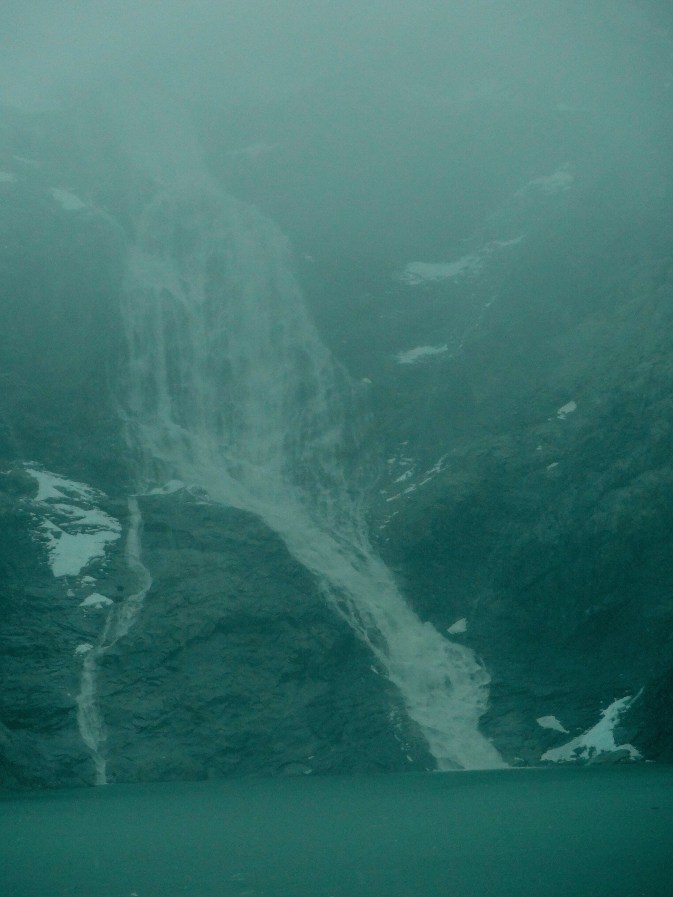
Thursday, February 2 was our first day in Antarctica. It was a pretty ugly day, full of fog, snowstorms & 40 mph gales. Nonetheless, your intrepid tourists spent much of the day on deck, freezing our you-know-whats off. We told you that Patagonia & the Magellan Strait were impressive, but they can’t hold a candle to Antarctica. Unfortunately, because of the weather conditions many of the pictures really don’t convey adequately what it looked like in person. But here are a few to start out with, of coastline & icebergs & mountains wrapped in mist, all during a snowstorm.


Stay with me, ‘cause the pictures got better as the sun came out in the afternoon. We saw some impressive mountains, I think on Wiencke Island (we are not entirely sure of the location of many of these pictures).


There was also wildlife, particularly birds on the first day. They move incredibly fast and it is very difficult to catch a decent picture of a bird in flight. There were a dozen or more wasted pictures for every good one below. But I did manage shots of a Kelp Gull (cheating a little, since this was actually shot in Ushuaia), a Giant Petrel, a Wandering Albatross (the largest seabird in the world, with an 11 foot wingspan) & the beautiful Pintendo, or Cape Petrel. As always, you can see the captions by moving your cursor over the picture.


Fans of towel animals may be wondering where they are. Well, they stopped coming for a couple of days, then we got reruns for a few days. We are told that the laundry can’t get sufficient water in the Antarctic region and the towel animals are the first thing sacrificed to reduced laundering. I hope we get them back when we reach Argentina. In the meantime here is an ice sculpture to satisfy your artistic needs; it is a pair of hands holding a red globe centered on Antarctica. I wish it had been made for purely artistic purposes, but in fact it was the background for a jewelry raffle & sale.

So we went to bed the first night, hoping for better weather the next day (preview: prayers answered).
Ushuaia, Argentina & the Beagle Channel
On January 31 we sailed down the Beagle Channel (named for the ship on which Charles Darwin visited here) toward Ushuaia. Yet more fabulous scenery (ho-hum) with a healthy helping of swirling clouds.


We saw some more glaciers (or what’s left of them), but I can’t remember the name of each of them. There were about 6 and they were named after European countries. This area is nicknamed Glacier Alley.

We passed a rainbow unlike any we have ever seen. It was not in the sky, but on a hillside beside the channel & lasted until after we had passed beyond it.


 About 12:30 we came to Ushuaia, Argentina, located on the island of Tierra del Fuego on the north bank of the Beagle Channel. It has a rather spectacular setting. It is also quite remote. It began as a penal colony which could not be escaped, since you would not survive an escape through this territory without quite a bit of gear & preparation. There is also a well-known lighthouse here called the Les Eclaireurs Lighthouse (red & white stripes, below). It is (often said to be Jules Verne’s “Lighthouse At The End Of The World,” but it’s not (we think the tower with the black roof below, which is at the penitentiary in Ushuaia, may be the one).


Ushuaia is generally considered the world’s southernmost city, but there are two other claimants to that title. Punta Arenas, though north of Ushuaia (and undoubtedly the southernmost city on the South American continent, since Ushuaia is on Tierra Del Fuego island), claims that it is the southernmost city, and that Ushuaia is just a “village,” since it has only about 50 – 60,000 people. Puerto Williams, which lies south of Ushuaia along the Beagle Channel, is certainly the furthest south of the three, but since it only has about 2400 people, it does not qualify for the title of city to the folks here.
Well, we were supposed to pull up to the dock (next to last picture above) and then have from 1:30 to 7:30 to spend in Ushuaia. But the wind was very high & the water was very turbulent. The ship tried to dock but couldn’t, so the Captain announced we would have to go ashore in tender boats. A little while later he came back on the loudspeakers to announce that the Argentine authorities had informed him that their dock was closed to us, even in tenders, and he said it was just as well since we wouldn’t have been able to land in the tenders anyway because of the turbulence. So, the result was that what you see in the pictures above was pretty much all that we were able to see of Ushuaia.
This actually turned out to be a stroke of luck (unless, like us, you actually wanted to see Ushuaia). We ended up leaving several hours earlier than scheduled and the Captain hauled ass toward Antarctica. By doing so, he was able to outrun a nasty storm heading into the Drake Channel (which is the part of the Southern Ocean you cross to get from South America to the Antarctic Peninsula) from the West. We had an extremely rough night bouncing over the waves near Cape Horn (which we didn’t see because it was night when we passed it), but the Captain assured us the next morning that if we had left Ushuaia at the scheduled time it would have been very much worse. We heard later that one woman slept that night in her life jacket, so not everyone agreed with the Captain’s post hoc assessment that the crossing was “relatively calm.”
Anyway, I will leave you with some pictures of the Beagle Channel south of Ushuaia, including a couple of pictures of Puerto Williams as we sailed past. And our next missive will be from (or at least about) Antarctica.


Punta Arenas, Chile
The morning of January 30 found us docked a couple of miles north of Punta Arenas, Chile. Because another cruise ship was due in that day Prinsendam had to move out into the harbor to make way at the dock. So while we left by the dock for our excursion to see the Magellanic penguins at Seno Otway (Otway Sound), we had to return by tender boat from the center of town, which suited us perfectly. Punta Arenas means “Sandy Point,” which was the name of this place until the Spanish took it over. It has between 100,000 & 150,000 people.

The main thing here for us was penguins. You can’t come all this way and not see some penguins. We went on a shore excursion to Otway Sound, about an hour from Punta Arenas (on a bumpy unpaved road), where there is a rookery of Magellanic penguins (named, obviously, after the Magellan Strait where they breed). The place is on private farmland and you have to walk on a boardwalk for about half a mile across some pretty barren land to get to the penguins.


Magellanic penguins mate for life (which can last 30 years) so you usually see them in pairs.


Note that these are not all the same penguins; each pair is different, although they look remarkably alike. There was also a penguin chick (this was near the end of mating season and all the penguins will be gone in another month or so). He still has light gray feathers with a mostly white head and some fluffy chick feathers still on the back of his neck. It was funny to see his parents chasing him around, scolding him (“You get right back here, young man!”), although because he was bigger than they he mostly ignored them. The chicks have to grow up fast; in a few weeks all the penguins will leave & have to fend for themselves in finding food and swimming.


On the beach nearby a lot of penguins were gathered, presumably to look for food.


And here are a few more, just because I have them. They look like they have big smiles on their faces.
.


Near the penguin rookery we also saw some Rheas. They are relatives of the Ostrich and I am told that crossword puzzle fans will be familiar with them (or at least with their name).


While the Otway Sound area looked pretty bleak from afar, with no trees or bushes, if you looked closely there were some striking wildflowers close to the ground.


From Otway we went into Punta Arenas, passing on the way a forlorn looking antique car museum in the middle of nowhere (literally); I can’t imagine how it gets any visitors. In Punta Arenas there was, of course, the Plaza de Armas.


In the Plaza de Armas was a monument to Magellan (the city is, after all, on the Strait of Magellan). Across the street was the church & around the plaza were a number of interesting buildings with vintage architecture.


Two more statues: one of Bernardo O’Higgins, one of the leading generals of the South American independence struggle. You will recall statues at previous ports of tuna and penguins & seals; here there is a statue of the tail of a whale, which can be found in the Strait of Magellan (but not by us, alas). There was also a lovely rainbow over the harbor after we got back to the ship.


And finally for today, a look at some old pictures of the original inhabitants of this area, all of whom are long gone. The pictures are outfitted with reproductions of the masks they produced. You will note that they painted their bodies all over (I don’t actually know if that is paint or tatoos). More interesting, however, is that they lived in this area stark naked (if you look closely, you can confirm this for yourself), and believe me it gets cold here (its summer now, & still pretty chilly). Clearly, they were made of sterner stuff than we are.


Strait of Magellan
January 29 was a ship day as we sailed through the Strait of Magellan toward Punta Arenas. The Strait cuts all the way through the continent several hundred miles north of Cape Horn and, as you might have guessed, Fernando Magellan was the first European to go through it.
In the morning we saw our first glacier, called the Amalia Glacier. Most of the glaciers down in this area have been shrinking for the last 200 years, but faster & faster over the last 30 years or so. The Amalia Glacier is the biggest one we have seen in South America (I expect we will see more in Antarctica).


The front wall of the glacier, which you can see above, is about 200 feet high. On the first small picture, after the one with Mary in it, you can see an island in front of the glacier. If you look very closely, there are fairly tall evergreen trees on top of the island, so that gives you an idea of how high the glacier wall is.
We continued through the Strait of Magellan after that. It is lined with impressive hills and mountains but it was pretty overcast & hazy, so the pictures really don’t show the mountains very much. We could see them in person, though, & the swirling clouds around them gave a mysterious air to the whole affair.


In the afternoon we came to a shipwreck from 1969. The story (perhaps apocryphal) is this: The convention at that time for instructing the helmsman was to say “all left” or “all stop” or “all right” or “all ahead.” It seems that a crew member made a proposal about something to the captain, who agreed, saying “Alright.” He said it a little too loudly and the helmsman immediately turned the ship to the right, directly into the big rock you can see in the first picture. It reminds me of the people who follow their GPS directions onto a railroad track or into a lake. I guess (hopefully) they now say “all starboard,” rather than “all right.” Anyway, no one was killed in the mishap, but apparently no one saw any reason to clear it away either.


We spent the rest of the day cruising toward Punta Arenas, with some small lighthouses spotted on top of hills by the water.


 BADER JOURNAL