Souda Bay (Chania), Crete 2022
As we were having breakfast by the large aft window in the Main Dining Room on the morning of October 26 the Zaandam sailed in through Souda Bay. On one shore we passed the ruins of an old stone fortification on the water. Located in Northwest Crete, this bay has been an important port for commercial and military ships since at least the 7th century BCE when the Minoans ruled the island. It has since been held by the Venetians and Ottomans as well as the Greeks who rule here now. There is an Allied cemetery nearby and today there is a Greek & NATO naval base.


There is a small town at the end of the bay but not much to see there. So we caught the local shuttle bus to the nearby city of Chania (pronounced with a silent C). Dating back more than 3500 years, when it was a city called Kydonia in the Minoan civilization, this is one of the oldest continuously operating towns in the world. In fact, Kydonia’s citizens are mentioned in the Odyssey. In the ensuing centuries it has been controlled by Greeks, Romans, Byzantines, Venetians, Turks, Germans and Cretans. With a population a bit over 100,000 it is a delightful city to explore, which is what we spent this day doing.
The shuttle dropped us off in a green square across from the Agora, a huge enclosed marketplace built in 1913. Unfortunately we couldn’t visit the Agora because it had been completely gutted, with only most of the outside walls still standing. We hope it is being renovated rather than demolished, but on this day there were no vendors (or much of anyone else) there.
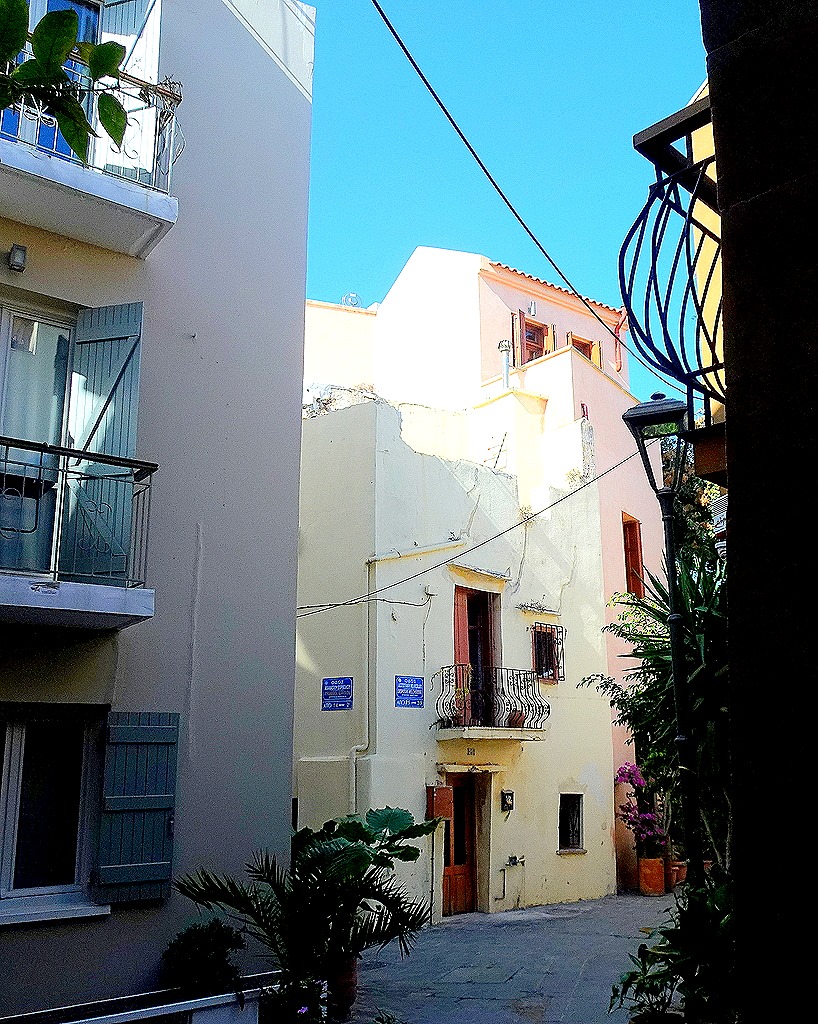
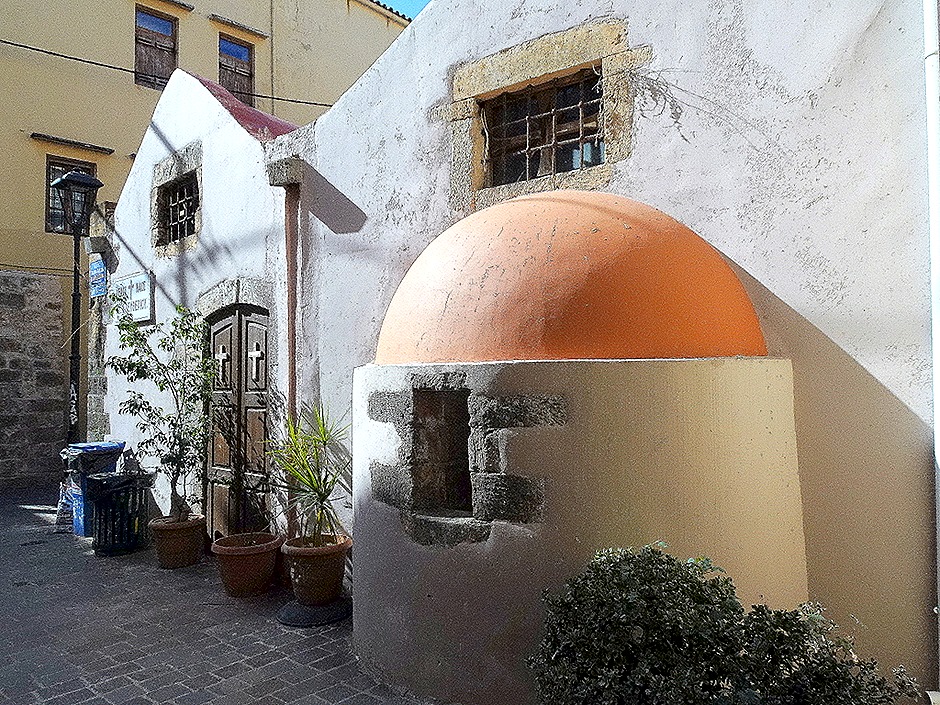
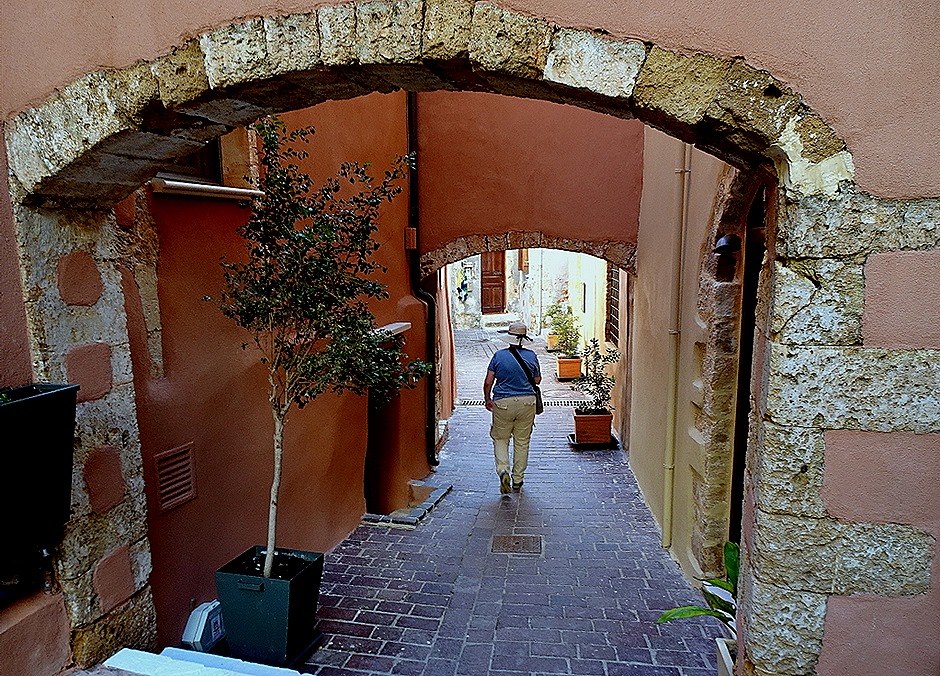
We had read about archaeological excavations not far away trying to uncover Minoan ruins (although many of them are covered by modern buildings). We didn’t find them, but we did have a chance to wander some through an atmospheric neighborhood of narrow maze-like streets that we think is called Splantzia. On one of these back streets was a tiny Greek Orthodox church.
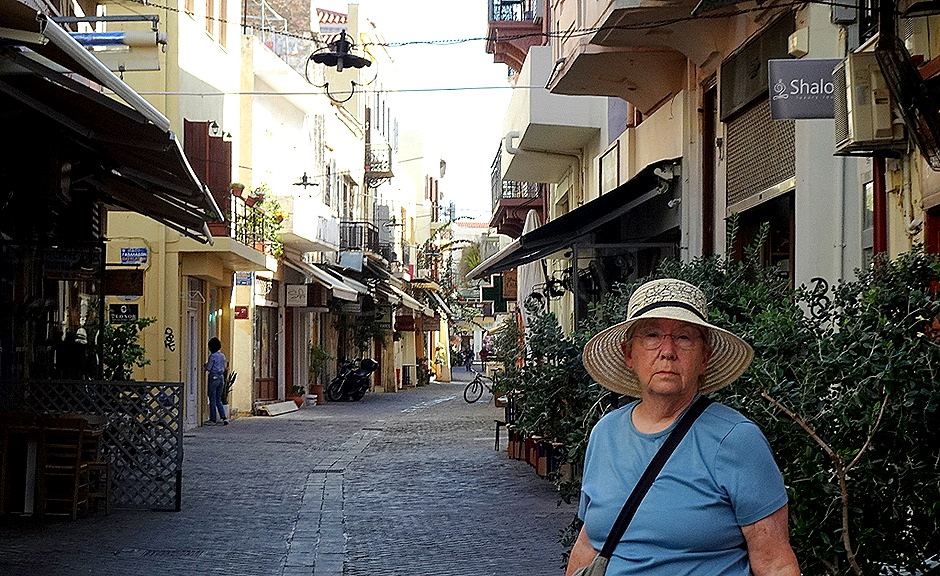
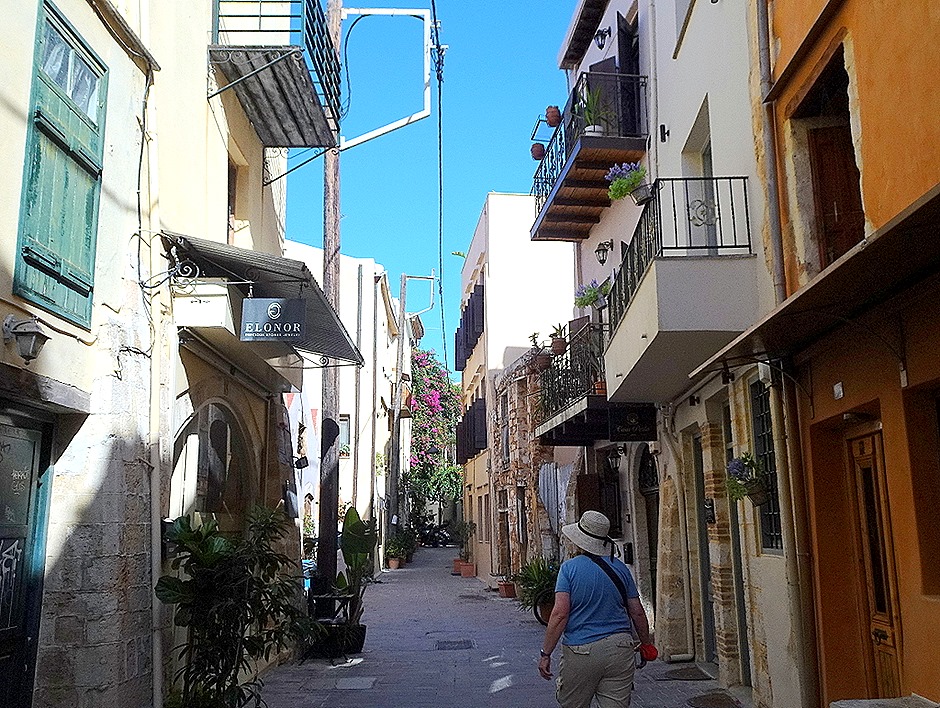

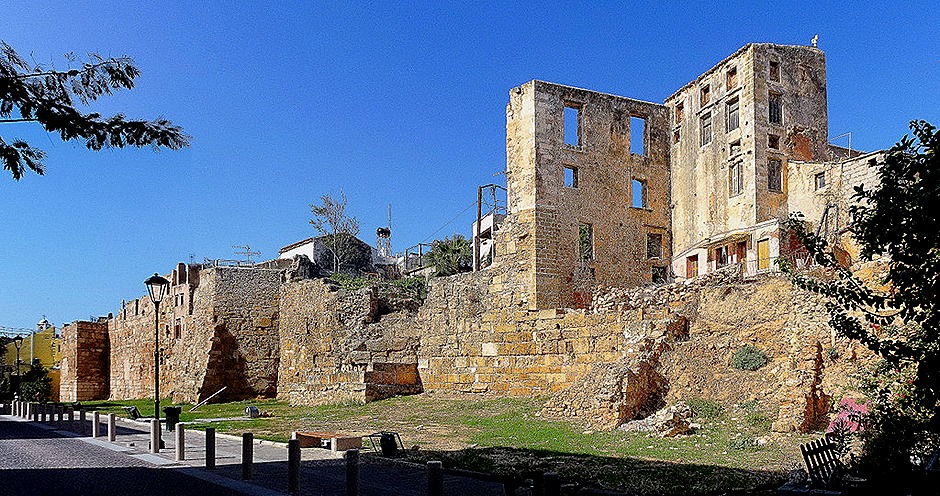
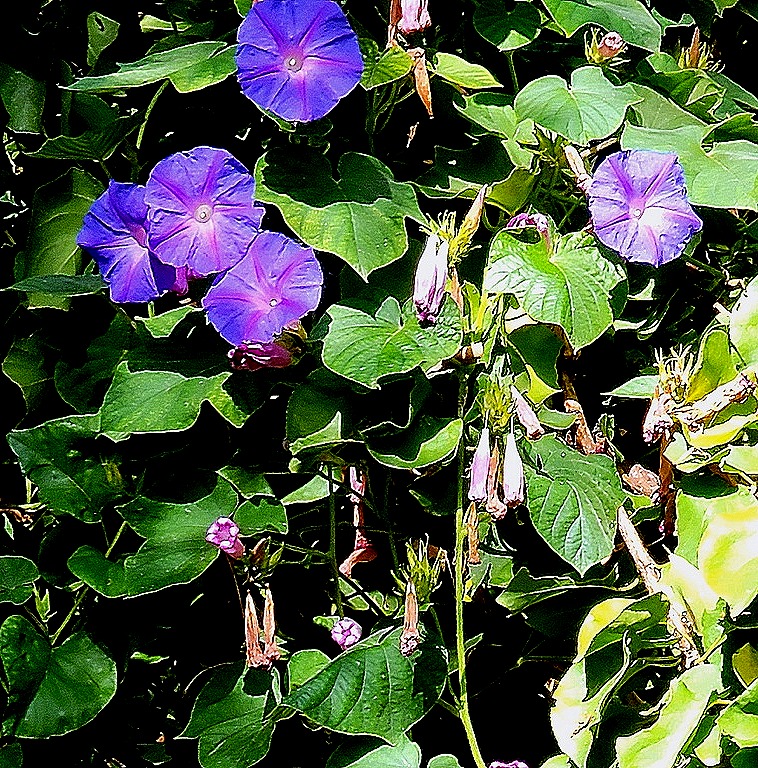
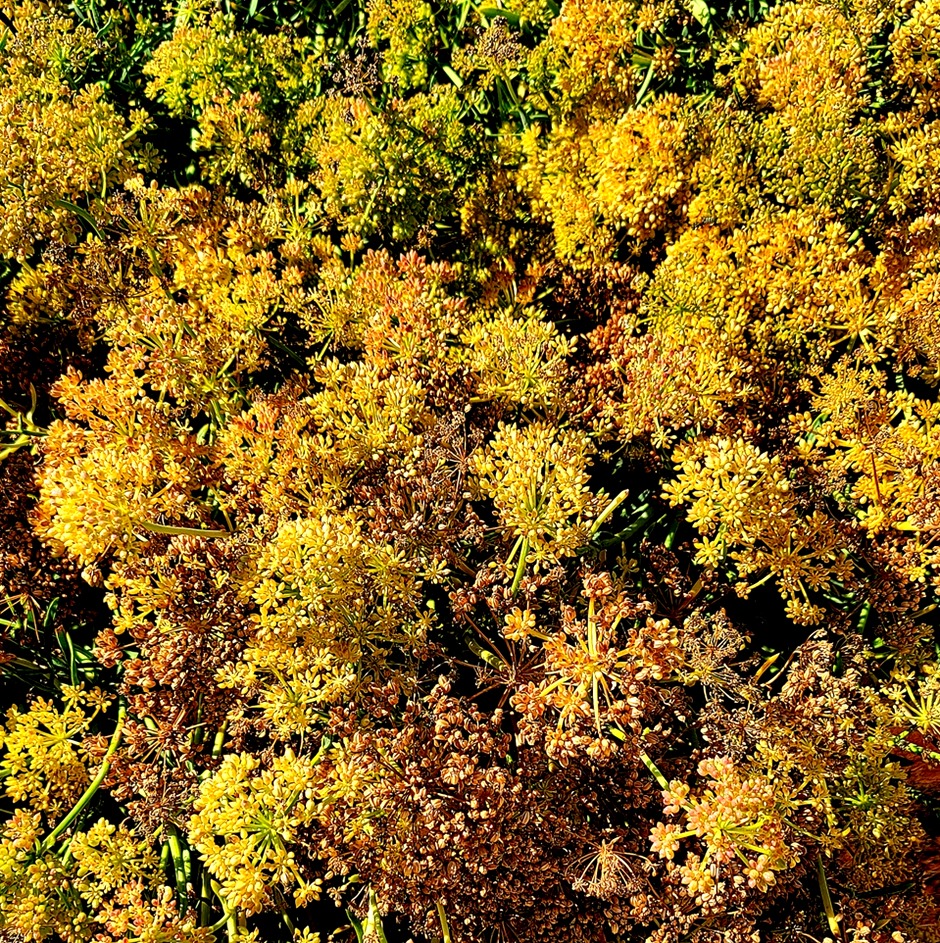
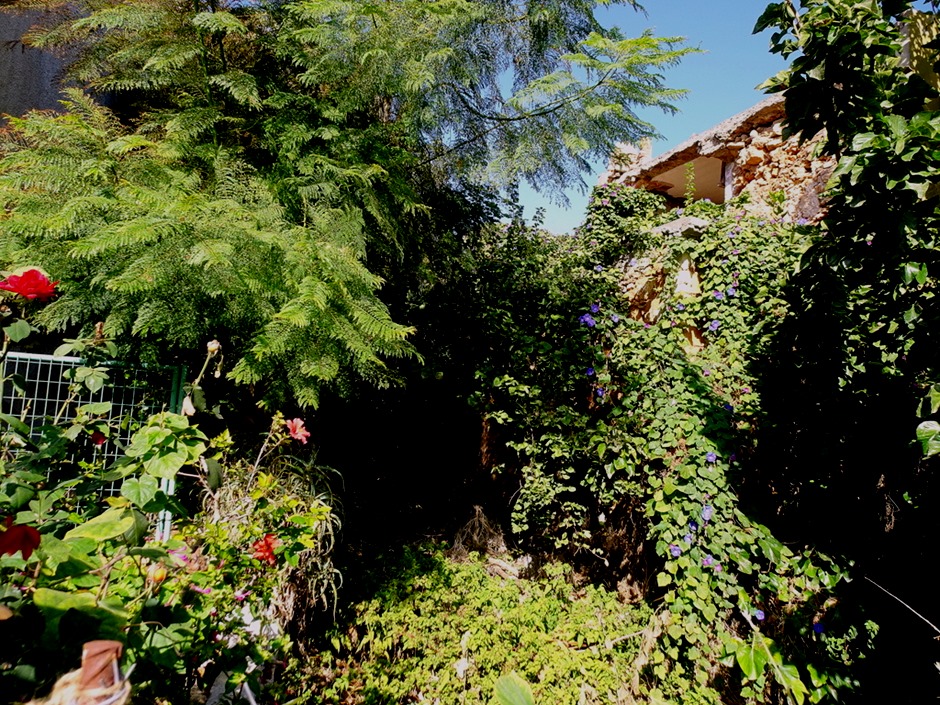
We came out to a wide street with high retaining walls and ruined buildings on top. With think this hill is called Kastelli. We aren’t sure what to make of it (the signs are in Greek), but it might be the remains of old city walls and we understand that Minoan excavations are in progress there. As we walked along the road at the base of the walls we encountered several nice domestic gardens.
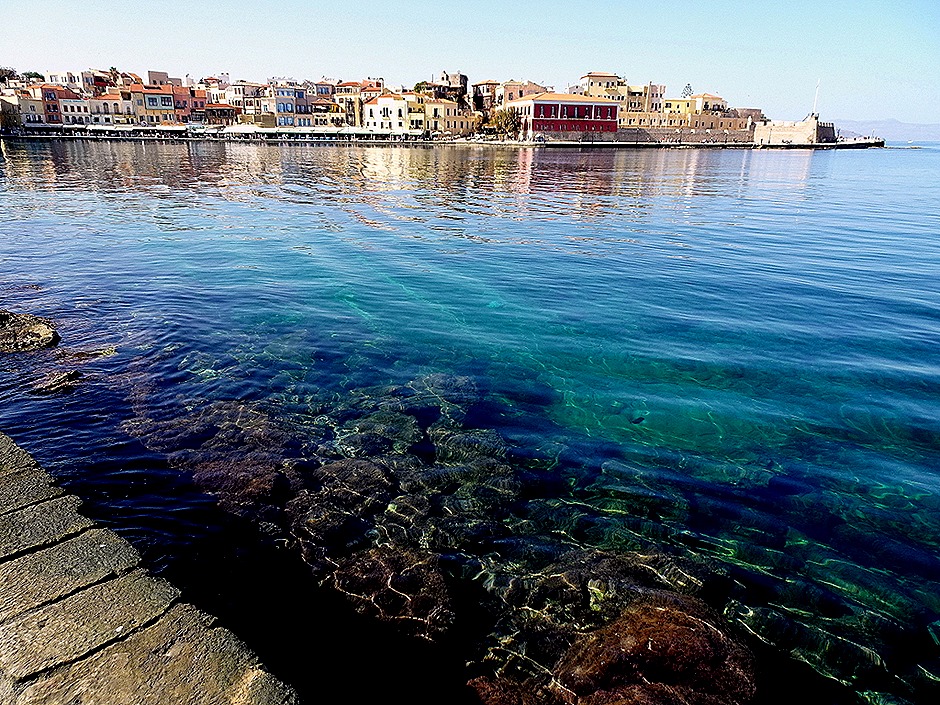
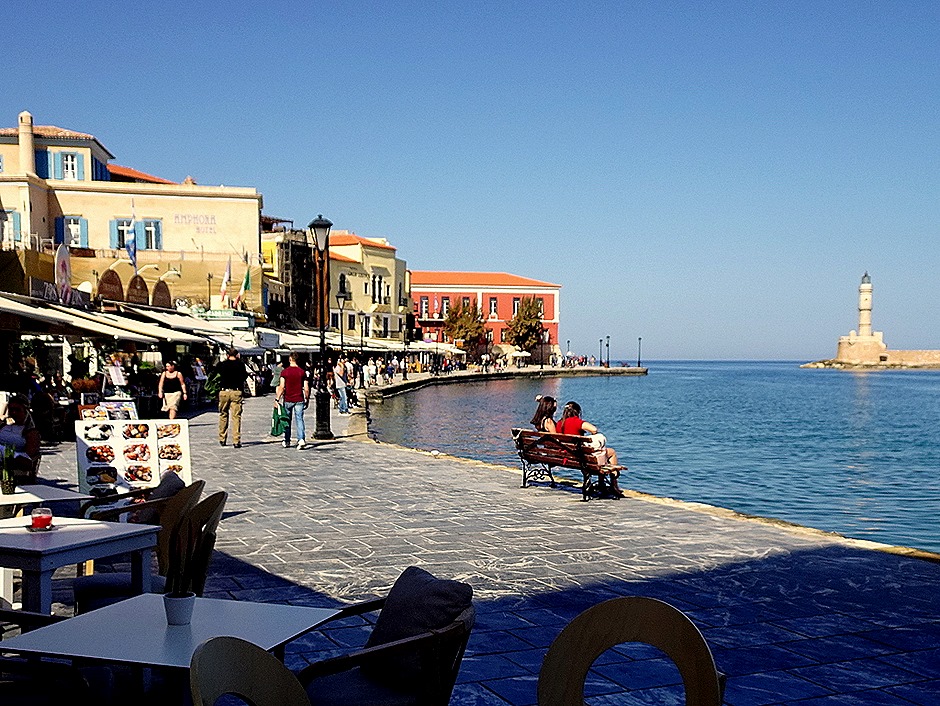
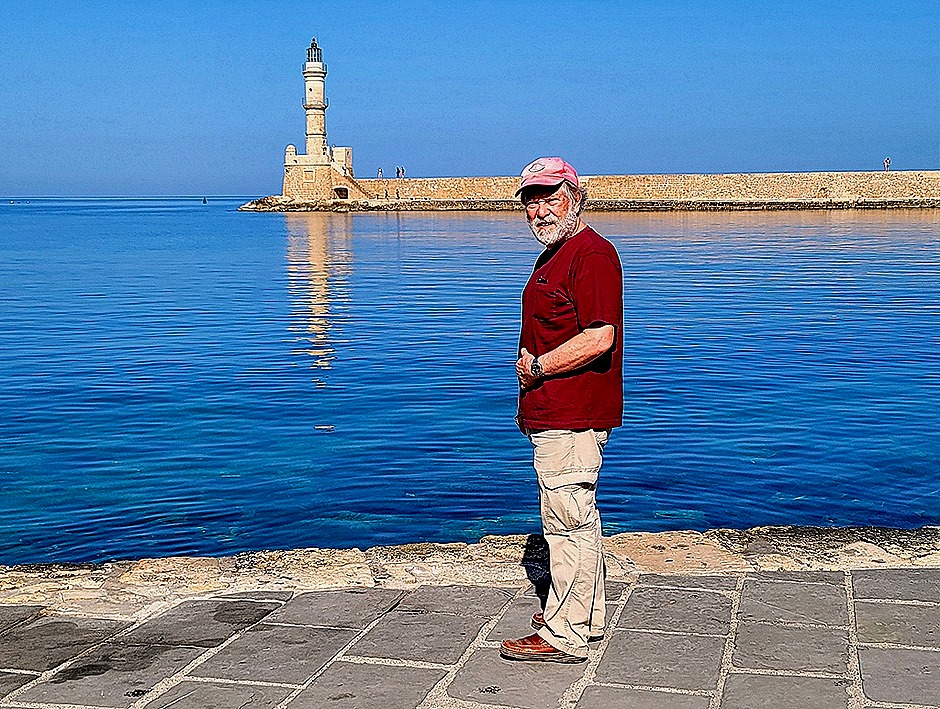
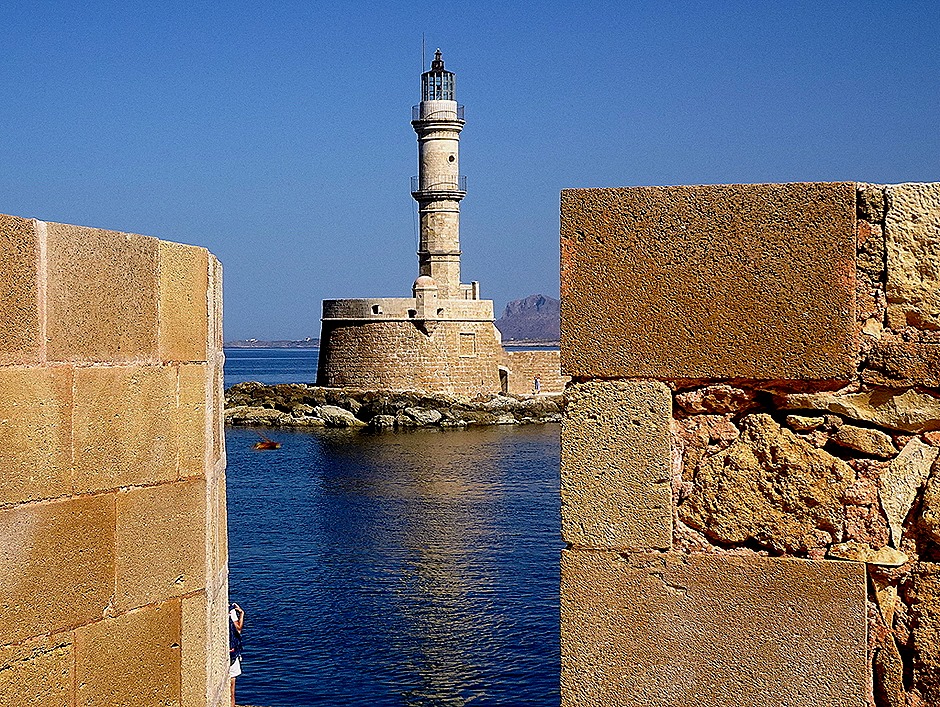
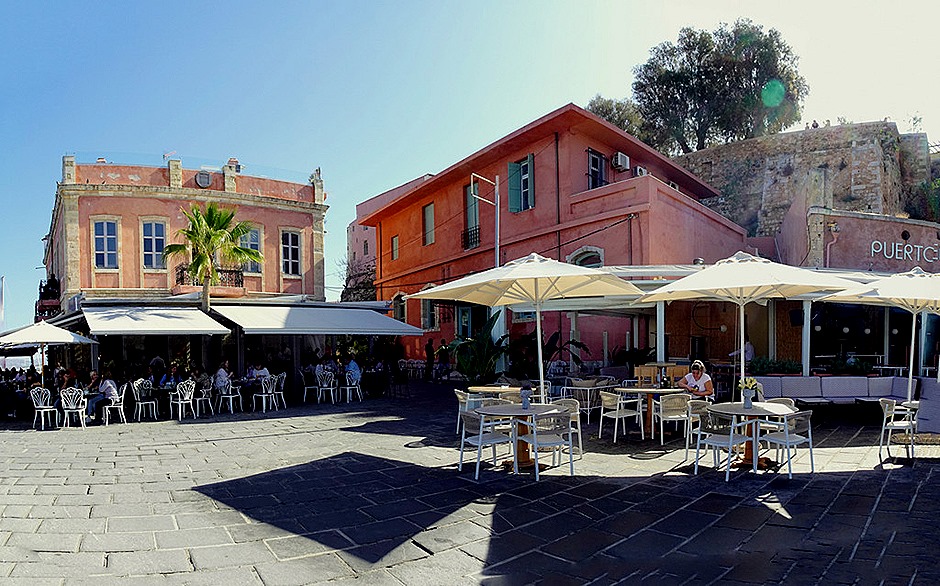
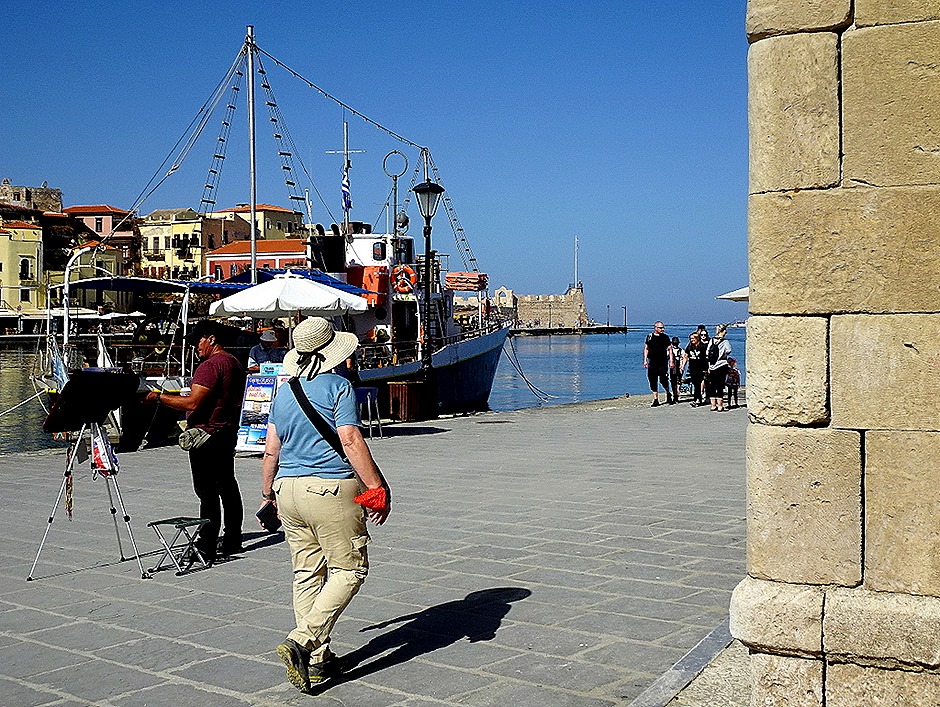
We continued walking north until we came to the center of town, which is arrayed around its old harbor. It was a beautiful day and the area almost glowed in the sunshine. The harbor is not big as harbors go and it has a narrow entrance from the sea between the lighthouse at the end of a long seawall and a fort, all of which were built by the Venetians in the 16th century. The water is remarkably clear.



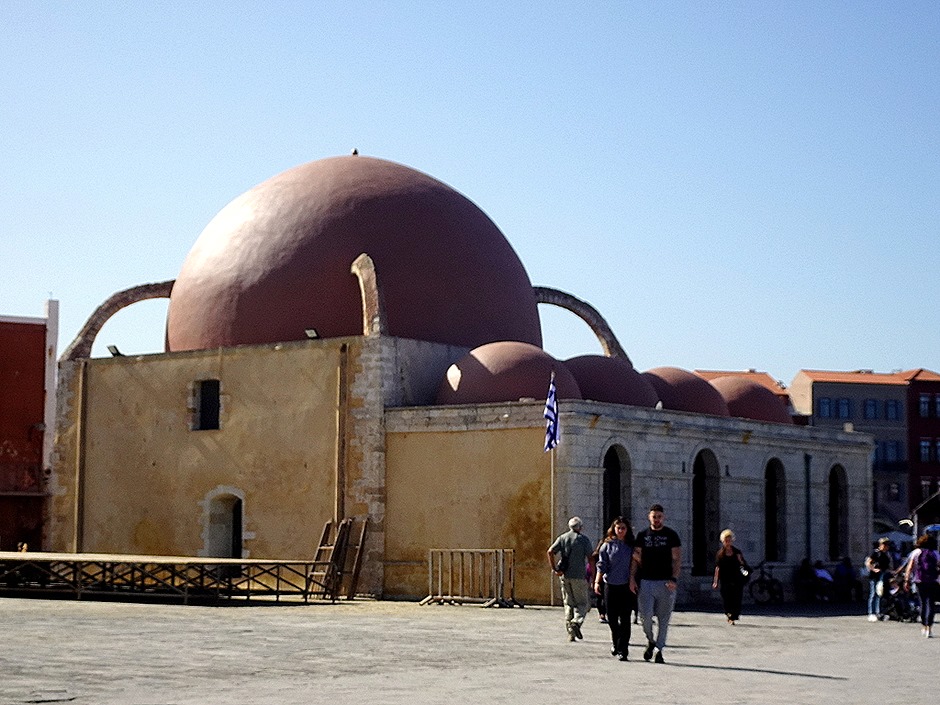
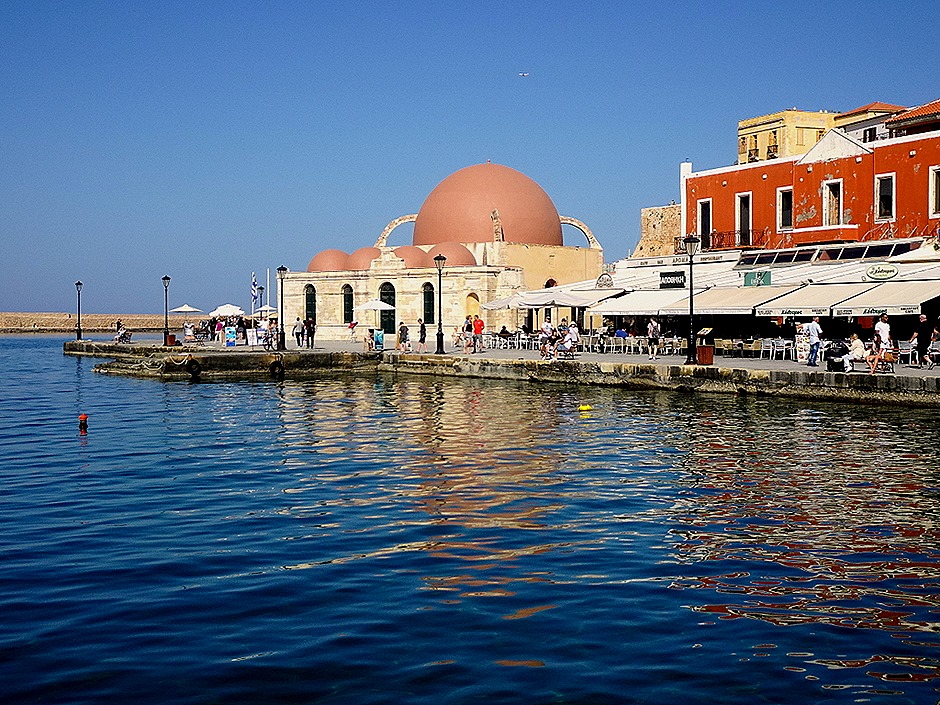
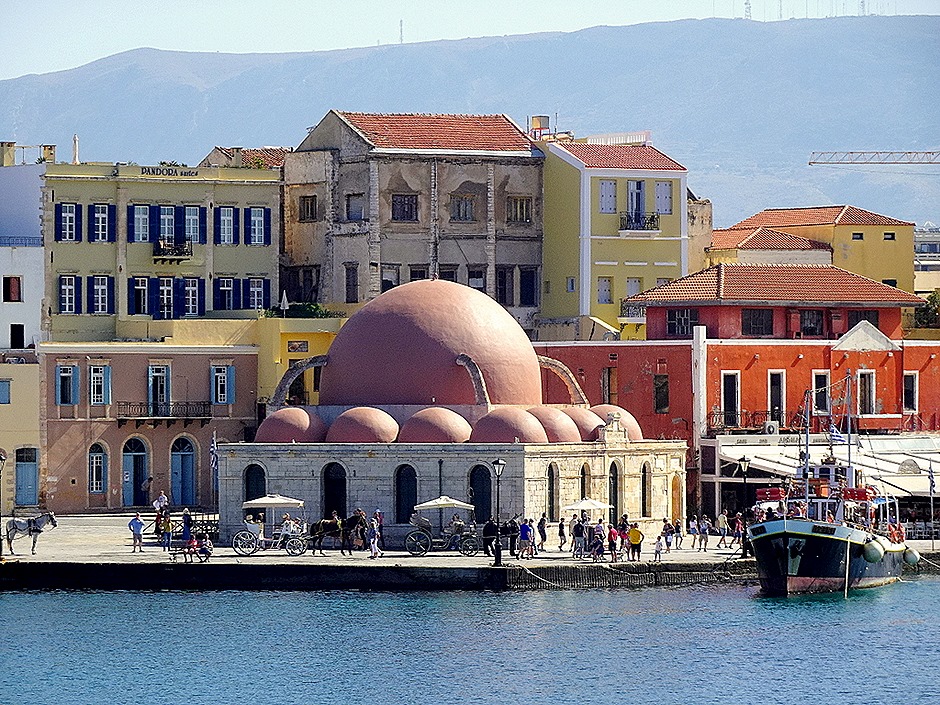
Small but quite distinctive, the Mosque of the Janissaries sits near the center of the harbor promenade. Built in 1645, the year the Turks took control of the city, it is no longer used for religious purposes. It has been an art gallery but was completely closed when we were there.

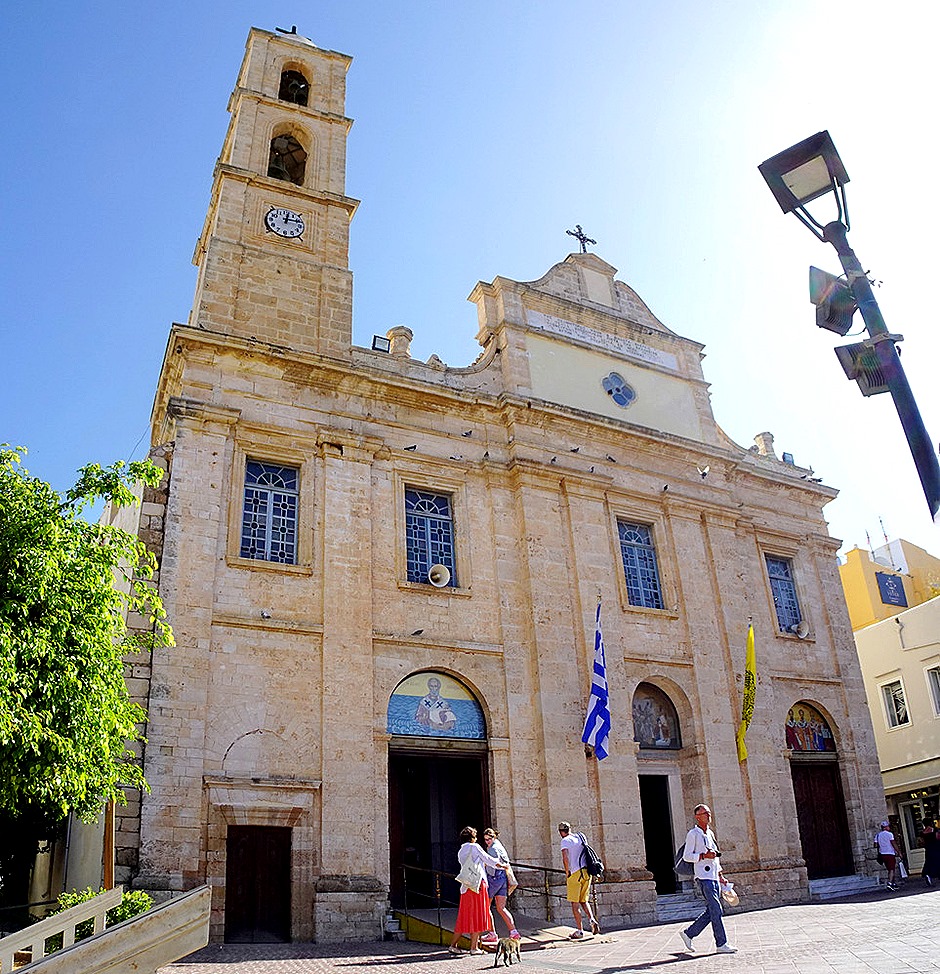
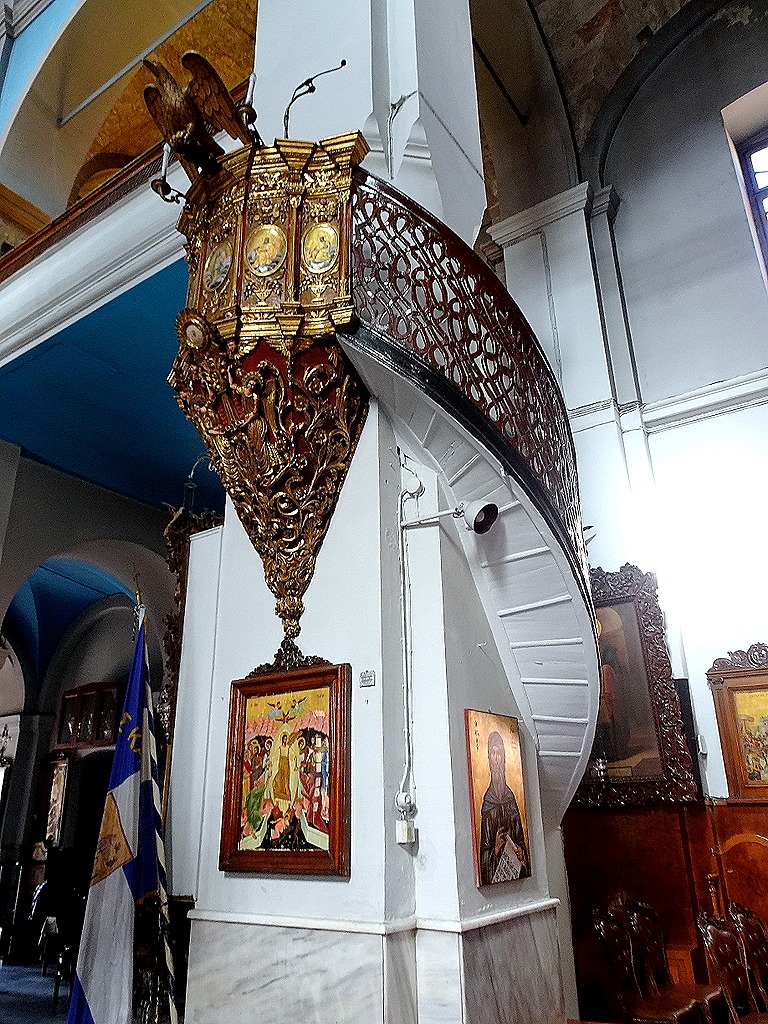
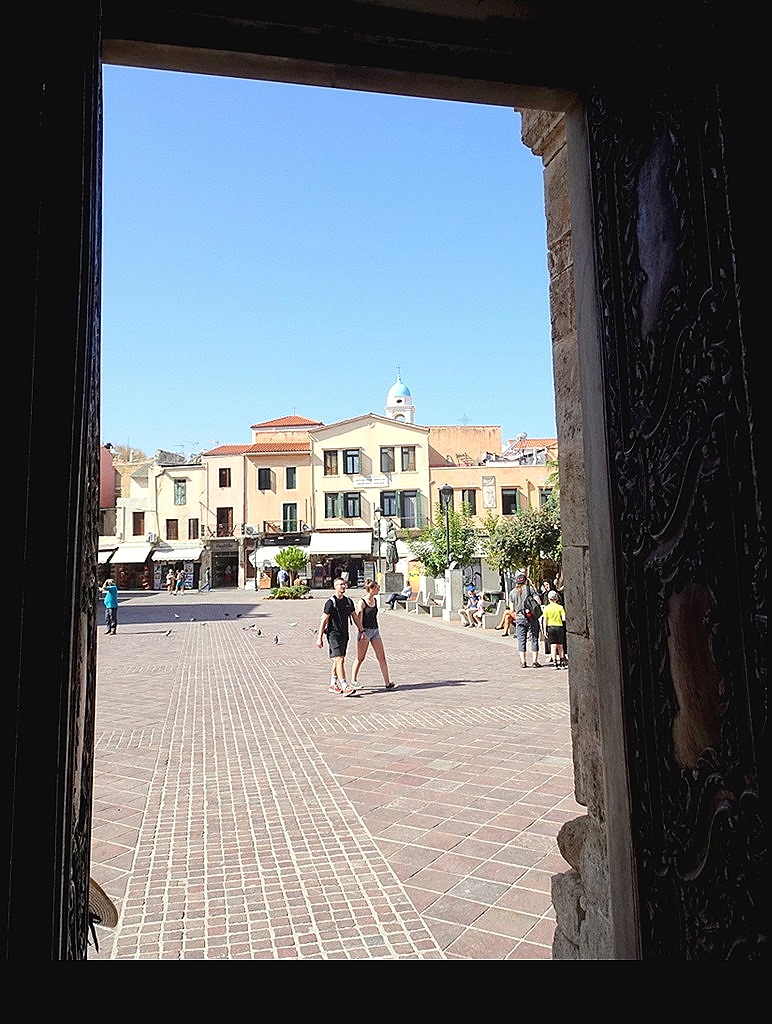
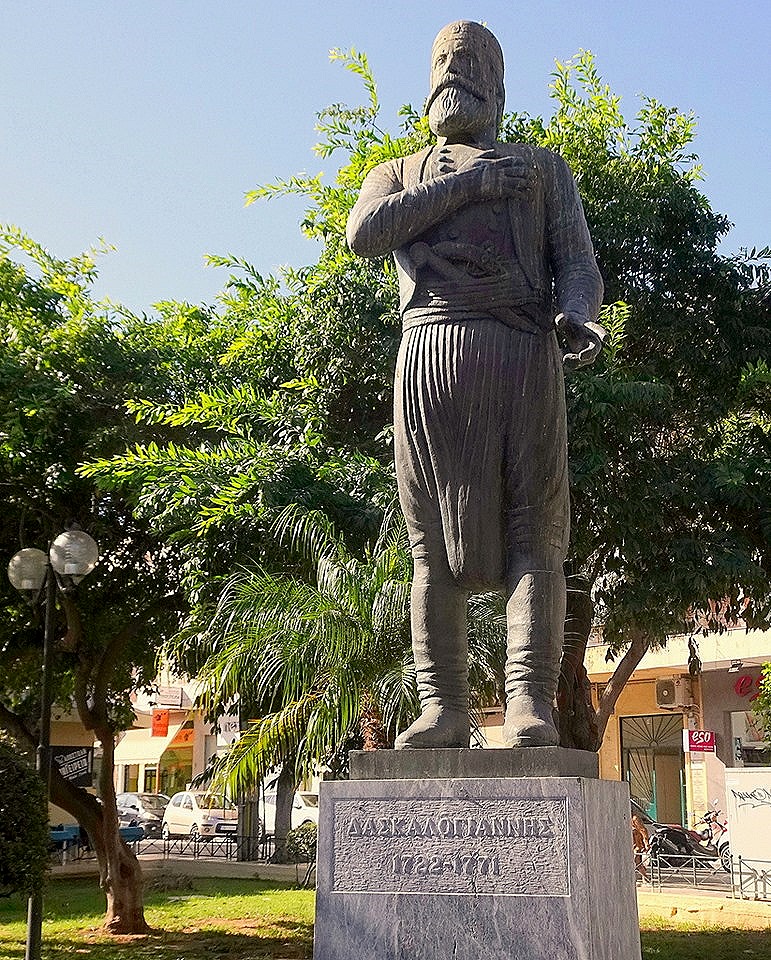
Up the road a bit from the harbor is the Cathedral Trimartiti, which appears to be Greek Orthodox. It was built in 1860 on a spot where an earlier Byzantine church had been destroyed by the Turks in 1645. The cathedral sits back from the road on a nice plaza with benches and a statue we think is of an 18th century Cretan martyr who was tortured to death here.


We set off to find the Etz Hayyim Synagogue, originally built in the 15th century. There had been a Jewish community in Crete for more than 2000 years when World War II broke out. The British controlled the island at that time and were, we have read, confident of defending it because of their sea power. But the first successful paratroop invasion in history bypassed the naval defense and, after 10 days of intense fighting, the Germans took control of the island in May, 1941. Chania suffered extensive damage in the fighting.
In 1944 all but one of Chania’s 276 Jews were rounded up by the Germans and placed on a transport ship along with 500 resistance fighters, heading for Auschwitz. They escaped that gruesome fate when a British submarine torpedoed the transport, which sank with all aboard. The names of the 276 are now inscribed on a plaque near the synagogue. The synagogue deteriorated over the decades from disuse, but in the 1990’s a group of local Christians, Muslims and Jews led an effort to restore it. The synagogue reopened in 1999 and is once again the center of a local Jewish community.
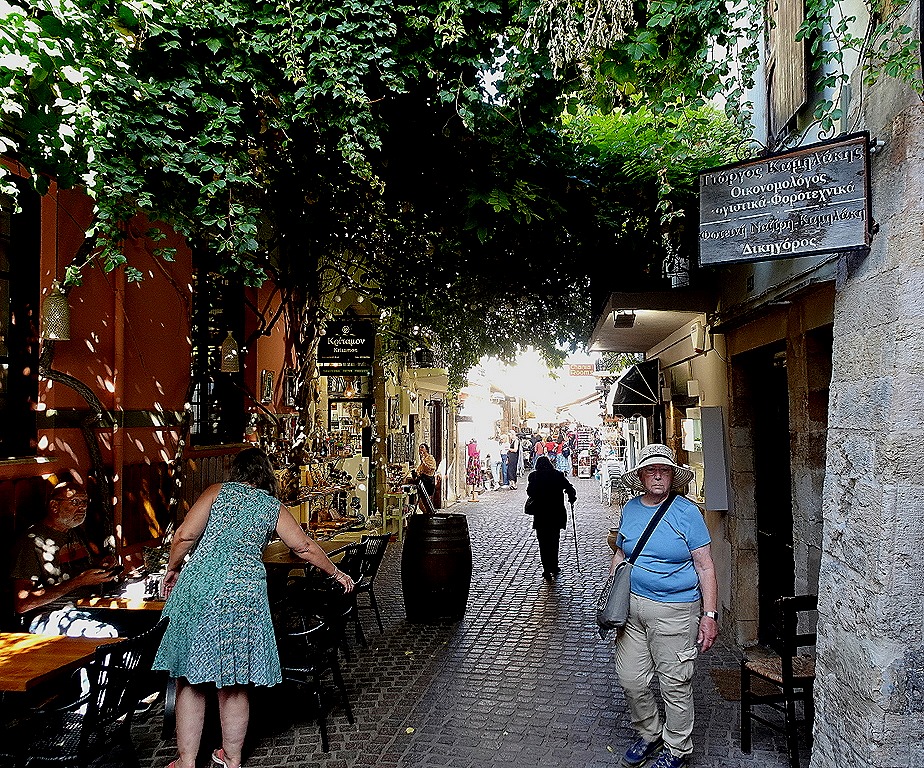
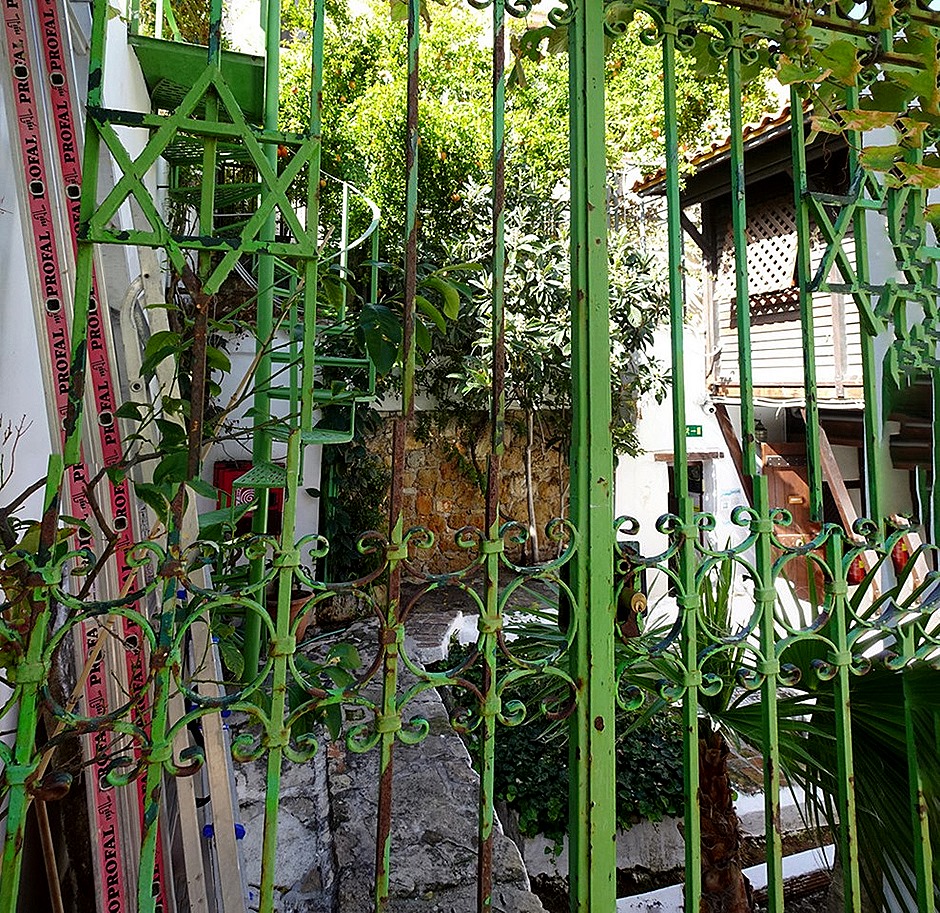
The synagogue was difficult to find because it is on a dead end back street. We walked around the area in which we understood it to be (the area of the medieval Jewish ghetto) but couldn’t find it. We asked a woman who was managing a sidewalk café and she said you reach it by walking through my restaurant! We did that and behind the restaurant, invisible from the main street, we found the synagogue. A sign on the gate said it was open during business hours and to ring the bell to gain admittance. We rang it several times but nobody came to open the gate so we were unable to view the inside. But we did get a couple of pictures of the building and its green gate with a star of David.

We walked through some interesting back streets and along the waterfront to the Firkas Fortress, across from the lighthouse.


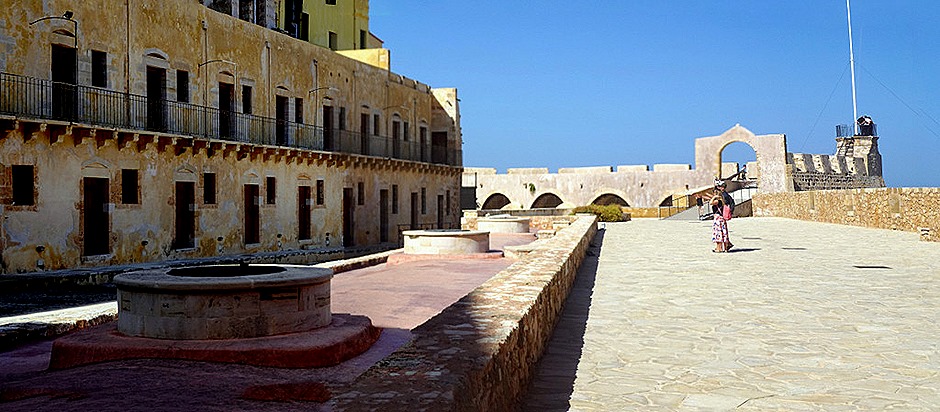
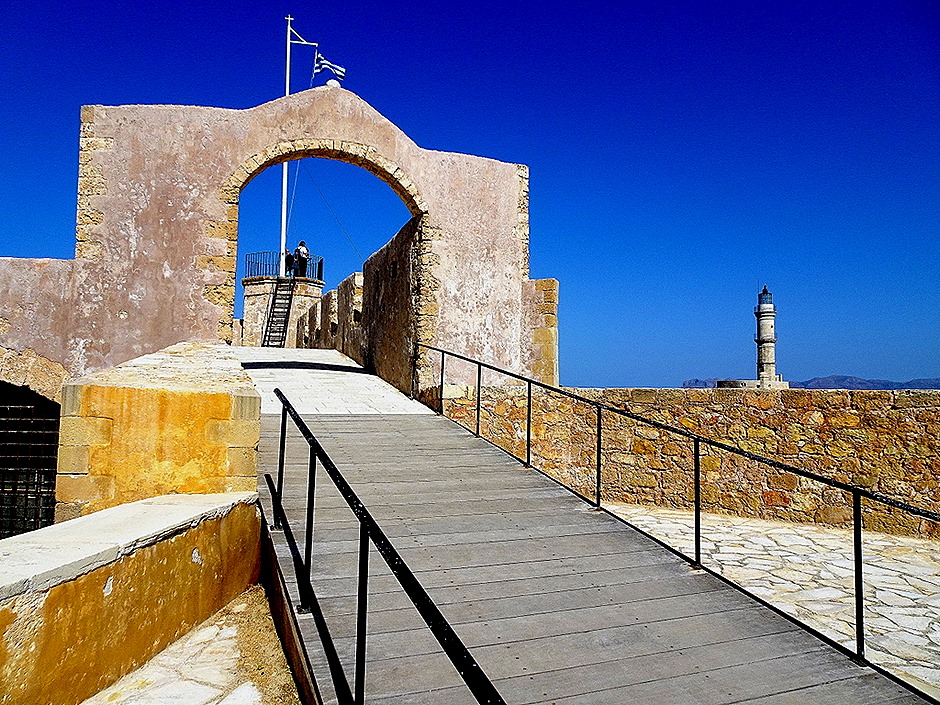
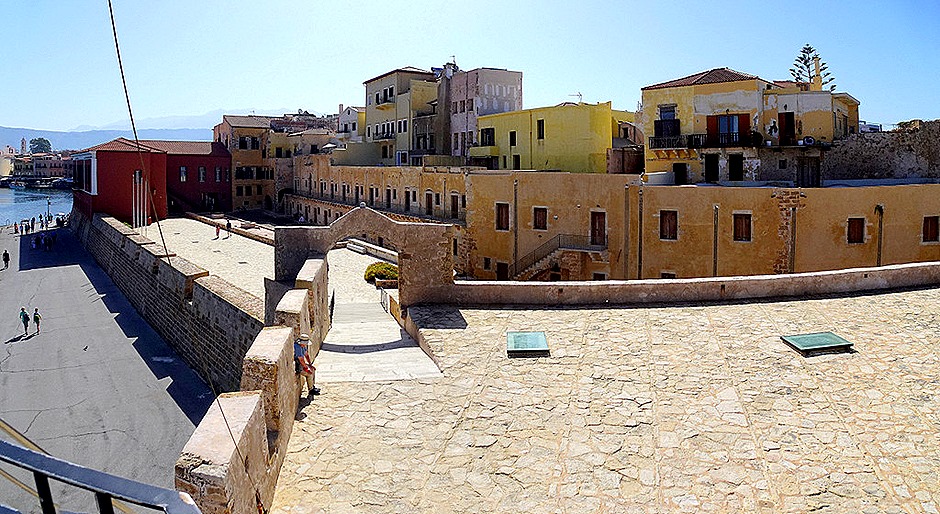
Constructed in 1629 by the Venetians to protect the harbor from raiders, the fortress was originally named Revellino del Porto. Control of the island passed to the Turks in 1645, however, and the name was changed to Firkas which means barracks, because Turkish troops were housed in it. At one time there was a chain that could be stretched from the fortress to the lighthouse to bar harbor entrance to hostile ships. Made of stone, it seems very sturdy and many cannon were installed on its high walls. The fort had great views of the harbor and lighthouse. In addition to the long barracks building on the side away from the water there were a number of what looked like skylights that covered former dungeons. A lookout tower was at the corner of the fort facing the lighthouse, but it was a difficult climb so Rick went up there alone.
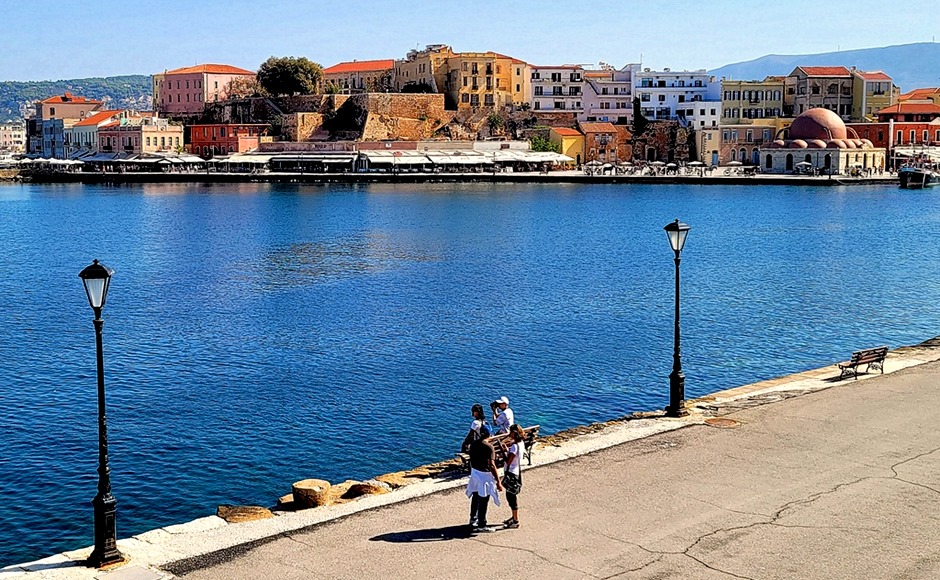


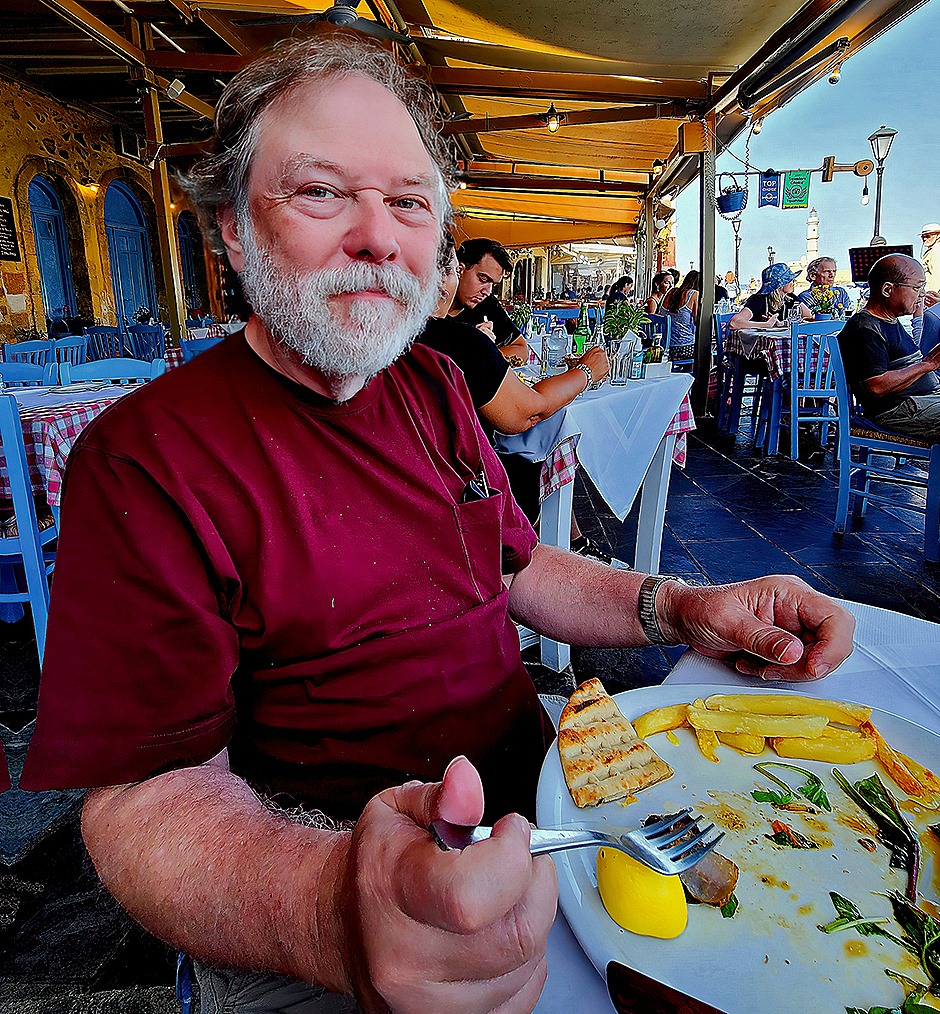
After leaving the fort we had a late lunch at a waterfront restaurant nearby called Amphora. There are quite a few waterfront restaurants around the harbor, so we had a lot of choices. This one advertised that they had been recommended by Tripadvisor and Lonely Planet, so we almost passed it up as a likely tourist trap. But we were glad we didn’t because we had a delicious souvlaki lunch along with a nice view. We planned to stop for gelato at a stand we spotted that was on the way back to the shuttle stop but when we asked for the bill the waiter brought us some tasty chocolate tarts and a small flagon of dessert wine on the house. We couldn’t turn that down, but what the heck we were on vacation so we stopped for the gelato as well.



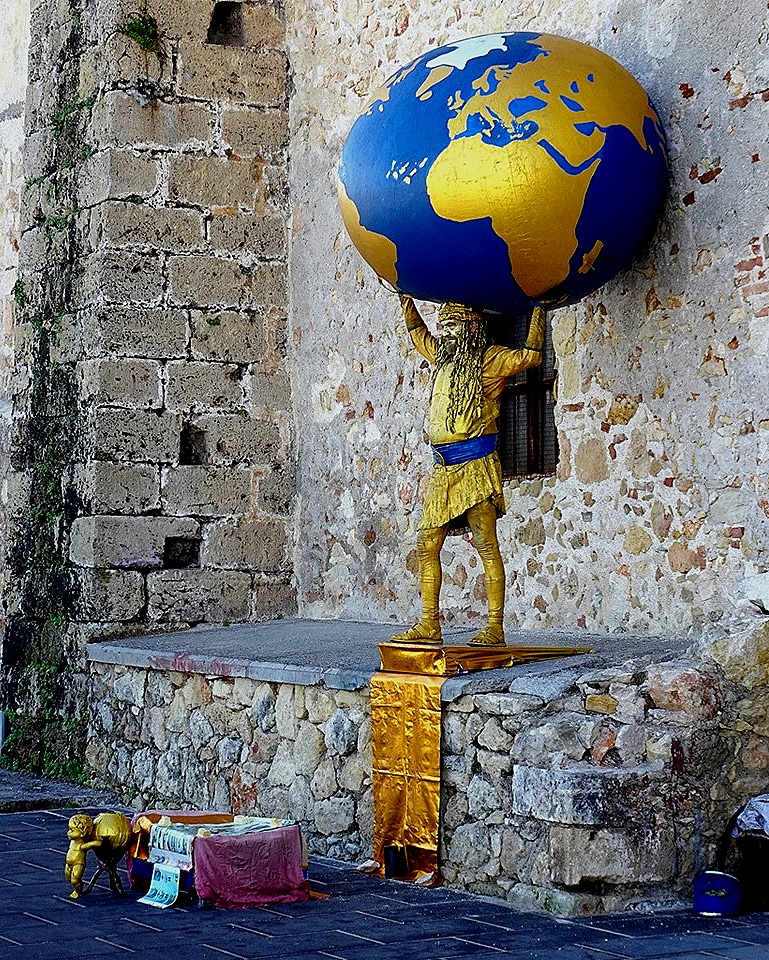
Lastly, a few miscellaneous photos that didn’t fit anywhere else. Notably, we passed a human statue of Atlas; we didn’t see him move but we know he can. He is standing in front of a building that looked like a warehouse (ergo no picture), but is actually the 500 year old Venetian Arsenal where they repaired their ships (today an office building).

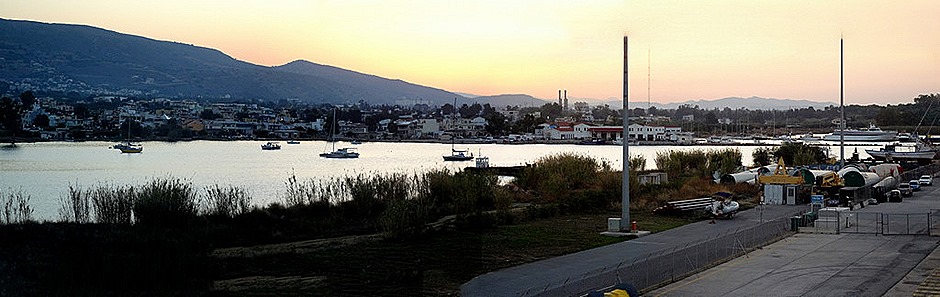
So that’s pretty much all there is to tell about our delightful day in Chania. We had our gelato on the walk to the shuttle bus stop then went back to the ship, which later that evening set sail to leave the Mediterranean Sea. The last sight before retiring was a muted sunset over the port of Souda.
Agadir, Casablanca & Rabat, Morocco 2022
Agadir, Morocco
We stopped in Agadir on the morning of October 20. Founded by the Portuguese in the 15th century, Agadir was mostly destroyed by an earthquake in 1960 that killed thousands of people; it has since been rebuilt into a city of close to half a million. Last time we were here we took an excellent excursion to the 1000 year old walled city of Taroudant and visited the Agadir Kasbah on our return. You can see that visit here:
https://baderjournal.com/2013/03/29/agadir-taroudant-morocco/
Today was scheduled to be a rather brief stop (7AM to 1PM) so there was no time for a long excursion like that. We planned to visit a museum and walk around the streets for a while and perhaps visit the souk (market) if there was time. But the museum turned out to be closed and then upon our arrival the local officials surprised the ship with a requirement that everyone coming ashore present a new negative Covid test. The ship distributed rapid Covid tests to everybody, which had to be displayed to the locals when leaving the ship. This was a little silly in our view since we had been warned that the tests are no good after 15 minutes and you had to wait 10 minutes to see the result, so by the time you reached shore the test results would be invalid. We were told later that an overnight trip to Marrakesh was delayed more than an hour longer because a few people’s tests were inconclusive by the time they reached the bus & they were sent back to do it over.
Anyway, with the short stop, the closed museum and the substantial delays going ashore we decided that it was not worth the trouble of taking the test & then a shuttle bus to an area where we were only going to be able to walk around the streets for a short while. So we stayed on the ship. Here is a picture of Agadir’s beautiful long crescent shaped beach front taken from the ship as we sailed away.

Casablanca & Rabat, Morocco
The next day, October 21, found us in Casablanca. Everybody knows this city from the great film of the same name but nothing in that movie was filmed here, it was all shot in Hollywood. Last time we were here we took a very long one day bus excursion to Marrakesh:
https://baderjournal.com/2013/03/31/casablanca-marrakesh-morocco/
This time, after a couple of excursions we had booked fell through (remember, we have been planning this cruise for three years), we ended up on an excursion to Rabat, the capital of Morocco. Founded in the 12th century, Rabat today has a metropolitan population of about 1.2 million. In the 17th century Rabat and its close neighbor Sale (sometimes called Sallee) were home ports for Barbary pirates. In 1912 France took over Morocco as a protectorate with Rabat as the capital and in 1956 Rabat became the capital of an independent Morocco.
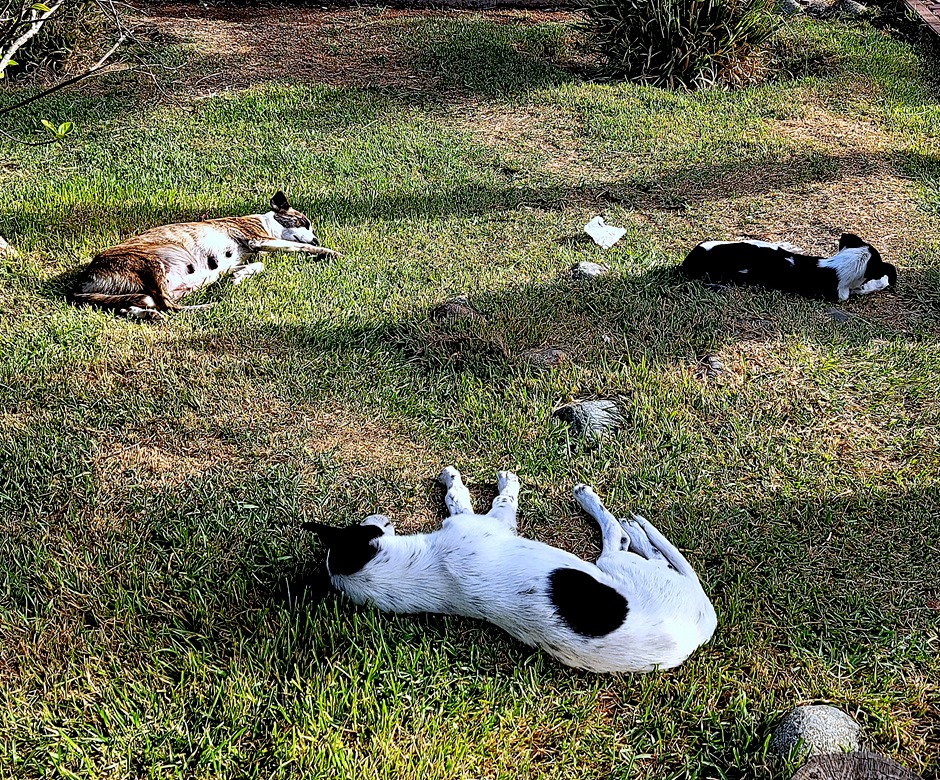
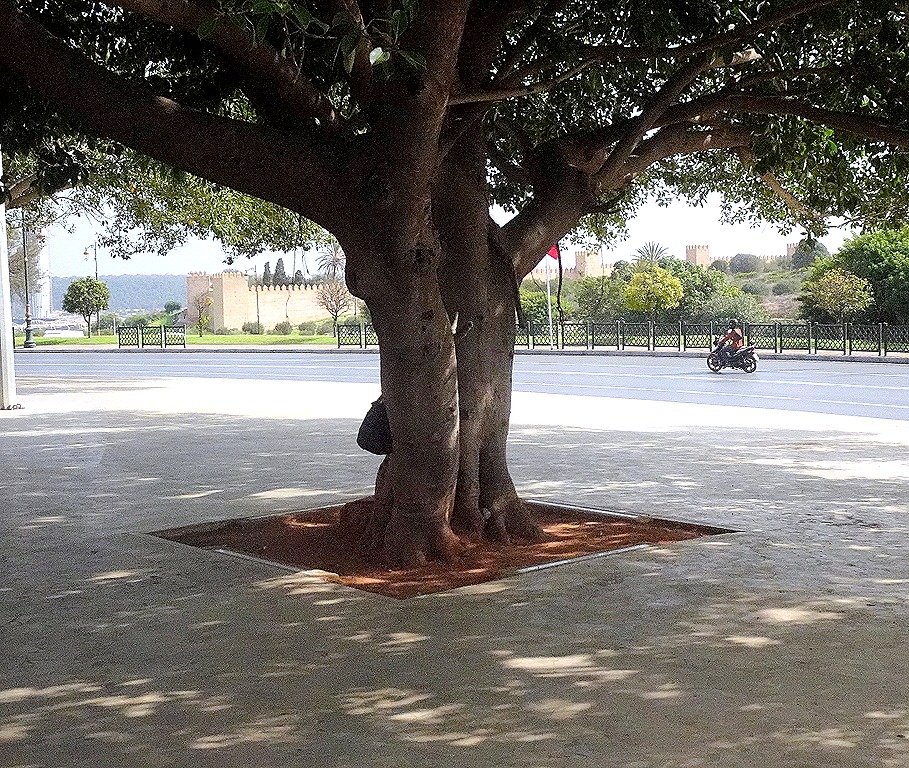
We set out for Rabat in the morning through the very congested traffic of Casablanca. At a rest stop shortly before reaching Rabat we encountered some dogs who were so sacked out they didn’t even notice all the people around them and also a lovely pink hibiscus. As we reached Rabat we drove down streets lined with trees (some kind of ficus, we think) pruned to look like one long plant with many trunks.


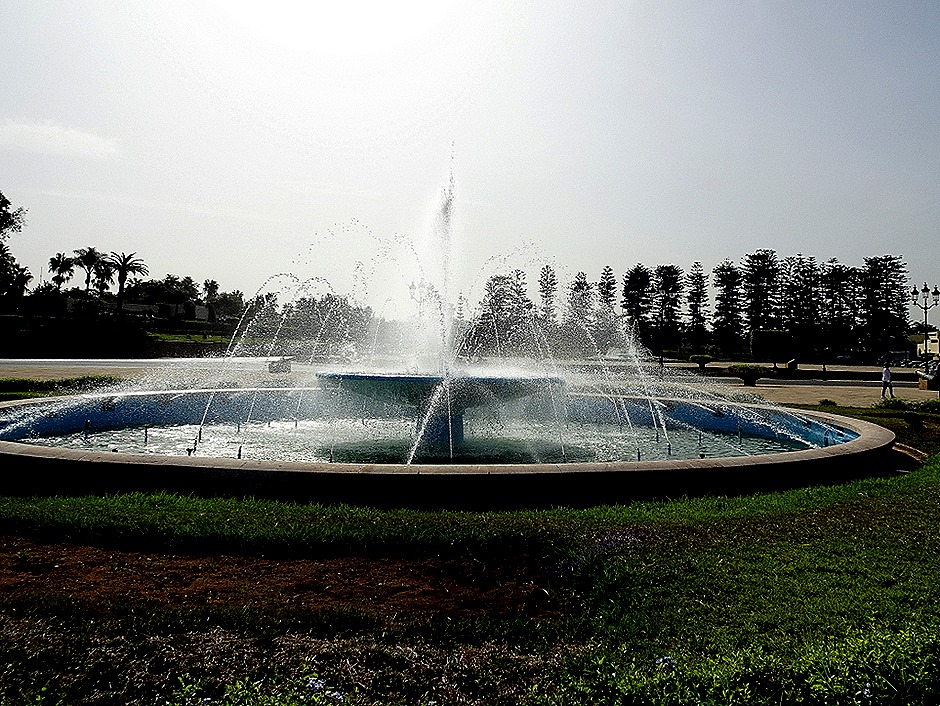
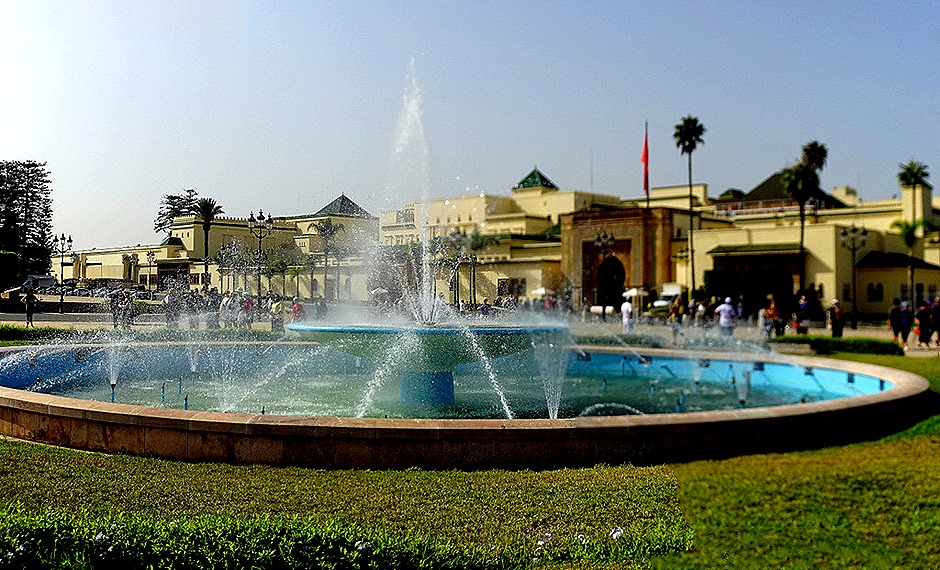
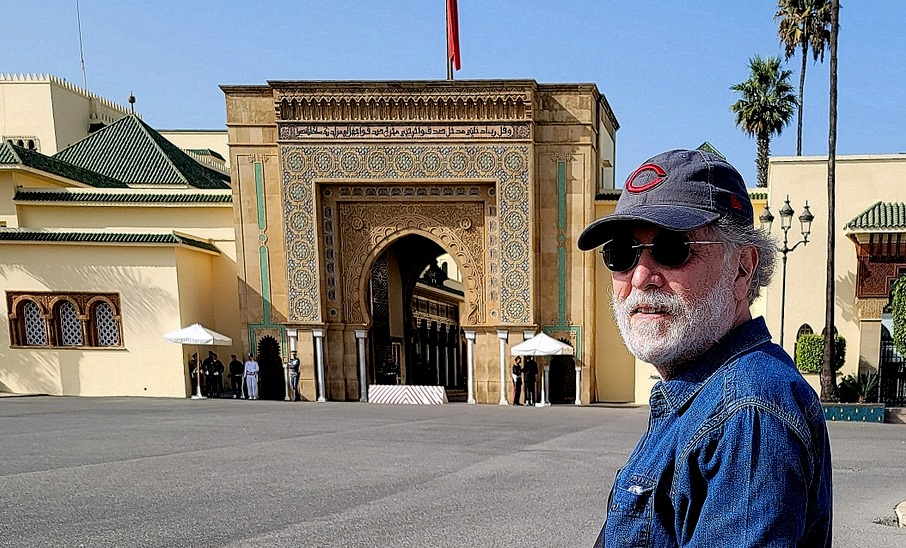
Built in 1864, the official residence of the King of Morocco is a palace called Dar al-Makhzen. In addition to the palace there is a mosque, presumably for the King’s use, a large parade ground for official ceremonies, and a wall surrounding the whole complex. We parked near the mosque and walked across the parade ground, past some fountains, to the palace.
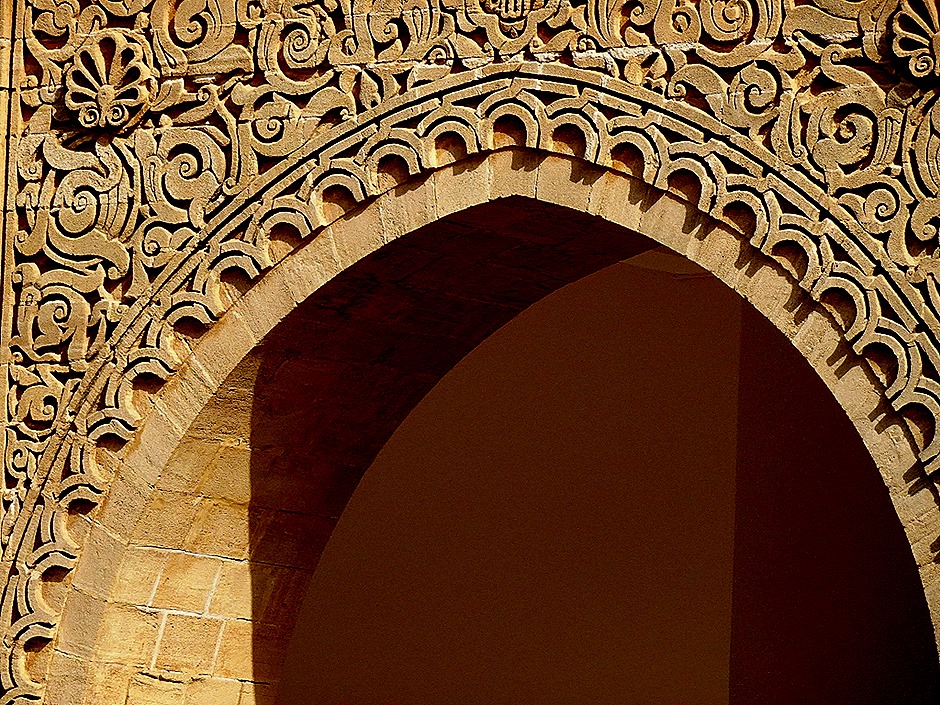


The palace itself is a very long low building with numerous guards at its entrances. The palace contains several schools and a library housing the royal collection of manuscripts, but there is no admittance for visitors so we were unable to see anything on the inside.



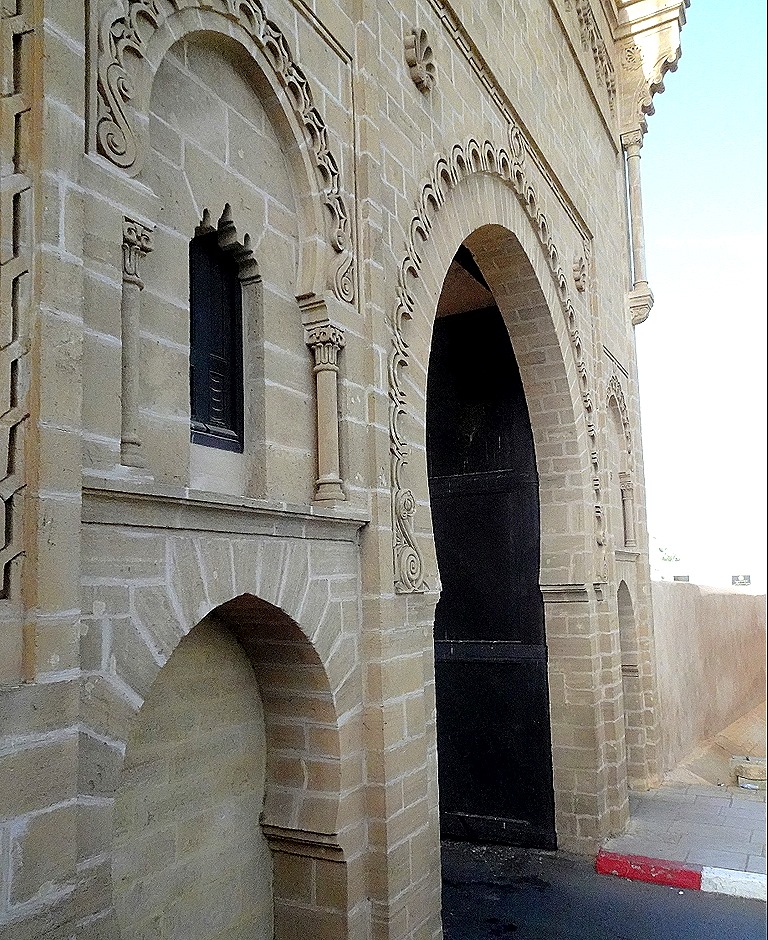
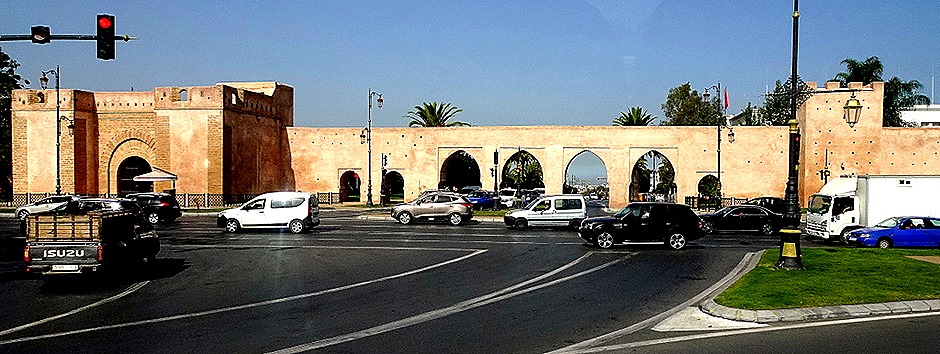
We drove through the wall to exit the palace. And later we drove through a large gate in what we assume is the old city wall.


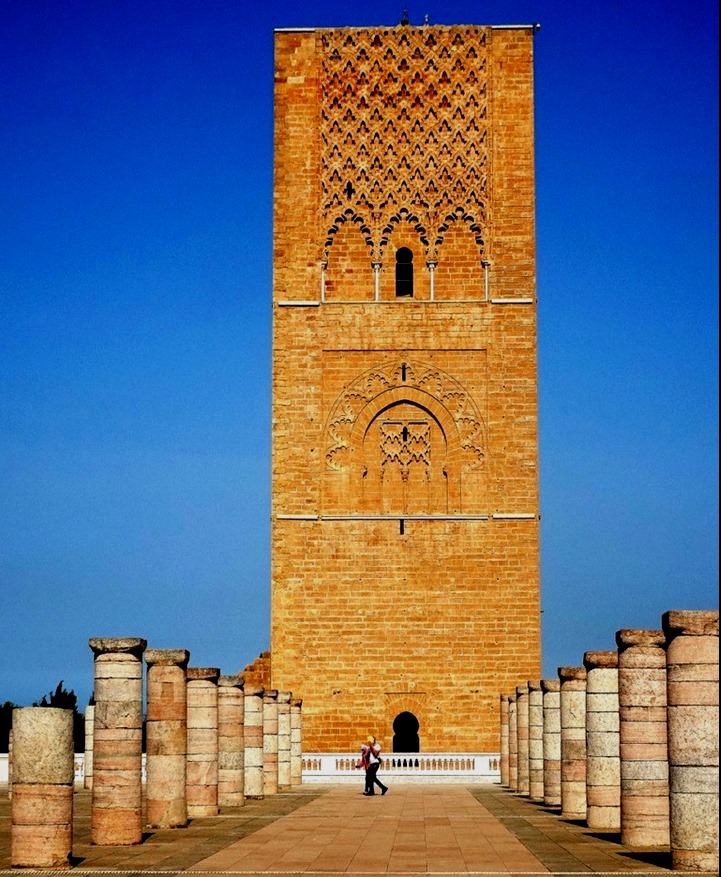
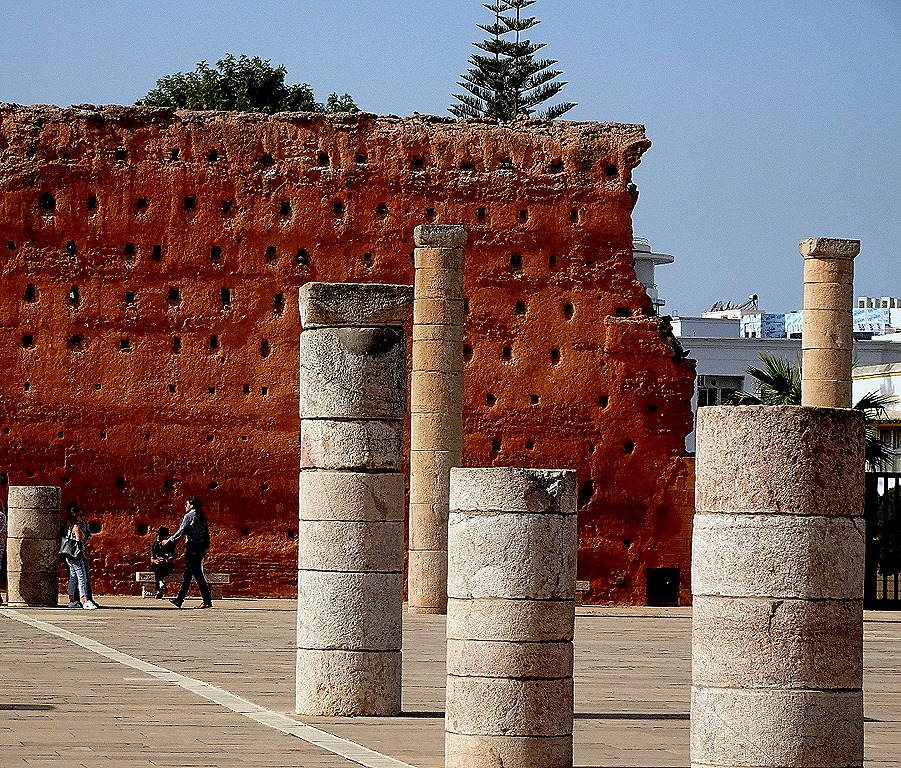
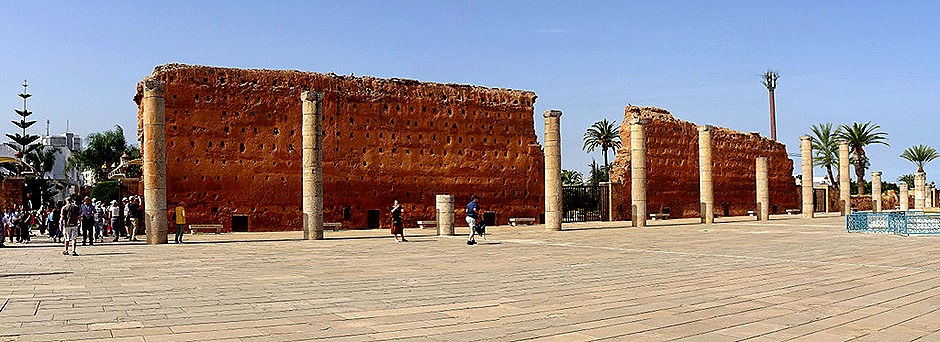
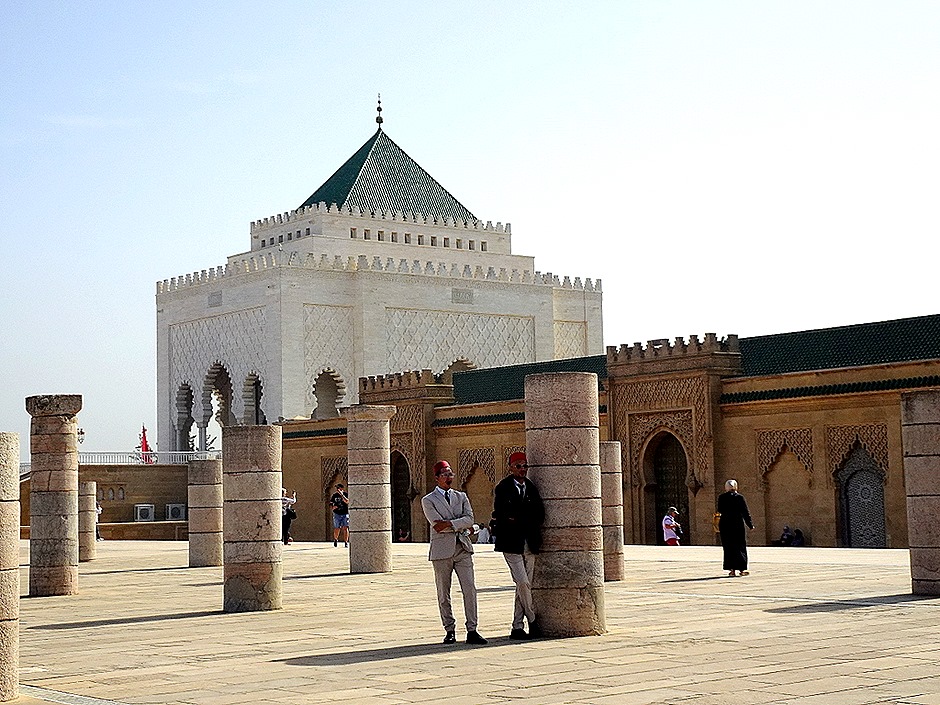
We next visited the Hassan Tower. Built at the end of the 12th Century, this was intended to be the tallest minaret and the largest mosque in the western Muslim world. However when the sponsoring Caliph died in 1199 the construction stopped with the minaret only half completed and one wall of the mosque and 348 pillars to hold up the roof partly finished. And so they stay today. If completed the mosque would have measured 600 x 456 feet and the minaret probably about 260 feet tall. The existing portion of the tower is 140 feet tall. Inside the minaret are ramps instead of stairs, which would enable the Muezzin to ride a horse to the top. We entered the grounds through a gate manned by two mounted guards.


Across the complex from the tower is the Mausoleum of Mohammad V. It was completed in 1971 and contains the tombs of King Mohammad V and his two sons, King Hassan II and Prince Abdallah. A mosque sits next to the mausoleum on a lower level so as not to detract from the view. We left the complex through the same guarded gate through which we had entered.



Rabat’s Kasbah is situated on a cliff overlooking the river Bou Regreg that runs between Rabat and Sale. Kasbah means citadel, and this one was not only on high ground but surrounded by an imposing wall. The uphill part of the Kasbah (left in the picture) was built in the 12th century and the lower part (on the right) in the 18th century. If you look closely at the picture you will see that the old part is darker in color and is made of stone while the new part is lighter and has a smooth surface.

The main entrance (top left in picture above) is a monumental gate called the Bab Oudaya, built in the 12th century. Its inner façade opens into the Street of the Mosque, down which we walked.

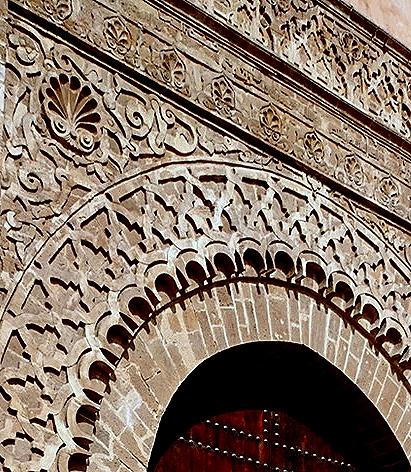
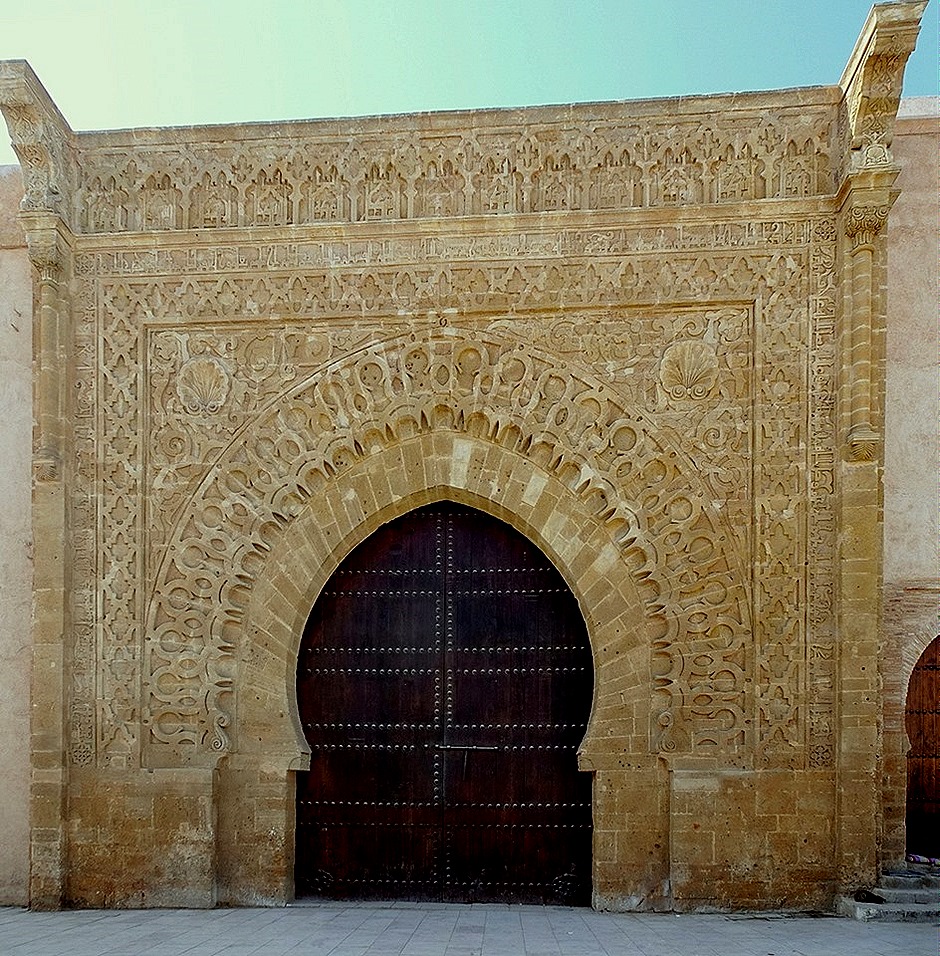
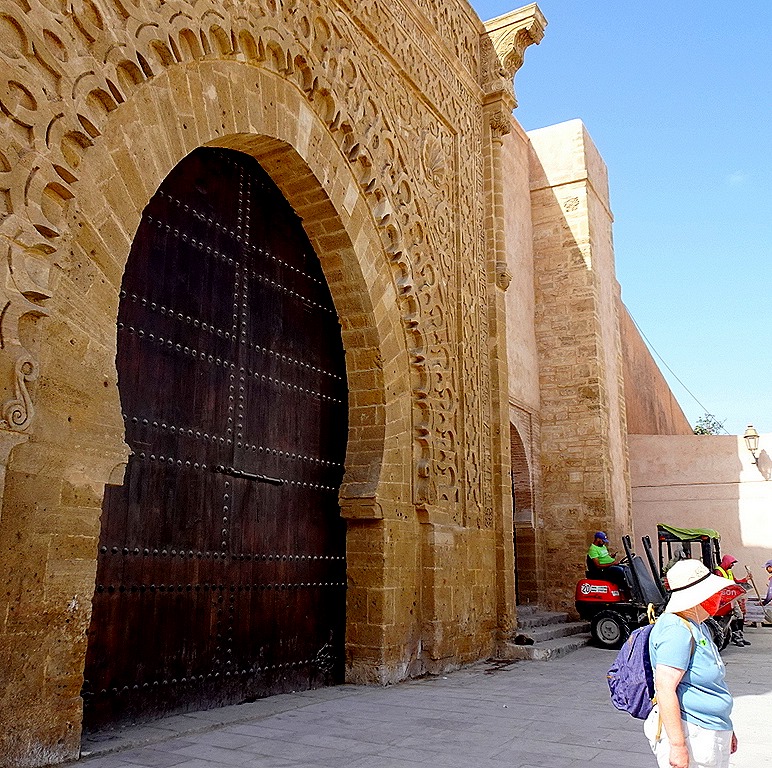

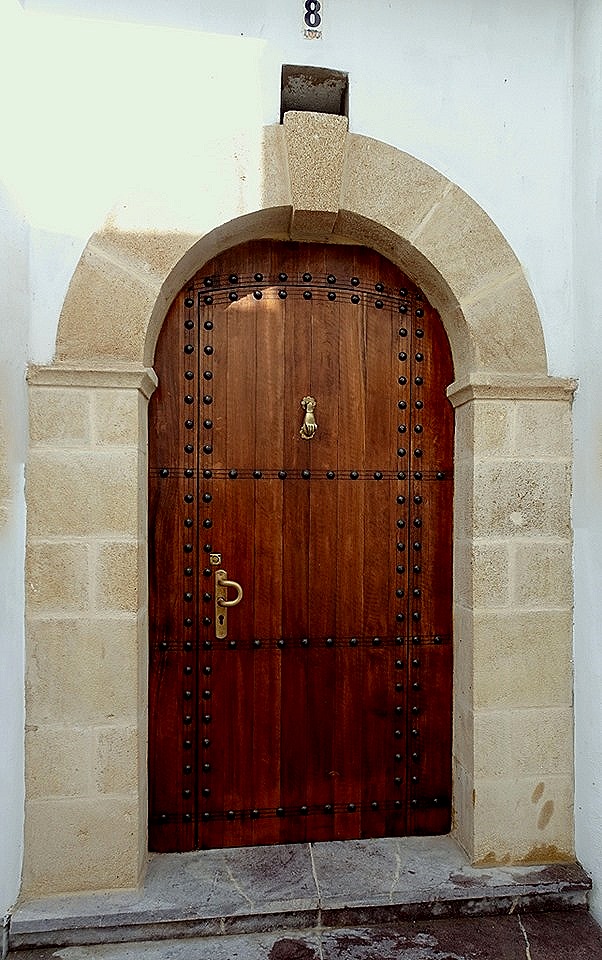
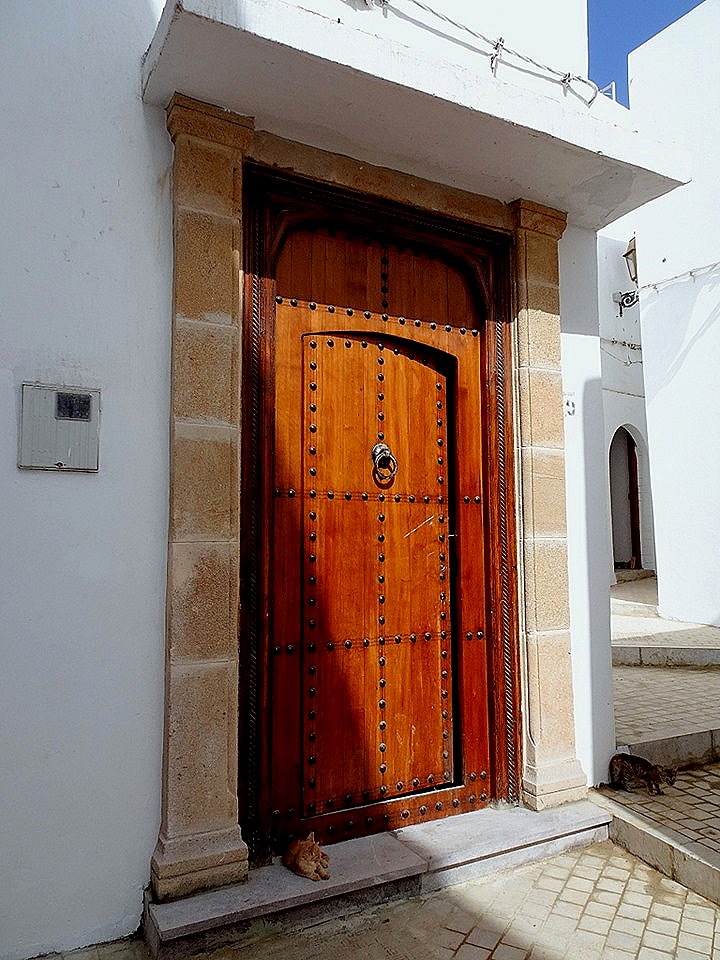
Mosque Street is notable for its many beautiful carved doors. Some have a knocker in the shape of a hand, which is called the “hand of Fatima,” named for Mohammed’s daughter.


At the end of the street we turned right and walked down a steep street with stairs toward the river.

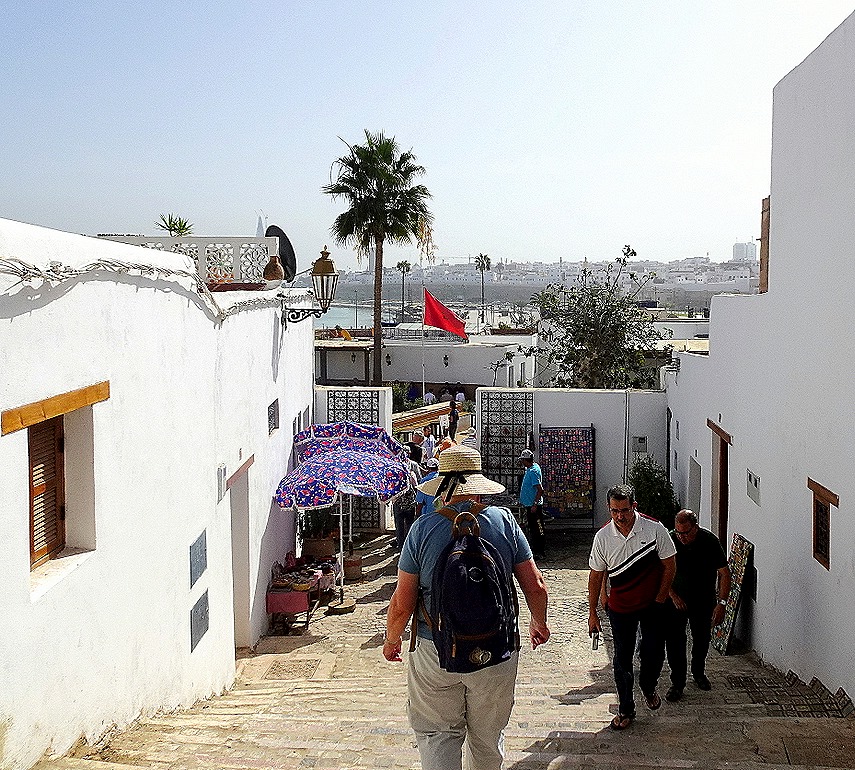
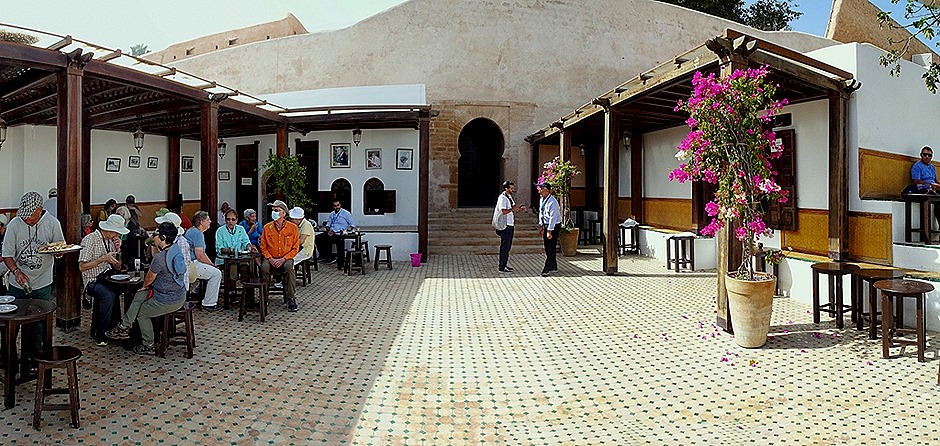
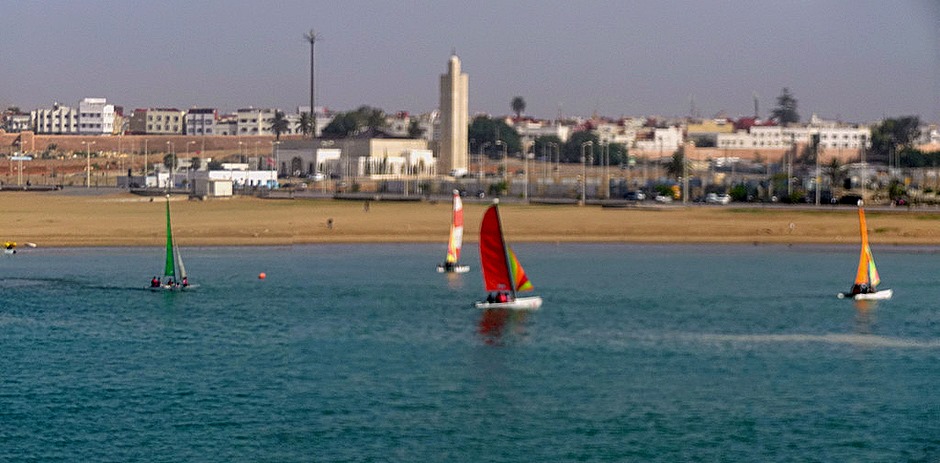
We came to a level with a café where we stopped for mint tea and a cookie (just one cookie, more would have cost you). On the other side from the café was a broad view of the river with Sale on the other side. Today Sale is a commuter suburb of Rabat but back in the day it was a notorious refuge for Barbary pirates.
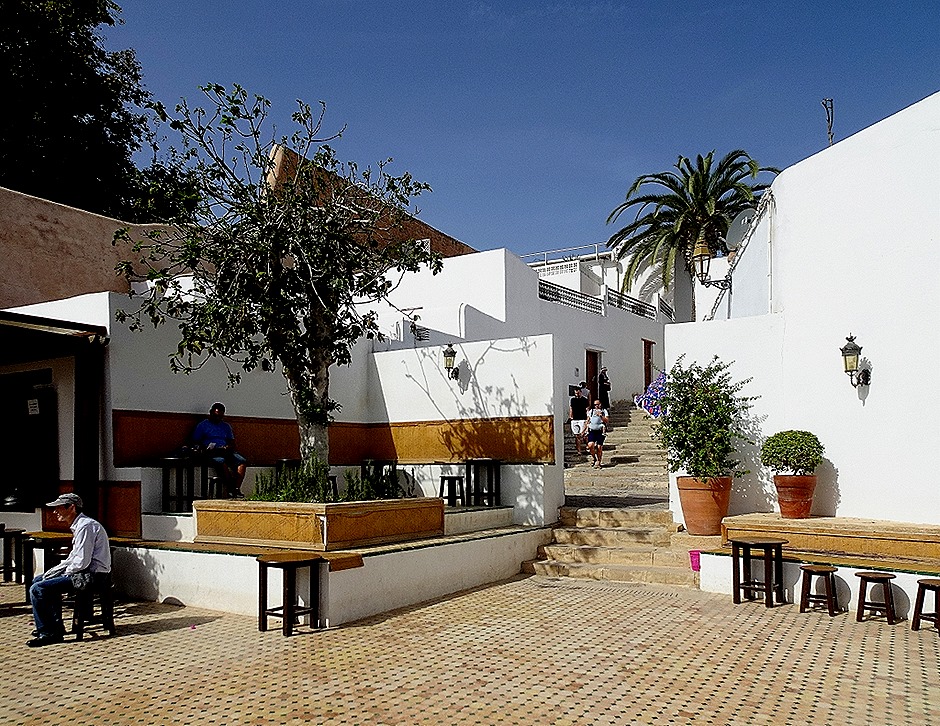

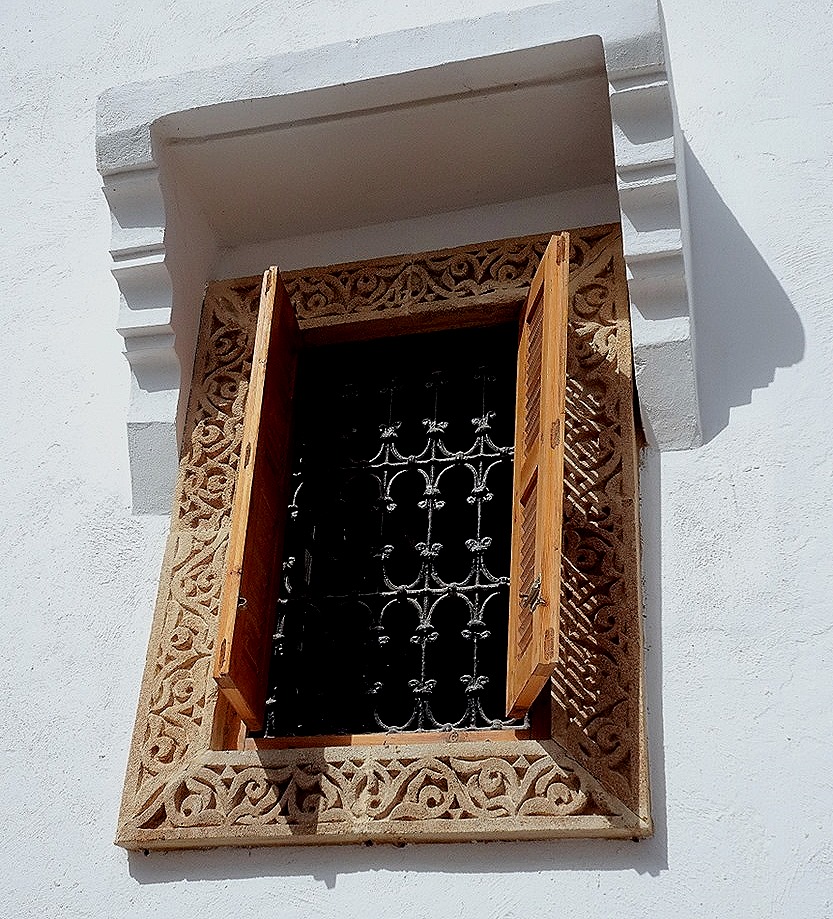
We left the Kasbah through a gate in the lower portion, passing a very tall bush with pink flowers trained up the side of a wall and another wall near the exit gate that was built on top of an outcropping of natural stone. Walking past the walls of the Kasbah we boarded the bus for the trip back to Casablanca. Among other things, we passed a couple of Muslim cemeteries full of graves raised above ground (apparently to keep people from inadvertently sitting or stepping on them). A number of buildings had what looked like covered lounges or laundry facilities on the roof covered by an awning. And the street lamps here are rather distinctive.


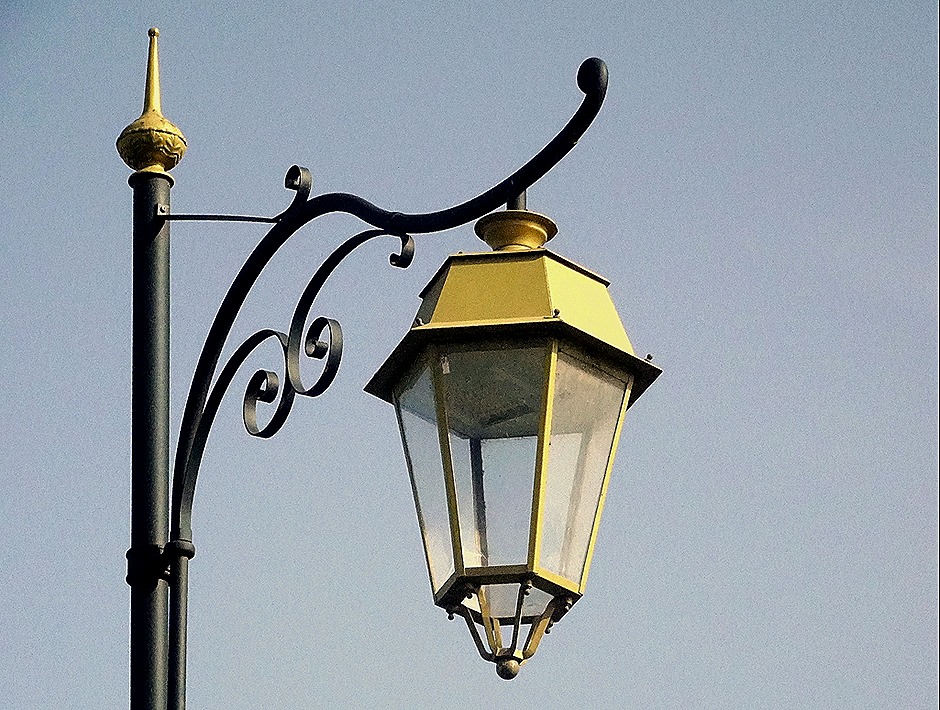
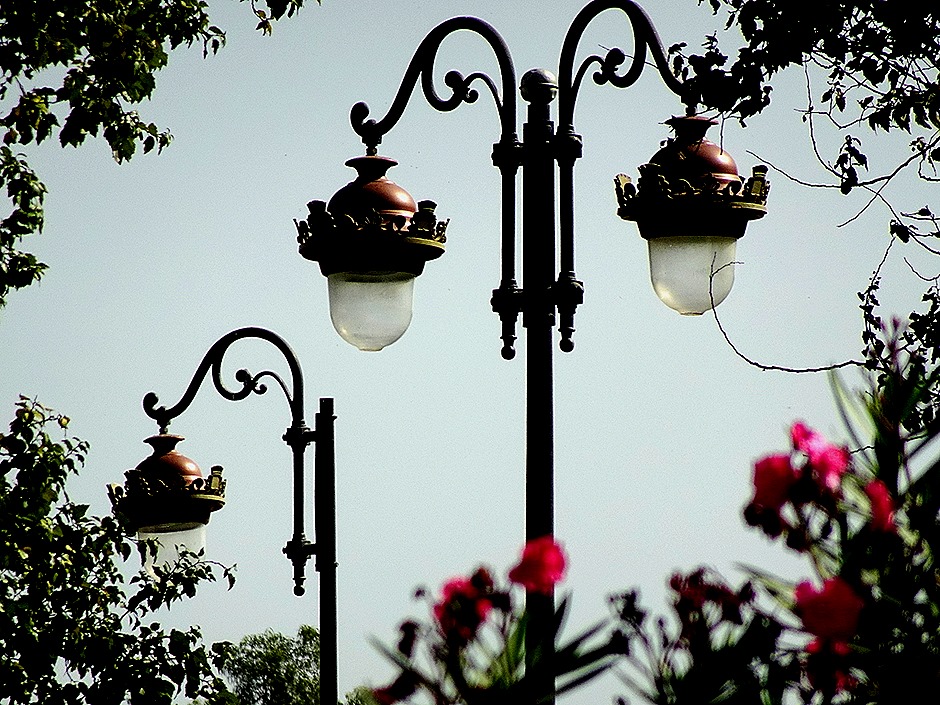


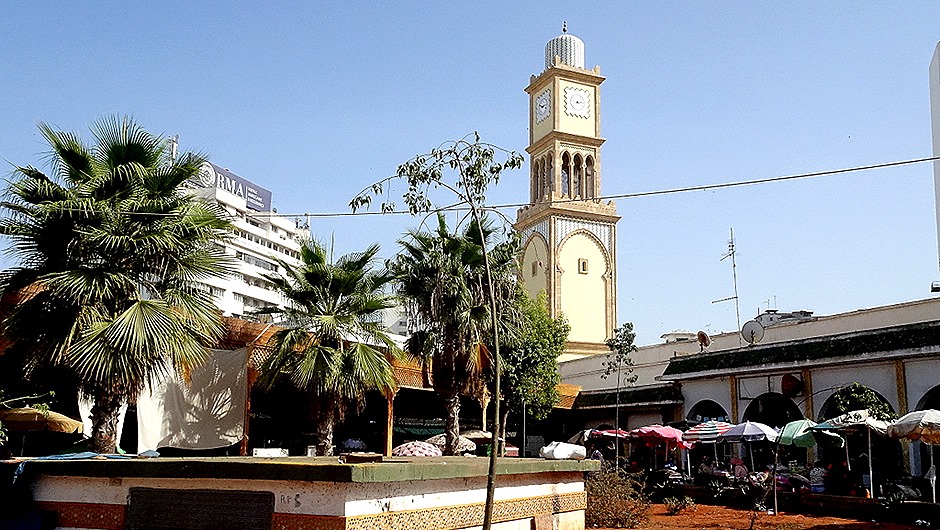
After our return to Casablanca we had hoped to visit the humongous Hassan II mosque, but it was too late to have a tour of the inside and we had seen the outside on our last visit to Casablanca. So we took the ship’s shuttle bus to United Nations Square in downtown Casablanca and walked through an underground passage beneath a busy street to the old walled Medina. Next to its wall is a smaller copy of a clock tower that had been built here some time ago by the French. As we entered the gate we were met by a vendor who told us his goods were genuine but everything we would see inside was made in China. Yeah, sure, heard that kind of come on before. Well, we don’t know whether his goods were genuine Moroccan crafts but he sure was right about all the other tchotchkes we saw for sale inside.
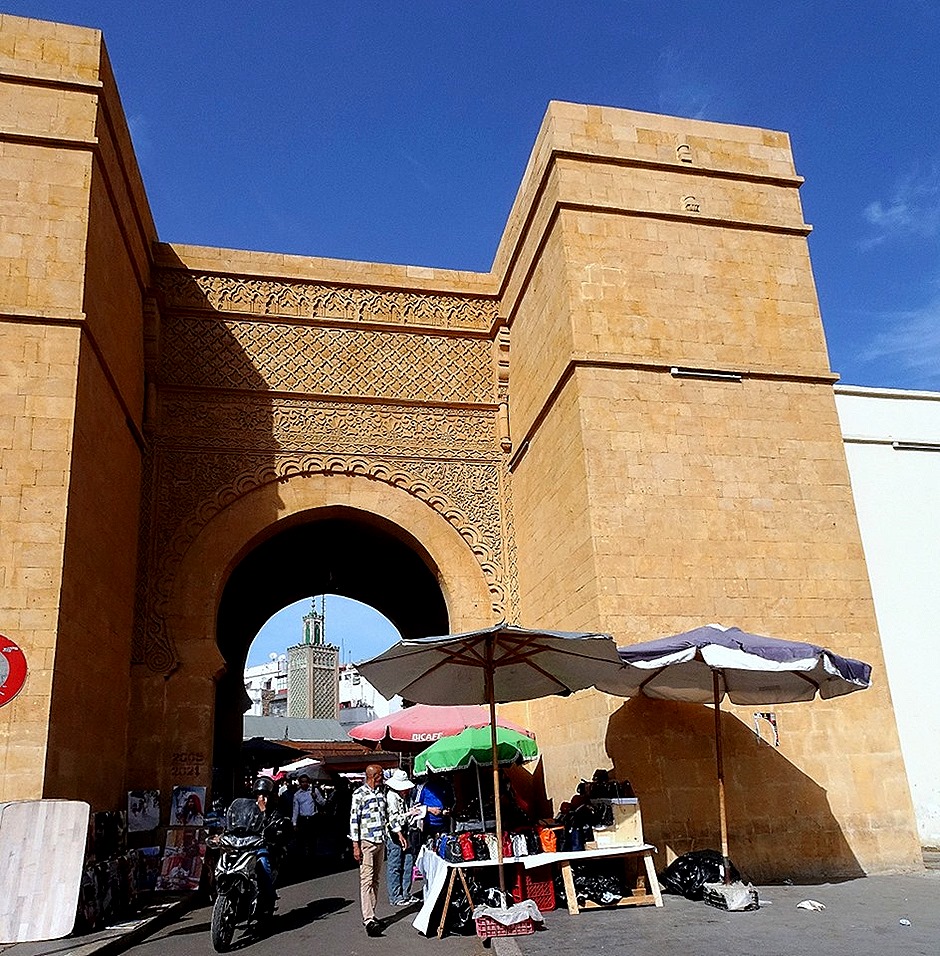
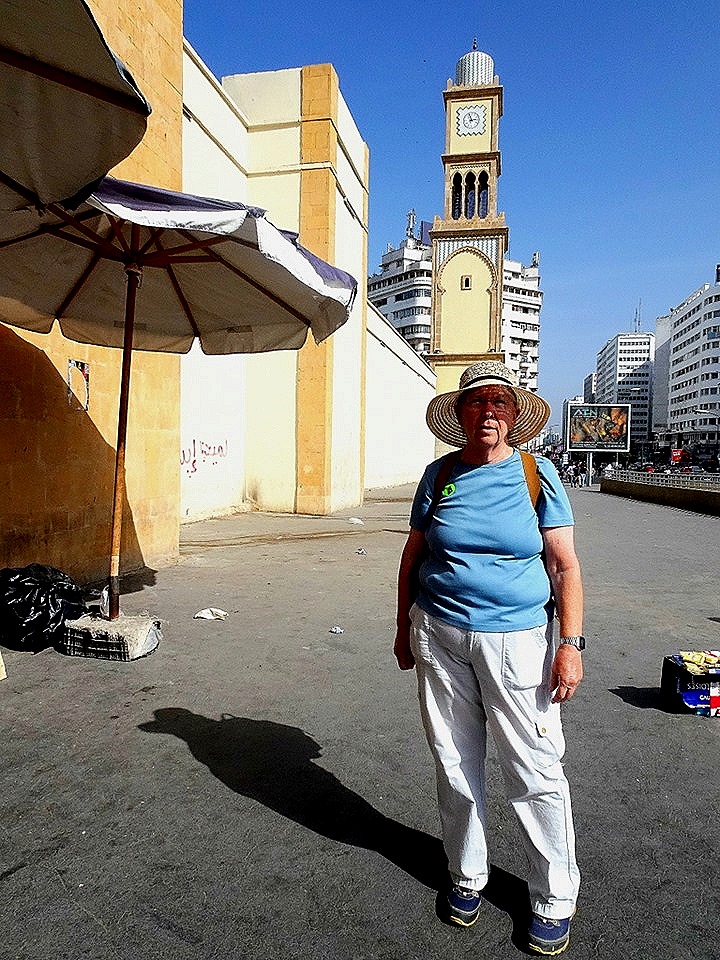
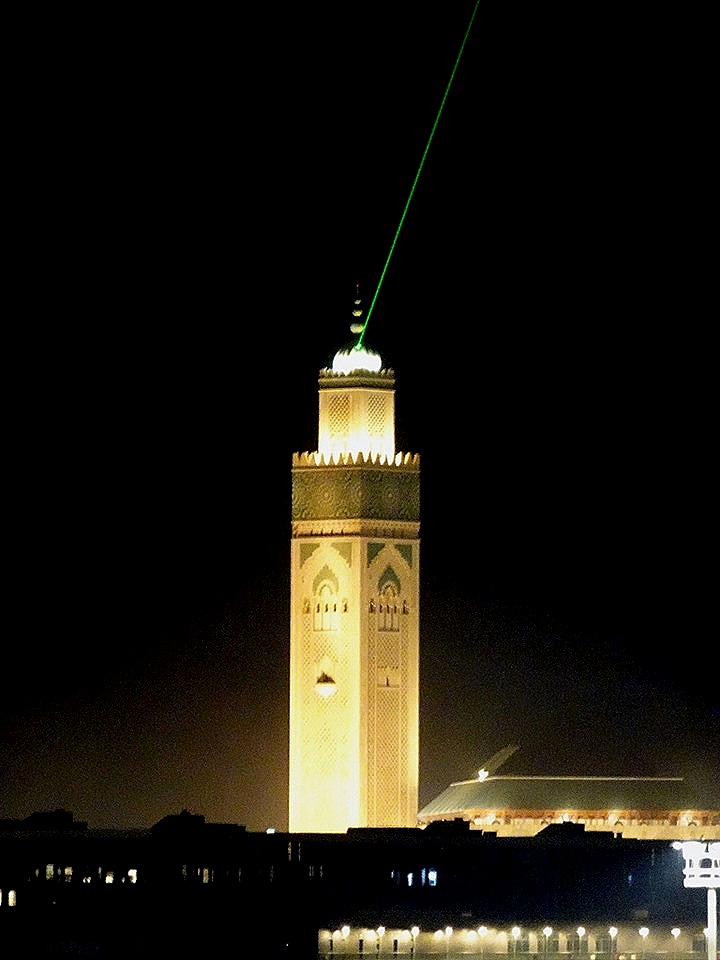
We walked around the Medina for a little while but saw nothing very interesting so we returned to the ship. After dinner we went up to the aft pool deck to see the Hassan II mosque all lit up. Most mosques have a piece of metal near the top of the minaret pointing toward Mecca so people will know which direction to face when they pray. Bringing this practice into the 21st Century, the Hassan II mosque has a green laser pointing into the sky toward Mecca. It was a pretty striking sight to bring an end to our visit to Casablanca.

Around Africa – 2022
Note: As this is posted our Grand Africa voyage has been over for several weeks. For some unknown reason we were unable to connect to our blog from Rick’s laptop to post these episodes during the cruise, but his home desktop seems to be doing this OK. So in the spirit of “better late than never” the postings from the Grand Africa cruise will roll out over the next several weeks (schedule uncertain because not all of them have been written yet & at home other obligations get in the way).
_________________________________________________________________________________________________________________________________________________________
On October 10, 2022 we set sail from Ft Lauderdale on Holland America’s Zaandam for a 71 day voyage to circumnavigate the continent of Africa. We originally booked this cruise more than three years ago for a sailing in October of 2020, but you know what happened. The pandemic shut down all cruise ships in the Spring of 2020 and this cruise was postponed to 2021, then again to 2022. The ship was also changed twice, first from Amsterdam to Rotterdam for 2021 then, after Amsterdam and Rotterdam were sold, to Zaandam for 2022. All three of these ships were built at about the same time and are of virtually identical construction and layout, although internal furnishings and decoration are different. So we ended up still in the same cabin on the Starboard (right) side of the Lower Promenade Deck that we booked in 2019 but on a different ship. This is the Zaandam:

Our cabin was between the last two lifeboats in the picture. This gave us a nice ocean view and enabled us to walk through the exit doors next to our cabin onto the walking deck under the lifeboats on either side of the ship.
So finally, after three years of preparing and waiting and packing, it felt great to be on board. Like everybody else on the ship we were vaccinated against Covid and for the first week (at least) everybody had to wear a mask inside when not eating. We were rather nervous right up until we left home for the two day drive to Florida because we had to pass a monitored Covid test on Oct 7, within 3 days of boarding. We had visions of receiving a positive result from our tests after driving a couple hundred miles south and having to turn around and spend the next 10 weeks at home after all. But at 4:30 AM Saturday, about 5 hours before we left, we both received our negative test results and we were good to go.
We don’t know whether any other potential passengers tested positive & had to abandon at the last minute (HAL generally doesn’t tell you things like that) but we were told there are a little over 1100 passengers on board the ship, which has a capacity of about 1400, so some of that difference might be folks who tested positive. It would have been quite a kick in the teeth to be left behind after waiting three years! We know of at least one couple who had to cancel during the last week after being booked for a long time because of health reasons; not Covid but that probably doesn’t make it feel any better.
Here is our itinerary, in map form (half moon means late departure & a black half sun means a two day overnight stay) and then a list of the ports with arrival and departure times:
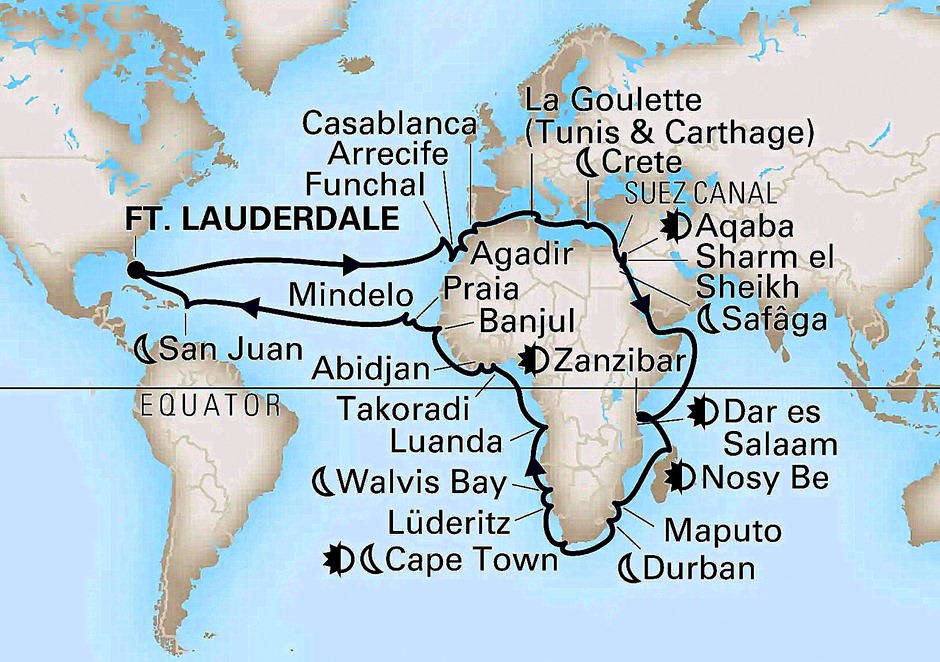
DATE DAY PORT ARRIVE & DEPART
Oct 10 Monday Ft. Lauderdale, Florida Embark 4:00 PM
Oct 18 Tuesday Funchal, Madeira, Portugal 8:00 AM 5:00 PM
Oct 19 Wednesday Arrecife, Lanzarote, Canary Islands, Spain 11:00 AM 6:00 PM
Oct 20 Thursday Agadir, Morocco 7:00 AM 1:00 PM
Oct 21 Friday Casablanca, Morocco 7:00 AM 9:00 PM
Oct 24 Sunday Tunis (La Goulette), Tunisia 8:00 AM 5:30 PM
Oct 26 Wednesday Soúda, Chania, Crete, Greece 11:00 AM 10:00 PM
Oct 28 Friday Transit Suez Canal- Cruise Only
Oct 29 Saturday Sharm el-Sheikh, Egypt 7:00 AM 5:00 PM
Oct 30 Sunday Aqaba (for Petra), Jordan *7:00 AM —
Oct 31 Monday Aqaba (for Petra), Jordan — 5:00 PM*
Nov 1 Tuesday Safaga (Luxor), Egypt 8:00 AM 12 Midnight
Nov 10 Thursday Dar es Salaam, Tanzania *10:00 AM —
Nov 11 Friday Dar es Salaam, Tanzania — 8:00 PM*
Nov 12 Saturday Zanzibar, Tanzania *8:00 AM —
Nov 13 Sunday Zanzibar, Tanzania — 5:00 PM*
Nov 15 Tuesday Andoany, Nosy-Be, Madagascar *11:00 AM —
Nov 16 Wednesday Andoany, Nosy-Be, Madagascar — 3:00 PM*
Nov 19 Saturday Maputo, Mozambique 8:00 AM 3:00 PM
Nov 20 Sunday Durban, South Africa 11:00 AM 11:00 PM
Nov 23 Wednesday Cape Town, South Africa *8:00 AM —
Nov 24 Thursday Cape Town, South Africa — 11:00 PM*
Nov 26 Friday Luderitz, Namibia 8:00 AM 5:00 PM
Nov 27 Saturday Walvis Bay, Namibia 10:00 AM 11:00 PM
Nov 30 Tuesday Luanda, Angola 7:00 AM 5:00 PM
Dec 4 Sunday Takoradi, Ghana 8:00 AM 5:00 PM
Dec 5 Monday Abidjan, Côte d’Ivoire 8:00 AM 5:00 PM
Dec 8 Thursday Banjul, The Gambia 8:00 AM 5:00 PM
Dec 10 Saturday Praia, Ilha de Santiago, Cape Verde 7:00 AM 6:00 PM
Dec 11 Sunday Mindelo, São Vicente, Cape Verde 8:00 AM 5:00 PM
Dec 17 Saturday San Juan, Puerto Rico, USA 8:00 AM 11:00 PM
Dec 20 Tuesday Ft. Lauderdale, Florida, USA 7:00 AM Disembark
*overnight stay in this port
__________________________________________________________________________________________________________
We were hoping to make it to all these ports, of course, but we have had last minute itinerary changes in the past because of disease or political unrest or weather. You may have read about unrest in some of these places recently and there was no telling how Covid or weather could disrupt things. We had already had some itinerary changes about a month before departure, so who could tell? Stay tuned.
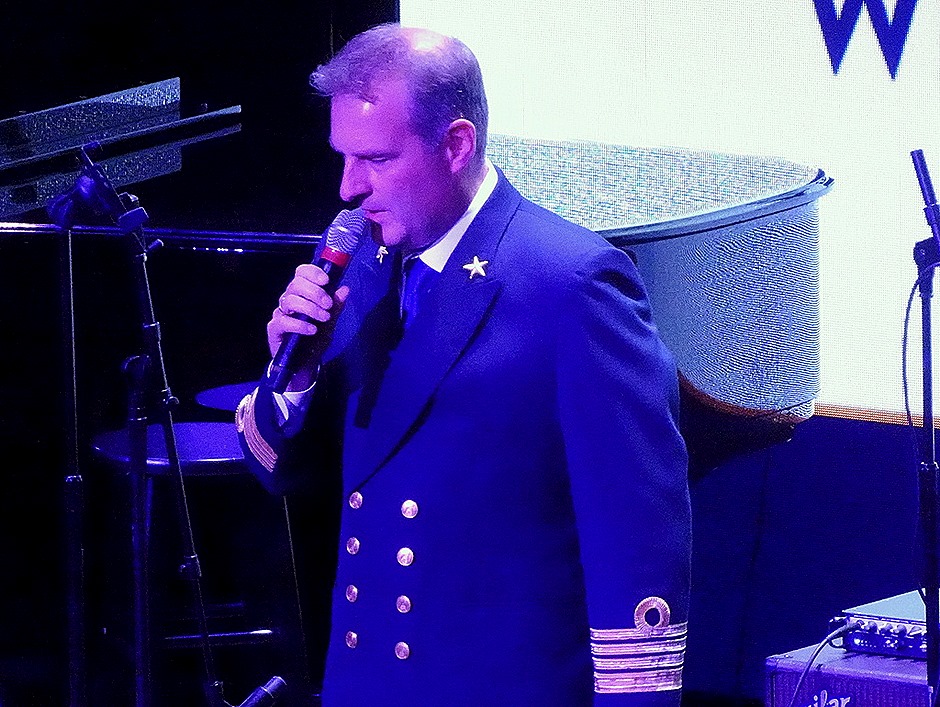
Crossing the Atlantic takes seven consecutive sea days, so everyone would be happy to set foot on land in Madeira. Among other things, on Wednesday we had the Captain’s toast to introduce the main officers and wish luck for the journey (free champagne for all) and on Friday we all had to take a self test for Covid, the results of which were reviewed by crew members. Even though every person on the ship had tested negative within 3 days of boarding, just 3 days after boarding some (we heard 15 and 25, but no official numbers were released) tested positive and were quarantined for seven days. A couple of them are friends of ours and they would miss at least the first two ports. It was a chilling reminder that this insidious virus can take a hunk out of your voyage at any time. I guess if you have to be quarantined, crossing the ocean is a better time for it than when we stop at new and exotic ports. We tried to be careful and kept our fingers crossed.
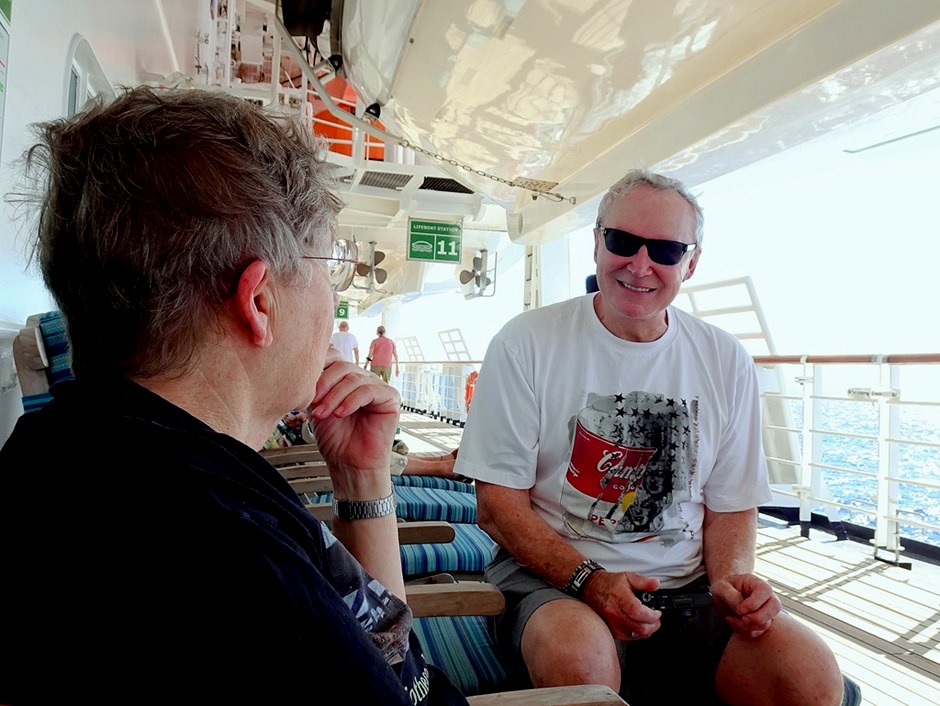
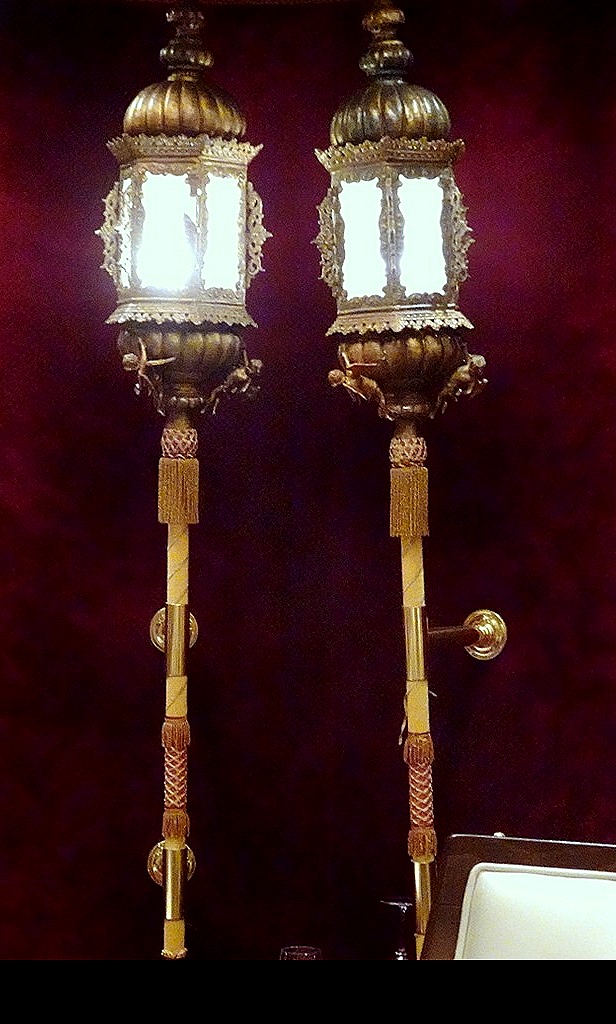
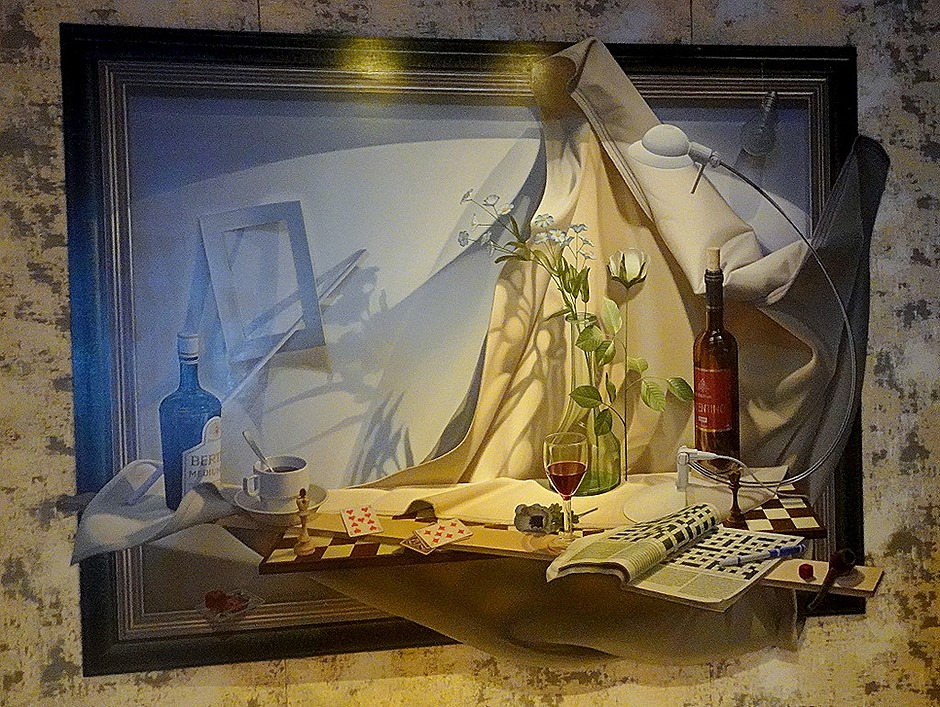
As I mentioned earlier, Zaandam is laid out just like Amsterdam, but with different furnishings and art works. In the Atrium in the center of the ship is a three story pipe organ. It was played one day in the first week but we were disappointed that it was just a recording (similar to a player piano we guess) with no one sitting at the keyboard. Among a lot of other eclectic art around the ship are a couple of paintings overflowing their frames outside the main dining room, a floor to ceiling sized painting in the hall near the Explorations Café, and a sculpture of a couple of seahorses near the entrance from the deck just outside our cabin. Several large MC Escher pictures were displayed on the walls of stairwell landings. And almost qualifying as a work of art, we received a box of Grand Africa themed chocolates after the first “dressy night.” (These are nights when men are expected to wear a tie & jacket to dinner, formerly called “formal nights,” then “gala nights”; no explanation for the name changes.) Other shipboard pictures may show up in later episodes.





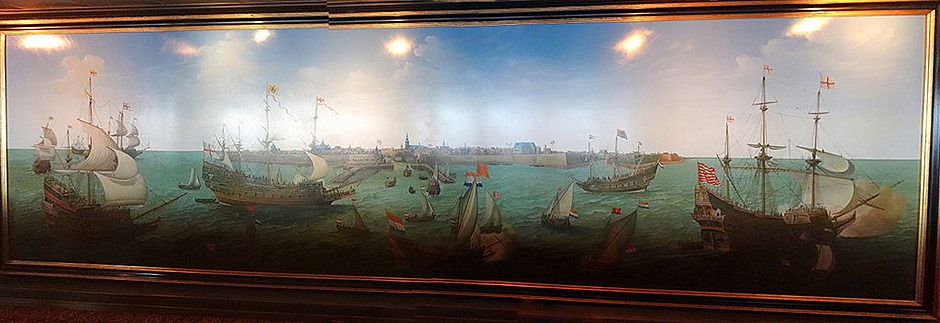
In the Explorer’s Lounge a young classical pianist named Luca presented concerts twice every afternoon. This was supposed to be a cello-piano duo but at the last minute the cellist was unable to sail with us, so Luca performed solo piano pieces, and quite excellently. He assured us that the cellist would join us soon. As on all the older HAL ships, the Explorer’s Lounge features a naval painting (or a reproduction) about 15 feet long.


So that is enough introduction and the next episode will be the first of our ports. Until then, we will leave you with the first of what we hope will be many beautiful sunsets on this voyage.


 BADER JOURNAL