
Kruger National Park, South Africa (Day 3)
We were awoken early again on April 2 for our predawn game ride. Our first big game spotting was . . . a large snail crossing the road, leaving a wet trail behind him. We also saw a bird that is probably a buzzard or a vulture, a greater blue eared starling, and a giant termite mound built against the trunk of a big tree.


We saw a herd of zebras, one of wildebeest & one of warthogs. We also spotted a couple of black-backed jackals walking up the road toward us, but they were gone before we could stop and get a good picture. I have included a picture of a jackal we didn’t see, taken by someone who was at a different camp, just so you can see better what they look like. There was also another female lion hiding in the tall grass.


Then there were more birds, some new some old. We saw a European Roller, a Red-billed Hornbill, a Steppe Buzzard and a little gray bird that might be an African Dusky Flycatcher. There was also a Red-backed Shrike sitting on a thorny acacia tree. We were told that giraffes like to eat these trees, but it’s hard to imagine having all these long thorns in your mouth.


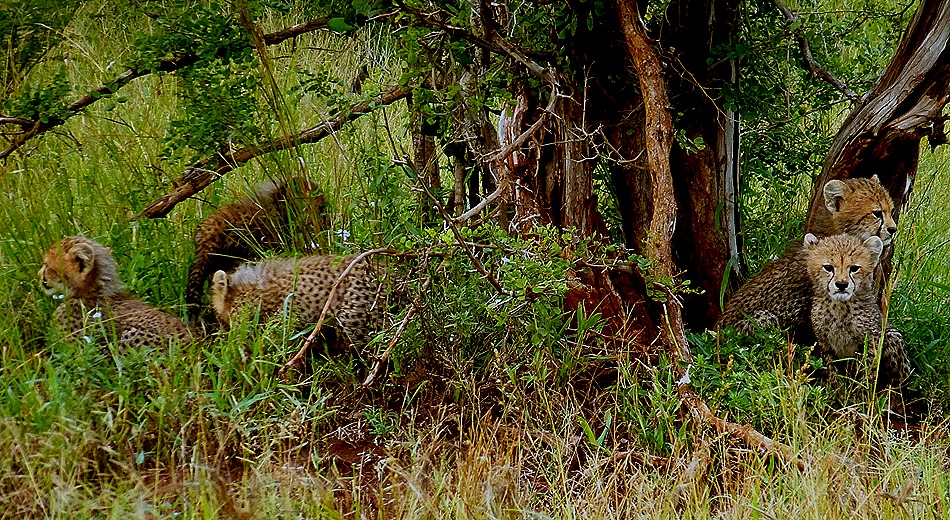
We found another family of cheetahs, the supposedly elusive species we have now seen for the second time in two days. This time it was a mother with four or five cubs, but the cubs were a bit older & bigger than the ones we saw yesterday. Cheetahs are an endangered species with only about 7,000 left, a majority in South Africa. Lions and other big cats prey on their young so that only about 5% live to 2 years, which is about when they can go out on their own. Cheetahs are also the fastest land animals in the world, capable of 60 to 70 mph in short bursts. It is hard to tell the adult from the cubs unless they are in a picture together, so we will make our best guesses about that.


We stopped for our mid-morning snack. While we were out on the ground we saw a huge striped centipede trying to hide under a rock & a large dragonfly with transparent wings, each with a large spot.


By this time we had seen four of the “big five.” which include Lion, Elephant, Rhinoceros, Cape Buffalo & Leopard. Seeing these five species is the general standard for a successful safari and often advertised by safari companies. But the “big five” was originally compiled as the ultimate goal for hunters because these were the hardest to bring down on foot with a rifle. This would seem to have little relevance for a modern photo safari, but it is still considered a test for a successful safari. Since this was our last full day on the safari we were beginning to wonder if we would see a leopard, which Safiso had told us was often impossible to find.
Then Safiso received a call on the radio from another safari driver who told him they had found a leopard in a tree. Safiso told us it was a long way from us & that it could well be gone by the time we got there, but we all agreed we should try. Determined to get us to the leopard on time Safiso gunned the engine (as much as you can in an open vehicle on a dirt road). We called it a Ferrari Safari and it was bumpy and fast. Still, it took about half an hour to get there & by the time we arrived the other vehicle was gone and the leopard was nowhere to be seen. Safiso thought there was a good chance the leopard was still hiding in the area so he took our vehicle off the road and explored through the bushes. Sure enough, eventually he spotted the leopard hiding in a bush. It’s hard to understand how he saw it since we had trouble seeing it there even after we were told where to look. It was disappointing to think that we were this close and still unable to really see it, but then the leopard got tired of playing hide and seek. It stood up and walked to a nearby tree, then climbed the tree and spread out on a large branch to watch us with legs hanging down on either side for balance.


Not satisfied with this view from behind, Safiso pulled the vehicle around to the other side of the tree where there was a beautiful view of the leopard from the front. She didn’t seem to mind, maybe because she felt more secure up a tree.


While she was settled on the tree branch we were able to get a number of close portrait shots.


We spent a long time with the leopard (we took more than 50 pictures altogether) before returning to camp for breakfast. Safiso said this was the longest game drive he had ever done, & he’s been doing this for many years. On our way back to the camp we encountered a mixed group of herbivores on the road: giraffes, zebras and warthogs. There was a mongoose running down the road ahead of us, too far & fast for a good picture, and a large bird that may have been a bustard.


After breakfast & a shower we went back to the veranda of the main lodge to relax for the rest of the day until time for our sunset game drive. Our old friends the hippos, egrets, Blacksmith lapwing and Egyptian geese were still there. We also saw some black-headed herons and some impalas across the lake. And a bold little bird was standing on our our shower head, possibly a crimson-breasted shrike.


Across the lake we saw a family of elephants hurrying off to our right after drinking their fill.


A rhino came down to drink on the other side of the lake. He was accompanied by four egrets who were jockeying for about three seats on the rhino’s back. No picture of it, but at one point an ejected egret perched on the ground behind the rhino was covered by a huge rear-aimed spray of urine from the rhino. Yuck. I guess this is just one of the hazards of earning a living.


There was another black-headed heron in the marsh on the other side of the lake. A wildebeest put in an appearance. And we spotted a skull from a Cape Buffalo on the other side as well. Daniel told us its story. One night a large herd of buffalo wandered up the shore of the lake on the side where the camp is located, a pretty narrow area. As they walked past the camp a pride of lions appeared at the other end. They tried to go back the way they had come but another group of lions was stationed there. With nowhere to go the buffalo spent the night by the shore in front of the camp’s cabins. In the morning they left, but about half a dozen of them didn’t make it past the lions. This skull belonged to one of them.


Another highlight this afternoon, an old elephant with very long tusks came walking up the shore right in front of our verandas. Daniel said he is a regular visitor.


We all ran up to the veranda of the last cabin to keep him close and coming toward us as long as possible. Rick got there about the same time as the elephant, who turned to see what the commotion was. Don’t worry, there is an electrified fence between the elephant and the veranda. The elephant then stepped into the water again for a few steps.
At that point we noticed there was another large elephant just across the lake. They looked at each other for a while & we thought there might be trouble, but the elephant near us eventually looked away and walked on.


The elephant across the lake was actively drinking and bathing. After a while he turned around and lumbered away past a resting wildebeest & the buffalo skull. Meanwhile the elephant on our side of the lake continued his walk away from Camp Shawu.


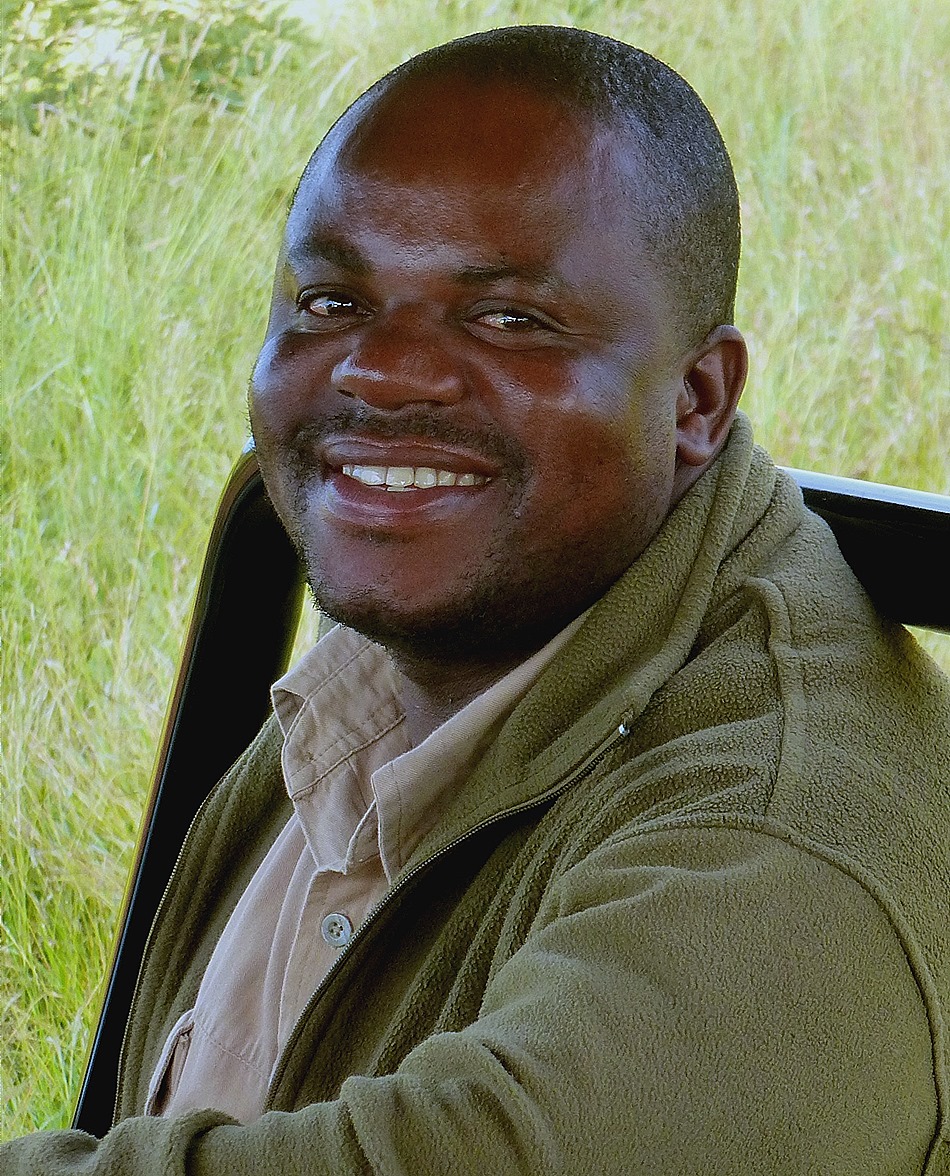
During the afternoon we took some pictures of our group hanging out on the main veranda. As game drive time approached Safiso showed up so we were able to include him in some pictures.


We set out on our last evening game drive. We saw several birds, including a Black-shouldered Kite, a Wooly Necked Stork, and a Pearl Spotted Owl.


We came across a family of elephants as the sunlight began to dim. This is really the day for elephants! They walked by us, then away past a tree.


We ran into a female waterbuck. Safiso thought it was a kudu, a species of antelope we had eaten for dinner the night before, but further research indicates he was mistaken. They look very similar but female kudu have a white strip across their noses, while waterbucks have a distinctive white circle around their behinds, which you can barely see part of in the second photo. A pretty easy mistake to make when the animal is far away and behind some bushes!


We had a very beautiful sunset this evening.


We stopped for our usual sundowner with the other camp vehicles.


On the way back to the camp we came upon a Marsh Owl standing in the road. We also saw some trees filled with bird nests. Safiso told us that one very large nest was home to a large number of birds at a time. We also saw a Secretary Bird, a huge bird with a goofy looking head. But as soon as he was caught in the spotlight he took off, much too fast to get a picture.


When we got back to the camp the moon was shining brightly over the lake. Thembisile came out as she always did before a meal to announce the menu, & told us that unfortunately there would be nothing for dinner. Funny, but hardly credible at this place! In fact we had a particularly fine going-away dinner, highlighted by delicious grilled lamb chops & a passion fruit cheesecake that was truly memorable.


After dinner we were about to go back to our cabins when we were told to stay put. Then we heard a rhythmic beat in the kitchen and out came Daniel, Thembisile & Pretty dancing and singing. The rhythm was beaten out with a wooden cooking spoon on a plastic food container. It was quite a show & something we certainly weren’t expecting. A few of these pictures were taken by Rick (you can see him doing it in pictures 9 & 10 below), but most of them were extracted from a phone video taken by Robert. Despite efforts to improve focus and contrast in the extracted photos they are rather below standards. Don’t get me wrong, Robert’s video was great; it is just the photos made from the extracted frames that aren’t so hot. But they do give you a pretty good idea of what was going on.


After a while they induced a few of the guests to join in the dancing, following Thembisile’s lead.


They danced out the door into the kitchen, with Daniel still beating the rhythm on a plastic food container.


So a great time was had by all, a perfect end to an extraordinary day.
Kruger National Park, South Africa – Day 2
We were awoken shortly after 5:00 AM by a knock on the door (no telephone for a wake-up call). It was still very dark out. We dressed and headed for the main lounge where coffee & rolls were waiting. Soon Safiso showed up & we all piled into the safari vehicle & headed out to the bush in the dark.
We (meaning Safiso) spotted several birds, including what may be a Burchell’s Coucal (looking like he hadn’t really woken up for the day) and some Helmeted Guineafowl running down the road in front of us. There was also another Lilac-breasted Roller and a European Roller, both of which stand out from their surroundings with brilliant coloring. And what is probably a Temminck’s Courser was standing in the road.


We passed some warthogs, a hyena, a wildebeest & a hippo skull. Safiso spotted a male lion sitting on a fairly distant hill perusing the area and we passed an elephant making tracks away from us. Then Safiso got a call from another driver that they had seen a leopard. He told us that leopards & cheetahs are the big animals most likely to be missed since they often see them only once or twice a month, so we sped to the spot some distance away. The other trucks were gone & so was the leopard, but we saw what was left of the impala the leopard had for lunch hanging from a tree. We were told that leopards are the only cats that drag their prey up into trees to dine.


One of the ways Safiso could tell what animals had been nearby was by looking at tracks in the mud on the side of the dirt roads we travelled. Another was by identifying what kind of animal had left piles of poop! We don’t really remember which animals Safiso said these belonged to, but will make a guess.


We saw a grazing rhino accompanied by his egrets & a group of female lions looking sleepy, perhaps after a meal.


Safiso spotted a tawny eagle & a grey shrike for us. Then in the distance we saw a large and diverse gathering of non-carnivorous animals, looking like something out of The Lion King.


We stopped for a morning snack of coffee & rolls (they wouldn’t want us to go more than a couple of hours without eating). It was in an open area that must be considered safe since we were allowed to exit the vehicle.


We continued after our snack, spotting what is probably a tern, a yellow hornbill, yet another European roller & some Southern Ground Hornbills with bright red faces out in the tall grass. We have read that this last is an endangered species


We came upon a herd of zebras & a group of giraffes.


We saw a groups of impala and of warthogs.


On our way back to the camp we saw more birds. Probably another coucal perched in a distant tree, a couple of what are probably Pin-tailed Whydahs with very long tails and a yellow-billed stork perched at the very top of a tree.


Back at the camp it was time for breakfast. The table was set with good sized bowls of yoghurt, fruit & cheese. There were also baskets of rolls & toast. We began to eat all this, then the Thembisile, the chef, walked out to take orders for eggs. After that was done she brought out a huge platter of pancakes. Nobody goes hungry at Camp Shawu!


After breakfast we went back to our cabin to shower. The electricity is off for most of the middle of the day so we wanted to use the shower before the hot water went off. The shower is outside with a view of the lake. The cabins are covered with screen & canvas on three sides, have a thatched roof & the solid walls are made of buffalo dung. How’s that for authentic? Inside they are roomy, with a large bed inside mosquito netting, a bathtub, a woodstove and an overstuffed leather chair. Outside by the lake is a private veranda.


We spent most of the rest of the day before leaving for our sundown game drive sitting on the veranda of the main lodge watching the animals. The hippos were a never-ending source of entertainment.


There is a well known children’s book called “Everybody Poops.” That includes hippos. When the urge came upon one of them he or she would stand up just out of the water, start its tail spinning rapidly like a propeller & let fly. The result is just what you would expect when “the sh*t hits the fan!” All accompanied by a loud wail. The urge seemed to be catching as several more of them did this after the first one. Sadly, we didn’t have a camera handy and it was over way too quickly to fetch one. We hoped they would do this again before we left for Cape Town, but no luck. Its sad that there are no pictures because it was quite a show.
The banks of the lake were lined with many varieties of birds, most of which you have seen before, including white-faced ducks, Egyptian geese & egrets.


A crocodile came by. The hippos don’t seem to mind the crocodile, probably because (we were told) they only eat fish & leave the hippos alone (which seems like a good strategy). But at one point a Fish Eagle flew down & landed on a rock near one of the hippo families. The hippos were outraged, milling about & raising quite a din; some of them even moved away. The eagle seemed to be wondering what their problem was.


And, to top it all off, yet more hippos, opening their big mouths in play (we think).


After our afternoon snack we set out on our evening game drive, which began with a herd of Impala.


We came across some giraffes & some wildebeest.


Then came one of the day’s highlights, a cheetah with her two cubs only a month or so old. You may recall that we had been told that cheetahs are often hard to find so we were glad to see them. And the cubs, who were unbelievably cute, made it really special. After we first saw them Safiso pulled the vehicle around to a spot where the cubs would be walking toward us, giving us a great view. The mother had a very big belly, looking like she was pregnant, but Safiso told us that she had actually just had a big meal.


After passing our vehicles the cubs rejoined their mother and they all continued walking down the road ahead, turning once for a last look at us before heading on to the left.


As the sun dropped toward the horizon the landscape began to glow. We saw some monkeys climbing a tree. Then Safiso noticed that the bright orange sun was in a perfect spot behind the tree and pulled up to enable Rick’s favorite picture of the entire cruise!


After this inspiring sunset we met the other vehicles at a dam for a sundowner. This may be the dam that created the lake outside our camp, but we aren’t sure about that. A Goliath Heron was standing on the dam looking downriver & we saw some hippos emerging from the water on the other side of the water for a nighttime foraging excursion. These pictures were taken after sundown, so aren’t as clear as one would hope.


It was night by the time we headed back to the camp from the sundowner, so we were mostly searching for animals with the spotlight. We saw a tawny eagle & a porcupine. The porcupine panicked when the light hit it & took off so fast it was impossible to get a decent picture, but here is what we have. It looked a good bit larger than we would have expected.


We also passed a group of Cape Buffalo (not sure of the timing; this might have been before the sundowner). Unfortunately they were all so intent on eating that they never turned in our direction or lifted their heads. No pictures of their faces, therefore, just a couple that show their distinctive horns from the back. Not very cooperative of them!


Finally, we encountered a pair of Spotted Hyenas who appeared to be out hunting in the dark (until our spotlight found them). They walked down the road ahead of us, then one went off into the bush on our right while the other waited in the road. After a while they went off to the left & split up, apparently trying to surround a small Springbok that leaped over the bushes & ran away to the right of the road too quickly to photograph. As Safiso said, the Springbok would easily outrun the hyenas, so they would have to look for a different meal.


When we got back to camp we had dinner. We had Kudu for dinner; OK, but a little tough. It had been a long day & there would be an early wake-up call again the next day so we went to bed right after dinner.
Maputo, Mozambique (Kruger National Park, South Africa–Day 1)
We docked in Maputo early in the morning on March 31. Maputo is the capital and biggest city in Mozambique, with a population in excess of 1 million. Until after independence was achieved in 1975 Maputo was called Lourenço Marques, after the first Portuguese visitor to this spot in 1544. Mozambique is still struggling to rebuild its economy and infrastructure after a lengthy civil war that ended in 1992.
We were signed up with our travel agency for a 4 day/3 night safari in South Africa’s Kruger National Park so we had no opportunity to explore Maputo. Our group met in the Ocean Bar for an expected early departure, but we didn’t leave until the local officials cleared the ship after 8:00. We would be driving to the safari camp in what turned out to be an incredibly cramped little bus. It had no room for luggage above or below the seats, which were themselves way too narrow. So we had to keep our carry on luggage (a backpack with our electronics, primarily) on our laps the whole way. This crowding, along with very small windows, made photographing from the moving bus difficult. That’s why some of these pictures aren’t very sharp.
We drove through Maputo, past the iconic 100 year old railway station and through some rather run down neighborhoods. We don’t know whether there are better areas of Maputo than we passed through but what we saw looked pretty basic.


Outside Maputo we continued driving toward the border. We passed markets, a mosque & many local folks.


We had to leave the bus twice at the South African border. First we had to pass through Mozambique customs, then board the bus again for about 100 yards, then go through South African customs. Near the customs buildings were some interesting flora and some buildings. South African customs went very slowly at first because they were photographing each entrant & scanning their fingerprints, but the machines were not working properly. This was frustrating because there was another line on the other side of the desk that was moving briskly with no photographs or fingerprints. Finally, they dispensed with the photos & fingerprints on our side as well and we moved through customs much more quickly.


After clearing customs we drove to a parking lot where we were given box lunches. We drove on a highway, which had an interesting sign at the entry gate. We listened carefully, but never heard the “boom.” We crossed the Crocodile River & entered Kruger National Park by the Crocodile Bridge Gate. Then we drove to the main lodge of our safari camp.


On the way to the main lodge we got our first taste of wild animals. Some wildebeest were lounging near a group of Impala. A warthog was bathing (hopefully not dead; we didn’t see him move). In a creek we crossed, a giraffe looked out at us from behind a tree and some rough looking birds were perched in a dead tree. Note: We have a book about Kruger animals & will do our best to label them all in the pop-up captions, but this is not easy & they may not all be correct (if you don’t know how to access pop-up captions, see “About This Blog” button at the top),


Our lodge, Camp Shawu, is one of three that are run by a single company in an area a little north of the Crocodile Bridge Gate. Our bus took us first to the main lodge, called Shishangeni, where many of the group would be staying. It is in a wooded area & monkeys felt free to enter the lodge, although the kitchen & dining room workers used squirt guns to chase them away. It was very nice, but beyond the monkeys there was little in the way of wildlife. After the long ride on the cramped bus, it felt good to get out & stretch our legs here.


Originally, Robert, Mary & Rick were to be the only Amsterdam passengers at Camp Shawu. The reservations for this safari, less than half the cost of HAL’s similar Kruger safari, filled up well before the deadline so we were too late to book it. Then they obtained additional rooms at the other two camps run by this company. Most of the overflow passengers ended up at Camp Shonga but we didn’t make that cut either. We thought we had been shut out, but then our travel agent obtained two rooms at Camp Shawu & we grabbed them. This turned out to be a great development for us because Camp Shawu was (at least in our opinion) the best of the three lodges.
Apparently some other folks backed out of reservations at Camp Shawu because while we were at the lodge our group leader, Tom, announced that two more couples were to be assigned there. The two couples, Terry & Marsha and Rob & Marlene, completed what turned out to be a very compatible group. Occupying 4 of the 5 huts at Camp Shawu, the seven of us turned out to be the only guests there. We all climbed into one of the game drive vehicles for the trip to Camp Shawu where the manager, Daniel, greeted us with refreshing drinks on the central lodge’s veranda.


Our drive to Camp Shawu was through the Park, so of course we encountered more animals. In particular, our first zebras & another giraffe, with tiny crazed-looking Oxpecker birds riding onboard. We also encountered two male lions hiding behind a bush. We had actually gone by them when Mary called out “Lions!”, then our driver backed up so we could see them. One of them never bothered to look in our direction but his brother watched us apprehensively the whole time we were there. We were told that the animals see the vehicles as other animal, which they know are harmless from ample experience with them. We were told not to stand up because that might destroy the illusion and lead to trouble.


Camp Shawu was named after an elephant who lived in this area for some 60 years and had the longest tusks ever measured in South Africa. It included a central building with a lounge area, a dining area and a veranda, and 5 individual sleeping huts, four of which were occupied by visitors when we were there. Raised wooden walkways connected all the buildings & an electrified fence surrounded the compound, so it was safe to walk between buildings even at night. The small size & excellent and friendly staff were great, but what really made Shawu special was its location on the edge of a lake created by a downstream dam.


Game drives are scheduled in the morning, leaving before sunrise, and in late afternoon, returning after dark. The late morning and early afternoon represent free time (at least when you aren’t eating, which occurs frequently). Mostly we sat on the veranda of the main building watching the wildlife in and near the lake. The primary occupants of the lake were hippos, which were there pretty much all the time. They are nocturnal eaters, leaving the lake after dark to seek vegetation, and spend their days lolling around, sleeping or playing or fighting (its hard to tell what is playing and what is fighting). The hippos were quite loud; they sound a little like Jabba the Hut.


During the day the lake shore was lined with many kinds of birds. On our first afternoon we noticed White-faced Ducks, Egyptian Geese, Yellow-billed Storks, and a Spotted Thick-Knee wading in the water.


The lake also serves as a watering hole for a variety of animals. On our first afternoon we spotted impala, rhinos and an African Fish-Eagle on the other side of the lake.


After yet another snack, in late afternoon we boarded the game drive vehicle and set out on our first actual game drive. On some safaris I have read that each vehicle has a driver/guide and a tracker sitting at the front to spot game. Our driver, Safiso, was also our guide & tracker. He has extraordinary vision, time and again picking out animals and birds so hidden or distant that the rest of us had difficulty finding them even with binoculars. Our game drive vehicles were open on the sides with a roof, providing plenty of visible space along with protection from sun and rain. It seems that having a tracker sitting in front would often have cut into the view of the animals and landscapes we were there to see. The seats are tiered so that everyone sits higher than the person in front of them, giving everyone a good view. We rotated seats throughout the visit and, since there were only seven of us plus Safiso, everyone always had a window seat.



A case in point was Safiso’s spotting of some baboons with a herd of impala very far away early in our evening game drive. They were so far away that none of us would have seen them at all without Safiso’s sharp eyes & experience.


We saw some unusual birds: a striking Southern Yellow-billed Hornbill, a Swanson’s Spurfowl and a Lilac-breasted Roller (of which we would see many later).


We had a long & close look at some White Rhinos. White birds called Cattle Egrets hang out with them & on their backs, eating insects. You will notice the long white lines on the rhinos’ face and back, which result from the birds on their backs doing what birds often do after eating! The rhinos don’t seem to mind (little fashion sense, I guess).


We encountered a herd of wildebeest and one of impala. The impala are called “McDonald’s” by the folks in this area. This is partly because they are very numerous & often make a delicious snack for the carnivores. More specifically, though, when their tails are down their backsides look just like a McDonald’s golden arches sign!


As dusk turned everything darker, Safiso spotted buzzards in a distant tree & a Red-backed Shrike. Darkness and distance made the pictures pretty blurry though.


As the sun set each night we met the other safari vehicles carrying Amsterdam folks for a “sundowner,” which includes drinks & snacks. Always have to have something to eat!


As we drove back toward Shawu in the dark Safiso used a hand-held spotlight to search for game. We didn’t see any game this time but we almost ran into a small owl standing in the middle of the road, possibly a Marsh Owl though it is hard to tell in the dark. Another bird in the road may have been a Dusky Lark. Above, the moon & clouds made for a dramatic sky.


When we returned to the camp it was time for . . . guess what? Dinner! We were read the menu, could choose from two entrees, then ate too much. The food here was very good in addition to being plentiful.


After dinner we retired to our room/ hut. From inside the hut the hippos sounded like they were right on our veranda. We actually looked to be sure & they were nowhere near us. Others had the same feeling in their rooms. Despite the loud hippos we had no trouble getting to sleep since it had been a long and eventful day. Good thing because our wake-up call was scheduled for 5:00 AM!
La Possession, Reunion Island (France)
The morning of March 27 found us docked at La Possession, a commercial port on Reunion Island. This was not on our original itinerary but when the Madagascar stop was cancelled because of an outbreak of plague(!) this island, about 300 miles to the east, was added. Discovered in the early 16th century by the Portuguese, it has been French since the 1630’s. It has a diverse ethnic mix, most of the non-Europeans having come as slaves or, after slavery was abolished in 1848, as indentured servants. Today it has a population of about 850,000 and is a department of France, with seven deputies & three Senators in the French legislature.
We spent the day on an excursion that circled the entire island. Reunion has several large volcanoes at its center, but there were fairly low clouds all day so we couldn’t see them. We started out to the north toward Saint-Denis, the capital & largest city of Reunion. The highway runs between the sea and large cliffs that are held up by wire mesh because in the rainy season they are unstable. A new highway is being built on risers over the water, which will presumably protect it from mudslides and storm surges. We did not stop in Saint-Denis, driving by it on the highway, so all we have is a few pictures from the bus window.


Our first stop was at an unusual church, Eglise de St Anne, which has a very elaborately decorated exterior. We were told that it was built by Hindu craftsmen, from whom it got this decorative style. The church also had a nice garden in front.


Reunion is a volcanic island and Piton de la Fournaise is still very active. It last erupted in July, 2017. We visited a large field of cooled lava from this volcano called Grand Brule. It was not clear to us when this lava formed, but we think it was in 2007. The lava goes all the way down to the ocean. Unfortunately the low clouds prevented us from seeing up to the mountain itself.


In Saint-Philippe we visited the Garden of Perfume & Spices, a botanical garden containing some 1500 types of flora, many of which produce perfume products & spices as the name suggests. We started out at a hut with a veranda (and a gift shop), then proceeded with a guide provided by the garden. He speaks only French so our overall tour guide translated for us.


So fasten your seatbelts; we saw a lot of unusual flowers & plants.


But we thought the most exotic flower was the one we were told was a called a Black Widow flower. Google tells us, however, that it is a Black Bat Orchid. Whatever its called (it looks more like a spider), it is quite spectacular.


We had lunch in a restaurant at Cap Mechant (naughty cape). The restaurant was just OK, but out back were some lava cliffs being pounded by surf from large ocean swells.


We headed for home up the western side of the island, but first stopped at a large beach. Swimming is not allowed here, or in many of the other beaches on this side of the island, because of a rash of shark attacks over the last decade or so. But we weren’t planning to swim anyway & this beach was a nice area to relax, with large palm trees lining it.


Every year the CEO’s of Holland America & its parent, Carnival Corporation, come aboard the ship during the grand world voyage for about a week. This year they boarded in Reunion Island & so there was a big sail away party by the Lido pool, complete with band & free flowing alcohol. Of course the Lido pool is inside (with a roof that opens) so you couldn’t actually watch the sail away (and it was a beautiful evening), but not many passengers seemed to be sober enough to enjoy it anyway. We would have to say, however, that the party was a success.


After the party & dinner in the main dining room (which had been largely empty at the early seating because of the party) we went to bed. Next stop, the continent of Africa.


Victoria, Mahe, Seychelles Islands
On March 24 we docked at Victoria, on the beautiful island of Mahe, the largest of the 115 islands that make up the Seychelles. About 90% of the Seychelles’ population of around 90,000 live on Mahe and Victoria is the nation’s capital. It has a French & British background, gaining independence from the UK in 1976. As we left the ship we were greeted by dancers and musicians on a small stage on the dock.


We had signed up for a private excursion to tour the island. Our first stop was in the town of Victoria. In the center of town is a small clock tower that is a copy of the “Little Ben” Vauxhall clock in London.


We walked over to the Sir Selwyn Selwyn-Clarke Market, an open air market surrounded by walls that dates back to 1840. An egret was perched near the entrance, perusing all who entered.


The first floor was mostly a food market, with a lot of fish (this is an island, after all).


From the ground floor we could see the sculptured roof of a Hindu temple. From the top floor, where there were mostly clothes & handicrafts for sale, we looked down on the umbrellas covering the market’s courtyard.


We climbed back into the van & headed for a beach. Mahe is rich in beautiful beaches, not to mention green mountains & breathtaking views. Really a beautiful place. Sadly, we don’t know the names of these beaches but they are worth looking at anyway. We think this one might be called Grand Anse, but are not sure.


The Seychelles are famous as the home of many giant tortoises, and Mahe has its share. We went to a hotel where about half a dozen of them live. They are huge and looked worn out by the heat. But some friends saw some of these guys mating in another spot & told us they were surprisingly quick when they wanted to be.


These giant tortoises seem to be pretty popular around here as we saw a number of artistic renderings in shop windows.


We drove up into the mountains and stopped at an overlook with some gorgeous views.


We drove higher up to the Mission Lodge. Now just some ruined walls, this was a school for freed slaves near the end of the 19th century. On the path to the overlook are several interesting varieties of trees, some of them labeled.


Quite a lot of colorful flora are to be found on this tropical island and a good percentage are in this area. So this is a good place to post some of them.


From the mountain we went, where else, to another beach. This was a very large beach with an island off shore and some large boulders on the beach. It was very nice, with a good surf, & we spent some time there walking on the sand.


The Seychelles are known for the Coco de Mer, an unusual type of coconut native to this island. It is a double nut in a large and very heavy shell. It also floats & we were told that sailors found these floating in the ocean before discovering this archipelago. The trees are male & female and you can’t tell which yours is until it reaches fruit bearing age. After planting it takes something like 7 years to sprout, then 25 years to mature. If it turns out you have only female or only make trees, you are out of luck! The female trees (obviously) grow the large nuts & the male trees don’t. You should never stand under a female tree bearing nuts because one of these falling on your head will be the end of you. Other food plants we saw here included vanilla, papaya and breadfruit.


We visited one more beach with incredibly clear water & an offshore island where some people were swimming & kayaking.


Our last stop was at a craft village. It is a former plantation with 12 separate studios. But most of them were closed & the ones that were open were selling souvenirs that didn’t look much like real crafts. So, really, it looked to us more like a tourist souvenir village than a craft village. Then, on the way back to the harbor, we passed a very upscale condo development on reclaimed land just off shore. There was a yacht harbor filled with impressive boats. We stopped to walk through a mall to the yacht harbor, a pointless effort when we were ready to be back at the ship after a fairly tiring day.

So, after a successful day exploring most of the island of Mahe, we found ourselves back at the ship shortly before sunset. As the sun began to set there was one more look at the harbor. The harbor had a number of windmills producing electricity set up on both sides of the entrance. High on a nearby mountain was a villa owned by the Sheik of Abu Dabi who vacations here often. He apparently travels from his yacht to his villa via helicopter. From the size of the villa he must bring quite an entourage with him.


Since we were setting sail late at night we had a local dance show after dinner. It wasn’t one of the most interesting we have seen but it was entertaining. The people here have basically two kinds of dances: sega & moutia. The most interesting involved dancing with feet on either side of a pole.


And so to bed, with one more island before we reach to African continent.


 BADER JOURNAL