Colombo, Sri Lanka
March 20 found us in Sri Lanka. When we visited here in 2016 we walked some 13 miles round this town, quite exhausting in the heat & humidity. We saw a lot, which you can see here:
https://baderjournal.wordpress.com/2016/05/07/colombo-sri-lanka/
This is the last episode with a reference back to 2016; all the ports from here on out are new to us (except San Juan, Puerto Rico, which we visited many years ago).
So this time we decided to sign up for an all day HAL excursion that said it would take us to see Galle, a city on the southwest corner of Sri Lanka with a very long history as a major stop on the east-west trade routes. This turned out to be a somewhat dishonest description, but more about that later.
Galle has been important to sea trade since at least Biblical times, when it is thought to have been Solomon’s source for gold, ivory and other exotic things, referred to as Tarshish in the Bible. It was important enough to be included in Ptolemy’s world map of 125-150 AD. The Portuguese came in 1589 and it was captured in 1640 by the Dutch, who fortified the entire town. The British gained control in 1796 and held it, along with the rest of what they called Ceylon, until independence after World War II.
As we left the ship there was a very polished Sri Lankan dance company performing.


We headed out of town through some rather impoverished areas, then south on a highway. Our first stop was at the Handunugoda tea plantation. Sri Lanka, of course, was called Ceylon when it was a British colony & Ceylon tea has been famous for quite a long time. Among other things, this is the only plantation in the world that makes what is called “White Tea,” which is never touched by humans before it is consumed. The owner of the plantation told us that this originated as a drink only for the Chinese Emperor & the story goes that it was tended & picked by virgins & the first human flesh it touched was the Emperor’s lips. Today it is quite expensive and the plantation sells the white tea exclusively to a restaurant in France. The plantation’s tea factory uses equipment that is more than 140 years old.


After spending time in the tea tasting room, where many kinds of tea grown here were for sale, we were taken upstairs to a kind of dining room where we were served tea and cakes. We saw some interesting flora & fauna at the plantation, but were not taken to see the tea fields or the owner’s house as promised in the tour description.


Our second stop was to see stilt fishermen. This was once a serious way to make a living, unique (as far as we know) to Sri Lanka. Today fish are caught by more modern methods & these guys are strictly employees, paid by the hour to sit out for tourists to photograph.


We drove on to the south, passing Galle, then stopped about half an hour later at a hotel where we had an excellent Sri Lankan lunch. The hotel had a very dramatic staircase, lined with metal sculptures.


There was plenty of leisure time after the meal to walk around and take pictures. We took a few pictures of Galle in the distance across the water. But the unnecessarylength of the lunch stop would add to the problem with this excursion, as you will see.


We got back on the bus and finally headed for the headline destination for this excursion, the only reason we decided to purchase it (it wasn’t cheap). After driving half an hour back we entered the Galle Fort, which is what the old city is called. We parked in front of the library (yay!) & were told we all had to go into the Maritime Museum across the street, where we would have 10 minutes (!) to walk through it. If we didn’t go into the museum, they said, we might not be able to find the bus. And this 10 minutes was our ENTIRE stay in Galle! No going up to the walls, exploring the famous old Dutch Church or “the narrow streets, old churches, cloistered courtyards and shuttered mansions,” as HAL’s excursion description promised.


We hurried over and took some pictures of the library while others were exiting the bus, then we followed the group into the Maritime Museum. The museum is housed in the Great Warehouse, built by the Dutch in 1669 to store spices. It was moved to this location after the original museum was destroyed by the 2004 tsunami. As you can imagine, there could be no lingering to actually learn about the museum artifacts during a 10 minute run-through.


As we left the building to board the bus we saw a couple apparently having wedding pictures taken near the museum and also the Archaeological Regional Office of Sri Lanka across the street.


That was it. The bus drove around the main street to the gate & we left the fort & headed back north to Colombo. On the way we passed a Buddhist temple and a funeral, among other things, but our stay in Galle . . . the title and supposed central destination of this excursion . . . was a total of 10 minutes in a maritime museum. That’s not what we came for and we never would have signed up for this long and expensive trip if we had known that only 10 minutes of a 7.5 hour excursion would be spent there. It certainly took a lot of gall to title this excursion a trip to Galle! After complaining (we weren’t the only ones) we were given a 15% refund, but in our opinion that was pretty lame compensation for not only failing to provide what was promised but also using up our only day in Sri Lanka in the bargain.


Perhaps the best part of the visit was the sail away. Its always good when you sail away from a large port at sun down and Colombo’s port is situated where you can see a number of landmarks from the ship as you go. We saw the candy striped red and white mosque, the brand new lotus blossom tower that was scheduled to open the week after our visit & the huge stupa on stilts over one of the entrances to the port. Then the sun set as we sailed past the last lighthouse & out to sea.


So after dinner we went to bed, having left our last repeat port until San Juan, Puerto Rico. From here on in it’s all new to us, which certainly increases the sense of adventure.


Phuket, Thailand
We docked in Phuket on the morning of March 17. Last time we were here we had a great time riding elephants & visiting temples. See it here:
https://baderjournal.wordpress.com/2016/05/02/phuket-thailand
So this time we decided to go in an entirely different direction. If you have seen the movies “Man With The Golden Gun” or “The Beach” you have seen the craggy limestone islands that lie a ways off the coast near Phuket. We joined a private tour by speedboat to see these islands & maybe do some snorkeling there & have lunch.
We got off to a good start, driving to the nearby boat dock & boarding the speed boat. There were about 15 of us, more or less, and the boat was open on the sides & back for a good view while also protecting us from the sun with a roof. It wasn’t too long, however, before we began to encounter some very high waves & swells. Not only did this slow us down substantially as the boat was constantly rising on the waves then crashing down after, but a couple of people began to get seasick (one a member of our family). So the sea conditions (and the condition of the passengers) prevented us from going to the islands we had hoped to see. Instead we headed for some closer islands.
We landed at Khai Nok, a tiny island with a hill and a beach. It was crowded with visitors, who were taking pictures on the beaches, sitting in the many beach chairs under umbrellas and shopping at the many food stands. We were told that a large percentage of the visitors were Chinese, who do not swim but just take pictures of each other standing in the water. This was not what we had hoped for at all, but at least we were able to relax for a while on dry land.


In the ocean near the island were a number of fishing boats & there were some rocky islands visible in the distance.


A few people went in the boat to a nearby island to snorkel, but they were snorkeling right off the boat so most of us stayed behind and relaxed on the beach. When they returned we all boarded the boat and headed for another island where our guide hoped we could be accommodated for lunch. Since our itinerary had changed the place where we had lunch reservations was too far away. The guide went up to the restaurant on the first island but they didn’t have room for our party. So we headed off to another island where she was confident we would be served.


On the next island we hit pay dirt. Not only would they host us all for a delicious Thai lunch with fresh caught fish, but no other tourists were there to spoil the beauty of the long beach. We went ashore & headed down the beach to the open air restaurant.


An old wooden dock extended out into the water and a number of fishing boats were in the area.


We had a delicious & very plentiful lunch at tables set up on a platform open on three sides with the kitchen at the back. The dog who lives here was sacked out for the duration & next to the platform we found a pair of fish lying on the sand . . . no, wait, those are actually sandals.


After a last look at the still deserted beach we headed off to the new floating dock to board our boat for the trip back to Phuket. We got a close look at some fishing boats that were tied up to the dock.


We sped away from our lunch island and headed back to Phuket. As we neared the port we passed some navy ships at anchor.


After some shopping in the market set up on the pier we sailed away shortly before sunset. We could see in the distance Thailand’s Big Buddha sitting on top of a mountain. It had not been finished when we saw it in 2016, but now it is, we were told, the largest sitting Buddha in the world, surpassing the Big Buddha we visited on Lantau Island in Hong Kong.


After dinner we hit the sack after a day that turned out much better than it started.


Singapore (Day 2)
On March 15 we set out on foot after breakfast to see the Gardens By The Bay, a huge horticultural installation built about a decade ago containing some 250,000 plants. You won’t see pictures of all of them here but by the time you get through this long episode you might feel like you had.
There is a very long covered walkway leading from the port along the waterfront to near the Gardens By The Bay entrance. We stopped to talk to our daughter on the way there.

We reached the nearest entrance to the Gardens, which appeared from there to be a large park with lots of trees & flowers. So here are the flowers we passed as we walked down the path from the entrance.


After meandering along a nice stream among all these flowers for quite a while we suddenly came to the main event: two huge domed greenhouse buildings. The Flower Dome, the first we entered, is the largest greenhouse in the world.


The flora, gathered from all over the world, is divided into separate gardens. We started in the cactus/succulent garden.


There was a Palo Borracho tree, with a fat bottom, & a Baobab tree, with Desert Rose flowers in front of it. We saw some Queensland Bottle trees & some Monkey Puzzle trees. There was also a grove of Olive trees, some said to be 500 years old.


Some whimsical sculptures were scattered throughout the gardens. For example, in the succulent garden were figures from Alice in Wonderland (called “Aloes in Wonderland”). Some wood sculptures appeared to have been carved from bundles of wood, most strikingly a spectacular dragon overlooking the cacti.


To make a long story a little shorter, here is a grab bag of other flowers on display in the Flower Dome.


We left the Flower Pavilion and walked next door to the Cloud Forest Pavilion. In this giant greenhouse was a mountain of flowers with an artificial waterfall more than 100 feet tall. A group of school children entered at the same time we did & each one exclaimed “Oh my God!” as he or she walked in. They were very cute.


This pavilion is designed to show plants native to higher and higher altitudes as you climb the mountain. As we walked the path up the mountain we passed incredible numbers of very colorful flowers hanging out from the mountain, along with ferns & other leafy plants. Quite lush. We came out at one point on a platform behind the waterfall, from which you could see Singapore & the Ferris wheel on the other side of the river.


We continued up the spiraling path around the mountain, seeing ever more flowers. As we gained altitude we got a different perspective on the mountain & waterfall.


The paths near the top veer far out from the mountain, giving you a good view of all the flowers hanging there.


After leaving the second pavilion we walked over to the grove of Supertrees. On the way we saw some more exotic flowers & a floral clock. The clock is about 25 feet in diameter & is operated by GPS technology.


The giant Supertrees are made of metal and have vines & flowers growing on them to make them green. It looks like maintaining these takes quite a lot of work. At the top is a pathway where you can walk among the treetops; the view is probably good but we didn’t spend the time & money to go up there.


At night a light show illuminates these supertrees with various changing colors. It made quite a show from the Amsterdam’s aft deck.


We left the Gardens by the Bay & headed across the bridge to the city. We passed the ArtScience museum, looking like a giant lotus blossom, and what looked like an inflated playground.


We walked on over the double helix bridge, called “The Helix,” which is lighted at night & looks like a strand of DNA.


At the other end of the Helix Bridge we came to the Merlion fountain. What is a Merlion, you ask? Well, it is a mythical animal worshipped by the ancients in this area . . . not! Actually, it was created by the local tourist board several decades ago to be an advertising emblem of the city (although Singapore does mean “Lion City,” so its not entirely made up). Passing the fountain we walked up the waterfront to find a place for lunch. We ended up in a tiny restaurant where we had excellent fish & chips & local beer.


We walked back to the shuttle bus stop for the return trip to the ship. On the way we walked by the Theaters on the Bay. A very controversial building that many consider to be ugly with its spike covered domes. It is known locally as “The Durian,” after the notoriously foul smelling fruit that is endemic in this area of the world.


Today was Mary’s birthday. In the main dining room on the Amsterdam the waiters gather around and sing an Indonesian birthday song when there is a birthday, and a birthday cake is also provided. The waiters seem to enjoy this ritual & you hear the song once or twice just about every night. Mary’s birthday was no exception & she held up to it well even though she really doesn’t like this kind of thing. We divided the cake into 9 pieces so our waiters & wine steward could have some, in addition to the three couples at the table.


If you thought we were finally done with this long episode, you were wrong. That evening we attended a performance by a Singapore cultural group, presenting song and dance of various ethnic groups in this diverse city. In particular, there were Malay dancers (Singapore was once part of Malaya), Chinese dancers, Indian dancers and a lion dance. There were two guys inside the lion, and when the lion stood up the front guy jumped onto the other guy’s arms.


So that’s more than enough for today. After a very full & taxing two days in Singapore we went to bed as the ship headed for Thailand.


Singapore (Day 1)
March 14 found us in Singapore, a very diverse city of historical interest and full of attractions. We spent more than two days here in 2016, which you can read about here:
Day 1: https://baderjournal.wordpress.com/2016/04/22/singapore-day-1/
Day 2: https://baderjournal.wordpress.com/2016/04/25/singapore-day-2/
Day 3: https://baderjournal.wordpress.com/2016/04/28/singapore-day-3/
We were docked at a different wharf this time. Some folks were disgruntled (well, really, there are always some folks disgruntled) because it was a good walk to the subway & you had to go elsewhere to buy two day subway passes. But we actually liked this one better because there was a good view of the city from the ship & there was a shuttle bus to a convenient (for us) location in town.


Today we decided to visit the Sultan Mosque, which was closed the last time we were here, & do some shopping on nearby Arab Street. So we boarded the shuttle bus for a short drive to the drop off spot at a shopping mall in town. It was only about a 15 minute walk from here to the mosque, but we managed to make it into an hour walk by turning the wrong way & finding ourselves next to the Singapore Flyer Ferris wheel instead of the mosque. But eventually we found ourselves walking along the interesting ethnic streets near the mosque.


The mosque was closed for another hour for midday services so we spent that time scoping out the stores on Arab Street. This is a small street across from the mosque that is lined with textile stores, each stuffed to the gills with every kind of textile you can imagine, many at bargain prices. Some of the stores also sell finished clothes, rugs & other middle eastern items. It is extremely crowded & hectic and after a few minutes it becomes difficult to pick out the patterns you actually like from the myriad others surrounding them. As you walk past a shop, each of which is open to the street with goods displayed on both sides of the sidewalk, the shop owners call out and invite you to come in & peruse their wares. It’s not our favorite shopping environment, but we did not come away empty handed. Then it was back to the mosque.


The Sultan Mosque was built in the 1920’s on the spot where a mosque had stood since the 1820’s. Sir Stamford Raffles had made a deal to recognize as sultan the brother of the sitting local sultan & they agreed to this spot for a mosque and a Muslim district. To enter the Sultan Mosque we had to take off our shoes & leave them in a rack near the door. We were appropriately dressed (long sleeves & pants), but visitors wearing shorts or tank tops were provided with a long robe to wear inside.


After leaving the mosque we decided to walk to Fort Canning Hill & look for a lunch spot along the way. At this time of day, mid afternoon, it was hard to find a place serving lunch, but we finally found a German restaurant that suited. This is a very cosmopolitan city with every kind of cuisine available. Just before we reached the hill we passed the beautiful National Museum, with a huge India Rubber Tree sitting out in front. Originally built in 1887, this was the National Library and Museum until 2004, when the National Library was moved to a new location (which we visited in 2016).

We did not have time to visit the museum (maybe next time), so we walked on to Fort Canning Hill. We were happy to see a huge escalator up the side of the hill, but it turned out to be broken. So we had to treat it as a staircase; much less satisfactory.

Fort Canning Hill has a long history. In the 14th century it was probably the seat of a Malay kingdom, and it became known as Forbidden Hill because the last ruler was thought to be buried there. It was forbidden to climb the hill. When the British came in 1819 they unhesitatingly ascended the hill and erected a flagpole, then a house for the British Resident. None of the locals would accompany them up Forbidden Hill so they took Malays up with them to build the house & renamed it Government Hill. In 1861 a fort was added & the fort & its hill were named after the Viceroy of India, Viscount Canning. In the 1920’s a barracks was built, used today as an arts center, and an underground complex was built in 1936 to house the British Far East Command. Called the Battle Box, this is where the decision was made to surrender Singapore to the Japanese in 1942.
The Battle Box was our main objective on the hill, but it was closed by the time we got there. Among the things we did see on the hill were an old Christian cemetery, which operated from the 1820’s until the 1860’s. The most interesting graves were built into a long brick wall leading up to the Arts Center. There is a sculpture garden on the hill and some interesting flowers, a few of which are included here, but this is only a small taste of the flora you can see in the next episode.


We walked back to the shuttle stop and rode back to the port. The night brought another beautiful view of the lighted city from the ship. And so ended our first day in Singapore.


Ho Chi Minh City (Saigon), Vietnam
In the morning on March 12 the Amsterdam sailed up the Saigon River to Phu My & docked among the container cranes at a very industrial pier. There was nothing to do near the pier so we signed up for an excursion that would drive us the 1.5 hours into Saigon, drop us off for 5 hours on our own, then pick us up for the return to the port. Apart from spending 3 hours in a bus seat, this turned out to be a good trip. We visited many places we had seen on our tour in 2016, but this time we could set our own schedule and wander where we saw fit. To see our last visit to Saigon look here:
https://baderjournal.wordpress.com/2016/04/16/phu-my-vietnam-ho-chi-minh-city/
In Vietnam, as in most of Southeast Asia, motorbikes are kings of the road. You see whole families on a single motorbike: parents, children & babies. People use them to move surprisingly large things too. We once saw someone on a motorbike dragging a 12 foot ladder behind him. Another interesting thing here is that many people cover up their whole bodies and faces despite the withering heat and humidity. We were told that this is to prevent suntan because pale skin is considered more attractive here. If you have ever seen the movie “The Invisible Man,” that will give you some idea of how this can look.


Saigon is a huge city with many millions of people. There is construction everywhere, from a project of high rise residential buildings across the river called “New Town” or “New Saigon” to a subway in the middle of town being financed partly by the Japanese. The construction downtown actually made it somewhat difficult to get around.


The bus dropped us off in front of the tallest building in Saigon, near where the broad boulevard Nguyen Hue meets the river. This boulevard has streets on either side of a very broad pedestrian walkway. It was still dressed up for the lunar new year, but was mostly empty on the day we visited.


We walked up the boulevard, past the Rex Hotel where the American military press briefings (known to journalists as the “Five O’Clock Follies” because they were not easy to believe) were held during the war, to the Hotel de Ville. Built by the French in 1908 as the center of city administration, today it houses the People’s Committee responsible for governing Saigon. It is quite beautiful and is fronted by a park with a statue of Ho Chi Minh in the middle.


The park in front of the Hotel de Ville has many colorful flowers. So here are a few.


We walked over to see the Opera House, whose official name is the Municipal Theater. It was built by the French in 1898 and has elaborate carved stone details & fountains on the grounds. It was closed to the public but we were able to see the lobby through the glass door.


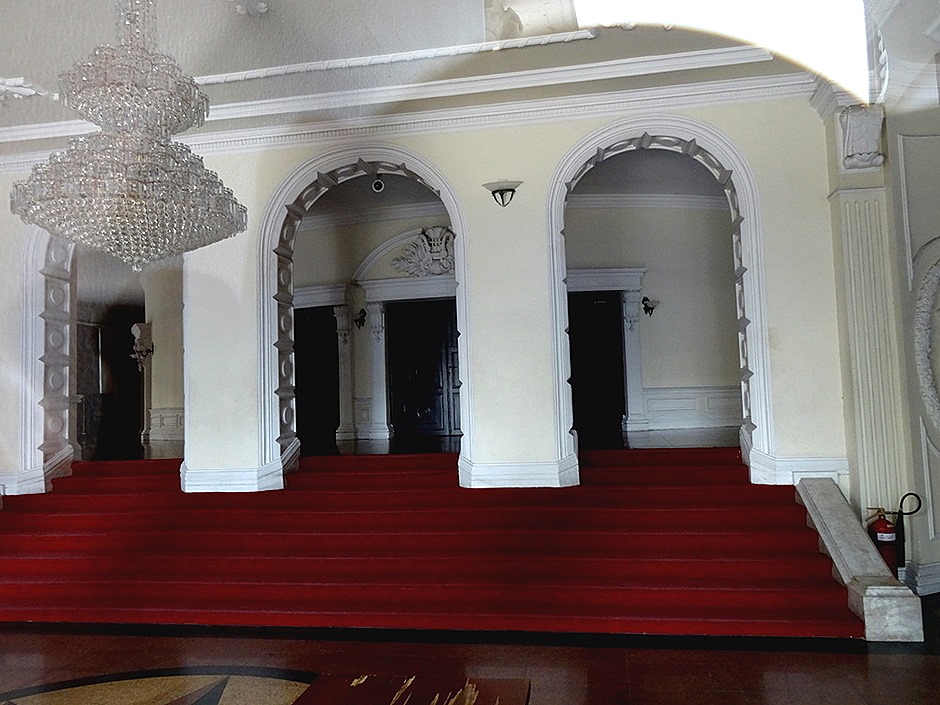


In front of the Opera House was a promotion for a play consisting of a whole lot of bamboo fish traps attached to a bicycle. Walking on, we came to a small park full of flowers and passed a monument in a tiny park commemorating something that happened on Christmas Eve in 1964, but we can’t read Vietnamese so we didn’t know what that was. We have since learned that this was the bombing of the Brinks Hotel in Saigon by the Viet Cong.


It appeared from signs we saw (again, we can’t read Vietnamese) that the city was celebrating the 50th anniversary of the Tet Offensive that was a major turning point in the war. Although many more Vietnamese were killed than Americans in that battle, American confidence was shaken by the Viet Cong’s ability to invade the American embassy in Saigon. Tall sculptures of lotus blossoms decorated a number of street corners. We don’t know whether these were there for a special purpose or just normal. We walked around a little, visiting some stores & getting lost until we found ourselves back by the river. The streets of the city were pretty interesting in themselves.


Finally discovering the correct route (we had turned in the direction opposite from where we wanted to go), we walked up to the Post Office, built by Gustave Eiffel in 1891. The outside is bright yellow with carved stone decoration, including busts of famous European artists and philosophers. There is much hustle and bustle outside with street vendors selling, among other things, very colorful folded cards that open up like children’s pop-up books to display a Vietnamese building or scene. Inside is a vast hall with iron pillars and a portrait of Ho Chi Minh displayed prominently on the wall in the back. Its really an interesting building.


Across the street is the Notre Dame Cathedral, built by the French in 1880. It looks like brick but it is actually made of red tiles from Marseilles covering granite walls. It appeared to be undergoing renovation as it was mostly covered in wide scaffolding. Down the street to the right of the post office is the building where, we were told, the last American helicopters left Vietnam as the Vietnamese army was closing in on the city. It is the subject of a rather iconic photograph showing the desperate people left behind.


We had done a lot of walking on a hot & humid day, so we stopped for a late lunch in a restaurant next to the post office. We had pizza & beer, very refreshing. Unfortunately it was open on three sides & not air conditioned.


After lunch we walked down to the Ben Thanh Market, built in 1913 by (yes, again) the French. Inside are hundreds of vendors in booths divided largely by subject matter: clothing aisles, food aisles, etc. It is very crowded & busy and as you walk down an aisle each vendor jumps up to point you to their wares (as if you couldn’t see them yourself). Lots of bargaining going on and the shops have spilled over onto the surrounding streets.


After that we met our bus (having to fend off dozens of street merchants who kept approaching us as we waited) and drove back to the ship. It was a shame we had only one day in Vietnam this year.


 BADER JOURNAL