
Viatape, Bora Bora
This was our first visit to Bora Bora, an island Rick has wanted to visit since he read James Michener’s Hawaii when he was in high school. So he was out on deck early on January 14 for the sail in. Curiously, not many passengers were out this morning for what turned out to be a pretty spectacular approach with the sun rising behind the big mountain that dominates the island.

I’m sure I am not the first to notice this, but this huge island mountain made me think of Bali Hai in the movie South Pacific. Which is not far fetched since Michener spent time on this island while in the Navy during World War II before writing the book on which the musical & movie were based. But Bali Hai is undoubtedly an amalgam, since the view of Moorea from Tahiti is also reminiscent of the movie. Our friend Peggy was on deck for the sail in too, and a nice fellow passenger offered to take our picture, undoubtedly under the impression we were a couple.


We anchored surprisingly close to shore & could see the town of Vaitape clearly from the ship. We could hardly wait to get there, it looked like such a beautiful spot. On an island across the water from the town was an abandoned resort that looked like it might once have been quite a nice place to stay.


Our plan was to explore the town during the morning, then we had an open truck tour of the island scheduled for 2:00. So after breakfast we took the short tender ride into town, where we were greeted by a musical group.


The town as a whole was a real disappointment. It was small & crowded with commercial buildings. The traffic was unrelenting on the one road in the town & there was a very touristy commercial vibe, nothing like what the island looked like from the water. Of course, the touristy vibe was emphasized by the hundreds of tourists who poured into this tiny town, constituting the majority of people on the street.


There were two interesting churches in town. One was pink with a red roof & steeple, which looked nice in front of the green mountain. We aren’t sure what denomination it is, but the other one may be Catholic since it had stations of the cross inside. The second church was less attractive from the outside, but inside was a large window with stained glass around the sides, painted images in the middle & a number of clear glass panes that allowed a view of the mountain behind. Very interesting.


We wandered up the street & back, perusing shops & art galleries but finding nothing we wanted to purchase. We went back to the ship for lunch, then tendered back to the pier in time for our 2:00 excursion. There were eight folks in the truck for this outing. The roads on this island were built by the U.S. Navy, which maintained a supply base here during World War II. We found that many of them go straight up a mountain, no switchbacks or zig-zags, so we had to hold on tight to avoid sliding into the next person’s lap. But it was fun.


While some of the travelling was a little rough, the lookout spots on the mountains were well worth it. Bora Bora has a particularly wide lagoon inside its reef & our guide told us there are 14 colors of blue in the water here. While we didn’t count them, we believe it because we saw a lot of shades of blue on our short visit.


During World War II the US Navy had an important supply operation on Bora Bora. To protect the island several large cannons were put in place on the mountainsides. There was never any actual fighting here, however, so the guns were not used. But they are still there and we visited one of them.


At the gun site were several reddish flowers lying on the ground, having fallen off a tree. We were told that these were a type of Hibiscus. The flower lasts only one day: it opens yellow in the morning, turns bright red in early afternoon, then turns dark red & falls off before evening. It sounds kind of sad, really. We saw a lot of other nice flowers on this lush island, so there are some more pictured below.


We stopped at a beach & also drove by several of the expensive resort hotels with glass bottom bungalows over the water.


We stopped at a place where they were making pareos, decorated Polynesian cloth that can be folded to wear as a skirt, dress, shawl, etc. Many are printed in bright designs, but the more interesting ones are sort of tie-dyed, then left in the sun with decorative linoleum cutouts on top. The exposed dye is activated by the sun in a way the covered dye is not, giving the design (often including the name of the island) a varied & colorful design. Pareos are everywhere in Polynesian shops.


We returned to the dock & tendered back to the ship. Here are a couple of miscellaneous pictures that didn’t fit anywhere else.


In 2016 we had a number of cook-outs on the lido deck, which were fun. But last year the health inspectors nixed that for some reason, so now they have “cook-ins” in the lido buffet and you can take the food out on the deck to eat. This isn’t nearly as much fun. But tonight there was a Polynesian cook-in at the Lido, complete with suckling pig & drinks sipped out of coconuts. We ate in the dining room.


Sunset was behind an island, but Bora Bora itself was bathed in sunlight.


We sailed away from Bora Bora looking forward to a relaxing sea day (finally after 4 consecutive ports). The sky was clear, the moon was bright & of course there was a towel animal at bedtime.


Opanuhu Bay, Moorea
We left Tahiti around 5:00 AM for the short sail to Moorea, approaching the island shortly after sunrise. Moorea has two large bays parallel to each other: Cook’s Bay & Opanuhu Bay. We had been told, right up to bedtime the night before that we would be anchored in Cook Bay this time but as we emerged on deck for the sail in we discovered it was Opanuhu Bay, the same as last time. It is an amazingly beautiful spot, but we (and others) had been hoping for something new. 
In 2016 we enjoyed a 4X4 excursion through the mountains & pineapple groves of Moorea, and you can see that here:
https://baderjournal.wordpress.com/2016/02/16/opunohu-bay-moorea
So this time we decided to take it easy by tendering ashore and hiking down the road toward the bay. So, after breakfast in the dining room we boarded a tender to go ashore. We sat by the rear windows during breakfast where a crew member was hanging on a rope outside washing the windows. We were glad to be on the inside.


We walked out of the little village at the tender port, which seems to be named Papetoa, then turned left toward the bay. They have recently upgraded the road so that it is paved & fairly smooth going. It was a very nice day & there was a lot of great scenery every way you turned . . . mountains, palm trees, etc.


We passed bananas, breadfruit, mangoes & coconuts growing on trees. There was also a fruit stand in front of someone’s driveway, but no one was manning it. Maybe it’s an honor system.


As we neared the bay we had views of the ship and of the pointed peak in the middle of the bay shore.


We saw a lot of flowers along the road to the bay. Here are a few of them.


We were walking along the road on our way back to the port when suddenly a horse stepped out of the brush right in front of us. She wasn’t the least bit afraid, and a moment later her two foals followed her out. They grazed by the road as we continued on. We also passed a goat, working hard at keeping the grass short in someone’s yard. A bird hopped up on the goat’s back, but the goat didn’t seem to notice. We also walked past the local school before reaching the tender port.


In Papetoa (if that is the right name for the tender port village) is a small octagonal church with a bright orange roof. We were hoping to go inside this time (it was locked in 2016), but no dice. We were told that this was the first church in Polynesia, originally built in the first half of the 19th century. We saw a tile mural that centered on this church. There was a market set up at the pier, about the best place we have seen to buy nice black diamond jewelry, as well as tee shirts & other items.


Waiting on deck for the sailaway, we saw a number of outrigger canoes in the water near the ship. There was also a resort hotel nearby with cabanas over the water. These are available for visits (for a whole lot of money) on several of the Polynesian islands we visited.


We sailed away well before sunset. As we did so we saw another ship, a small Europa vessel, sailing out of Cook’s Bay. Apparently they were given the port position there that Amsterdam had anticipated using. Moorea is probably the most beautiful island we have seen, lush green craggy mountains & a calm blue lagoon surrounded by a reef where the surf breaks. As we sailed away in the evening we appreciated the view once again.


It was too early for a real sunset, but the sun did dip dramatically behind some clouds. And after dinner a towel animal was waiting for us as we hit the sack to prepare for an early morning arrival at Bora Bora, the last of our four consecutive port days.


Papeete, Tahiti
At about 8:00 Am on January 22, we docked (yes docked!) in Papeete, Tahiti, the second of four consecutive shore days, the only such stretch on this voyage. Last time we were here we took an excursion along the west side of the island, which is documented here:
https://baderjournal.wordpress.com/2016/02/13/papeete-tahiti
So this time we had a morning excursion along the north coast to Venus Point, where Captain Cook observed the passage of Venus across the Sun in 1769 as part of a worldwide effort to measure the distance to the Sun. Upon leaving the ship we were greeted by local singers & dancers in costume.


Driving north we passed the crown peak, which actually looks like a giant crown among the mountains. Then our first stop, the house of American author James Norman Hall. So, who is that, you may ask (we did). It turns out he was a flyer in the Lafayette Escadrille in World War I, then co-author of the Bounty trilogy, upon which the Mutiny on the Bounty films were based. He was, therefore, partly responsible for the maligning of the reputation of Captain Bligh that is still with us. Bligh (who had been Cook’s navigator on his final voyage) came to Tahiti on a mission to collect breadfruit seedlings for transplanting in the Antilles, where it was thought to be a perfect source of food for slaves. His ship was here for months & many of his seamen became enthralled with the beauty of the island and, probably more importantly, its friendly women. Bligh did not treat his men any worse than other sea captains of the time, and better than many, but Fletcher Christian considered himself to be a gentleman who was above the normal treatment of ship officers. He was popular among the seamen & his growing animosity toward Bligh culminated in the mutiny. The mutineers set Bligh & a couple of dozen others afloat in an open boat & returned to Tahiti, where they split up, some staying in Tahiti with their new wives & the rest sailing with Tahitian girlfriends & slaves to Pitcairn island. Meanwhile, Bligh brought all but one of his open boat contingent safely to what is now Indonesia, some six thousand miles away, now considered one of the great feats of navigation history. The mutineers on Tahiti were later rounded up by the British & most ultimately executed, while most of those on Pitcairn did not survive a slave uprising there. Bligh completed his breadfruit mission on a second voyage and went on to become governor of Australia.


We drove on to Venus Point. The only lighthouse on Tahiti is situated here, built in 1867. It was reputedly designed by the father of Robert Louis Stevenson, a notable lighthouse builder (we saw one of his in Shetland in 2014). A plaque commemorates Stevenson’s statement upon visiting it in 1888 that he was moved because he worked in his father’s office the year it was designed. We have read elsewhere that it really wasn’t designed by Stevenson the elder, but his son would probably have known.


There are two monuments at Venus Point. The first is to commemorate Cook’s viewing of the transit of Venus. Our guide told us the spot was picked because of a piece of coral with a ridge cut into it that the finders thought was left to mark the spot, but he said it really wasn’t. The second monument was erected recently to commemorate the Bounty mutineers, built apparently by some of their descendants.


Today Venus Point is a very pretty park. To its left is Matavai Bay, where Cook anchored in 1769 & the Bounty anchored for several months in 1788. The beach is black sand, which gets extremely hot in the sun . . . never walk on it barefoot! Part of the Marlon Brando version of Mutiny on the Bounty was filmed here, as the ships sailed into the bay. But the coming ashore scenes were filmed at another island because the director wanted a white sand beach; he though American audiences would never accept the real thing.


Our last stop before returning to town was at a lookout point on top of a hill overlooking Matavai Bay. We don’t know its current name, but Cook’s men called it “One Tree Hill.” We can imagine why, but today it is covered by trees. There is a huge rubber tree at the top that has been cut back several times. It looks like it could have been there when Cook visited, but our guide told us it is only about 40 years old. Apparently the grow really fast.


Back in Papeete we first walked to the Catholic Cathedral. Papeete is a modern city with busy streets & lots of nondescript commercial buildings. One distinctive thing here is the paintings and/or graffiti on the walls of many buildings. Some are quite impressive.


We visited the Catholic Cathedral in 2016, but it was closed. This time it was open to worshippers & visitors so we were able to see its interior & stained glass windows. The windows have Tahiti influenced images, such as breadfruit trees, canoe paddlers, and local musical instruments. Papeete means basket of water, & one of the windows included this image.


We visited the Marche, a large two story market building. The first floor is mostly produce, with some other products like straw hats. The second floor has a bar & higher end jewelry & textile stores. There was a group singing & playing on the first floor as well today.


In recent years Papeete has turned its waterfront into a very long & beautiful park, full of trees & flowers. We decided to walk all the way down to the end, where sits the public library. In 2016 the library was closed, so we were hoping to see the inside today.


They have built sort of an aquarium in the water along one part of the park. The fish are under netting & there are signs not to touch or feed the fish. They are not easy to see, but its an interesting concept to have this right there in the salt water.


Since we are in the park, this is a good place to show you some of the many beautiful flowers we saw in Tahiti. A lot were in the park, but some were at Venus Point & elsewhere. We also saw some birds.


We reached the library, but the outer gate was locked . . . worse than last time! But Rick explored around the back & finally found an open entrance. I guess you have to know the secret entrance in order to use the library. Inside was a courtyard with a huge tree in the center with hanging plants somewhat like Spanish Moss. It looks somewhat like a Banyan tree but for the free hanging fronds. The library is in three rooms, each with a vaulted ceiling, but it’s a lot smaller than that makes it sound.


We walked back from the library on the other side of the main street, passing the pink Evangelical Church. Bougainville Park has a bust of the French explorer after whom the beautiful flowers are named. Next to the park is the post office, where we mailed some post cards. Then we stopped at a street café for some French Fries & Hinano dark beer. It had been a long hot day, and this was very refreshing. We liked the Hinano dark better than the light, and the fries came with mayonnaise in the French fashion.


Another distinctive thing about Papeete is the Polynesian stone sculpture you see in parks and on streets.


It was getting to be about 5:30 as we reached the ship, so we walked over to a nearby area that is home to a Papeete institution: its famous food trucks. They are parked in an open space where tables and chairs are set up so people can buy their food, then sit down while it is cooked and brought to their table. Not just sandwiches and such, you can get French crepes and other delicacies. We thought the prices a little high until we spotted a fellow eating a giant crepe that filled his plate after being folded in half. We were just discussing what kind of crepe to get for sharing when it started to rain. So we ran back to the ship & still haven’t tasted those crepes.


After dinner tonight there was a dance performance by a local Tahitian dance group. We saw one of these last time and certainly didn’t want to miss it. But there was only one performance (usually there is one scheduled for early eaters and one for late eaters) and by the time we reached the Queen’s Lounge the place was packed. We usually sit in the front of the balcony, but this night we were lucky to find seats at the very back of the first floor. So that is why most of these pictures have the tops of people’s heads silhouetted at the bottom.


Well, this was a long and tiring day, so nothing to do after this high energy show but go to bed. The ship would be leaving at 5:00 AM for Moorea, which you can see from some of the pictures is very close, so the sail in would be early.


Avatoru, Rangiroa
On the morning of January 21 the Amsterdam slid through the Tiputa Pass into the lagoon of Rangiroa. In 2016 we didn’t make it onto deck in time to see the arrival through the pass as the Captain had gone through a little earlier than we had been told, so this time Rick got up an hour before the scheduled arrival. But to no avail, as the Captain beat us again.


Rangiroa is a series of long, thin, low coral atolls surrounding the second largest enclosed lagoon in the world. The lagoon is tens of miles wide & you can’t see from one side to the other. Very few people live here & there isn’t much to do unless you are into water sports. Rick went snorkeling last time we were here at a place called “the aquarium” just inside the Tiputa pass, and you can see the photographic results here:
https://baderjournal.wordpress.com/2016/02/10/rangiroa-tuamotu-archipelago
But today was a Sunday and in Polynesia everything closes on Sunday, so there was less to do than usual. We decided to tender ashore & walk around for awhile. But before that, in the early morning we watched a storm pass by from the ocean over the atoll and off into the lagoon, hardly touching our ship. Afterward, however, there was a magnificent rainbow that dwarfed the island.


We were greeted at the dock, as is usual in these islands, by a group of singers & musicians. A tent market was set up behind the dock. As we walked up the road away from the dock we ran into our friends Robert, Bill & Lee near the local grocery.


It doesn’t take long to walk across the atoll to the Pacific Ocean. While the lagoon waters are rather calm the Pacific coast is rough, with pounding surf. Rangiroa is made up of coral atolls & a lot of the rocks along the road are coral pieces. We did pass one or two buildings, at least some of which are resorts, nestled among the palms.


As is true throughout Polynesia, this island has a great deal of colorful flora, as well as birds & fish. Most of these flowers were growing on trees or bushes, not directly out of the ground. Rangiroa also has the only vineyard in Polynesia, but we didn’t see that (it is not open for visiting).


It was really very hot & humid, & the irregular ground was something of a challenge for Mary’s new knee, so we headed back to the dock. There wasn’t much more to see anyway. On the walk back we passed whole fields of palm trees & we saw people swimming from a beach beside the dock.


We stopped for a Hinano beer at a little open air restaurant just off the dock, a great refresher on such a hot day. From our seats we could see the Windstar sailing ship that was also anchored here today (a much smaller ship than Amsterdam). There were also fish & birds to be seen from a tiny rock outcrop right beside our table. After that we tendered back to the ship.


We had heard that dolphins often play in the ship’s wake as it goes through the pass. So we went down to the second deck at the aft end of the ship for the sail away in hopes of seeing them. It was a lovely & very sunny evening as the ship circled through the lagoon in order to build up speed for the run through the pass. It didn’t reach 88 miles per hour, but then we weren’t trying go go Back to the Future.


We were pretty disappointed since we didn’t see any dolphins (or other wildlife) as we traversed the pass. We were just about to give up & leave when suddenly there they were, leaping in the ship’s wake. So cool! Well worth the wait.


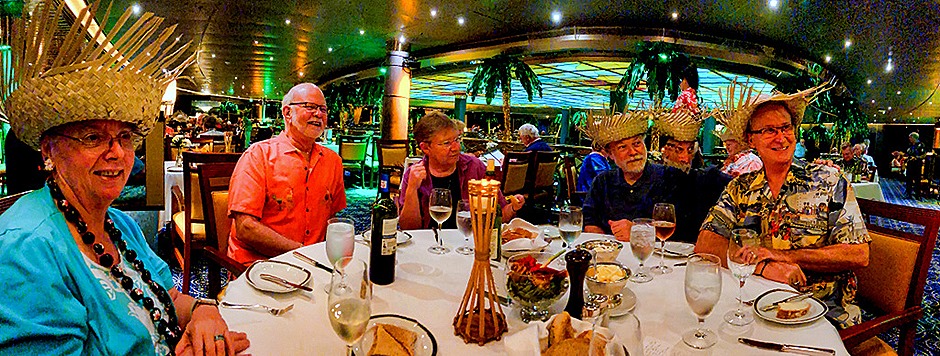
Not sure which night, but probably after Rangiroa, was Polynesian night in the dining room, with Polynesian dishes on offer & Tahitian straw hats distributed to everyone. And here is another ending with towel animals.


Taiohae, Nuku Hiva
After eight days at sea we sailed toward Taiohae bay on the island of Nuku Hiva on the morning of January 19. The last time we were here, in 2016, it was cloudy & rainy as we approached the island, but today it was beautiful and sunny.


Lots of passengers were out on the front deck as we sailed past some of the mountains & rock formations & the crew were out there too, serving coffee & “Nuku Hiva Rolls,” which tasted remarkably like Panama Canal rolls.


Nuku Hiva is the largest of the Marquesa Islands. It was famous in the 19th century as the island where Herman Melville lived for several months with a village of cannibals, which he turned into his best selling novel Typee. In 2016 we went on a very beautiful tour of the island, which you can see here:
https://baderjournal.wordpress.com/2016/02/08/taiohae-nuku-hiva
So for this visit we decided to explore Taiohae ourselves on foot. It was a very short tender ride from the ship to the dock, but three tenders went out of commission with engine issues almost immediately so we were not able to get to shore until about noon. We went up to the Lido deck where they were distributing tender tickets, then sat near the pool waiting for them to reach our number. From there we saw some local fellows in canoes following in the wake of the tenders (once they got going again). When they are able to do it correctly the tender wake pulls them along without paddling and this seems to be a popular sport in several of the islands we visited.


We finally made it onto a tender & then to the dock. We were greeted by local musicians & dancers who handed each visitor a flower bud to wear behind an ear. An impromptu market was set up behind the dock, selling everything from produce to t-shirts to wood carvings. Nuku Hiva is famous for its wood carvers; most of the Tiki sculptures for sale everywhere on the Polynesian islands are made here (and so the prices for them are much better here than elsewhere).


On a hill above the dock & clearly visible from the ship is a large tiki style statue of a woman. This is new since our last visit & reportedly very unpopular with the locals. We had to agree with their view, especially after seeing the back of the tiki that has a warrior apparently emerging from the woman.


We began the approximately 2 mile walk from the dock to the end of the road on the other side of the bay. It is a very beautiful walk, with many colorful flowers, mountain views & views across the water. While some of the mountains were green the lower areas were quite dry & the flowers much less lush than last time we were here. We were told there had been no rain for three months. Still, there was a lot of beauty.


About half way across the bay is the Catholic Cathedral of Notre Dame. Unlike any other cathedral we have seen, this one is full of wood carvings covering doors & the pulpit as well as the stations of the cross on the walls. The figures look like Polynesians rather than Europeans (the actual people depicted, of course, were Semites from the Middle East), with other Polynesian touches, such as breadfruit trees instead of olive trees in the garden. The building is constructed of stones brought from each of the Marquesas Islands. Very special.


In front of the cathedral is an arch with two towers, which may be a remnant of an earlier church. Behind the cathedral is a very colorful garden. Two interesting Jewish references. Across the courtyard from the church is a smaller building with carved wood pillars. One of them is Moses with the ten commandments. Interestingly, he is depicted with horns on his head, perhaps derived from Michelangelo’s sculpture of Moses in Rome. The horns come from a mistranslation of the Torah, which says Moses had beams of light, rather than horns, emanating from his head when he brought the tablets down. The other is a star of David carved into the inside of one of the doors. We don’t know what the inscription says or what it was intended to represent.


Continuing on, we visited the memorial to Herman Melville, a carved wood pillar. Apparently some French officials were expected to visit in a few days, so workmen were out refurbishing the thatched roof of a platform near the water. Some women were busy weaving palm fronds into mats, presumably as part of this project. Some outrigger canoes were stored near the shore as well. And we walked past a cemetery, with white concrete & stone graves similar to others we have seen in Polynesia.


This is a good place to show you some of the many brightly colored flowers that were all around. Noticeably fewer than in 2016 because of the lack of rain, but still a lot. Most of these flowers are on trees or bushes. As usual, the names of the few we know are in the pop-up captions.


We visited a very tiny museum of Nuku Hivan artifacts at the very end of the road around the bay. It had one small room of artifacts, some of which were many hundreds of years old, and the other room was a gift shop. The owner, Rose, was really friendly and helped explain what we saw. After that we walked up the hill behind the museum to a restaurant highly recommended for its food and its view of the bay. Unfortunately, after we reached the top of the hill, panting in the heat & humidity, we found that it was closed for renovation! Why couldn’t they have put a sign to that effect at the bottom of the hill?
Anyway, after admiring the view from just under the restaurant we walked back down the hill & stopped into the small restaurant in front of the museum. Our friends Peggy & Bill were still with us, the rest of the group having turned back long before. We had Hinano beer, the main Polynesian brand, and Poisson Cru. Made of raw tuna, some salad ingredients & coconut milk, it was quite delicious.


Much refreshed, we made the long walk back across the bay to the tender dock. There were several groups of families at different spots along the bay having picnics & swimming. We did a little shopping at the dock, then boarded the tender for the short ride back to the ship.


We sailed away from Nuku Hiva at sunset. It was a very dramatic sunset, which deserves more than one picture.


So as we sail away from beautiful Nuku Hiva, we will leave you with a couple of towel animals, preparatory to a good night’s sleep.


 BADER JOURNAL