
Rome, Italy
We arrived in Civitavecchia, the port for Rome, on the morning of April 29. Unlike our last few ports, this one involved intense sightseeing rather than lovely vistas. There is so much to see in Rome that you can’t do more than touch a few high points in a one day visit, particularly when you have to factor in about 1.5 hours each way in a bus between the port and the city. To top it off the ship was leaving before dinner time, so getting back before its departure was an issue. For all these reasons we decided to take a HAL excursion, which was more expensive than it ought to have been but still well worth it (after all, who knows when/if we will get back to Rome?). While there was a lot that we would have liked to see but didn’t, it was amazing to us how much one could see in this short time. Inevitably, there are a lot of pictures in this episode taken through a bus window as we drove by places where we didn’t stop, but the sights we did get to visit were all very satisfying.
There really isn’t much to see in Civitavecchia, which doesn’t seem to be much more than the busy port for Rome, which is some 45 miles away. There are some Renaissance era fortifications, including an imposing fort designed by Michelangelo, but not much else to see.


Rome, of course, was the capital of the dominant empire of ancient times, controlling most of the Mediterranean area from about 100 BC to 200 AD. It was founded in the 7th or 8th Century BC, either by the Trojan prince Aeneas fleeing the disaster of the Trojan war (he must have been old since the Trojan War was a few centuries earlier), or by the twins Romulus & Remus who were suckled by a wolf, or by a slow process of several villages on neighboring hills growing together into a single city. The first two are more literary but the last one is most likely true. I will skip discussing its history here since it is readily available & most people have already learned about it in school, except when relevant to the places we visited.
We left early on the bus and arrived first at the Vatican for a tour of St. Peter’s Basilica. Established by a 1929 treaty with Mussolini, the Vatican is an independent sovereign state wholly enclosed by the city of Rome, the smallest state in the world. Interestingly, although St. Peter’s is the largest of all churches in the world it is not a cathedral. Cathedral is defined as the seat of a bishop, and the seat of the Bishop of Rome (the Pope) Is the Church of St. John Lateran, not St. Peter’s.


Emperor Constantine, who legalized Christianity in the 4th Century AD, built the first church here because it is traditionally considered the place of burial of the Apostle St. Peter, who was also the first bishop of Rome. The current structure was built in the 16th and 17th Centuries and many other Popes have been buried here over the centuries. The dome on top is the tallest in the world and is visible from a distance (although not from directly in front of the church). It is illegal to erect a building in Rome that is taller than this dome.


The vast open space in front of the Basilica is bordered by long colonnades on each side, with numerous sculptures lining their tops as well as the top of the façade of the Basilica itself. In this courtyard there are two fairly lavish fountains, a 13th Century BC Egyptian obelisk with a cross on top, and huge statues of St. Peter and St. Paul. The obelisk was once in the Circus of Nero that was in this area & is thought to have been a witness to the martyrdom of St. Peter there. Oh yes, there were a whole lot of people there as well, even though it was morning and not yet tourist season (although far fewer than in the summer months). Our guide told us they were getting an unusually large number of visitors this Spring because of the election a month earlier of a very popular new Pope. As a result we had a very long wait (close to an hour); there is no line or charge to get into the Basilica (how refreshing after all the fee charging churches we had seen) but you have to go through a metal detector security check first & that was very slow & backed up. Many visitors apparently felt they were not bound to follow the church rules & simply cut in near the head of the line, making the wait that much longer for the rest of us, but no one was there to stop them.


Having finally finished the security check we headed for the massive entrance to the church. It was framed by huge pillars and bronze doors with pictures; one set was made in the 15th Century and was part of the original basilica and another was made in the 20th Century. Stepping into this massive interior space is pretty awesome.


Our first stop inside was at Michelangelo’s Pieta. Michelangelo was only 24 when he sculpted this masterpiece & it was only his 3d sculpture. After a deranged guy caused some serious damage to it in 1972 they repaired it, mostly with the pieces that had been hammered off although Mary’s nose is entirely new, & surrounded it with bulletproof glass. There was a crowd around it and you couldn’t get close, but the glass is so clear you wouldn’t know from the pictures that it is there at all.


The ceilings of the basilica are (if I understand correctly) carved stucco decorated with gold leaf. To give an idea of the scale of the building, the words on the gold ribbon at the top of the walls are more than 6 feet tall. There are several smaller domes in the church which appear to be oval in my pictures, but I think that may be a result of camera angle and that they are actually round. They are decorated inside by what looks like frescoes but are actually mosaics. In fact there are very few paintings in St. Peter’s (our guide said there are none but I have since read about a couple of very small ones); all of the large pictures that are actually mosaics executed with such tiny glass tiles that you really have to get close to see that they are not paintings. Many of them are mosaic copies of important paintings however.


We walked on past several tombs of popes, many of whom are entombed here, and innumerable statues of saints, martyrs & popes in niches in the marble walls. In the center of the church, directly under the primary dome, is the Baldachin created by the sculptor Bernini in the early 17th Century to mark the spot where St. Peter’s remains are thought to be. It is a gigantic bronze canopy covering the altar, on which only the Pope is allowed to celebrate mass.. Although it doesn’t look outsize in the context of this space, it is actually 96 feet high (more than 10 stories if it were a building). Most (if not all) of the more than 100,000 pounds of bronze used to build it was looted from the roof of the Pantheon (which we will see later). Its helical pillars were copied from the marble pillars supporting a canopy in the original St. Peter’s; they are called “Solomonic pillars” because the originals were thought to have come from the Temple in Jerusalem, but in fact they were made in the 2d Century AD, probably in Greece. In the large picture below two of the original pillars can be seen on the balcony on the left. The top of the Baldachin is designed to look like the cloth canopy that was on the original in the old church.


In the apse behind the Baldachin is the Cathedra Petri, also by Bernini. It was built as a reliquary for a chair long thought to have been used by St. Peter, but which actually appears to have been a gift from Charles the Bald to Pope John VIII in 875. The chair is encased in the object at the center of the structure, which is chair shaped if you see it in person. The chair holder has a gilded picture of Jesus giving the keys to St. Peter & the elaborate gilded gloria above is carved stucco covered in gold. The light in the middle is from a pre-existing window in the wall that Bernini effectively incorporated by including a yellow alabaster window in the gloria that lets in the outside light. The dove in the window represents the Holy Spirit & the chair is supported by sculptures of four “Doctors of the Church.”

Above the Baldachin is, of course, Michelangelo’s great dome. On the outside it is the tallest dome in the world and on the inside it rises almost 400 feet from the floor. It is filled with mosaics designed by Michelangelo. The inscription at the top memorializes the pope at the time of its completion rather than the artist who designed it: “To the glory of St. Peter, Pope Sixtus V in the year 1590, fifth of his pontificate.”


Each of the four massive supports of the dome displays a sculpture of an individual associated with an important relic that lies below it. Here is St. Helena, the mother of Constantine, who is considered the finder of the True Cross, a fragment of which lies below her sculpture. Here also is a picture of people standing by the base of one of the columns of the Baldachin, which gives you a better idea of its scale. The relief on the base of the column is the coat of arms of Pope Urban VIII.


So then we headed back toward the door, walking through several side chapels. The floors of the church were beautiful inlaid marble. I think the bronze door through which we exited is the one made in the 20th Century & that the picture to the left is Pope John XXIII bowing before the martyred St. Peter.


As we left the Basilica and headed for (yes) the Vatican souvenir store, which thankfully had a restroom & some cold water, we passed the Swiss Guards on duty by the church. Very colorful.


Leaving the Vatican, our bus headed for the Colosseum, our next stop. To get there we crossed the Tiber River and drove past Trajan’s Column & an architectural site that shows how the current city street level is about 25 feet higher than it was in classical times. Trajan’s column is hollow & has one of the first spiral staircases inside it. It originally had a statue of Trajan on top but a statue of St. Peter has been there close to 500 years. The reliefs spiraling up the sides portray Trajan’s military engagements with the Dacians, who lived in roughly the same area as modern Romania.


The Colosseum was commissioned by Emperor Vespasian in 72 AD. Its elliptical design was derived by combining two amphitheaters. It could hold about 55,000 spectators, all admitted free of charge, for the gladiatorial combats & wild animal fights that were its stock in trade. We were told, however, that contrary to popular belief Christians were martyred in the Circus Maximus and not in the Colosseum, which wasn’t built until after Nero’s reign. Originally called the Flavian Amphitheater (Vespasian was the first of the Flavian dynasty), it is thought to have obtained the name Colosseum after a colossal statue of Nero, some 30 yards tall, that stood nearby.


Only about a third of the original structure is still there. It was damaged by earthquakes, but mostly it was used as a quarry for already-cut stone, a large portion of which was used to build St. Peter’s Basilica. The stone blocks used to build the outer walls were fitted together without mortar and connected by iron pegs. In the pictures immediately above you can see the walls covered with pockmarks, which were made by people drilling into the walls to extract the iron pegs. We entered the Colosseum through the outer arched passage while the guide explained that the crowd flow was so well managed by the system of entrances and passageways that the entire stadium could be emptied of its 55,000 spectators in just 15 minutes.


The Colosseum was constructed on the inside mostly of concrete and brick. When the Empire disintegrated in the 4th & 5th Centuries AD the secret of making concrete was lost and not rediscovered until the Renaissance. Quite a lot of the brickwork evident today in the building was added in the 19th Century in an effort to prop up what was left of the structure. Its not too hard to tell the modern from the ancient brickwork.


The floor of the Colosseum was a huge wooden platform covered with sand. Beneath this floor was a two story complex of animal cages, gladiator rooms, storage rooms and hallways. It was outfitted with elevators, operated by winches, that could raise animal cages to arena level. where they would suddenly appear in dramatic fashion. Archers stood by at all times just in case an animal escaped.


The archways and structures of the building provide some nice views. And, oh yes, Mary & I were both there!


Right next to the Colosseum is the impressive Arch of Constantine. It was built in 315 (the last of the triumphal arches) to commemorate his victory in a battle against a rival for the Imperial crown. It was before this battle that Constantine is supposed to have seen a vision of the cross, which led him to legalize Christianity when he then won the battle (Constantine himself did not become a Christian until he was on his deathbed, if then, although his mother and wife were Christians). Most of the decorations on this arch were actually scavenged from earlier monuments, in particular statues and reliefs relating to the campaigns against the Dacians which, we have already learned here, were actually conducted by Trajan. Even so, it is well worth examination.


Near the Colosseum we passed an elaborate marble gate to the Palatine Hill, where the Emperors had their palaces (the word palace actually derives from Palatine). Actually, the inscription says it is the gate to the Farnese Gardens, built in the 16th Century by Alessandro Farnese, whose grandfather Pope Paul III made him an Archbishop at the mature age of 14. A little later we drove by the edges of the Palatine hill, where we saw what is left of the Circus Maximus (not much) & the palaces of Augustus & Septimus Severus. We also saw Roman soldiers outside the Colosseum who I am told will let you take their picture for a steep fee.


On the opposite side of Constantine’s Arch from the Colosseum was the Via Sacra (on which processions were held) leading to the Arch of Titus & behind it the Forum. The Arch of Titus was erected in 82 AD to commemorate the Emperor Domitian’s deceased brother Titus and his Palestinian victory in 70 AD. Inside the arch is a well known relief showing Roman soldiers carrying away the contents of the Temple they destroyed, notably a large menorah, but we didn’t see that since our tour did not go to the Forum. To the right of the Arch in the picture is a row of columns from the Temple of Venus & Roma in the Forum, which we glimpsed as we drove by some of the Forum in the bus. Built by Hadrian, this large temple had statues representing the love goddess Venus & the city of Rome sitting back to back. It has been suggested that this was a bit of humorous wordplay by Hadrian, since the word for love was “amor,” which is Roma spelled backward, & the goddesses were sitting back to back. I doubt it, but it’s a clever point. We also saw the Basilica of Julia (the Roman legal courts) and the Temple of Saturn on our drive by the Forum.The Basilica was originally built with spoils from Caesar’s Gallic wars, but was burned down & rebuilt several times before its final destruction by the Visigoths when they sacked Rome in 410 AD. Later in the day we drove past the 4th Century Arch of Janus (a name it was given about 1,000 years later), which is not in the Forum but is the only four sided arch still extant in Rome.


After a long morning we stopped to eat at a very nice restaurant where we had a delicious lasagna lunch. On the way there our guide pointed out the pink American Embassy.


After lunch we walked to the Trevi Fountain. Built in the 18th Century on the site of the terminus of an ancient Roman aqueduct, the fountain is about half as long as a football field. Its central figure is Neptune, flanked by two Tritons with seahorses (half horse half fish). There is a tradition that if you throw a coin in this fountain (over your left shoulder with your back to the fountain) you will be sure to return to Rome. This was featured in the movies Roman Holiday and Three Coins In A Fountain. Lots of people must believe it, since the fountain collects about 120,000 Euros a year for charity. Our guide stopped us about a block away and told us to take out any coins we want to throw in the fountain before we got there, because this square is always frequented by thieves & pickpockets.


At this point we were given about an hour of free time to go where we liked & meet back at the fountain. There had been a very interesting lecture on board by an Architecture professor about the Pantheon so we decided to walk down and see that. It was not a short walk but it was a nice one through several squares with sidewalk cafes and street artists and across one of the main drags, Via Del Corso.


The Pantheon sits on a square called Piazza della Rotundo. First built in 27 BC by Augustus’s son in law Marcus Agrippa, the original building burned down and was completely rebuilt by Emperor Hadrian in the early 2d Century AD. Showing a humility unusual in a Roman Emperor, Hadrian (who may have helped design the building) kept on the new building an attribution to the original builder: “Marcus Agrippa, son of Lucio, three times consul made this.” It sounds like Agrippa may not have been so modest. As its name suggests, this was originally built as a shrine to all of the Olympian gods. But at the end of the 6th Century it was consecrated as a church, which saved it from the kind of destructive looting that was applied to other ancient buildings like the Colosseum (although we have noted that the bronze roof was recycled at St. Peter’s & the gold leaf that originally adorned the interior of the dome was also taken by a Byzantine Emperor). As a result, this is the best preserved building from ancient Rome. I remember visiting it in 1970 and not being impressed, but looking back I think that was because it wasn’t a ruin so it didn’t seem as authentic (and really I didn’t know anything about it at that time). Only when one gets older does one realize how stupid he was when young!


The portico is Greek in style. Those 40 foot long granite pillars are single pieces of stone, quarried in Egypt, unlike the Greek pillars that were made of round blocks stacked on top of each other. The main building is exactly as tall as it is wide (142 feet) & its shape is designed as a sphere inside a cylinder. We were told that this dome is, even today, the largest concrete dome in the world, but it looks less impressive than others on the outside because much of it is hidden by the cylinder. As you can see from the pictures above, the dome isn’t even visible from the front of the building. In the pizza in front of the building is a 16th Century fountain topped by an obelisk originally built by Egyptian Pharaoh Ramses II for the Temple of Ra in Heliopolis.


From the inside the dome is much more magnificent. It was made by pouring concrete into a wooden mold. It is more than 20 feet thick at the base and tapers to less than 5 feet at the top. The coffered pattern in the ceiling makes the structure much lighter by reducing the amount of concrete without reducing the strength of the dome. The opening in the top, some 30 feet in diameter, further reduces the weight of the dome and is also the only source of light in the building (other than the front door when it is open). Of course this opening also lets in the rain, so the beautiful marble floor has holes under the opening and also slants down toward the sides to permit the water to drain.


The opening in the dome cast a dramatic spotlight on the walls that moved as the sun travelled across the sky.


The walls were covered with a pink marble pattern including pedimented decorative windows, framed panels & columns.


As mentioned before, this is a church. It has a very nice altar integrated into the niche directly across from the entrance. And several favored people are entombed here, notably two kings of Italy (and Queen Margherita of Italy after whom the pizza is named) as well as the great Renaissance artist Raphael.


Well, there was a little time left before we had to be back at the Trevi Fountain, so we decided to push on for a quick look at the Piazza Navona which appeared to be nearby. To be more accurate I wanted to see the Piazza Navona & Mary was more worried about getting back in time. It was a longer walk than I had expected & we got lost enough that we asked a policeman for directions. By the time we arrived at this gigantic piazza there was only time for a very quick walk through. The Piazza Navona is very long and narrow because it used to be a racetrack. The Domitian Stadium was built here in the 1st Century AD & held 33,000 spectators. Considered by many Rome’s best Baroque area, the piazza has three outstanding Baroque fountains and the Church of Saint Agnes on one side in the middle. We entered the piazza on one end where we encountered the 16th Century Fountain of the Moor, containing a Bernini sculpture added later. We walked up to the center of the piazza where Bernini’s Fountain of the Four Rivers sits in front of the Church. This is considered one of Bernini’s masterpieces. The base displays sculptures representing four prominent rivers in the continents then subject to papal influence: the Nile in Africa, the Ganges in Asia, the Danube in Europe and the Rio d la Plata in South America (visited last year in Uruguay & Argentina). On top is yet another obelisk, this one dating only from First Century Rome.


Have I mentioned it was getting late? So we hurried back as best we could (the route was a little confusing). We never found a public library in Rome, but on the way back to the Trevi Fountain we stopped briefly to look at a lovely little fountain just for bibliophiles that we happened to encounter. It was built in 1927 in the wall of what is now the national archives & commemorates a university that once was here. I was also interested by what appears to be a water pipe cover with the ancient designation “S.P.Q.R.” that the Romans carried into battle (standing for Senatus Populusque Romanus or “Senate and People of Rome").


Well, we made it back before our group left the Trevi Fountain, although we were the last ones back. Sadly, we didn’t have time to buy a gelato from the vendor there as we had planned, but I think I would trade a gelato for the Piazza Navona any day. We got back on the bus & drove to the Piazza Venezia where the gigantic Monument to Victor Emmanuele II, the first king of Italy, stands to glorify the unified nation. The equestrian statue of Victor Emmanuele at its center is almost 40 feet long; his mustache alone is 5 feet long. This monument has always been controversial, not only because many consider it an outsized eyesore (Romans sometimes call it “the wedding cake” or “the typewriter”), but because part of the Capitoline Hill and a medieval neighborhood were cleared to build it in the first decade of the 20th Century. Across the piazza is the 15th Century Palazzo Venezia which served as Mussolini’s headquarters. It was from the window pictured below that Mussolini harangued the crowds, making more than 60 speeches from that spot.


From here we walked behind the monument for a brief look at the Cordonato, Michelangelo’s stairway leading up to the Capitoline Hill. This was Rome’s first citadel and its center of government. It was redone during the Renaissance pursuant to a design by Michelangelo. Surrounding the square on top of the hill today are the Capitoline museums on each side & the Palazzio Senatorio, which is now the mayor’s office. In the center of the square on top of the hill is a bronze equestrian statue of Marcus Aurelius (actually a copy, the original is in the museum). This is the only equestrian statue to survive from ancient Rome & the only reason it wasn’t recycled like the rest is because it was erroneously believed that this was Christian hero Constantine the Great. On either side of the bottom of the stairway is a granite Egyptian Lion spouting water & at the top are statues of Castor & Pollux, considered the protectors of ancient Rome after they appeared to assist the Romans in an important early battle and then appeared again in the Forum to announce the victory. All four of these statues were dug up in pieces then fitted back together, as you can plainly see on the lion below; the head of Castor was entirely new since the didn’t find the original, and is a copy of the head on the Pollux statue. Unfortunately, it was getting late and we didn’t have time to walk up to the square, so all we have are pictures from below the staircase.


That was it for Rome. We climbed back on the bus for the long drive back to the Prinsendam in Civitavecchia. To get there we passed through the massive city walls of Rome & drove past the Basilica of St. Paul Outside The Walls, which was built over what is thought to be the grave of St. Paul (actually just his body is supposed to be here, since his head is in St. John Lateran). The first church was built on this spot by Constantine in the 4th Century, but it has been destroyed & rebuilt several times, the most recent at the turn of the 20th Century. Still, it is considered a faithful rendering of what was there before & has many artifacts from the old Basilica. Of course we didn’t see any of them because we just glimpsed the building through the woods as our bus flew by.


One last note of importance (at least to us). All of our companions at the “fun table” at dinner left the cruise in Rome. They had all boarded in Istanbul and you can see their jolly pictures in that episode, so I won’t put them here again. It is always sad when good friends depart, but in Rome we got a whole new set of table mates who also proved to be interesting & congenial. But this has been a very long posting, so I think I will wait until the next episode (much shorter, I assure you) to post their pictures. So that was the end of our visit to Italy, a very rich and rewarding portion of the cruise.
Sorrento, Italy
Sorrento is just on the other side of the Bay of Naples, so it was a short hop for Prinsendam and we arrived early on the morning of April 28. Founded by the Greeks, it was named after the Sirens in the Odyssey who failed to lure Odysseus to crash his ship into the cliffs supposedly on this spot. Thinking they had lost their powers (he had actually tricked them) they committed suicide by throwing themselves on the rocks, which made this area habitable.

The previous day in Naples, with touring Pompeii in the rain, had been pretty tiring so we decided to make Sorrento a leisurely stop, particularly since there wasn’t anything there we felt we had to see. This worked out great, since we had a nice day and Sorrento is a nice small (16,000) city for just walking around & soaking up the ambience. So we started the day by sleeping a little later & having a leisurely breakfast in the main restaurant, then we went out on deck for some pictures & took the tender to Marina Piccola, the (yes) tiny port at the bottom of the cliffs on which the city is situated.


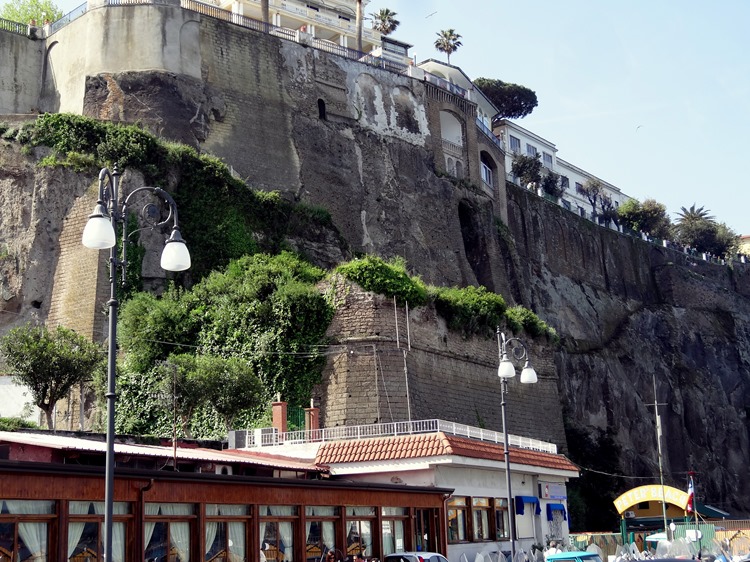


Fortunately, HAL had a shuttle bus to take us up the hill to Tasso Square, which is the center of town, because it is a steep climb. This was a very nice plaza, with several large outdoor cafes & a statue of St. Antonino (St. Anthony), the local patron saint whose relics are in a basilica near the statue, in the middle of the street. But the best thing is that this square was built over a large gorge that cut in through the cliffs from the sea. Before this plaza was built in the 19th Century the gorge divided the city, so the part of the city to the right is the ancient Greek city while the part to the left (beyond St. Antonino) was farmland before the square was built, There are buildings sitting precariously on the edge of the gorge with great views. I tried going into the gardens of one but was politely informed that this was private property and I was not welcome. Hmpf!


We walked on toward the Via Santa Maria della Pieta, a street built several centuries BC. We went into the courtyard of the Palazzo Correale, said to be typical of 18th Century aristocrats. We also saw a small shrine to Mary, closed but you could see the picture and flowers through the door. There is supposed to be a 13th Century palace on this block as well but we must have walked right by it, not noticing anything that looked palace-like.


Next we came to the Duomo, the cathedral of Sorrento. It was Sunday and they were having services so we didn’t go inside, but I took pictures of the beautiful inlaid wood doors (inlaid wood is a specialty of this region) & the elaborate ceiling from the entrance. There was also a lovely reddish clock tower, which I think was on the other side of the courtyard from the Duomo.


Next we came to the Sedile Dominova, an 18th Century building that was once the meeting place of the city’s nobles and is now a men’s club. The outside has beautiful old frescoes, again with effective simulated 3D. And there was a local band playing in front of the club’s loggia.


We continued strolling around the charming streets of Sorrento. One of the things Sorrento is known for is lemons, and we saw a whole lot of them in all shapes and sizes, in stores and outdoor stalls. They are also loaded with lemon product, like soap & ceramic lemons & a liqueur called limoncello. It was Sunday, so there were a lot of townspeople on the streets after services along with the cruise folks and other tourists. So the streets were the opposite of deserted.


Sorrento was also full of beautiful flowers and other flora of all varieties.


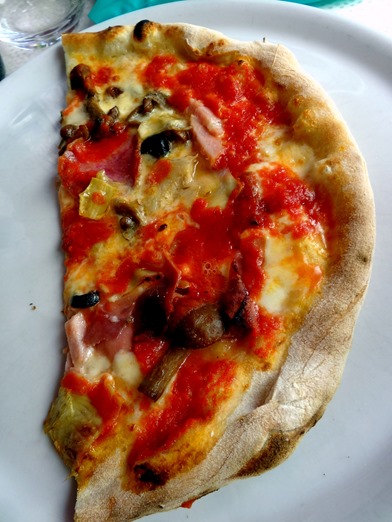
We had a delicious pizza for lunch at Ristorante Pizzaria da Gigino, a spot recommended by Rick Steves. Pizza, of course, was invented in the Naples region. Many Americans are disappointed by Italian pizza because it tends to be rather simple and has few of the toppings and spices Americans are used to, but we found it delicious. One of the most famous (but not what we had) is the Margherita pizza, named in 1889 after the first queen of united Italy, which is made with just red tomato, green basil & white mozzarella representing the colors of the Italian flag. We ate out on their patio surrounded by several local families who seemed to have come here after church. It was on a narrow street that was infested with a cloud of gnats, but for some reason they never came over to the tables. Walking back through town toward the shuttle bus stop we also stopped for gelato at Gelateria Primavera (also recommended by Rick Steves). They have 70 flavors, all home made, but you have to pick just 2 or 3. I had the noce, made from local walnuts, but I don’t remember the other flavors. Great stuff. We saw an interesting style of sign for gelaterias around town. Then on the bus ride down the hill was a sign with an evocative way to say “go slowly.”



After a leisurely & enjoyable day we took the tender back to the Prinsendam. It occurred to me that I had never posted a picture of the inside of a tender, so here are a couple. Not luxurious (or even comfortable), but its good enough for a short ride.


I will leave you with a few pictures of interesting parts of the Sorrento cliffs taken from the ship before we sailed in the evening.


Naples, Italy
We arrived in Naples on April 27, despite the fact that Naples was not on our itinerary and we were originally scheduled to be in Sorrento that day. Why, you ask? Well, Sorrento is a tender port & it seems that it often has windy weather that precludes tendering. Discovering that Sorrento was scheduled to be crowded on April 27 while no ships were scheduled for nearby Naples that day, our savvy Captain & crew managed to obtain a berth in Naples on the 27th. But Naples was fully booked for the 28th so we would have to move to Sorrento (as originally scheduled) for that day. Well, this turned out to be a very smart move because the morning of the 27th was rainy & windy, and all the other ships were scrambling for a last-minute berth in Naples and we already had one.
But then again, the downside was that it was windy & there was a steady rain as we pulled in on the 27th. We had originally scheduled an excursion to Pompeii on our second day in Sorrento on the theory that it is best to be on a ship tour on an early departure day since the ship won’t leave without you while getting back late on the first day would not cause a problem since the ship wouldn’t be leaving until the next day. But then we heard that there was bad weather in the area & that there was no room for Prinsendam to stay in Naples a second day, so there seemed a possibility that we would be unable to tender ashore the second day if the weather was bad in Naples. So we switched our Pompeii excursion to the first day, since we wanted to make sure we didn’t miss it. Well, it seemed like a good idea at the time (& I still think it was the best choice given the uncertainties) but we ended up outsmarting ourselves, since we toured Pompeii in a steady rain while the folks who took the second day tour from Sorrento had a beautiful sunny excursion. Oh, well, can’t win them all.
In any event, we did get to see Pompeii even if it wasn’t under the best of conditions and it was very interesting, although our guide kind of rushed us through because of the rain and, I think, because a number of the older passengers on the trip decided to wait near the entrance rather than taking their chances with the wet & very uneven streets of Pompeii. Because of the rush I ended up with some pictures I can’t identify and a lot that are too blurry to use (because we were hurrying in the fairly dark interiors of buildings), and we also ended up skipping some of the best known locations (like the brothel & the theaters). But here is what there is.
Founded by the Greeks around 600 BC Pompeii is famous because in 79 AD it was buried in ash by an eruption of Mt. Vesuvius, only about 5 miles away. Vesuvius threw up a column of smoke, ash, dust & pumice 15-20 miles into the air which rained down on the coastal area next to it. This was the first indication to the local populace that they were living by a volcano, since Vesuvius hadn’t erupted for some 1200 years. About 75-90% of the 15 to 20,000 people in Pompeii escaped (although we don’t know where they went or whether they perished elsewhere in the vicinity) before the blast of hot air (400 degrees Fahrenheit or more) hit Pompeii and instantly killed everyone who remained. The ash & pumice continued to rain down until the city was completely covered and it was this dense covering of ash, which excluded water & oxygen, that accounts for the astonishing preservation of everything in the city. In fact, while the heavy ash accounted for the collapse of most roofs, much of the other damage to buildings was caused not by the volcano but by an earthquake that had devastated the town in 62 AD and from which they were still rebuilding when the eruption occurred. Pompeii was removed from the maps & forgotten until 1499 when it was stumbled upon by men digging a river diversion channel. But it wasn’t until 1748 that actual excavation began.
Before going into the excavation site we were taken to a nearby store selling cameos & watched a craftsman making them. This is kind of like a commercial before a TV show, an irritating retail moment that is the price of admission (in addition to the actual money you paid for the tour). But it was really raining so we were glad to be able to go inside & dry off & many of the cameos really were beautiful even if we had no interest in buying any. We entered Pompeii on a steeply inclined street through the Porta Marina, which 2000 years ago was close to the shoreline.


After passing the ruins of a house (I don’t know which one it is) we came to a street with large stones set in it. Our guide explained that these stones enabled people to cross the road without stepping in the water when they flushed the streets to clean them every night (refuse and horse manure would flow down these gutters as well), while the spaces between the stones would accommodate the wheels of chariots. They look a lot like our speed bumps. One bump meant a one way street, two was a two way street & three was a major thoroughfare.


Next we visited the forum, the large main square of the town. Lots of pillars whose buildings are gone & engraved capitals. 2000 years ago the forum was lined on 3 sides with two story buildings with pillared facades like these. The Romans were known for the extensive use of bricks in their buildings, which they often covered with stone veneers or stucco made from marble dust.


On the north side of the forum was the Temple of Jupiter (the Roman version of Zeus). Built a couple of centuries BC, it was once very imposing and contained a large statue of Jupiter. But it was badly damaged in the earthquake of 62 AD and was still awaiting reconstruction when the volcano erupted. When it was excavated the head of Jupiter was all that was found of the statue; the original is in the Archeological Museum in Naples, but there is a close reproduction at the site. On a clear day you can see Vesuvius looming over this temple, but of course it was rainy & overcast so the mountain was invisible to us. To the right of the temple is the Macellum, a covered market area.


Next we went to the covered market area where we saw what are probably the most iconic images of Pompeii, plaster casts of the bodies of Pompeiians at the moment of their death. We only saw a few of these, but there are more than 1,000 of them in existence. It seems that the early excavators in the mid 19th Century digging through the ash & pumice that had solidified in the 18 centuries since the eruption came upon large holes that had skeletons in them. Giuseppe Fiorelli, the head excavator, cleverly realized that these holes were left when the bodies of individuals decomposed & disappeared, leaving only the skeletons. He devised a technique of filling each hole with plaster then chipping away the solid ash, leaving a plaster cast of the individual’s body at death with the skeleton inside it. The most recent theory is that the eerie lifelike quality of these casts is due to the suddenness of the death caused by the wave of extreme heat, which induced a sort of immediate rigor mortise. The casts in the market area were in glass cases, and there are a couple of others shown here that were in a different location.


This open market area was also the first place we saw frescoes. I know that many of the frescoes have been removed to the Naples Archeological Museum & replaced with replicas and I have no idea which are original and which are replicas, but these look original to me. In any event, the replicas are really good so they are worth seeing regardless. Note the use of perspective in some of these pictures, a technique that was lost in the middle ages and only rediscovered during the Renaissance more than 1000 years later.


We went on to visit the Forum Baths (there were several public bathhouses in the city). It had a hot bath, a warm bath & a cold bath in addition to a gymnasium & a dressing room. The warm room has a carved blue & white stucco ceiling and the walls are lined with male caryatids supporting a shelf, between which were pegs for patrons to hang their clothes. It was warmed by a bronze brazier. The hot room was heated by hot air pumped into the hollow center of the double walls & floor & there was a fountain at one end, labeled with the names of the politicians who donated it, that pumped water onto the floor to steam up the air and provided a source of cool water for those who were overheated. The ceiling is fluted so that condensation from the steam would drip down to the walls rather than fall on the patrons. The cold bath was pretty plain but, really, who would want to go there? It was pretty dark in here, & we were hurried through to make room for others, so a lot of these pictures are less than clear.


Across from the baths was a fast food joint. No, really! Called a Thermopolium, there was one of these on just about every corner because very few Romans had houses with kitchens, most lived in apartments. Originally this probably had an awning over it & sliding doors or shutters to secure it at night. The holes held pots of food with wooden covers to keep the food hot. Nothing new under the sun. Note the extensive use of what appears to be pumice rock in the walls, even though the Pompeiians didn’t know there was a volcano nearby.


We visited one home, the House of the Tragic Poet (named after its mosaics, now in the Archeology Museum, rather than its owner). Inside the front entrance was a mosaic of a dog on a leash with the inscription “Cave Canem,” which is Latin for “Beware of the Dog.” It was a reproduction (the original is normally in the Naples Archeology Museum but was on loan to another museum). Circumstances prevented a good picture, so I have included a picture of a copy made into a tile that I saw in a shop (copies of this famous mosaic are everywhere) to give a better idea of what it looks like. You enter through the garden, though, in which is a small shrine for worshiping family gods. There is an open skylight in the atrium with a pool underneath to catch the rainwater & a small wellhead next to it for drawing the water from the pool. The indentations on the inside of the wellhead were made by the ropes used to draw up the water. We saw a few interesting mosaics on the floor, a room that I think was the kitchen and a room whose walls were covered by frescoes which I think was the dining room. This house was featured in the 19th Century novel The Last Days of Pompeii by Edward Bulwer Lytton.


After this we headed for the exit. But before we do that here are a few random pictures taken on the streets of Pompeii.


As we walked to the exit from the town (way too soon) we passed a storage area locked with gates that was full of artifacts, many on shelves & others lined up on the ground. You have already seen two of the body casts that were stored here, and there was also a statue of Livia, the wife of Augustus, which was probably part of her effort to establish herself as a goddess. If you have read or seen the TV miniseries of Robert Graves’ I, Claudius, you know that Livia was quite a piece of work! There was also a lovely marble table with lion legs that almost looks like it could have been made yesterday. Leaving the city walls we came to the Temple of Venus, which was by a necropolis (of which there were several, all outside the walls of the city). And at this point Vesuvius began to emerge from the grayness for the first time. Last but not least is Zorro the service dog. You don’t often see animals traveling on a cruise ship but Zorro was along to help his master with his deafness. He was extremely well behaved.


When we returned to the ship from Pompeii around noon it was still raining steadily so we expected to spend the rest of the day on the ship. We had lunch then Mary took a nap while I worked on the blog. However, it stopped raining about 3:00 in the afternoon so I woke Mary up. She reluctantly got out of bed & we left the ship to walk to the Naples Archeological Museum. The ship was docked right in the center of town, so that was a great place to take in Naples, an attractive city with a variety of pastel colored buildings mixed with a number of old monumental ones. Naples was founded by Greeks in about 600 BC. They creatively named it Neapolis, or “New City.” Actually, the Phoenicians were no better at naming cities: both Carthage and Cartagena were originally named Qart Hadasht by the Phoenicians, which means (you guessed it) “New City.” From the ship we could see both the city and the bay.


We walked through the Piazza Municipio in the first picture, then around behind the Castsel Nuovo and up to the Via Toledo which would take us to the Archeology Museum (after a long walk). We saw a number of the city’s landmarks on our way to Via Toledo, Including (in addition to the Castel Nuevo) the Teatro San Carlo, the main theater (Teatro San Carlo), the old royal palace (Palazzo Reale), the church of San Francesco di Paola, and the Galleria Umberto I (a huge and glorious old shoppng mall with a glass roof). There were a couple of other interesting buildings I can’t identify.


The Archeological Museum was really fantastic. We were very glad we had made the effort to get there. Opened in 1777 the museum is in the 16th century palace Palazzo degli Studi. Here is a tiny sample of its vast collection of ancient statuary(read the captions for the identifications I have).


We wandered into a gallery containing artifacts from the Villa of the Papyri that was on the outskirts of Herculaneum. There were some interesting frescoes from the Villa (much of which is still not excavated), but that was not the main story here. It seems that Pliny the Elder, a renowned scientist & the local admiral, was trying to reach this villa to rescue his friend Rectina, who owned it and her vast library. But Pliny died on the beach and the villa along with its library, much of which was already packed in boxes for moving, was covered by the debris from Vesuvius. The 1800+ scrolls of papyri were blackened by the heat but the burial also preserve them. In the mid 18th Century the villa was rediscovered by workmen digging for construction. They tunneled through it, recovering a large number of ancient statues and discarding what appeared to be long pieces of charcoal. When they broke through into a room lined with shelves full of these black artifacts it became apparent that they were books. In fact, this is the only ancient library to survive to modern times. However, no one could read the scrolls, not only because they were blackened but because all attempts to unroll them destroyed the scrolls. Then a priest from the Vatican invented a machine that could, very slowly, unroll the papyri without destroying them so that many of them could be identified. In this room of the museum was one of his unrolling machines, which was quite fascinating (although the pictures are hard to decypher because of the light reflecting from the glass case). Today attempts are being made to use a kind of CTI scan to decipher the scrolls without unrolling them (I don’t know if there are any results from this yet). Meanwhile, a whole new level of the villa has been discovered near the shore, and experts believe it may contain another library, perhaps with copies of the ancient classics like the missing plays of Aeschylus and Sophocles. But the Italian government has not, so far, permitted any excavation there and there are fears that whatever is there may be destroyed by water or even by another eruption.


Then we found what we were hoping to see at this museum: the artifacts uncovered mostly in Pompeii (& a few from Herculaneum & the surrounding area). While one large Pompeii gallery was closed, we found several others that were really interesting, particularly since we had just been to Pompeii. The first gallery contained a lot of physical artifacts, including a number of bronze household statuettes & articles of everyday life, such as lamps, kitchen utensils and even dental tools and dice. Most, if not all, of these are from Pompeii. I will put what little I know about these in the captions.


Most of the frescoes were in the gallery that was closed the day we were there, but we saw a few. Unfortunately, most of them were in the Gabinetto Segreto or Secret Cabinet. This was a separate gallery containing artifacts from Pompeii of a sexual nature. It seems that ancient Romans had a very liberated attitude toward sex. Statuettes with huge phalluses and fairly explicit art were found in their homes. The Secret Cabinet also contains the original frescoes from the brothel, which explicitly depict various sex acts and served as a sort of menu on the wall of the brothel, kind of like a barber shop with pictures of various hair styles that are available from the barber. The items in the Secret Cabinet were kept under lock and key and shown only to educated mature males by appointment for most of its existence. It was opened to the public only in 2000 and the separate gallery was opened in 2005. There is a sign at the door that says only adults may enter, but there is no one there to enforce it and we saw some adolescents in the exhibit. I have pictures of a number of these items, many of which are quite beautiful pieces of art, which I would be happy to share by email upon request, but since there may well be children reading this blog I will only include here a couple of the most benign ones. We also saw some beautiful mosaic covered pillars from the House of the Mosaic Pillars in Pompeii and some pictures made with inlaid colored marble.


Finally, we saw a large collection of mosaics, most of which are from Pompeii. Again, I will tell you what little I know about them in the captions. The most famous one seems to be the large mosaic (almost 9’ by 17’) of Alexander and Darius at the Battle of Issus, which is a mosaic copy made in the 2d Century BC of a Greek painting from the 4th Century BC that is now lost. The battle was fought in 333 BC and Alexander won. It was originally in the House of the Faun in Pompeii. There were also two very long mosaics, maybe 10 feet, from the House of the Faun: a scene from the Nile, complete with a hippo & a crocodile, and a theater theme with two theatrical masks. Remember, everything in this section is mosaic. Some look more like paintings because the tiles are so tiny, but they are all mosaics. I have included a few closeups of details that reveal the tile work.


We left the museum around 6:30 having barely scratched the surface of its incredible collection. Across the street on our way back was another monumental glass roofed shopping mall, the Galleria Principe (which seemed eerily empty, I guess because it was Saturday night). Further down Via Toledo we passed the interesting looking Convitto Nazionale, a school, in the Piazza Dante. It was, as I said, Saturday evening and it seemed that everyone in Naples – parents with strollers, families with children, young people on motorcycles — was out promenading up and down Via Toledo, which is normally a primary traffic thoroughfare. It was a great atmosphere & made us feel very much a part of the city life. Just before we reached the ship we saw the 18th Century opera house, the Teatro Mercadante.


Just as we got back to the ship the sun broke through the clouds, lighting up just the top of Vesuvius. The weather was now clearing up nicely and the Bay of Naples was lovely. There was a dramatic sunset behind the Castel St. Elmo, and all the lights came on in the harbor and on the shore of the bay near the volcano. A pretty glorious end to a day that started out so dismal!


Taormina, Sicily, Italy
“Should you only have one day to spend in Sicily and you ask me ‘what is there to see?’ I would reply ‘Taormina’ without any hesitation. It is only a landscape but one in which you can find everything that seems to have been created to seduce the eyes, the mind and the imagination.” — Guy de Maupassant, 1885.
We arrived in Naxos harbor off Taormina, Sicily, on April 26. Located on the eastern coast of Sicily between Catania & Messina, Taormina has been a favorite retreat of the rich & famous, particularly authors, since the early 19th Century. D.H. Lawrence wrote Lady Chatterley’s Lover while living in Taormina & Nietzsche wrote Thus Spake Zarathustra there. Goethe’s praise for the town in his Italian Journey as “a piece of paradise on earth” landed it on the standard itinerary for the 19th Century aristocracy’s Grand Tour of Europe. It was chilly & overcast the day we were there, but the place was spectacular anyway, just as these authors would have told us.

Taormina was originally founded in the 4th century BC by settlers (some say refugees) from the Greek colony of Naxos founded in the 8th Century BC, which was located on the shore beneath the hills where the modern resort town of Naxos is now. Taormina has a long and complex history that I won’t go into here (do I hear cheers?), having changed hands many times over the centuries, from Greeks to Romans, Arabs and Normans, among others.
The dominant landmark in eastern Sicily is Mt. Etna, the largest active volcano in Europe, which was clearly visible from Taormina. As you can see, we were lucky in that it was putting out impressive plumes of white & gray smoke when we were there (suggesting that a new pope was both elected & not elected at the same time, reminiscent of the quantum physics conundrum of Schrodinger’s cat). I was told by somebody that the gray smoke is an indicator that an eruption is coming &, sure enough, the mountain erupted the week after we visited (darn!) sending fire in the air and hot lava down its sides. At the spot where we tendered ashore at the edge of Naxos to meet the shuttle bus to take us up to Taormina the shore consisted mostly lava rocks.


The shuttle took us through Naxos & then up a narrow winding road with very sharp switchbacks to Taormina, which is at an elevation of about 600 feet. At some of the switchbacks it looked like a near thing when two buses passed each other going different directions, but I am sure the drivers are very experienced at it. I sure wouldn’t want to drive on that.


We entered Taormina through the Catania Gate & continued down the main drag, Corso Umberto I. The first square we came to was the Piazza Duomo, named after the cathedral that fronts on the square. In the middle of the square is a fantastic fountain built in the 17th Century called the Fountain of the Minotaur. The Minotaur is the figure on top, but to me it looks more like the Red Queen from Alice in Wonderland.


The Cathedral of San Nicolo was originally built in the 13th Century but the front portal was built in the 17th century. Lots of marble columns & altars inside and a good deal of very old art as well.


The streets of Taormna are pretty narrow, even the main street, & many of the side streets go steeply up the mountain, many with stairs. It doesn’t take many people before these narrow streets start looking crowded. But the streets are lined with 15th & 16th Century mansions, many of which now house shops, restaurants, cafes & bars. And there is a lot of interesting sculptured stone decorating the walls and brightly colored ceramic tiles.


The next square was Piazza IX Aprile, a large open plaza on the very edge of the cliff. Of course this gave some spectacular views, but this plaza also has the Torre del Orologio (a clock tower) next to the Church of San Giuseppe. There was also the Metropole Café with its fabulous view.


But that’s not all, because in the Piazza IX Aprile we found the library, housed in a 15th Century church called San Agostino. And through its back windows were, of course, more great views.


We continued strolling down the road heading vaguely for the Greek Theater, enjoying the ambience of the town that included a lot of colorful flora.


Taormina is full of expensive shops. We particularly enjoyed the colorful ceramics characteristic of Sicily & southern Italy. So here is some window shopping.


At the end of a side street called Via Teatro Greco is, you will not be surprised to learn, the Teatro Greco (Greek Theater). Originally built by the Greeks, probably in the 7th Century BC, it was completely reconstructed by the Romans on the Greek foundations (brick is characteristic of Roman architecture but not Greek), who used it for gladiator shows. It is the second largest ancient theater in Sicily with a diameter longer than a football field, but it is extraordinary more for its location on a cliff overlooking the bay with a view of Mt. Etna than for its size. As a bonus, the steep 6 Euro ($11) entrance fee was waived for those past their 65th birthday, so in effect the two of us were admitted for half price.


Of course, there were many spectacular views from the site of the theater.


From the theater we walked to the Messina Gate on the opposite side of town from where we entered. Outside the gate we saw the San Pancrazio Church, which is built on the foundations of a Greek temple. We had a closer view of the Saracen Castle on top of Mt. Tauro & we passed the Roman baths (I think) just inside the gate. We were tired, so we decided not to explore further outside the gate since it was all either up or down a steep slope.


And then we walked all the way back through the town to catch the shuttle back to the ship’s tender port, stopping on the way for some gelato (can’t miss that). We saw a lot of delicious looking food in the shop windows but, amazingly enough, it was all made of marzipan! Taormina is famous for its marzipan, but I’m pretty sure its not as good for you as the real thing.


As we sailed out in late afternoon we took a final look at Naxos then headed for the Straits of Messina, which separate Sicily from the toe of the boot of Italy. These narrow straits were reputedly the basis for Homer’s Scylla & Charybdis in The Odyssey and large whirlpools have been known to appear there (although we didn’t see any). The straits are narrow enough that there used to be a wire between electrical towers on either side that was the source of electricity for Sicily. The wire is no longer there but the towers have been preserved, apparently for historical interest. It wasn’t all that dramatic, although there were some nice views as the sun was setting.


After dark we sailed past Stromboli, a small inhabited(!) island with a very active volcano that has been erupting regularly for several thousand years at least. We weren’t close enough to get pictures, but we could see the reddish eruptions clearly in the dark sky every 10 or 15 minutes. It was cold & windy, so we had dinner & went to bed to prepare for another long day in Naples (not one of our originally scheduled stops, but that story in the next episode). But in closing, we have to catch up on the Prinsendam’s food sculptures and towel animals.


Venice, Italy
Surprise, I’m back! This took a long time because we were out of town for 2 weeks. But as compensation (or maybe just an additional annoyance) this will be an unusually long post. Venice is such a uniquely beautiful place that it is hard to take a bad picture without some effort. So I am going to be even more self-indulgent than usual & include a lot of pictures, just because there are so many I like.
We sailed into Venice early in the morning on April 23 for a stay of almost 2 full days. Venice was founded in the 5th Century by people fleeing the chaos resulting from the disintegration of the Roman Empire and the incursions of the Goths. They escaped into a large inaccessible lagoon and built villages on a number of islands there. As time passed, the islands were connected with bridges and the city grew together. Because of its inaccessibility by land, the Venetian Republic (not like our republics, since only aristocrats & the wealthy were represented) relied largely on sea power to develop into a great empire that dominated the eastern Mediterranean for many centuries. We have seen its influence in such places as the Dalmatian coast cities & Cyprus. It came to an end when conquered by Napoleon at the end of the 18th Century and after his fall it was ruled by Austria until in 1866 when it was incorporated into the newly unified nation of Italy.
It was misty & overcast as we entered the lagoon in the early morning light & turned left to sail past the island of Lido, a long & skinny island that protects the Venetian lagoon from the sea. Lido is famous for its beach, which has given its name to countless beaches around the world & the main pool deck on most cruise ships (including Prinsendam).


Because this is such a swampy area, the buildings of Venice are supported by literally millions of wood pilings driven through the muck to the more solid clay level some 25 feet down. The pilings, many of which are well over 1,000 years old, do not rot because there is no oxygen down there to support destructive insects or bacteria. So think about all those invisible wood pilings (and the work it took to drive them in) as you look at the buildings that they support. We turned toward the right from Lido & sailed toward the central square of Venice, Piazza San Marco (St. Mark’s Plaza).


Passing Piazza San Marco we sailed by the entrance to the Grand Canal & the church of Santa Maria della Salute, built in thanks for the end of the plague of 1630. This building alone is supported by more than a million wooden piles.


We continued through the channel between the island of Giudecca & the main part of the city. We passed the 16th Century church of Il Redentore on Giudecca, considered one of the masterpieces of Antonio de Palladio (from whose name comes the architectural term “palladian”), built in thanks for the end of the plague that killed a third of the population in 1576. We sailed on toward the port, on the west side of the main city islands, passing a variety of scenic waterfront views.


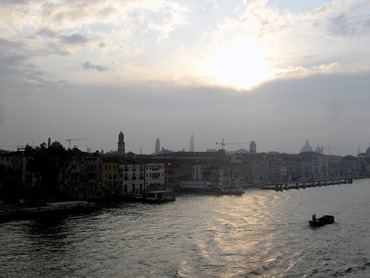
As we approached the cruise ship port the sun began to come out from behind the clouds, giving a dramatic effect similar to sunrise.
After a shower & breakfast we started into town. We had been afraid, from the overcast sail-in, that the weather would be a problem but in fact it was sunny & beautiful throughout our stay. While one can get to St. Mark’s plaza by vaporetto (the floating public transportation system) we decided to walk since there was plenty of time and wandering through the streets is the best way to get a real feel for the city. During the almost two days we spent in Venice we walked between 16 and 17 miles according to Mary’s pedometer (which seems to underestimate a bit) and we enjoyed every minute of it.
The first third of the way (I am guessing about a mile & a half from the ship to St. Mark’s) from the cruise port wasn’t all that interesting. From the top of the ship you could see a good bit of the city, and the walk to Piazzale Roma, the limit for car & motorcycle traffic, gave us a view of the single long bridge to the mainland, first built in the mid 19th Century.


We walked into town with our friend Israel, a very engaging fellow who was the Rabbi on the ship. Prinsendam has a priest, a Protestant minister & a Rabbi (that sounds like the beginning of a joke, but it isn’t). I hope you made it this far in the blog Israel! Wherever there is water in Venice (which is just about everywhere) there is a beautiful view. The weather had turned very clear & sunny, which enhanced the reflections in the water.
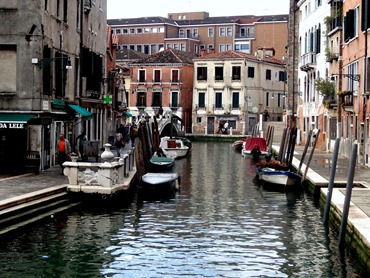


The Campo San Rocco was bounded on one side by the Scuola Grande di San Rocco and on an adjacent side by the Church of San Rocco. St. Roch (Rocco in Italian) is the patron saint of contagious diseases & his body is under this 18th Century church. Scuola means school, but the Scuole of Venice were actually more like fraternal organizations than schools. We toured the Scuola on our second day in Venice; unfortunately no pictures are allowed because it was filled with beautiful Tintoretto paintings. I did manage one picture through the front door, but it really doesn’t give an idea of the grandeur in the upper gallery.


We continued wandering through the streets, generally in the direction of the Rialto Bridge, passing more interesting buildings & canals.


The Rialto Bridge is one of the iconic landmarks of Venice. This is reputedly the site of the first settlement in Venice which was called “Rivoaltus,” meaning "high bank," later shortened to Rialto. This has been the commercial center of Venice for a thousand years & the produce markets are still held in this area. The first wooden bridge was built on this spot in the 12th Century, but after two collapses (at least one under the weight or a crowd) a stone bridge was erected in the 16th Century. It was the only way to cross the Grand Canal on foot until the mid-19th Century.


The inside of the bridge is lined with busy shops and kiosks.


The Rialto Bridge and its environs also have gorgeous views of the Grand Canal. The Canal cuts through Venice in an S shape & this bridge is right by one of the turns in the Canal. The Canal in this area is lined with palazzos, cafes & docks with tall wooden boat mooring columns, and the water is filled with gondolas and other boats.


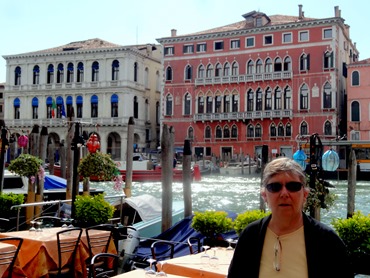
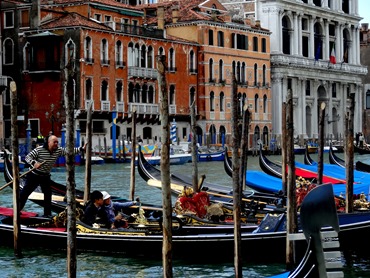

After crossing the Rialto bridge we continued on generally toward Piazza San Marco, passing yet more interesting spots on the way.


So finally we came to Piazza San Marco, one of the world’s premier public spaces. On the east side the Doge’s palace & St. Mark’s Cathedral sit side by side. Across the square is the Campanile (bell tower) and beyond that is a vast open space surrounded by buildings with colonnaded loggias housing shops, museums & cafes. There is so much to see in this area!


Having looked at the overall scene, now we will take a closer look at the buildings & landmarks in the Piazza. We found the Biblioteca Marciana (national library of St. Mark) in the building on the right in the picture above. This building, erected in the 16th Century, is called the Libreria Sansoviniana (named after its architect) and Palladio called it the finest building since antiquity.


The first building we visited was the Doge’s Palace. The line to get in was almost non-existent, one of the big advantages to visiting Venice at the beginning of the season. We entered into the grand courtyard, with two story loggias on three sides & a wall of the cathedral on the fourth side. The cathedral originated as the private chapel of the Doge, so this gave him a private entrance; it has since been greatly expanded of course. The columns of the loggias were topped with intricately carved capitals each of which was different.


In the courtyard are a number of interesting sculptures. In the middle are two intricate cast bronze well heads. The Giants Staircase is a marble affair with huge statues of Mars & Neptune on either side at the top. There is an old gondola in one of the loggias (I’m not sure why) & a peaked roof over part of the cathedral wall with a number of marble statues. There is a clock tower at the top of the cathedral wall on the north side of the courtyard


The rooms inside the palace were fabulous, full of old carved woodwork & massive oil paintings by Renaissance masters. Notable among them is Tintoretto’s “Il Paradiso,” one of the largest oil paintings in the world at 82 feet in length, which depicts 500 figures in portrait-like detail. Unfortunately, no photography is allowed of the rooms of the palace so I can’t show it to you here (you might try googling it). However, I did get some pictures of the elaborate ceiling of the Golden Staircase leading into the palace from the second floor loggia, and of the statues of Hercules & Atlas that guard the entrance to it. Also on the wall of the second floor loggia is a “Lion’s Mouth” mail slot, through which you could submit anonymous accusations against people you didn’t like. Venice had something of a police state mentality, always searching for potential traitors. One of the rooms of the palace has portraits of all the doges lining the wall under the ceiling all the way around the room . . . except for one who was beheaded for treason, whose portrait space is all black. The Italian inscription on the Lion’s Mouth means: "Secret denunciations against those who hide favors and offices or collude to hide the true income of them.” I was also able to get a few nice pictures out of upper floor windows in the palace.


We crossed the Bridge of Sighs to visit the prison on the other side of this small canal, the Rio de la Palazzo. Prisoners were originally kept in cells in the Doge’s Palace, from which Casanova escaped. But they proved too cramped for the growing prison population so in the 17th Century a new prison (which still looked pretty grim to us) was built on the other side of the canal, with this bridge to connect the interrogation & court chambers in the palace with the prison. The bridge’s name comes from Lord Byron, who concluded that prisoners would sigh as they saw their last glimpse of the outside world as they passed through this bridge to the prison, often never to be seen again outside its walls. Again, no pictures allowed inside the prison, but there are a couple in a prison courtyard & through the windows of the bridge, which are obstructed by decorative stone grating. You may have seen this bridge & canal before, since James Bond & his Russian girlfriend go up this canal at the very end of From Russia With Love.


Next we visited St. Mark’s Cathedral (or Basilica) right next door to the Doge’s Palace, where it was originally built to house the remains of St. Mark who is thought to be the author of one of the Gospels. It is a magnificent building full of sculpture, domes & golden mosaics. So what’s the story about St. Mark? It seems that the original patron saint of Venice was St. Theodore. But the Venetians weren’t satisfied with this and in 828, either to fulfill a vision or aggrandize their city depending on who you believe, a delegation of Venetians went to Alexandria, Egypt and purloined his body. St. Mark was interred in Alexandria because he had been the first bishop there & was martyred there. The body was smuggled out of Egypt, secreted under a layer of pork to discourage the Muslim Egyptians from inspecting it, and brought to Venice where a church was built to house it. The church was rebuilt & expanded a number of times to reach its present magnificence. During construction of the Basilica in the 11th Century the body was lost (how does that happen?) but 30 years later it was miraculously “found” & reinterred under the Cathedral that bears his name (whether this body was really St. Mark or not seems to me to be uncertain). So St. Mark, whose symbol is a winged lion often holding a book, is now the primary patron saint of Venice & St. Theodore occupies a back seat (although his remains are in another church in the city). The Venetians are very proud of their body snatching caper; the Cathedral has a prominent mosaic portraying the stealing and transportation of the body to Venice.


Signs said photography was forbidden inside the Cathedral, but once inside we saw many flashes from cameras & no one seemed to be enforcing the rule. So I took a few photos as well. It wasn’t very light (and I didn’t use flash) so some of them didn’t come out very well. But you can see that the whole ceiling – domes & supports – was covered with golden mosaics, some of which are identified in the picture captions. The floors were also very beautiful with varied marble mosaics and there were polished stone columns of varying colors & marble panels on some walls reminiscent of Santa Sophia in Istanbul (where they might have come from, since the Venetians & Crusaders stole a lot from that church when they sacked Constantinople in 1204). Across the front of the area of the main altar is a row of statues of saints; the only one I know the identity of is St. Mark, fourth from the left in the picture below.


On the upper floor was a small museum, mostly housing items that had been replaced during renovations. Particularly interesting (to me) were some mosaics that gave a chance to see more closely how the tiles are put together to construct a lifelike face. Also there are the original bronze horses that stood above the entrance to the Cathedral for many centuries, recently replaced with exact replicas. These horses were probably originally made in Greece around 300 BC, then taken to Constantinople where they adorned the Hippodrome, then in turn purloined from Constantinople when the city was sacked in 1204 by the Venetians & Crusaders. Quite a history, and they are still quite beautiful after all that time outside in the elements.


The last place we visited in the Cathedral was the balcony atop the front entrance (which I pointed out in the caption to the first picture in the Cathedral section of this episode). On this balcony are the replica horses standing just where the originals used to be. The balcony provided excellent views all around the Piazza. To the right is the 15th Century clock tower, with a Lion of St. Mark above the clock & a bell on top rung by two figures called “the Moors” because of the dark patina of the metal. Directly across is the Campanile (bell tower), more than 300 feet tall with a beautiful entry porch at the bottom. The original 16th Century Campanile collapsed in 1902, but was rebuilt. To the left is the original grand entrance to the Doge’s Palace called the Porta della Carta (today you enter by a different door on the lagoon side of the building). It has a (19th Century reproduction of a previously destroyed) sculpture of the lion of St. Mark with a kneeling Doge Francesco Foscari, who built this entrance, then above the window is a bust of St. Mark and the whole thing is topped by a statue of Justice with sword & scales. From the balcony we also had a level view of the figures atop the columns near the water of the lion of St. Mark (which had a previous life as a different lion somewhere in Anatolia) & St. Theodore standing on a crocodile (which represents the dragon he is supposed to have killed). This is also a copy; the original is somewhere inside the Doge’s Palace (we didn’t see it). I have included here a few pictures of these items not taken from the balcony, just to give some context.


And to finish off our visit to Piazza San Marco, here are a few more random items that didn’t fit anywhere else. Venice is situated just above water level & is sinking a little every year, so in the winter time there is always flooding & Piazza San Marco is inundated with water. The Venetians have adapted to this by installing temporary wooden walkway to enable people to walk through flooded areas without getting wet. A few were still there in side streets when we visited. In the open Piazza square are several cafes with outdoor seating that also have small musical groups playing mostly light classics. In particular are two cafes that date to the 18th Century: the Caffe Quadri (shown in a picture at the beginning of the San Marco portion of this posting) on the north side & the Caffé Florian on the south side. During Austrian rule in the 19th Century, Austrians patronized the Caffe Quadri while Venetians hung out at Caffe Florian across the square. Both were frequented by many famous writers & composers. Attached to the southwest corner of the Cathedral is the porphyry statue of the “Four Tetrarchs,” another item plundered from Constantinople in 1204. Note the foot that has been replaced with a stone carving in the lower right; the original foot was discovered in Istanbul in 1960 & is in now in the Istanbul Archeology Museum. The sculpture was probably created in the 3rd Century when the Roman Empire was briefly governed by a group of 4 coequal emperors. Other pictures are identified in the captions.


We left Piazza San Marco & set out to find the La Fenice theater & opera house, as always passing engaging sights along the way.


Gran Teatro La Fenice, the opera house & theater, was first built in the 18th Century. It was destroyed by fire in 1836 and again in 1996 (by arson according to court verdict). The current building reconstructed after the latter fire opened in 2005. The burning & reconstruction of La Fenice (which means, aptly, “The Phoenix”) is the central story of John Berendt’s The City of Falling Angels, an enjoyable book that gives a good portrait of Venice.


After that we wandered around the streets for a while, which means more canal views (I hope you like these as much as we did, since I have included an awful lot of them in the blog post).


On our way back to the ship we stopped at a café by the Grand Canal near the Rialto bridge for a snack & to rest our aching feet. The food was great & so were the views (of course). Sitting there I was struck by the abstract patterns made by the reflections in the water. You see that in most of the canal pictures, but it is a different effect when they are isolated in a picture without context.


That night on the ship we had a show by local talent. Alas, it was not a folkdance or folksong group, as we have enjoyed in many other ports, but a pretty lame group of older guys dressed as gondoliers who sang overused Italian standards (Volare anybody?). What were they thinking when they booked this group?


Our second day in Venice was spent largely in museums. We went to the Academia, a renowned museum full of Renaissance & pre-Renaissance Venetian masterpieces. It pretty much lived up to its reputation, although a lot of the pre-Renaissance art didn’t do much for me. Unfortunately, no pictures were allowed. We then visited the Scuola Grande di San Rocco, some pictures of which are included earlier in the episode. The upstairs was a huge room jam-packed with Tintorettos and a few Titians on walls, ceilings & easels. Pretty impressive but again no photography. We had wanted to spend some time visiting the Ghetto area in the north part of Venice. Established in the early 16th Century, this was the first ghetto ever established for confinement of Jews. Its name came from the large foundry in the vicinity: “gheto” was Venetian for “slag.” The word ghetto acquired its modern meaning as other cities applied it to their confined Jewish quarters. Unfortunately we ran out of time in the museums (we had to be back at the ship in mid-afternoon to avoid being left behind), so this will have to await our next visit.
One place we did see the second day was the large Basilica di Santa Maria Gloriosa dei Frari. It has the second largest campanile in Venice and Titian’s painting of the Assumption over the altar area. Titian is buried in the Frari. We didn’t have time to tour the interior, & there was no photography inside anyway, but I managed a few pictures from the front entrance.


Some miscellaneous things we saw walking around town. Many of the plaza’s contained old covered wellheads that used to be the source of water for people living in the neighborhood. Venice is also known for the characteristic balconies with unusual arrays of windows in the many palazzos, each one of which is different. We also saw an interesting poster of a new version of Shakespeare’s Richard III. The good news: he’s not hunchbacked any more; the bad news: now he’s a borg!


One of the things we really enjoyed in Venice was looking at all the colorful shop windows. Venice is famous for glass, which is mostly made on the island of Murano. The glass here is very beautiful (& expensive).


Venice is also famous for its elaborate fancy-dress carnival parties and for the elaborate masks it produces for them.


Last, but far from least, were the shops selling baked goods & gelato, all deliciously displayed to make you want to eat it all. We did not try the baked goods, but we did have gelato on our way back to the ship. We had been looking for a gelato shop displaying the notice Rick Steves says indicates home made gelato, but although we passed a number of gelato shops (mostly just holes in the wall) we didn’t see any of these. So we stopped at a gelato stand on wheels in the middle of a plaza, since it was getting late. Wow! It was fabulous! Mary had a cone piled high with lemon & pistachio while I had pistachio & chocolate. It was easily the best ice cream we had ever had. All I can say is that real Italian gelato is to regular ice cream as steak is to hamburger (to be fair, although the gelato we had elsewhere was consistently better than ordinary ice cream it didn’t seem to live up to what we had in Venice, perhaps because in Venice it was completely new to us). If you visit Italy be sure to try it.


So we returned to the Prinsendam, which sailed out in late afternoon the same spectacular way we had come in. You have seen this route before, of course, but this time it was sunny, so I will show you some of the sailaway here. First from the port toward Piazza San Marco.


As we passed Piazza San Marco the late afternoon sun created areas of bright light and shadow.


We sailed on down past the waterfronts to the west of San Marco, took one final look back as the sun fell lower in the sky, and headed south toward Sicily.


 BADER JOURNAL