
Valparaiso & Santiago, Chile
On Tuesday, January 24, we arrived in Valparaiso, Chile’s third largest city with close to a million people (we think). We were on a bus tour to Santiago, Chile’s capitol, which was to leave at 7:15 AM (!), so we got these pictures of Valparaiso harbor just before sunrise.


Valparaiso is built on a number of steep hills (heard that before?). It has cliffs not far back from the harbor and a whole series of funiculars to carry people to the upper city. We were told that only 4 of them are currently in working order.


Santiago de Chile, the capital, is in a valley in the Andes mountains about 100 miles east of Valparaiso. It was an early Spanish outpost & now has some 7.5 million people spread out for many miles. They told us it never rains there in summer & never snows there in winter, although the surrounding mountains get plenty of snow. Most of our tour was, sadly, spent on the bus. On the way there we saw vineyards in several mountain valleys (Chileans are very proud of their wine, which is supposed to be first-rate).


Now for some pictures as we drove around Santiago. The train station with, if you look very closely behind the pole at the right, a carousel (not great, but the bus was moving). Then an unusual red church, a wall with graffiti (we have seen a lot of graffiti in Chile), a clock tower near the central plaza (where we couldn’t get out because someone was robbed there on our guide’s last trip, which she blamed on Peruvians who hang out there), and the Palace of Justice (which I assume is like a Supreme Court).


We did get out to see the Presidential Palace. We were pleased & surprised to see a statue of Salvador Allende there. Our guide’s favorite word was “nice”; everything was “nice” except two things: the earthquake two years ago & Augusto Pinochet (she pronounced the “t” at the end). She said he took away all freedoms & passed laws to benefit himself & his supporters. This was a welcome change from our ship, where we heard two lecturers (one British & one American) praise Pinochet for saving the country from communism & establishing a strong capitalist economy (although the British guy acknowledged that “some people disappeared”). I guess a bloodthirsty police state is OK for some (who don’t live there) so long as free enterprise is protected. There is no statue of General Pinochet at the Presidential Palace.


Before lunch we went up to a scenic overlook on the side of a hill that had great views of the Andes & Santiago in the valley below. Unfortunately there was a blanket of smog that interfered with what would have been quite a picture.


After visiting a disappointingly overpriced artisan place in Santiago the bus took us back. We slept most of the way back but our guide detoured us at the end through a resort town next to Valparaiso called Vina del Mar. Apparently, there is a beach house there for the President and government officials & rich folks from Santiago go there to swim. Tough to get pictures from a moving bus (& we were sitting on the wrong side for pictures).


Finally, some views of Valparaiso as we sailed away, the harbor pilot leaving the ship, and yet another towel animal.


I guess that’s all for now. We are headed south to Patagonia right now & it has been a very bumpy ride since yesterday, almost like a roller coaster. And we haven’t even gotten to the really wild water yet! To make it just a little scarier, the ship creaks a lot (it’s pretty old for a cruise ship; built in the early 80’s,). But so far we are holding up pretty well. We have 2 port days in a row, so it will probably be a few days until we post here again.
General San Martin & Matarani, Peru
On Tuesday, January 17. we visited a port called, poetically, General San Martin. Its not much in itself, as you can see.


It is located on a sort of large rounded peninsula, described evocatively by the ship’s travel guide as a “carbuncle on the coast of South America.” Up the coast a few miles is the city of Pisco, which was devastated by an earthquake a few years ago & is still not fully rebuilt. But the big attraction here (at least for us) is Isla Ballestras, sometimes described as a poor man’s Galapagos. While it is hardly the rich nature preserve that the Galapagos are, it is a wildlife sanctuary that is home to an unusually diverse and numerous collection of bird and sea animals. One guide told us that this area of Peru has more diversity of species of wildlife than anywhere else in the world. I’m not sure about that grandiose claim, but its pretty impressive.
We took a speedboat to Ballestras holding about 25 people from a little town not far from the port called Paracas. It seems to be building itself into a resort town but is still a pretty sleepy place and, as you can see, it is on the edge of a rather bleak desert. We did, however, enjoy its outdoor statues of a penguin & a sea lion.


After boarding the boat & donning our life jackets the first place we came to was an ancient cliff drawing called the “candalabra” or “trident.” It is quite huge and very old, created by ancient indians, but no one knows why it is there or what it is supposed to represent. It seems to point directly to the Nazca lines (landscape drawings much further inland by the ancient Nazca indians, the shape of which can only be seen from an airplane) but it is not now thought to be related to them.


Then on to Ballestas, about a 25 minute trip at high speed over choppy ocean waters.

So now, before we get to the wildlife you are all waiting to see, my sad story. We were told that we needed to worry about our hats on this trip. You need them not only for protection from the sun but for protection from bird droppings. There is a strong wind while speeding to the island so I put my Cincinnati Reds baseball cap on backwards to avoid having it blown off (as you can see in the picture above). Well, when we got to the island there didn’t seem to be much wind anymore, so I turned the hat around. Almost immediately a gust of wind came along & blew my hat overboard! The guide tried to retrieve it with a pole but the waves were too choppy. So now my hat sleeps with the fishes. Worse, the lack of a hat led to a bad sunburn on my face & the top of my head where my hair used to be (I hadn’t put sunscreen there or on my face because my hat was always sufficient protection), which was probably made worse by windburn on the trip back from the island. As a result I have been feeling pretty sick over the last few days, which Mary attributes to sunstroke, although now it is starting to get better. Enough about me.
As you can see below, Ballestras is completely covered by hundreds of thousands of birds of many varieties. Its a pretty impressive sight.


Herewith some photos of a few of the various species of which I managed to get pictures from a seriously rocking boat. Pelicans & a Kelp Gull:


Humboldt penguins:


Guanay Cormorants:


And my favorite name, Peruvian boobies:


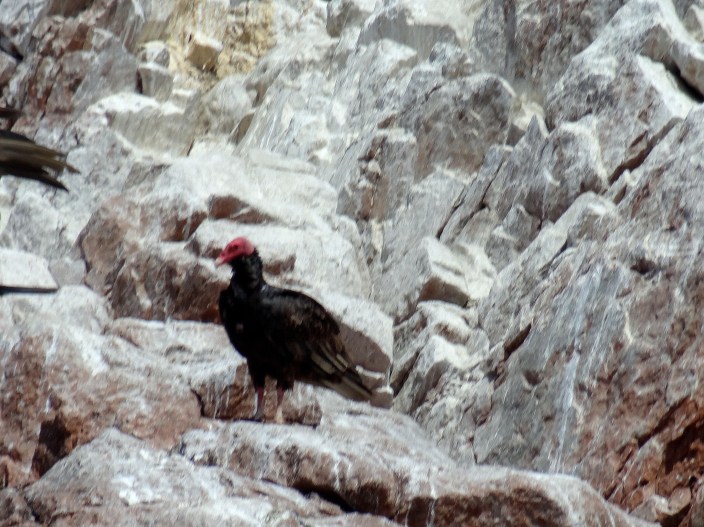
This striking red-headed bird was not in the bird guide we were given, but it looks to me like some kind of vulture. The second one on is eating what appears to be a fish.

Sea Lions:


The sea lions are very loud; there is a constant bellowing coming from the group. I don’t know if they do that all the time or just when there is a boat nearby. In the next picture the shadows at the bottom are full of yelping sea lions & some birds, while the white rock is covered with birds.

Well, all these birds are gathered in one spot & you know what birds do best. As a result, this island is very rich in guano (bird droppings) which makes excellent fertilizer (it also makes this island really stink). So every 7 years they harvest the guano from the island. There is a pier built for this purpose which, like everything else, is usually covered with birds. When the Spaniards first collected and shipped guano from here to Europe it caused something of a revolution in agriculture there.


This area of Peru, and really most of the coastal area of Peru & northern Chile, is a desert area. In this general area of southern Peru & northern Chile (mostly further inland) is the Atacama Desert, which is the driest spot on the globe. It literally never rains here. We were told that this is the reason all the Indian ruins are so well preserved, particularly the adobe mud bricks & the mummies that would have deteriorated badly in a more temperate environment. But the desert hills around here are sometimes quite beautiful, showing a variation in color and light & shadow, particularly at sunset.


Looking out at the water before sailing we saw a whole lot of these huge brown jellyfish (left above) floating by; Mary thought they might be Men-o-war. And gulls floating on the water; mostly they fly around, then suddenly dive-bomb straight down into the water after fish, but that happened too quickly & unexpectedly to get a picture. We also saw a squadron of Pelicans flying in a V formation, just a few inches above the water. They looked very military in bearing, but again no picture since I didn’t have my camera out in time (d’oh!).
I want to keep you up to date on the towel animals and bread sculpture as well, since we have been enjoying them. Our best towel sculpture by far to this point has been the hanging ape, which we didn’t notice for several minutes after entering our room because it wasn’t on the bed like the others. The cornucopia is all bread (with, I presume, some food coloring), despite what it looks like.


January 18 was a sea day then on January 19 we docked at Matarani, a very small port in southern Peru. I think this is the first time Holland America has visited here & it appears that they get little or no other cruise traffic. The port itself is pretty, but there is nothing else there except more desert.


The nearest spot of real interest is an old Spanish colonial city called Arequippa but it was an all day bus trip to see it, with 2 1/2 hrs on the bus each way, so we skipped that. (Actually, with the way my innards were acting, I never would have made it that far without a rest stop.) The cruise line was operating a shuttle bus to the closest town, a small town called Mollendo which really had nothing to distinguish it. The shuttle took us through rather barren desert for half an hour, with narrow bumpy roads often hugging the sides of steep hills.


The town had an interesting indoor market with colorful fruits and stalls with hanging meat (hanging unrefrigerated for who knows how long). They had an interesting variety of corn with very large kernels. Peru has more than 300 varieties of potato (!) and also a large variety of corn, both of which originated here.


Mollendo also had the inevitable church and a central plaza. Below right is a picture of Mary walking along a street of food vendors which is, as one of the passengers kept saying, “evidence that we were there.”


So basically nothing special here, but it was interesting to walk around a real Peruvian town that is not set up to cater to tourists.
That brings us up to date (today is a sea day & tomorrow we will dock in our first port in Chile). Before leaving Peru, there is one thing I meant to show you earlier; it doesn’t have anything to do with Mollendo but I am going to put it here anyway because its the only place left. For those of you interested in elections, it seems that they had elections in Peru last year. A whole lot of people were running for President, it seems, and political signs were everywhere, in Trujillo & Lima especially but also in Paracas. Peruvians paint their political signs on walls (there are walls along most streets and hardly any buildings have a front yard without a wall in front of it, often with barbed wire, broken glass and even electrified wire on top of the wall). The signs are still there, of course, even though the election is long over, & I guess they will stay there until someone pays the owners of the walls to paint something else over them. It makes you glad to have all the crappy little political signs we have in the US that look so bad but can at least be cleared away from the landscape once the election is over.


And one last interesting thing we saw all over Peru was a large number of these little 3 wheel cars. We had never seen them before but they are everywhere here, quite often with this kind of original paint job.

That’s it for now. See you in Chile in a few days.
Lima, Peru
We were in Lima, Peru Sunday & Monday, January 15 & 16, so this will be a two day posting. We actually docked in Callao (pronounced Kai-yow) which is the nearest port, about 25 miles from downtown Lima. 
Lima is a huge city, 8 or 9 million people depending on who you ask. Much of it is very pretty, with beaches (pretty rocky ones, though), cliffs, parks and lots of beautiful flowers.


However, it is also a city with a lot of poverty (in fact, we have seen this throughout Peru). We were told that 11% of the population of Lima live without electricity or water service. You can see thousands of what are essentially huts (someone said they look like ship containers) on hillsides, occupied by squatters.


On our first day in Lima we were on a tour booked by one of the other passengers that was supposed to take us to the 2 best archeological sites in Lima. However, when our van pulled up to Pachacamac we learned that because there was a major car rally finishing in Lima that day they had decided at the last minute to close Pachacamac at noon. So we did not get to see the site that was the main reason we booked this tour. The rally was a big deal, with cars from all over the world competing, & lots of folks came out to see it, but that was a disappointment.


So, having seen nothing up to then, they took us to lunch. We ate at a nice Peruvian buffet place where we could sample a large variety of Peruvian food, including the largest corn kernels I have ever seen. I also tried a Pisco Sour, the national drink of Peru & Chile (and thus a dispute about who originated it). And on our table was a small pot of hot sauce that tasted very much like what you can get at local Peruvian chicken places in Arlington such as Crisp & Juicy, which is our favorite. The comparable restaurants here are called “Pollo de Brasas.”


After lunch we visited several parks. The first one, on the edge of a cliff in the Miraflores district (a wealthy suburb), contained a sculpture the Peruvians are very proud of picturing two indians kissing. It also has a wall that was inspired by Antonio Gaudi’s architecture in Barcelona.


The second park was all olive trees that were planted by the Spaniards more than 300 years ago. They are set out in neat rows.


Finally, we visited an important archeological site, right in the city, called Huaca Pucllana. It is a large pyramid that is in the process of excavation. The most interesting thing about it (for a visitor, not an archeologist) is the “book style” technique of laying the adobe bricks, which we hadn’t seen before. We were told that the entire thing is made of bricks; there is no space inside. Apparently, each generation would build a new layer on top of the old one. According to our guide, the last picture in the group is the remains of some human sacrifices uncovered here.


And here is the skyline of Miraflores from the top of the pyramid.

Also at the Huaca Pucllana site we saw our first llamas, some guinea pigs (which Peruvians eat), and some Peruvian Hairless dogs (which are exceedingly ugly).


The last thing on our tour was a park with a variety of creative fountains, called the Magical Circuit Of The Waters. This park was very popular; lots of local people there on a Sunday evening (even though it cost to enter), with everyone taking their pictures in front of the fountains.


That night on the ship a local folk dancing group put on a really terrific show (which included an old Peruvian folksong written by Paul Simon). The last dance, of which I did not get pictures, had two young fellows doing some impressive gymnastic dancing (back flips, etc.) while holding a long scissors in their right hands with which they kept the beat of the song. I wonder how much blood was on the floor while they were learning to do that!


On our second day in Lima we visited two archeological museums. The Larco Museum allowed photos but the Gold Museum did not. Larco was an archeologist/collector who collected a huge amount of pottery & sculpture, mostly in northern Peru, early in the 20th century when it was still legal to do so. He established a museum in what used to be his hacienda, a beautiful building with fabulous gardens. We had an excellent guide & learned a lot at this museum.
Most of this collection is pre-Inca. The Inca conquered much of Peru in the 12th & 13th centuries, so their empire was only a few hundred years old when Pizarro came and conquered them (that’s an interesting story in itself, since he did this with a total of 168 men). Other civilizations in this area, such as the Moche & Chimu, lasted for 6 or 7 hundred years before declining. Many of these pots, which are in astonishingly good shape, are actually water vessels (you can see the long spouts on the top), but probably were never used for that since they were made to put in the tombs of noblemen. In these tombs they have also found the skeletons of dozens of other people who apparently were the nobleman’s retainers, buried alive to serve him in the next world.


There is also a room containing ancient textiles that were in the tombs.


In a separate wing of the Larco museum is a collection of extremely explicit pottery, demonstrating that these Indians knew how to have a good time, & expected to continue doing so in the next life. I was going to post some pictures of these but Mary prevailed upon me not to include pornography in the general blog posting. If anyone really wants to see these, email me & I will try to email you copies of some of the pictures (not sure it will work on this spotty internet connection). You can specify the type of sexual depiction you are interested in, if you like, since these Indians pretty much covered the field!
The Lorco museum also has gardens with beautiful flowers hanging over walls & giant cactuses, so I will share a few here.
\


Here is a “Chifa” restaurant, which is a Peruvian version of Chinese food (we didn’t get to try any), and the national library of Peru, for the librarians in the audience. Also, we have here laundry drying on the roof of a house, which we have seen quite a bit of here in Peru. Note that there are steel construction rods sticking out of the roof on the building nearer the front. You see this all over Peru; we are told this is because property taxes are lower for unfinished buildings so people keep their houses permanently “unfinished.”


Finally, here is the monkey towel animal we received at the end of the day and a bread sculpture of a barrel with a bunch of grapes at the lower left made out of 2 different colors of bread.


Trujillo, Peru
Hi again. Its been a while since we have posted to the blog. This is because we had 4 consecutive port days with land tours that didn’t leave any time for blogging, then 2 days of me (Rick) being sick (which isn’t really over yet). So, there is a lot to catch up on, & I think it will take several postings.
On Saturday, January 14, we were in Trujillo, Peru. This is a city of between 800,000 and 900,000, depending on who you ask. It seems to be a very poor city, with most people living in what amounts to brick or adobe shacks. We saw lots of small fields of sugar cane, chili peppers & other vegetables, as well as cows & a lot of dogs. We were on a bus tour to three fascinating archeological sites in this area, so we did quite a lot of driving around the area, much of it on bumpy roads that, as Mary said (quoting Big Bird) “really shook up my giblets.”
Anyway, here are some pictures of adobe brick walls at residences outside Trujillo, & the local church in this village.


Here is a field of sugarcane (with the foothills of the Andes in the background). They tell us that they harvest the sugarcane by setting fire to the field. Only the leaves burn, & then they come along & slice off the remaining with machetes. The second picture is of sugarcane harvesters carrying the cane from a burned field. They are trying to convert the industry to mechanical harvesting to avoid releasing so much carbon dioxide into the air but that is still in an early stage of acceptance. The third picture is a street vendor with a bunch of sugarcane stalks on the right side of his cart for sale. And then a store selling Inca Kola, which is ubiquitous around here and can be purchased in Arlington Va as well (although Carrie tells us its pretty vile).


The first archeological site we visited was called El Brujo, and was a good ways north of the city. This was a temple/pyramid built by the Moche people, who lived in the area about 1500 years ago. long before the Aztecs. The pictures below really don’t do justice to it; the figures on the walls are a deep & vivid red. In the large picture, the figures have a rope around their neck, which indicates that they are captives who will be used for human sacrifice. That does not mean they were captured in war necessarily; these people engaged in a sort of ritual combat within the community and the loser would be sacrificed. It appears that they did this most often by drugging the victims with some sort of potion they drank, then they would be taken up to the sacrificial alter & the priest would cut the artery in their necks & they would bleed to death (although sometimes they were just thrown onto rocks below).
At the El Brujo museum (where photography was forbidden) there was a mummified body of a woman who was apparently some kind of shaman & a noble person. Her body and face are covered in tattoos. There are a lot of mummies that have been found in this area; they have survived in very good form because of the dryness of the weather & can be seen in quite a few museums, we are told.


The second site we visited is called Chan Chan. It was a city built by the Chimu people, who lived about 800 years ago & were conquered by the Incas. The frustrating thing about this site is that apparently much of this stuff is “reconstructed” to look like they think it did originally, and its very difficult to tell what is original & what has been enhanced or reconstructed. So with that caveat here are some pictures. This was a large palace, with many decorations carved in the adobe walls. You can see what are thought by some to be squirrels, then fish & then birds. The even horizontal likes are thought to represent the water in the sea nearby. The cross-hatch design in the large picture below are thought to represent fishing nets, and these people are thought to have subsisted largely on seafood.


Below left is an interesting looking duck that was in a pool inside Chan Chan, and below right is one of several hokey folks who help give the place a Disneyworld tinge (consistent with the “reconstruction”), that seems a bit out of synch with an important archeological site.


Our third archeological site was Hauca de la Luna (Temple of the Moon), another temple built by the Moche. Of course, that is a name given by modern archeologists and there is no evidence that the Moche called it that. Anyway, it was the most spectacular of all in terms of preserved artwork uncovered on its walls. I think the god in the picture in the top right below looks a little like Homer Simpson (if you disregard the hair & the fangs).


Those pictures were all on the inside of the temple, but there is an even more spectacular display on one of the outside walls.

The bottom row above shows captives to be sacrificed, the second row shows a line of Indians holding hands, the third row is spiders, the fourth row shows warriors carrying clubs & the top row is snakes. The big hole at the top was made by the Spaniards, who were a lot like the Taliban (who destroyed the ancient giant Buddhas) in their efforts to destroy everything that wasn’t Christian oriented. Below are some closer pictures of some of these images.


Then there was this particularly intricate wall at the Temple of the Moon, with a close-up of some if its busy decorations.


And finally, lest we forget what this was really all about, here is a picture of the spot where they conducted human sacrifices (many skeletons were found in this area), and also a picture of the nearby Huaca del Sol (Temple of the Sun), which is bigger than the Temple of the Moon but has not yet been excavated.


Back on the Prinsendam that night we discovered that there is a talented bread artist (of all things) on board. Here are a couple of his or her sculptures, baked entirely of bread. There will be more of these in upcoming days.


Panama Canal
Before we get to the Panama Canal, on Sunday we visited a small town on a tropical island off the coast of Panama called Bocas Del Toro. It is one of a group of islands, largely owned by United Fruit Co., which exports hundreds of thousands of tons of bananas every year, mostly to Europe. They tell us that Columbus landed here on one of his voyages, & repaired one of his ships on one of the islands in this group. Anyway, here is your opportunity to finally see this place you have never heard of before, and probably will never hear of again. As mentioned the other day, if you hover your mouse over a picture, a caption will pop up.


Leaving Bocas Del Toro we saw this unusual island, which reminded us of a certain animated character some of you might be hip enough to know.

On Monday we traversed the Panama Canal. Interestingly, because Panama is shaped like an S the canal runs from Northwest on the Atlantic side to Southeast on the Pacific side. After entering the canal from the Caribbean, you are lifted about 85 feet by 3 levels of locks at Gatun. Then you cross a huge man-made lake, created by damming the Chagres River. Then on the Pacific side you descend about 85 feet, one level at the Pedro Miguel lock, then two more levels at the Miraflores locks.
The current canal is only big enough to handle about 94% of the ships in the world, so they are building a new larger canal that will be able to handle the rest. The larger canal, which is quite near the current one, was actually started by the United States in the late 1930’s but never completed because of the war. Ships have to make a reservation to go through the canal more than a year in advance; it costs about $50,000 just for a reservation and another $250,000 or so to actually go through (rates are determined by weight), and all transactions are cash-in-advance.
The French tried first to build a canal across Panama in the late 19th century, but failed because they tried to do the whole thing at sea level (with no locks) & because of mosquito transmitted disease, particularly yellow fever which killed more than 25,000 workers. When the Americans came in, they were able to exterminate all of the disease-carrying mosquitos, an impressive feat (particularly because those at the top refused to believe that mosquitos were the cause of disease). There have been no cases of Yellow Fever in Panama since 1907.
Anyway here are a few of our pictures; the narrative above is designed to help you place where the pictures were taken along the canal.


You can see in the picture on the left above how the lock doors fit flush into the walls of the canal when open. On the right is one of the mechanical “mules”; two of these on each side help guide the ship through the locks with ropes. Below are two workers in a tiny rowboat next to the ship; the mule’s ropes are thrown down to them & they take them over to attach to the ship. It looks pretty precarious from where we were standing.


I tried to insert some video here of the locks opening, but apparently I can’t do that without being online. So I probably won’t be able to do videos, since the internet is spotty & expensive onboard this ship. Maybe I will figure it out later.


The ship above right is a 4 mast yacht operated by the Windstar cruise line. Our captain told us near the end of the canal that he had been captain of that ship for 4 years. Small world.
Below left are islands in the man-made Gatun lake that were mountaintops before the dam was built to create the lake. The crest in the distance in the picture below right is actually the top of the earthen dam built by the Americans to create the lake; it is half a mile wide at its base.


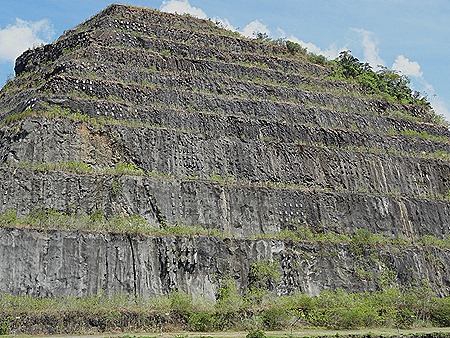
Above left is a small portion of the “Calebra Cut,” which was several miles of solid rock they had to blast through to create the canal. The terraces are where earth moving equipment & rail cars were brought to cut out the walls, layer by layer. On the right is another portion of the cut, at the continental divide.


Everybody likes wildlife, so above is a blue heron (I think) standing by the canal. On the right they are dredging the canal to make it big enough for the larger ships that will come through the new canal locks.


Above are people stopped to watch our ship, first near the Pedro Miguel lock and then at the viewing center at Miraflores. It was odd to see people taking our picture! We had to stop at Miraflores for one of our passengers to be taken off in an ambulance. Since he walked to the ambulance, we are hoping that nothing was seriously wrong. Below left is a beautiful bird with swallow-like divided tail, many of which we saw at Miraflores, and below right is the Panama Railway, the first transcontinental railroad. Then pictures of the Bridge of the Americas (where the Pan American Highway crosses the Panama Canal on its way from Alaska to Tierra Del Fuego), and of Panama City at the Pacific end of the canal.


That’s it for Panama. Today it’s raining cats & dogs here in the Pacific Ocean but we are hoping for better weather tomorrow when we go ashore in Manta, Ecuador, where we will arrive at 4:00 AM. The Captain has already apologized for waking us that early with the maneuvering engines but I’m sure an apology won’t seem like enough tomorrow morning. We will probably post again after leaving Ecuador in a few days.

 BADER JOURNAL