
Kobe, Japan (Day 1) – Kyoto (2024)
We docked at Kobe on the morning of March 2 for an overnight stay. Kobe is the 7th largest city in Japan with a population of 1.5 million and Japan’s third largest port. This area has been settled for at least 1,000 years, although the modern city was founded in 1889. Its cosmopolitan reputation dates back to 1853 when it was one of the first Japanese ports opened to trade with the West. Some 21% of the city was destroyed by Allied incendiary bombing in March of 1945, which killed close to 9,000 people, and large parts of the city were destroyed again in the Great Hanshin earthquake of January 17, 1995, which killed almost 6,500 people. If nothing else, you have probably heard of the extremely expensive gourmet Kobe beef, which comes from cattle pampered with special food and even massages.
No doubt Kobe would be an interesting city to explore and we know people who had a very good time there. But this was our first visit to Japan, we only had two days and there were two out of town cities that were higher on our to-do lists. So we signed up for long excursions for both days. On this first day we went to see some of the important sites of Kyoto, the ancient imperial capital of Japan until the 1870’s when the Meiji emperor moved to Tokyo after the Meiji Restoration. So really, just about our only view of the city of Kobe today was from the bus window as we crossed the bridge to head out of town.

As mentioned above, Kyoto was the seat of the emperor and thus the capital of Japan from 794 to 1879, more than a thousand years. In fact, Kyoto means “capital city.” Emperor Kanmu first moved the capital here from Nara because he wanted to get the Buddhist establishment out of his hair. There was unrest and violence in the city during the 15th century and again before the Meiji Restoration in the 1860’s, but on the whole it seems to have avoided the devastation of war and earthquakes seen by other cities in Japan.
One notable thing you will not read in this episode: Kyoto was not subject to Allied bombing in World War II, atomic or otherwise. It originally was at the top of the list of Japanese cities proposed as targets for the atomic bomb. But Henry Stimson, US Secretary of War, convinced President Truman to remove it. It is not clear just why he wanted Kyoto removed, possibly its importance in the cultural heritage of Japan (he had visited there at least twice, but not on his honeymoon as some suggest), or possibly because he thought its destruction would so alienate the Japanese that they would side with the Soviet Union after the war, or perhaps something else. Either way, this preserved the ancient wonders of Kyoto from destruction and, among other much more important things, made our visit to its landmarks today possible.
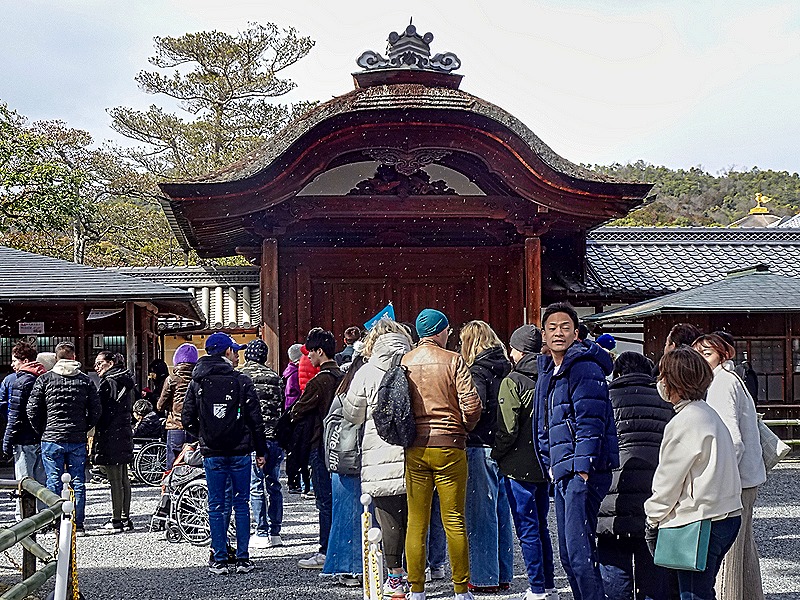
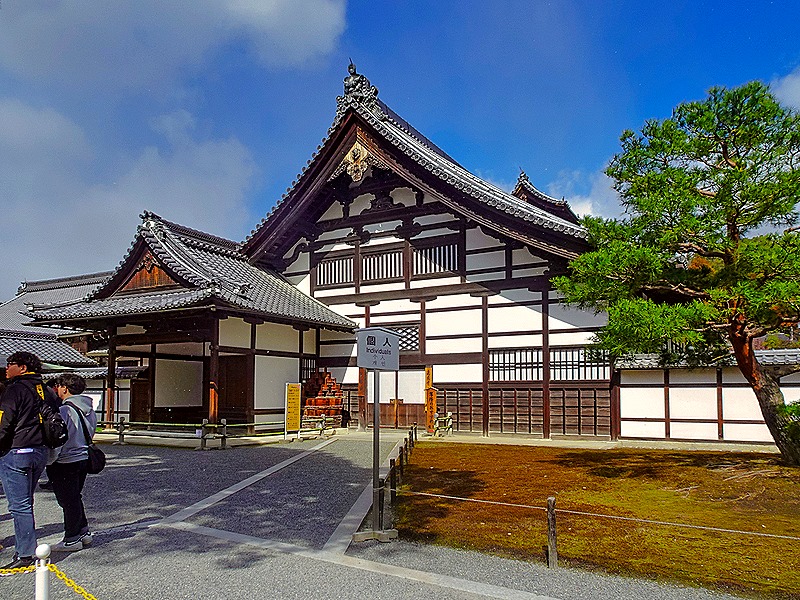
After about a 90 minute drive we arrived at our first stop in Kyoto, the Temple of the Golden Pavilion, called Kinkaku-ji in Japanese. Originally a private villa, it was bought by the shogun in 1397 and developed as his retirement villa. Pursuant to his wishes, when he died it was converted into a Zen Buddhist temple. The upper two stories of the three story building are entirely covered in gold leaf and are said to contain relics of the Buddha, including his ashes. Each of the three stories was designed in a different architectural style. Situated over the edge of a large reflecting pond in a woods, the Pavilion makes a rather spectacular sight when the sun is shining, and many consider it one of the most beautiful buildings in the world. After receiving our entry tickets (there was a bit of a crowd) we walked a path through the woods to arrive near the water’s edge on the opposite side of the pond from the Pavilion.


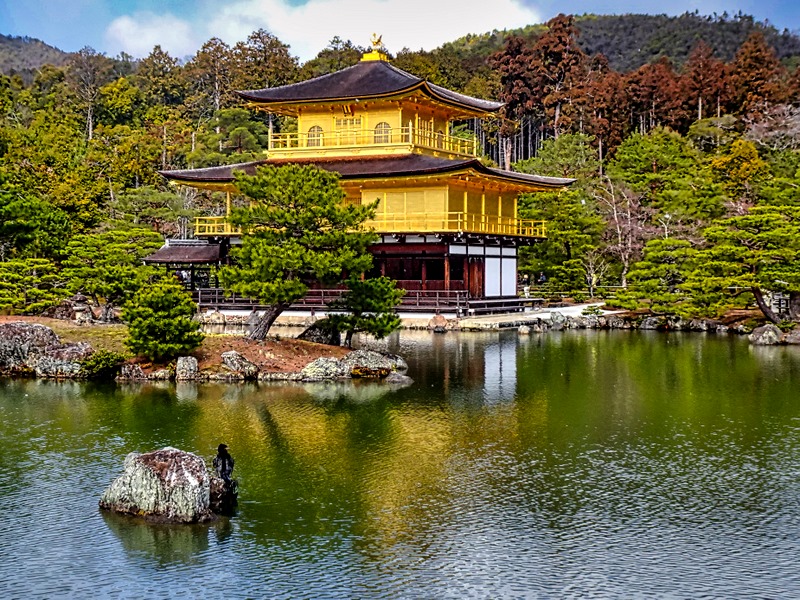

After admiring it for a while from this vantage (and after everyone got pictures) we walked around the right side of the pond toward the Pavilion. In the pond were a variety of rocky islands, carefully placed according to Zen principles. There were two birds, a black one and a gray one on two of the islands; we don’t know their species but they looked like something we had seen in Japanese paintings.


We told you earlier that Kyoto escaped the bombing in World War II so you might think the Golden Pavilion came through the war unscathed. And it did. But on July 2, 1950, the building was completely destroyed by a fire deliberately set by a young monk later found to be mentally ill (he was imprisoned but died six years later of tuberculosis). So despite surviving the war, not to mention the centuries before that, the building we see here is a recent reconstruction completed in 1955. It is supposed to be a very close copy of the original. In the 1980’s the gold leaf was replaced by a much thicker variety after it was found to be peeling off and in 2003 the roof was restored.
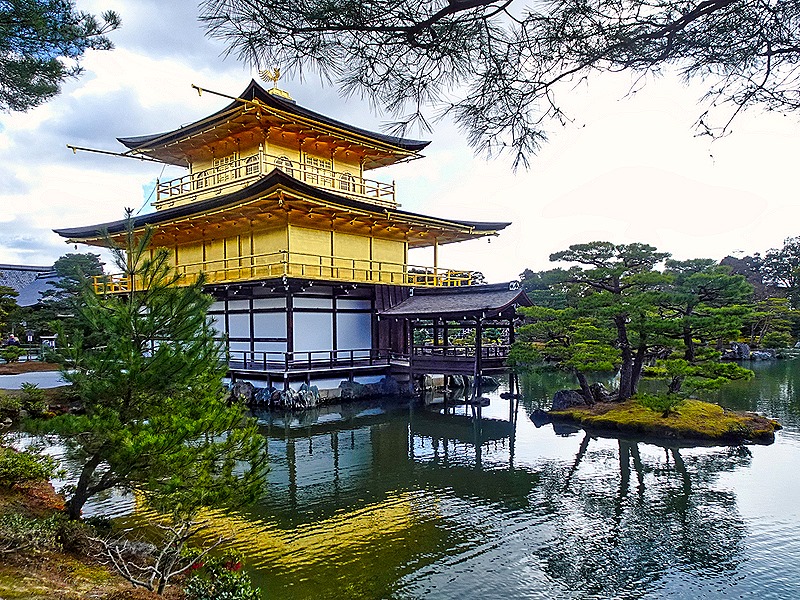
Coming around the back of the temple gave us a much closer view of its structure. Unfortunately, this was as close as we could get because there was no admittance into the building. At the apex of the temple’s roof is a distinctive bronze phoenix, which escaped the fire in 1950 because it had been removed for repairs. A wooden “fishing pier”juts out to the right with a floor high enough for small boats to pass under.


Behind the Pavilion we walked up a path that took us by some interesting spots. There is a small waterfall called Ryumon-no-Taki (Dragon’s Gate Falls). The large stone under the falling water is the Carp Stone, which is placed to look like a fish swimming up the waterfall. It represents an old Chinese legend in which a carp becomes a dragon after climbing a waterfall. We also passed some stone images called Jizo, which are supposed to be guardians of children, travelers and firefighters. People are invited to throw coins to invoke their protection. And we saw a small stone pagoda called the Hakuja-cho (White Snake Mound) sitting on an island in a woodland pond that never dries up and is therefore considered a good place to pray for rain. Looking in the opposite direction we had a nice view of the top story of the Golden Pavilion peeking over the edge of the hill.

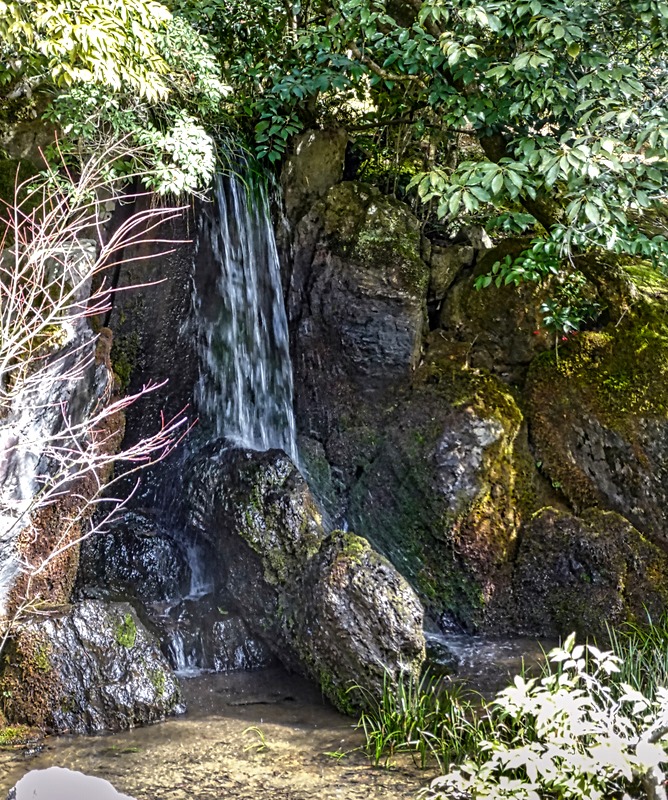

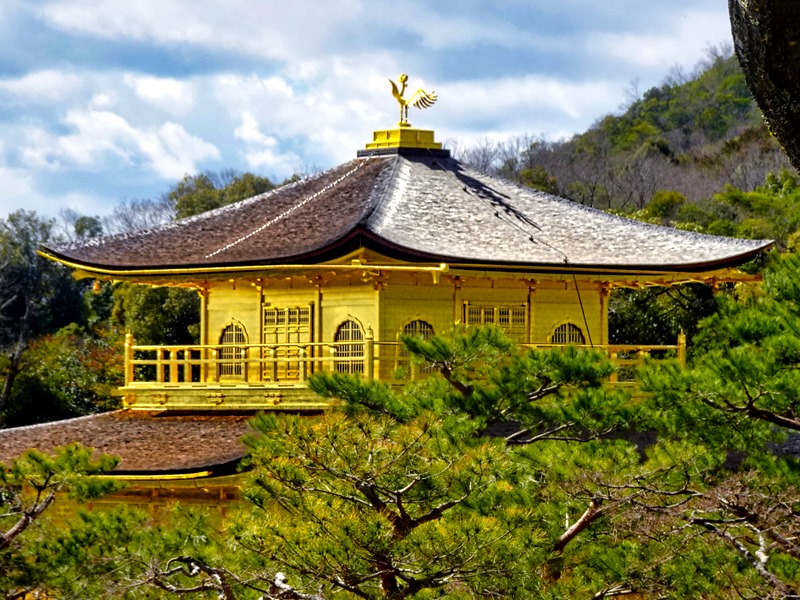
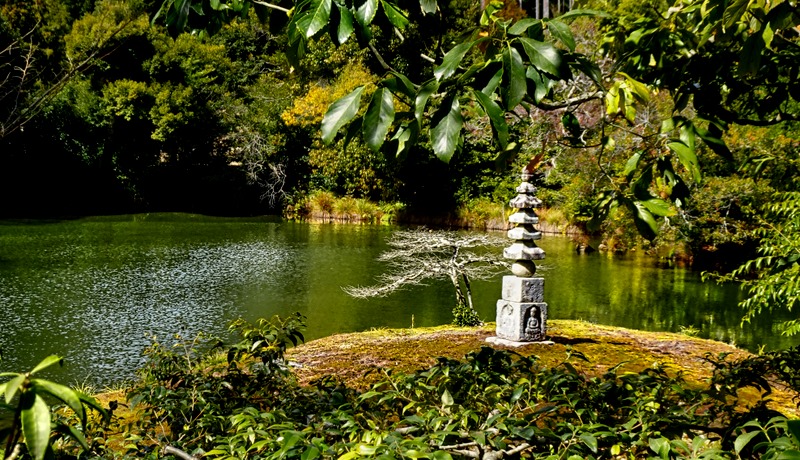
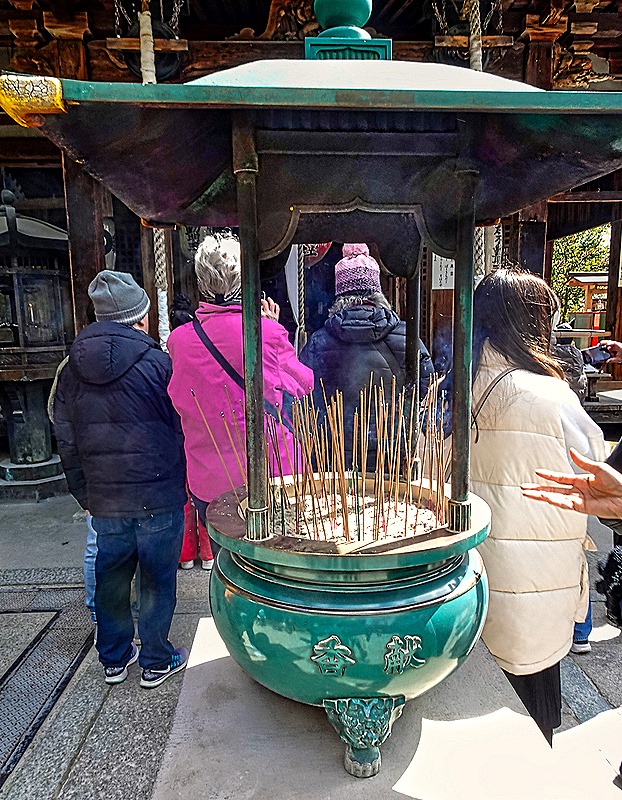
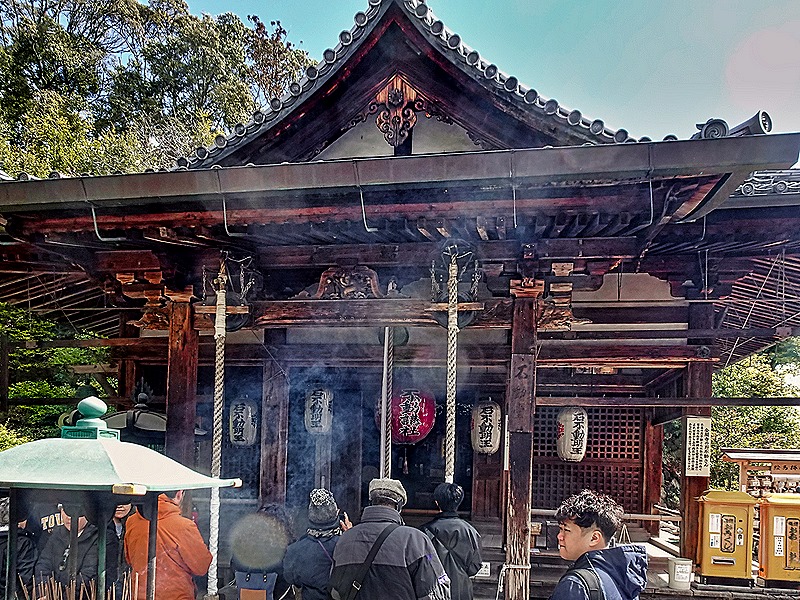
Finally we came to the Fudo-do, a Buddhist hall. Since the fire that destroyed the Golden Pavilion this has been the oldest building in the complex, the current iteration dating back to the 16th century. Inside is a statue of a protective deity that can only be viewed two days a year. In front of the Fudo-do is a large turquoise urn full of sand to hold burning incense sticks (which can be purchased nearby). When we were there it was putting out a lot of smoke.
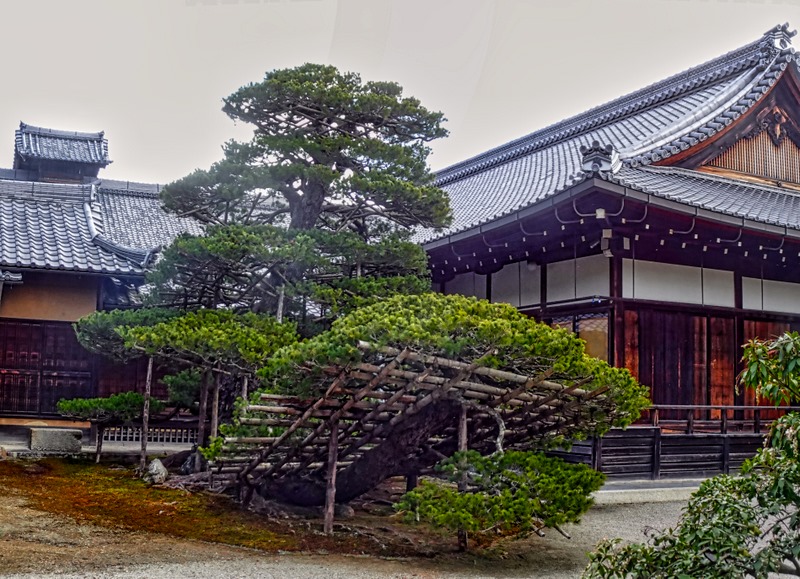
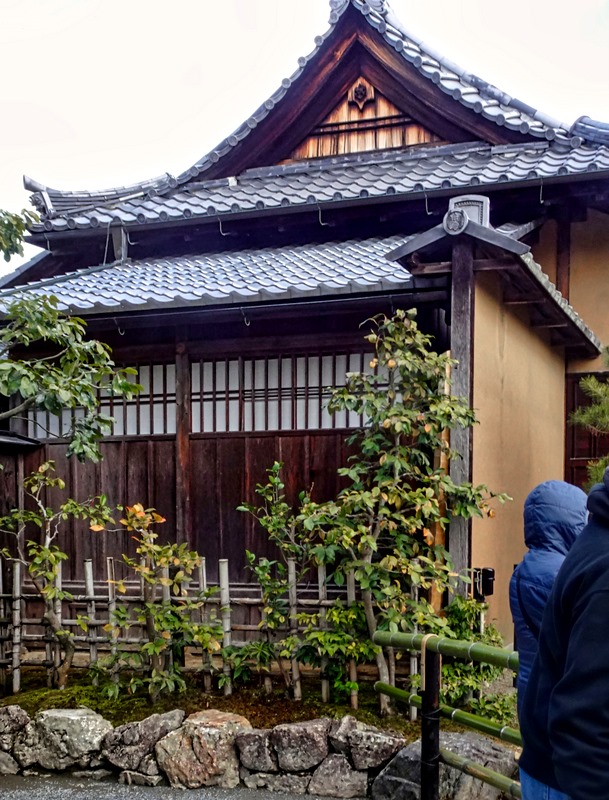
Another interesting building on the grounds was the Abbot’s House (where the temple’s abbots resided). In front of it is a 600+ year old pine tree planted by the shogun who built the Golden Pavilion. It was originally a Bonsai and has been trained to resemble a ship. The trunk growing straight up represents the mast and the large branch reaching forward, held up by a bamboo cradle, represents the bow of the ship. Some say it represents the journey the shogun hoped to take to the afterlife.

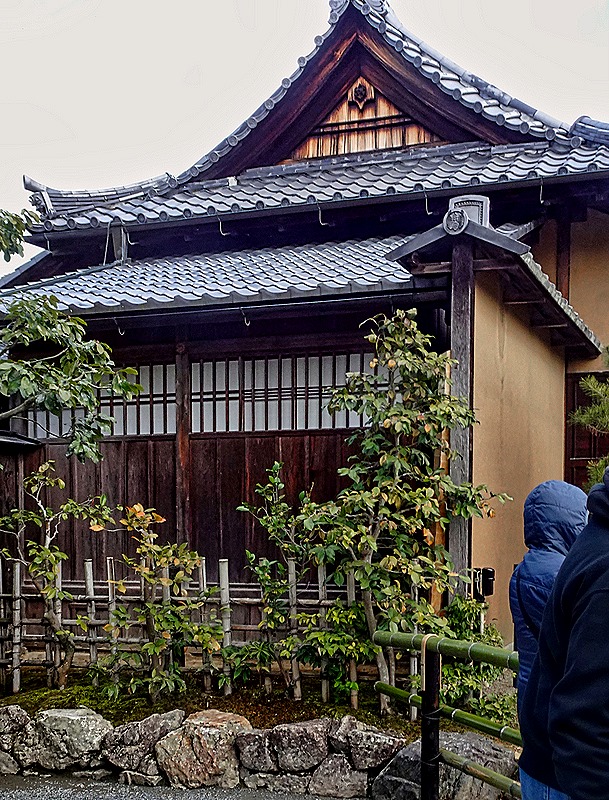
After visiting the gift shop near the exit (of course) we walked down a long path to reach the bus in the parking lot. Notice in the picture that the wall has five parallel white lines. We have read that the number of white lines indicates the importance of the temple, with five lines being the top tier.

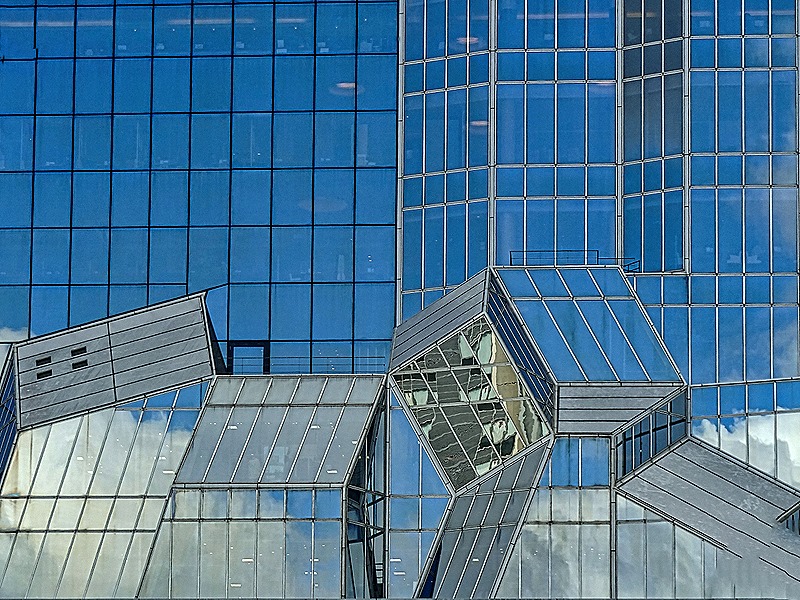
We had a buffet Japanese lunch in a hotel restaurant across the street from the very modern central train station in Kyoto. The food was good but the long buffet line was inefficient and time consuming. From our seat at the table we had a nice view of the interesting abstract facade of the train station.


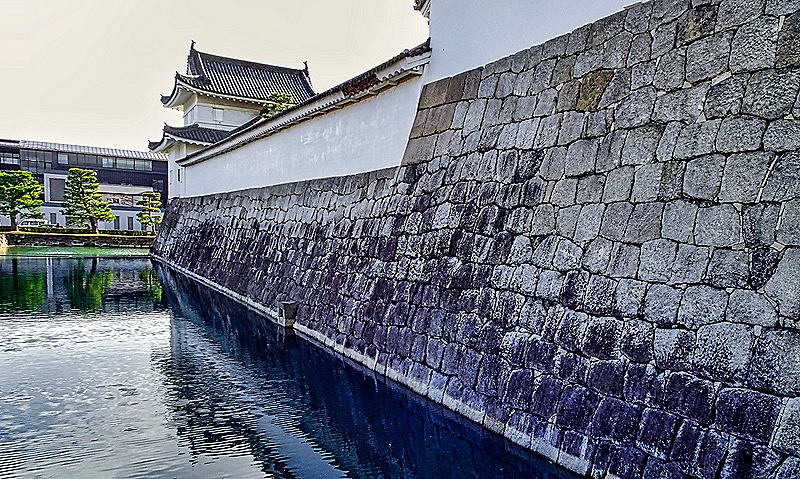
Nijo-jo is a castle in Kyoto built by the first Tokugawa shogun, which opened in 1603. It was financed by funds he forced all the daimyos (feudal lords) of Western Japan to contribute. It is surrounded by a heavy stone wall and a moat (actually two concentric sets of walls and moats). It is the only fortified castle in Japan from that period that still exists without having been destroyed and reconstructed (its tower was destroyed by lightning in 1750 but was not reconstructed). Of course Kyoto was the imperial seat at that time and the shogun lived in Edo (Tokyo), so the purpose of this castle was to serve as the shogun’s residence when he visited Kyoto (and to remind everyone who was the real power in the empire).
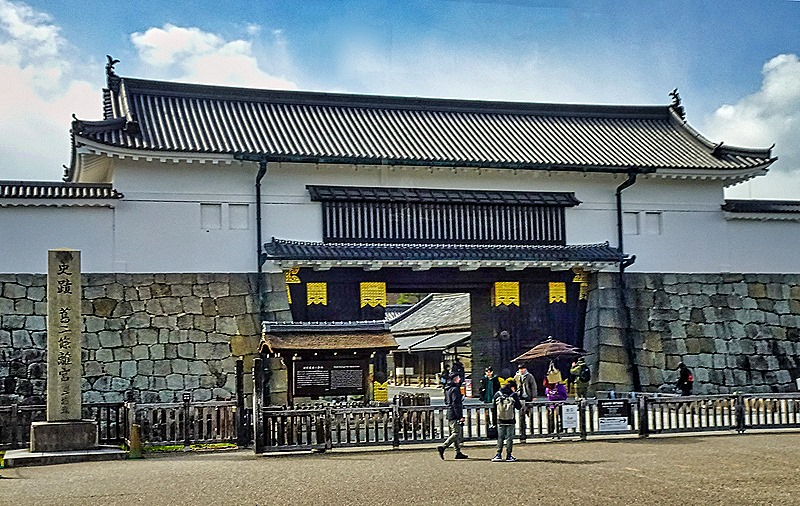
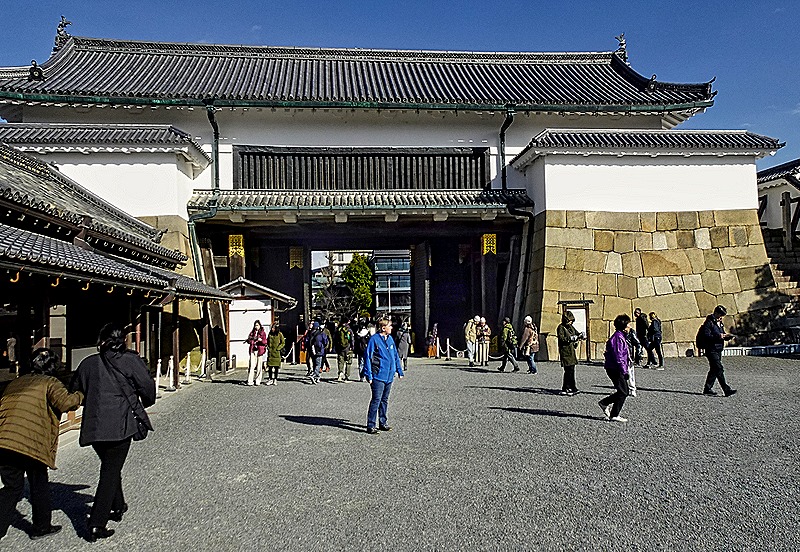
After obtaining our tickets we entered through the Higashi Ote-mon Gate, the main entrance that was probably built in 1662.
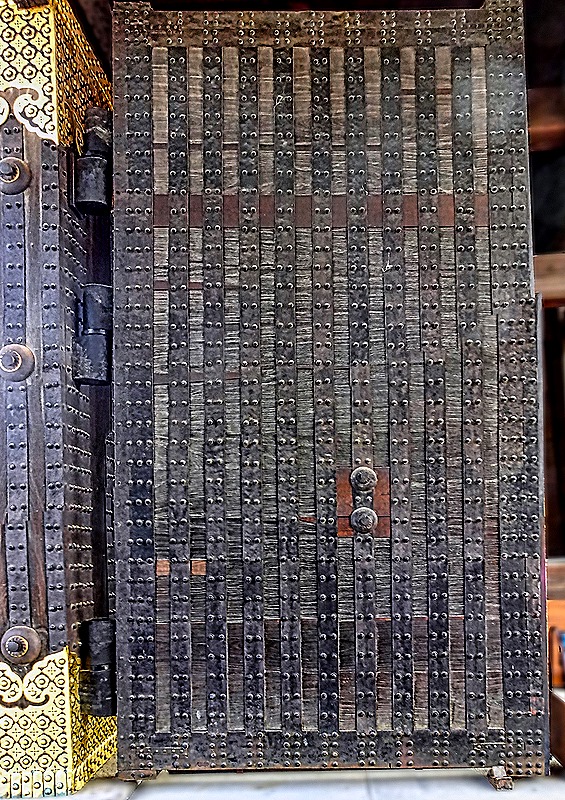
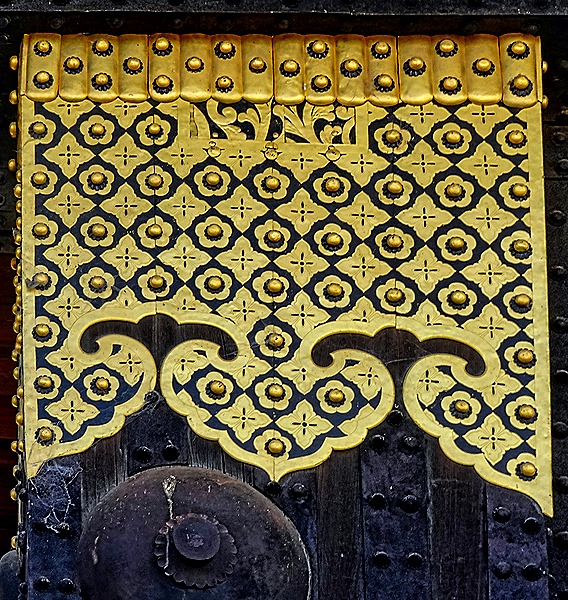
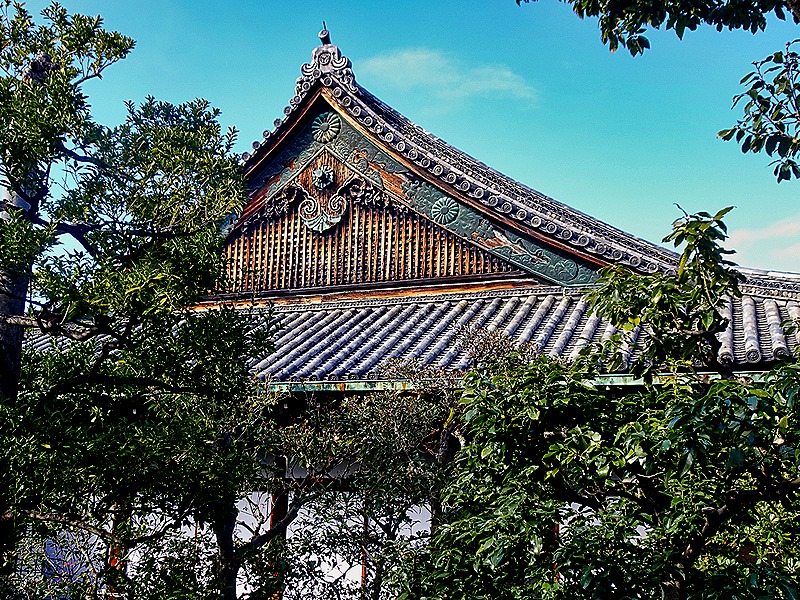
To enter the palace precinct we walked through the magnificent Kara-mon Gate. It was probably built in 1598 for another castle and moved here in 1626. The gate is very large and striking, covered in fine carvings and detailed metalwork.


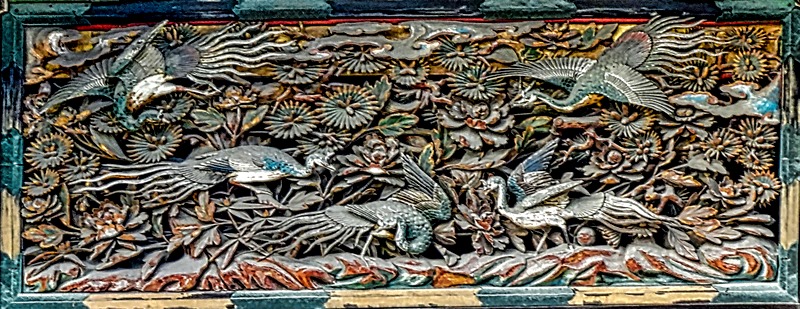
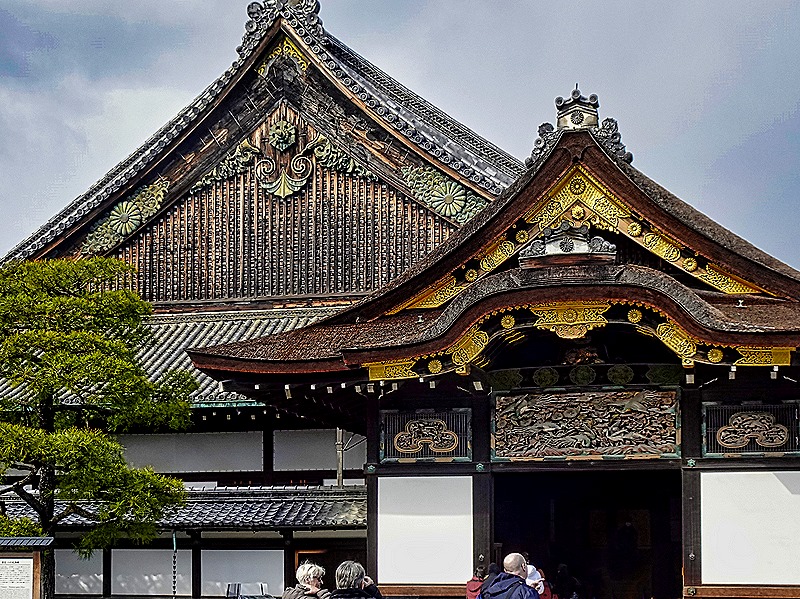
As you walk through the gate you can see the beginning of Ninomaru-goten Palace, originally the shogun’s living quarters and official reception halls. It is made up of six connected buildings with 33 rooms. The floors are covered by more than 800 tatami mats. The walls are covered by more than 3600 paintings dating to the early 17th century (actually what you see there today are very fine copies; the originals are kept in a separate painting gallery within the castle’s outer walls). We walked through the entire palace along wooden corridors that surround the rooms in the 6 buildings. The spacious rooms, intricately painted ceilings and numerous large and lively wall paintings were quite beautiful. In the room where in 1867 the last shogun announced to the nobles that he was ceding power to the emperor were a number of mannequins dressed in the colorful costumes of the time representing the nobles and the shogun. The wooden corridors are called Nightingale corridors because they make a squeaking sound when walked upon. The story that this was done purposefully to alert inhabitants to intruders is, apparently, not true (too bad, its a good story). Unfortunately we have no pictures of anything inside the palace because photography is completely forbidden there. Sad but true.

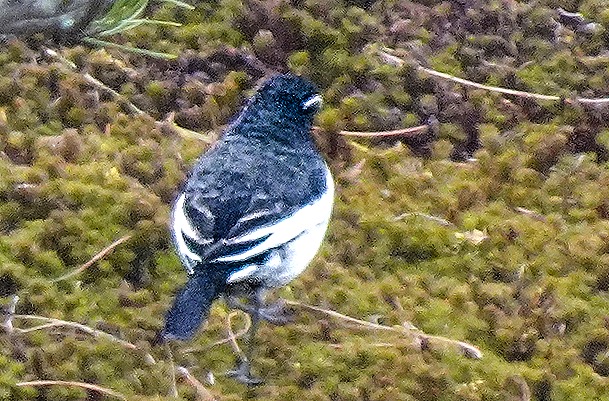
Behind the palace is the Ninomaru Garden, a leading example of a classic Zen garden. Originally built in 1603 at the same time as the palace, it was extensively redesigned in 1626 for the Emperor’s visit. There is a large pond with three islands, a large one representing paradise, and smaller crane and turtle islands representing longevity. Numerous rocks are carefully landscaped along the banks of the pond. The pond is fed by a small waterfall on the side opposite from the palace. We saw a small bird on one of the banks enjoying the garden while we were there.



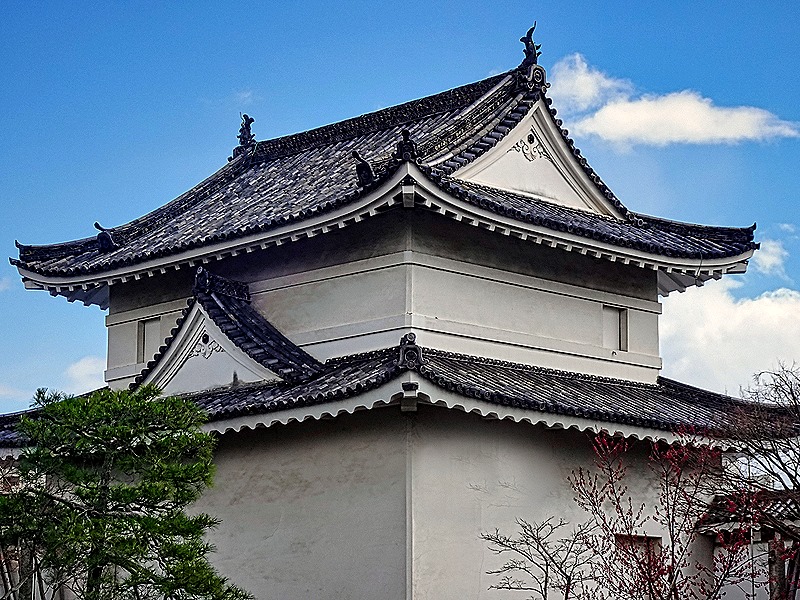
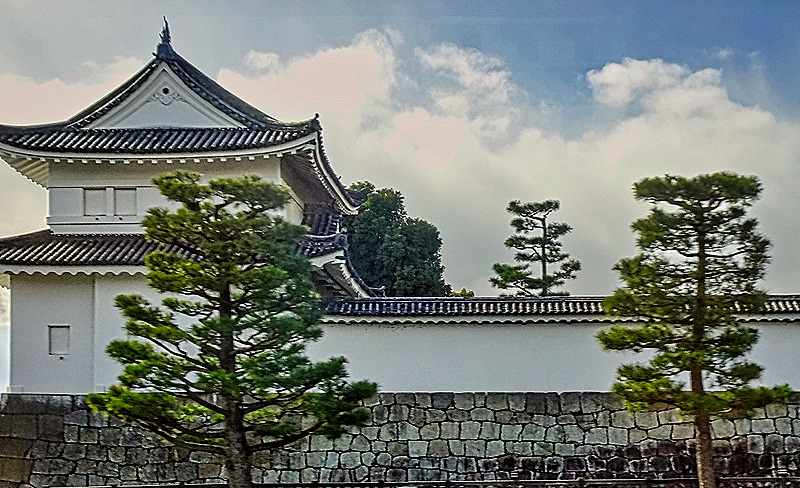
We left the way we had come, though the courtyard behind the main gate. To our right we could see the Southeast Watchtower, and that was also our last view of the castle, perched above the stone outer wall, as we headed back to the bus.
We spent the rest of the afternoon on a walking tour of the Gion district. Dating back to the 15th century, this district first developed to provide food, shelter and diversion to travelers visiting the Yasaka Shrine. It later became one of the most important geisha districts in Japan. Today it is still an important geisha district but is also one of the few areas where traditional architecture predominates.
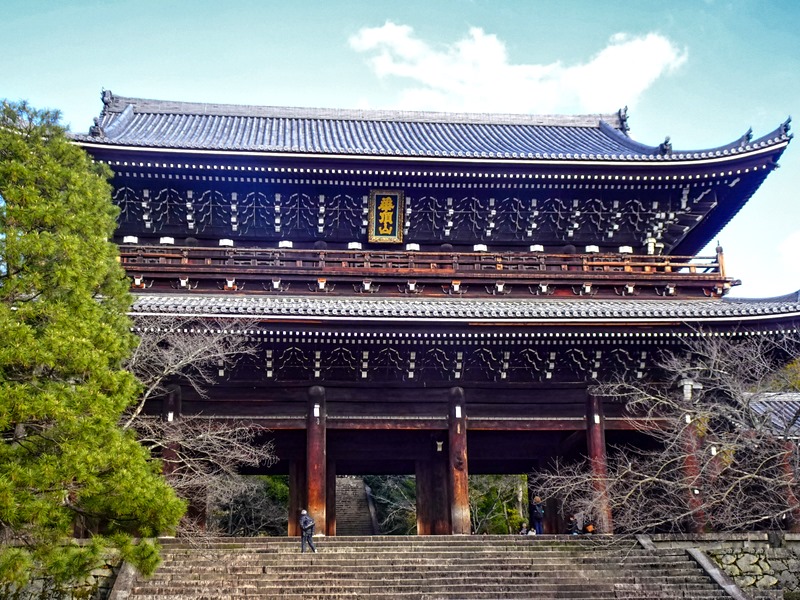
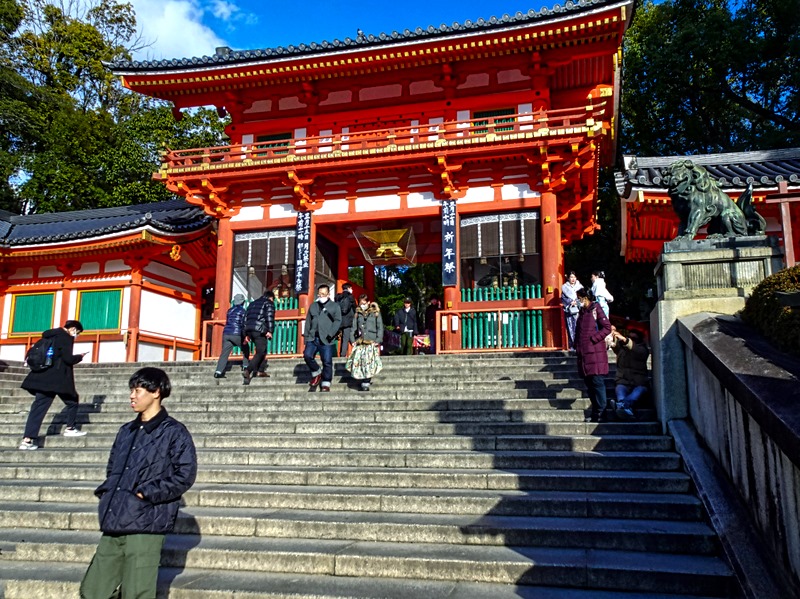
Leaving the bus we walked past two impressive religious buildings. First was a Buddhist temple called Chion-in (Monastery of Gratitude). First built in 1234, much of the temple complex burned down and was rebuilt in the mid 17th century and that rebuild survives today. The massive Sanmon gate that faces the street below was built in 1619. Second we came to the Yasaka Shrine, which serves the Gion sect of the Shinto religion. It was originally constructed in the 7th century and achieved importance with imperial support. As mentioned above, the Gion district began to serve the needs of pilgrims visiting this shrine.
We did not visit either of these buildings, merely walked past their entrances and viewed their entrance gates at the tops of tall and wide stairways. That’s too bad, but we had limited time left to see Gion and it’s impossible to spend time at all the temples and shrines in Kyoto, since there are some 1600 Buddhist temples and 400 Shinto shrines in this city.
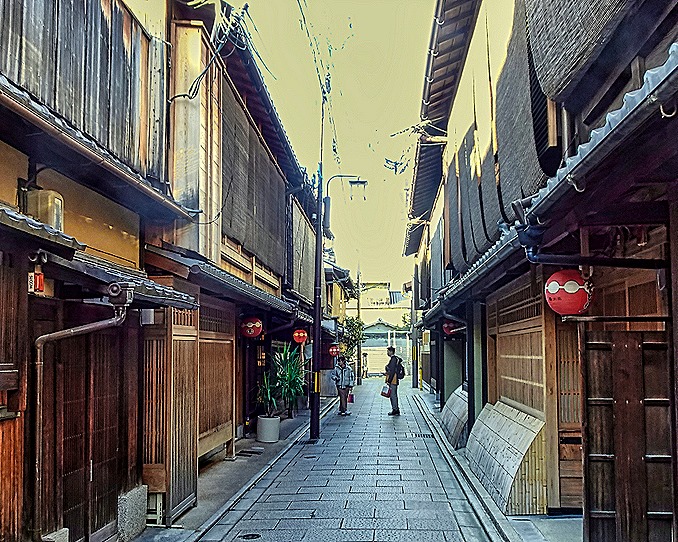
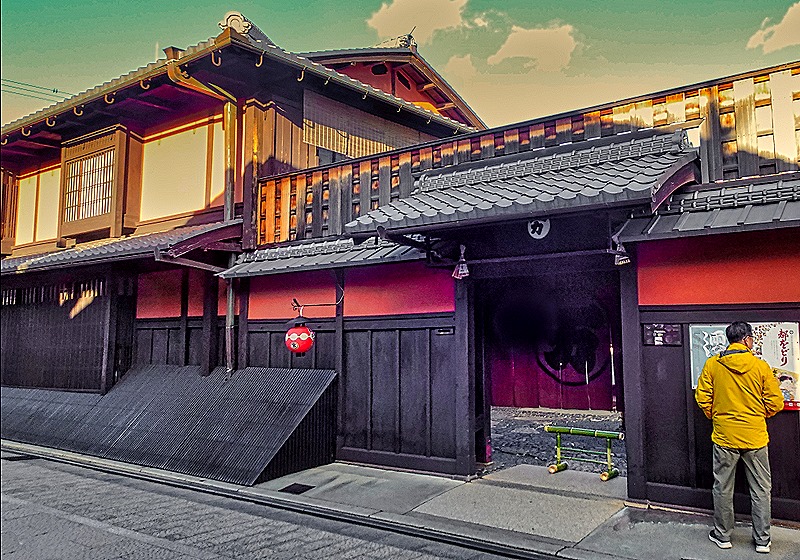
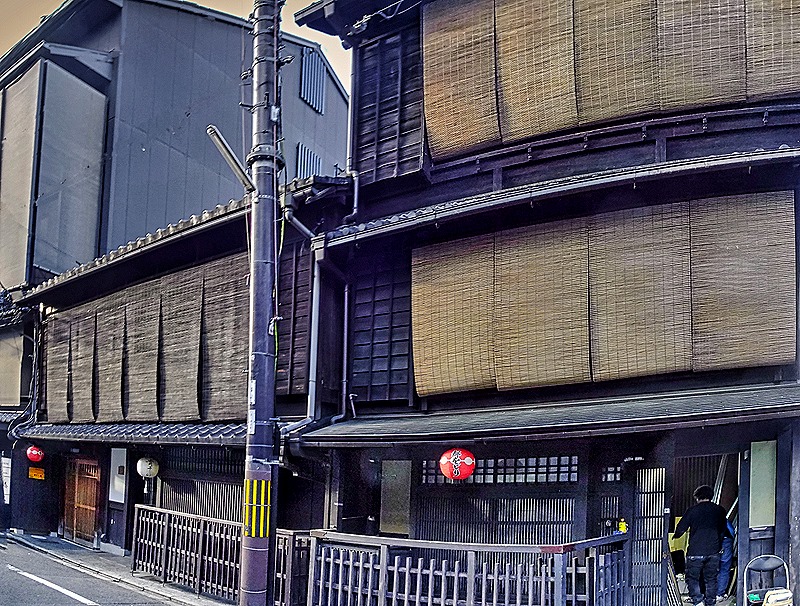
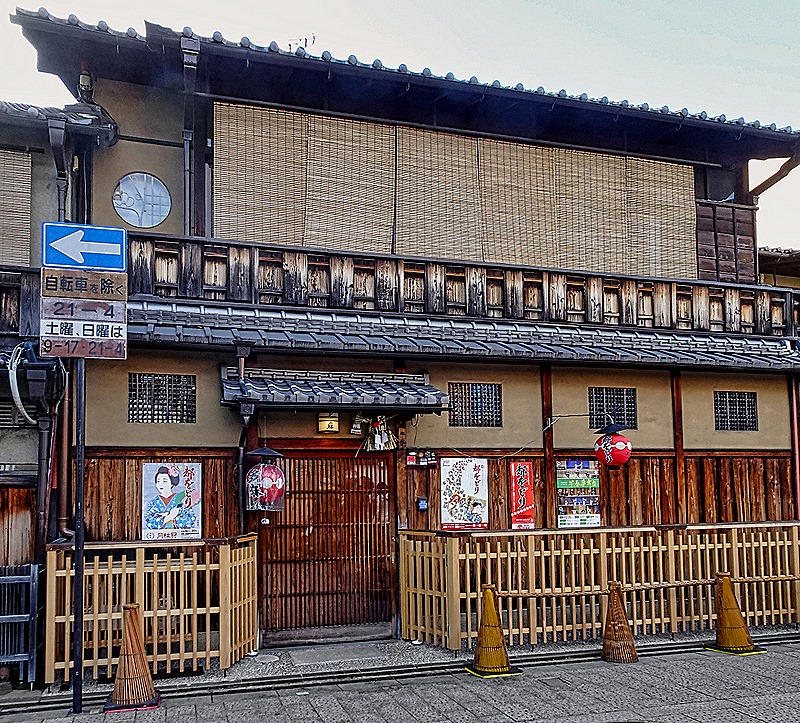
We walked down Shijo Street and turned left into the heart of Gion, with its narrow stone streets lined with vintage wood townhouses, mostly less than 3 stories tall, called Machiya. Urban buildings of this style, generally used by craftsmen and merchants with retail space lining the street and living quarters in back, have been in use in Japan for 1,000 years. They dominated in Kyoto for centuries but in recent decades have been disappearing to make room for modern buildings. They are typically about 20 feet wide along the street and about three times that in length toward the back, often including garden courtyards. We did not enter any of these buildings but walked by many of them lining the street and serving as restaurants, night clubs and shops as well as homes. We understand that each district has its own representative logo and that the red lanterns hanging in front of many of the Machiya here represent the Gion district.
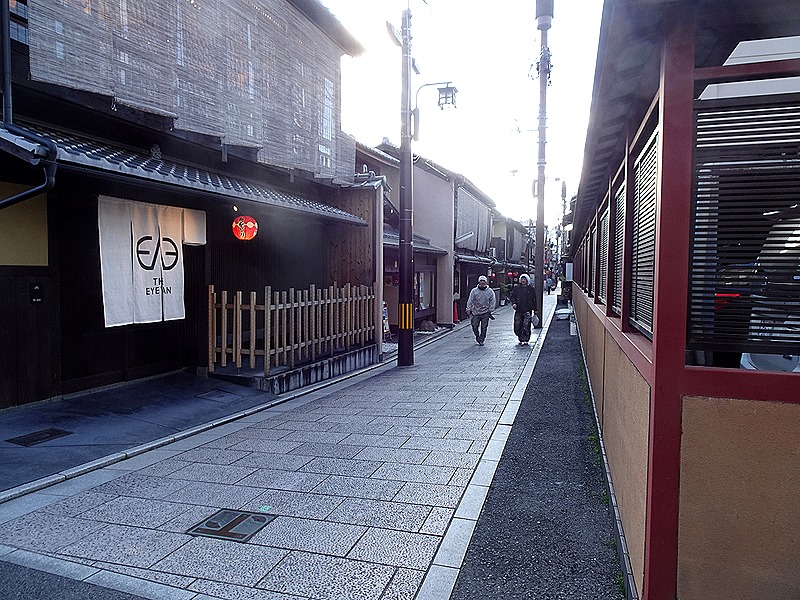
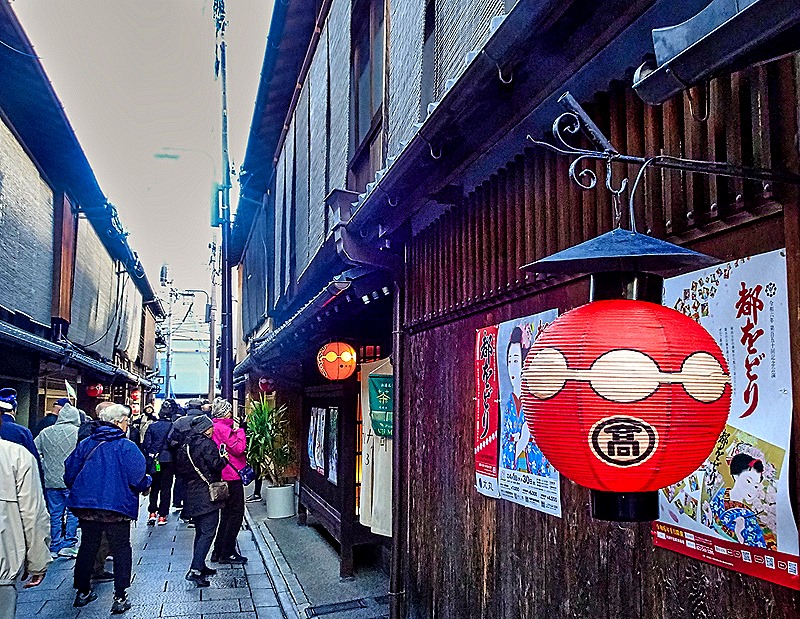
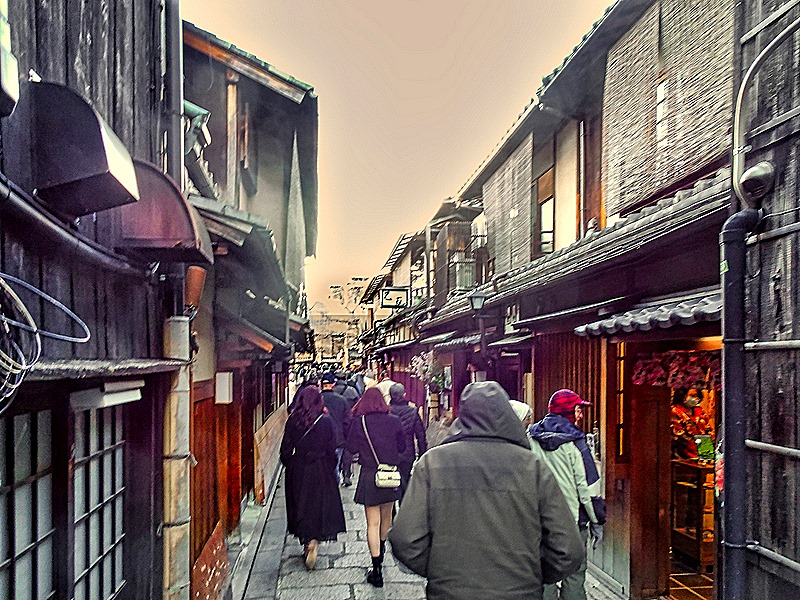
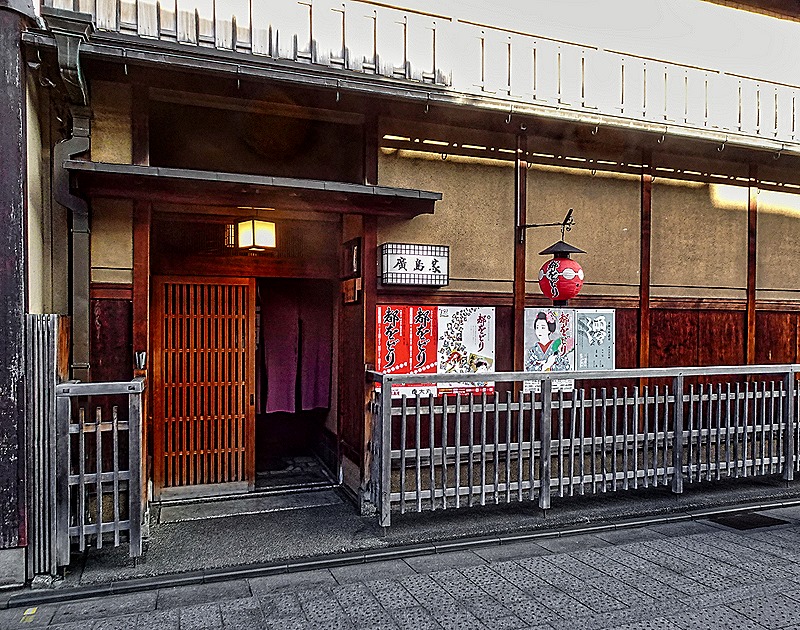
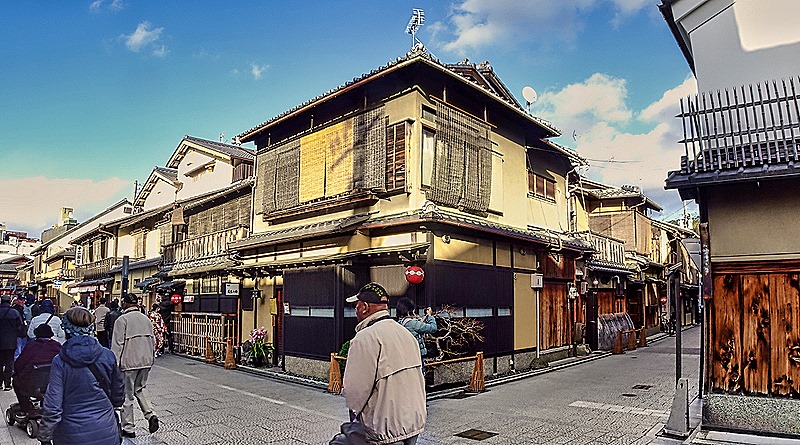
There are several notable features of the Machiya. Particularly on the second floor windows they usually have screens made of horizontal wood slats woven together with string or yarn, which can be rolled up or folded out of the way. These are called Sudare, and they let air and light in from outside while protecting from direct sun, rain, some insects and viewers on the street.

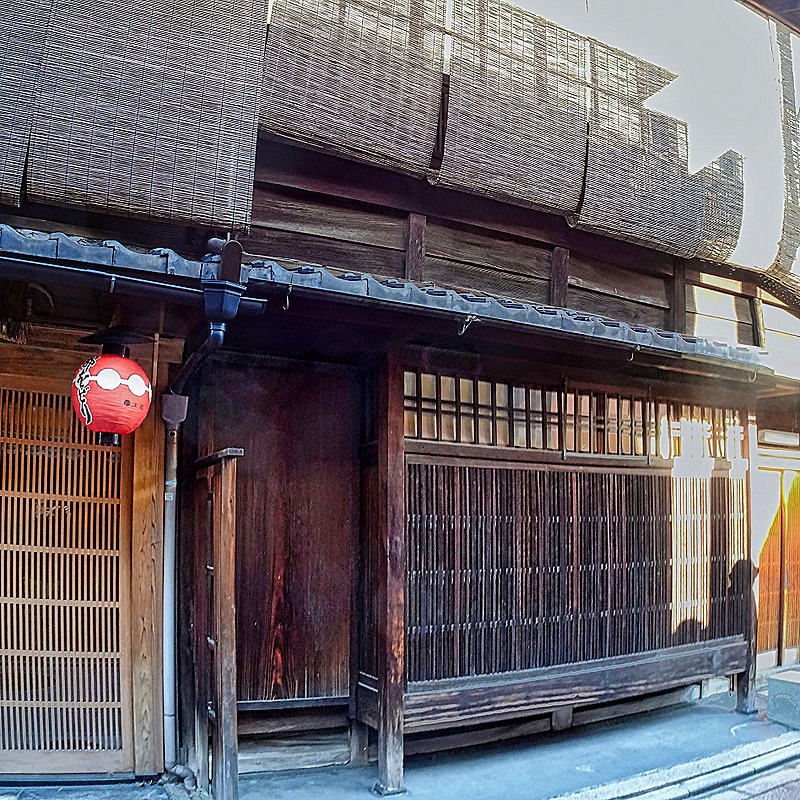
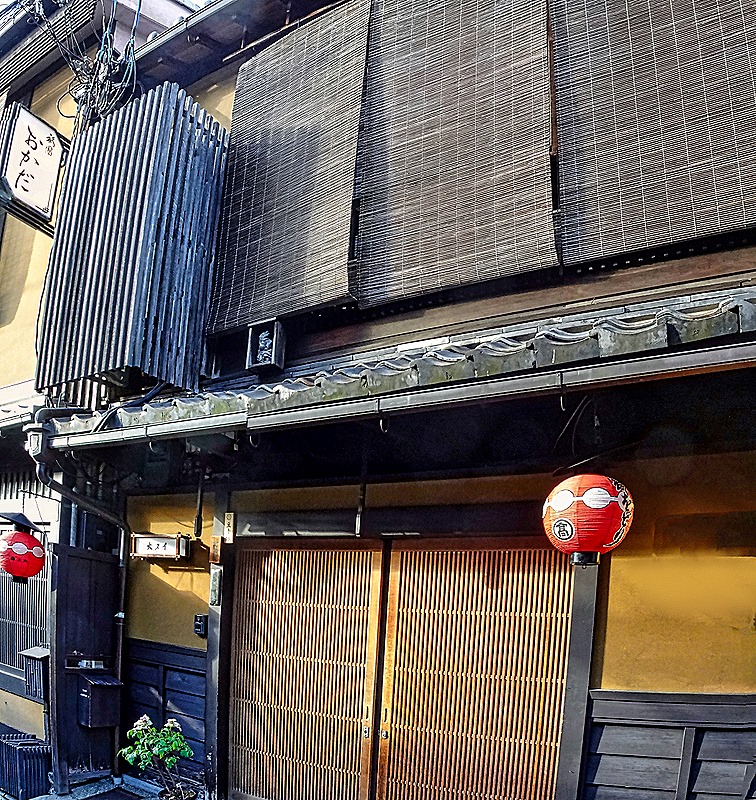
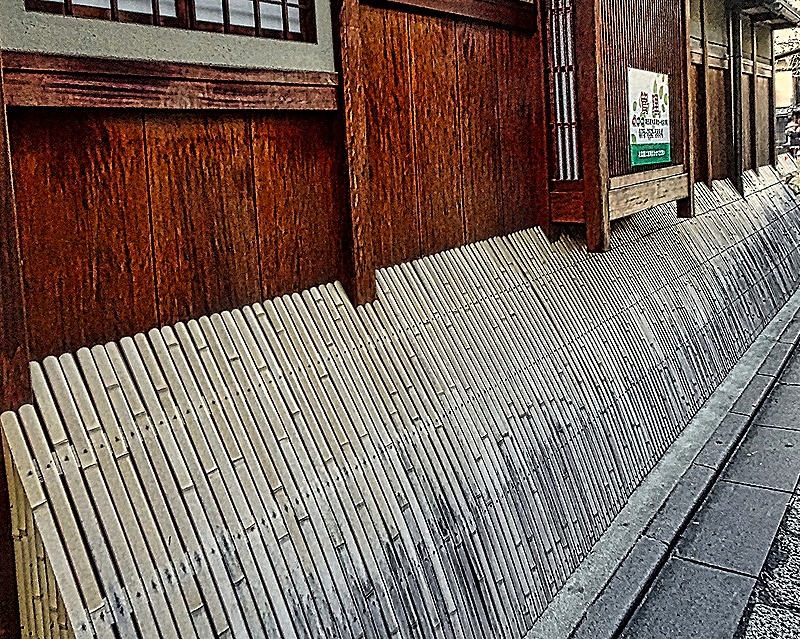
You will notice in the pictures that the sidewalks in this district are quite narrow and several of the houses depicted above have fencing barring use of the sidewalk in front of the house. Instead of fencing, many of these buildings have a sort of curved wooden skirt reaching from the front of the house to the curb. These are called inuyarai. Inu means “dog” and these skirts were probably originally used keep stray dogs from urinating on the front of the house. But they also protect the front wall from mud splashes and keep people from leaning against the house and eavesdropping on what is being said and done inside.
One famous building we passed is the Ichiriki Chaya (Teahouse). More than 300 years old, this has been an important building here since the beginning of the Gion district. It figures in the prominent story of the 47 ronin samurai, who were all forced to kill themselves after avenging the death of their master, and it was the scene of much of the plotting to end the shogunate in the 1860’s, which led to the Meiji Restoration. Access to the building and its geisha entertainment is strictly limited, mostly to individuals whose families have been patrons for generations.
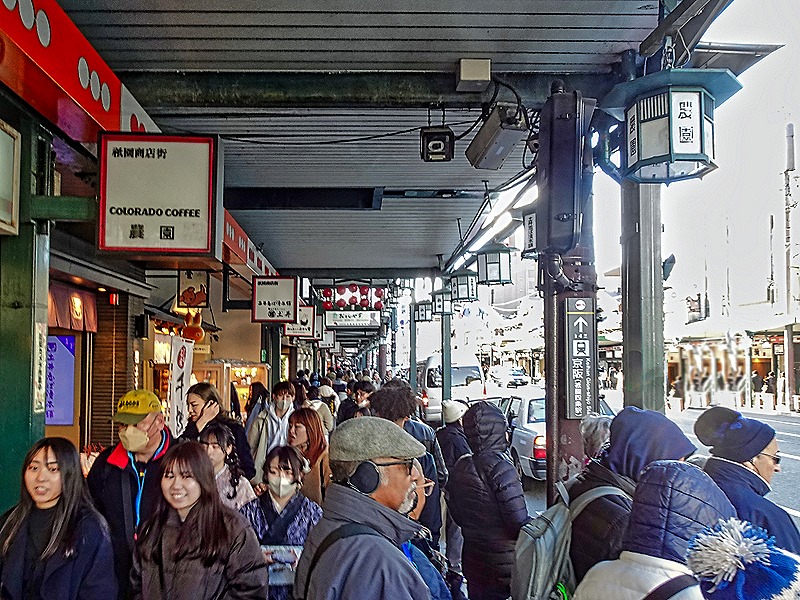
After a while we emerged for a time on what we think was Shijo street, a crowded boulevard lined with commercial establishments, such as shops and restaurants, although even here many of the buildings were of the Machiya design.
There are two types of geisha: Maiko are apprentices still learning the business, while Geiko are full fledged official geisha. It is possible to see actual geisha on the streets of Gion, but they are pretty rare. We were warned that although photography was permitted on the public streets we were using, there are private alleyways where it is forbidden. Less than a week after our visit we read that because so many tourists disregarded these rules, Kyoto had decided to completely ban them from entering the private alleyways. We hope that, despite this remarkable timing, no one on our voyage misbehaved in this way.
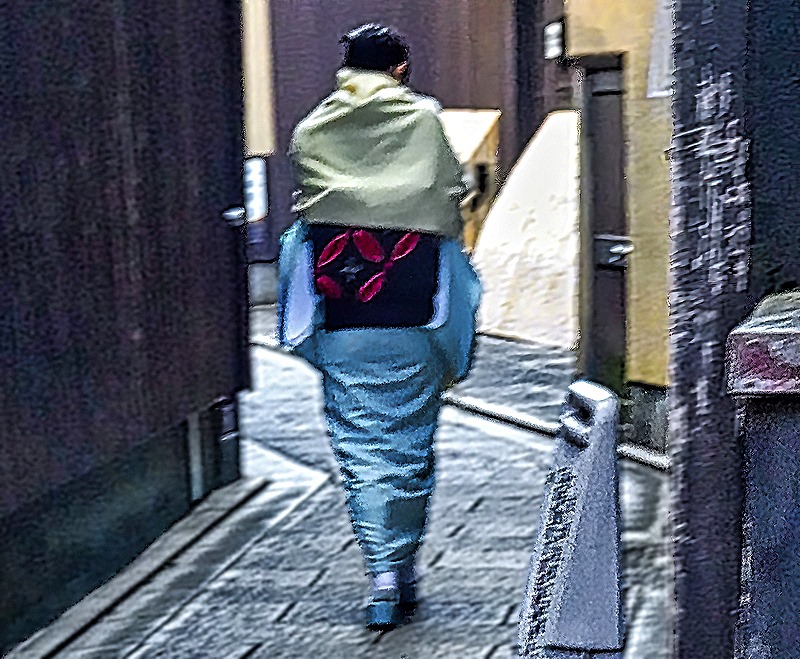
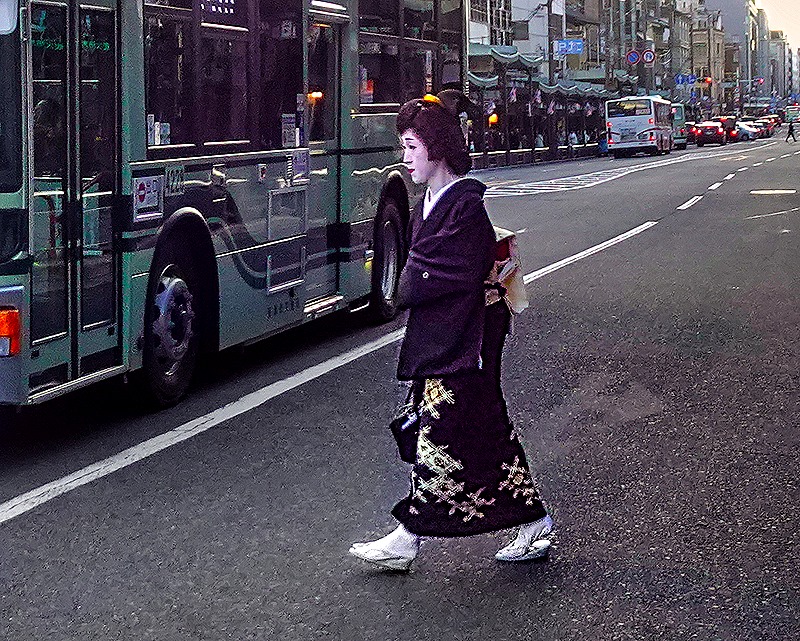
As we saw in Tokyo, there are also shops here that rent geisha style clothing to visitors who want their pictures taken in that guise here, but by law such rented clothing cannot be an accurate representation of geisha attire. Our guide told us that you can tell an actual geisha from a dressed up visitor despite the similar clothing because the geisha are always in a big hurry while the visitors saunter around the area, stopping for photos. Relying on that distinction we think we saw two geisha, both of whom were walking so fast it was difficult to get a photo. One of them was past us so fast we only have a picture of her back, while the other was crossing Shijo street at a distance from us.
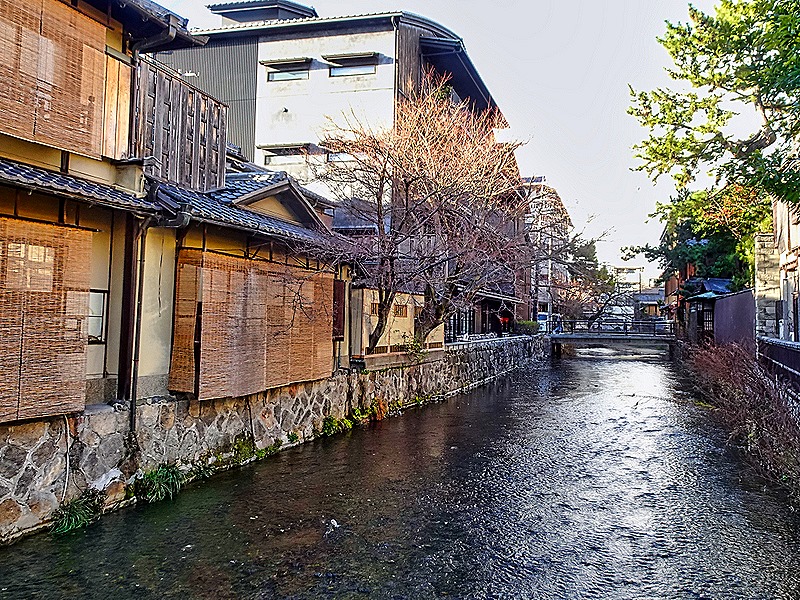
We turned right from Shijo street and walked for a while until we came to the Shirakawa River which runs along the border of the Gion district. We crossed a bridge or two from which we could see the Gion side was lined with teahouses and restaurants of the sort seen in Gion while the opposite side was a riverbank lined mostly with trees (many cherry trees we have read, although they were still in bare winter mode when we were there). We have read that the other side used to be lined with Gion style buildings as well, but they were torn down during World War II as a precaution against fires.

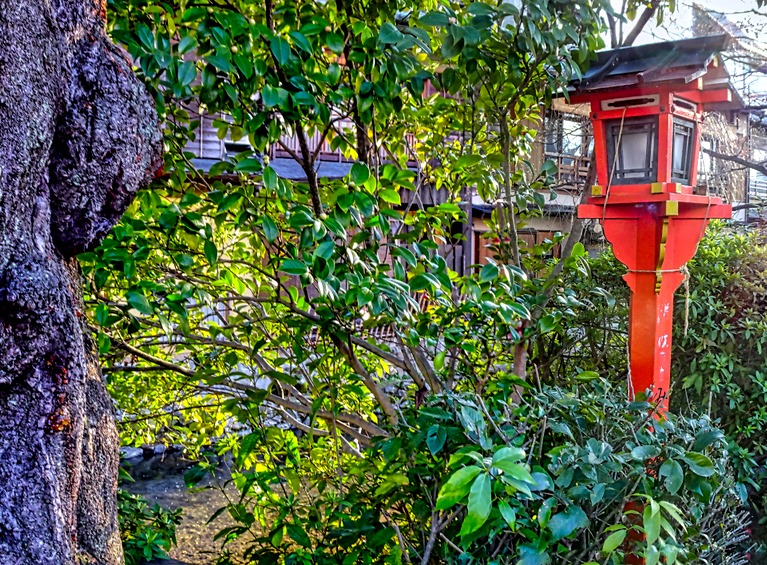
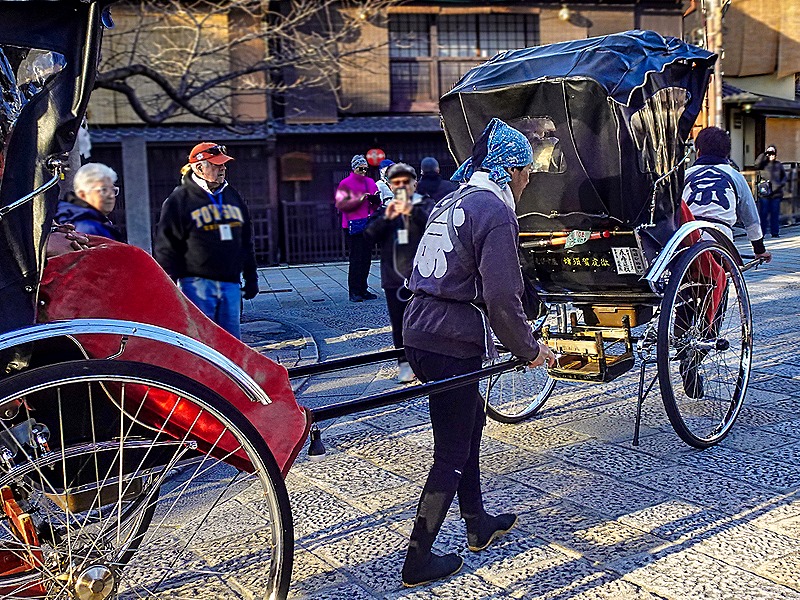
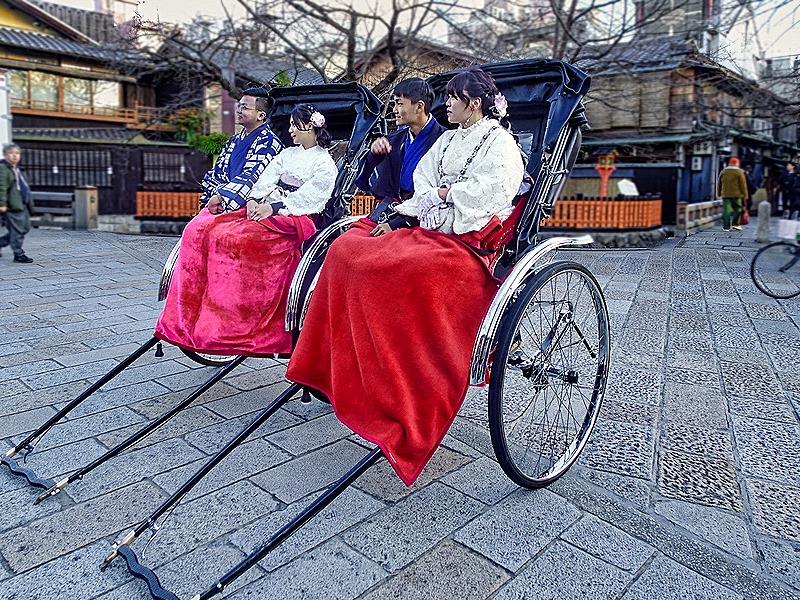
We emerged into a somewhat larger square, in the middle of which is a small red and gray Shinto shrine variably called Tatsumidaimyojin or “Inari of Gion.” Both local residents and geisha worship here. Two men walked into the square pulling metal rickshas, in each of which was a traditionally dressed couple. They stopped and put down the ricksha pulls, then took out cameras and took pictures of the two couples. It must have been some kind of special occasion for them as they posed for pictures in their fine traditional clothes in the ricksha seats.


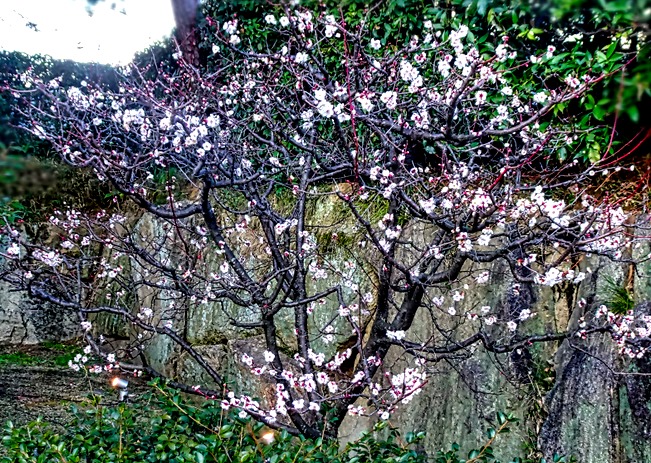
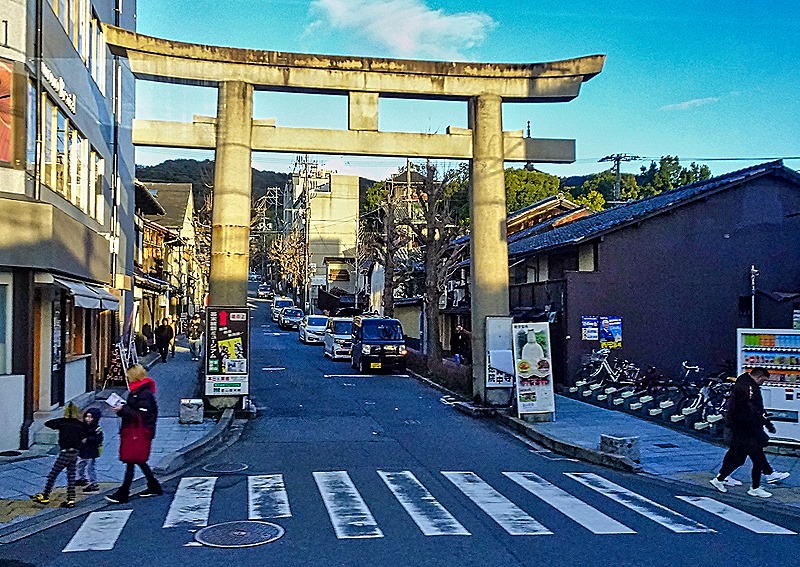
All that was left of our walking tour, and our visit to Kyoto, was the long walk back to the bus in the parking lot. We did pass some nice flora on the way and, as the bus drove through the town we passed a torii gate glowing in the lowering sun. Where there is a torii gate there is almost always a Shinto shrine nearby, although we didn’t see this one as we drove past. The sun was setting as we drove back to Kobe, where we had dinner and went to bed in anticipation of another very long and full day to come.


 BADER JOURNAL


Leave a comment