Hong Kong, China (overnight) — 2024
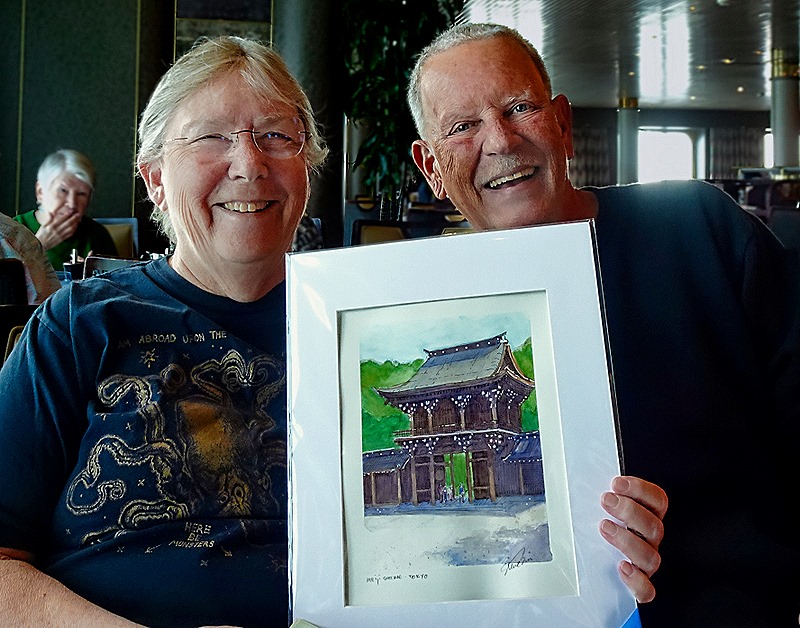
Between Tianjin and Hong Kong we had three relaxing sea days to recharge our batteries from the intensive days in Shanghai and Beijing. We spent time in our usual hangout, the Ocean Bar, for reading and catching up on the internet news. Zuiderdam has a lot of fairly quiet venues with upholstered chairs and tables but we have found few that feel comfortable for very long, particularly for folks like us who aren’t as young as we once were. But we settled on the Ocean Bar as the best of an unsatisfactory lot, better yet if you put your feet up on a table or another chair (although near the end of the cruise Henk, the hotel manager, distributed memos to everybody’s rooms asking that we not do this). One of our friends, Steve, is a watercolor artist who does a painting in each port. We bought his painting of the Meiji Shrine in Tokyo, which he delivered to us in the Ocean Bar on one of these sea days.

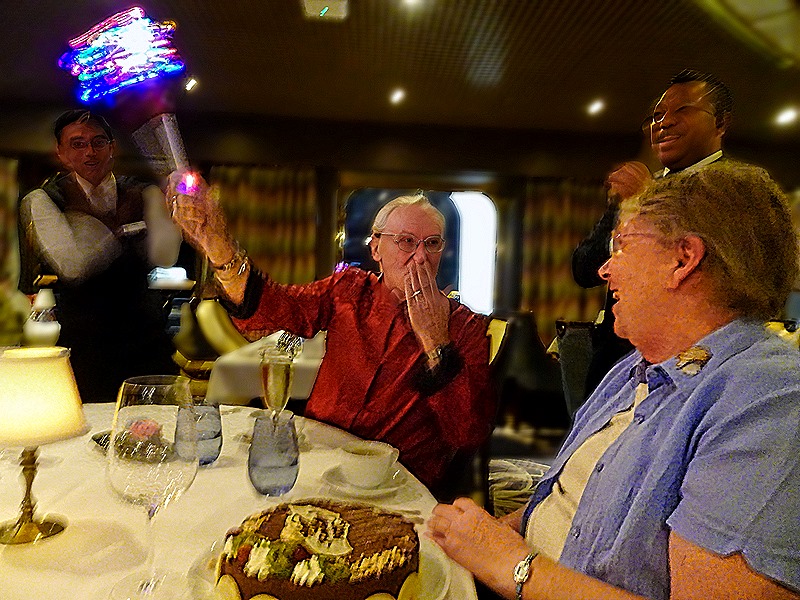
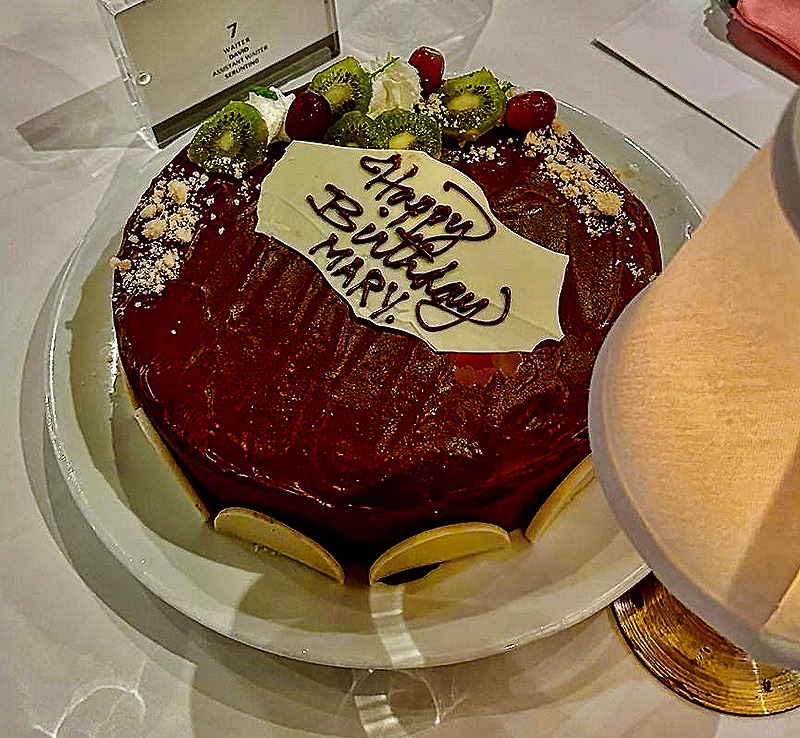
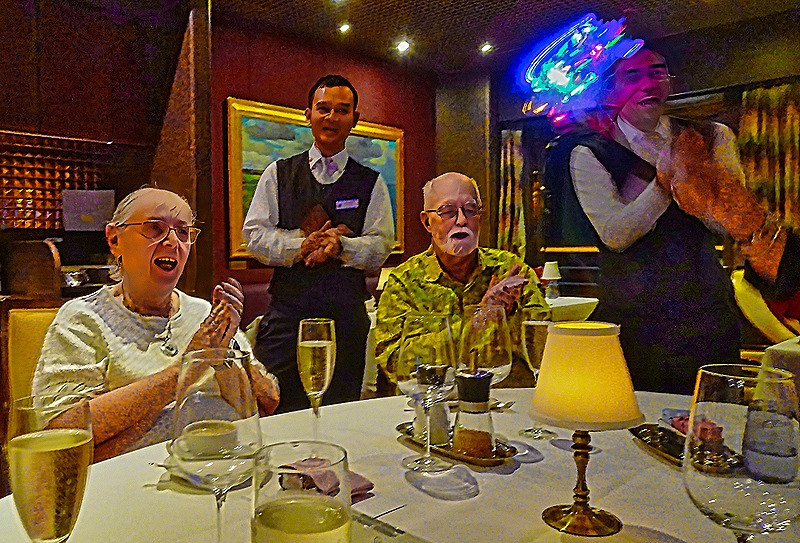
But the biggest event during these days was Mary’s 75th birthday on March 15, the day before we reached Hong Kong. We had originally planned to commemorate it by going to tea at the Peninsula Hotel on our second day in Hong Kong, but it turned out that would not have fit into the time available before our early departure that day, maybe next time. So we ended up celebrating at our usual table in the main dining room with our usual table mates: Bill, Robert, Bob & Judy. Robert provided a birthday cake and the restaurant staff, and some of the diners, sang the Indonesian birthday song. Robert (as usual) also provided the fireworks.


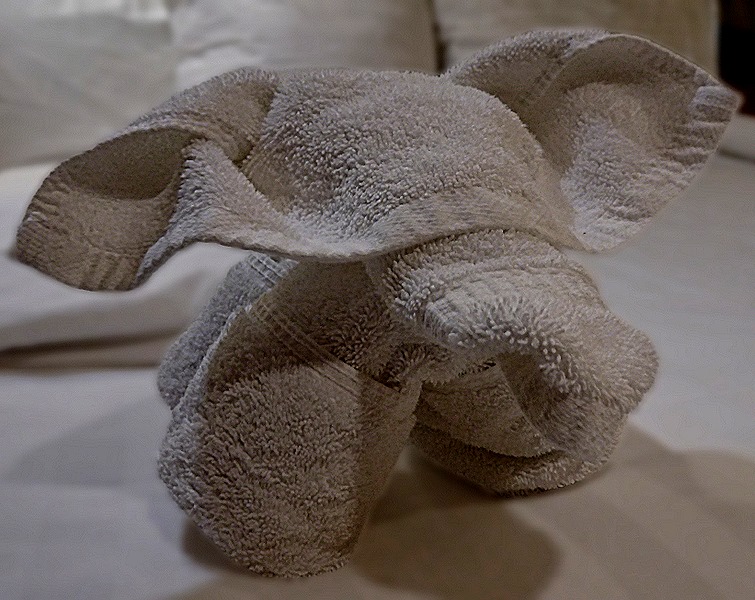
When we got back to our cabin after dinner we found that our room stewards had been busy too, leaving a very tall birthday cake (made of towels) on the bed, with a (towel) flame on top.

By about 8:00 AM on March 16 we were docked at Kai Tak cruise terminal in Kowloon, across the water from Hong Kong. (For those who haven’t been here, Hong Kong is an island and Kowloon is a peninsula extending from the mainland that was also part of the British colony.) This was our third visit to Hong Kong, the first place on this voyage since the Panama Canal crossing on January 24 that we had visited before. On our first visit in 2016 we were docked for two nights right in the center of Kowloon, next to the Peninsula Hotel and the Star Ferry terminal, just about the most convenient place in Hong Kong. You could see downtown Hong Kong across the water from the ship:
https://baderjournal.com/2016/03/20/hong-kong-china-day-1/
https://baderjournal.com/2016/03/22/hong-kong-china-day-2/
https://baderjournal.com/2016/03/24/hong-kong-china-day-3/
Our second visit was in 2018 and we were docked overnight at Kai Tak cruise terminal, formerly the Hong Kong airport, which was miles away with no view of the central part of Hong Kong island. But there was a shuttle bus that took us (on a pretty long ride) to the Peninsula Hotel, so that wasn’t nearly as good as the first visit but still enabled us to go where we wanted pretty conveniently.
https://baderjournal.com/2018/07/23/hong-kong-china-day-1-2/
https://baderjournal.com/2018/07/25/hong-kong-china-day-2-2/
This time we were docked again at Kai Tak terminal, but there was no shuttle bus to the Peninsula Hotel area. There was a shuttle bus, but it was provided by a nearby shopping mall and that was the only place it would take you. We were told (by HAL staff who had never done this) that there was a subway stop near the shopping mall where you could make connections for wherever you wanted to go, but we didn’t want to go to the mall and the connections sounded too iffy to us in a city where we can’t speak or read the language. We heard later that at least some passengers who took the shuttle had a difficult, at best, time trying to find the subway, so we were glad we didn’t do that. We thought about walking out of the port to explore the neighboring area, but it is a very long walk from the terminal to the exit (this used to be an airport with long runways) and a lot of construction was blocking the way.
Our choice came down to stay on the ship or sign up for an excursion, and we sure didn’t want to spend our entire visit to Hong Kong on the ship. So the day before we arrived we booked an excursion that would take us to several places in the general vicinity of the port. We didn’t have high hopes for this excursion but it turned out to be much more interesting than we had anticipated.
Our first stop was at Kowloon Walled City Park. This enclave’s history dates back to the 15th century when the Chinese established a military garrison to manage the local salt trade. It became a fort in 1810 and in 1847, after the British took control of Hong Kong island, a strong defensive wall was built. In 1898 China agreed to give the UK a 99 year lease on a Hong Kong concession extending for 200 miles . . . except for the Walled City that remained under Chinese jurisdiction. Chinese troops were withdrawn the next year but the British did little to control the area. The walls were demolished by the Japanese occupiers in 1943 to obtain stones to extend runways at the airport (now our cruise terminal). After the war the area was inundated by refugees from the Chinese civil war, who wanted to avoid British jurisdiction by staying in this nominally Chinese enclave. The rapidly increasing population density (some 3.25 million per square mile in a 1987 census, the most densely populated place in the world at that time) along with the failure of Britain and China to police the area, led to it becoming a haven for crime of all kinds (including, for example, unlicensed “doctors” and “dentists”). After decades of false starts, the population was moved out (finally overcoming their longstanding resistance) and the densely packed buildings were demolished in 1993 under an agreement between Britain and China. The almost 8 acre park we visited, which once had hosted more than 500 10-12 story buildings, opened in 1995.
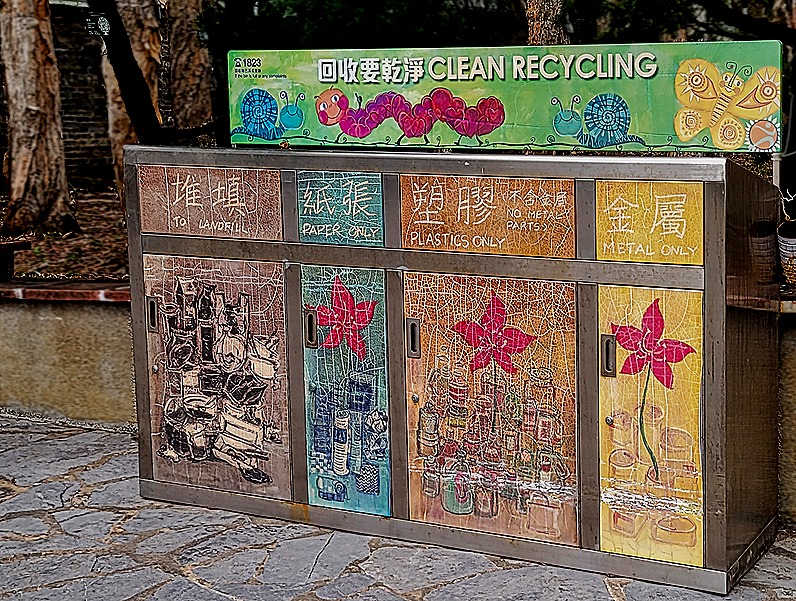
Our bus dropped us outside the park, which is now once again surrounded by a wall, although not a defensive one. On the way to the park we passed a tall building construction site with scaffolding made of bamboo, something we have seen before in Hong Kong. Near the entrance was a colorful bilingual recycling center.


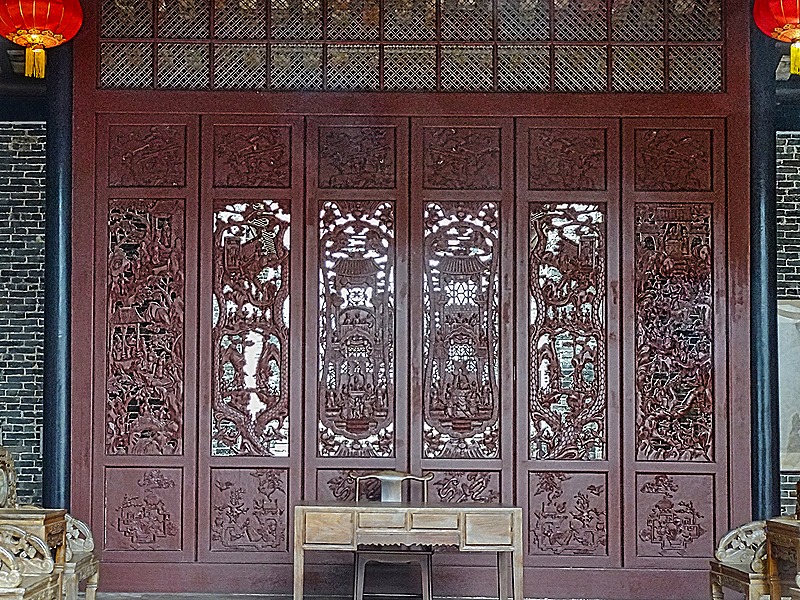
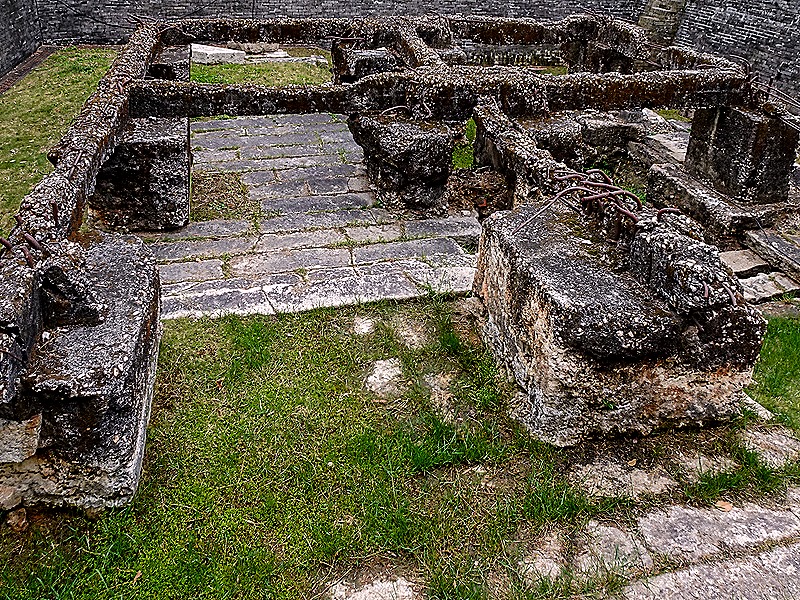
Two original parts of the old Walled City remain in the park. First is the Yamen, a single story building that was the house and offices of the Chinese administrator of the city, called the Mandarin. It had lovely carved doors in some of the doorways and several rooms of very interesting exhibits about the Walled City and its history, complete with period pictures. Second is the old South Gate entrance through the original wall, an archeological site that was about 10 feet below the current ground level.
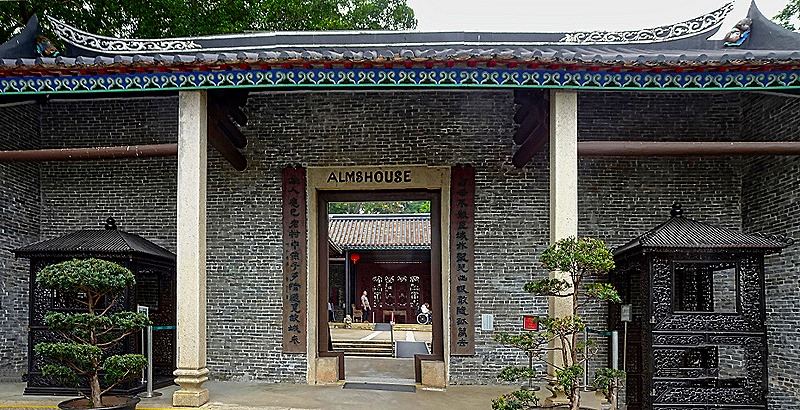
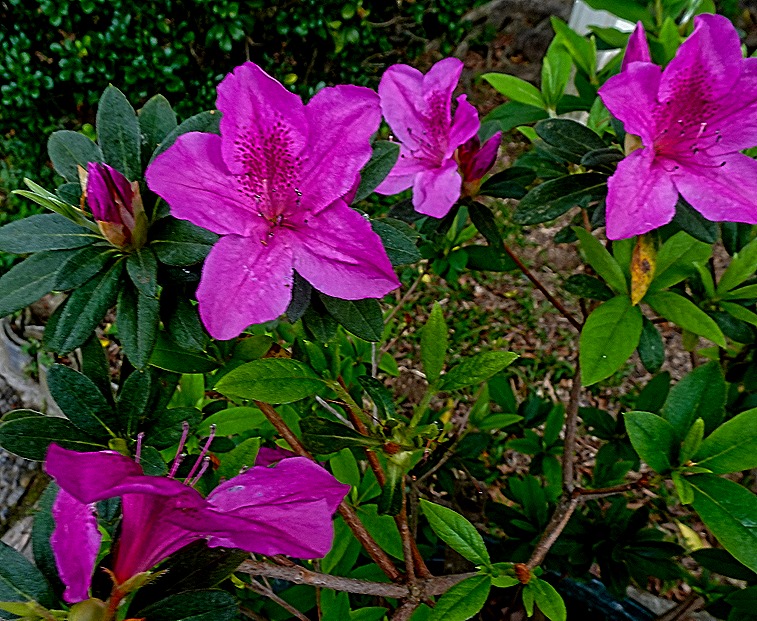
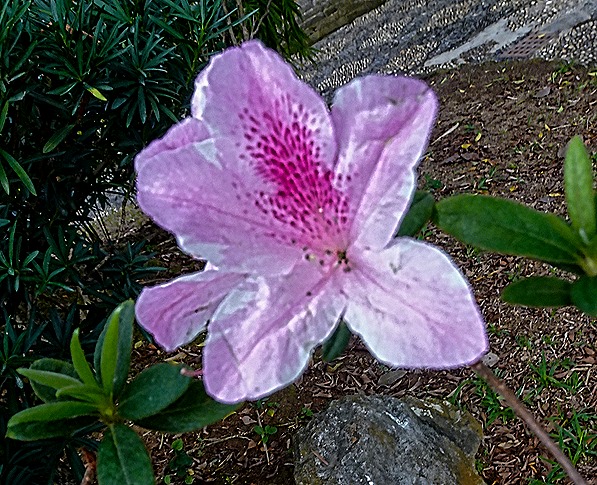
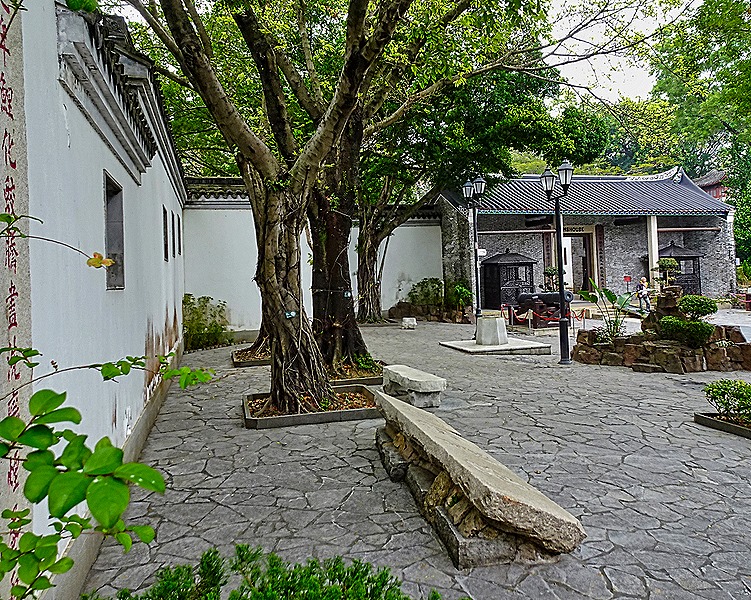
We walked around a white building with a row of bonsai trees along one wall and some cactus in front of another. The patio in front was covered in stone pebble mosaics and there were flowers around.

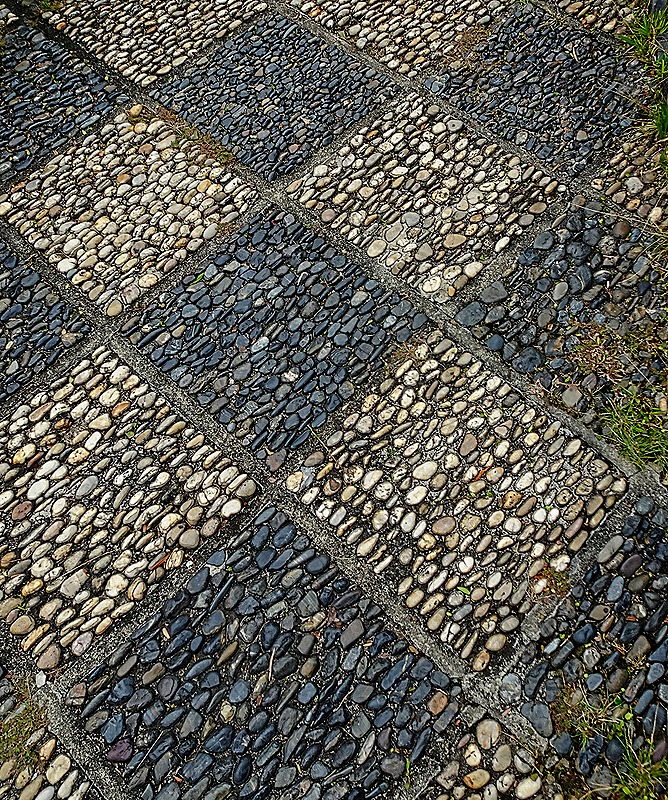
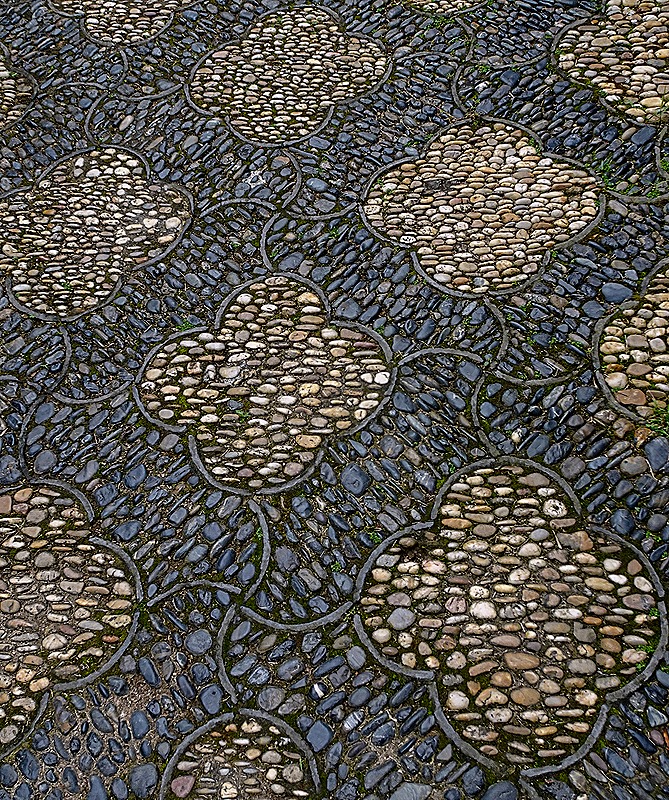
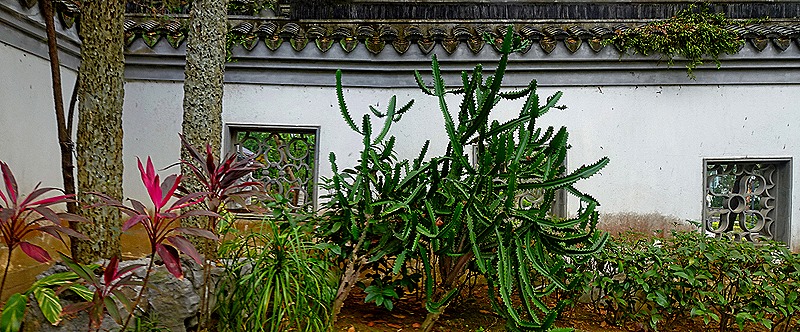
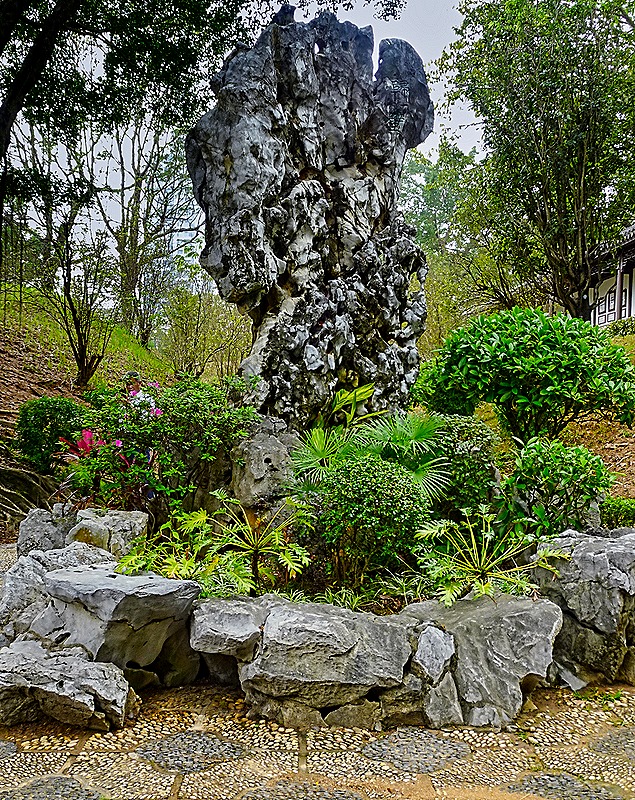
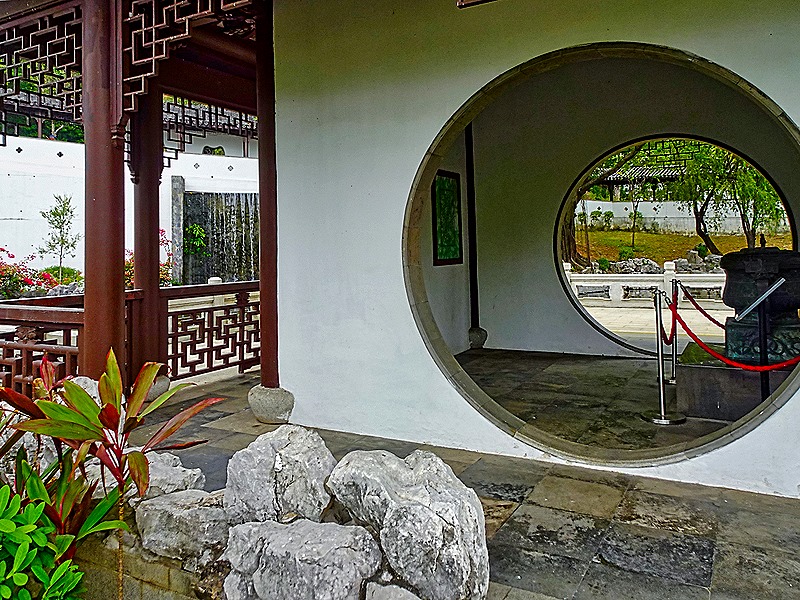
We walked past several other buildings. One that we think may be the Fui Sing Pavilion, had a nice moon gate inside a pavilion extension. Nearby was Guibi Rock, a stone quarried near Suzhou, whose name comes from its resemblance to ancient jade. It is difficult to miss the neighborhood skyscrapers towering over the perimeter wall of the garden, and there are several graceful moon gates and windows throughout the park.
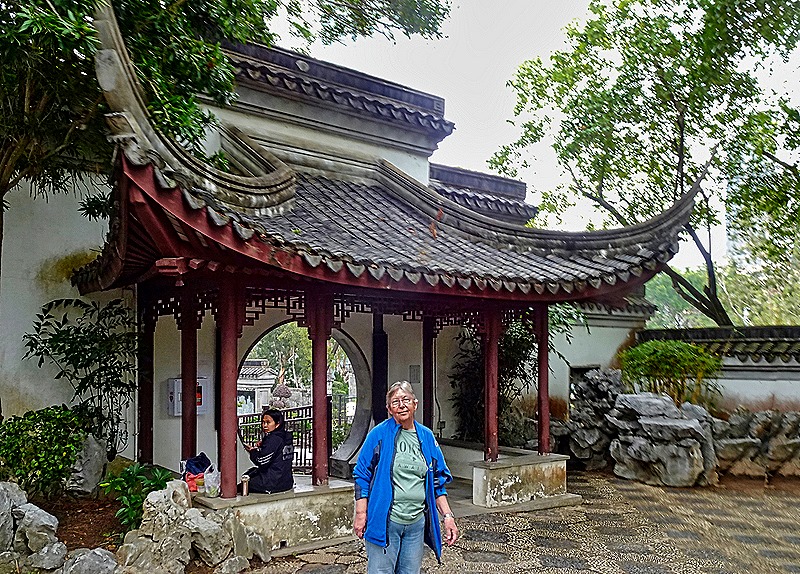



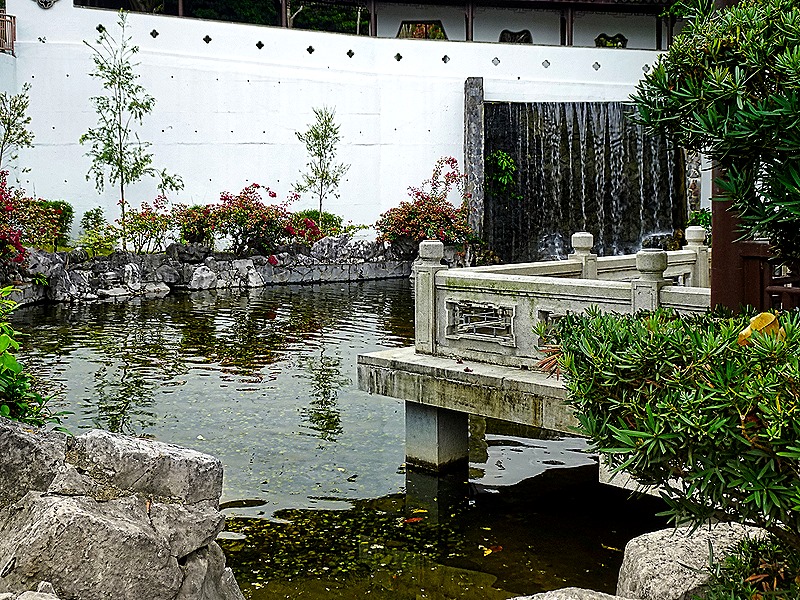
We also wandered past a lovely small pavilion sitting on concrete pilings in a small lake fed by an artificial waterfall. The building had moon windows and door and there were flowers nearby.

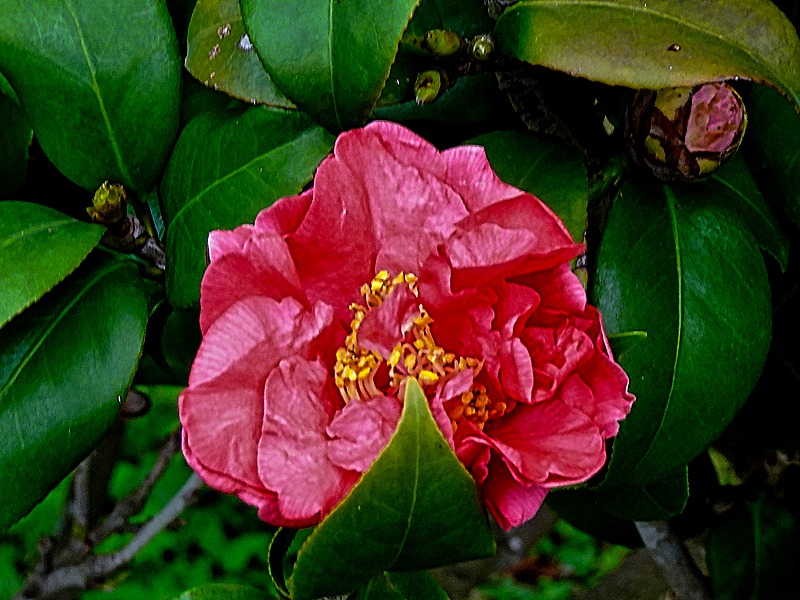
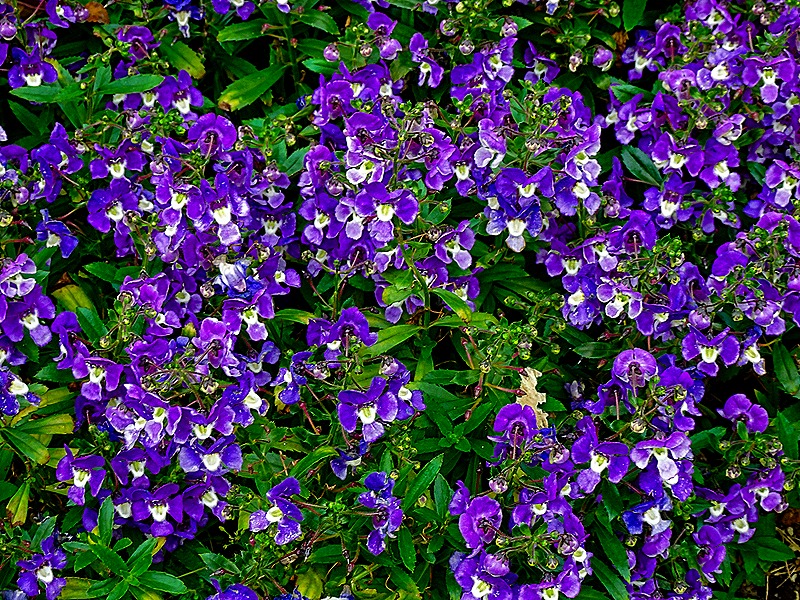
As with so many places we visited today (and previously), we would have enjoyed more time here. But the departure time was approaching so we hurried back to the bus.
Our second visit was to the Wong Tai Sin Taoist Temple. This place was quite interesting, but boy was it crowded. Wong Tai Sin (meaning “Great Immortal Wong”) is the deity name for a 4th century Chinese Taoist hermit. He was largely unknown in Hong Kong before 1916 when an immigrant from Guangdong province set up an herbal medicine shop in Kowloon with an altar to Wong Tai Sin in the back. Patrons could pray for advice at the altar and then the proprietor would sell them the recommended medicines. In 1921 he said he received instructions from Wong Tai Sin to construct a shrine. He and his coreligionists were told through divination exactly where and when to build it. It was funded by four rich businessmen who had probably been happy users of the herbal medicines. While Won Tai Sin was a Taoist, the temple accommodates Buddhist and Confucian worshippers as well.
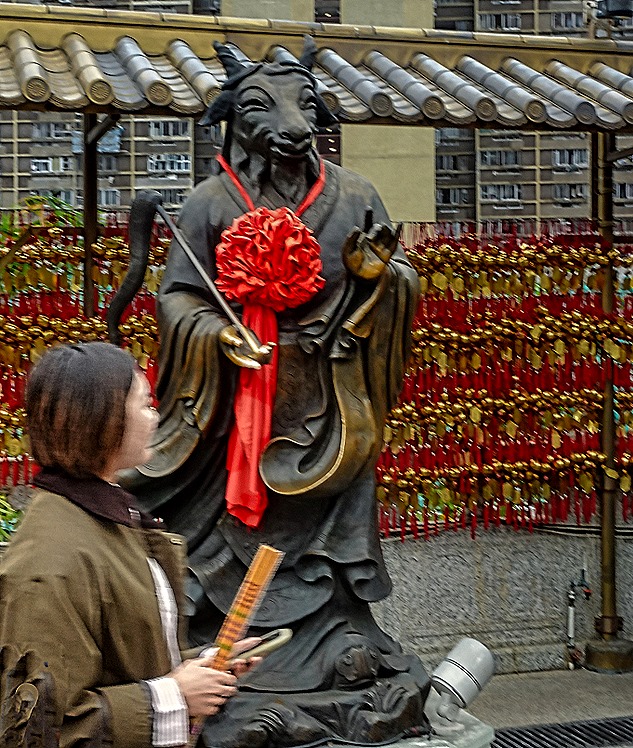
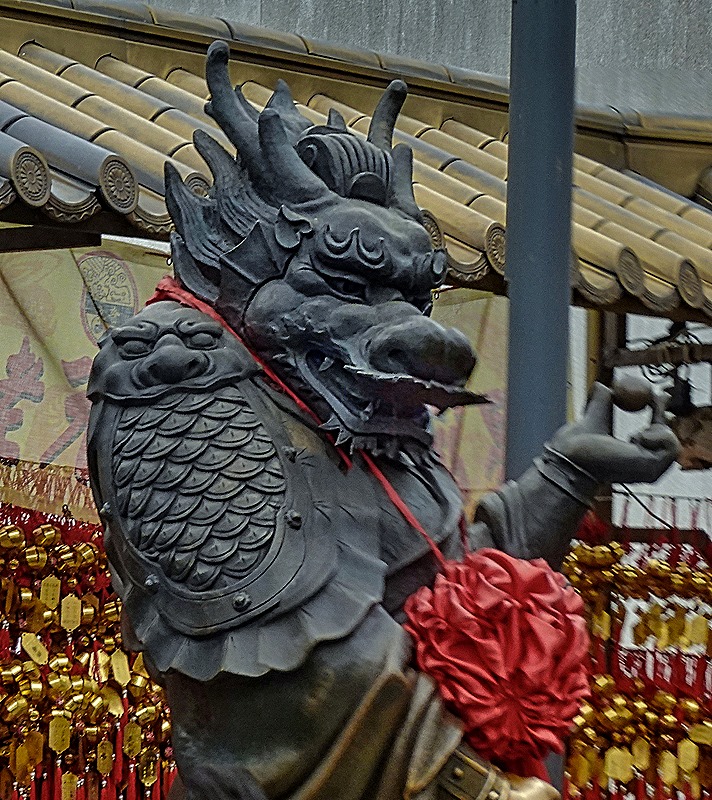
The small parking lot was quite crowded and we had to wait for a spot to open up. Then our driver exhibited his notable skill by backing us into a barely accessible spot. We had to walk a good way to the entry gate of the temple, which had dragon statues on each side that were shiny bronze (probably), where people rubbed them for good luck on the way in. Then we passed a number of black statues of Chinese zodiac animals, about 6 feet tall. Some were wearing large red ribbons, perhaps for a special occasion but we don’t know what. Inside the gate was a small altar pavilion with brightly painted and carved pillars, possibly dedicated to seeking good luck.
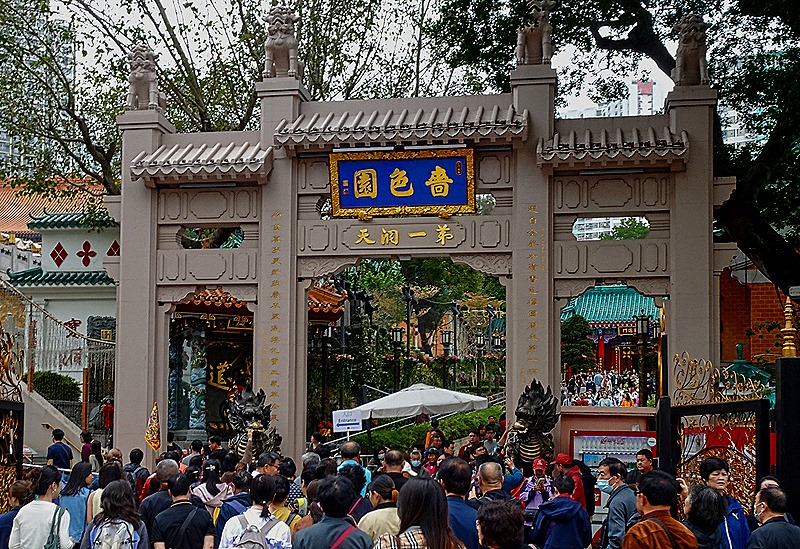


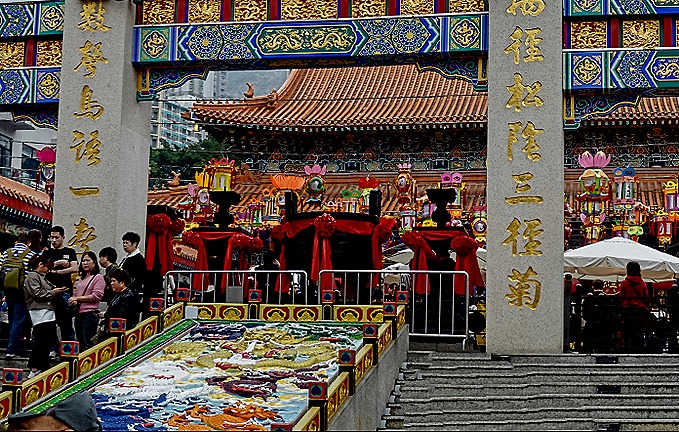
Another larger stone gate was at the top of the broad stairs leading to the Great Hall, the main Taoist temple. The center portion of the stairway was filled with what looked like a very colorful relief, perhaps a map? The plaza in front of the Great Hall had a number of red cushions for kneeling, most of which were in use, and an array of Chinese lanterns strung overhead. To its sides were kiosks for worshipping and also for obtaining and burning incense sticks.


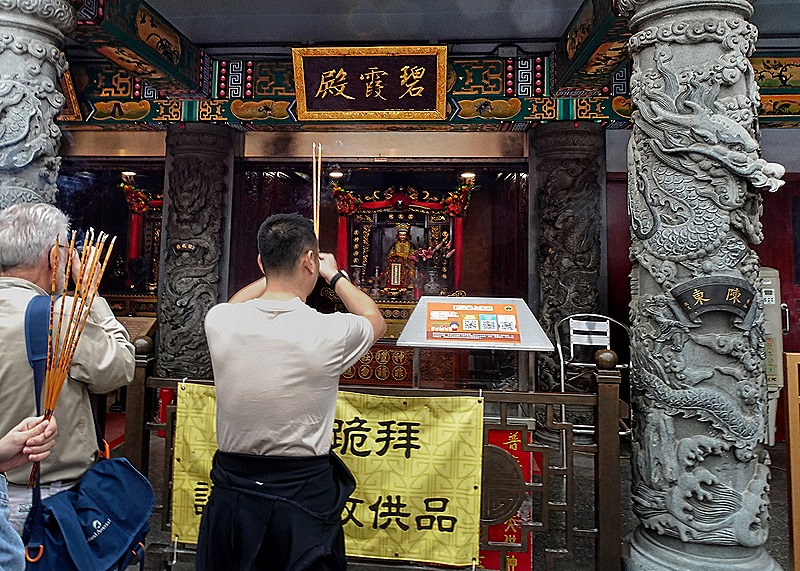
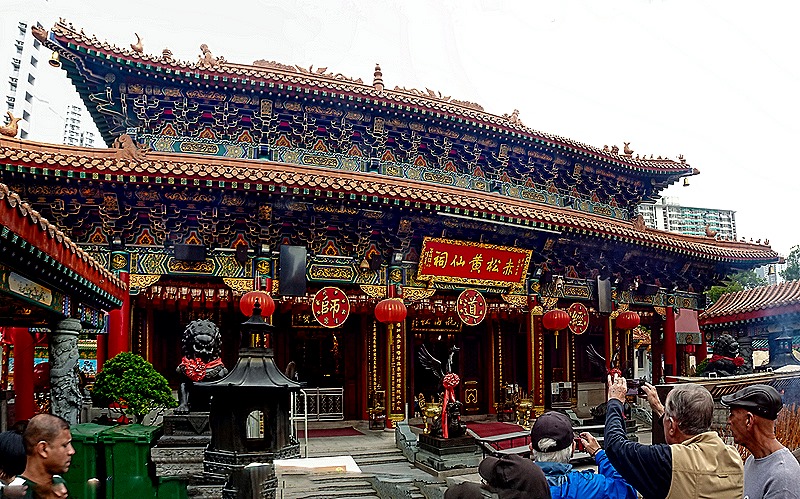

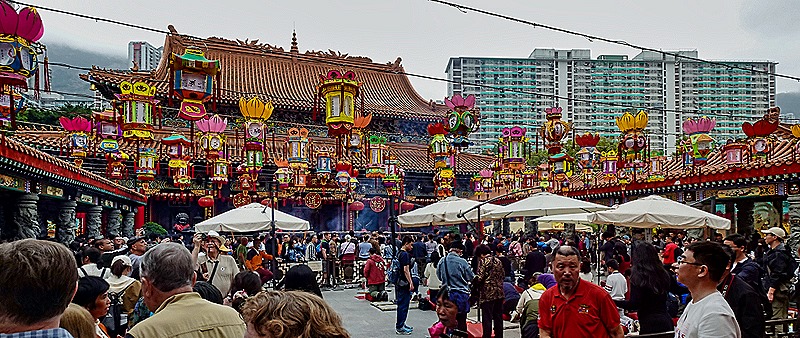
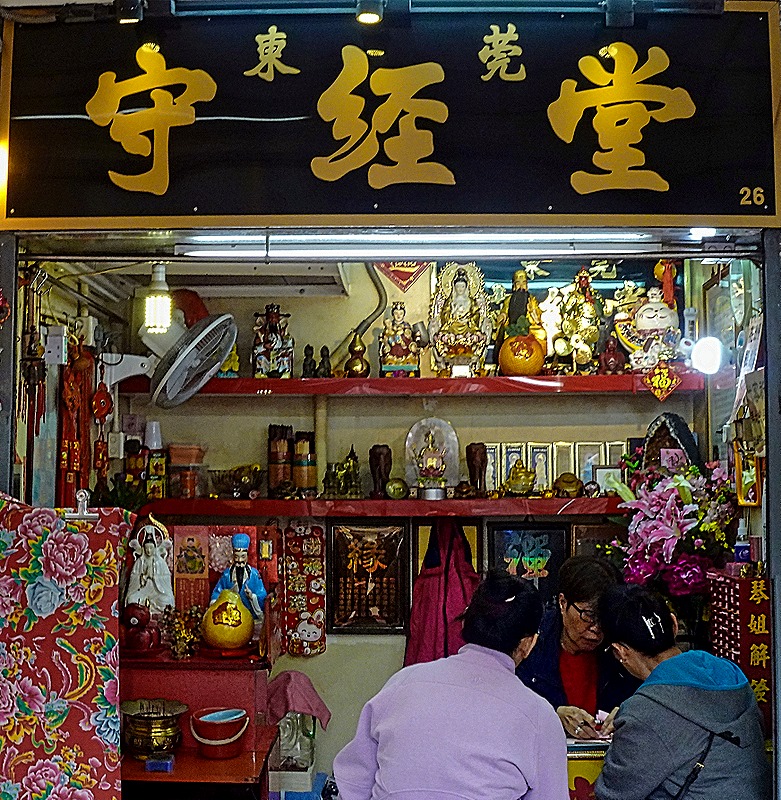
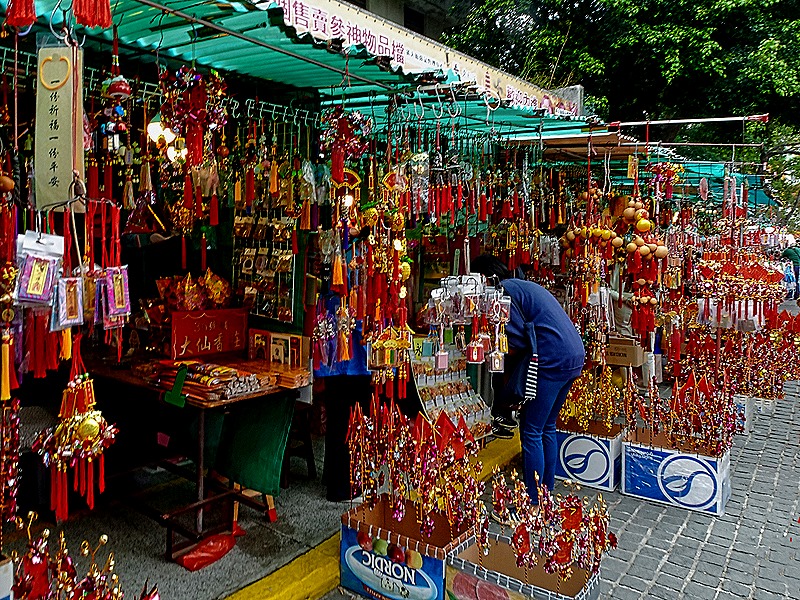
One reason for this temple’s popularity is Wong Tai Sin’s reputation for granting wishes. “What you ask is what you get” is the motto here. Worshippers seek spiritual guidance through a practice called kau chim. They light incense sticks and shake a bamboo cylinder containing numbered fortune sticks. When one falls out it is traded for a paper with the same number which is taken to a soothsayer’s booth for interpretation (sometimes to several booths for a second or third opinion). A long curved hall on a lower level is lined with soothsayer booths that seemed to be doing a good business interpreting fortunes (and they also had shelves of items presumably for sale). As we walked out of this hallway to return to the bus we passed a long row of kiosks selling religious articles and souvenirs, mostly in red and gold.


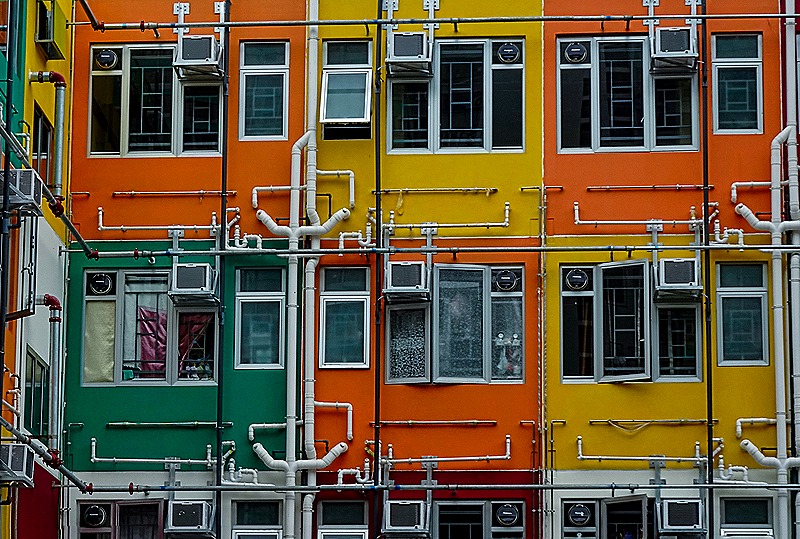
Hong Kong is a crowded city and housing is at a premium. Near the temple we passed a multicolored housing development. The apartments are tiny and are reserved for young people who haven’t been able to find a permanent place to live. If we remember correctly, these are allotted by lottery and tenancy is limited to three years. The theory is that you should be able to find permanent lodging within that time but whether or not you are able to do so you must move out when the tenancy period ends. To us they looked a lot like a the stacks of ship containers you see in shipyards (except for the bright colors and small windows).

Our last visit was to Chi Lin nunnery and the adjacent Nan Lian Garden. The nunnery dates to 1934 when it was opened as a retreat for Buddhist nuns. It was rebuilt in 1998 using traditional wooden, nail free architecture from the Tang dynasty period (7th – 10th centuries). The gardens across the street with an overpass bridge to the nunnery were opened in 2006, also designed in Tang dynasty style. They are laid out with a circular path leading all the way around the park.
We entered the park through the Black Lintel Gate and walked among carefully sculptured trees to the Chinese Timber Architecture Gallery, which displays scale models of old Chinese wooden architecture. One model on display was of the Hall of Supreme Harmony we had visited in the Forbidden City in Beijing just four days before.


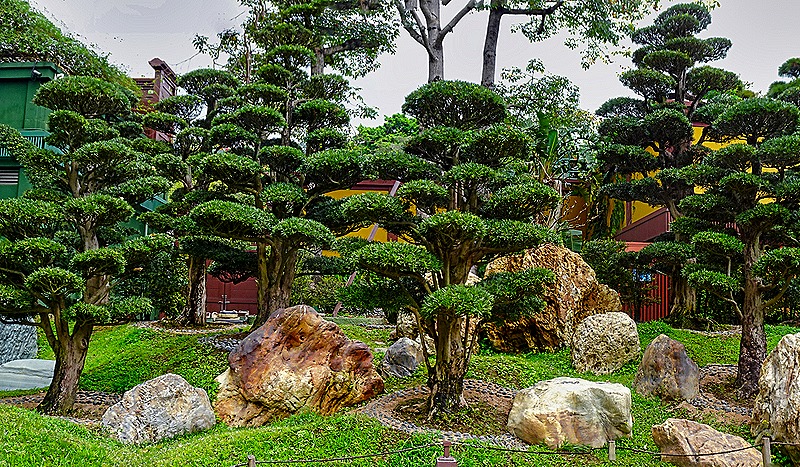
We walked past the large white Lamp of Enlightenment in its own garden spot in front of the golden Pavilion of Absolute Perfection, which sits on an island in the lotus pond between the striking orange Wu and Zi bridges.
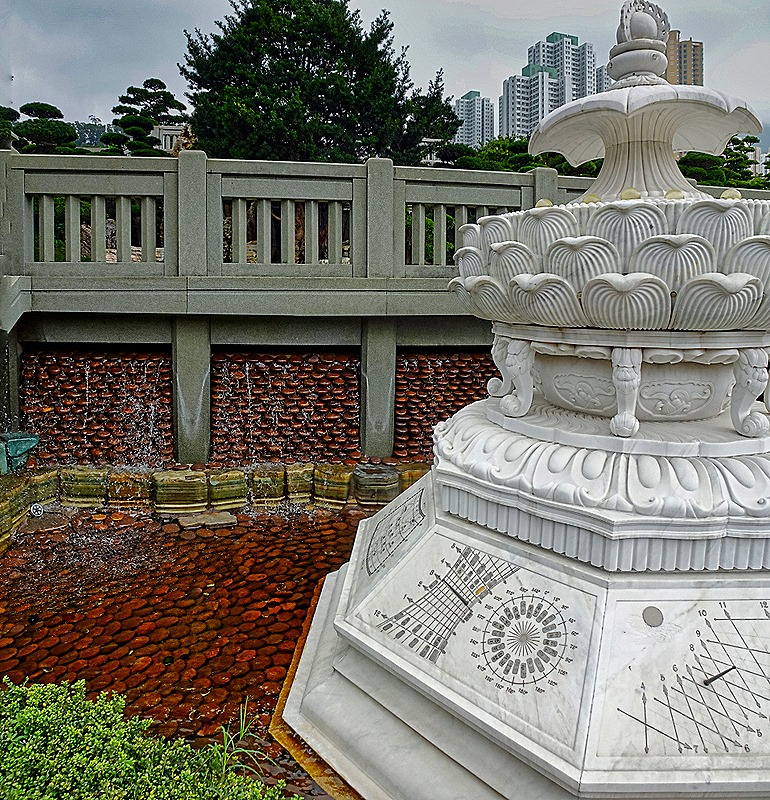

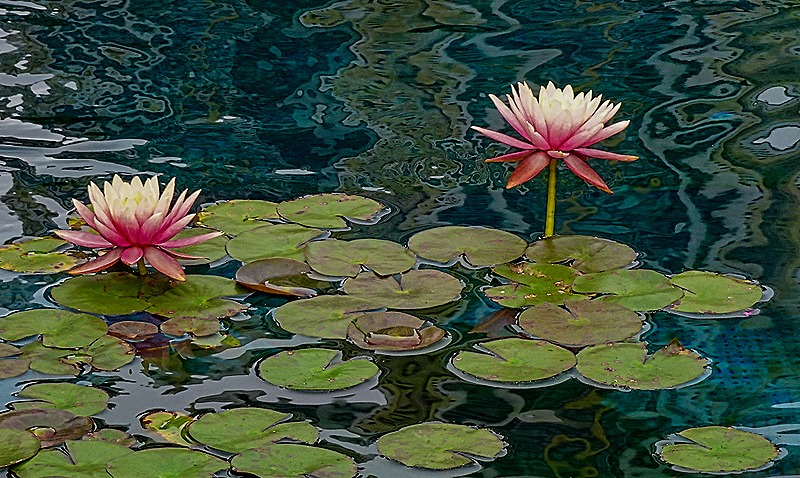
We crossed the stone bridge over a busy street to enter the Chi Lin Nunnery. Inside the gatehouse we saw across the large plaza the Hall of Heavenly Kings, the main hall of this large religious complex. Inside were, among other things, statues of Buddha and some disciples. But photography was not permitted inside. Behind this hall is a smaller courtyard and then a larger hall. The last two pictures in this group may be of that courtyard seen from the Hall of Heavenly Kings, but we aren’t really sure.

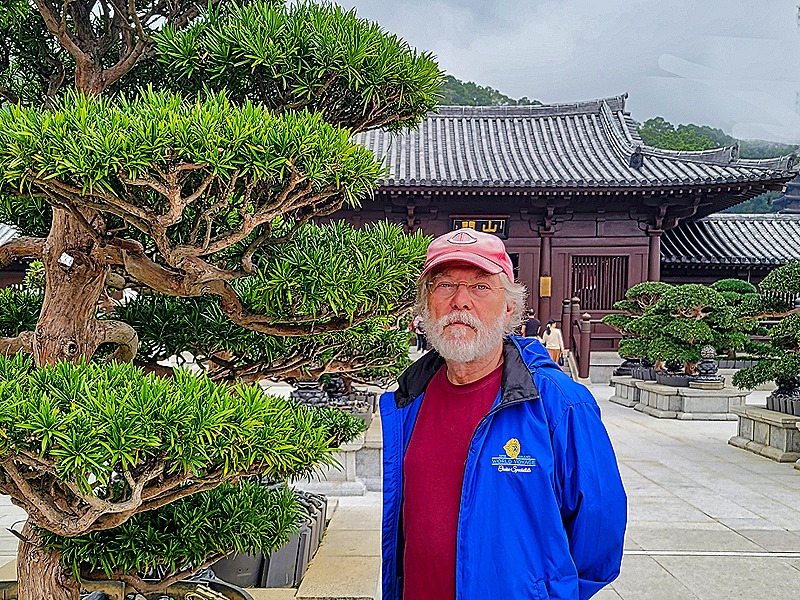

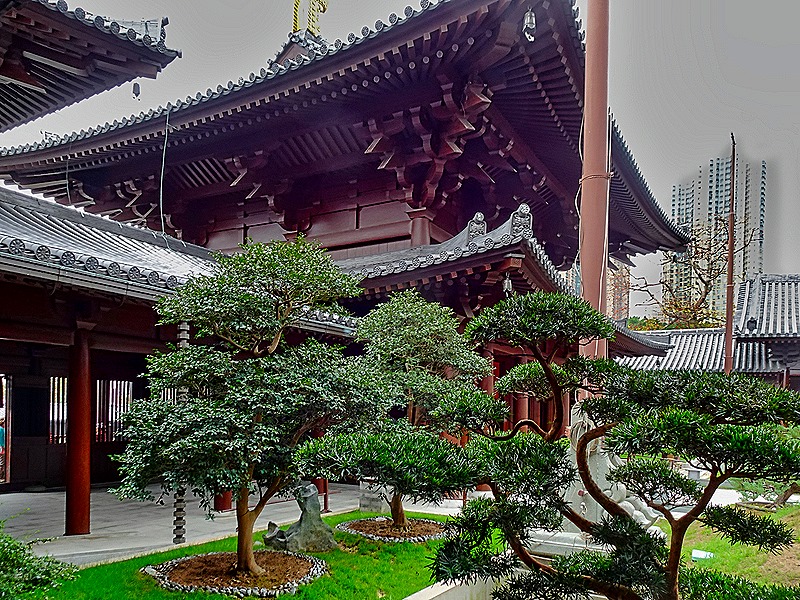
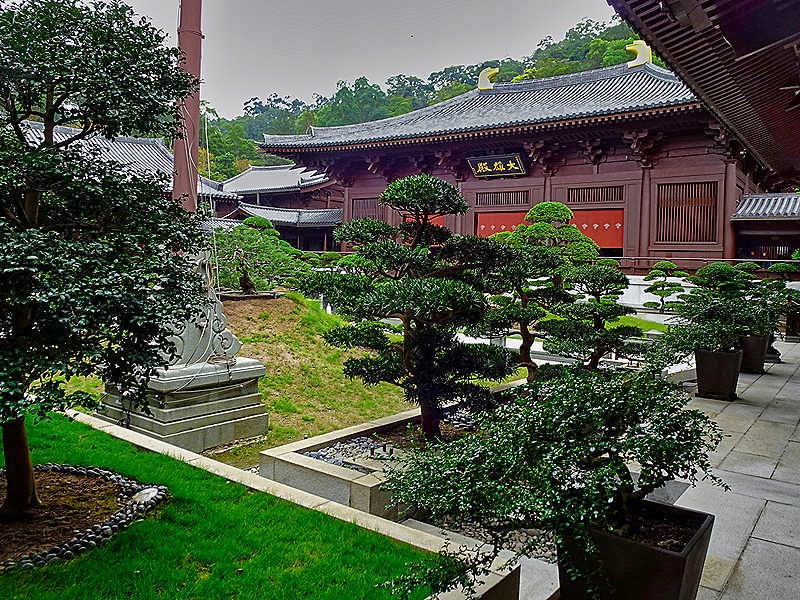
Exiting the Hall we had a nice view of the whole plaza surrounded by wooden buildings. In the plaza were several stone lotus ponds fed by lion head spigots and a number of bonsai trees.

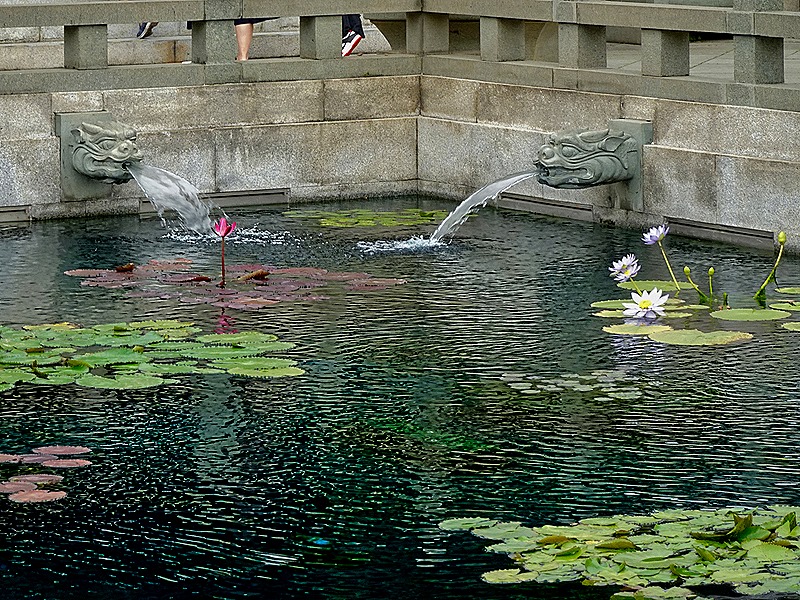

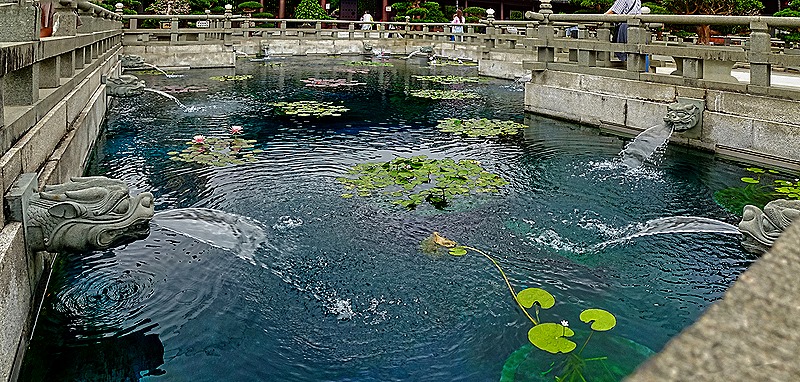
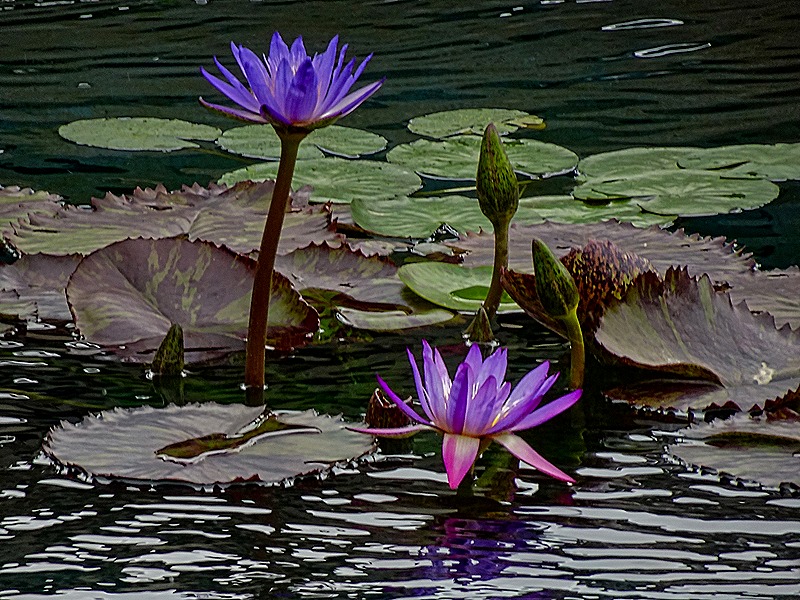
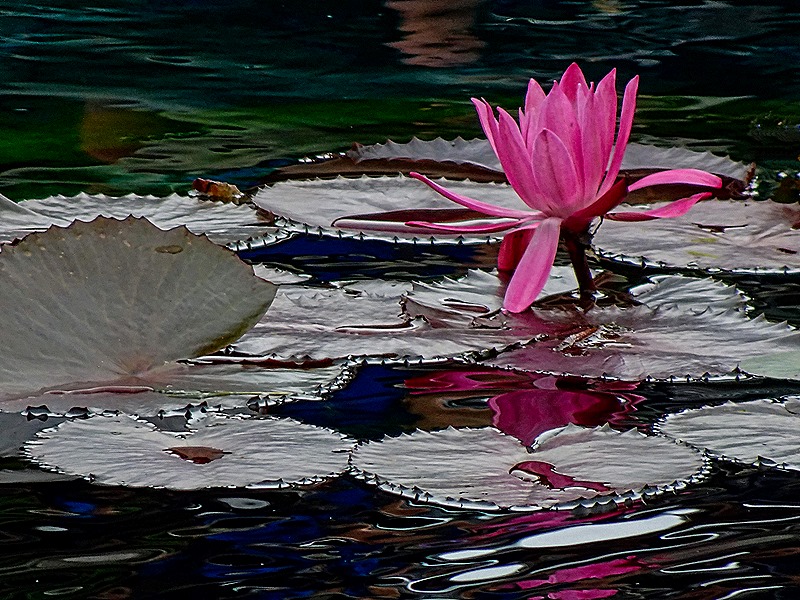


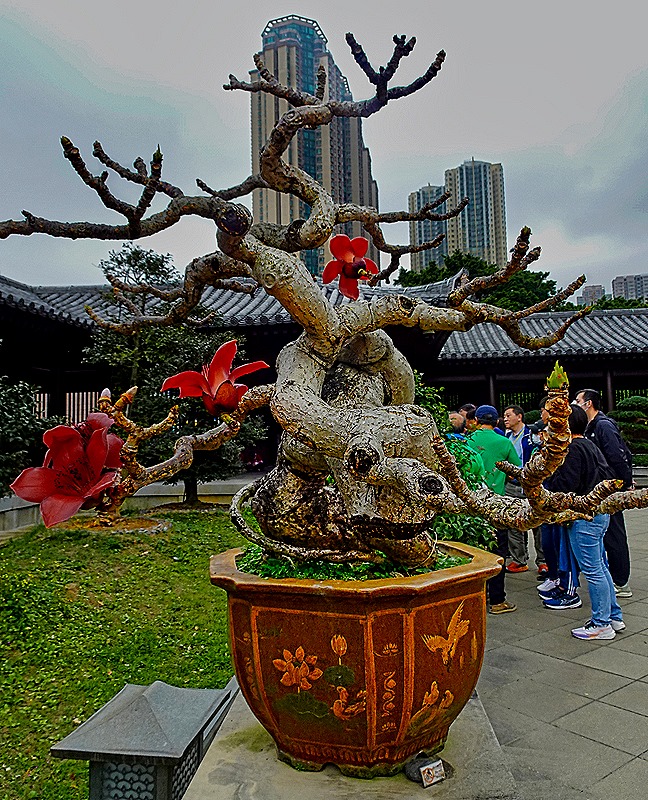

Leaving the nunnery we had a last view of the gate from the overpass and an interesting view of the Pavilion of Absolute Perfection from behind a large rock.


Reentering the gardens we continued along the path, passing a gallery, souvenir shops and restaurant. The gallery was quite elegant with a number of beautiful (and pricey) items of art. In front of these shops were more bonsai and flowers and at the end an (artificial) waterfall.
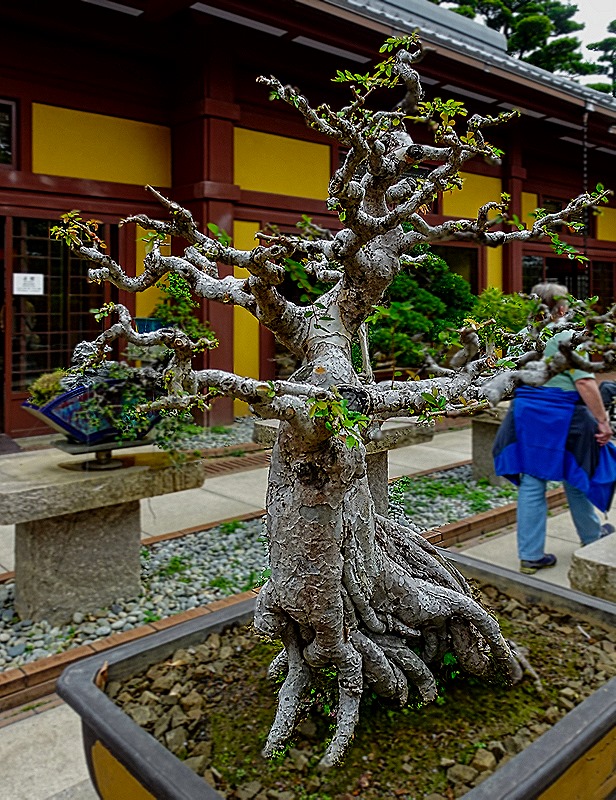
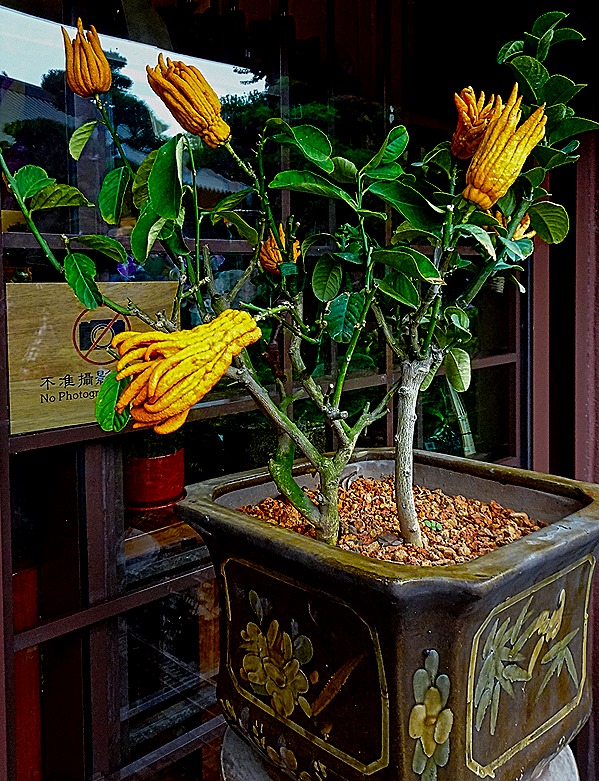
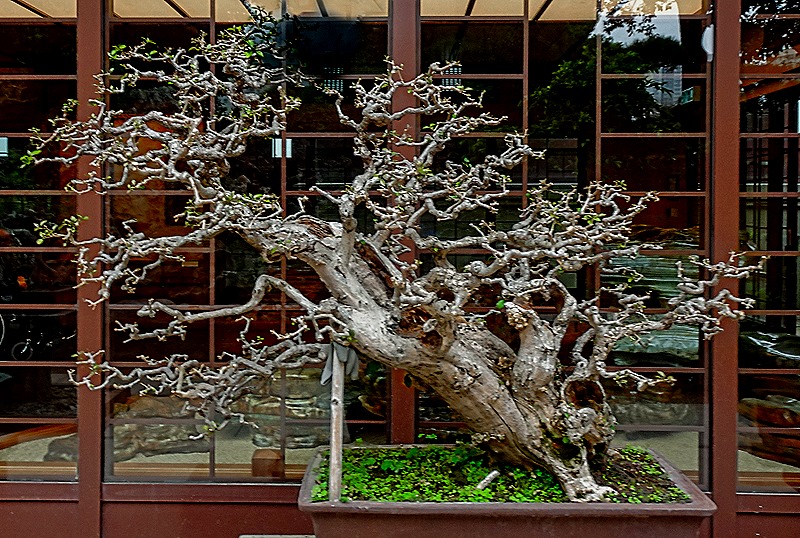
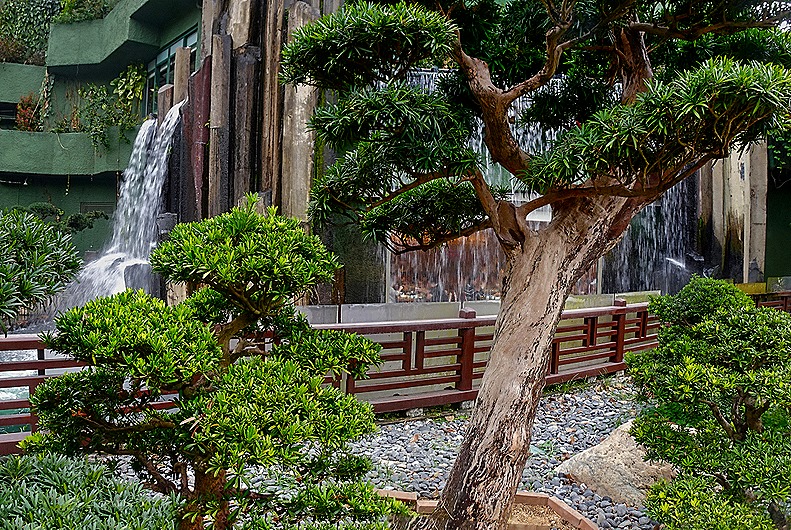
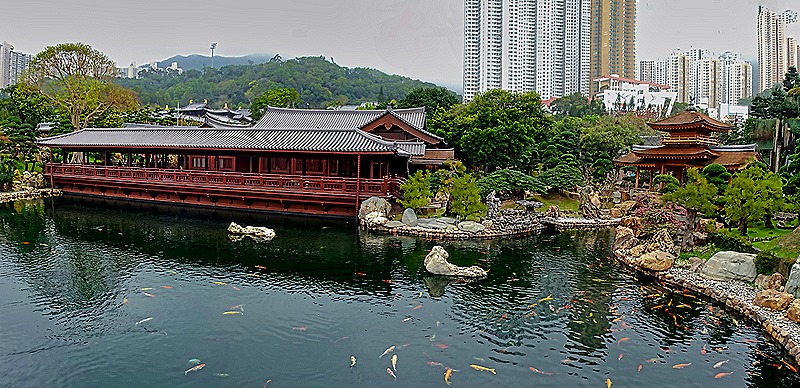
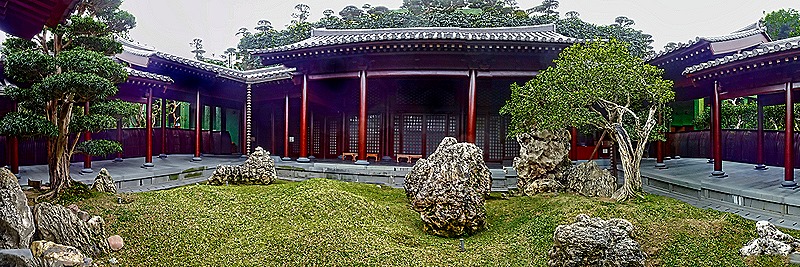
Turning the corner to head back to the entrance we came to the Blue Pond, a scenic lake full of orange koi. Along one side is the long Song Cha Xie, a tea house, and on the upper right is the Pavilion Bridge. Further along we came to the Xiang Hai Xuan Multi-purpose Hall, which had a very nice rock garden in its interior courtyard.


So that was the end of the excursion. Not sure why the time at these places had to be so limited since it ended in early afternoon and we weren’t sailing away until the next day, but I guess it is what it is. Back on the dock, just before we reached the cruise terminal, we passed several ugly blocks of identical buildings. Our guide told us these were built early in the Covid pandemic and people (including cargo ship sailors) arriving from outside China were detained here in quarantine for weeks and sometimes months, unable to leave their rooms. Presumably food was brought to them. This doesn’t sound like much fun.

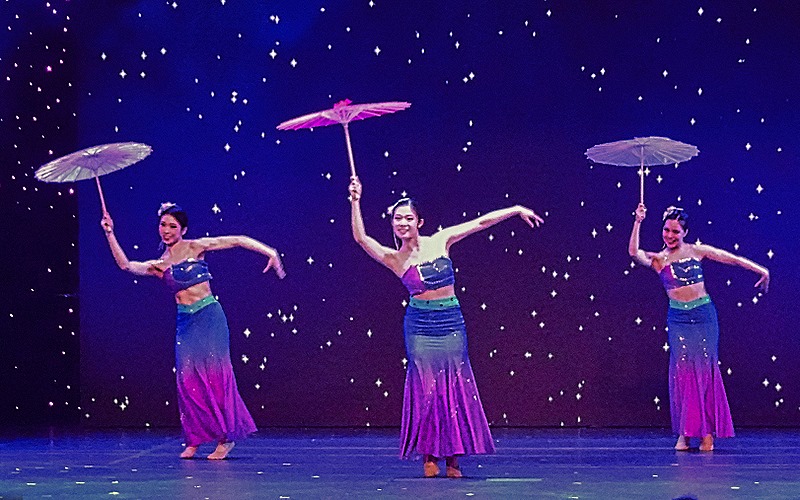
When we reboarded the ship the view from our balcony was completely foggy, a condition that would last until we sailed away the next afternoon. This evening a local group of dancers performed on the main stage.


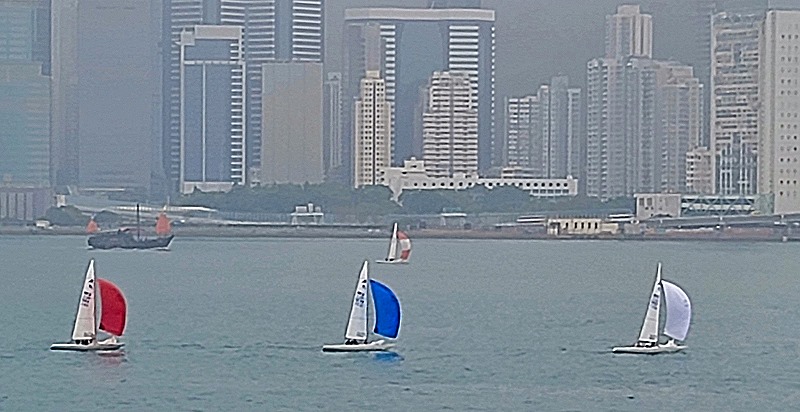
Since this was an overnight stay we obviously woke up the next morning in . . . Hong Kong! It was still quite foggy and chilly, all aboard was about 3:00 for an early departure, and it had been such a hassle finding something worth doing the day before that we decided just to spend this day on the ship. It was Sunday and a number of folks were out in their boats during part of the day despite the weather.
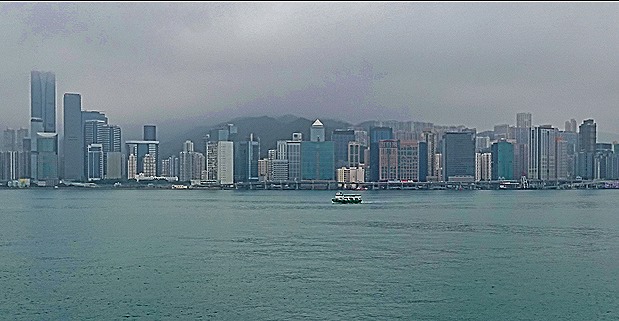
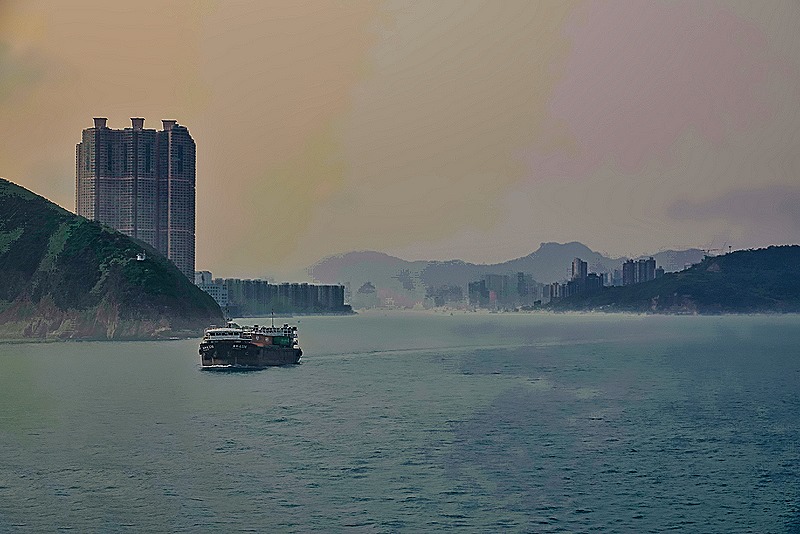
We sailed away in late afternoon, still with low visibility, although the conditions made for some interesting ambiance.


Tianjin, China (Beijing) Day 2 — 2024
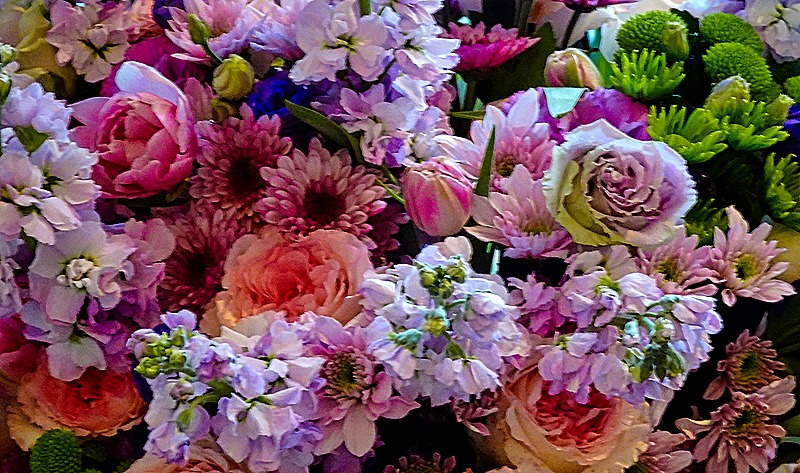
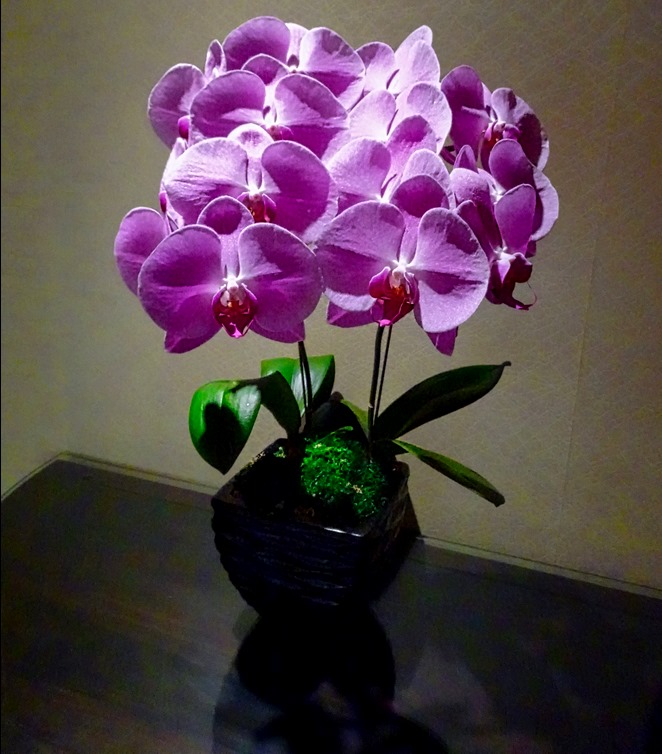
We woke up early in our hotel room on March 12. Already in Beijing, at least there would be no long bus ride to get there, but we were scheduled to check out and leave at 7:30 for the short ride to Tiananmen Square to try to beat most of the crowds that visit there every day. And before that was a vast buffet breakfast with many Chinese and Western foods, far more than anyone could even sample before a long day of walking. I was more than satisfied with a couple of croissants. We checked out of our hotel, quite beautiful inside with many flowers, and boarded the bus.

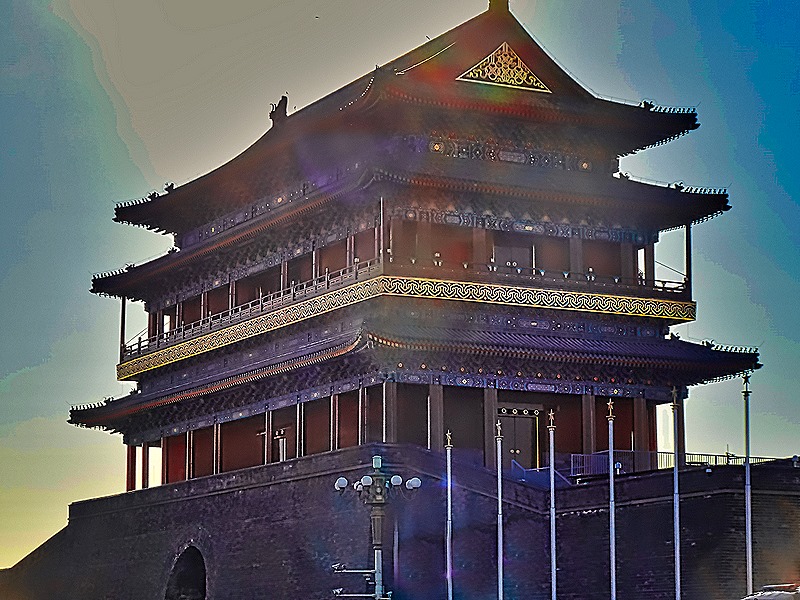
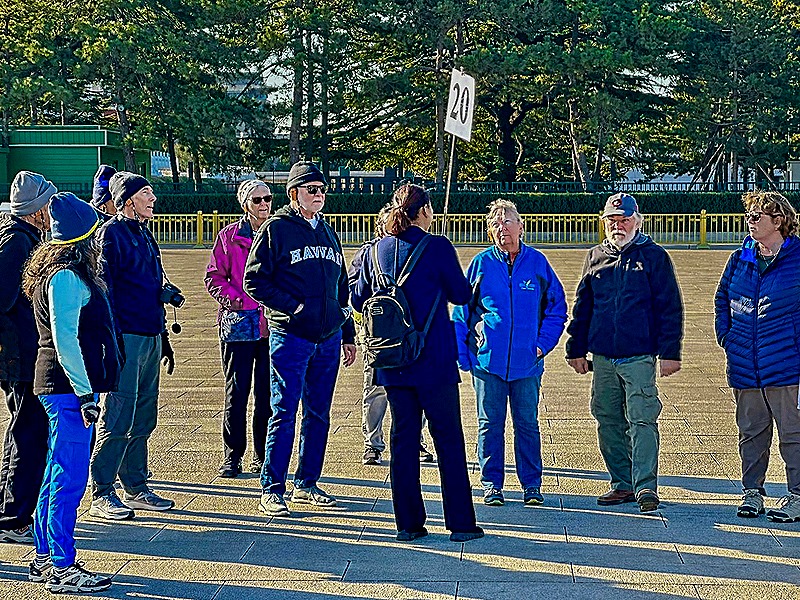
We walked from our bus to Tiananmen Square, entering from a bit to the side of the Quinmen, the huge gate at the front of the square. It is a beautiful building, which we saw from a distance all lit up the previous night, but by the time our guide pointed it out to us today the sun was directly behind it so our picture is pretty woeful. Far away on the opposite edge of the vast square we had our first view of the Tiananmen (Gate Of Heavenly Peace), with a painting of Mao Zedong above the entrance in the wall below. Tiananmen Square was first built in 1651 and greatly enlarged in the 1950’s. It measures some 835 yards long by 310 yards wide (think 8 football fields long by 3 wide) and will accommodate a crowd up to about 600,000 (thankfully not that many the day we visited).
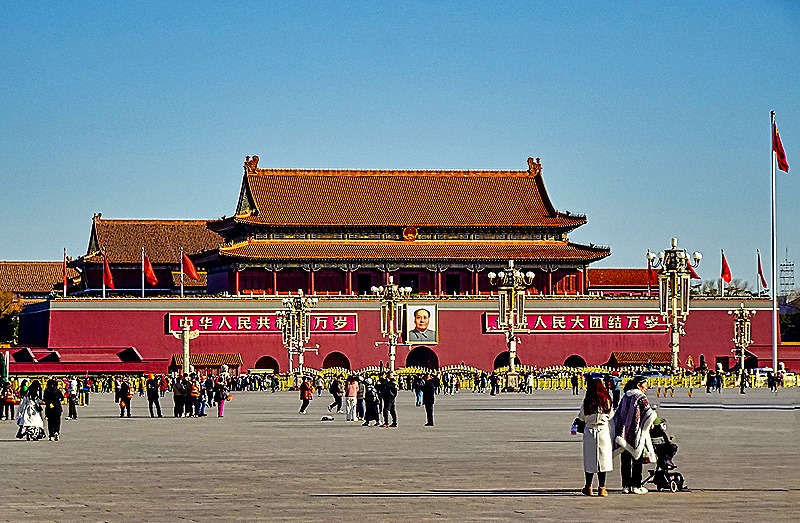
Most people reading this will probably associate this square with the violent suppression of student democracy protests in 1989, in which it is estimated that hundreds (some say thousands) were killed. In China no one speaks of this in public and most Chinese are not even aware that it happened. It is our understanding that the only public entrance to the Forbidden City requires walking across this huge square to the entrance below the painting of Chairman Mao. So that is what we did. Walking along we passed the Monument to the People’s Heroes, a 125 foot tall obelisk completed in 1958 and saw the National Museum of China behind it on the eastern side of the square. The museum, first opened in 1959, is the largest single museum building in the world. It has a vast and varied collection and it looks like one easily could spend a day or two just exploring this museum. We did not have that kind of time, so walked on by. In the center of the square just south of the Monument is Chairman Mao Memorial Hall, the mausoleum that is his final resting place. It was completed on May 24, 1977, about 8 months after Mao’s death.


Along the western edge of the square is the Great Hall of the People, meeting place of the National People’s Congress and the National Congress of the Chinese Communist Party, along with other official and ceremonial functions. Its construction was completed on September 9, 1959. A large building with a long and low profile, it is 1,168 feet long and 677 feet wide.
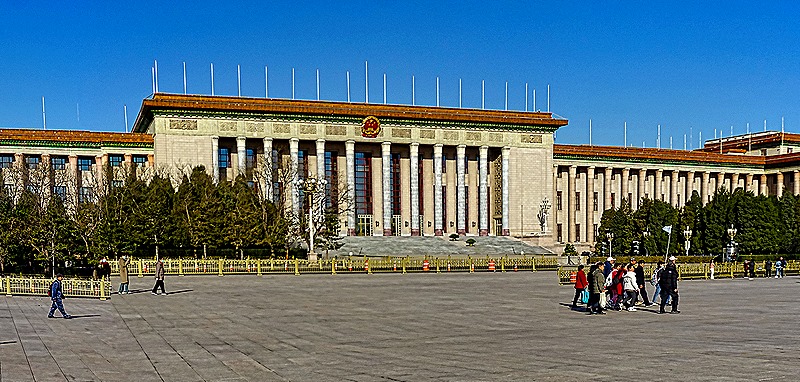
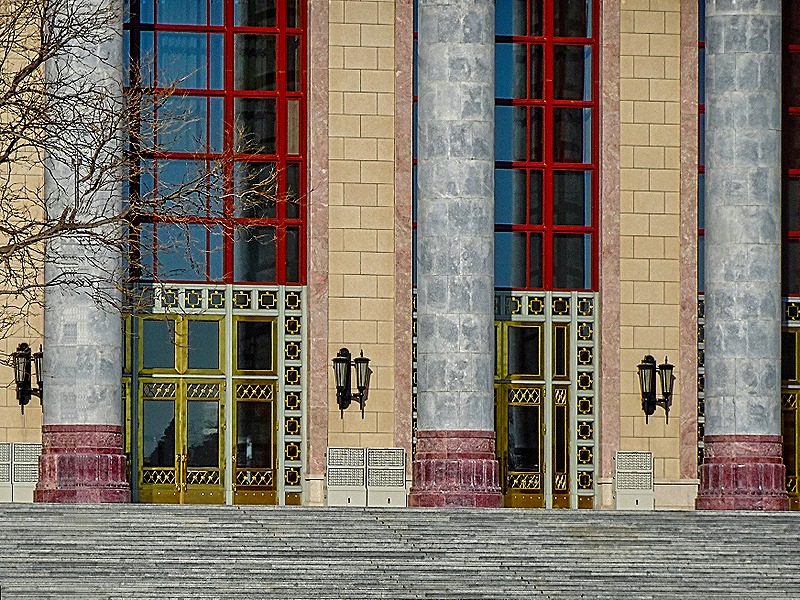
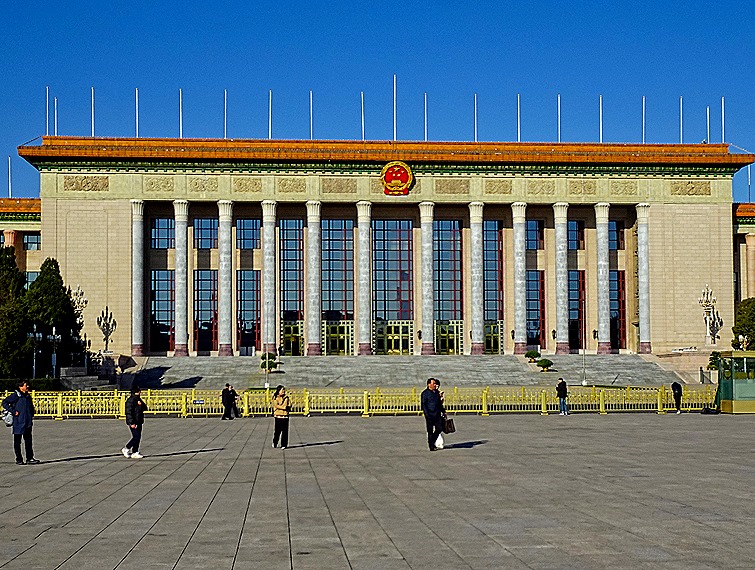
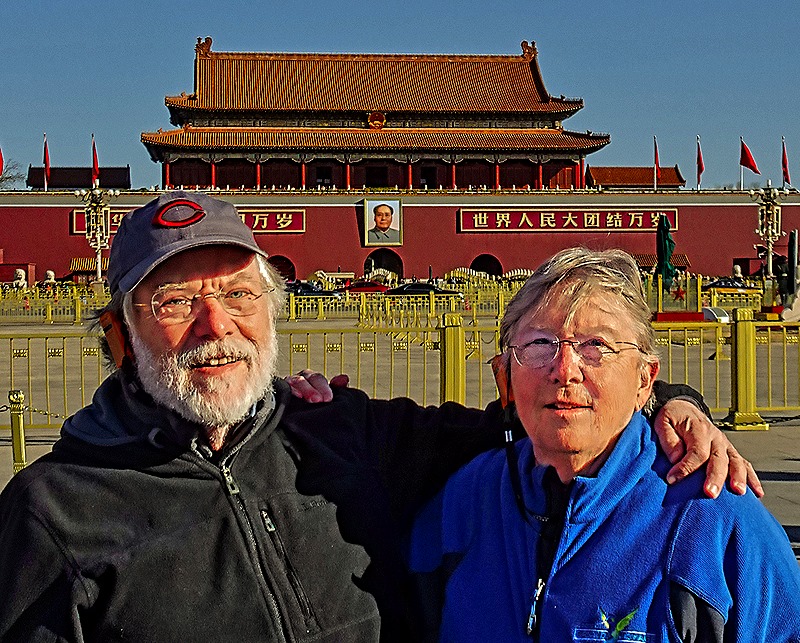
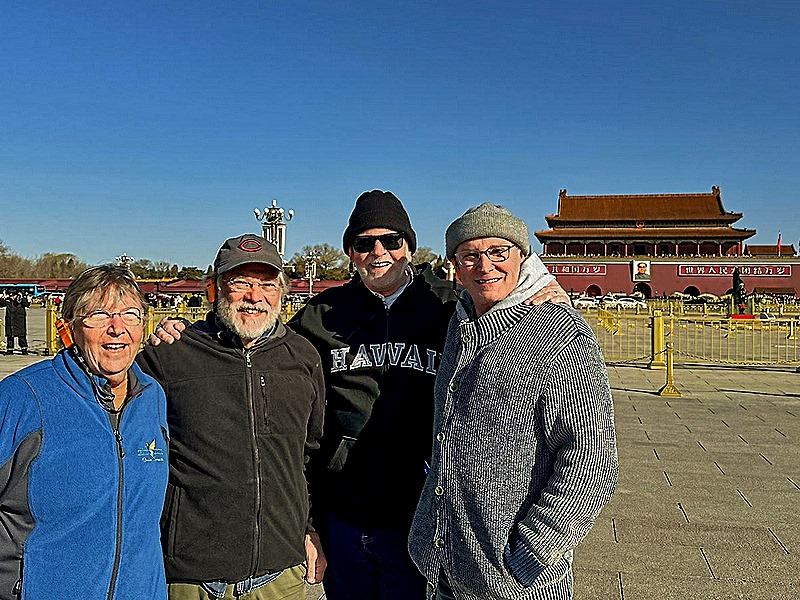
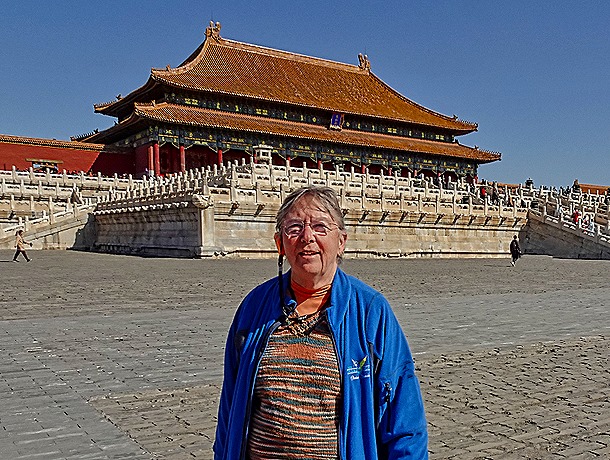
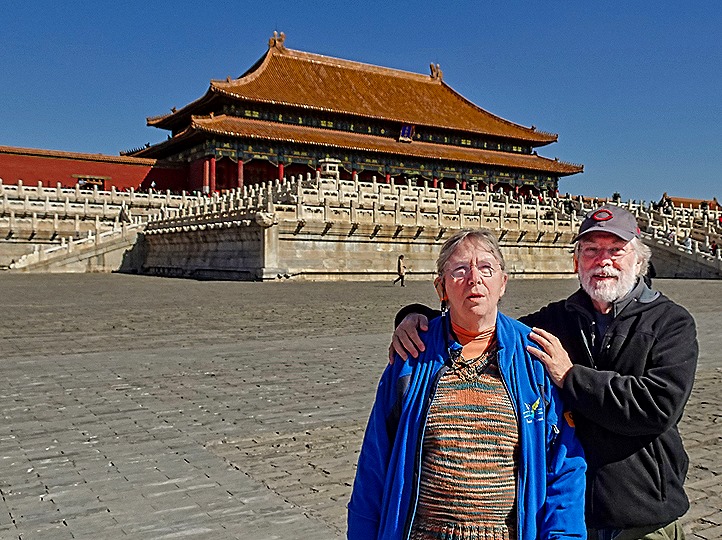
There would be more than enough time to spend in the square before we would be admitted to the Forbidden City and this apparently is a traditional place for visitors to take pictures. Well, we were visitors so here are some pictures of us and our companions with the Tiananmen as the background.


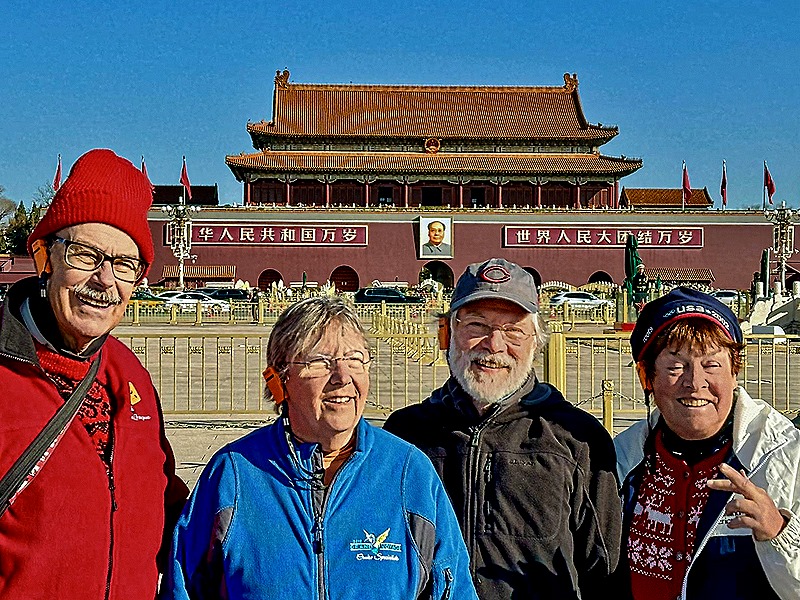
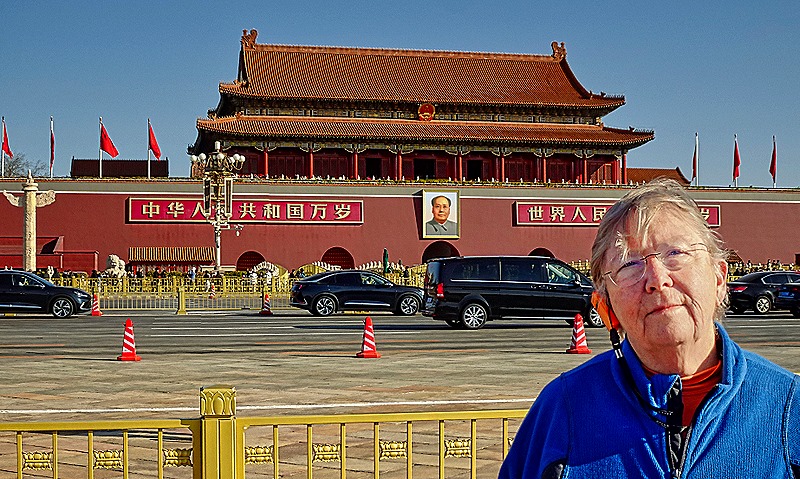
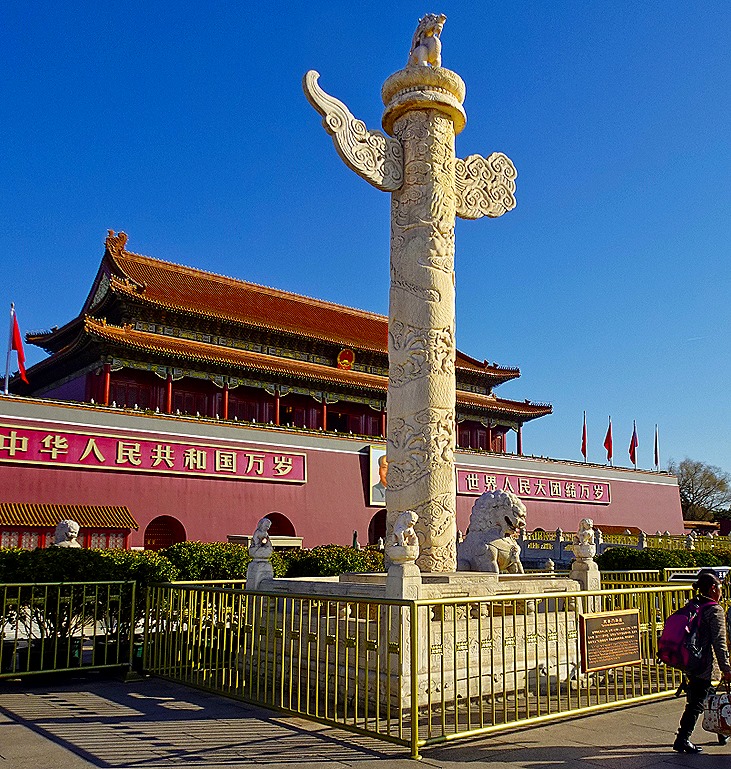
The Tiananmen itself (“Tiananmen Gate” is redundant, since “men” apparently means gate) is a widely recognized symbol of modern China. First built in 1420, this “Gate of Heavenly Peace” has been damaged or destroyed and rebuilt several times, most recently in 1970. It is 217 feet long, 121 feet wide and 105 feet tall. Across the front are two large inscriptions in Chinese: the left one means “Long Live The People’s Republic of China,” and on the right “Long Live the Great Solidarity of the World’s Peoples.” In front, between the building and the street, is part of the old Imperial moat that still surrounds the Forbidden City with carved marble bridges leading over it to the entrances. Decorative fountains shoot up from the moat on each side of the building. Over the main entry is a huge painting of Mao Zedong, which weighs 1.5 metric tons.
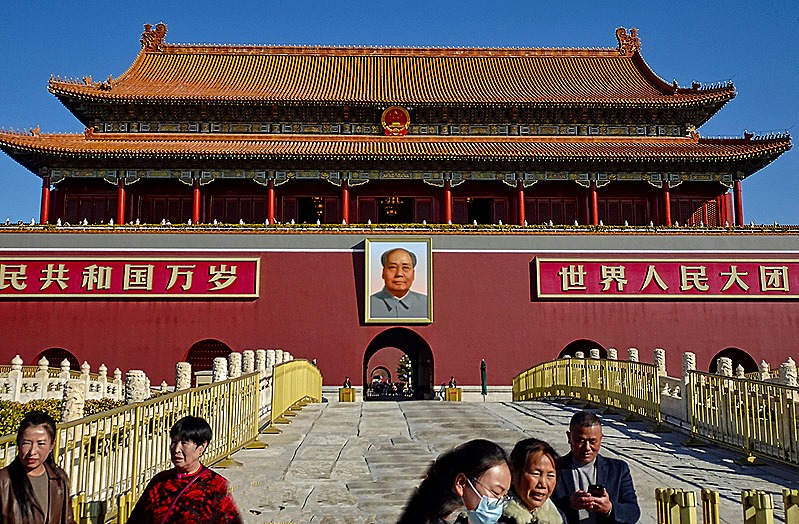


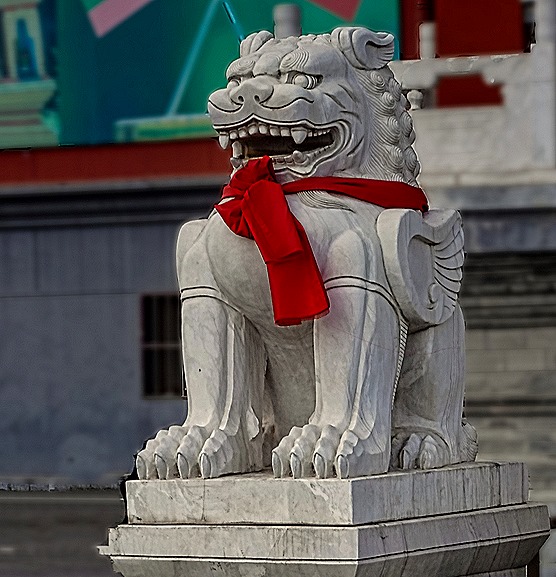
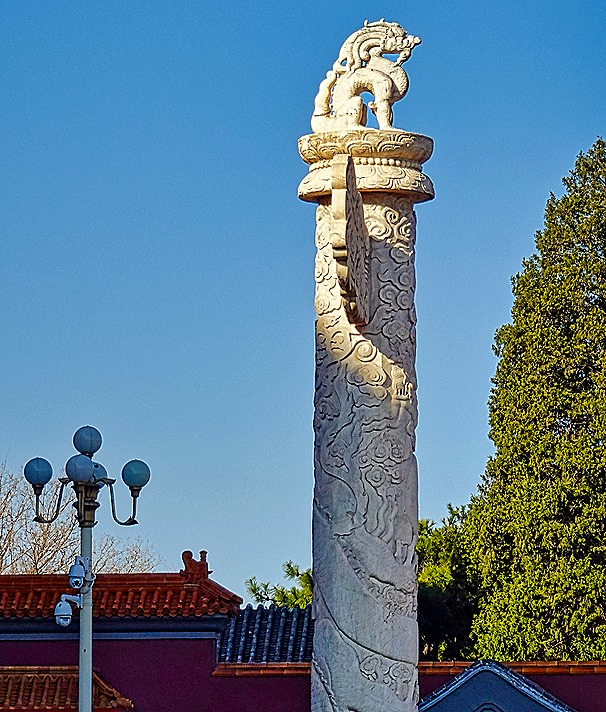
Two marble lions stand guard near the front of the building and there are two tall marble columns called “huabiao” standing just beyond each end of the building. With marble wing-like appendages near the top they look a lot like Alaskan totem poles. These date to the 15th century.


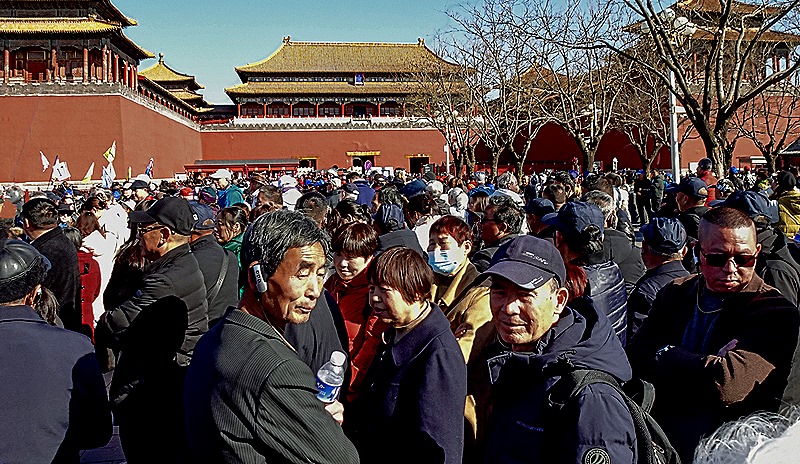
Finally it was our turn to proceed through the central front gate into a large courtyard leading to the Meridian gate, which is the actual entrance into the Forbidden City. This side of the Tiananmen is called the Upright Gate. There was quite a long wait here (just like Disney World, where you wait in line and when you finally enter you find yourself in another long line).
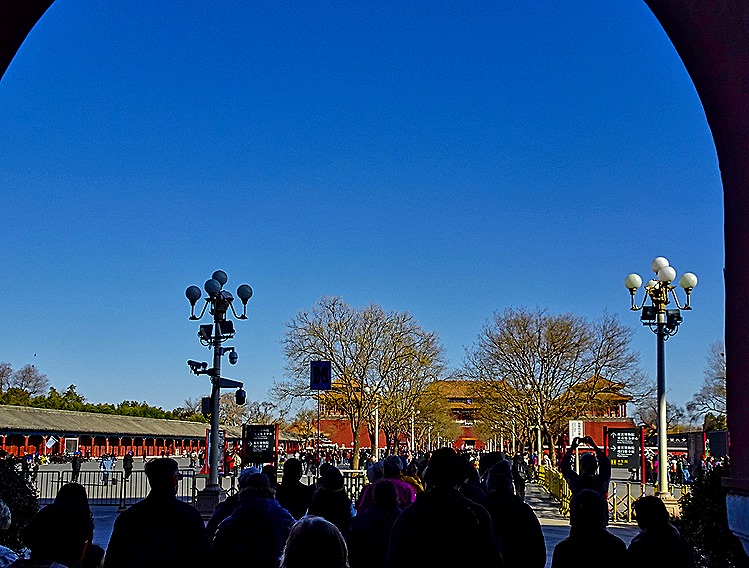

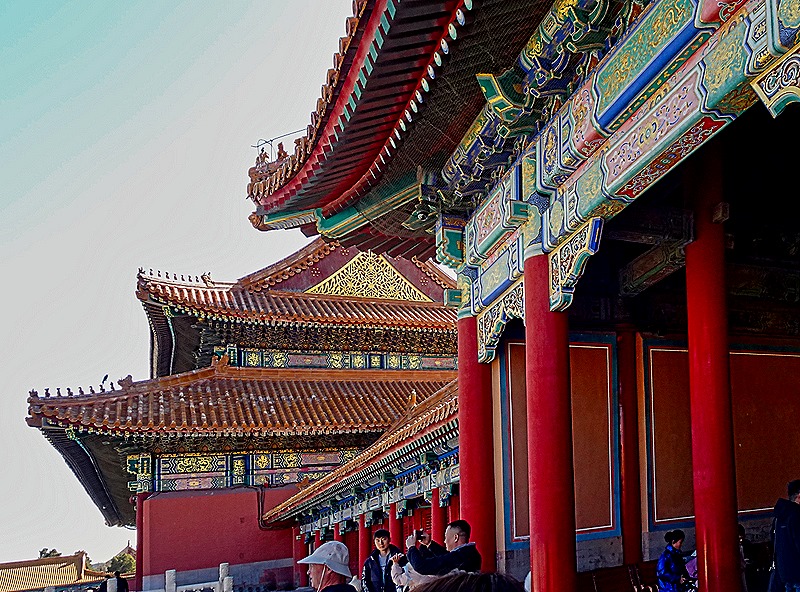
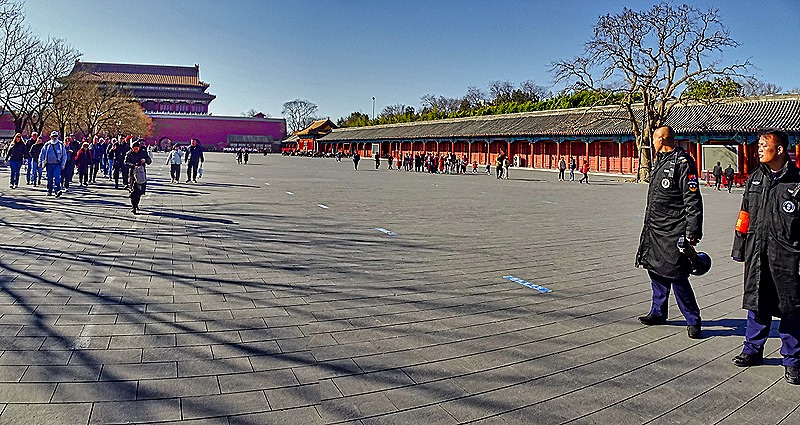
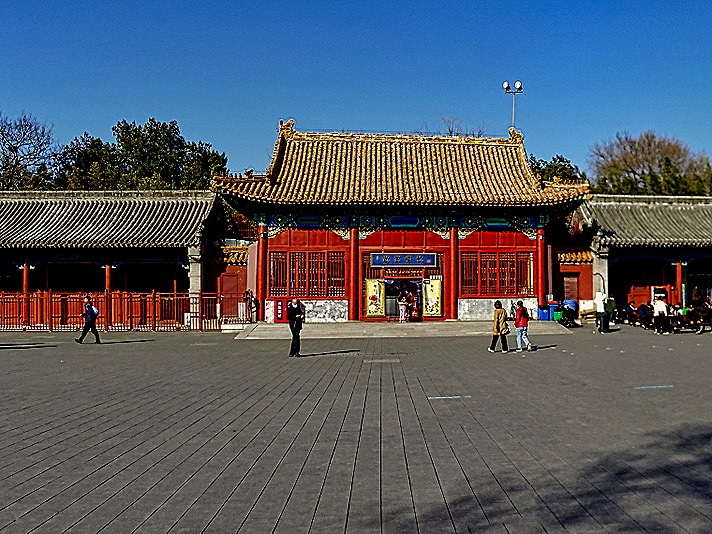
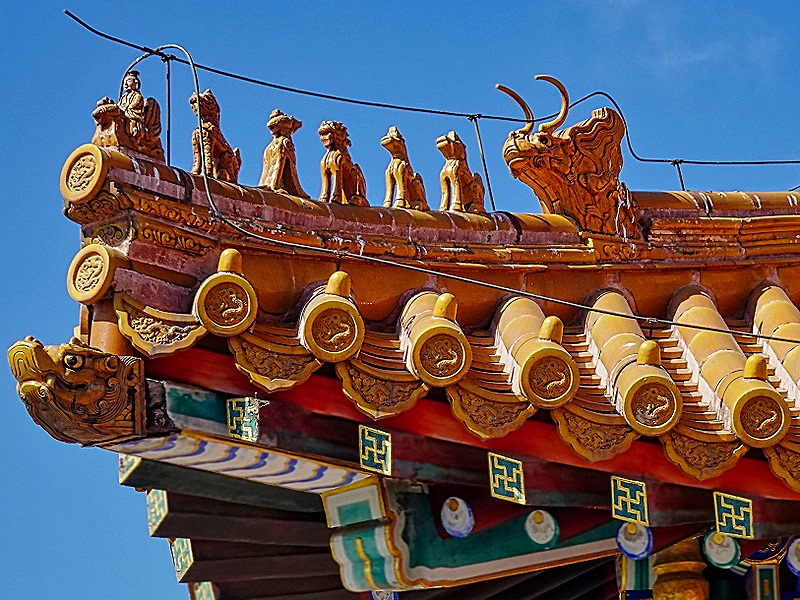
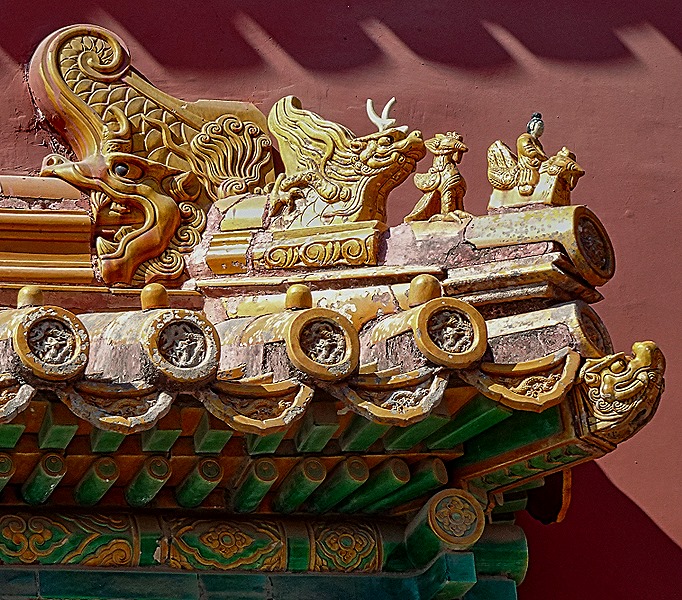
We spent quite a bit of time in this courtyard before being permitted to move on to the next one. The courtyard is surrounded by buildings in traditional Chinese style, much red, green and yellow. Yellow roofs like those seen on some of these buildings were permitted only for the Emperor’s buildings. Notable here and on other buildings are the decorations on the ends of the roof eaves, made up of a row of golden animals, including dragons, phoenixes and lions. They are quite beautiful and the number of animals indicates the importance of the building, from just a couple to as many as nine. The long rows of buildings along the sides of the square used to be administrative offices. Young men in uniform were in this courtyard to keep order, and as the courtyard got more crowded we were all required to stand in parallel lines, with each set of visitors in a different line headed by its guide carrying a numbered white sign.


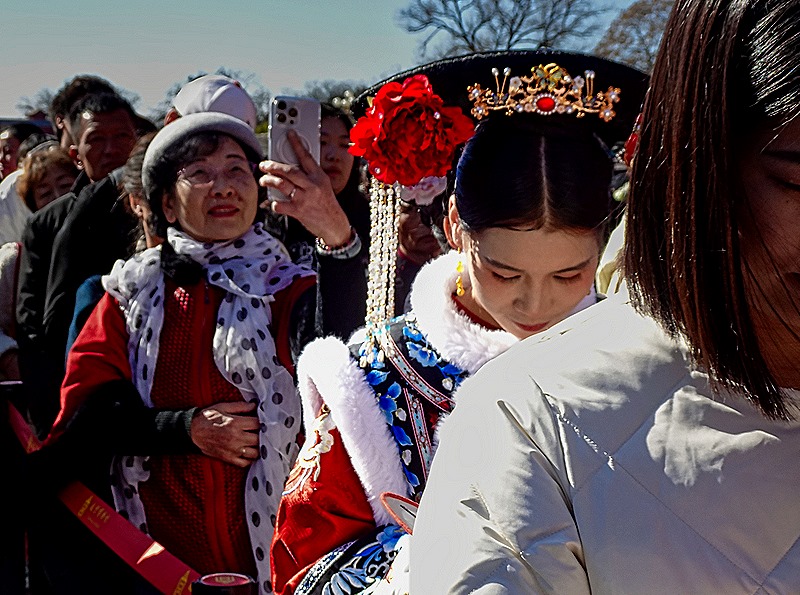
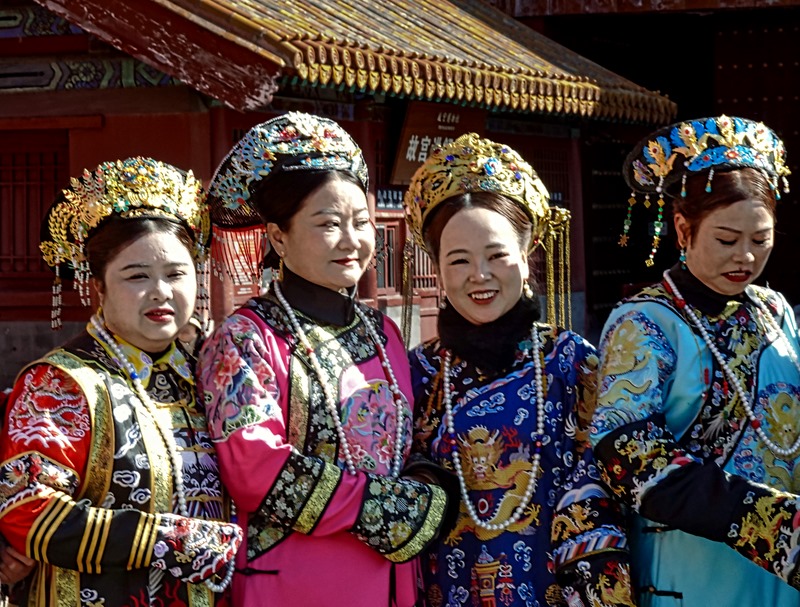
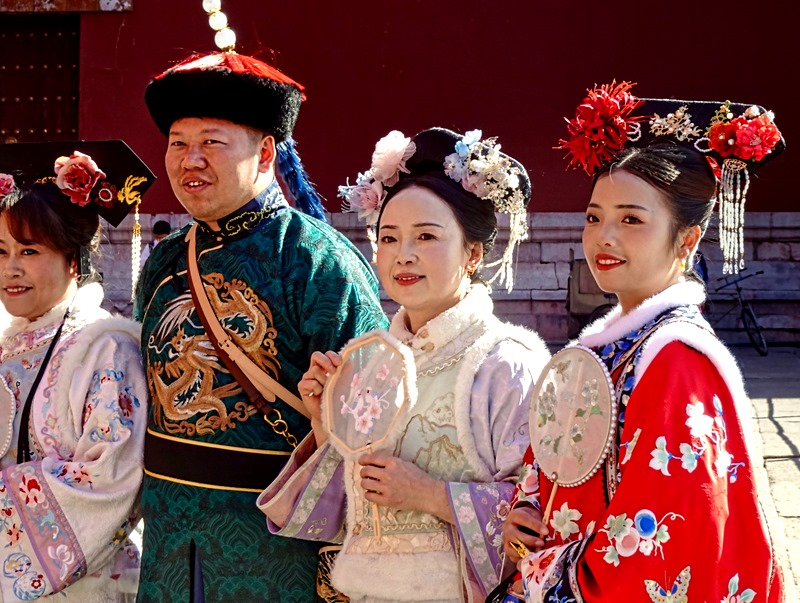
We have seen before in Japan and China that some young people like to dress up in rented period costumes when visiting historical venues. While we waited in line there was a group near us dressed in what we understand were Ming period costumes. Very colorful, and they happily posed for pictures. There was also a man with a baby in a beautifully embroidered backpack.


Of course, what we were all waiting for was our turn to go through the Meridian Gate. Unlike all the other gates in the Forbidden City, the Meridian has large side walls stretching forward along the sides of the courtyard like the arms of the Sphinx, each with a building on top. The Meridian Gate is the actual entrance to the Forbidden City proper.


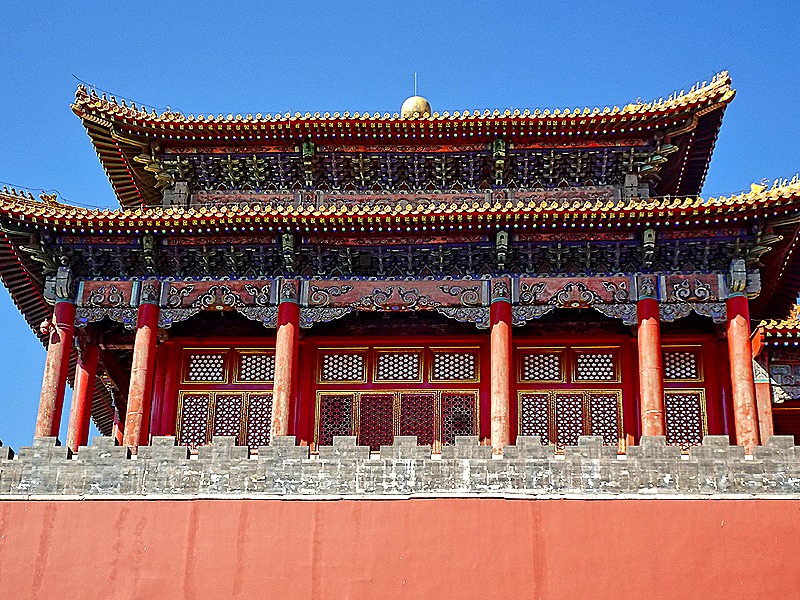
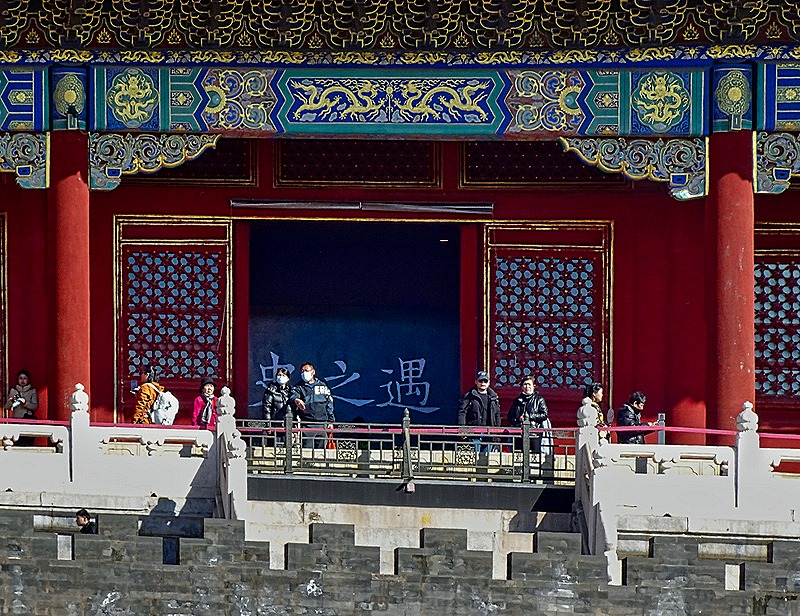


We finally walked through the Meridian Gate. There was a security check inside the gate where we had to show our passports and (if I remember correctly) walk through a metal detector. A bit irritating because there was a line, but not a big deal. Except for our travel agency’s host Susie. She was taken aside as the rest of us went on through. She was detained for about half an hour before being allowed to rejoin us, causing some concern because no one told us why. It turned out that she was carrying all our tickets for the Forbidden City and whoever had filled out a form to accompany them had miscopied one of the digits in her passport number so that they didn’t match. One of our guide’s assistants made the trip back to their office to obtain a corrected form, stepping up like a pro to fix the situation. We were all glad to see Susie finally return. Enough excitement for one day!
We emerged from the Meridian gate into another courtyard where we could see the Gate of Supreme Harmony on the opposite side. Through the middle of this courtyard runs a man made stream called the Inner River of the Golden Water, with five marble bridges over it. Green sculpted lions (perhaps old tarnished bronze) stood guard in front of it.
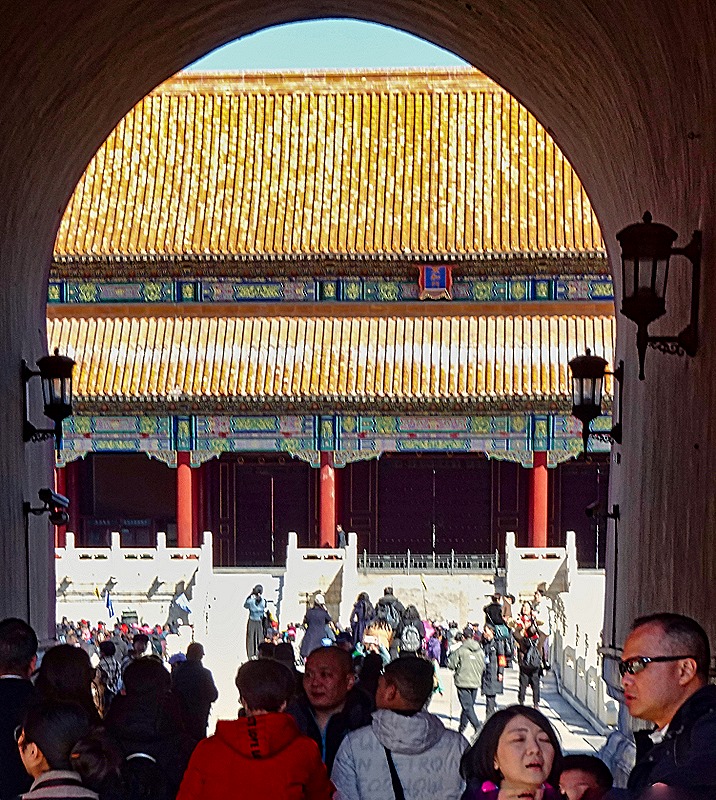

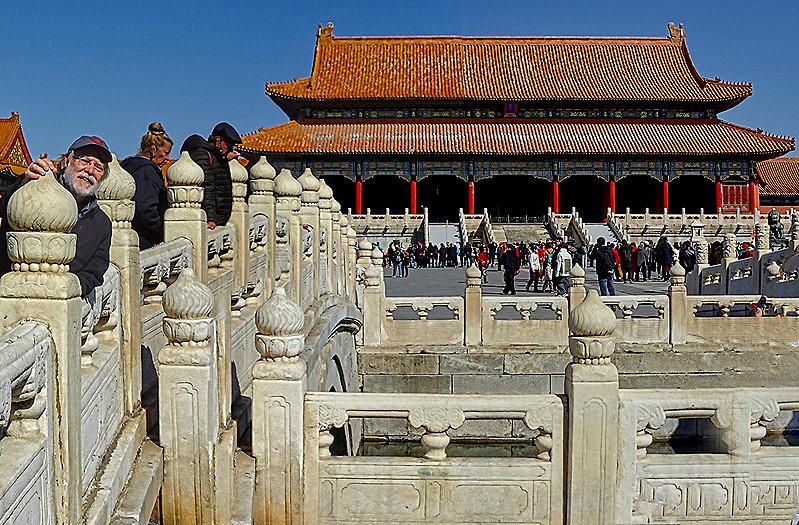


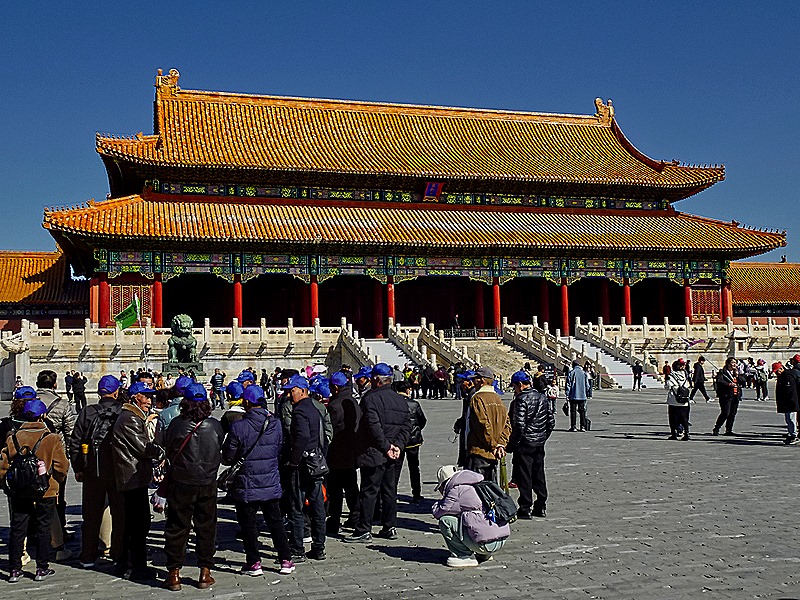
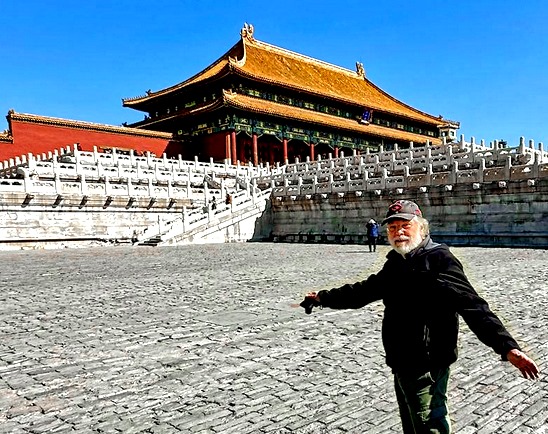
Walking through this gate (after Susie finally returned) we came out into a much larger courtyard leading to the Hall of Supreme Harmony, the largest building in the Forbidden City. This large building sits atop three levels of marble. The buildings in the Forbidden City are all made of wood, the largest collection of wooden buildings in the world. And they were constructed without nails, which were viewed as violent and non-harmonious at the time. Instead they are held together entirely by mortise and tenon joints. Large bronze cauldrons were distributed throughout the complex, which were once kept filled with water as a precaution against fires (always a danger with wooden buildings).
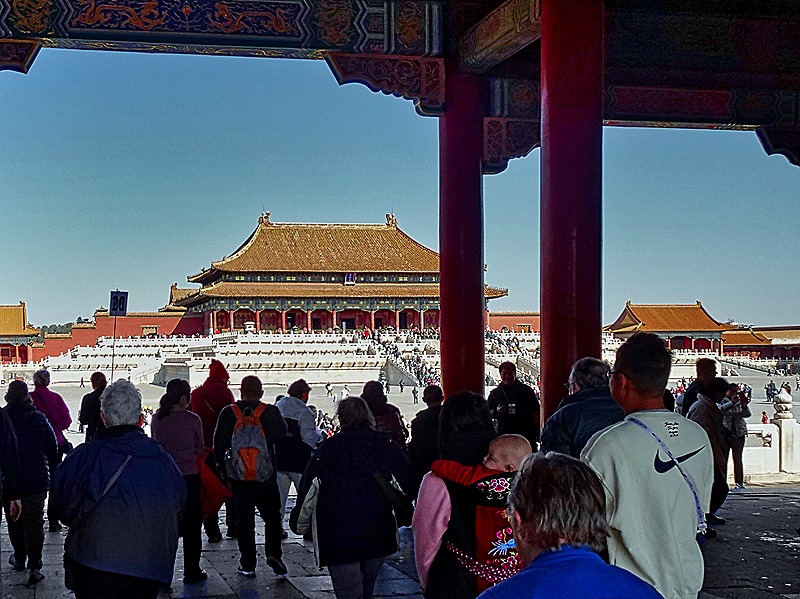


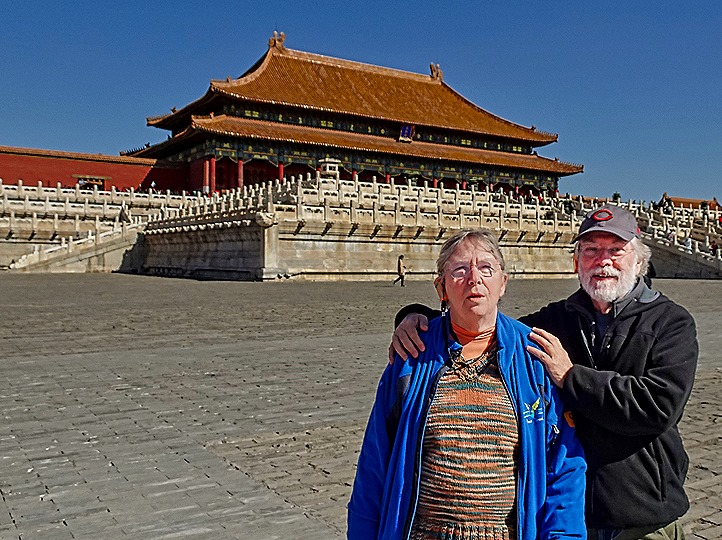


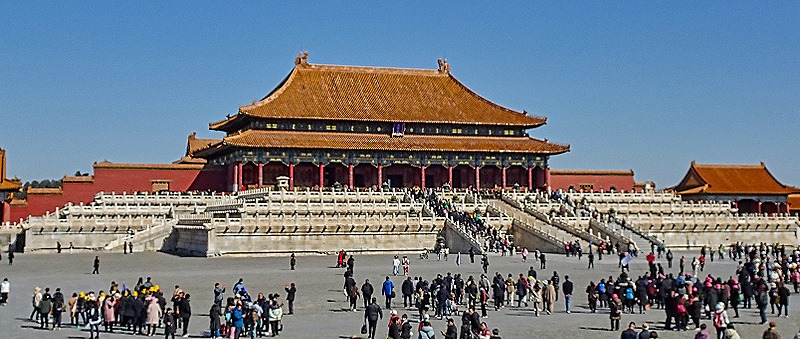
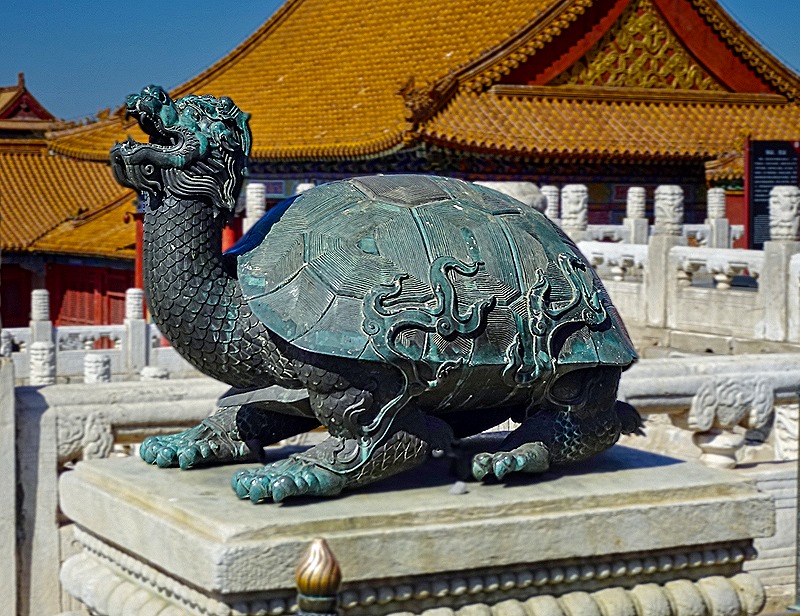
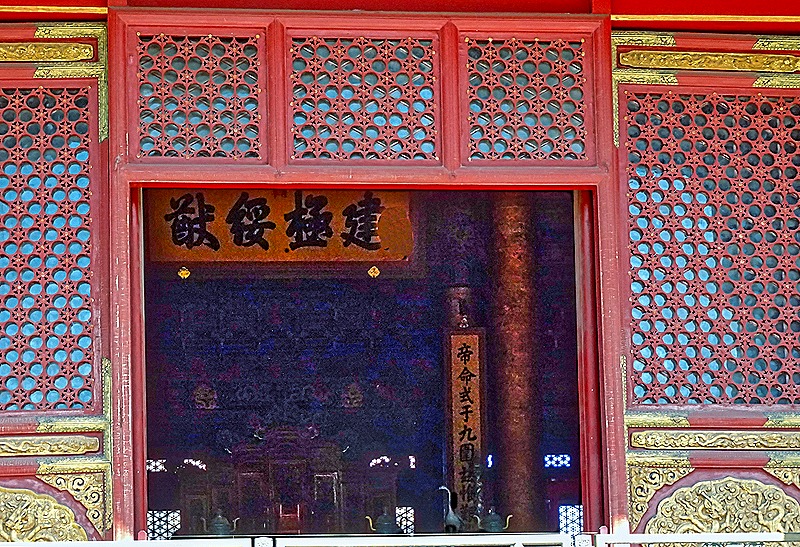
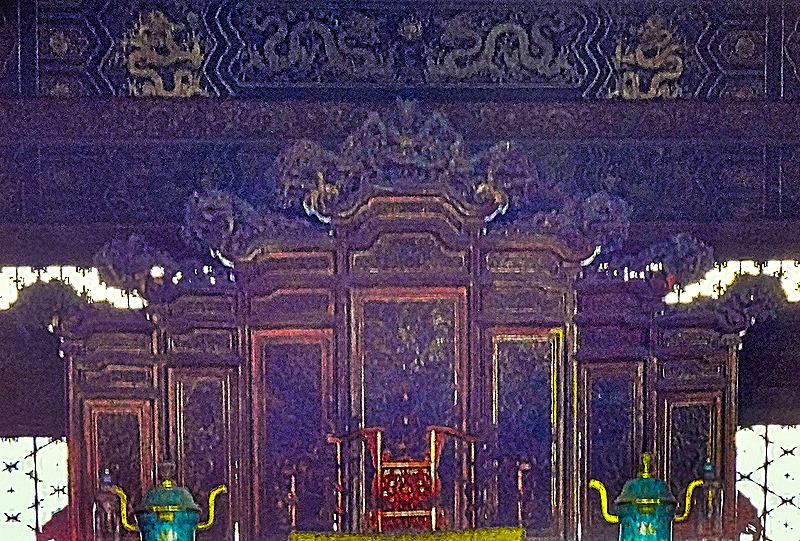
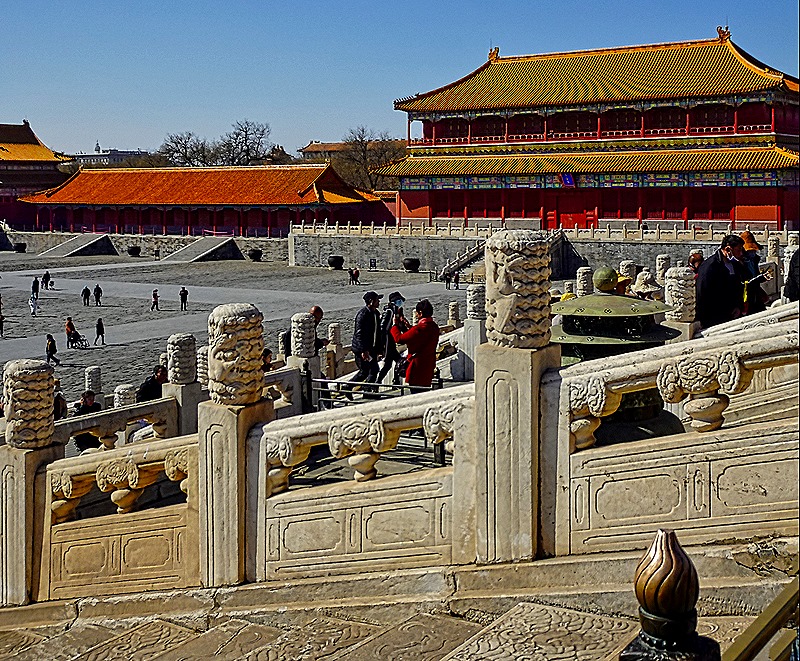
We climbed up the steps to the large stone veranda in front of the building. Bronze sculptures of animals and a large incense burner were out on the patio and inside the central entrance was the Emperor’s throne room where his Dragon Throne still sits. Unfortunately entrance to the building was not allowed and there was a big crowd of people behind a fence in front of this room angling for position to take pictures, even though the room was on a higher level. The room inside was dark and outside the sun was very bright, so we really couldn’t see anything inside the opening from where we stood behind the crowd other than some windows that were (un)helpfully backlighting the dark throne. But standing behind the crowd we raised our cameras over our heads and took some pictures blind in the hope that we could coax something out of them on the computer, because you never know. The images are there in the pictures below, but they look like they were retrieved from film that has been sitting in water a long time. Still, the throne (which actually is golden in color) must have been pretty impressive to court visitors.


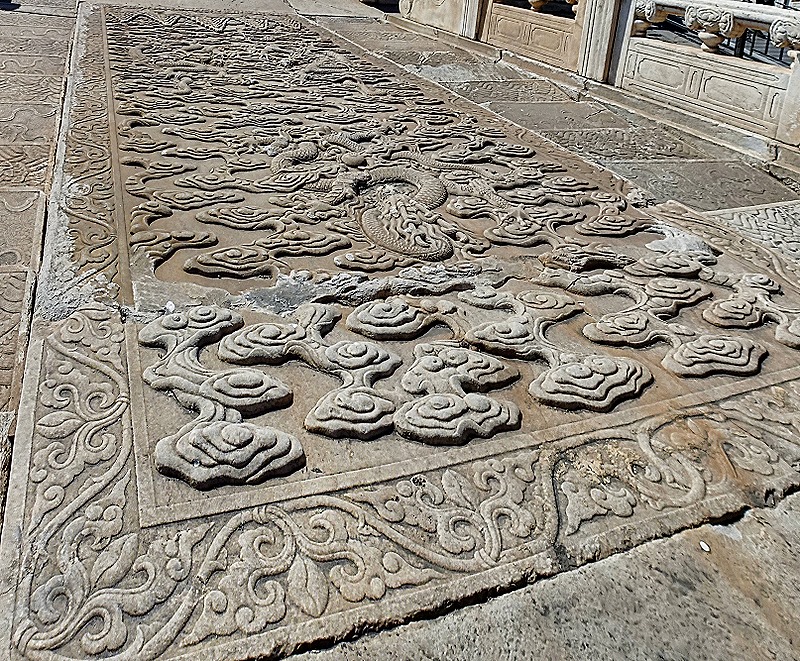
The carved marble staircases and veranda fencing were quite beautiful in themselves, with dragon heads lining the bottom at floor level serving as rainwater runoff spouts. It was quite a view from the veranda down the steps and across the courtyard to the Gate of Supreme Harmony through which we had entered. The central carriageway is covered with intricately carved marble reliefs. Back in the day, no one but the Emperor was permitted to use it.
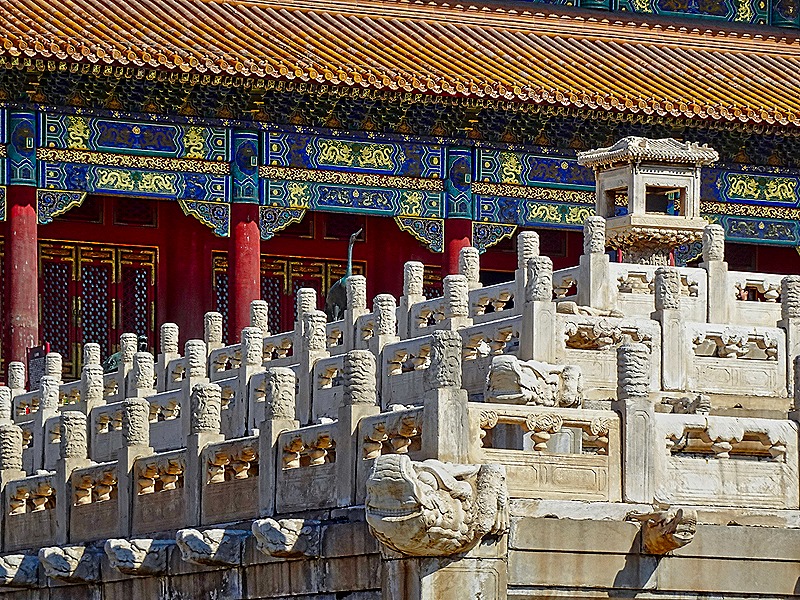
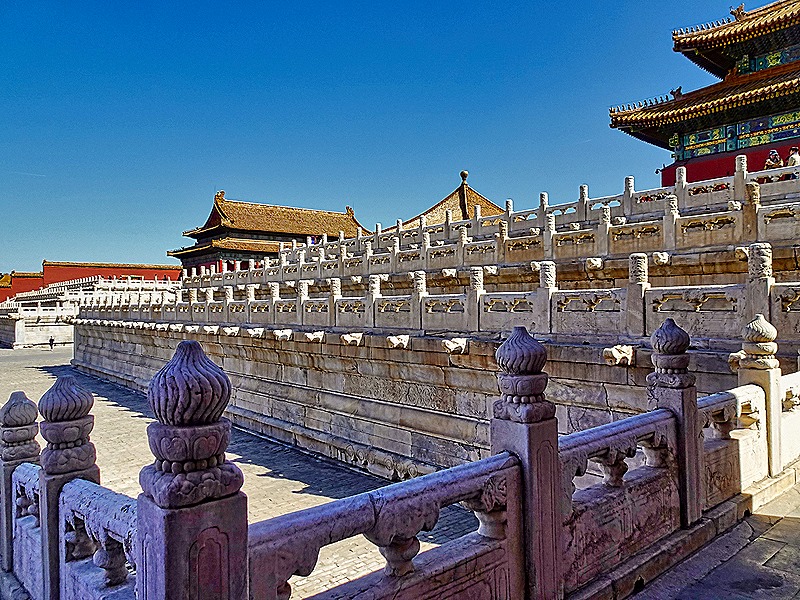

Behind the big hall is the much smaller square shaped Hall of Central Harmony. We walked through a small gate to the side of the Hall of Supreme Harmony to reach it. Walking through another gate we looked up and saw its elaborate ceiling, made of wood with mortise and tenon joints. And nearby were several side buildings with gracefully interacting eaves. Behind the Hall of Central Harmony is the larger rectangular Hall of Preserving Harmony.

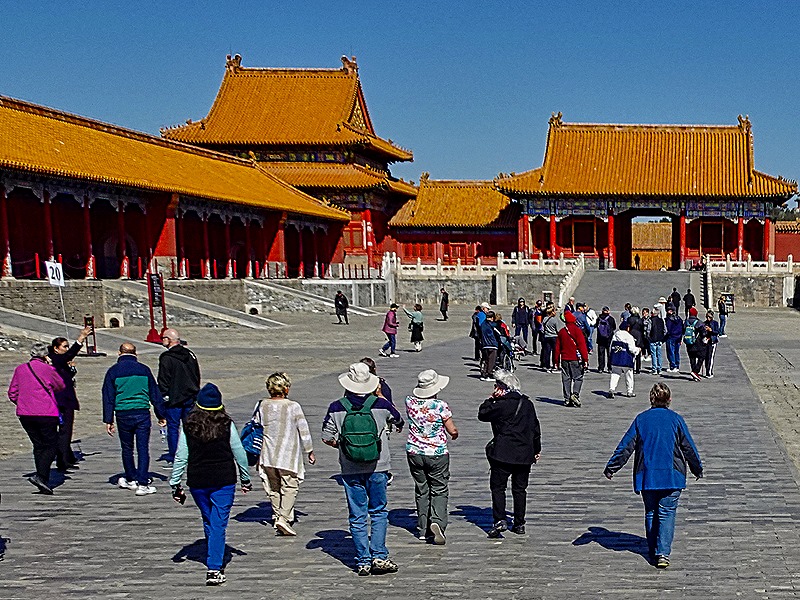

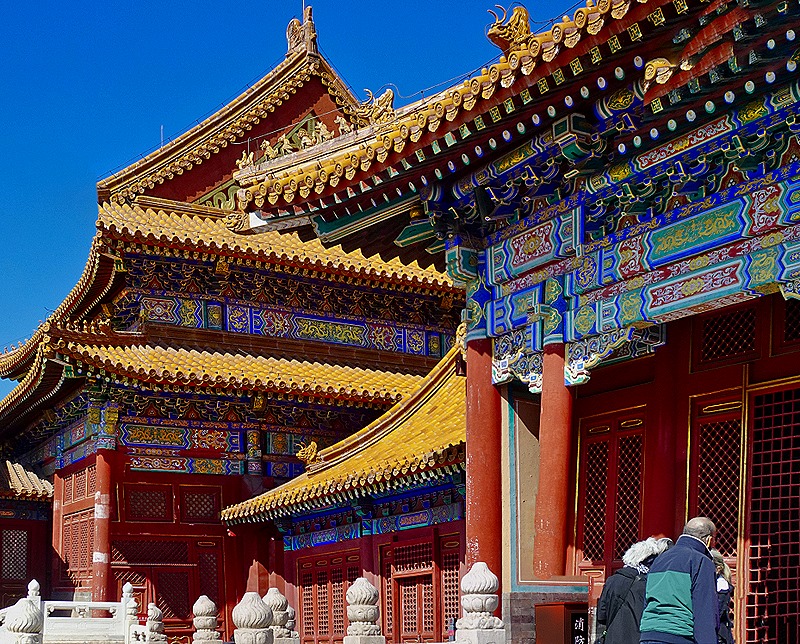
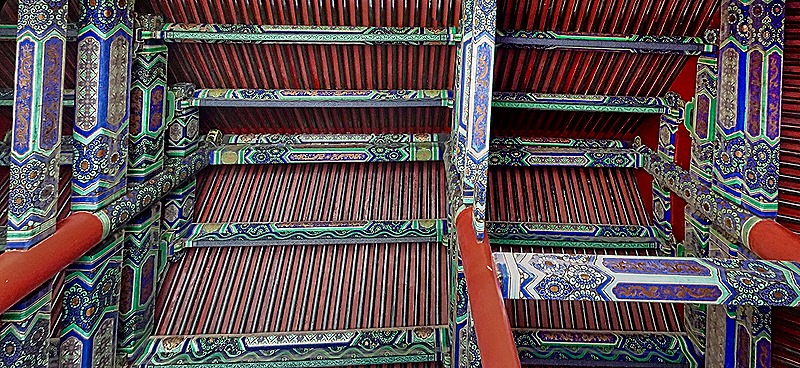

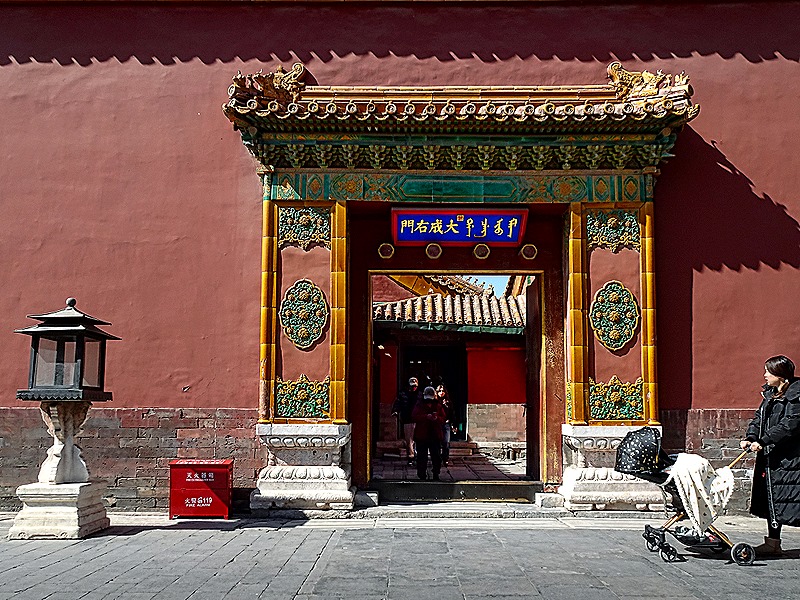
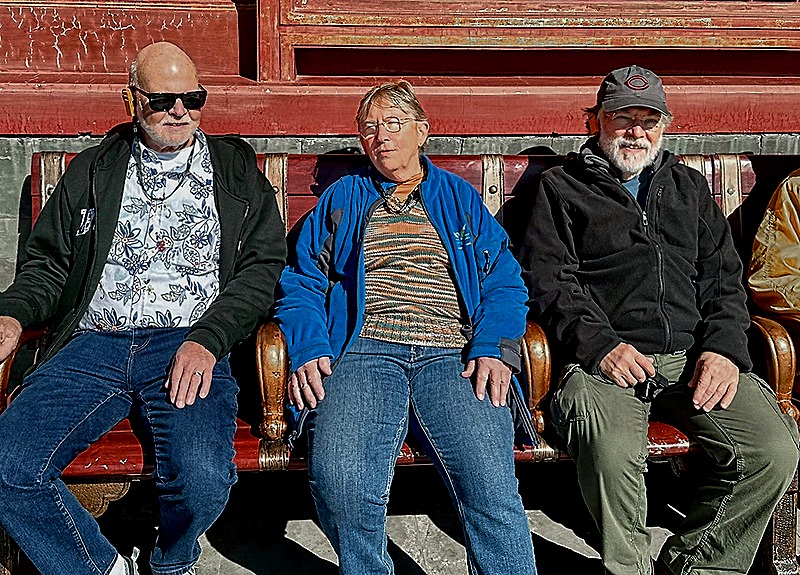
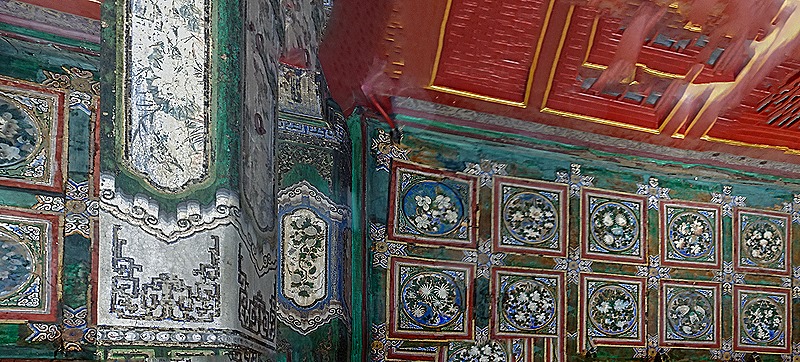
We walked further back, along a corridor between the walls enclosing the inner court on one side and the western palaces on the other. We passed gates in the wall that led to the western palaces, but we didn’t have time to go in. Several walls in this area sported glazed decorations that were quite nice. We also had a chance to rest and listen to our guide explain what we were seeing.


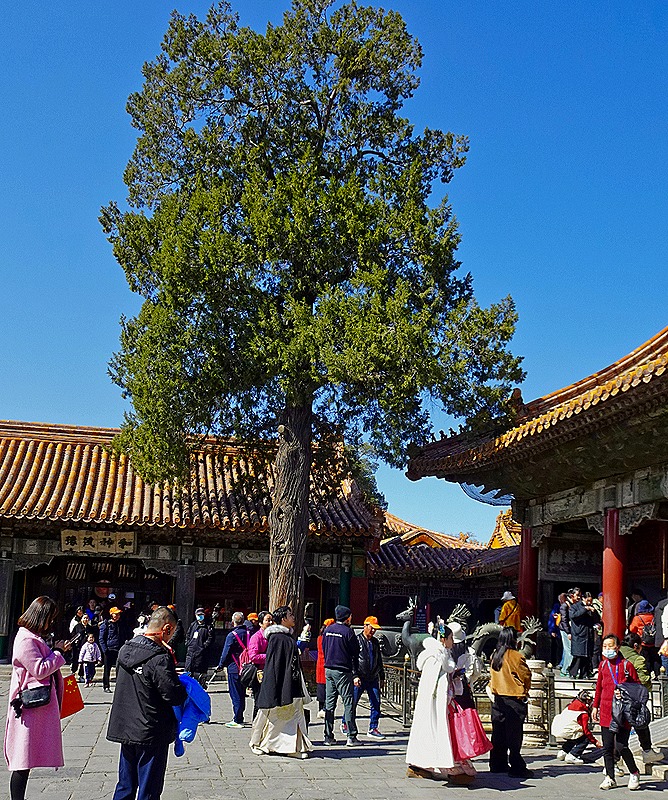
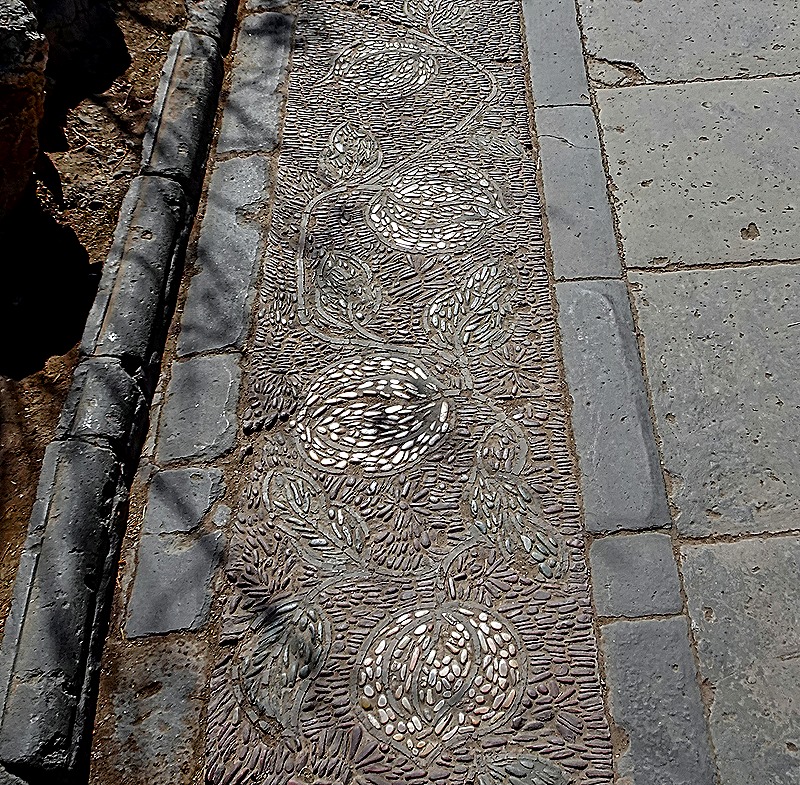
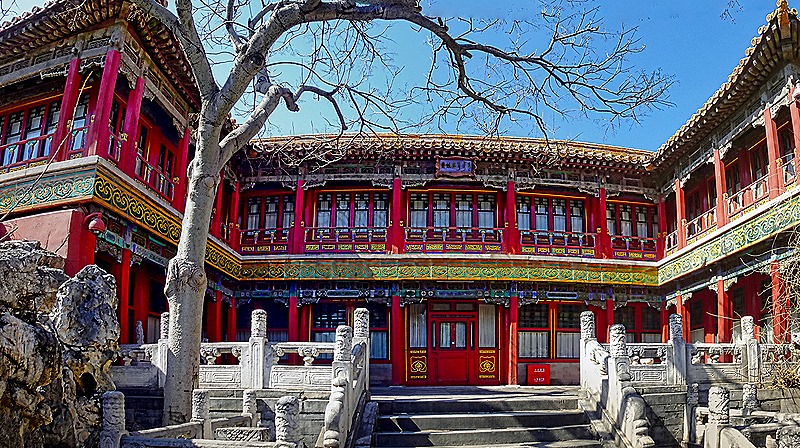
The last area inside the Forbidden City is the Imperial gardens. It has several pavilions, rock gardens and imposing trees, some we were told are well over a century old. Living quarters for the Emperor’s concubines and offspring were also located in this area. Many of the garden paths had stone mosaic designs.





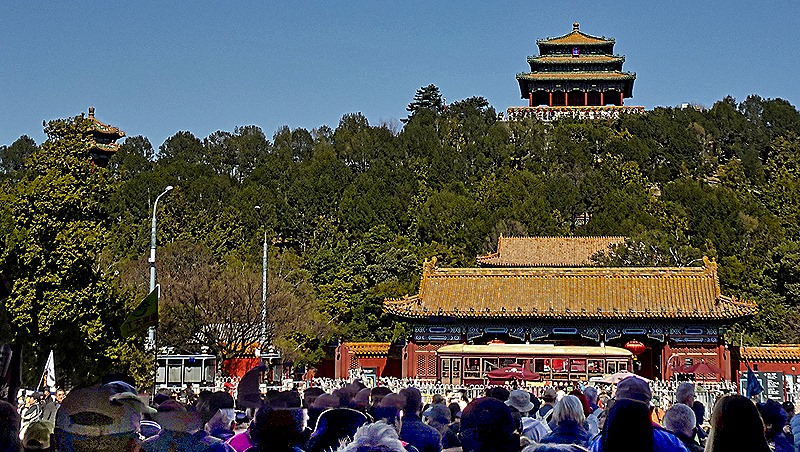
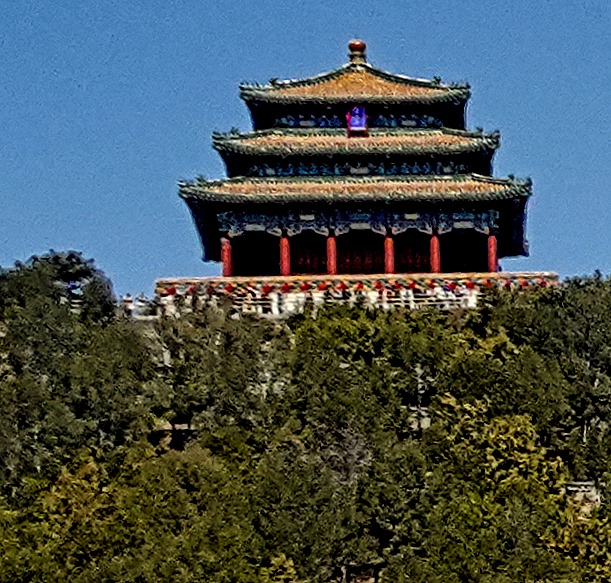
We left the Forbidden City through the Gate of Divine Might opening on a view of Jingshan Park across the street. What you see is an artificial hill (considered the highest point in Beijing) built in 1751 from soil excavated when digging the moats and canals in the Forbidden City. It was originally a private domain for the imperial family but was opened to the public in 1928. At the top of the hill, above the entry gate across the street from us, is the Wanchun Pavilion which sits on the central of five summits on the hill. To its left on another summit is Guanmiao Pavilion, which we were able to see over the roofs of the last part of the Forbidden City. From the Wanchun Pavilion on a clear day one has a panoramic view over the rooftops of the entire Forbidden City, but we didn’t have time to climb the hill to see that.

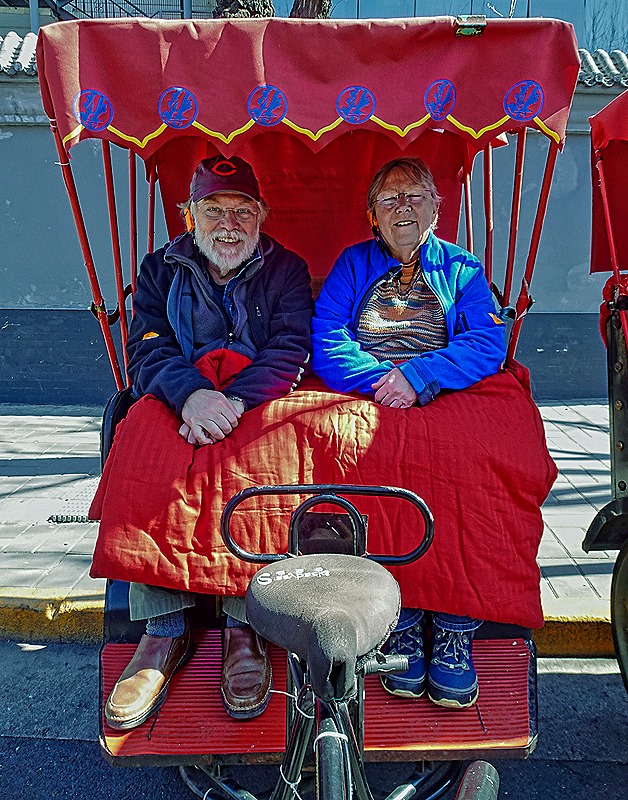
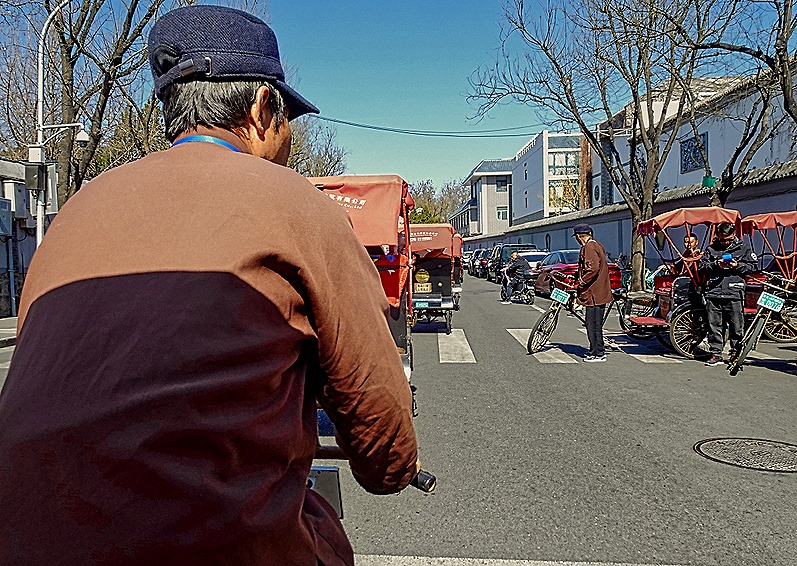
So that seemed like a pretty full day, right? It did to us. But no! There was more to come. We boarded the bus to drive to the nearby neighborhood where we would board bicycle rickshaws (pedicabs) for a driving tour of Beijing’s hutong neighborhoods. Hutongs are old Beijing neighborhoods, some up to 800 years old, populated by connected one story houses, each with a courtyard in the center. Most are built of gray brick and many of those left are hundreds of years old and lack plumbing and individual bathrooms. A courtyard house is called a Siheyuan, and a street or neighborhood of connected Siheyuan is called a Hutong. The Forbidden City was, in imperial times, surrounded by hutongs, with wealthier people living in more elaborate houses closer to the Forbidden City and less important and wealthy people living in more modest houses further out. In the mid 20th century there were thousands of hutongs in the area of Beijing surrounding the Forbidden City, but beginning in the 1990’s a majority of them have been destroyed to make way for high rise apartments and office buildings. Today there is a movement, supported by the government according to our guide, to preserve those that are left as a cultural treasure, although she also told us that many current residents are unhappy about restrictions on selling their property to developers for what can be a huge profit. We were very happy that they were still there when we visited.

We saw several two story buildings lining the roads, mostly stores it seemed. We have read that the old Siheyuan are almost all single story buildings and the two story emulations have been built in recent years, many for commercial uses.


We can’t tell you which hutongs we visited but most of them were lined with what seemed like continuous gray walls with periodic openings or doors, mostly red. We understand that these are very tight communities (after all, most people living in them meet at the public bathrooms), with much visiting, conversation and game playing. Some are very narrow and some very wide . . . from a couple of feet to perhaps 100 feet in width.
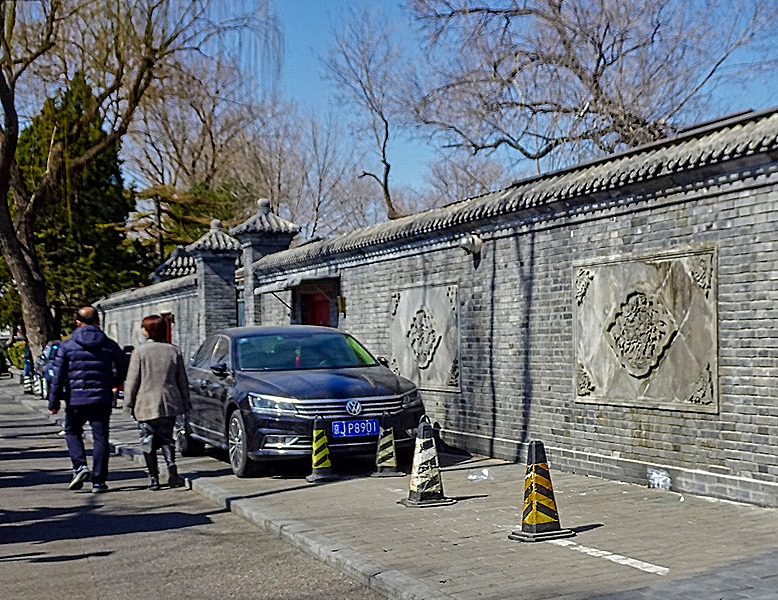

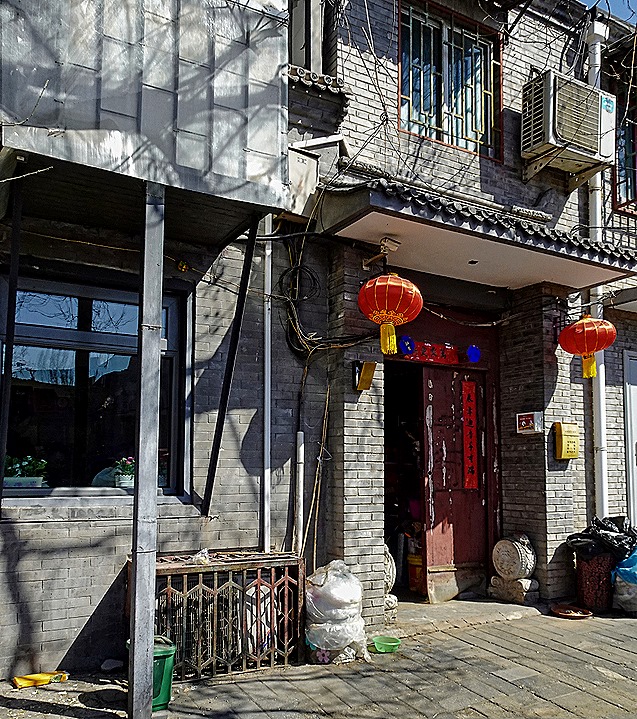

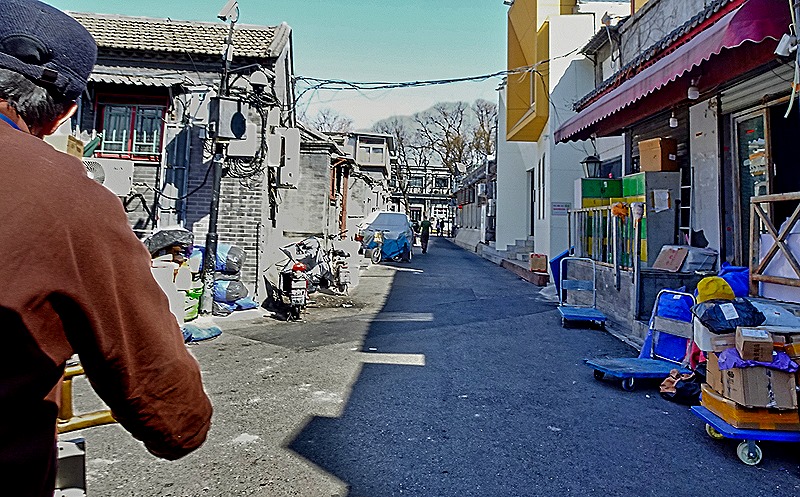
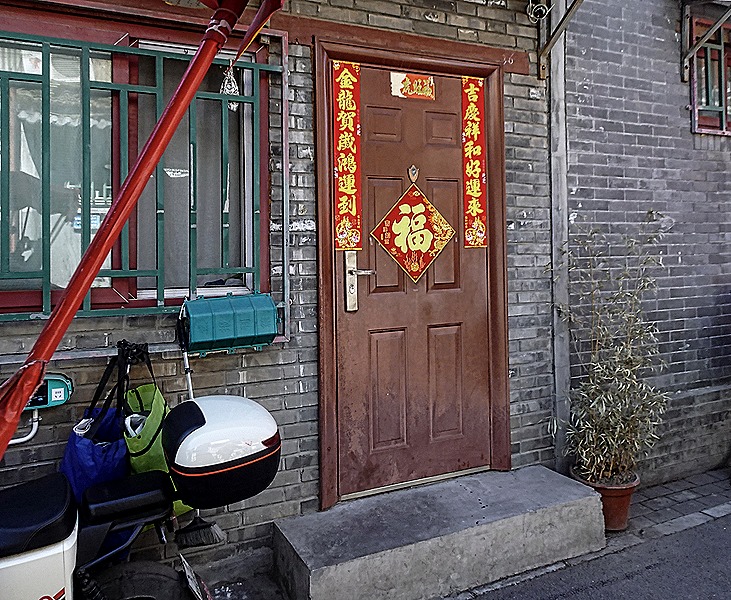
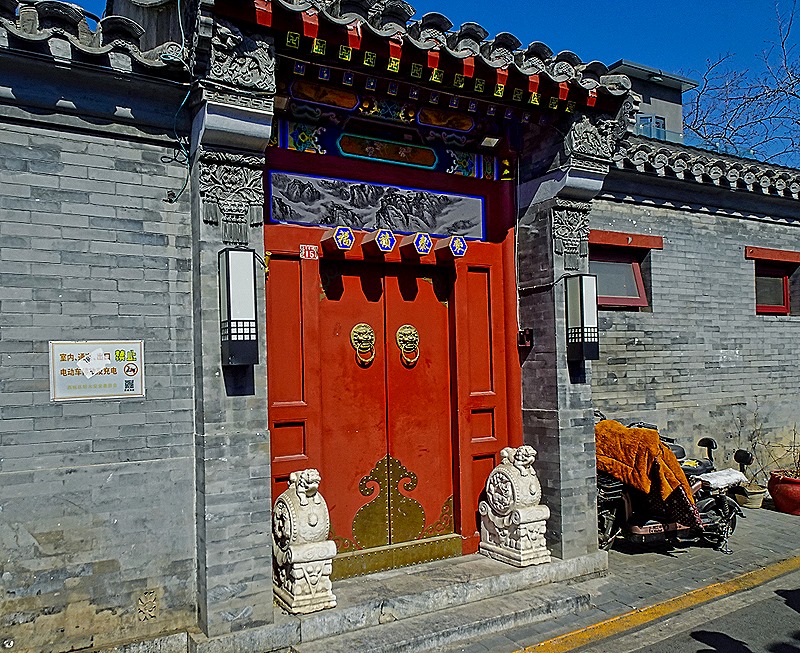
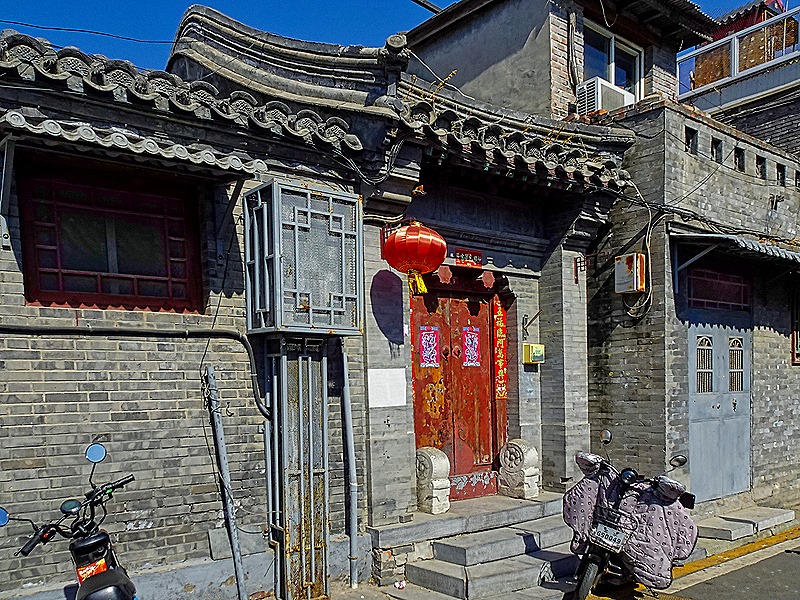

Rather than tear them down, the government has encouraged the conversion of some buildings in this area into restaurants, bars and stores. Not all of these are old single story hutong houses, but they are still part of the neighborhood.

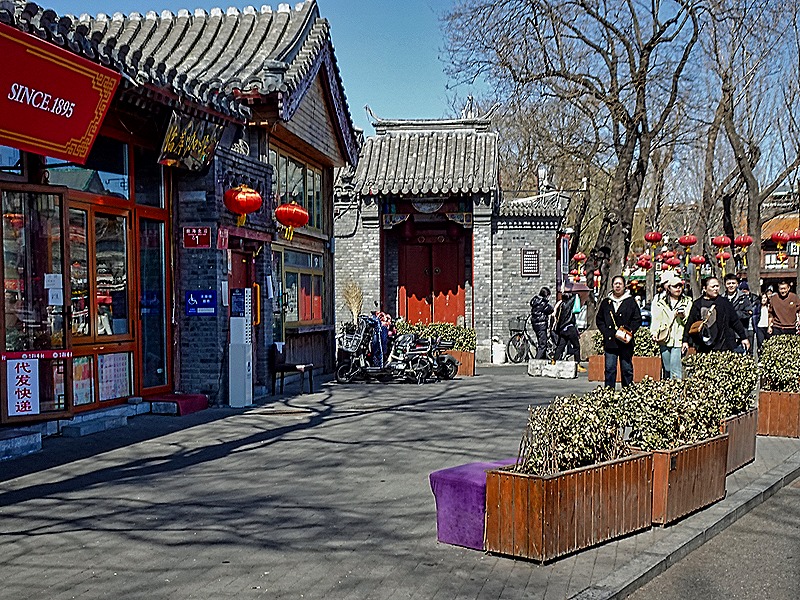

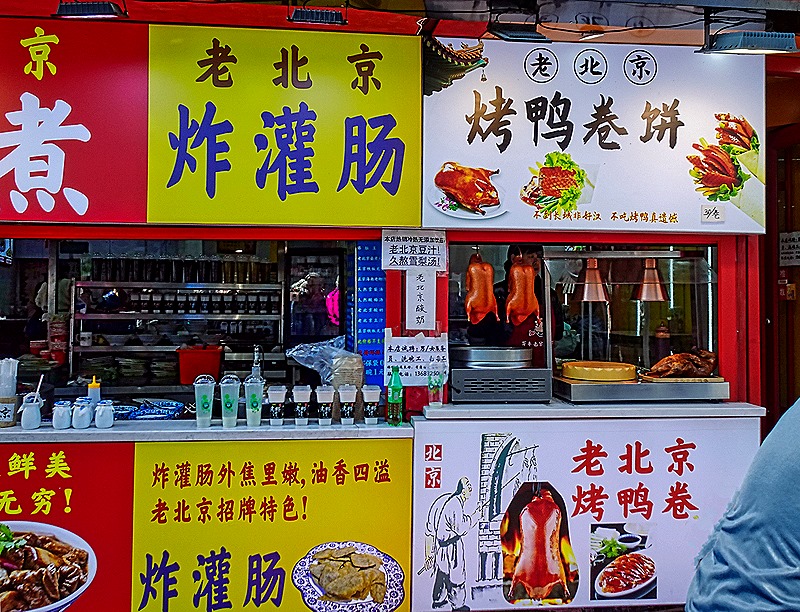
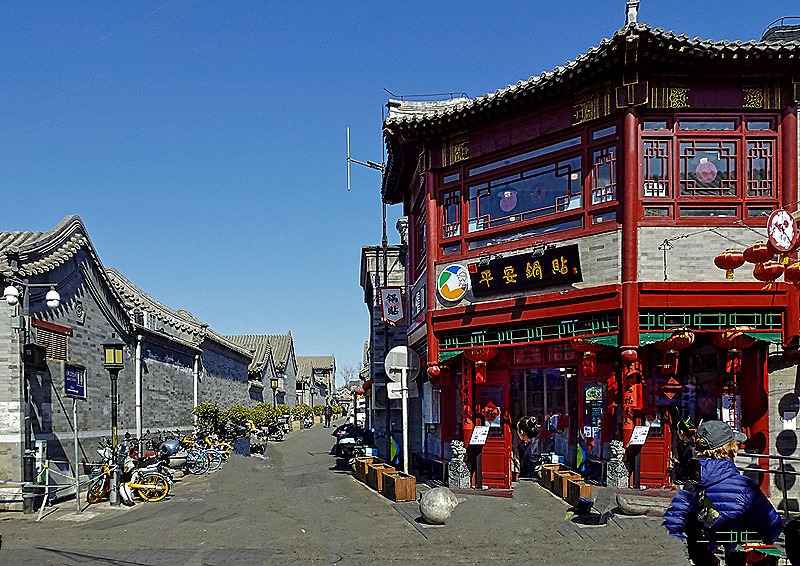
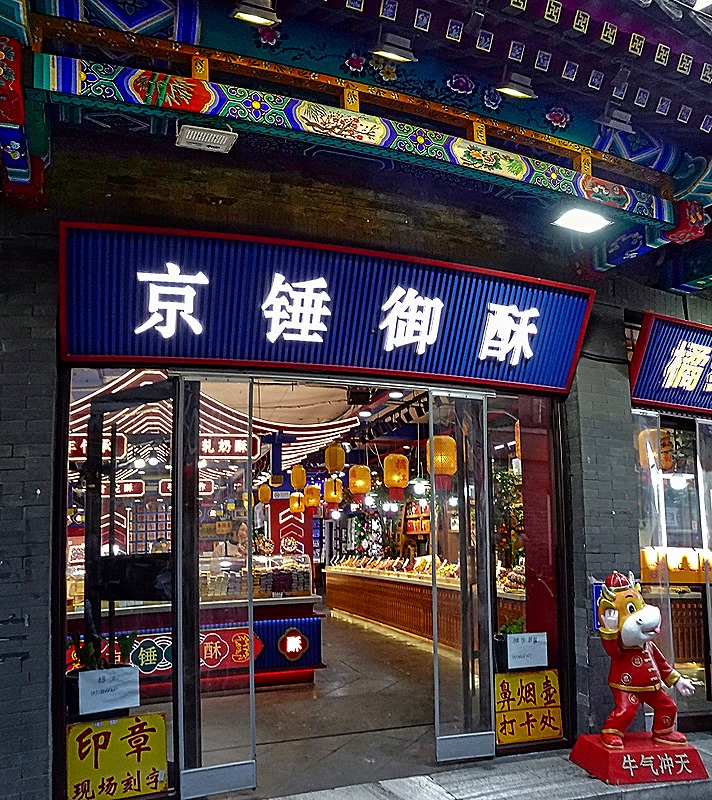

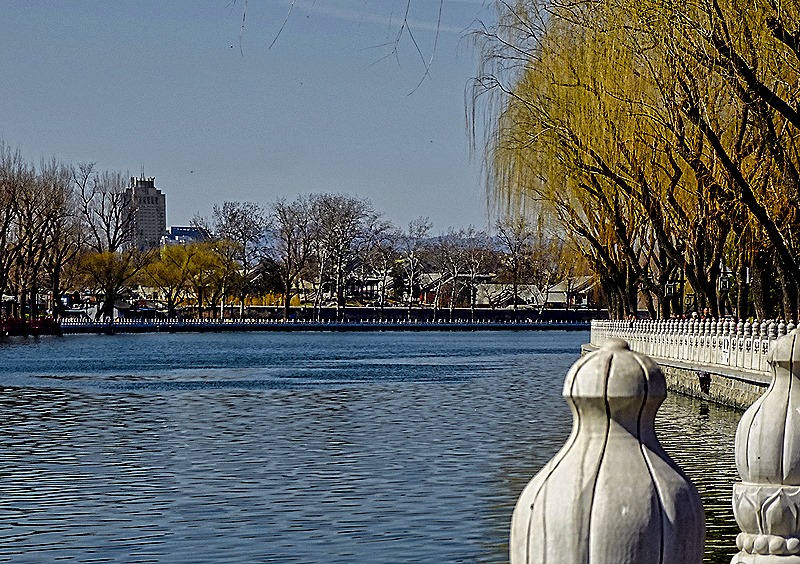
Our ride took us along Shichahai Lake. In the 13th and 14th centuries this was the northern terminus of the Grand Canal (discussed in our visit to Suzhou: https://baderjournal.com/2024/08/26/shanghai-china-day-2-suzhou-2024/) and was then a bustling commercial area. After the canal was extended to other destinations it became a noted scenic area, the largest body of water in Beijing and lined with green trees. We noticed that it is also lined with stone walls that look very similar to the ones lining the Golden Water channel running through the Forbidden City and wonder if the two are connected. Today the area is becoming a mecca for popular bars and restaurants. On the day we visited the water was still and reflective.
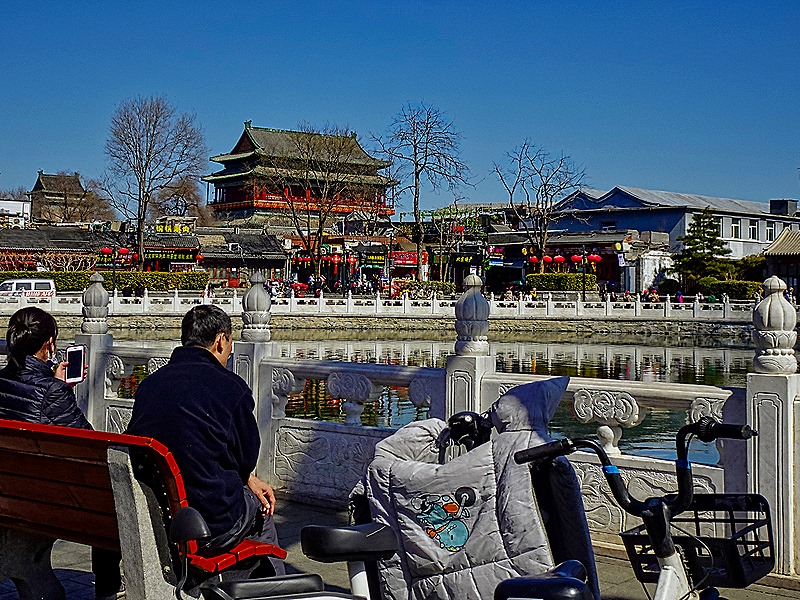
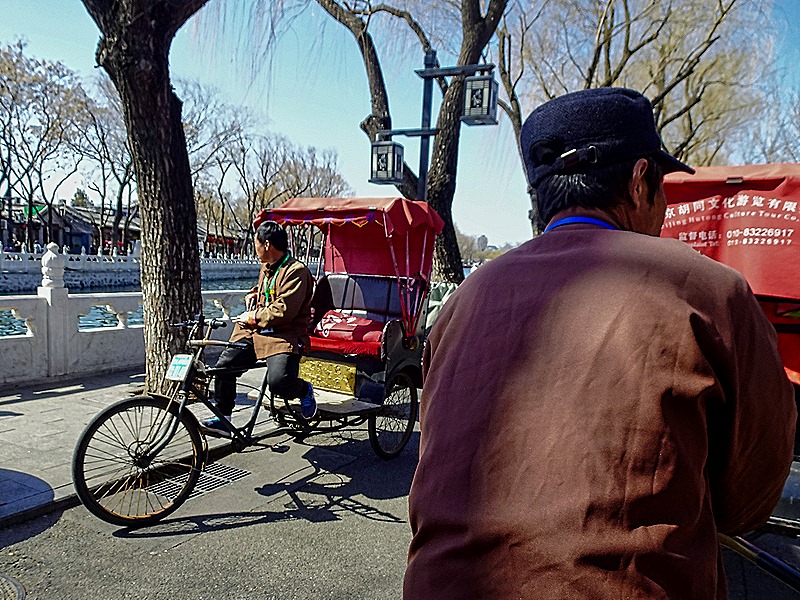
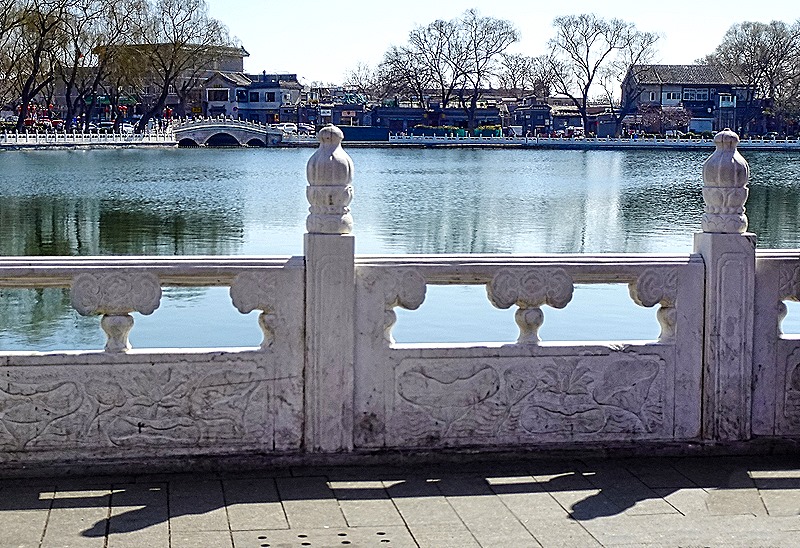
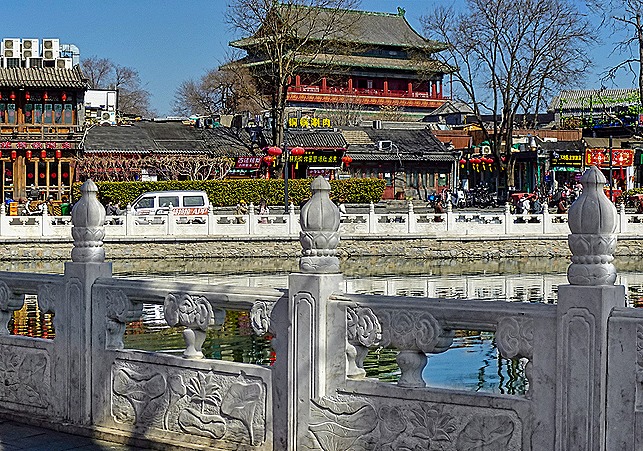

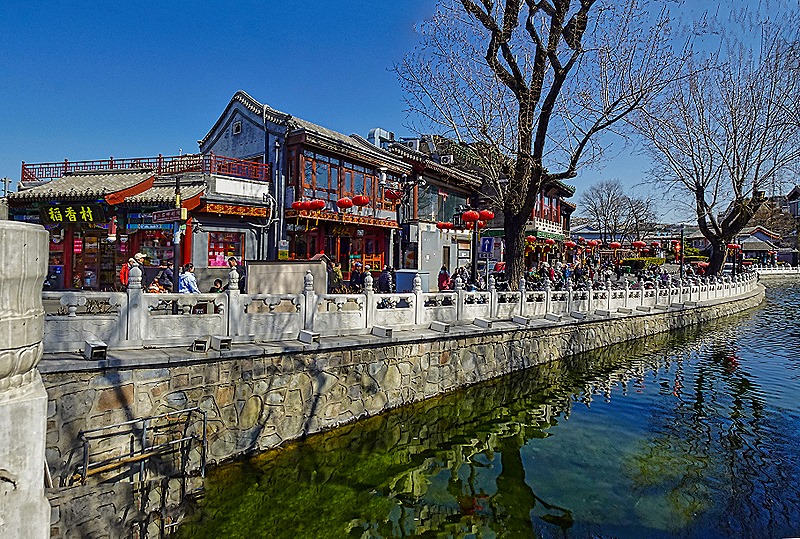

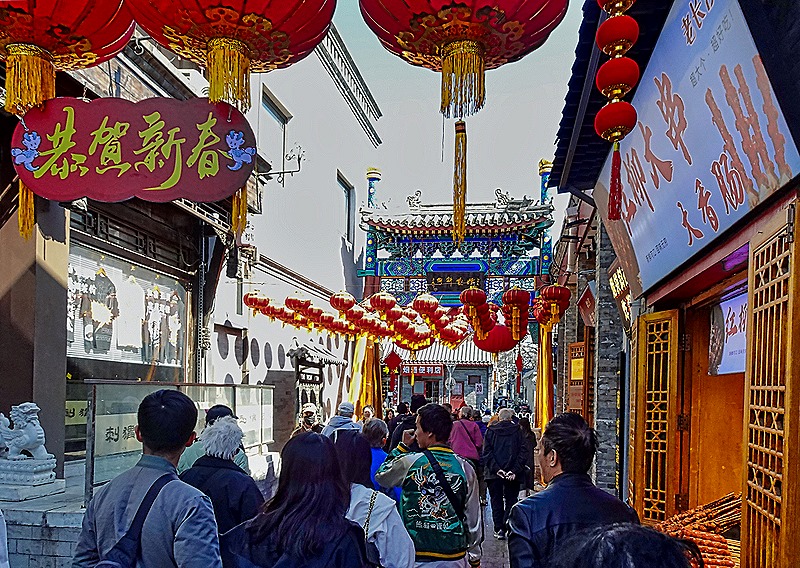
Leaving the rickshaws we had to walk back to meet the bus. Among other things, we walked down Yandaixie Street (we think). Before World War II this street was known for antiques, then in the 1950’s much of it was converted to residences. Beginning in 2007 it has been redeveloped to revive its historical appearance. This is a fairly narrow stone paved pedestrian street and many clothing, craft, pottery and souvenir stores have relocated here, along with various bars and restaurants. As we walked down the street toward a large arch at the end, festive red lanterns were strung over our heads. At one point we walked past a store advertising antiques and when one person asked about it our guide quipped “Yes, we have several antiques factories in Beijing.”


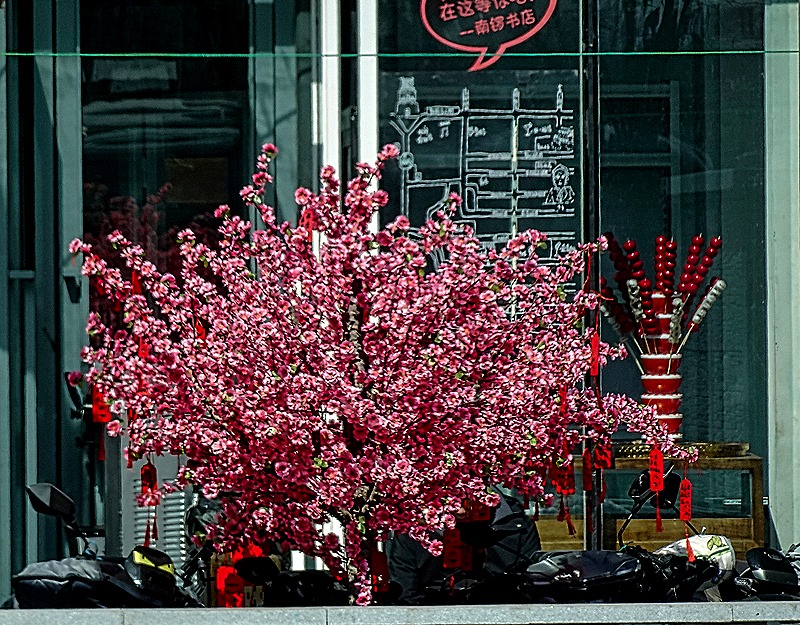

After all that we finally stopped for lunch in a restaurant serving good Chinese food. It was a bit of a rush, though, because our group was being divided here with some folks heading to the airport to begin a longer trip for several more days in China while the rest of us headed back to the port. On the way out of town we passed a guard tower on top of what we were told is a remnant of the ancient Beijing city walls. It was another very long drive and we were glad to get back on board the ship after such a full day. So ends our first visit to mainland China, where we felt we saw quite a lot but there is still much more to see if we ever get the chance.


Tianjin, China (Beijing) Day 1 — 2024
On March 11 we berthed in the port of Tianjin, the closest port to Beijing, for an overnight stay. When we saw the itinerary we thought Tianjin was just the port for Beijing but it turns out to be a city of almost 14 million people. HAL had excursions to see Tianjin, which has a long and eventful history and many interesting things to see, but this was our first trip to this part of China so there was no way we were going to pass up an opportunity to visit Beijing. We have read that about 95% of cruise ship passengers stopping here make the same choice we did.
However, it is about a 3 hour bus drive from Tianjin to Beijing in normal traffic and doing that trip twice in one day (there and back) would not only be exhausting, it would leave little time to do anything else in Beijing. So we were very happy when our travel agency posted an overnight trip to Beijing, which would cut the driving time in half, spreading those 6 bus hours over two days. So that is what we did here.
Beijing, of course, is the capital and second largest city in China, with some 21 million people. It has been the capital for some 600 years now. Perhaps the most famous thing to see in this part of the world is the Great Wall of China (which, contrary to myth, cannot be seen from the moon) and that was our destination for this first day.
We set out around 9:00 AM (after some people had delays making it through customs). In the cruise terminal we had an entertaining welcoming committee as we hurried the long distance to our bus.


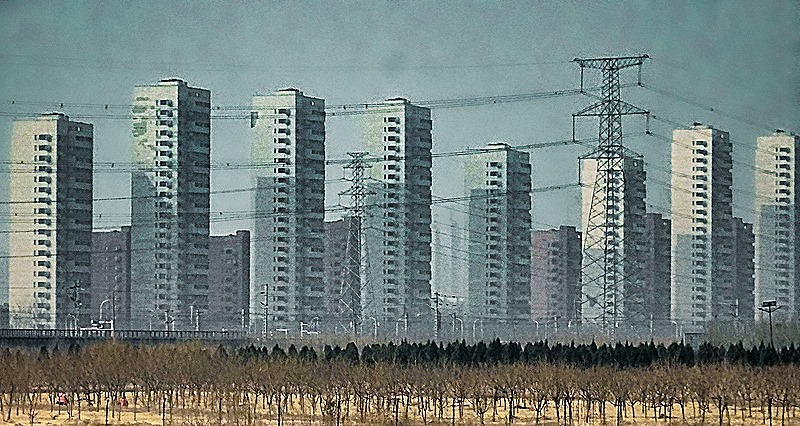
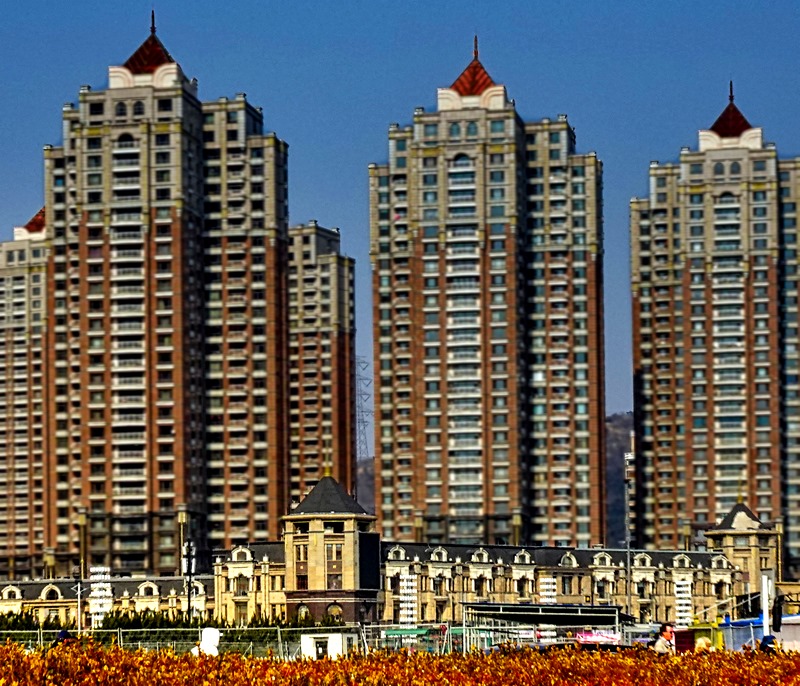
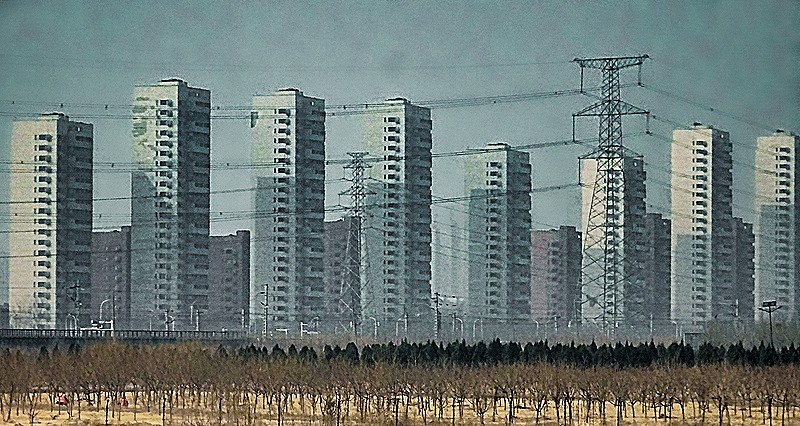
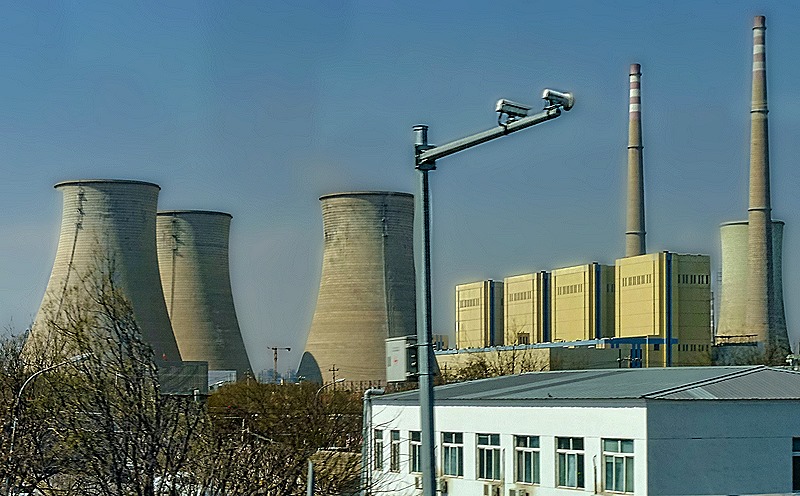
Beijing has a reputation for very polluted air, but the day we were there pollution was visible in the air near Tianjin, but the closer we got to Beijing the more it dissipated. In all, we had a beautiful day and even the temperature was nicer than expected. It seems the Chinese have been addressing their housing shortage by building sets of high rise apartment buildings in the countryside rather than in the cities. We saw this in the Shanghai area as well. It looks a little odd when passing by to see these large apartment complexes unconnected to a city, but I guess you do what you have to do to address an important problem like that. We also passed what appeared to be several nuclear power plants in the countryside.
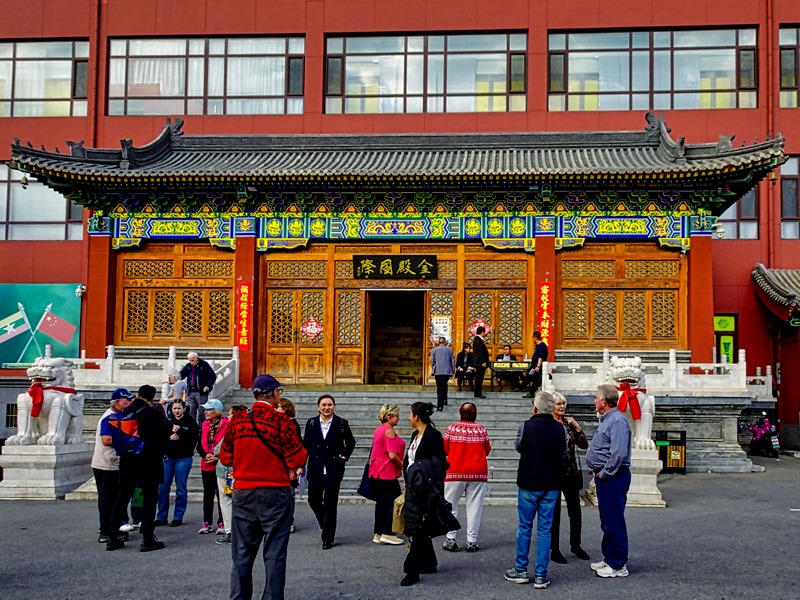
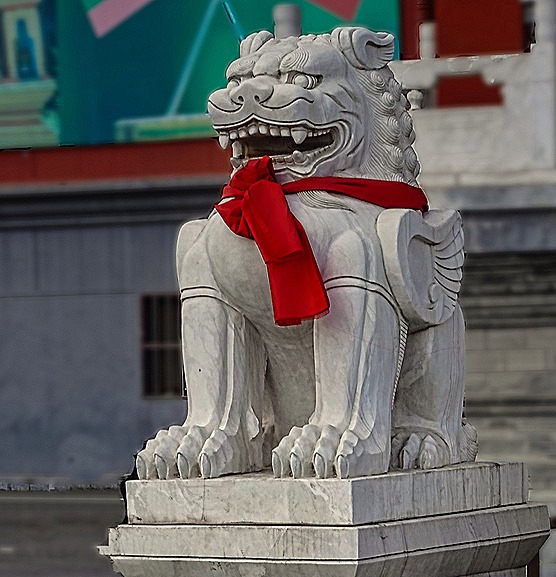
We made two stops on our way to the Great Wall, which is located on the other side of Beijing from the port. First, as if the drive from the port was not long enough already, we stopped at what appeared to be a security checkpoint, where everyone’s passport was inspected (again, since this had been done once at the port before we left). For some reason this took quite a while, maybe because other buses were ahead of us. We didn’t time it but would estimate that we sat there on the bus for about 45 minutes. Second, we stopped for lunch at a nice Chinese restaurant about 20 minutes from our destination. The restaurant and some neighboring buildings were in a traditional Chinese style of architecture, the food was quite good and there was a sculpture gallery selling jade items in all shapes and sizes, at substantial prices. Photography was not allowed in the gallery.


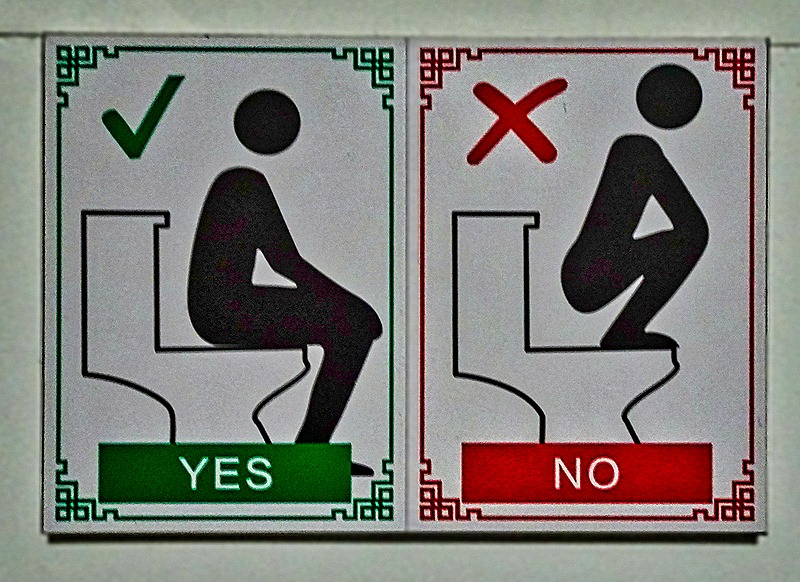
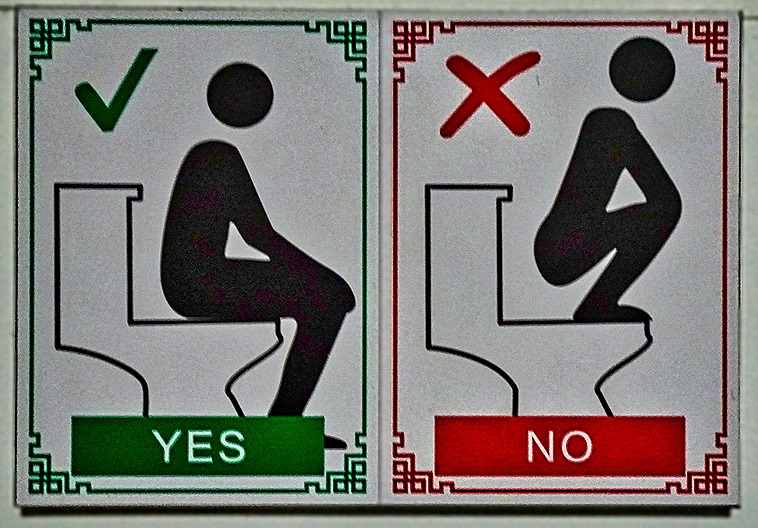
Since we are talking about a restaurant, this is probably a good place to mention one more thing about touring Asia . . . toilets, or rather the lack thereof. People in many parts of Asia, even in cities, squat over a hole in the ground for this purpose and have never seen a Western style toilet. If one has never used one, encountering a toilet must be bewildering. Here is a sign over a men’s room toilet in China which helpfully explains how it is used even for visitors who are illiterate. The picture is quite suggestive of the common response when no such instructions are available.
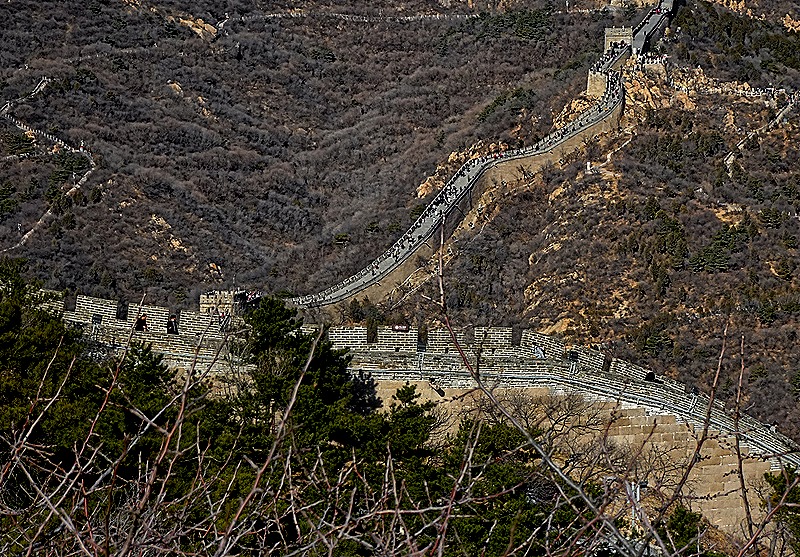
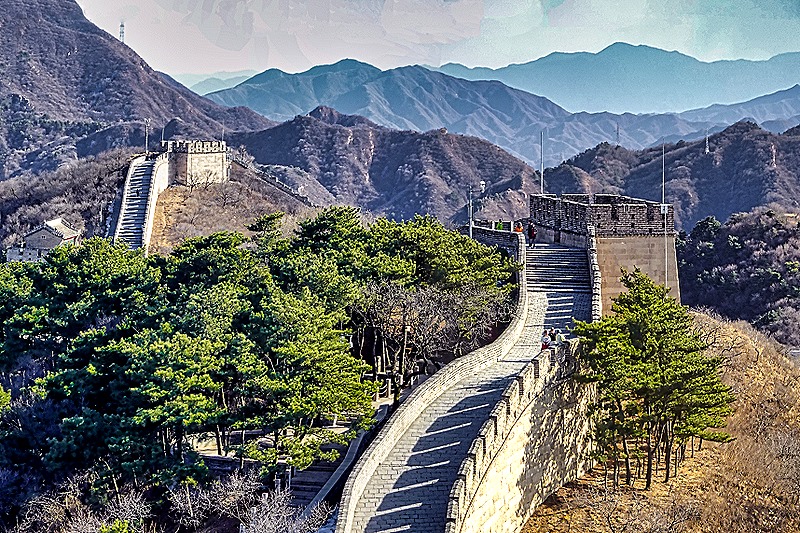
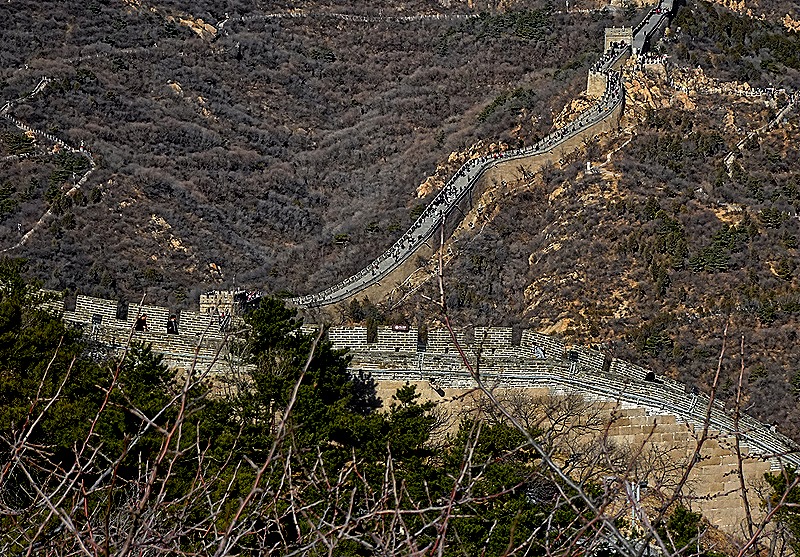
The Badaling section is the best restored and maintained portion of the Great Wall. Because of that, and because it is the closest to Beijing, it is often very crowded. In 2018, we have read, 10 million people visited this site and in 2019 a limit of 65,000 per day was instituted. We were extremely lucky in our visit, because not only did we have beautiful weather and clear air that allowed long distance viewing of other portions of the wall, but also (at least partially because we arrived in late afternoon) there were very few people other than our group in the area. A funicular here (this is the only section of the wall that has one) took us up the steep hill from the parking lot to just below the wall itself.





The Great Wall of China is more than 13,000 miles long. The first sections of the wall were built between the 8th and 5th centuries BCE, mostly of earth and stone. In the early 3d century BCE, however, the first emperor of a unified China had these walls destroyed because they were no longer at the border of his empire, and built new walls further north. Most of these ancient walls have eroded away long before now, with some of their materials carted away for use in other construction. In the 14th century CE the Ming dynasty began building a new wall along China’s northern border to defend against the Mongols. This wall was much stronger, built primarily of bricks and stone rather than packed earth. The Badaling section of the wall that we visited was built in 1504 and was the first section opened to the public in 1957. It is about 25 feet tall and 16 feet wide.
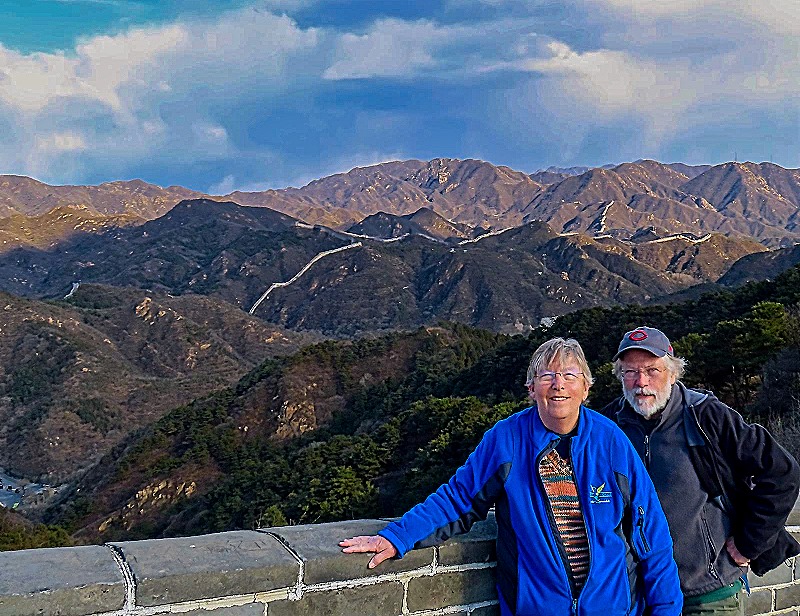
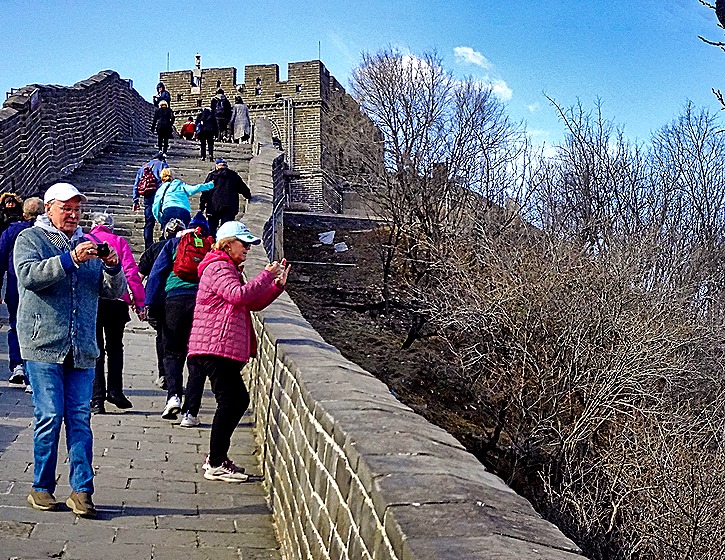


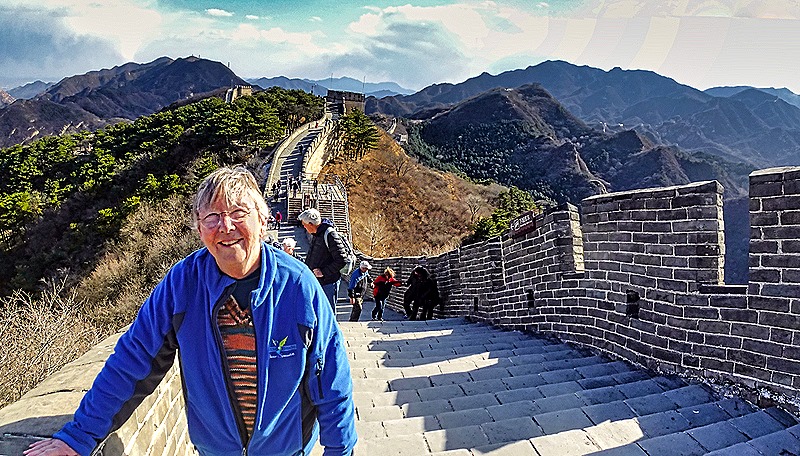
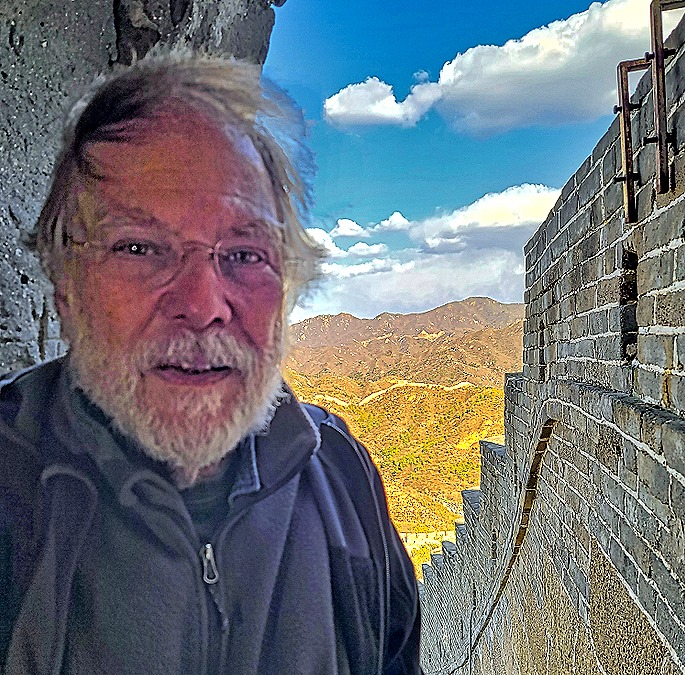
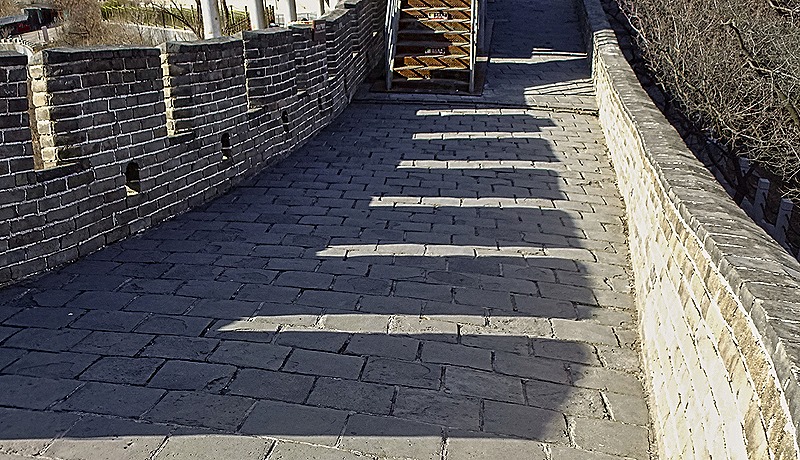
Note how few people are on the wall in these pictures; it almost seemed that the site had been reserved just for us! You can also see that the wall is crenelated on one side (which allows archers to fire through the openings without exposing themselves to enemy fire). Presumably the crenelated side faces away from China toward the enemy; the shadows show that this side faces west. This is very mountainous country and the wall undulates up and down with the hillsides. Among other things, this makes exploring the top of the wall challenging since it requires climbing some very steep inclines, steep enough to have steps in them. At the tops of the inclines are watchtowers and signal towers. . . tens of thousands of them across the entire distance of the wall.
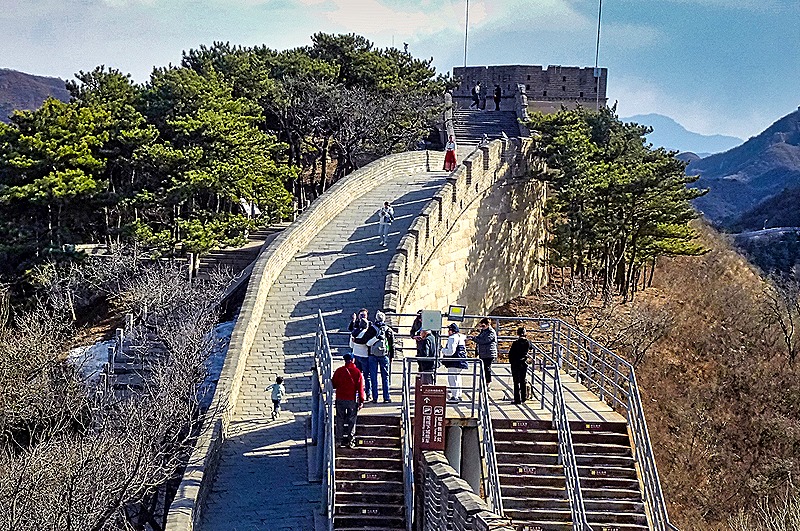
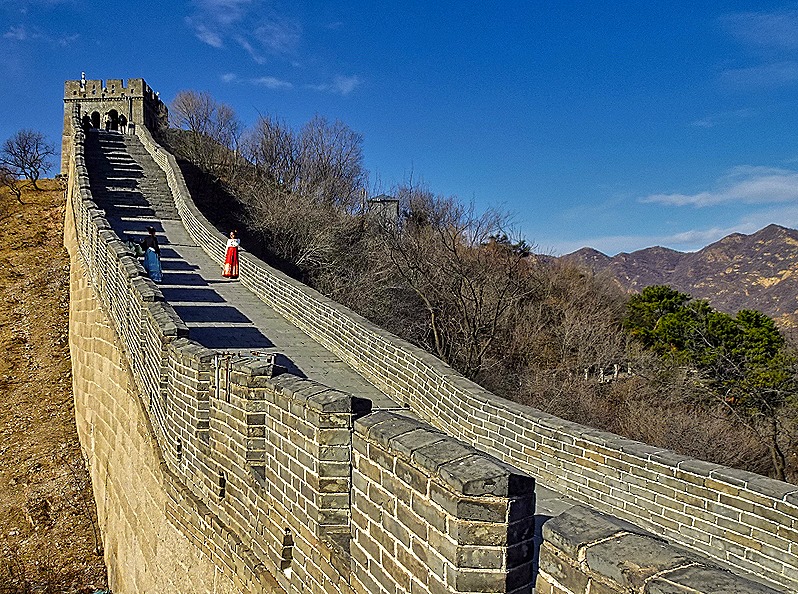
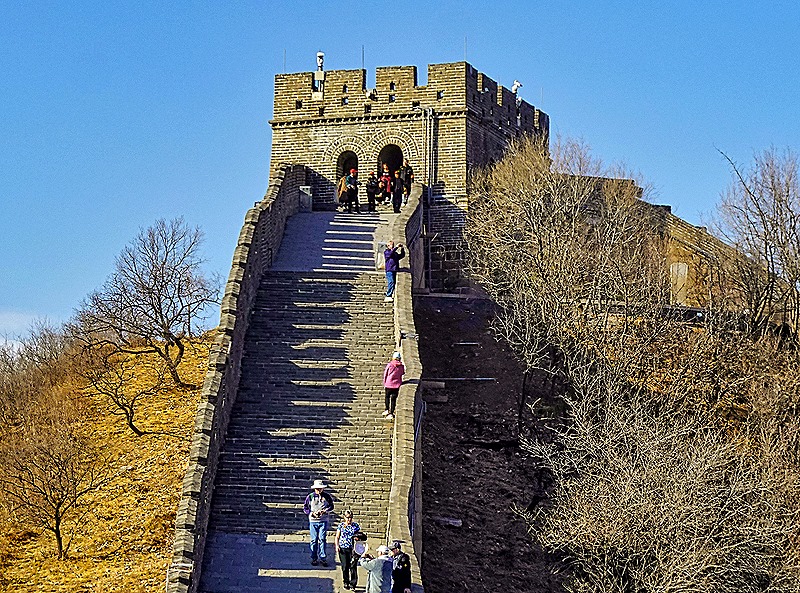
We did walk up and go inside this watchtower. Not much inside it today, but the views from the windows were interesting.


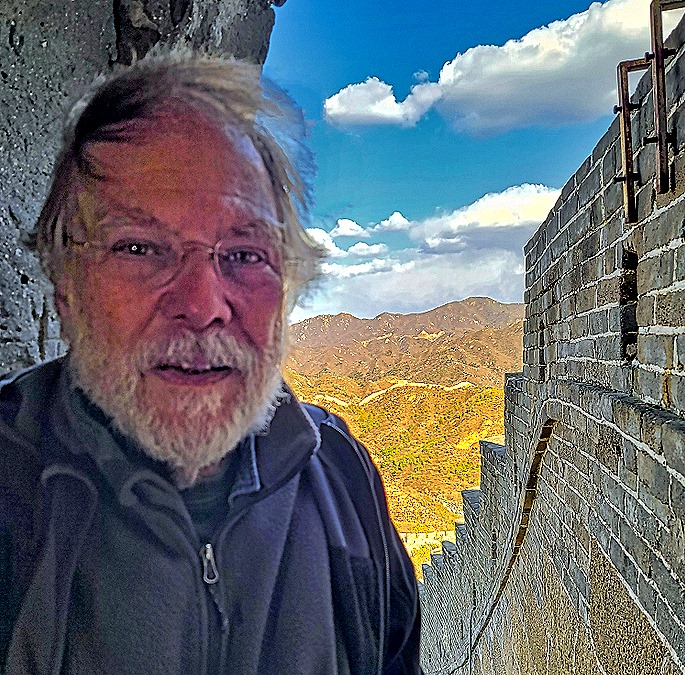

As seen in some of the pictures above, other sections of the wall could be seen in the distance from the top of the wall where we were. We aren’t sure how far away they are but they could be seen clearly on the day we visited.



The sun was dropping the whole time we were there and by the time we had to leave the shadows stretched almost to the opposite wall.
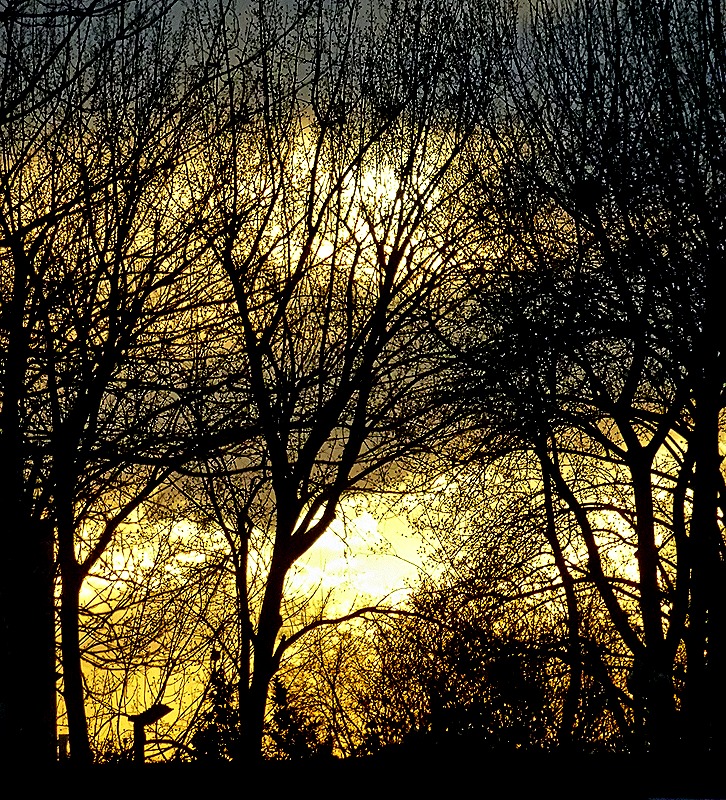
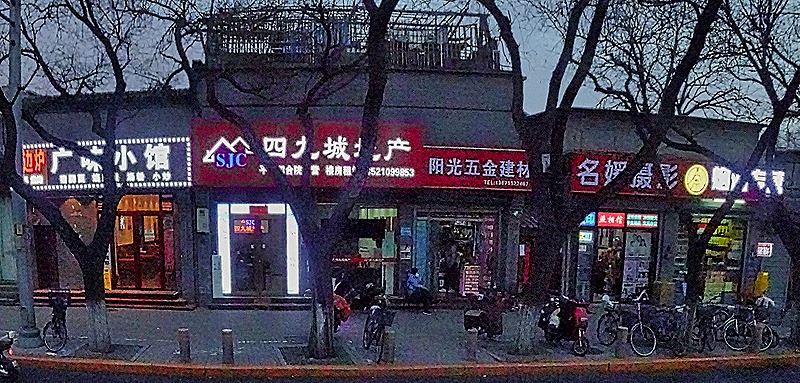
As we left we noticed a platform near the wall up on the mountain that appeared to serve as a cell tower, with a jumble of antennae. As we drove back toward Beijing we saw a fiery sunset through a leafless woods, then some lighted Chinese style buildings along the streets leading to our dinner restaurant.


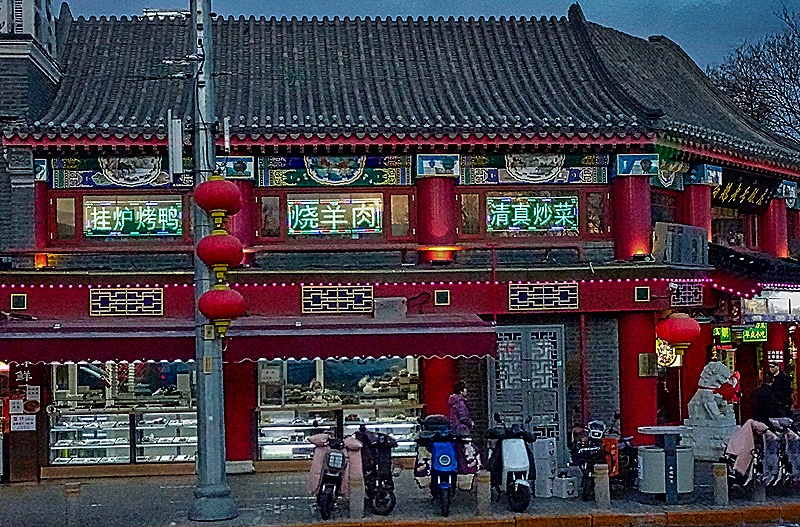


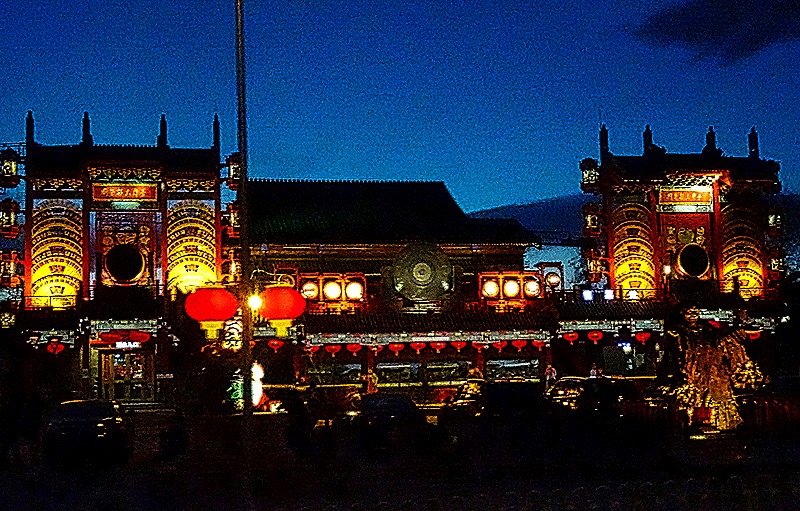
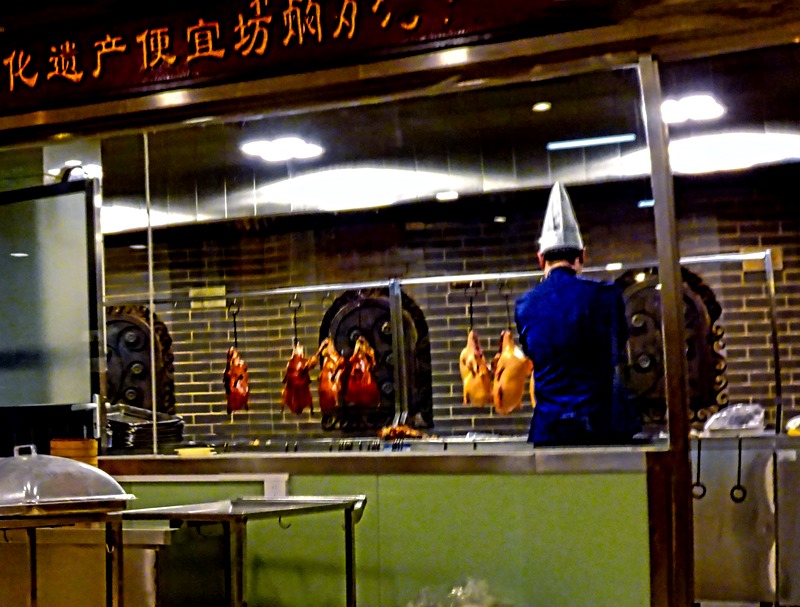
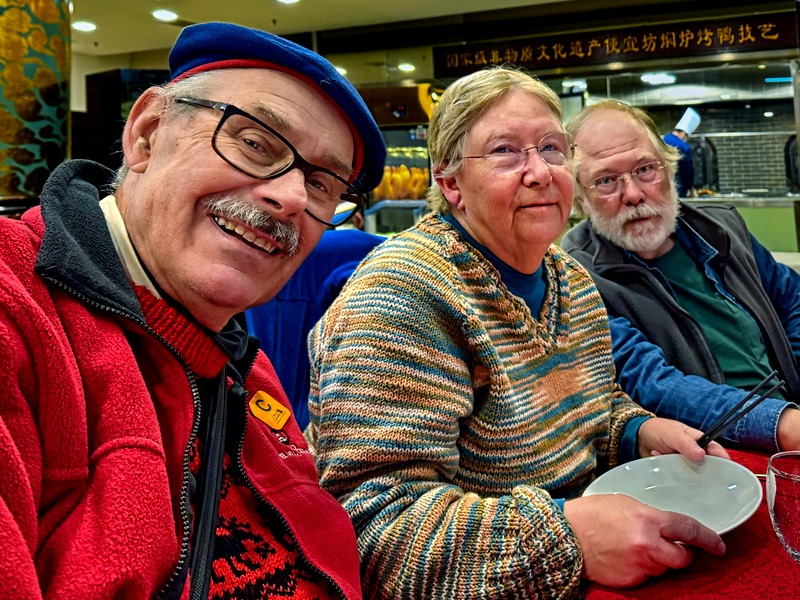
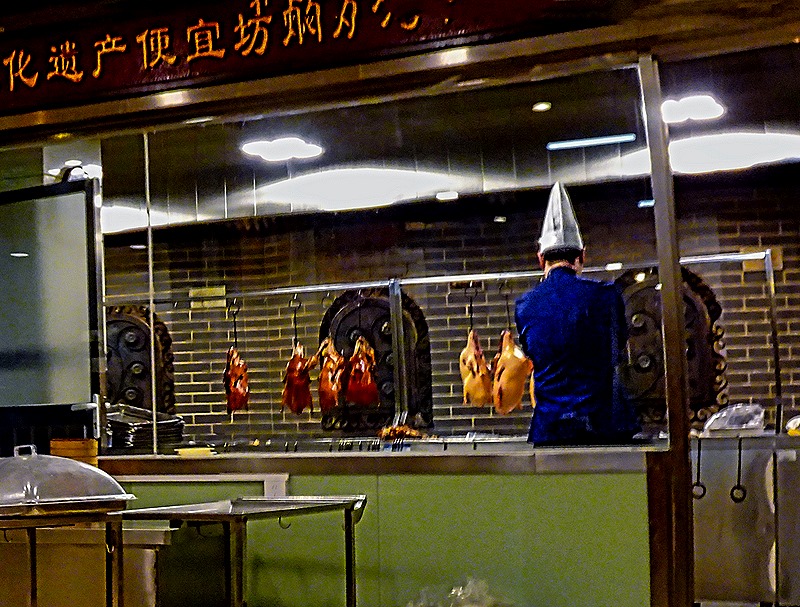
We had dinner in a Chinese restaurant where each large round table had a lazy susan in the center for sharing the many courses. The signature dish was Peking Duck (our guide explained that it is still called that even though the city is now Beijing). Many cooked ducks were hanging in the open kitchen and we watched the chef carving ducks not too far from our table. Yum.
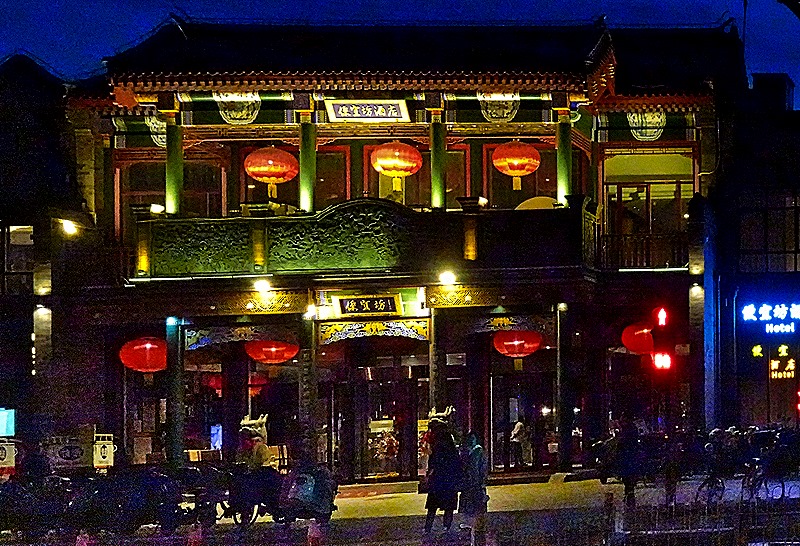
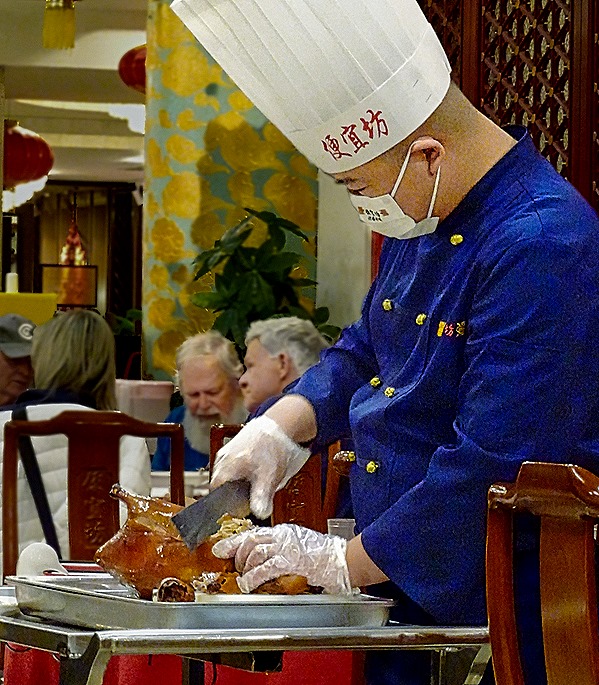

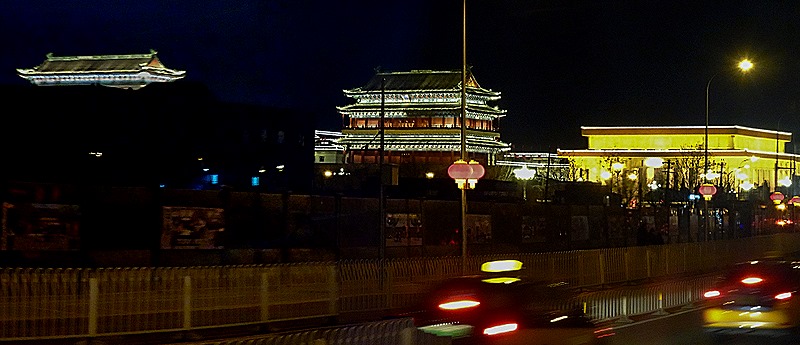
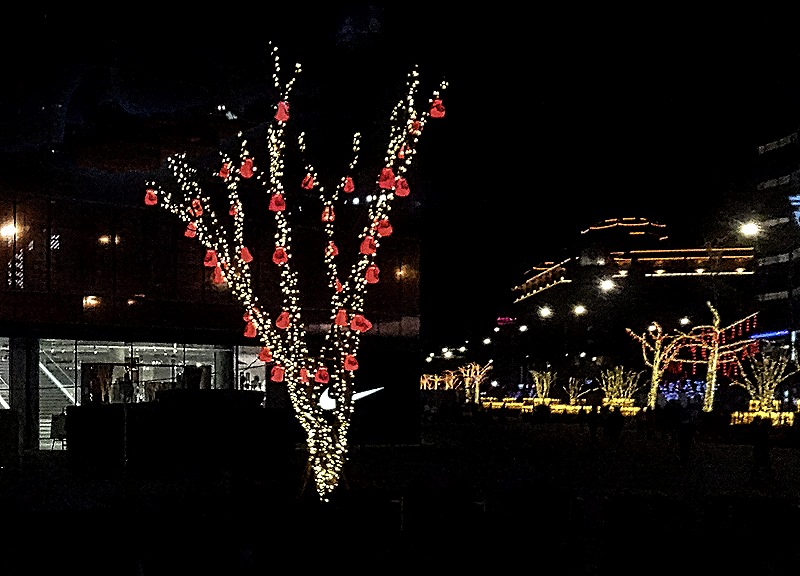
After our sumptuous dinner we drove to our hotel, the Regent Beijing, a luxury hotel not far from the Forbidden City. Again we passed through streets with lighted buildings and some lighted trees. Notably in the first picture the building on the right is a back view of Mao Zedong’s mausoleum and next to it is Qian Men gate, the front entrance to Tiananmen Square. We haven’t identified the third building whose lighted roof is further to the left, but it might be the archery tower associated with the Quian Men gate. The last picture in this group is a view through our hotel window of the lighted street below.


 We had a very nice hotel room but we did not stay up late to enjoy it because in the morning after breakfast we were scheduled to leave at 7:30 AM. It would be a long and enriching day.
Dalian, China 2024
We spent March 10 in Dalian, the largest passenger port in China, located on the shore of the Yellow Sea at the southern end of the Liaodong Peninsula. With a population between 7 and 8 million people, this is another to add to the long list of huge cities we have visited we didn’t know about until they appeared on our itinerary. While this area was home to fishing villages for centuries, the city was not founded until the Russians took control in 1895 and began to build a modern naval port to be the home of its Pacific fleet because this was the northernmost ice free coastal site in the western Pacific. The Russians built a town they called Dalniy (“far away”) and modernized the nearby Port Arthur for its Asian fleet.
Port Arthur (named for a 19th century British naval officer, perhaps during the short British occupation in 1858 during the 2d Opium War) was the focus of the Russo-Japanese war that ended in 1905 after the Japanese defeated the Russian navy here. This was a shock, because Russia was a European major power and Japan had only begun modernizing 50 years before. Japan was ceded control of the peninsula in the Treaty of Portsmouth. After the end of World War II China regained sovereignty over the area, although the Soviet military did not leave until 1955. In 1950 Lushun (formerly Port Arthur) was merged with Dalian to form a city called Luda, whose name reverted to Dalian in 1981. So, although we had not heard of Dalian before this trip, we had known about Port Arthur, which is now a district of Dalian.
There was a shuttle available to downtown Dalian (a long walk away), but as mentioned in the previous post of our first day in Shanghai – https://baderjournal.com/2024/08/16/shanghai-china-day-1-2024/ – because we had not gotten Chinese visas we could only leave the ship on a HAL sponsored excursion (or one operated by someone approved for the purpose by the Chinese government). But HAL (Holland America) was only offering 3 excursions, all less than 4 hours long, so there was not much to choose from. We surely wanted to see what we could of the city rather than spend the day on the ship, so we signed up for the longest of HAL’s excursions as soon as the visa-free program was announced (we think we were the last to get places on this tour). So off we went in the morning after breakfast, driving through a city that turned out to be full of tall skyscrapers and open city parks.
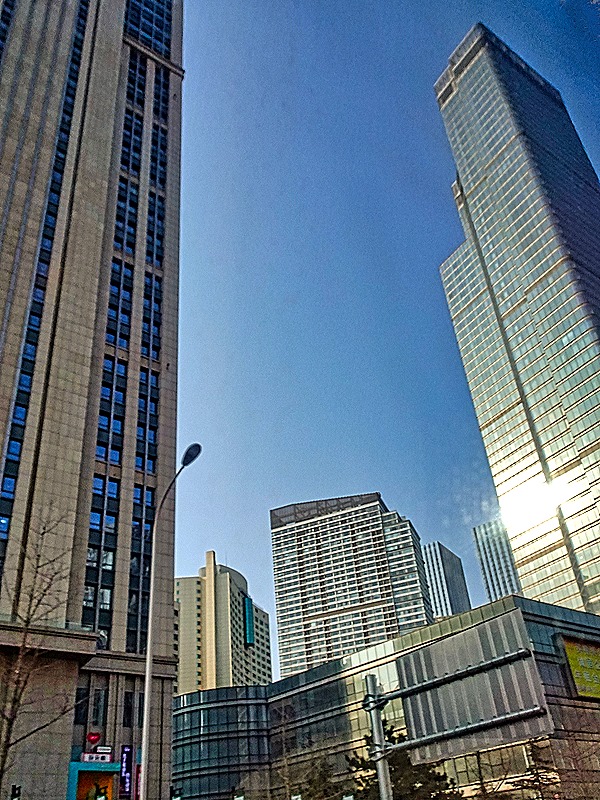
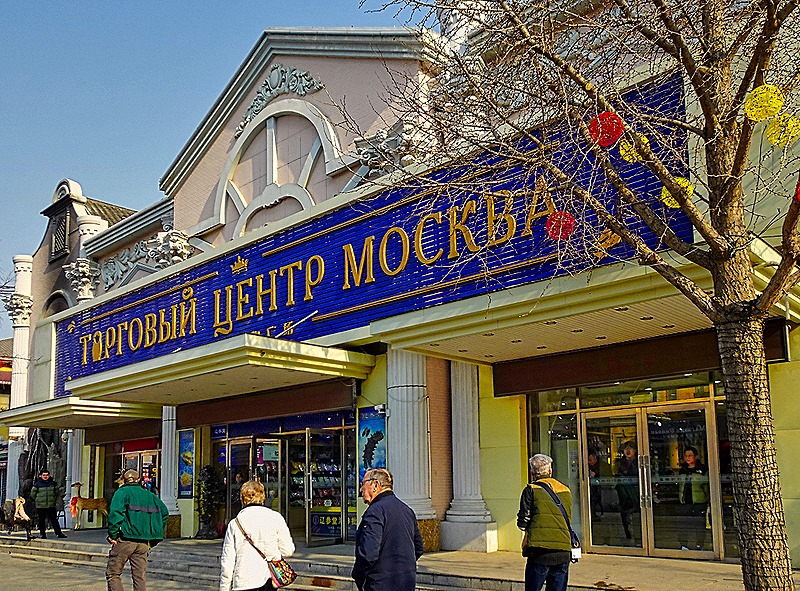
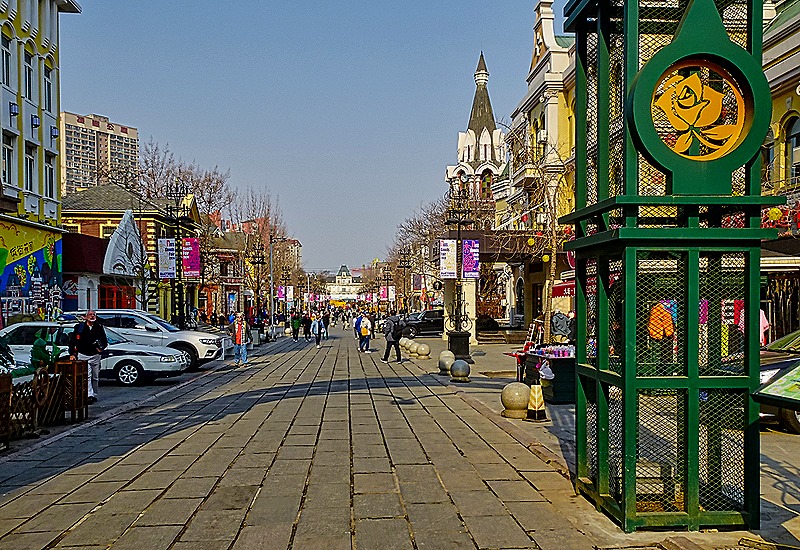
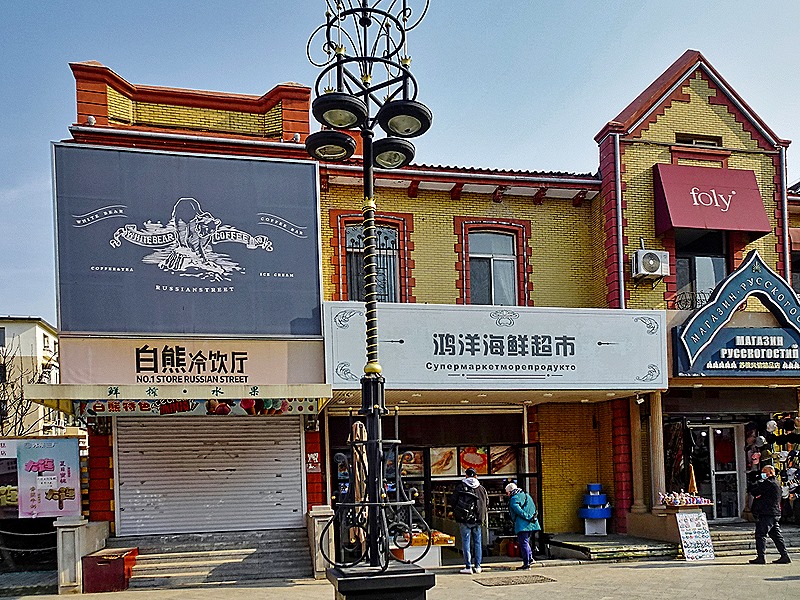
Dalian was originally built by the Russians beginning in 1895 and named Dalniy, replacing a small town called Qingniwa. Russian Culture Street, which we visited first, is the oldest street in town. Several of the buildings erected by the Russians were still there in 1999 when Bo Xilai, the mayor of Dalian, began the project to restore this district. Russian architects were employed to renovate eight old Russian buildings, add so-called Russian facades to six other buildings and build six new buildings in a Russian style. For the most part we don’t know which buildings are old and which are new, but none of them look Chinese (except for the signs outside them in Chinese). The area is somewhat atmospheric, but also highly commercial with many vendors selling tourist items you might expect to see in Eastern Europe rather than in China. We reached Russian Street through a side entrance, walking under a sign that is apparently lighted at night.


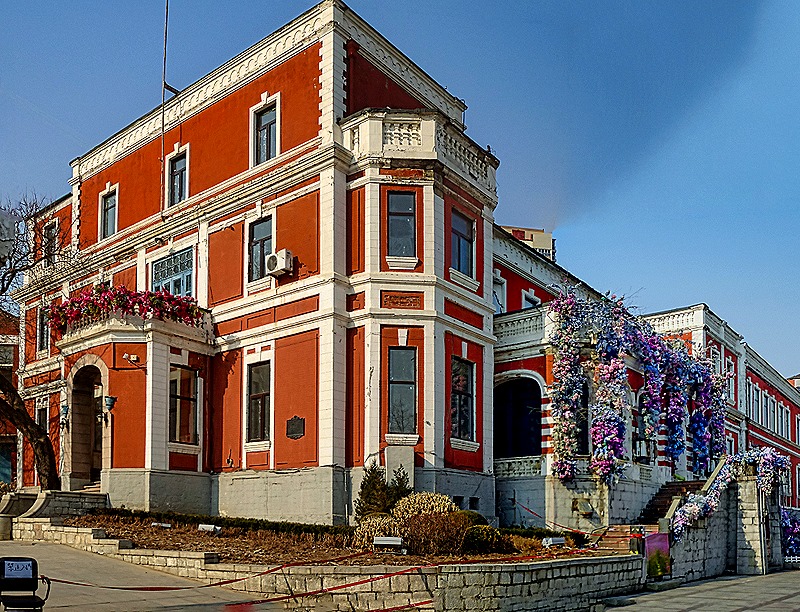
We saw some buildings seemingly dressed up for an occasion, such as with flower arrangements, but we don’t know what the occasion might have been. Maybe it was for our ship’s visit to Dalian . . . we were told we were the first cruise ship to stop here since the pandemic. Or maybe they keep it that way all the time to help attract tourists.


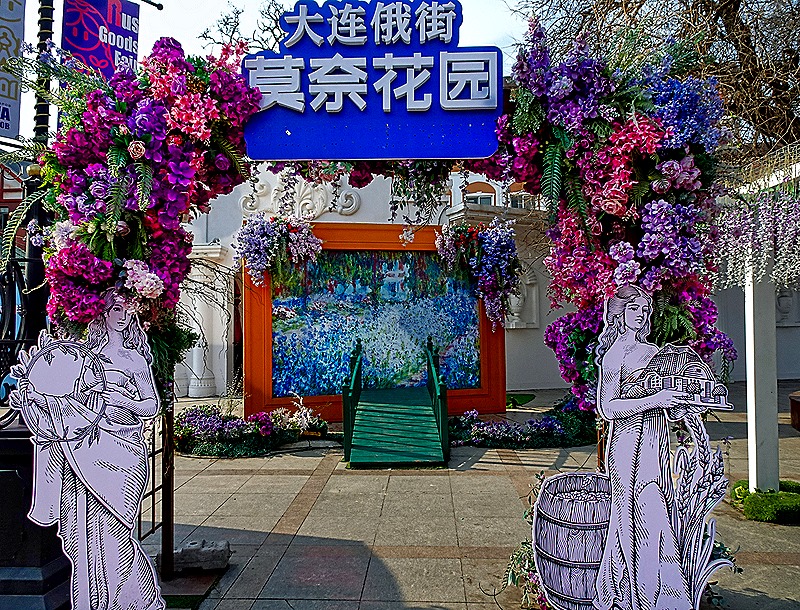
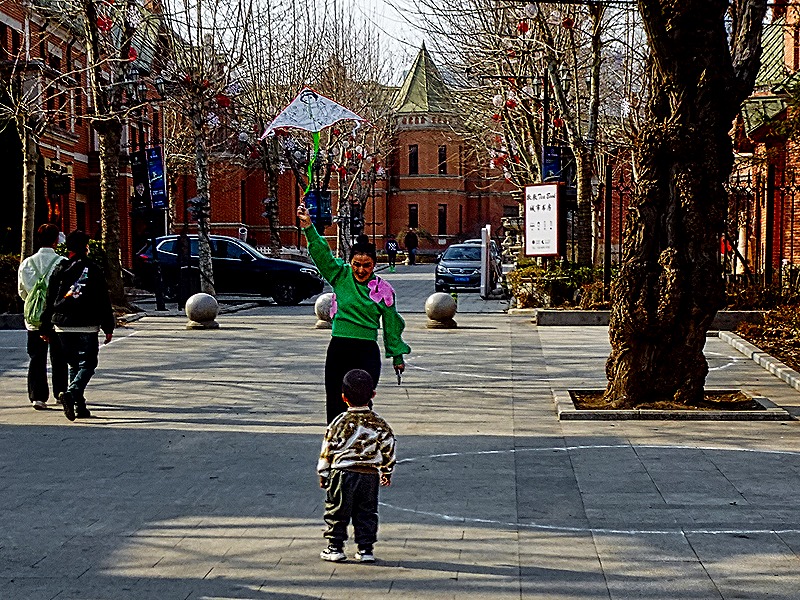
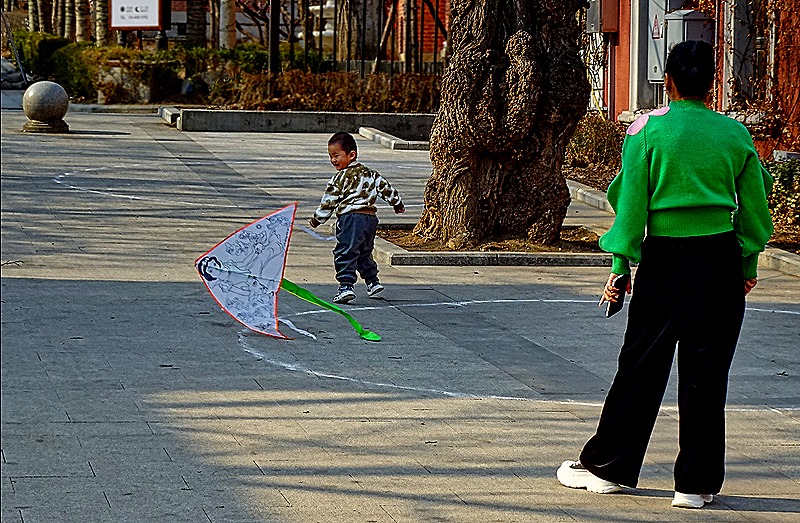
It was Sunday morning and bright and sunny (but rather cold) so as time went on more and more people were out and about. We stopped to watch a mother trying to teach her son (presumably) how to fly a kite.

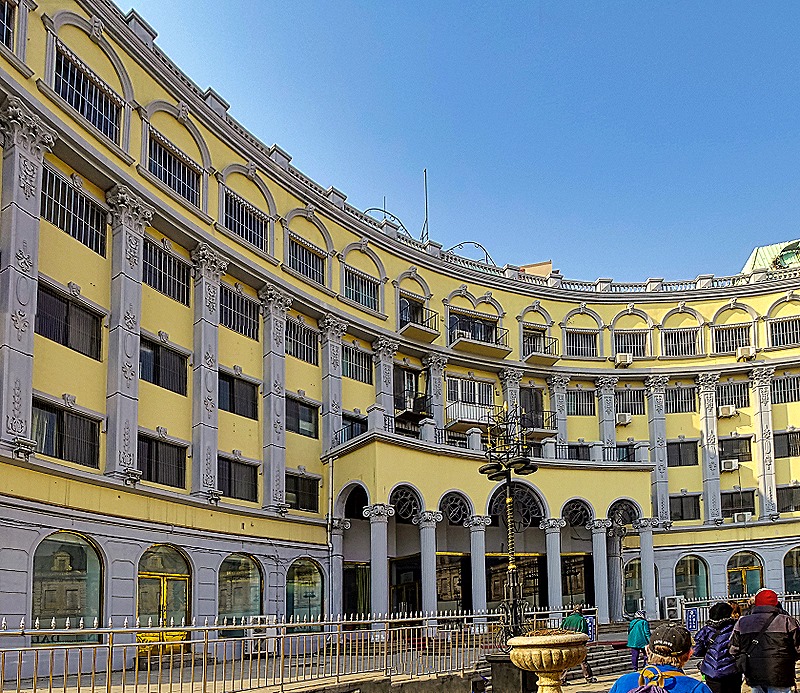
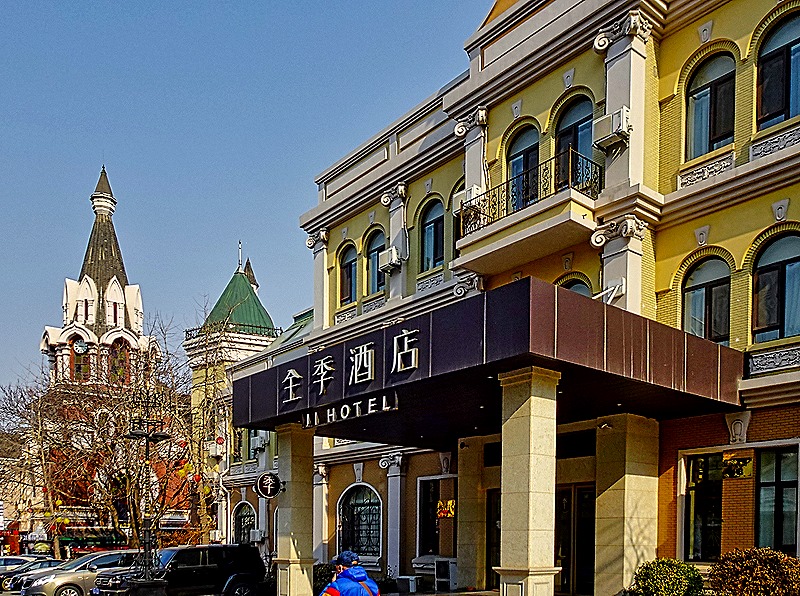
We didn’t get a lot of guidance from our very young guides about where to see original buildings or what their identity was. But we did walk past a Russian Orthodox church we think was old and a large curving building that might once have been a hotel.


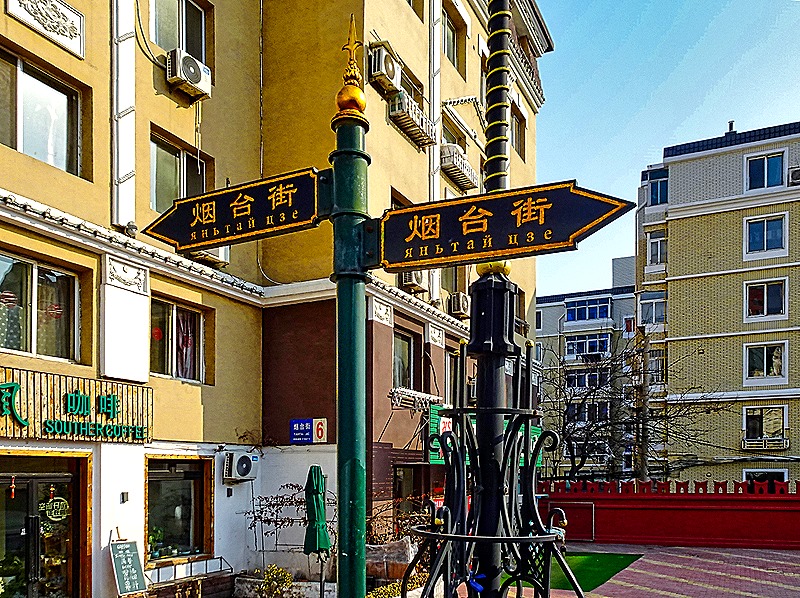
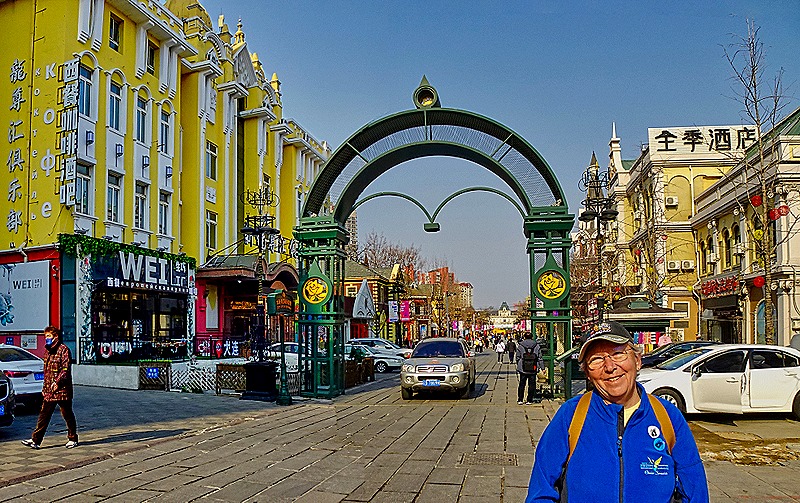
We spotted the main entrance to the Russian street and walked over to take a look. The large arched sign was over a wide avenue leading straight to the original Russian city hall. There was a big crowd there (and we didn’t know what that building was at the time) so we didn’t get close to it. If we had, we would have seen that it is much bigger than this picture seems, stretching out to the right and left.

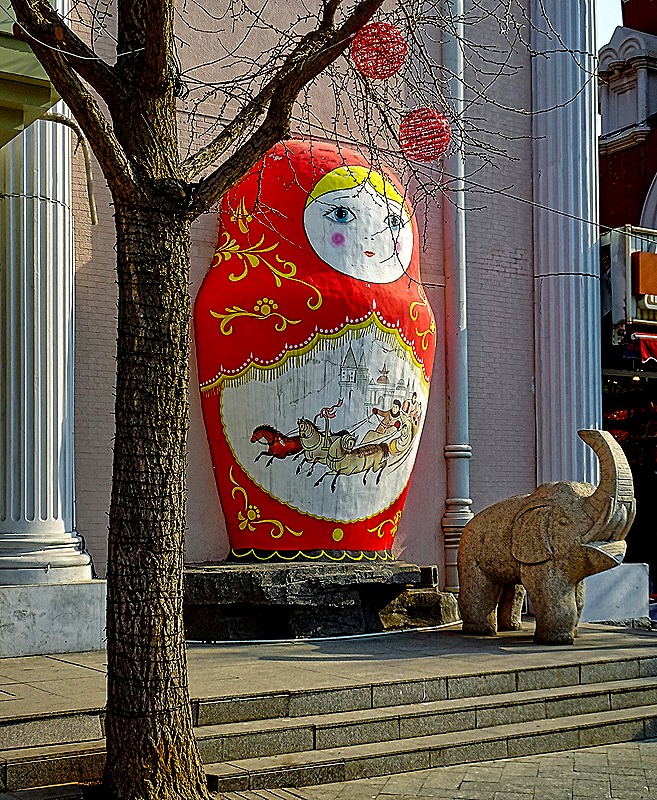
Finally, a few more random pictures of unidentified buildings, one of which had a large sculpture of a Russian nesting doll in front (along with a small elephant?). A lot of the trees in this area were decorated with what looked like balloons in red and yellow, all in all quite festive looking.


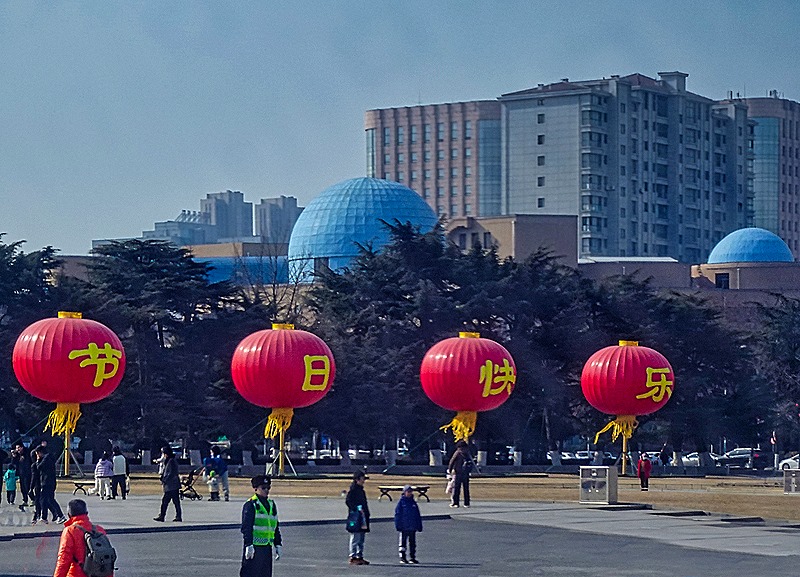
As we drove through town to our next destination we noticed that the whole town seemed brightly decorated with red lanterns and balls (balloons?). Among other things, we passed what we think is Olympic square, built in 1998 in anticipation of the 2008 Beijing Olympics.

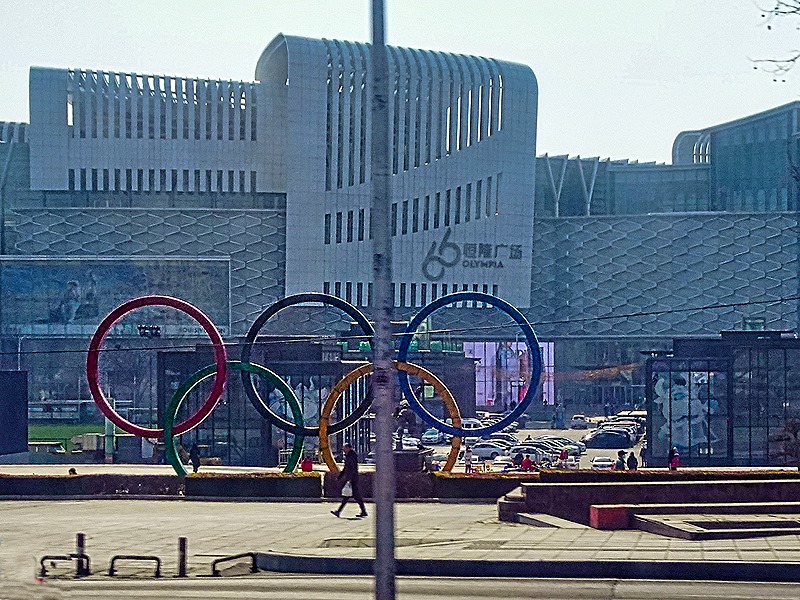
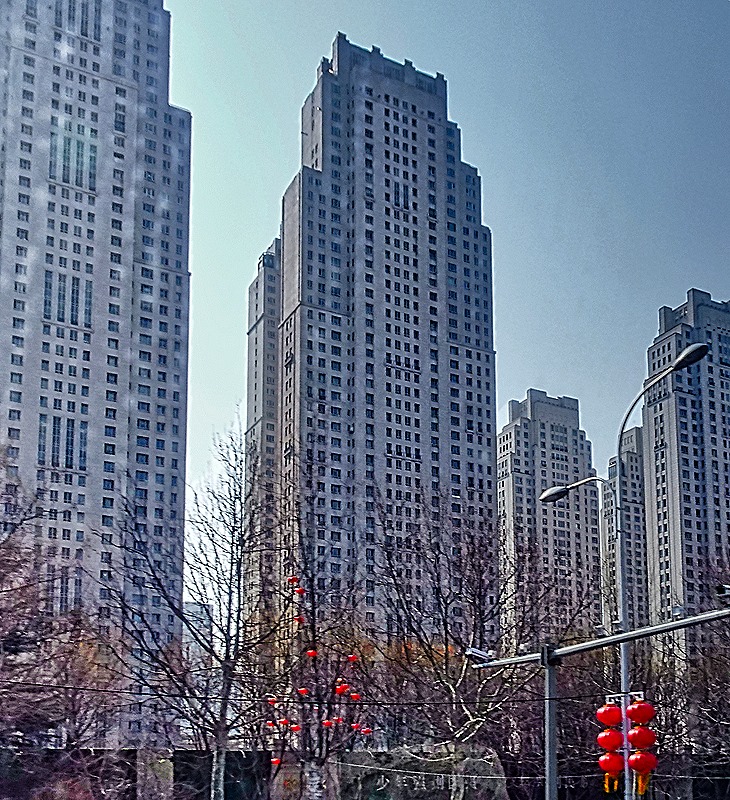
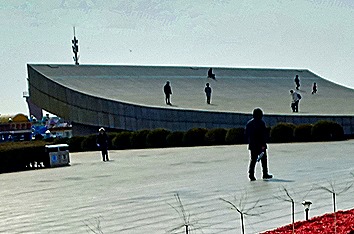
Xinghai Square in Dalian is the largest city square in the world with a total area of 270 acres, all of it reclaimed land. Its name means “the Sea of Stars.” We aren’t sure what the definition of “city square” is, but Central Park in New York is three times as big. Xinghai Square was built to commemorate the return of Hong Kong to China and opened in 1997. At the edge of the water is the Centennial City Sculpture, a huge stone sculpture of a book lying open on the ground, with its ends curling upward. It provides a large space for people to walk on and take in the view of the Xinghai Bay Bridge across the water.


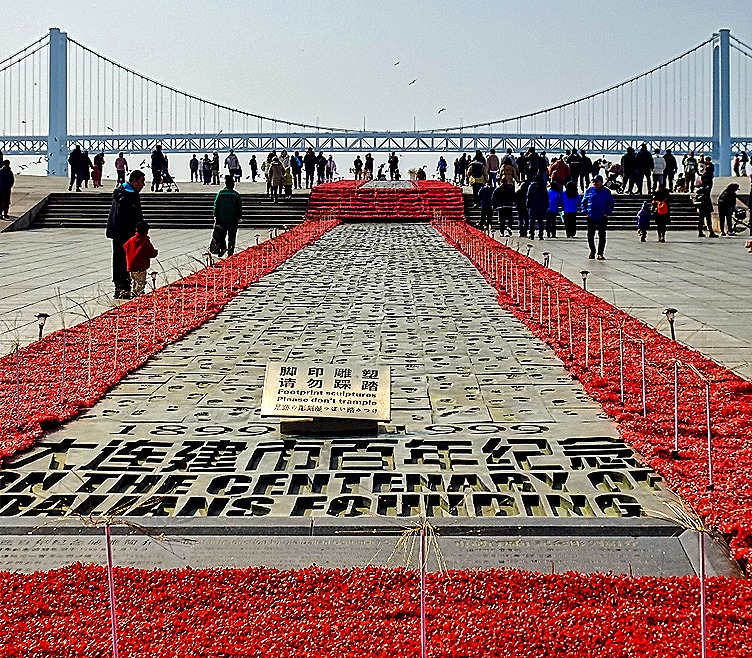
Leading up to the Centennial City Sculpture from the square’s interior is the long and low copper Sculpture of 1000 Footprints. It was completed in 1999, marking the centenary of the city’s founding. The footprints were made by Dalian citizens, starting with people born in 1899 and progressing toward the water with footprints of people born in 1999 at the end. Also at the end is a sculpture of two children who appear to be playing in the surf. When we were there it was surrounded by what looked from a distance like a bed of red flowers, but on closer inspection it appears to be some kind of carpet (look closely in the pictures and you can see some wrinkles).
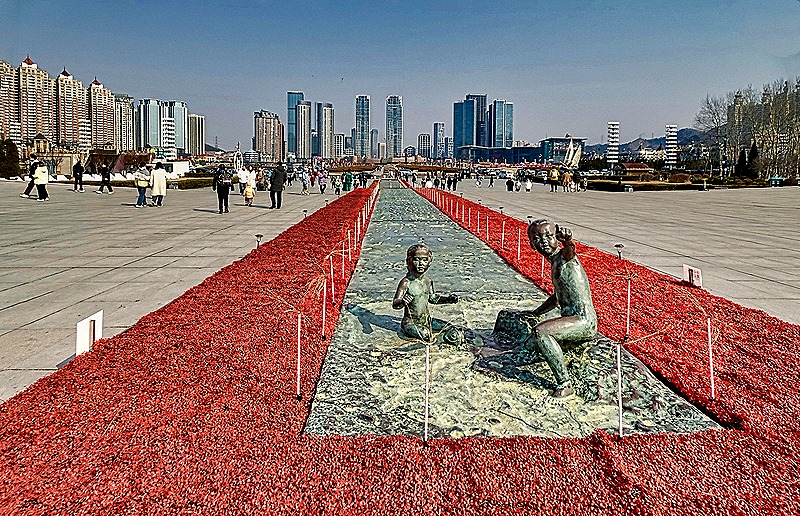

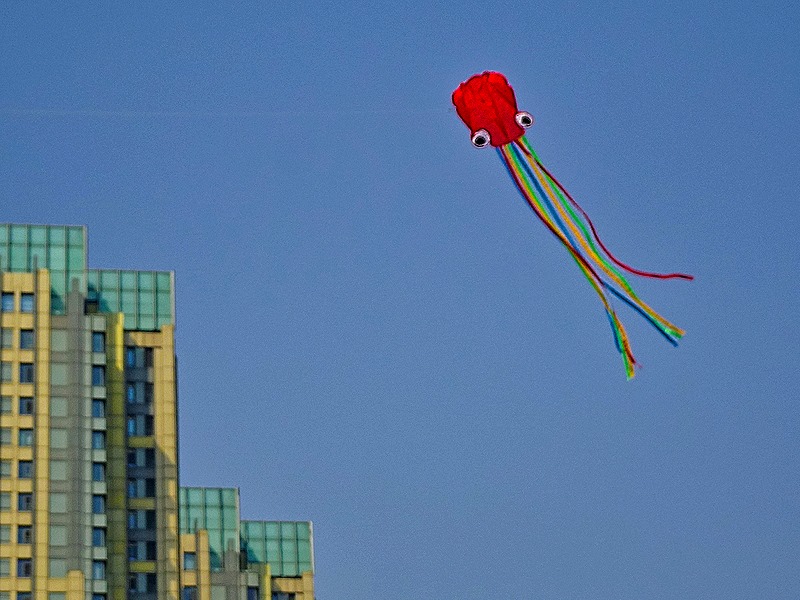
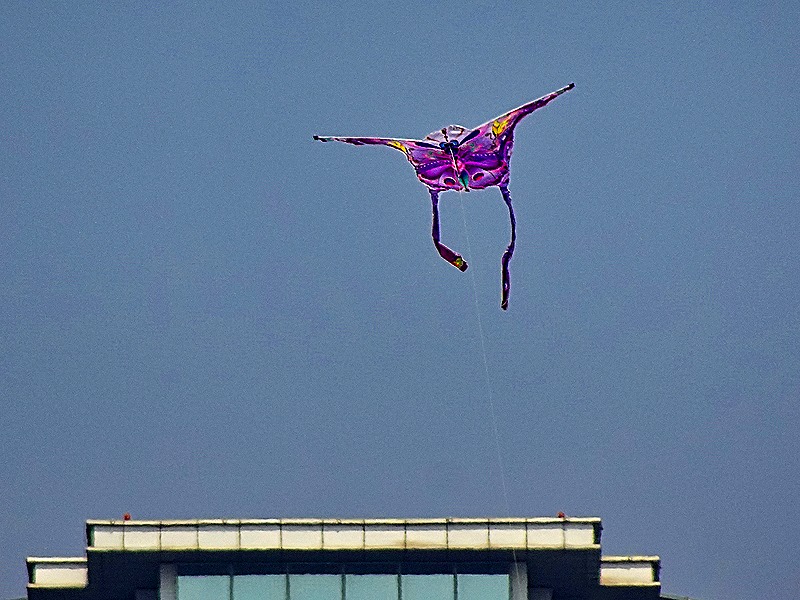
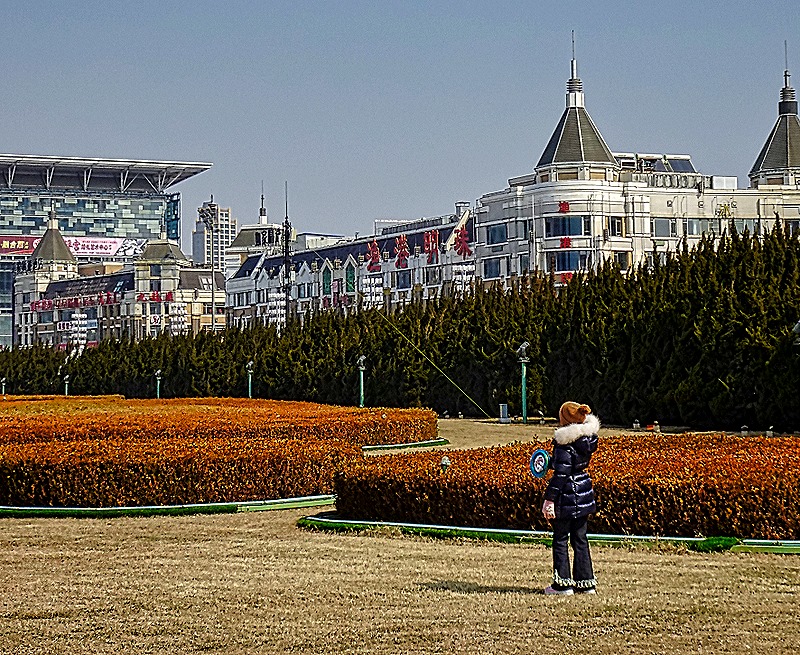
The square has a very large lawn area and is landscaped in bushes which, at least when we were there, were red. The red bushes really stood out against the yellow grass. Kite flying seems to be popular in Dalian; we saw a number of people flying kites, many quite high in the air.
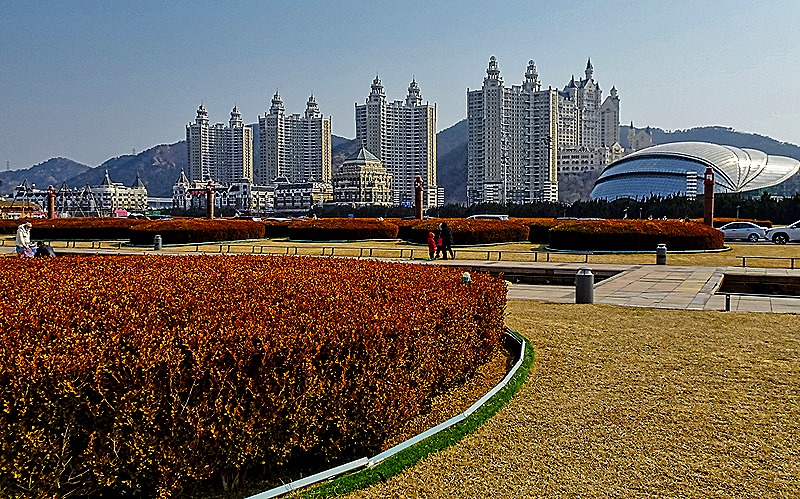

On one side of the square is the Dalian Shell Museum, opened in 2015. The building is shaped like a clam shell, slightly opened where the windows are placed. Next to it is the colorful Xinghai Bay Amusement Park.
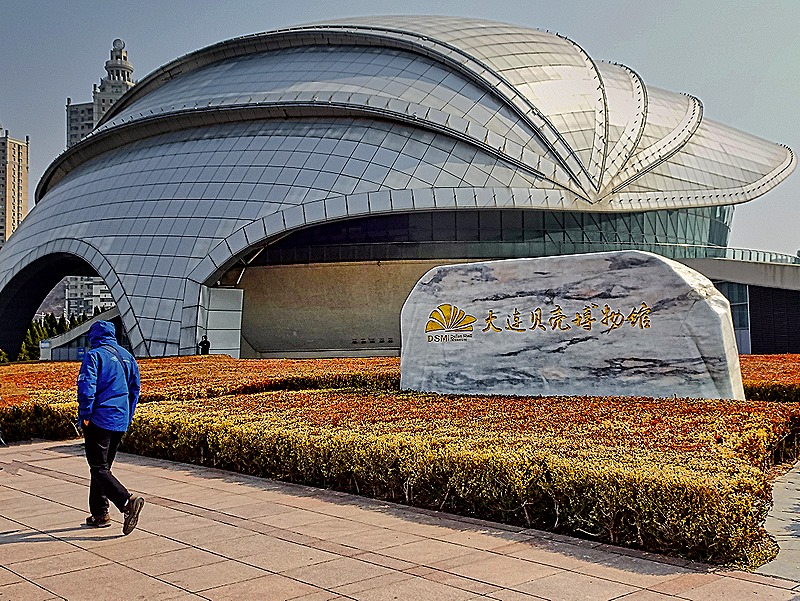

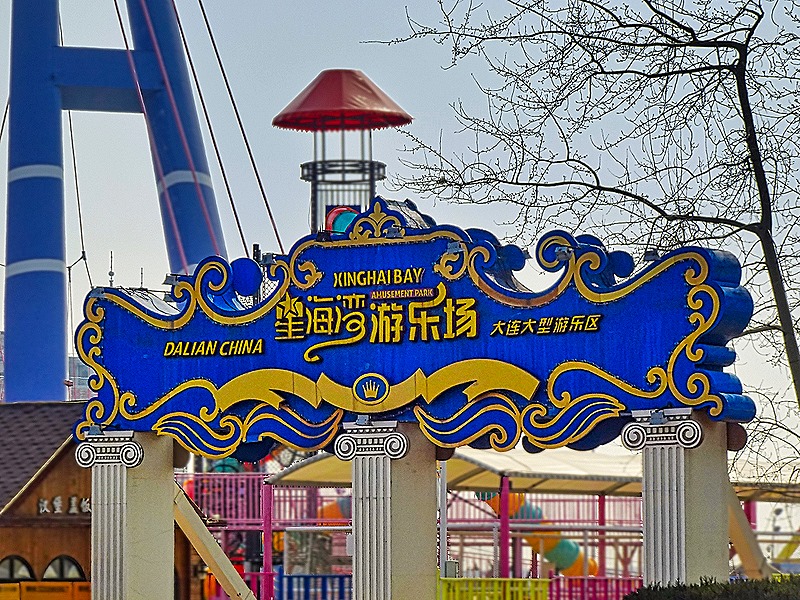

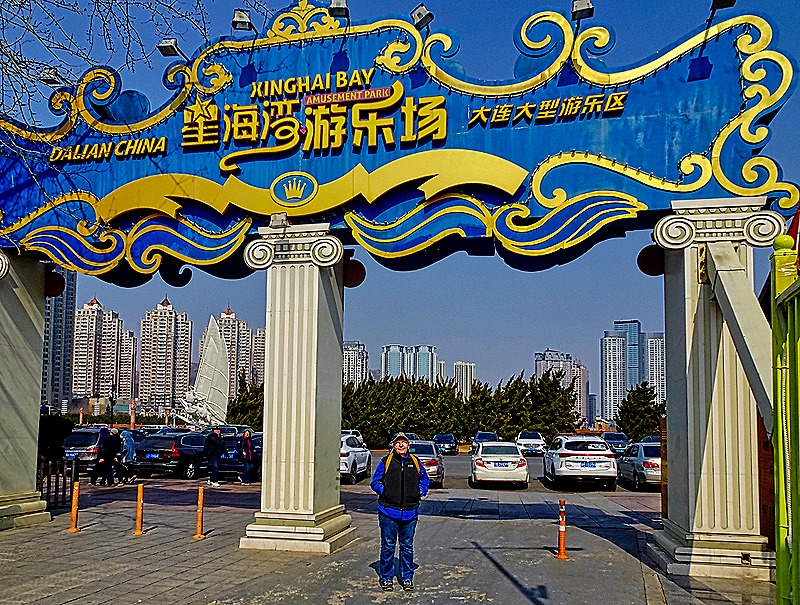
Most of the periphery of the park on the land sides was surrounded by tall buildings, reminding us of the view on the edges of Central Park in New York. In the business center area north of the park many of the buildings were glass and steel, but on other sides were a lot that looked like an older style made of concrete. Several of these rows of buildings appear in the pictures above. Most notable to us was a building that looked like an old European castle on a hill, appropriately called the Castle Hotel. Despite its appearance this hotel is only 10 years old.


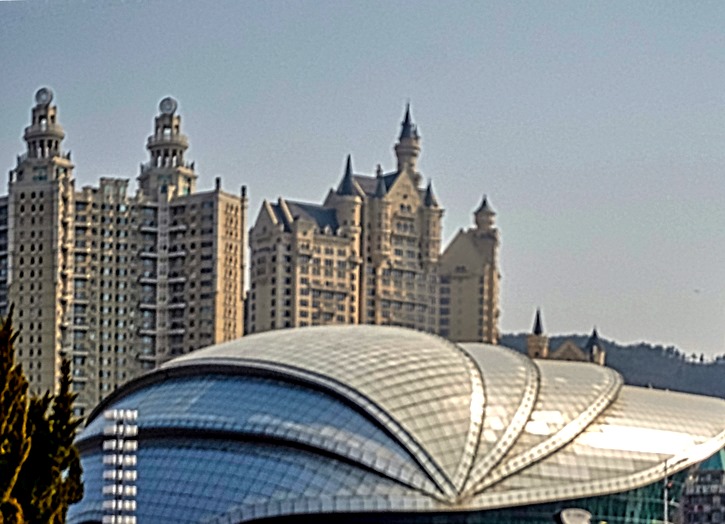
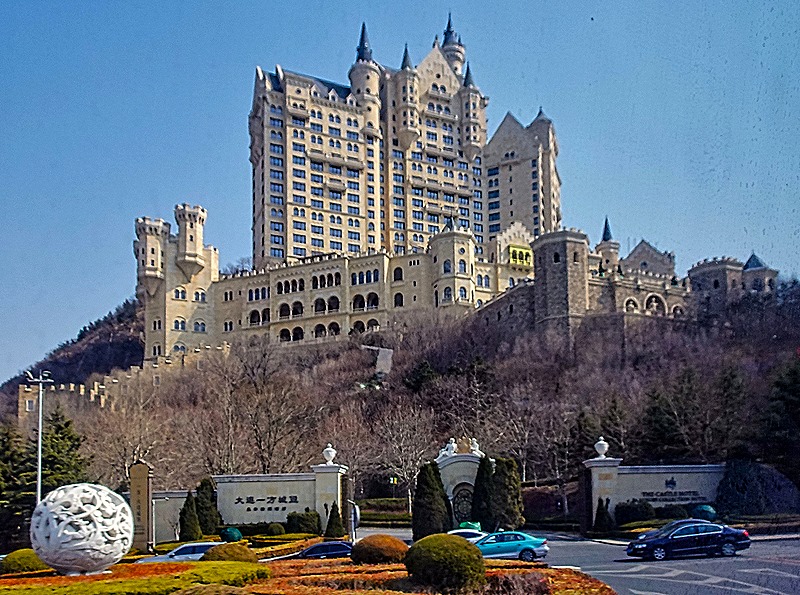
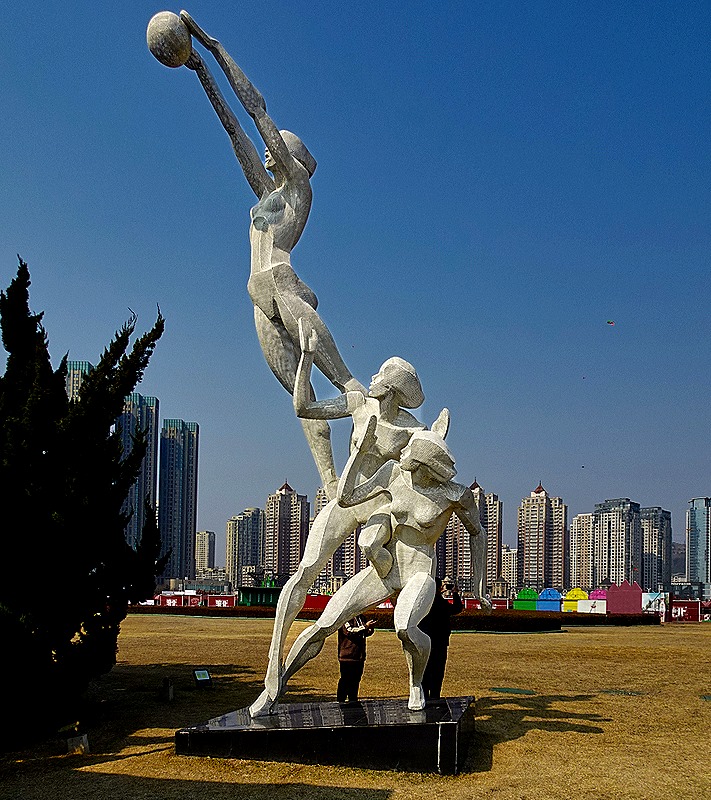
Finally (of the things we saw in the square), there are thirty groups of white steel mesh sculptures surrounding the square. Constructed for the 2008 Olympics, they depict athletes in action in a variety of sports. We only saw a few, but they were striking. Lighted at night they are probably even more striking. We also happened upon a pair of equestrian sculptures, but they weren’t of the mesh variety.
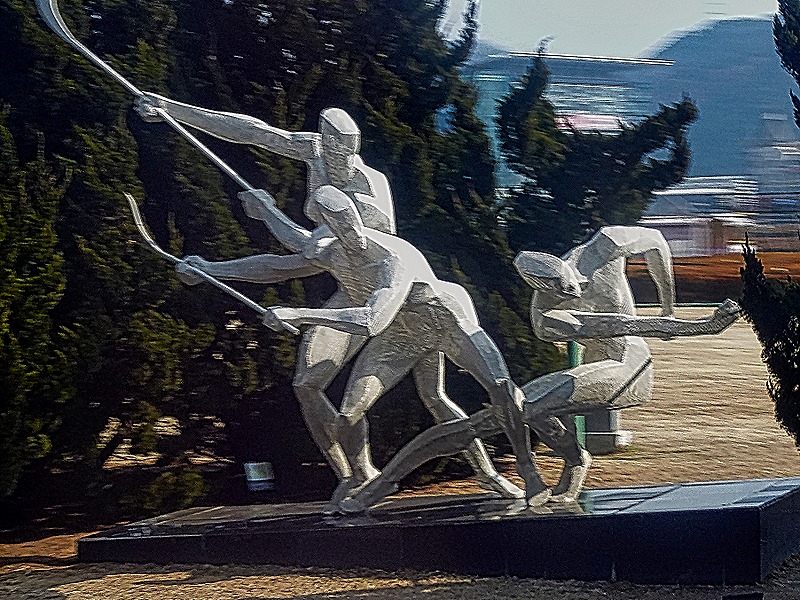


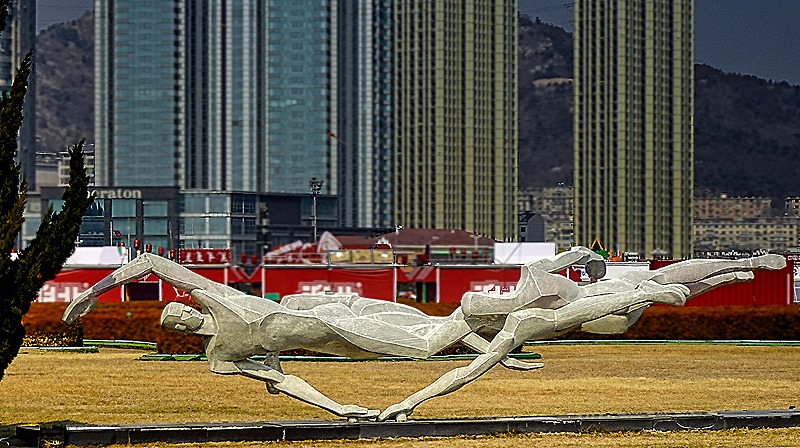
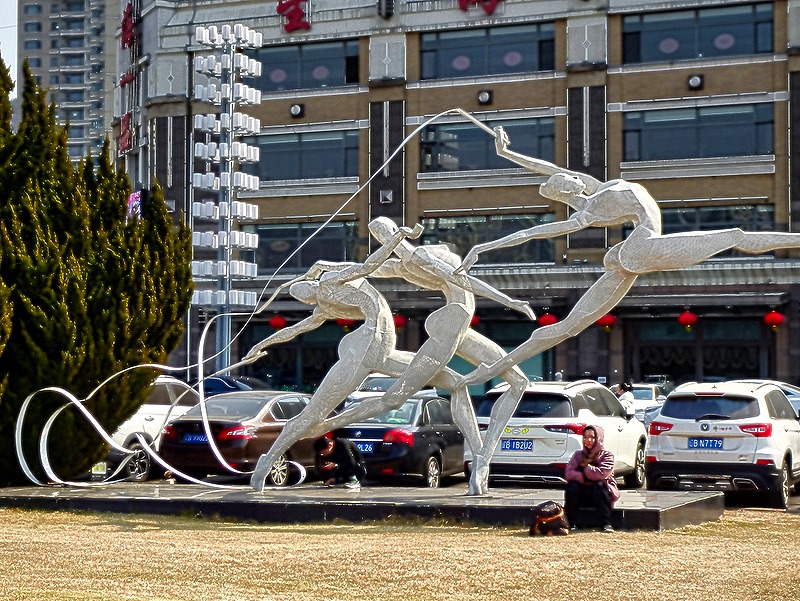

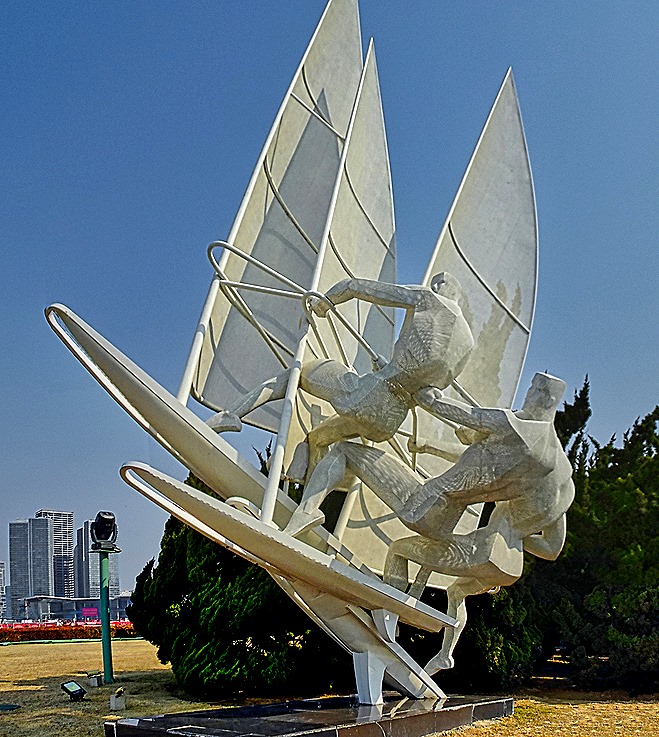

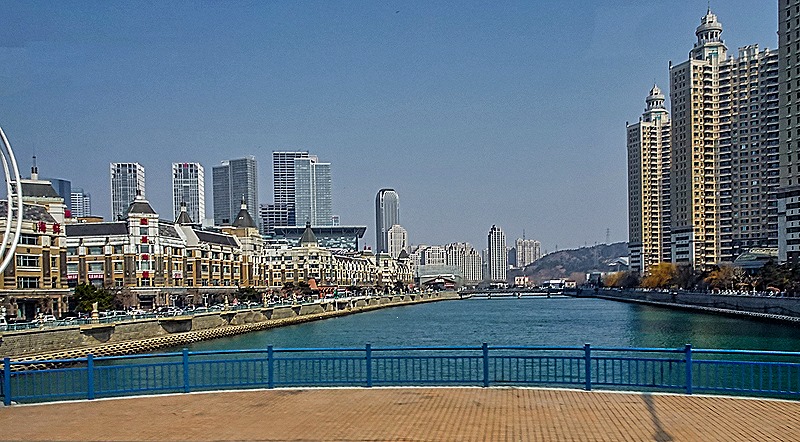
As we drove away from the square we passed a river or canal lined with tall buildings and an interesting green and white skyscraper.

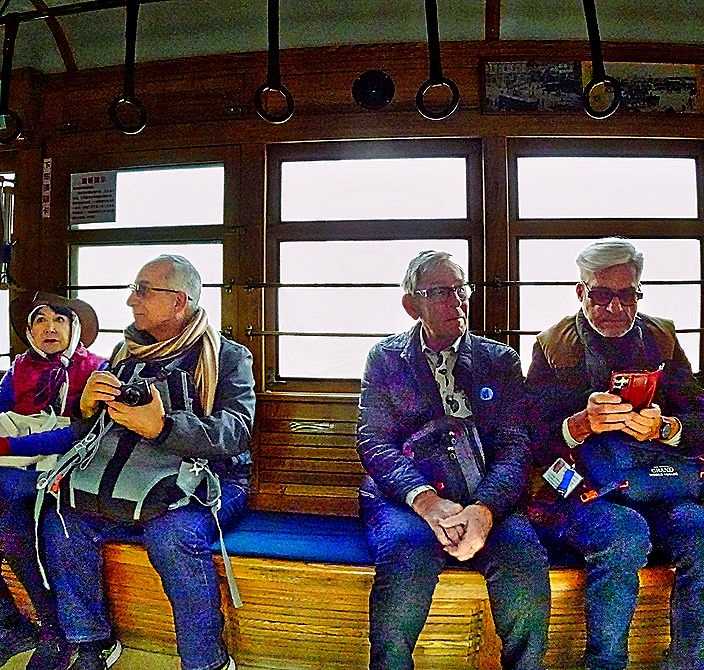
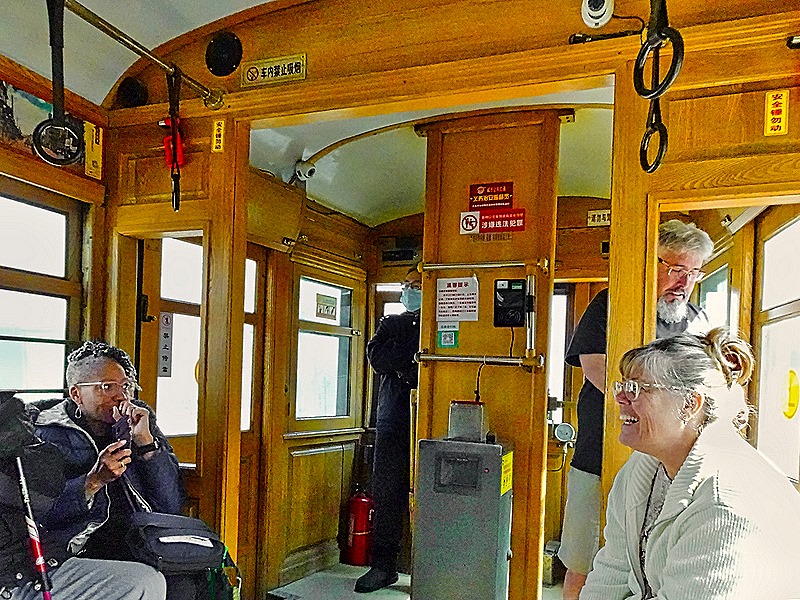
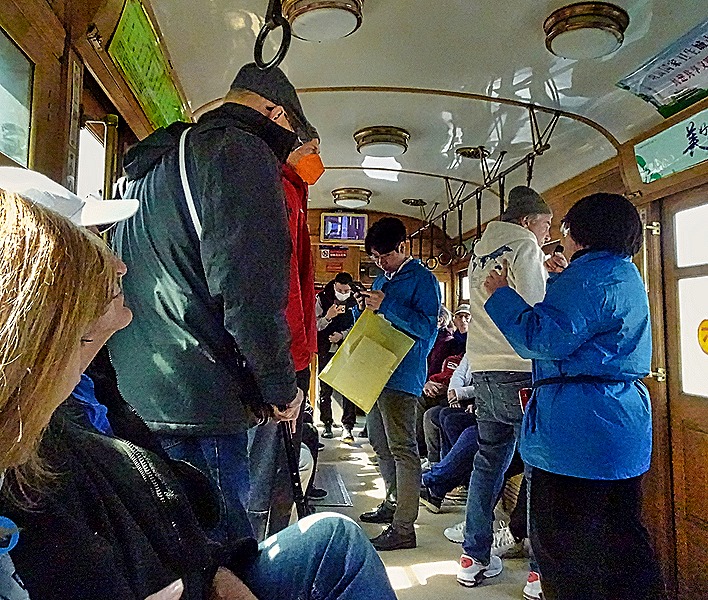
Dalian’s first municipal tram line opened in 1909 while it was under Japanese control. By the end of World War II eleven tram lines were in operation. During urban renewal in the 1970’s most of the tram lines were removed and today there are only two. A ride on the tram was the last event on our excursion.
Reading the excursion description we (or at least Rick) had envisioned riding on an overpass or along the side of a hill with a panorama of the city out the window. It didn’t really say that explicitly, but that was what we were hoping for. Alas, no. This is an old fashioned urban tram, running (slowly) on tracks laid out on city streets, with little to see out the windows to the sides. And the ride only seemed to be about a mile in length. Our excursion was led by two very young guides, maybe 20 or so, who spoke excellent English but did not seem very experienced. They told us afterward that they had been very nervous about this excursion because we were the first cruise ship in town since the pandemic. If we were correct in our perception of their very young ages that means they probably had been too young to have done this before. The young woman guide had a microphone and did an explanation during our tram ride. She was quite articulate and had obviously prepared carefully for this. The guides were delightful, but the tram ride itself was disappointing.

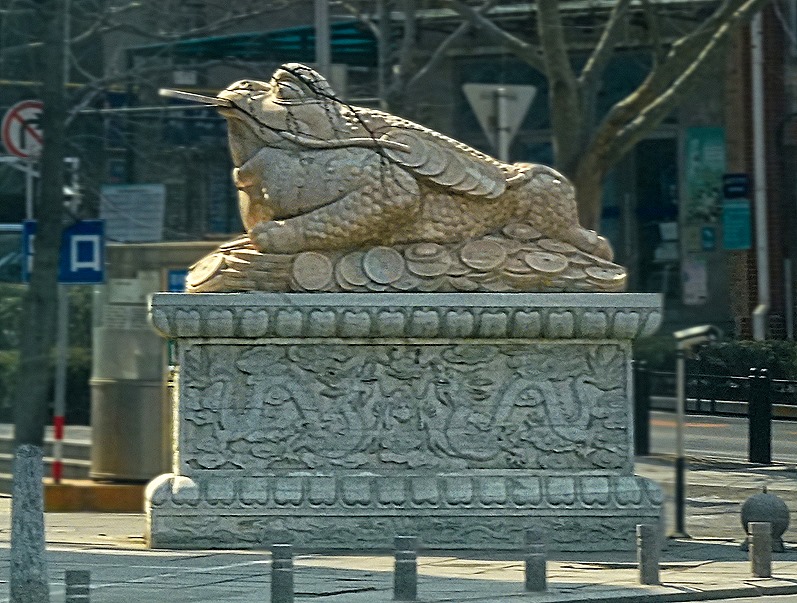
Dalian is known for its large open city squares and we passed several on the bus on the way back to the port. One was a sculpture of what looked like a toad sitting on a pile of money and the other we got a photo of had a large green and purple sculpture in the middle with large Chinese characters in front. We have no idea what either of these signified.

Back at the port we went through customs and boarded the ship. There were a number of police officers milling about near the ship entrance but we don’t know whether this was usual or something special. We took some pictures from our veranda, of the dock off to our left and of the city in the distance on the right. A Chinese flag was flying on the dock as well. On a trip that includes places like Beijing and Kyoto it would be hard to justify calling Dalian one of the highlights, but it was a good bit more interesting than we had anticipated and we enjoyed our day here. At around 5:00 we sailed away to our next stop tomorrow.

 BADER JOURNAL