
Hong Kong, China (overnight) — 2024
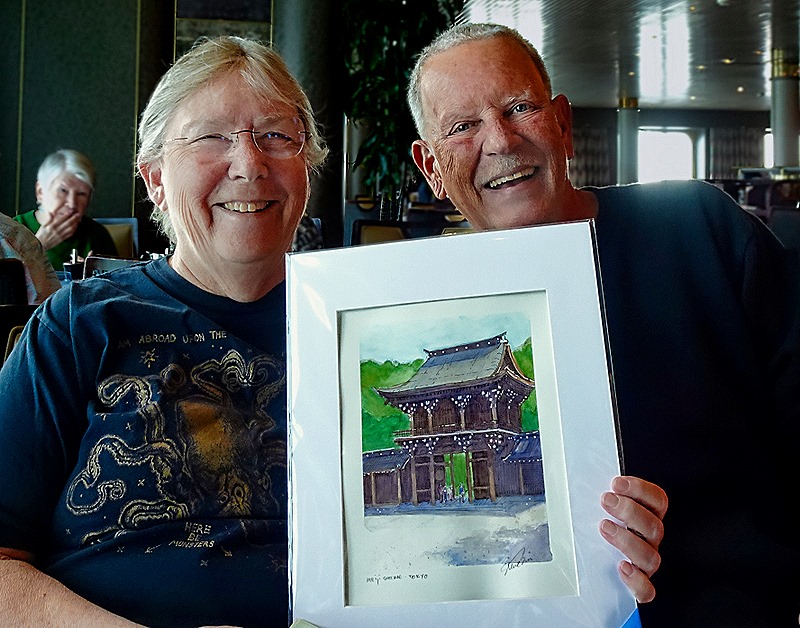
Between Tianjin and Hong Kong we had three relaxing sea days to recharge our batteries from the intensive days in Shanghai and Beijing. We spent time in our usual hangout, the Ocean Bar, for reading and catching up on the internet news. Zuiderdam has a lot of fairly quiet venues with upholstered chairs and tables but we have found few that feel comfortable for very long, particularly for folks like us who aren’t as young as we once were. But we settled on the Ocean Bar as the best of an unsatisfactory lot, better yet if you put your feet up on a table or another chair (although near the end of the cruise Henk, the hotel manager, distributed memos to everybody’s rooms asking that we not do this). One of our friends, Steve, is a watercolor artist who does a painting in each port. We bought his painting of the Meiji Shrine in Tokyo, which he delivered to us in the Ocean Bar on one of these sea days.

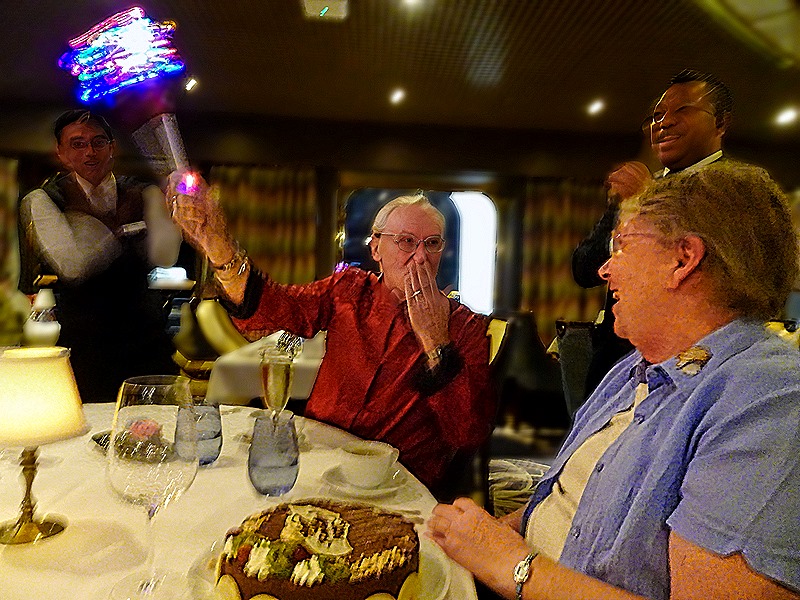
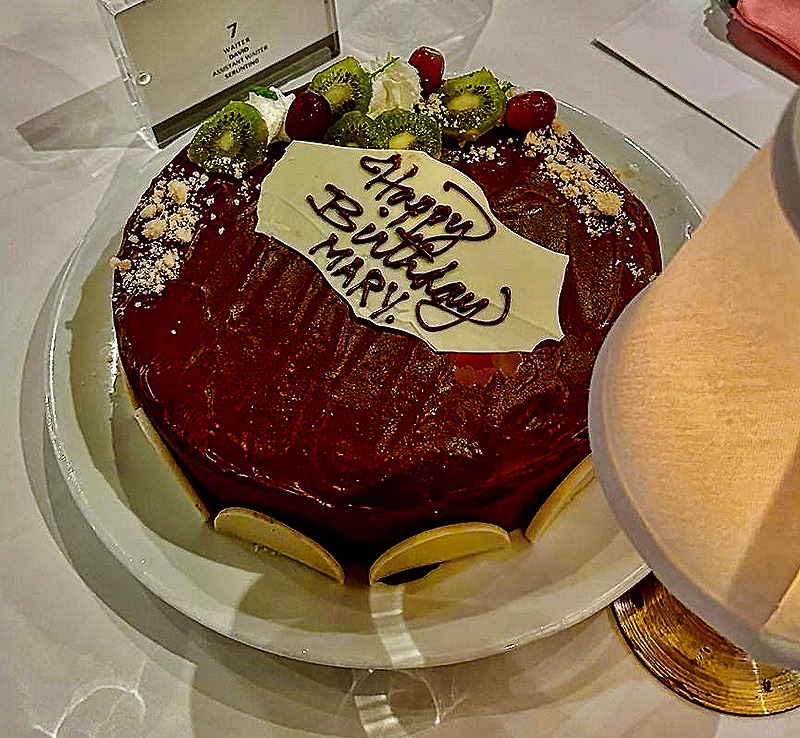
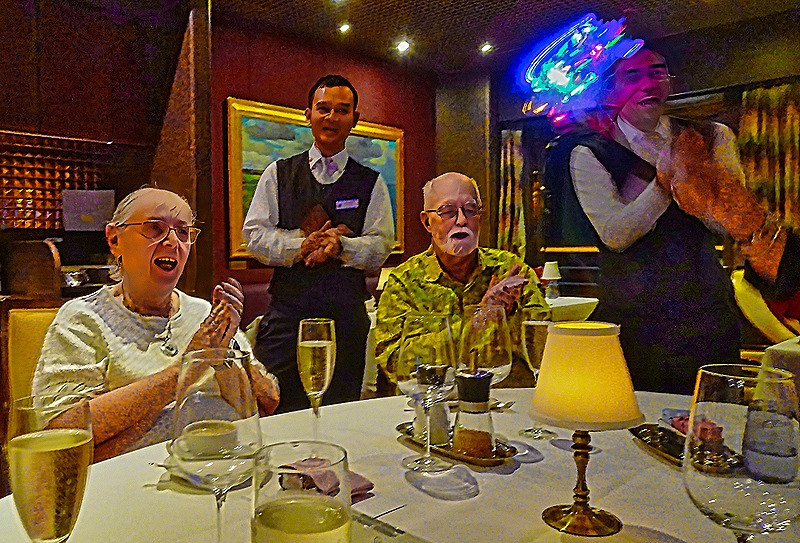
But the biggest event during these days was Mary’s 75th birthday on March 15, the day before we reached Hong Kong. We had originally planned to commemorate it by going to tea at the Peninsula Hotel on our second day in Hong Kong, but it turned out that would not have fit into the time available before our early departure that day, maybe next time. So we ended up celebrating at our usual table in the main dining room with our usual table mates: Bill, Robert, Bob & Judy. Robert provided a birthday cake and the restaurant staff, and some of the diners, sang the Indonesian birthday song. Robert (as usual) also provided the fireworks.


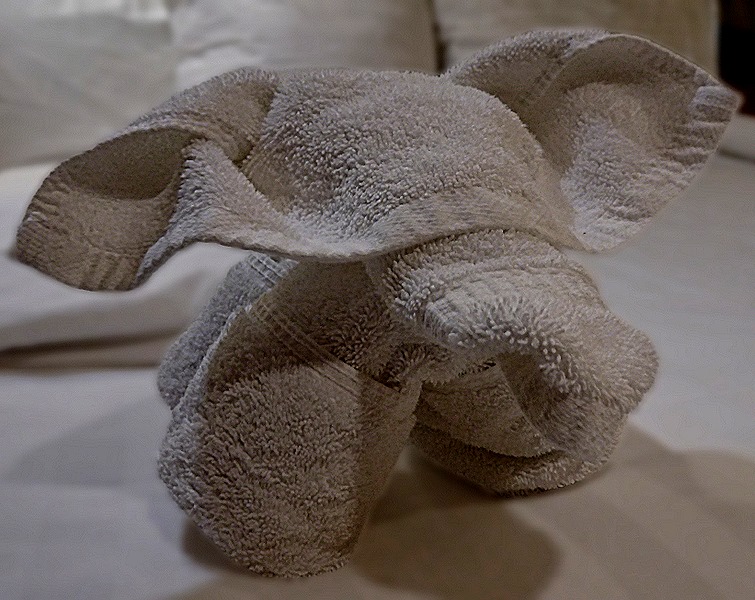
When we got back to our cabin after dinner we found that our room stewards had been busy too, leaving a very tall birthday cake (made of towels) on the bed, with a (towel) flame on top.

By about 8:00 AM on March 16 we were docked at Kai Tak cruise terminal in Kowloon, across the water from Hong Kong. (For those who haven’t been here, Hong Kong is an island and Kowloon is a peninsula extending from the mainland that was also part of the British colony.) This was our third visit to Hong Kong, the first place on this voyage since the Panama Canal crossing on January 24 that we had visited before. On our first visit in 2016 we were docked for two nights right in the center of Kowloon, next to the Peninsula Hotel and the Star Ferry terminal, just about the most convenient place in Hong Kong. You could see downtown Hong Kong across the water from the ship:
https://baderjournal.com/2016/03/20/hong-kong-china-day-1/
https://baderjournal.com/2016/03/22/hong-kong-china-day-2/
https://baderjournal.com/2016/03/24/hong-kong-china-day-3/
Our second visit was in 2018 and we were docked overnight at Kai Tak cruise terminal, formerly the Hong Kong airport, which was miles away with no view of the central part of Hong Kong island. But there was a shuttle bus that took us (on a pretty long ride) to the Peninsula Hotel, so that wasn’t nearly as good as the first visit but still enabled us to go where we wanted pretty conveniently.
https://baderjournal.com/2018/07/23/hong-kong-china-day-1-2/
https://baderjournal.com/2018/07/25/hong-kong-china-day-2-2/
This time we were docked again at Kai Tak terminal, but there was no shuttle bus to the Peninsula Hotel area. There was a shuttle bus, but it was provided by a nearby shopping mall and that was the only place it would take you. We were told (by HAL staff who had never done this) that there was a subway stop near the shopping mall where you could make connections for wherever you wanted to go, but we didn’t want to go to the mall and the connections sounded too iffy to us in a city where we can’t speak or read the language. We heard later that at least some passengers who took the shuttle had a difficult, at best, time trying to find the subway, so we were glad we didn’t do that. We thought about walking out of the port to explore the neighboring area, but it is a very long walk from the terminal to the exit (this used to be an airport with long runways) and a lot of construction was blocking the way.
Our choice came down to stay on the ship or sign up for an excursion, and we sure didn’t want to spend our entire visit to Hong Kong on the ship. So the day before we arrived we booked an excursion that would take us to several places in the general vicinity of the port. We didn’t have high hopes for this excursion but it turned out to be much more interesting than we had anticipated.
Our first stop was at Kowloon Walled City Park. This enclave’s history dates back to the 15th century when the Chinese established a military garrison to manage the local salt trade. It became a fort in 1810 and in 1847, after the British took control of Hong Kong island, a strong defensive wall was built. In 1898 China agreed to give the UK a 99 year lease on a Hong Kong concession extending for 200 miles . . . except for the Walled City that remained under Chinese jurisdiction. Chinese troops were withdrawn the next year but the British did little to control the area. The walls were demolished by the Japanese occupiers in 1943 to obtain stones to extend runways at the airport (now our cruise terminal). After the war the area was inundated by refugees from the Chinese civil war, who wanted to avoid British jurisdiction by staying in this nominally Chinese enclave. The rapidly increasing population density (some 3.25 million per square mile in a 1987 census, the most densely populated place in the world at that time) along with the failure of Britain and China to police the area, led to it becoming a haven for crime of all kinds (including, for example, unlicensed “doctors” and “dentists”). After decades of false starts, the population was moved out (finally overcoming their longstanding resistance) and the densely packed buildings were demolished in 1993 under an agreement between Britain and China. The almost 8 acre park we visited, which once had hosted more than 500 10-12 story buildings, opened in 1995.
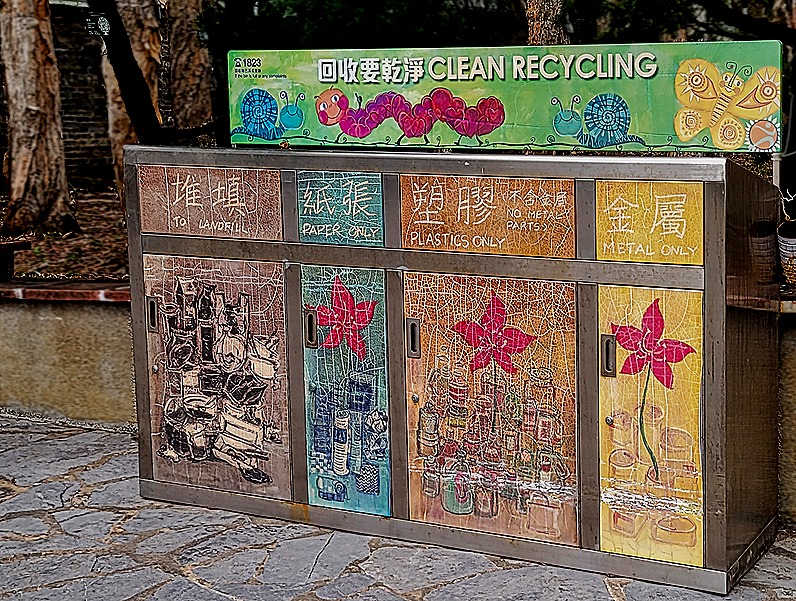
Our bus dropped us outside the park, which is now once again surrounded by a wall, although not a defensive one. On the way to the park we passed a tall building construction site with scaffolding made of bamboo, something we have seen before in Hong Kong. Near the entrance was a colorful bilingual recycling center.


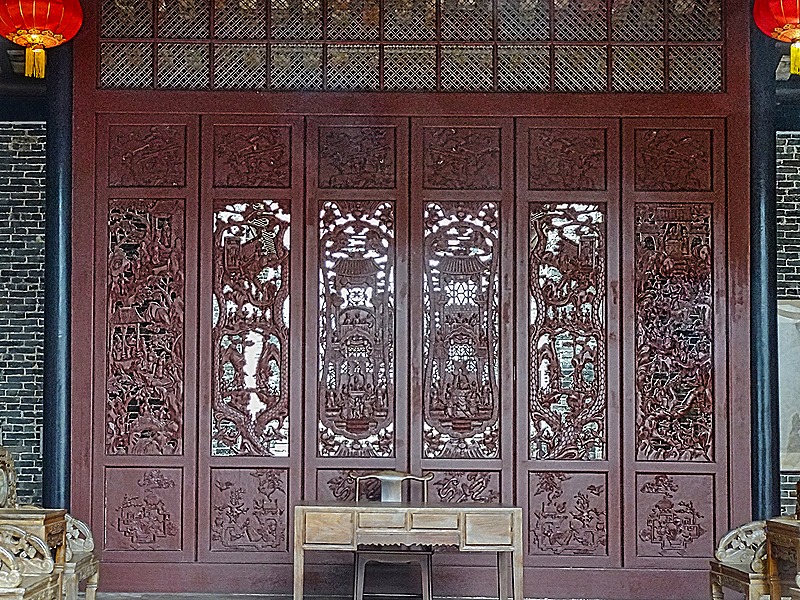
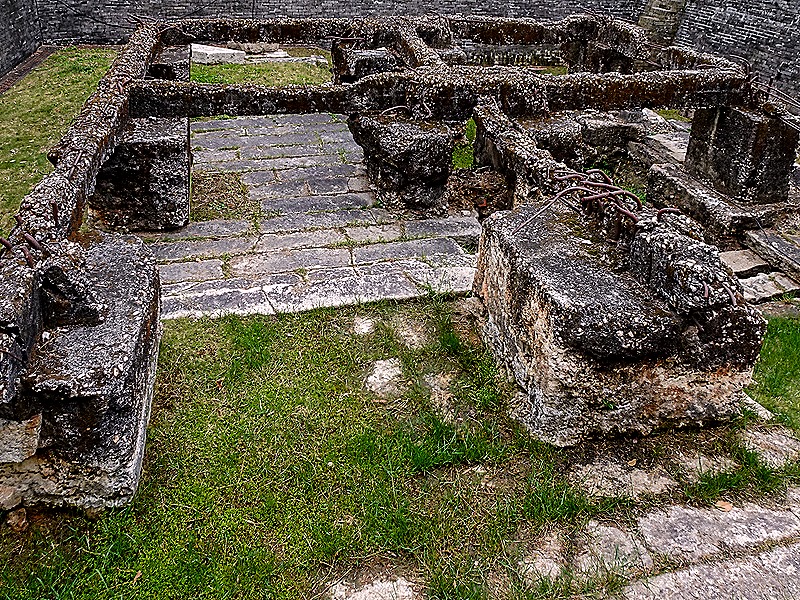
Two original parts of the old Walled City remain in the park. First is the Yamen, a single story building that was the house and offices of the Chinese administrator of the city, called the Mandarin. It had lovely carved doors in some of the doorways and several rooms of very interesting exhibits about the Walled City and its history, complete with period pictures. Second is the old South Gate entrance through the original wall, an archeological site that was about 10 feet below the current ground level.
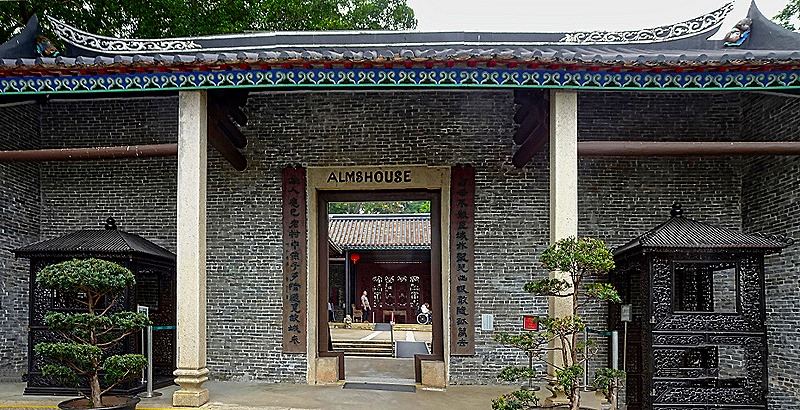
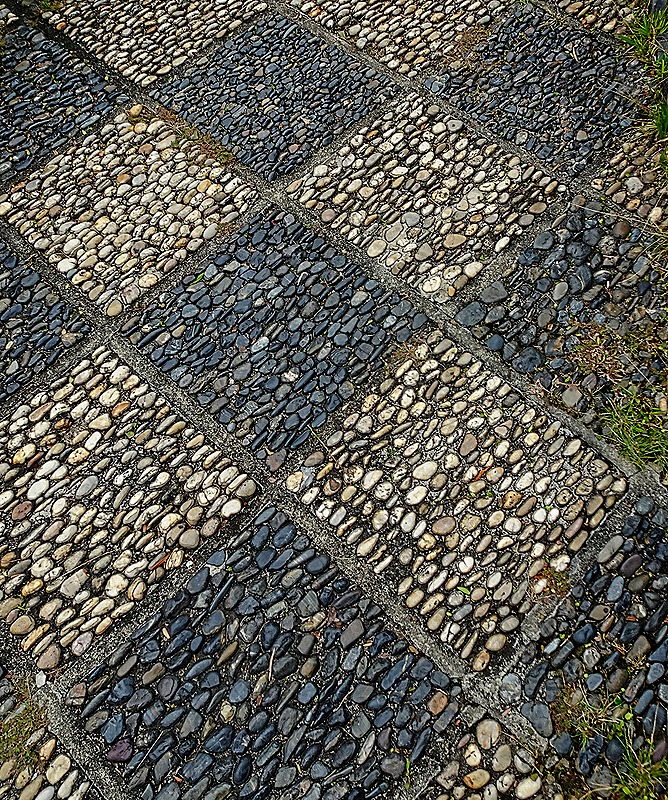
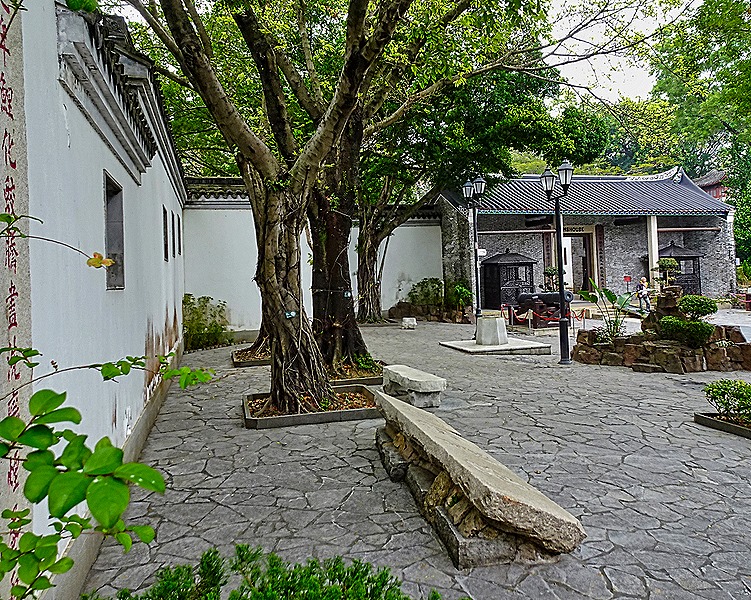
We walked around a white building with a row of bonsai trees along one wall and some cactus in front of another. The patio in front was covered in stone pebble mosaics and there were flowers around.

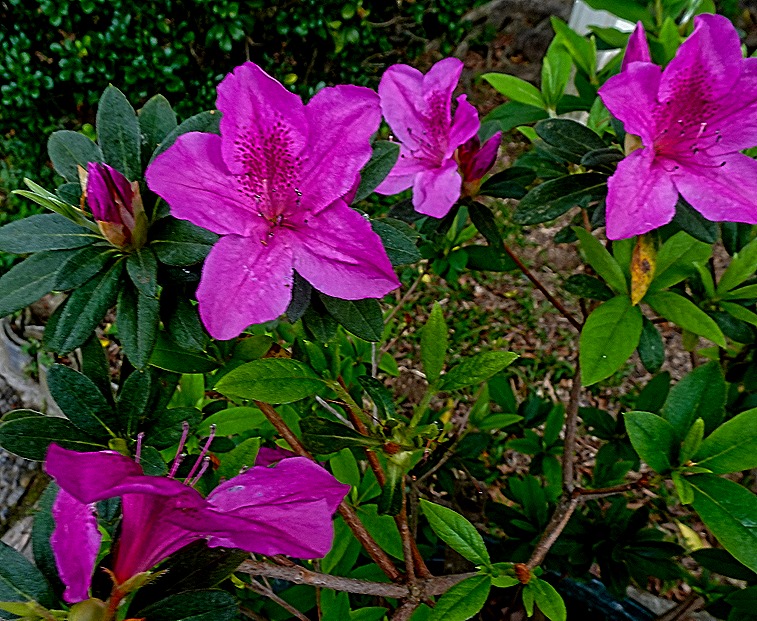
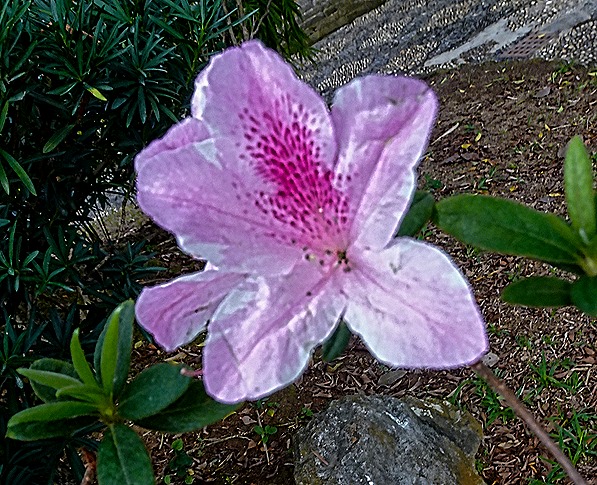
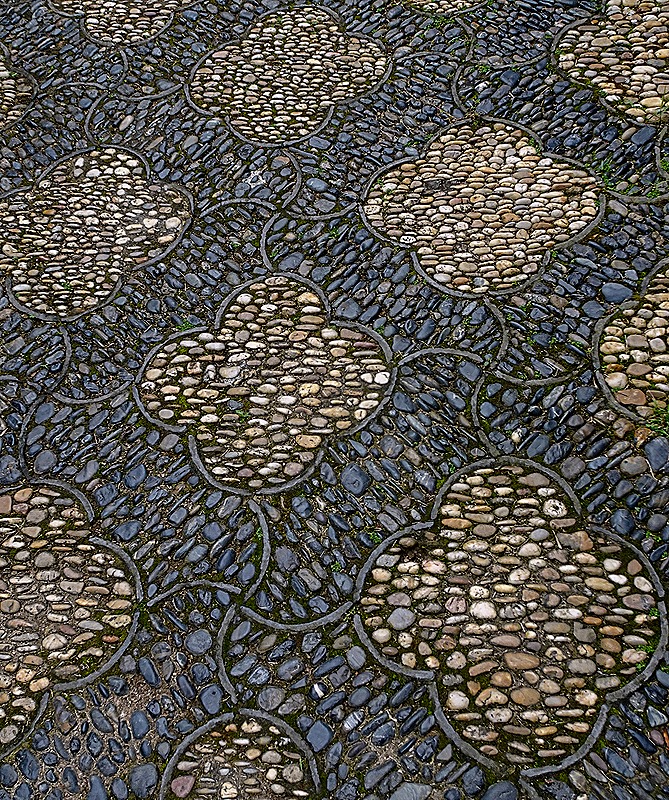
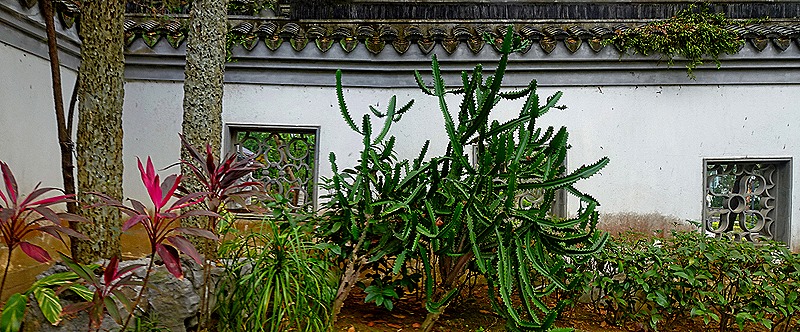
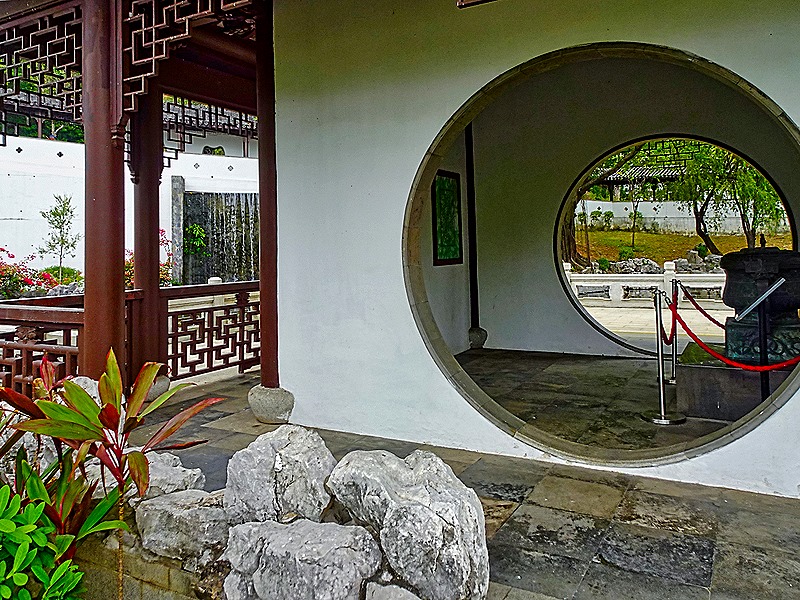
We walked past several other buildings. One that we think may be the Fui Sing Pavilion, had a nice moon gate inside a pavilion extension. Nearby was Guibi Rock, a stone quarried near Suzhou, whose name comes from its resemblance to ancient jade. It is difficult to miss the neighborhood skyscrapers towering over the perimeter wall of the garden, and there are several graceful moon gates and windows throughout the park.
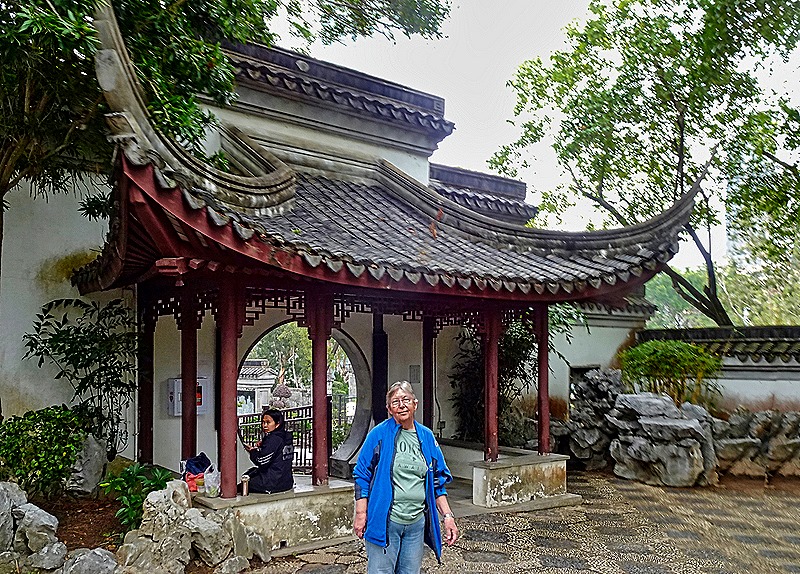
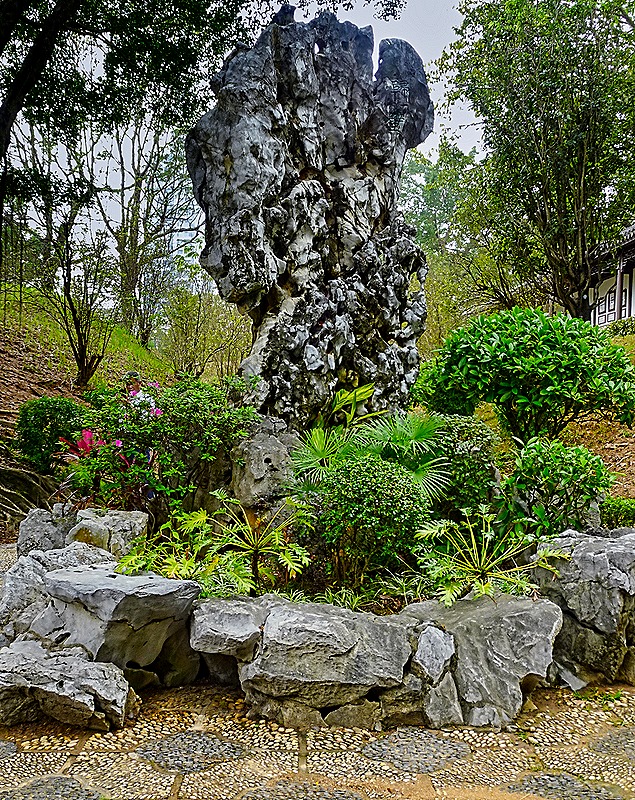



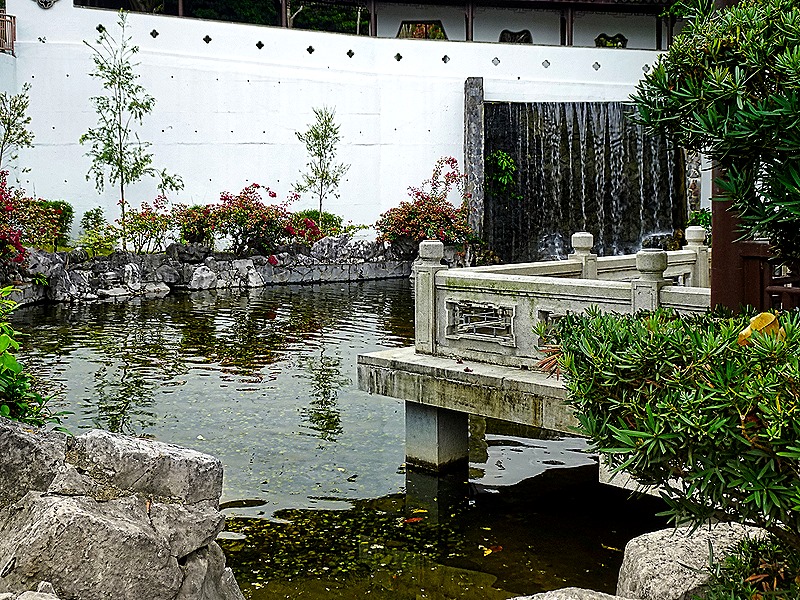
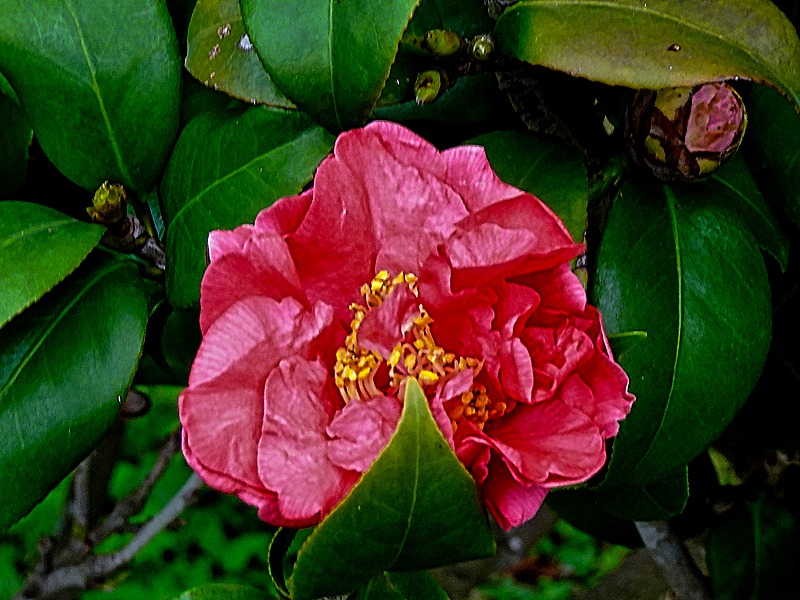
We also wandered past a lovely small pavilion sitting on concrete pilings in a small lake fed by an artificial waterfall. The building had moon windows and door and there were flowers nearby.

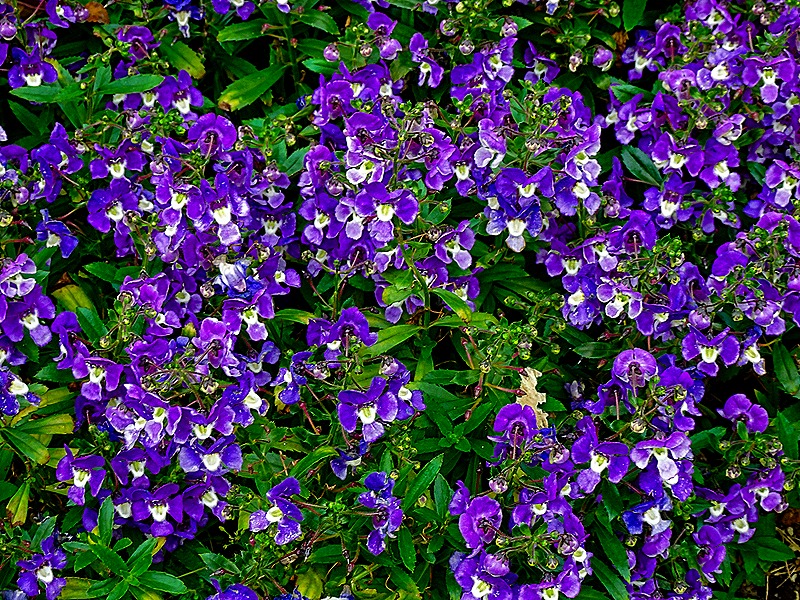
As with so many places we visited today (and previously), we would have enjoyed more time here. But the departure time was approaching so we hurried back to the bus.
Our second visit was to the Wong Tai Sin Taoist Temple. This place was quite interesting, but boy was it crowded. Wong Tai Sin (meaning “Great Immortal Wong”) is the deity name for a 4th century Chinese Taoist hermit. He was largely unknown in Hong Kong before 1916 when an immigrant from Guangdong province set up an herbal medicine shop in Kowloon with an altar to Wong Tai Sin in the back. Patrons could pray for advice at the altar and then the proprietor would sell them the recommended medicines. In 1921 he said he received instructions from Wong Tai Sin to construct a shrine. He and his coreligionists were told through divination exactly where and when to build it. It was funded by four rich businessmen who had probably been happy users of the herbal medicines. While Won Tai Sin was a Taoist, the temple accommodates Buddhist and Confucian worshippers as well.
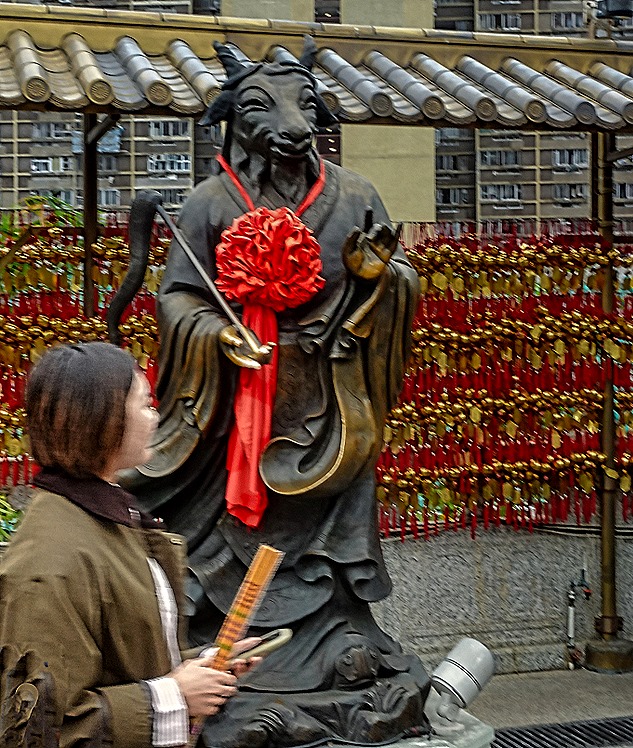
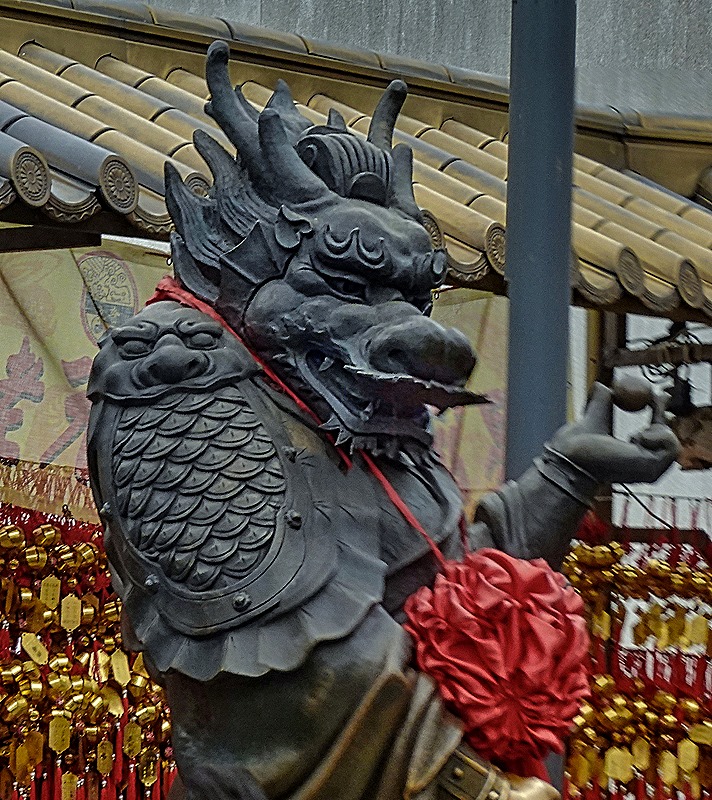
The small parking lot was quite crowded and we had to wait for a spot to open up. Then our driver exhibited his notable skill by backing us into a barely accessible spot. We had to walk a good way to the entry gate of the temple, which had dragon statues on each side that were shiny bronze (probably), where people rubbed them for good luck on the way in. Then we passed a number of black statues of Chinese zodiac animals, about 6 feet tall. Some were wearing large red ribbons, perhaps for a special occasion but we don’t know what. Inside the gate was a small altar pavilion with brightly painted and carved pillars, possibly dedicated to seeking good luck.
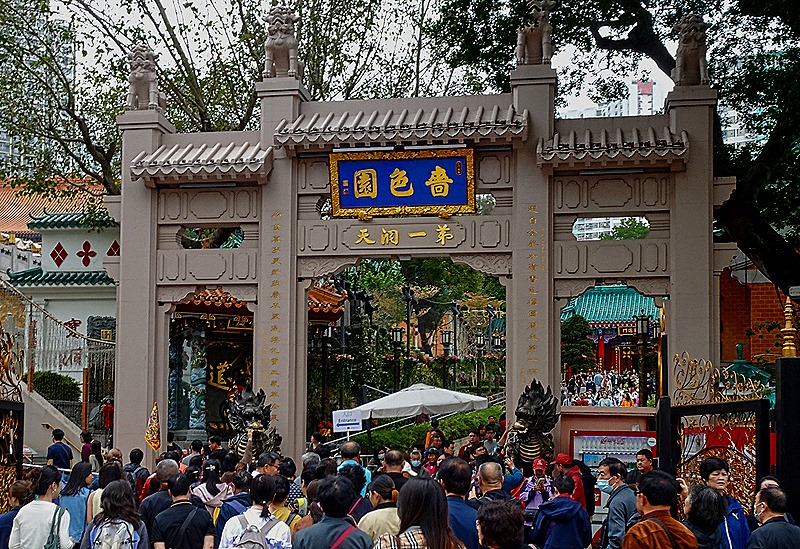


Another larger stone gate was at the top of the broad stairs leading to the Great Hall, the main Taoist temple. The center portion of the stairway was filled with what looked like a very colorful relief, perhaps a map? The plaza in front of the Great Hall had a number of red cushions for kneeling, most of which were in use, and an array of Chinese lanterns strung overhead. To its sides were kiosks for worshipping and also for obtaining and burning incense sticks.

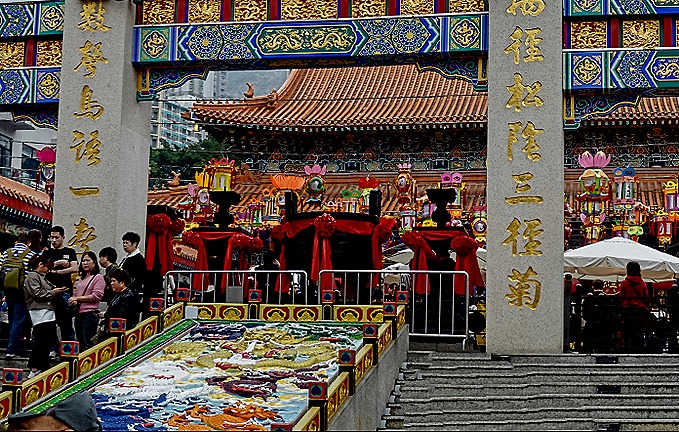

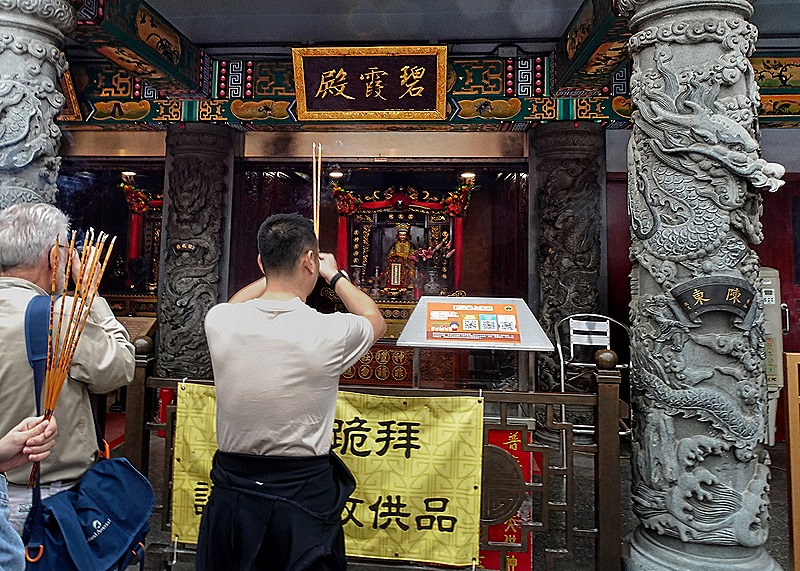
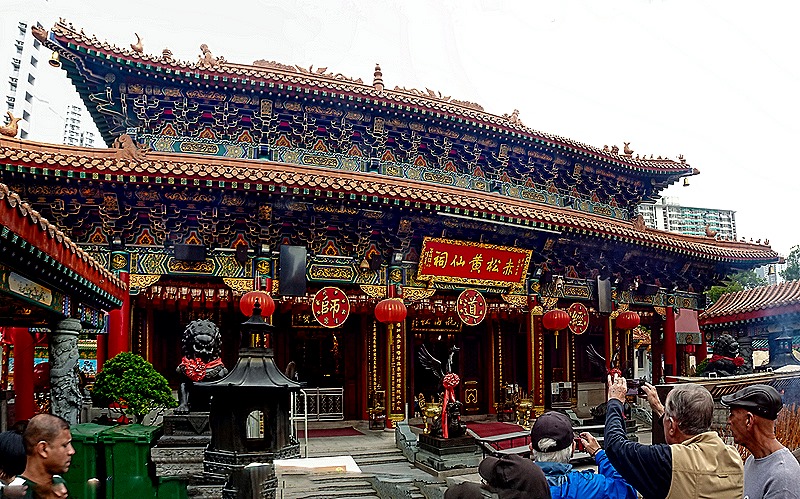

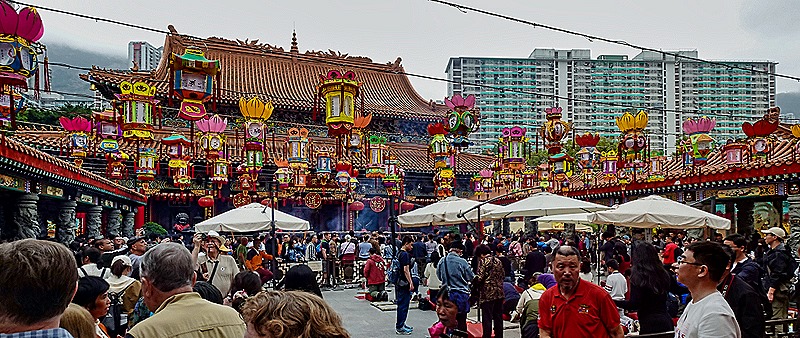
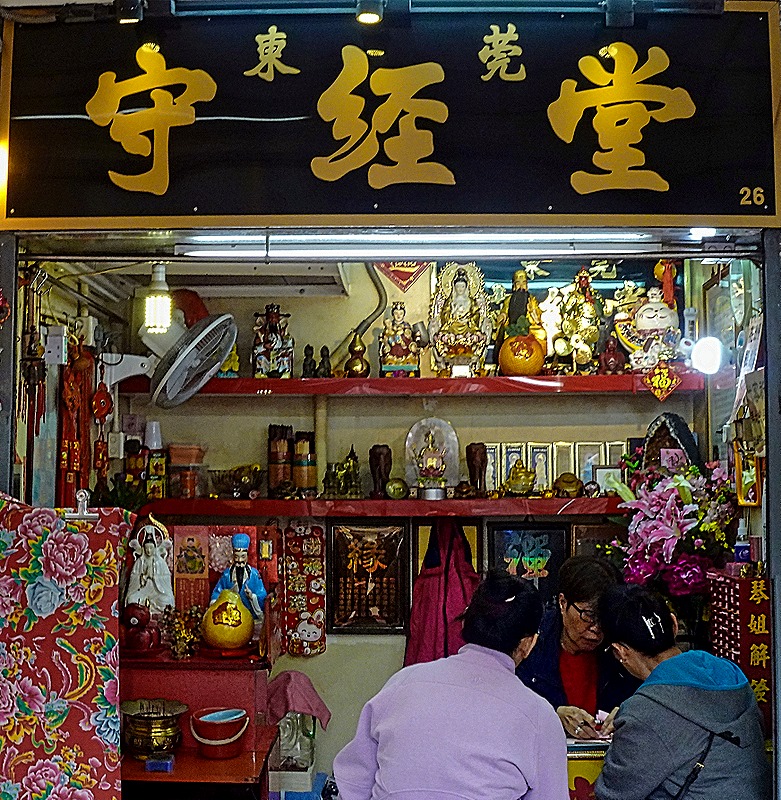
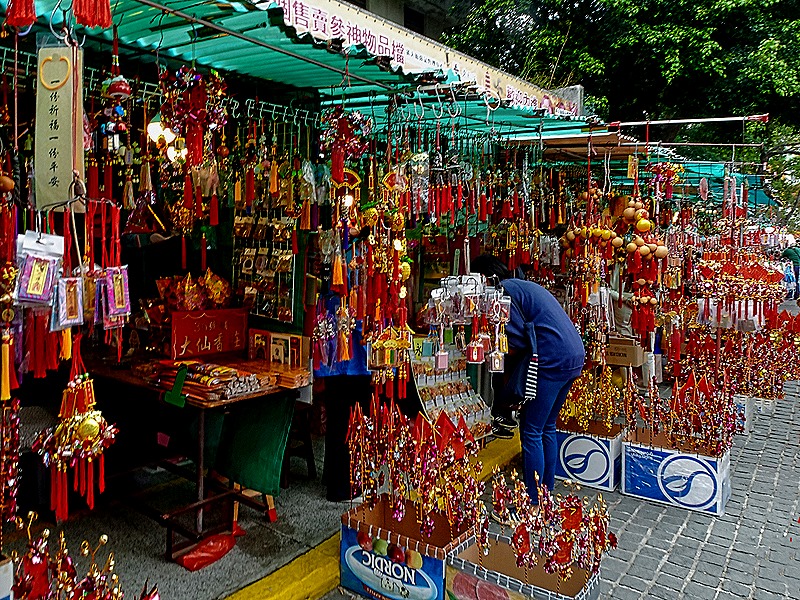
One reason for this temple’s popularity is Wong Tai Sin’s reputation for granting wishes. “What you ask is what you get” is the motto here. Worshippers seek spiritual guidance through a practice called kau chim. They light incense sticks and shake a bamboo cylinder containing numbered fortune sticks. When one falls out it is traded for a paper with the same number which is taken to a soothsayer’s booth for interpretation (sometimes to several booths for a second or third opinion). A long curved hall on a lower level is lined with soothsayer booths that seemed to be doing a good business interpreting fortunes (and they also had shelves of items presumably for sale). As we walked out of this hallway to return to the bus we passed a long row of kiosks selling religious articles and souvenirs, mostly in red and gold.


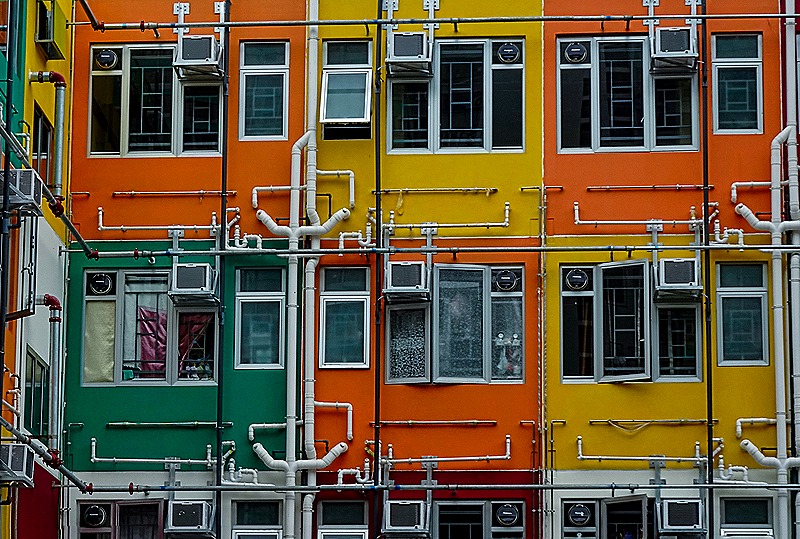
Hong Kong is a crowded city and housing is at a premium. Near the temple we passed a multicolored housing development. The apartments are tiny and are reserved for young people who haven’t been able to find a permanent place to live. If we remember correctly, these are allotted by lottery and tenancy is limited to three years. The theory is that you should be able to find permanent lodging within that time but whether or not you are able to do so you must move out when the tenancy period ends. To us they looked a lot like a the stacks of ship containers you see in shipyards (except for the bright colors and small windows).

Our last visit was to Chi Lin nunnery and the adjacent Nan Lian Garden. The nunnery dates to 1934 when it was opened as a retreat for Buddhist nuns. It was rebuilt in 1998 using traditional wooden, nail free architecture from the Tang dynasty period (7th – 10th centuries). The gardens across the street with an overpass bridge to the nunnery were opened in 2006, also designed in Tang dynasty style. They are laid out with a circular path leading all the way around the park.
We entered the park through the Black Lintel Gate and walked among carefully sculptured trees to the Chinese Timber Architecture Gallery, which displays scale models of old Chinese wooden architecture. One model on display was of the Hall of Supreme Harmony we had visited in the Forbidden City in Beijing just four days before.


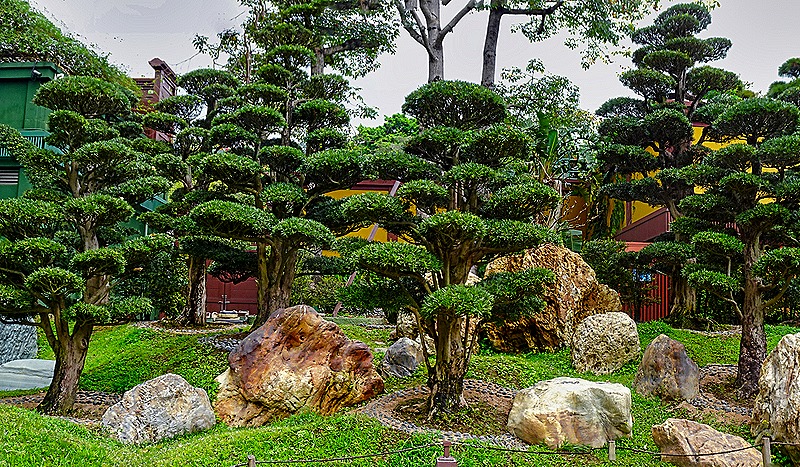
We walked past the large white Lamp of Enlightenment in its own garden spot in front of the golden Pavilion of Absolute Perfection, which sits on an island in the lotus pond between the striking orange Wu and Zi bridges.
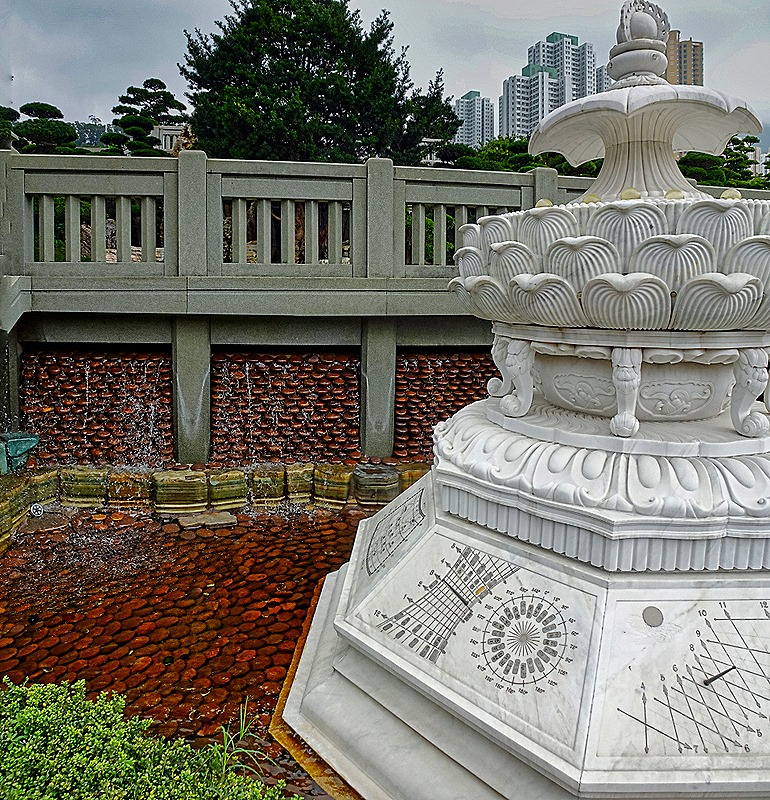

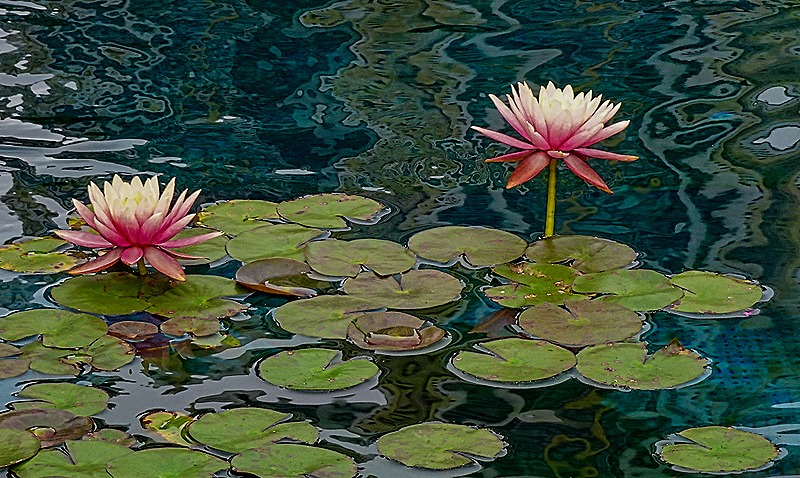
We crossed the stone bridge over a busy street to enter the Chi Lin Nunnery. Inside the gatehouse we saw across the large plaza the Hall of Heavenly Kings, the main hall of this large religious complex. Inside were, among other things, statues of Buddha and some disciples. But photography was not permitted inside. Behind this hall is a smaller courtyard and then a larger hall. The last two pictures in this group may be of that courtyard seen from the Hall of Heavenly Kings, but we aren’t really sure.

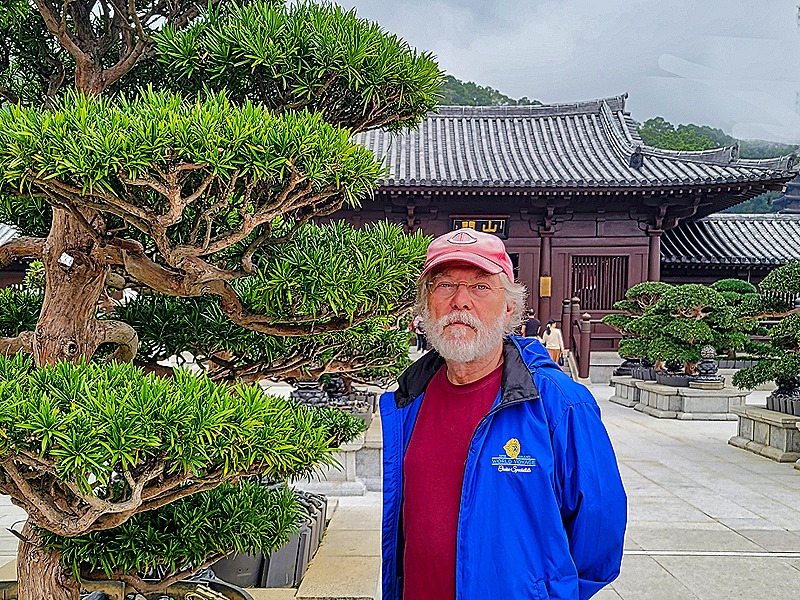

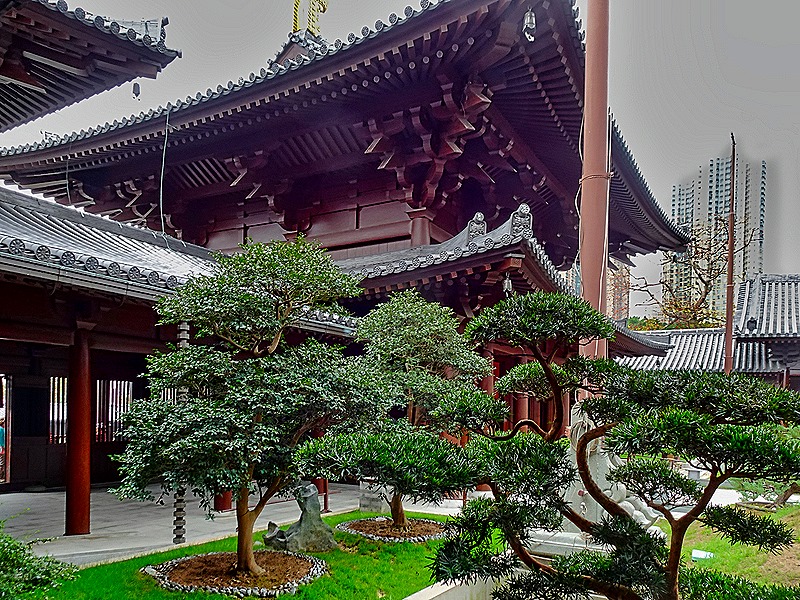
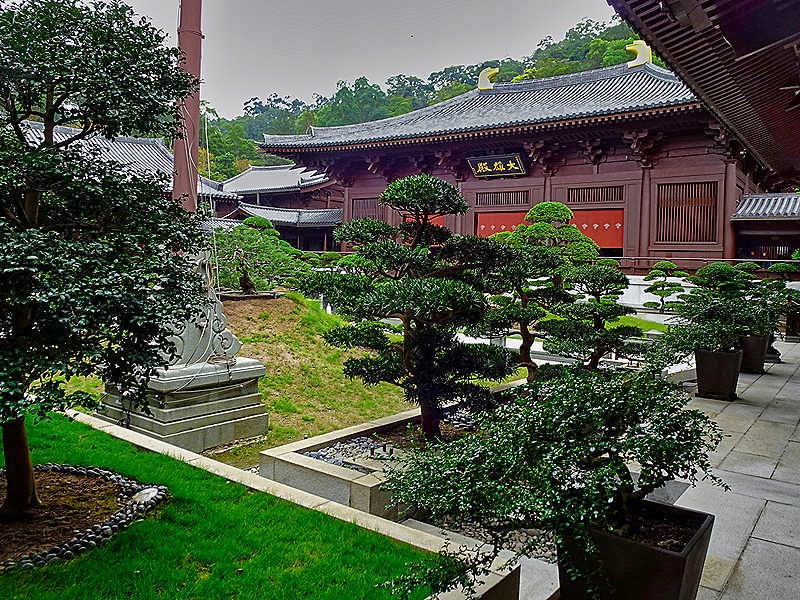
Exiting the Hall we had a nice view of the whole plaza surrounded by wooden buildings. In the plaza were several stone lotus ponds fed by lion head spigots and a number of bonsai trees.

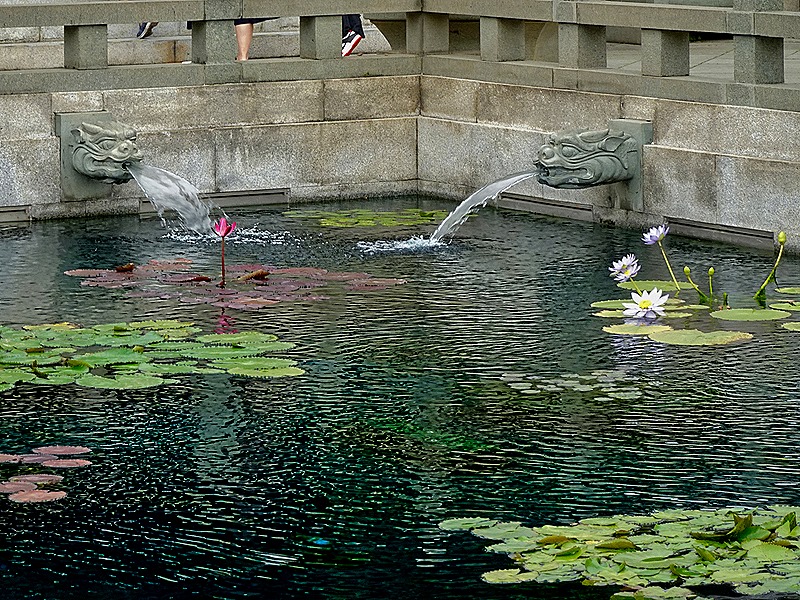

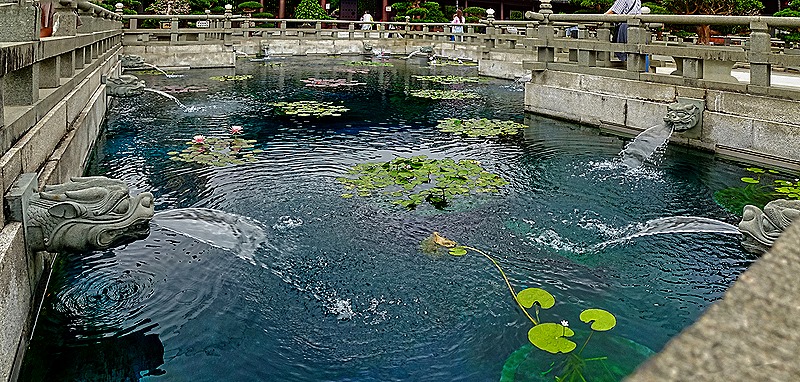
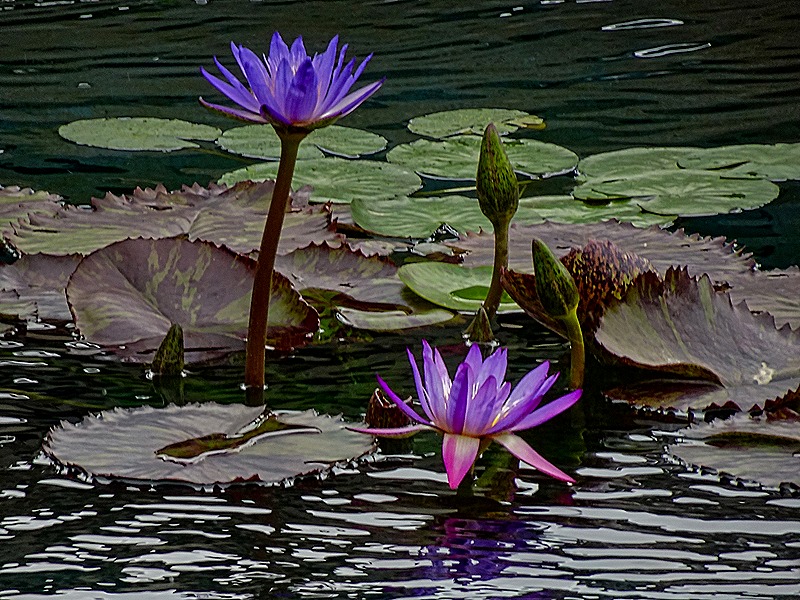
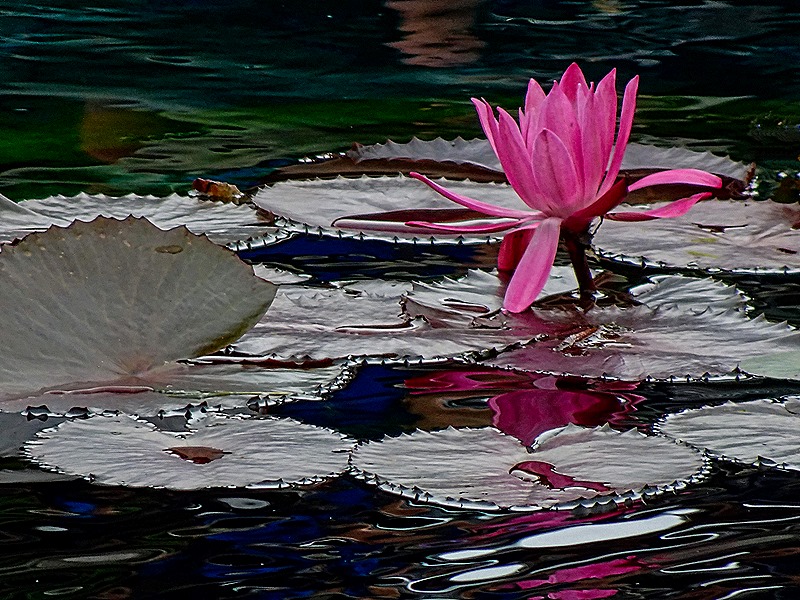


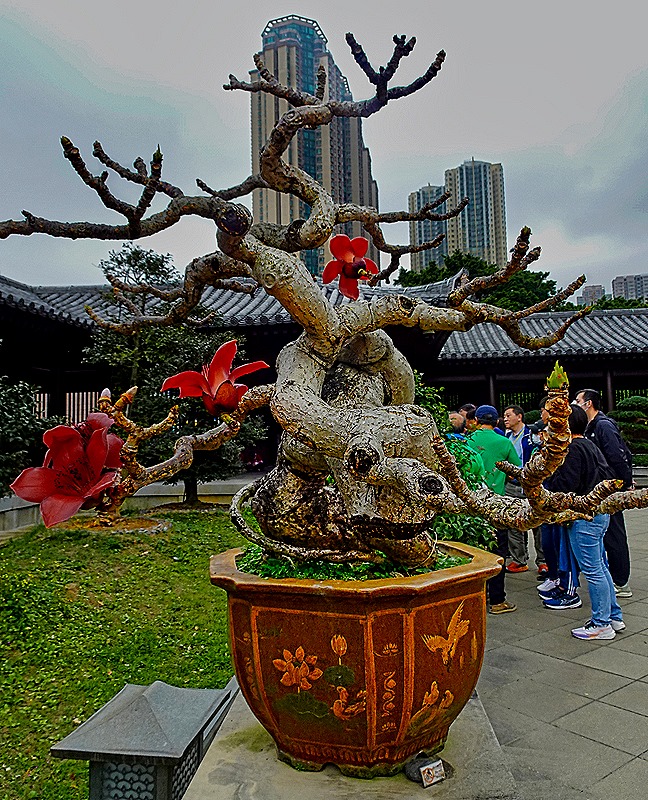

Leaving the nunnery we had a last view of the gate from the overpass and an interesting view of the Pavilion of Absolute Perfection from behind a large rock.


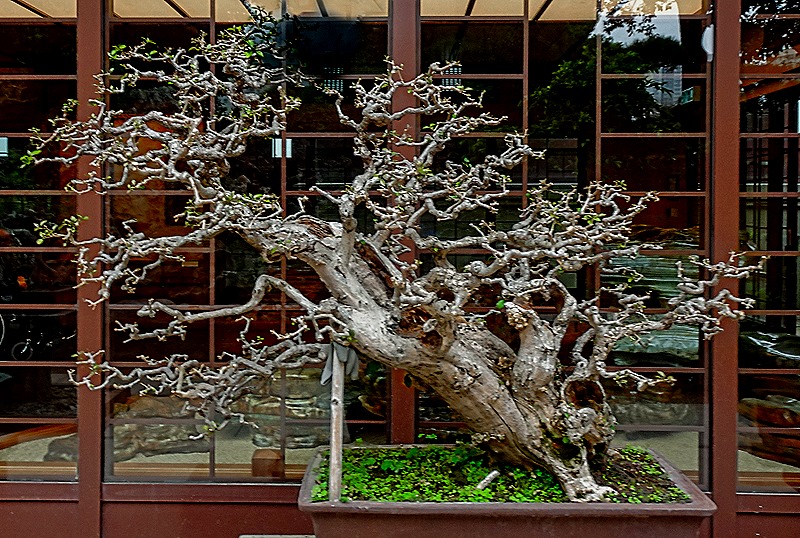
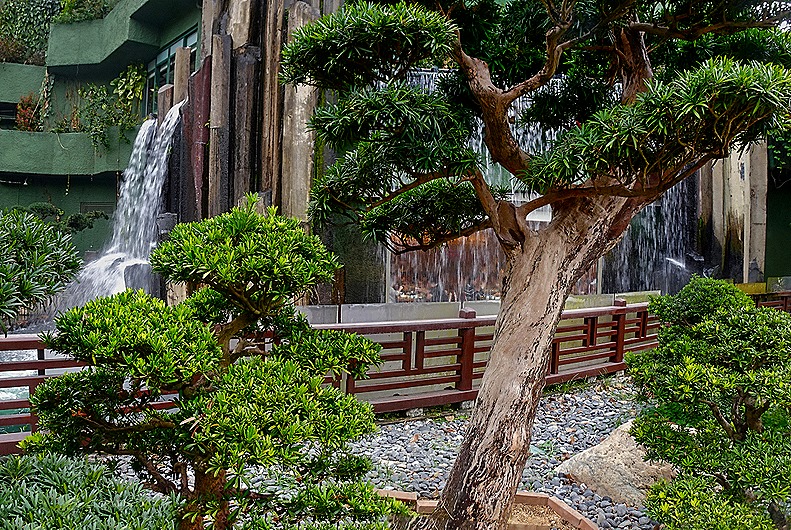
Reentering the gardens we continued along the path, passing a gallery, souvenir shops and restaurant. The gallery was quite elegant with a number of beautiful (and pricey) items of art. In front of these shops were more bonsai and flowers and at the end an (artificial) waterfall.
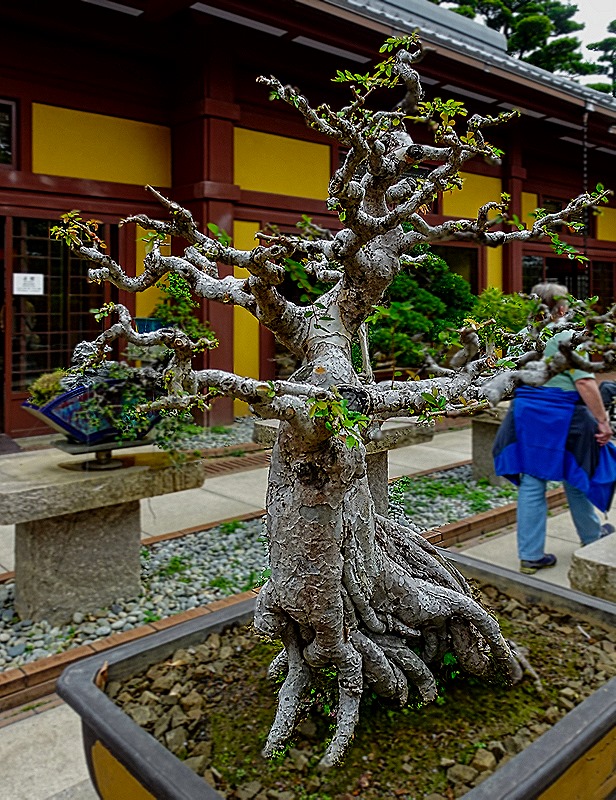
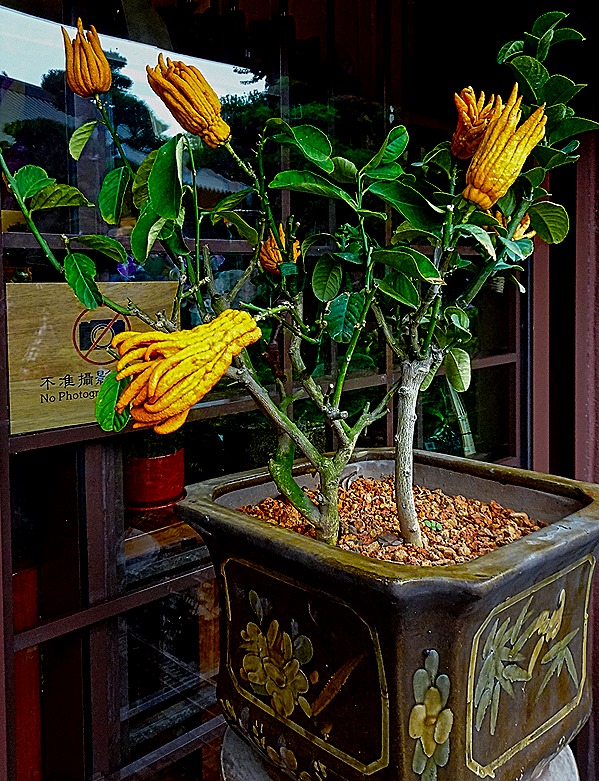
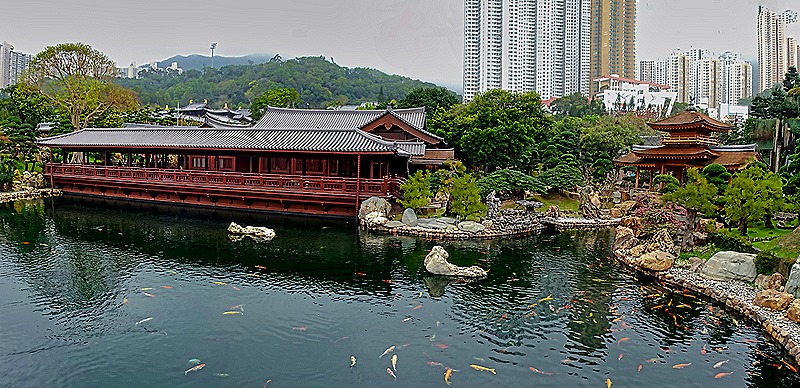
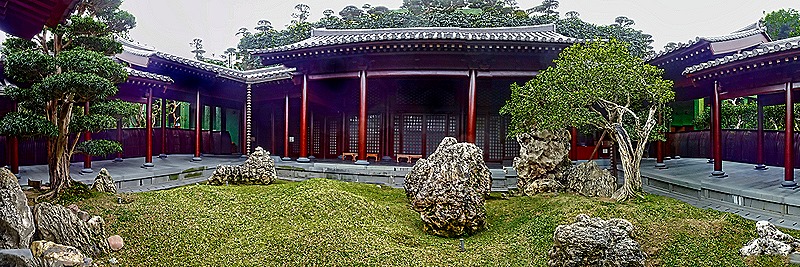
Turning the corner to head back to the entrance we came to the Blue Pond, a scenic lake full of orange koi. Along one side is the long Song Cha Xie, a tea house, and on the upper right is the Pavilion Bridge. Further along we came to the Xiang Hai Xuan Multi-purpose Hall, which had a very nice rock garden in its interior courtyard.


So that was the end of the excursion. Not sure why the time at these places had to be so limited since it ended in early afternoon and we weren’t sailing away until the next day, but I guess it is what it is. Back on the dock, just before we reached the cruise terminal, we passed several ugly blocks of identical buildings. Our guide told us these were built early in the Covid pandemic and people (including cargo ship sailors) arriving from outside China were detained here in quarantine for weeks and sometimes months, unable to leave their rooms. Presumably food was brought to them. This doesn’t sound like much fun.

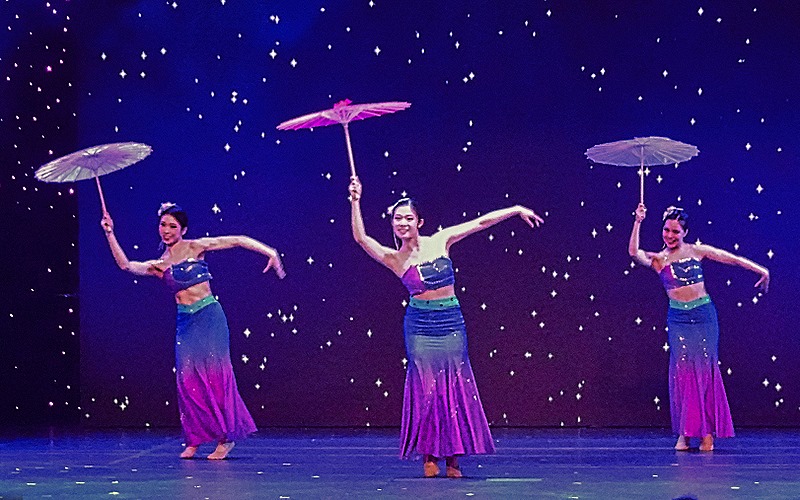
When we reboarded the ship the view from our balcony was completely foggy, a condition that would last until we sailed away the next afternoon. This evening a local group of dancers performed on the main stage.


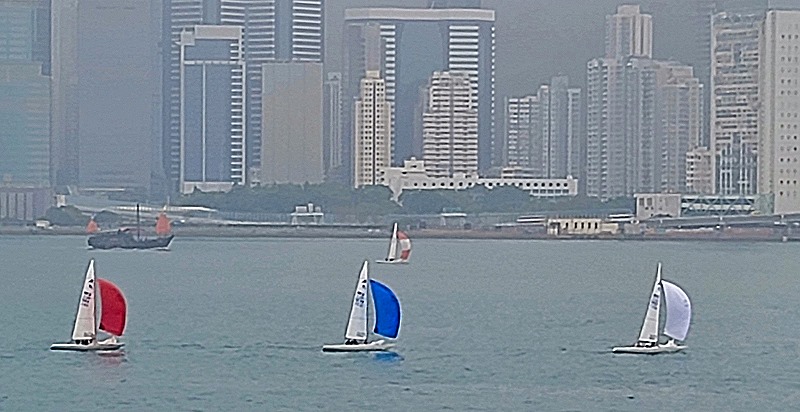
Since this was an overnight stay we obviously woke up the next morning in . . . Hong Kong! It was still quite foggy and chilly, all aboard was about 3:00 for an early departure, and it had been such a hassle finding something worth doing the day before that we decided just to spend this day on the ship. It was Sunday and a number of folks were out in their boats during part of the day despite the weather.
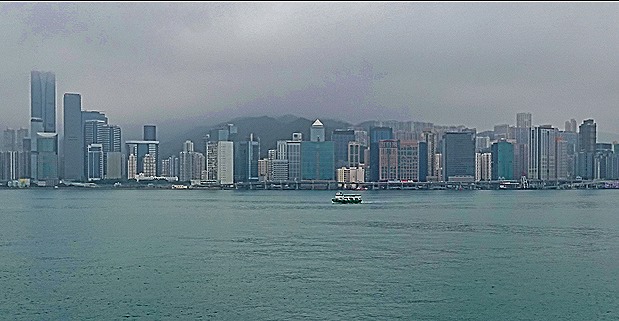
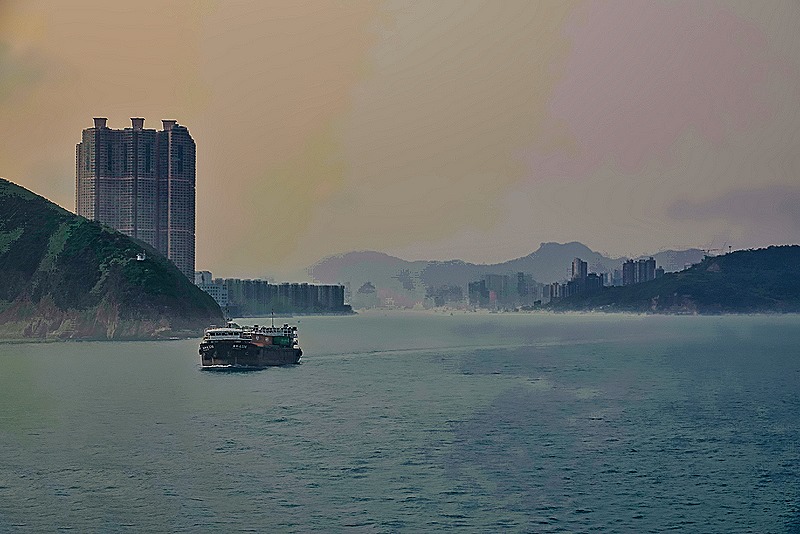
We sailed away in late afternoon, still with low visibility, although the conditions made for some interesting ambiance.



 BADER JOURNAL