
Singapore (overnight) — 2024
We spent March 23 and 24 in Singapore, an island nation whose city has the same name as the country. This was our third visit to Singapore. In 2016 we spent three days (more accurately, about 2 and a half) here. You can read all about that (and see a lot more pictures) here:
https://baderjournal.com/2016/04/22/singapore-day-1/
https://baderjournal.com/2016/04/25/singapore-day-2/
https://baderjournal.com/2016/04/28/singapore-day-3/
In 2018 we had two days here:
https://baderjournal.com/2018/07/30/singapore-day-1-2/
https://baderjournal.com/2018/08/01/singapore-day-2-2/
Day 1 (March 23)
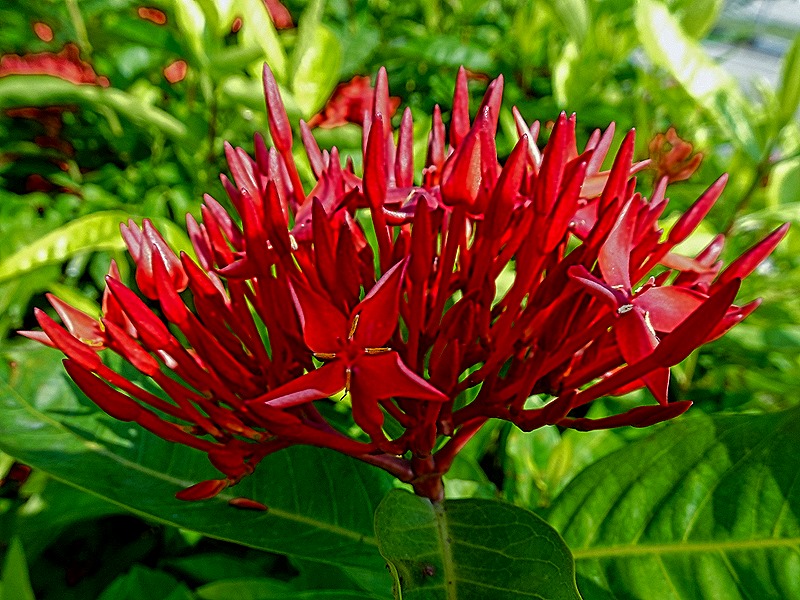
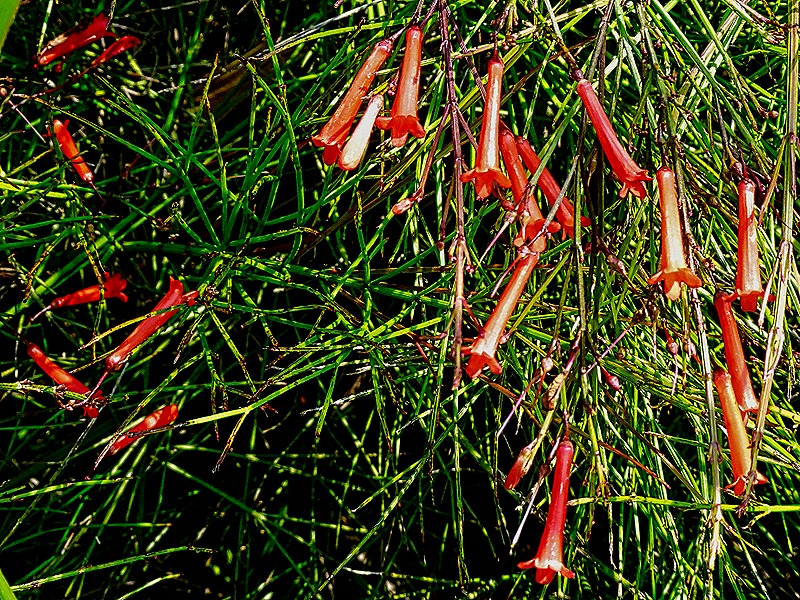
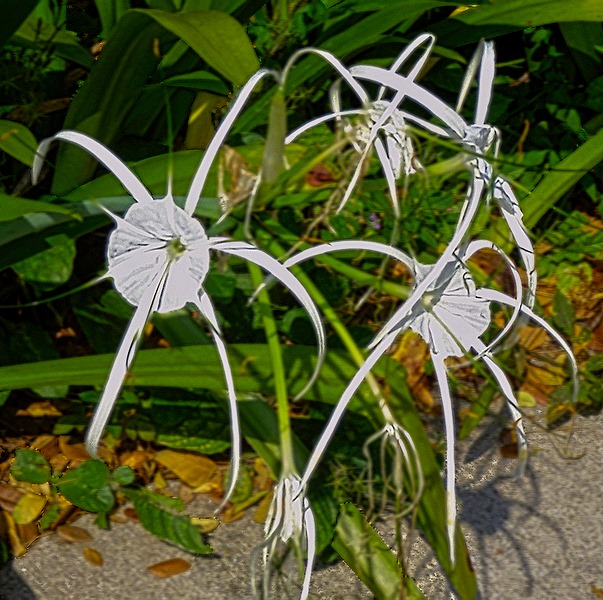
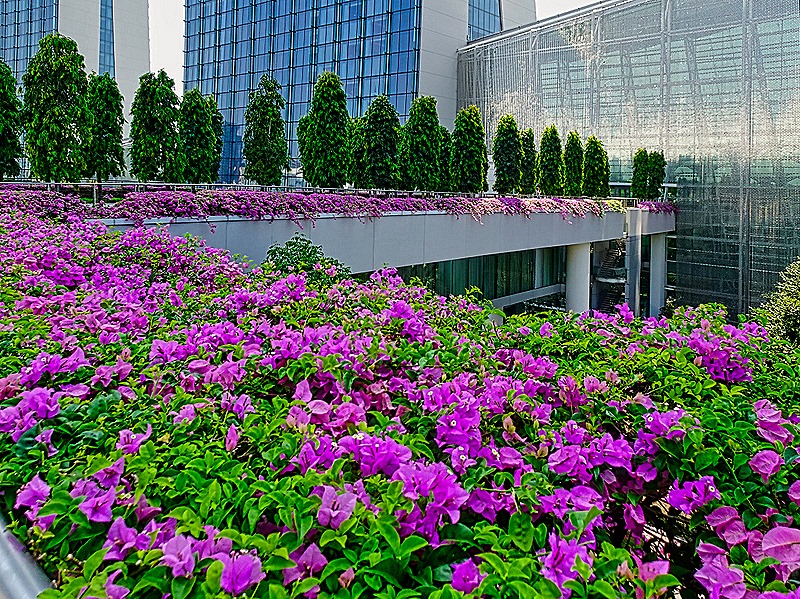
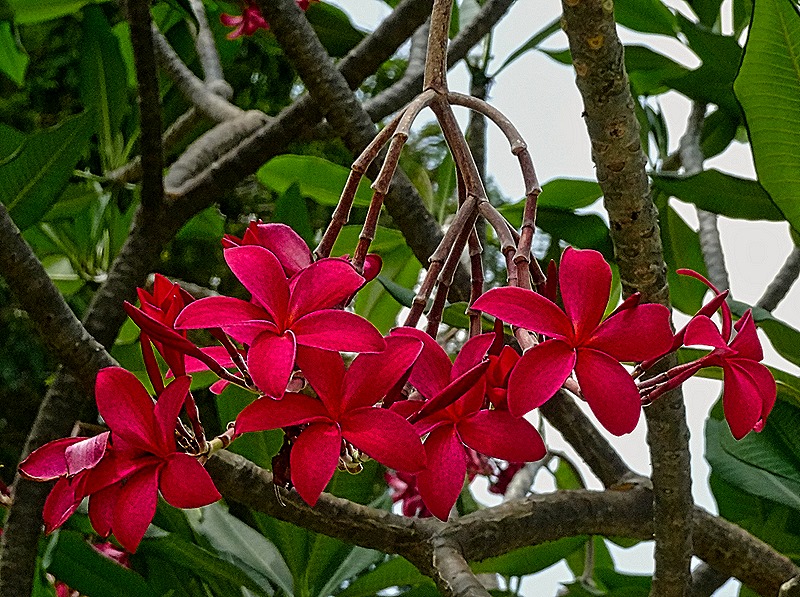
We decided to spend our first day walking around Singapore on our own, since we were already pretty familiar with the town. We set out Just after breakfast. The day was very sunny but also very hot and humid. On our way to the Sands hotel, an icon in Singapore, we walked past the Gardens by the Bay, which we had visited on our last visit. While we only walked along the edge this time there were many colorful flowers to see.



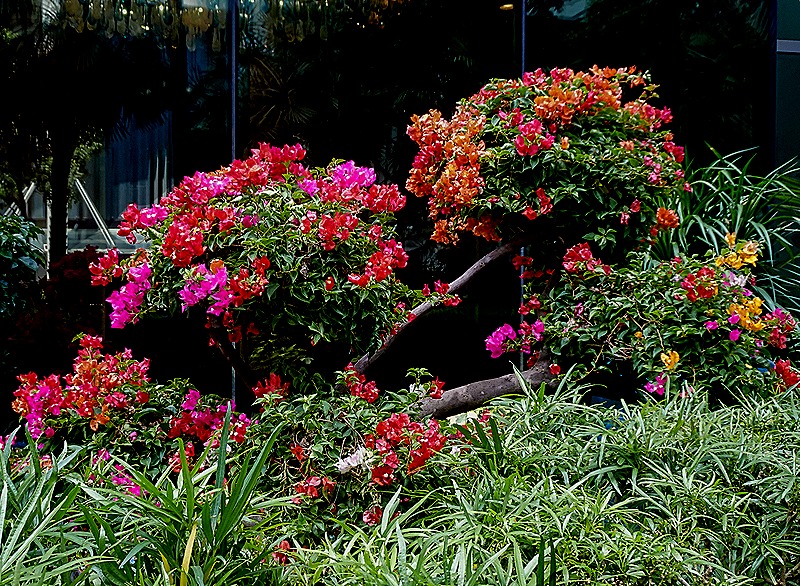
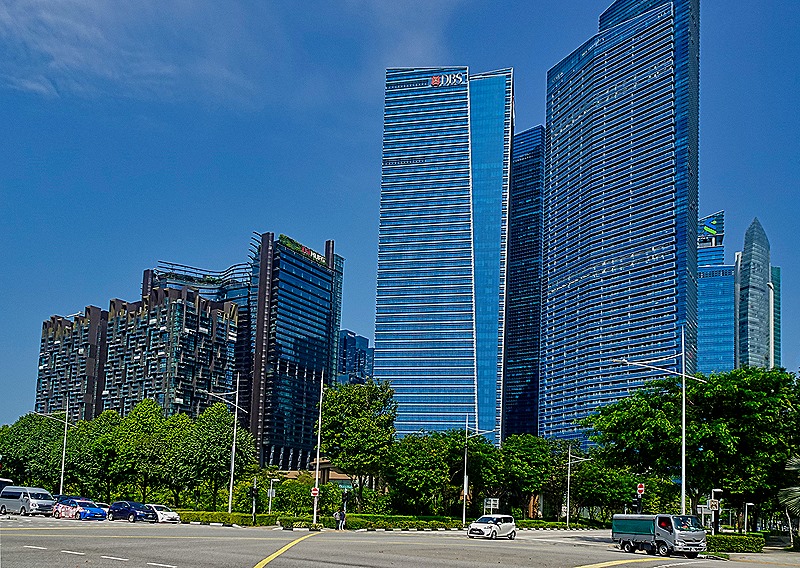
As we passed the gardens we had nice views of the three-tower, one-roof Sands hotel and the Singapore Flyer Ferris wheel, and also of the downtown clump of high rises. And as we approached the hotel there were (as always, it seems, in Singapore) more nice flowers.



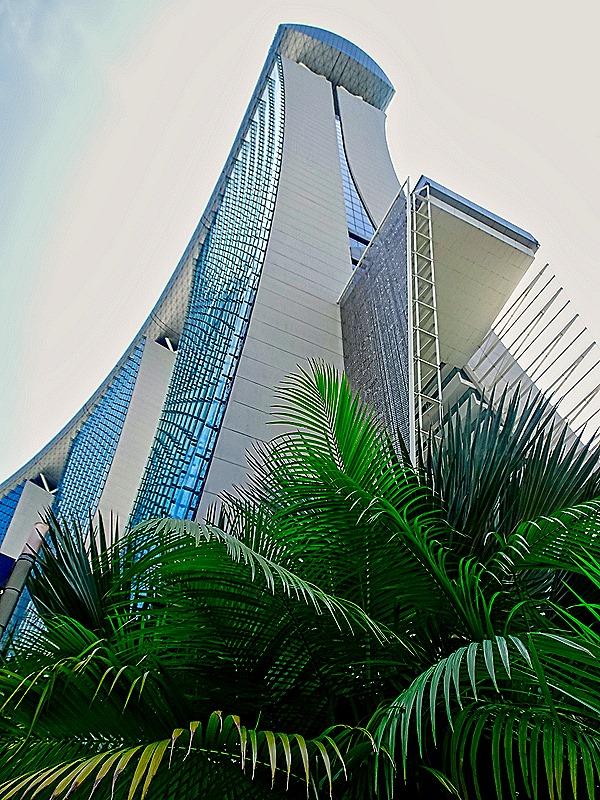

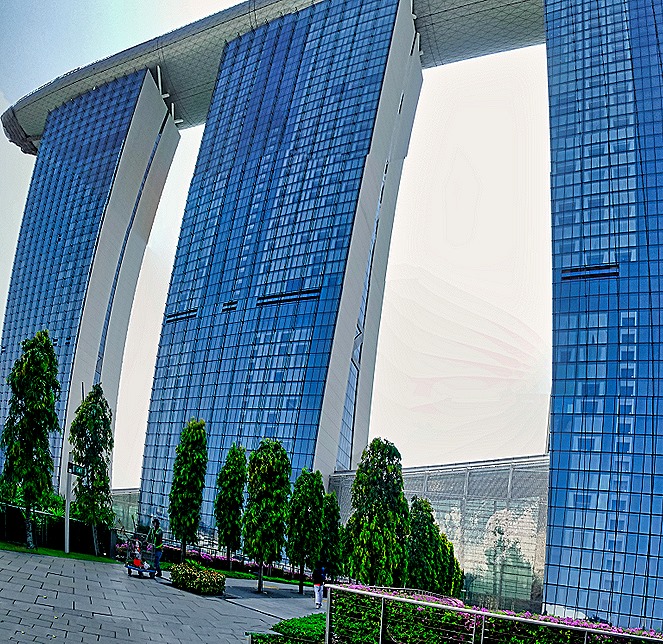
The Sands has a famous infinity pool on its roof with a spectacular view but we were told that it is now limited to hotel guests, so we didn’t go up into the hotel. There were a lot of people crowding the sidewalks in front of the hotel. We took an elevator up a couple of floors to an overpass to a convention center across the street (which we couldn’t enter). The overpass was laid out kind of like a park, with benches and many flowers.

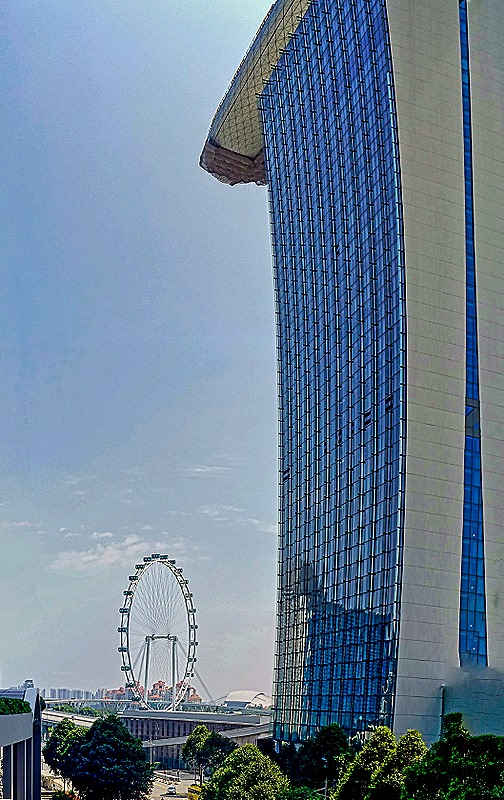


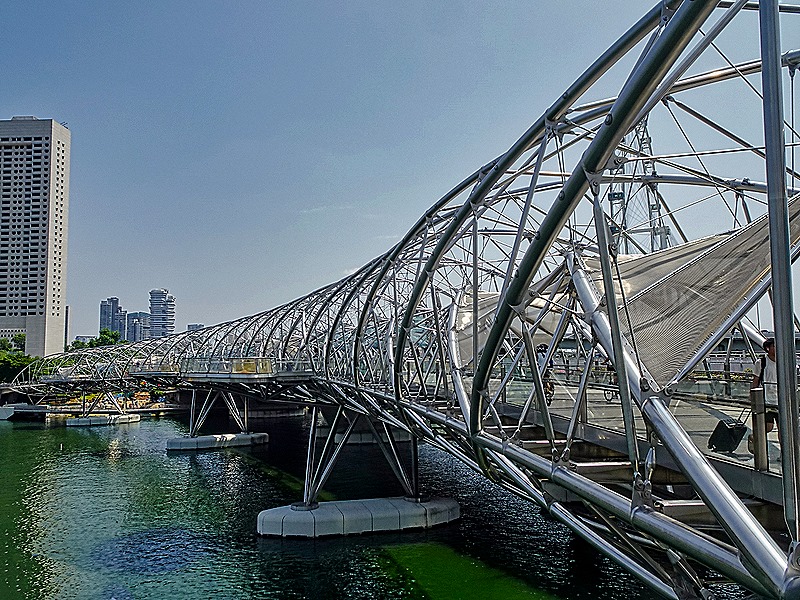
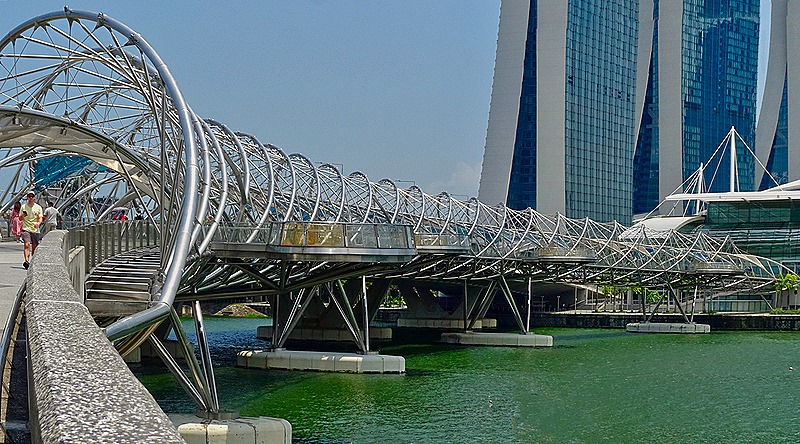
We crossed the Helix Bridge to reach the Marina Bay area. Opened in 2010, the design of this metal pedestrian bridge is based on the structure of the DNA molecule and the views of and from the bridge as you cross are endlessly interesting. Looking back as we crossed we also had a different view of the Sands hotel.
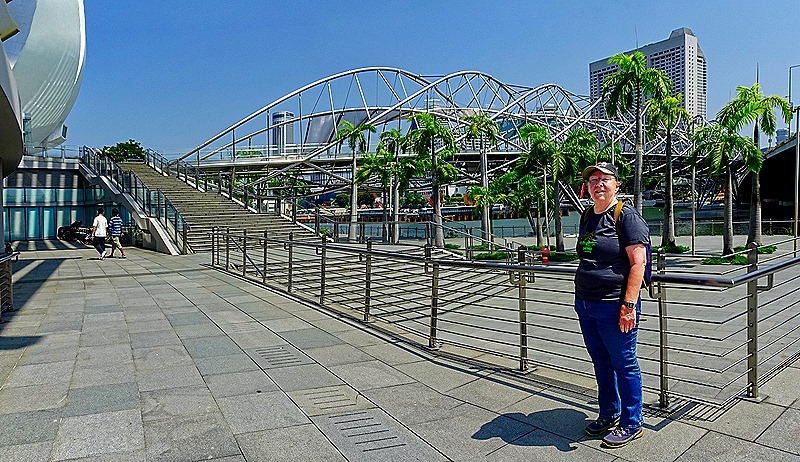




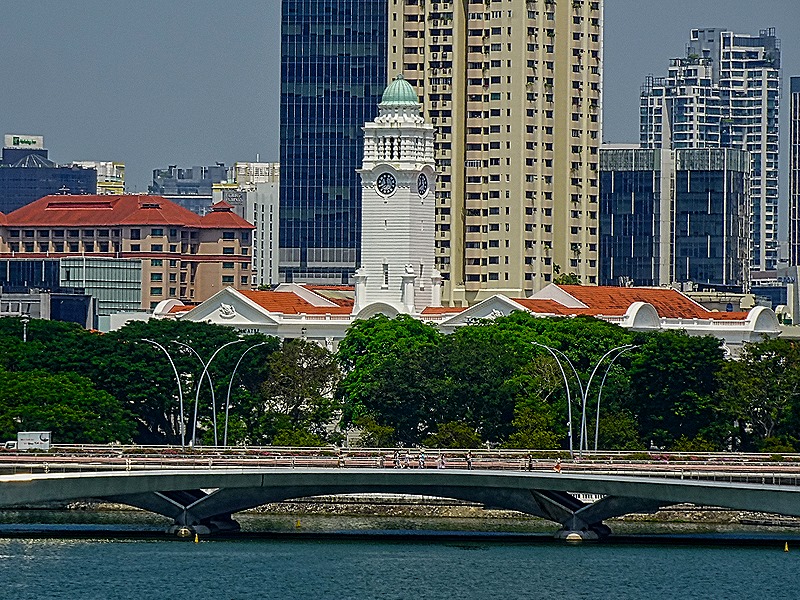
From a viewing platform on the bridge we could see several important structures.
*The green domed former home of the Supreme Court, opened in 1937, is now part of the national art gallery.
*The Victoria Theater and Concert Hall, built in parts between 1862 and 1909, has a distinctive white clock tower.
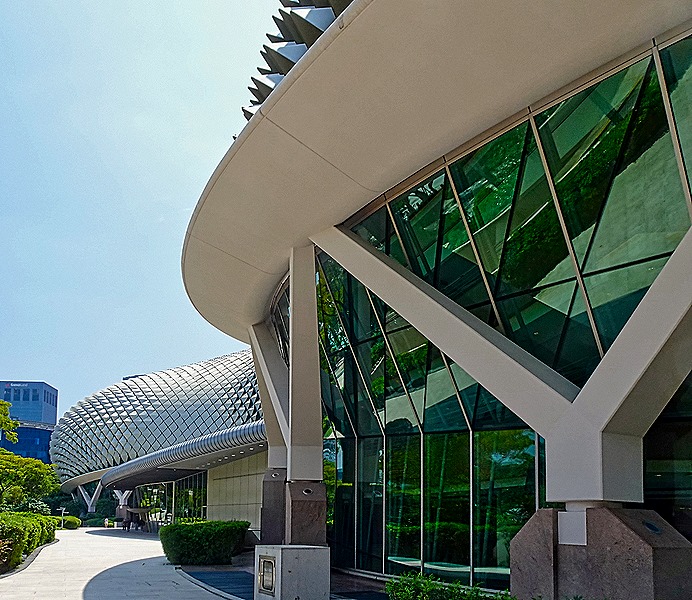
*The Esplanade – Theaters By the Bay opened in 2001. It is referred to colloquially as the “Durian” because of its resemblance to that popular but foul smelling fruit.
*The Merlion is a large sculpture/fountain of a beast that is part lion and part fish and spits a stream of water into the bay. It was created in 1972 and moved to its present location in 2002. The Merlion was dreamed up by the local tourist board in 1964 to be a symbol of Singapore and part of the board’s logo.
*Finally, the ArtScience Museum, which is associated with the Sands hotel complex, is shaped like a giant white water lily. It opened in 2011 and is a venue for exhibitions involving arts, sciences, culture and technology.


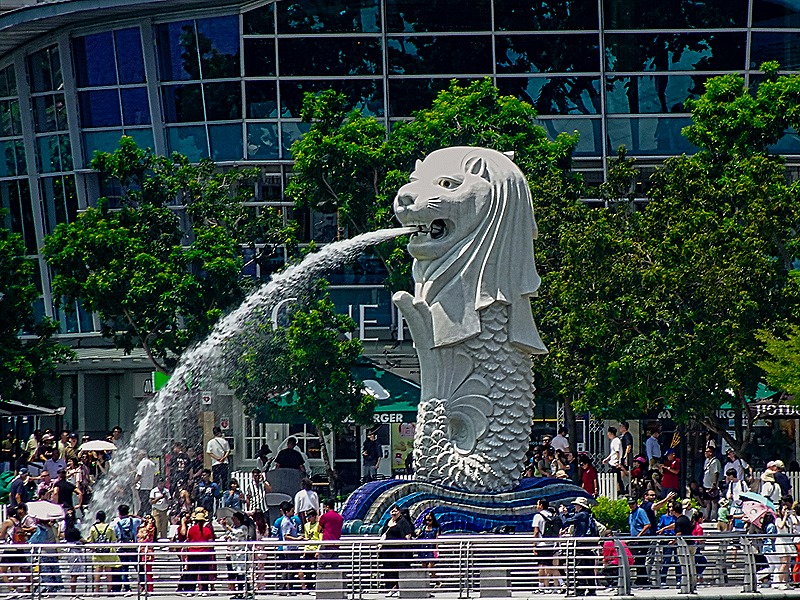
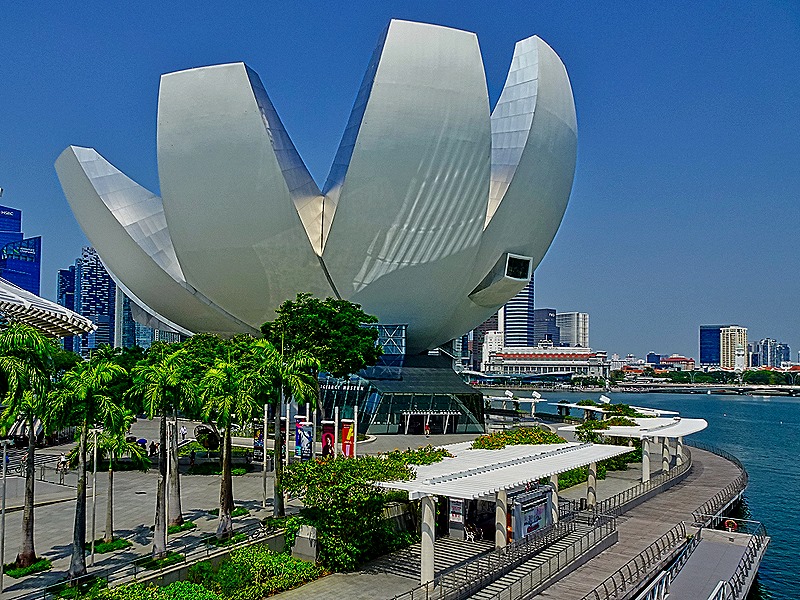
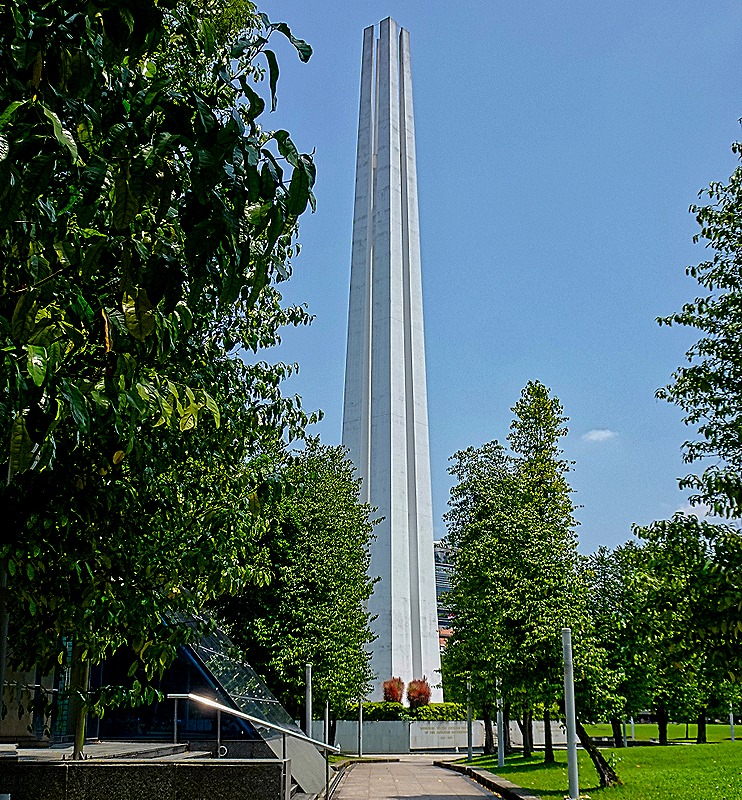
After leaving the bridge we walked past the Merlion and stopped briefly at the Esplanade, taking a breather on some small bleacher seats on the bay side of the building, We crossed a large and busy street through a large subterranean passage under an intersection and walked to the Civilian War Memorial. The Japanese occupation of Singapore from 1942 to 1945 was quite brutal. In particular, tens of thousands of men of Chinese ethnicity were massacred in a drive to suppress opposition to Japanese rule. This memorial was begun in 1963 to commemorate them, but was broadened to include victims of other ethnicities as well. The memorial was officially unveiled in February, 1967, but the year before a ceremony was held to inter more than 600 urns containing remains of unknown civilians killed during the occupation. The memorial is a very tall white obelisk divided into four sections representing different ethnicities honored by the memorial. It is surrounded by a fountain and a park, which is in turn surrounded by many tall downtown buildings. The official name is “Memorial To The Civilian Victims Of the Japanese Occupation 1942 – 1945.”

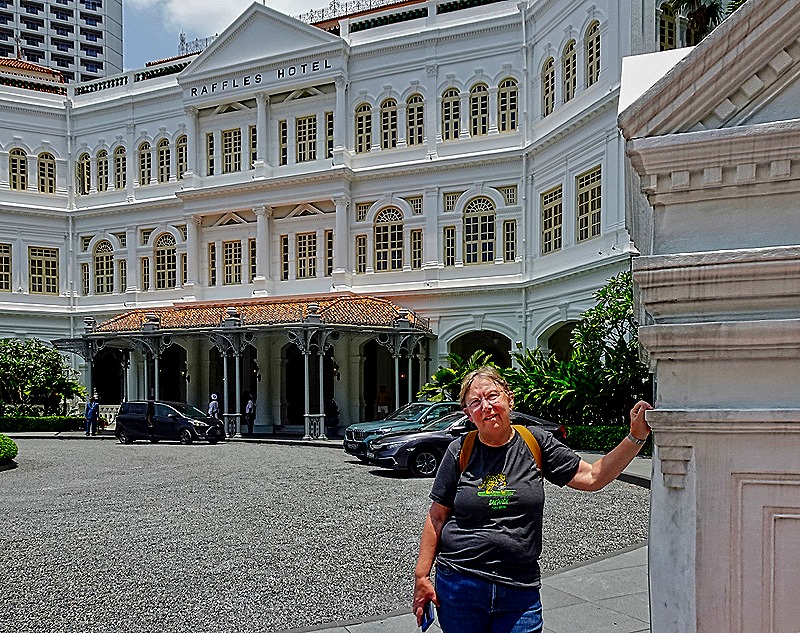
The Raffles Hotel has long been a prime landmark in Singapore. It began as a private beach house in the early 1830’s and was expanded into the 10 room Raffles Hotel in 1887. It has been expanded and renovated and has changed ownership a number of times over the years and is a good bit larger today, but still has a reputation as an elite hotel. Its most recent renovation had it closed on our last visit to Singapore in 2018 but it was open for business when we visited today.
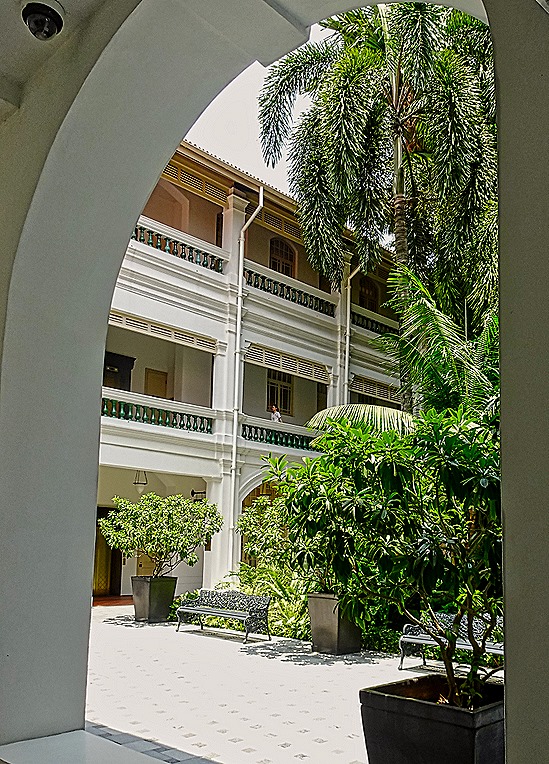
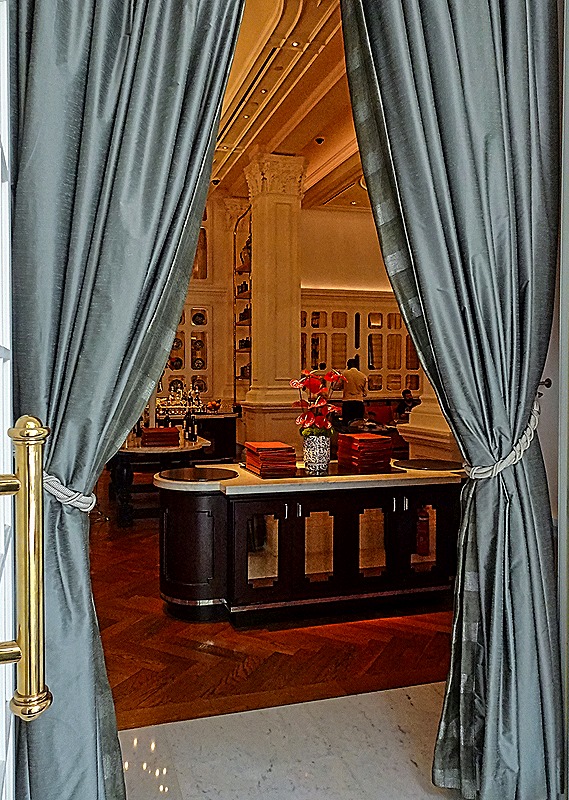
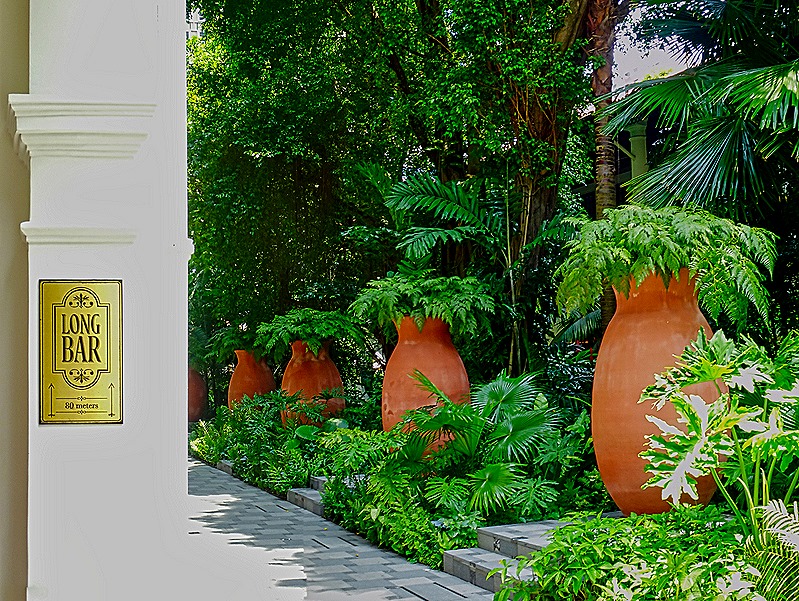
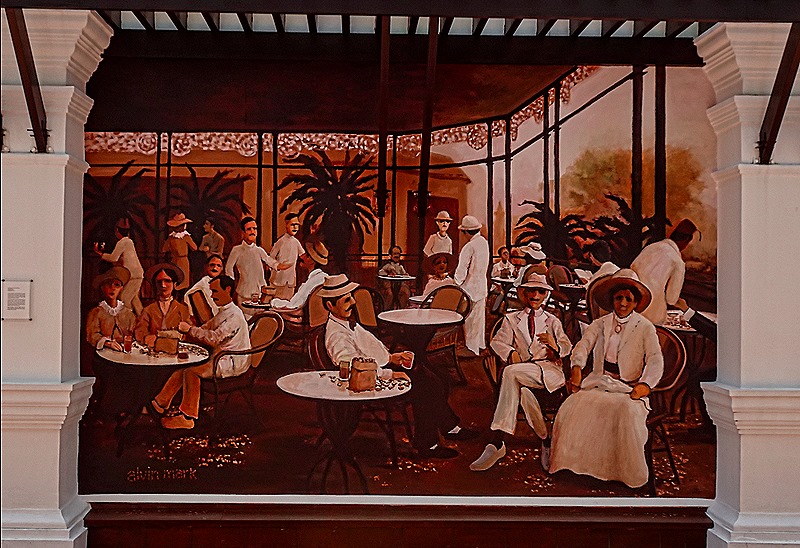
Behind the hotel is an upscale shopping arcade containing boutiques and restaurants, with a large courtyard in the center with a fountain where people can sit at tables and presumably eat or drink if they like. We walked back there with the intention of visiting the hotel’s famous Long Bar, which was moved here from the hotel’s lobby during a renovation in 1991. The Long Bar is famous as a hangout of famous people like the writer Somerset Maugham and was also known for its patrons’ practice of throwing used peanut shells on the floor. We thought we might try a Singapore Sling here at the drink’s birthplace (although we understand it can be shockingly expensive). But it was not to be. When we reached the second floor after following signs for the Long Bar there was a very long line of people waiting to get in. So we moved on. A series of interesting murals based on old pictures from the Long Bar was exhibited on the walls nearby.


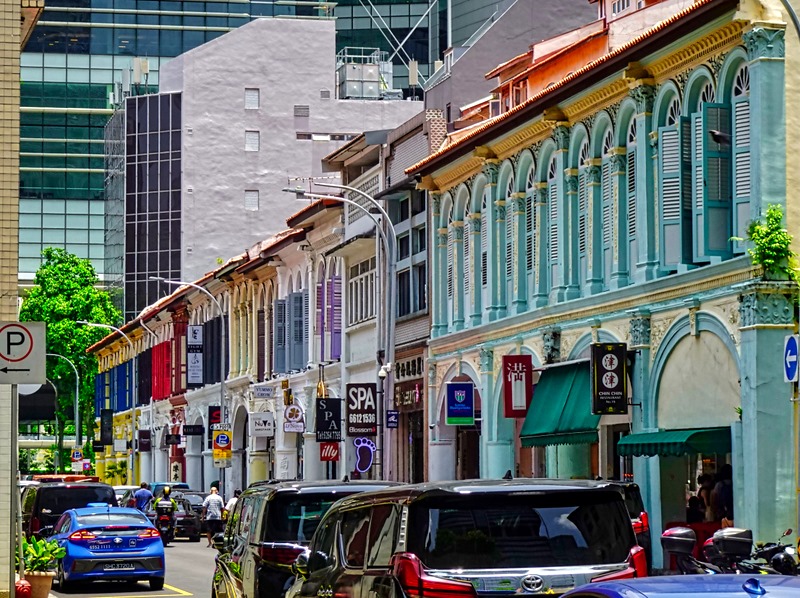
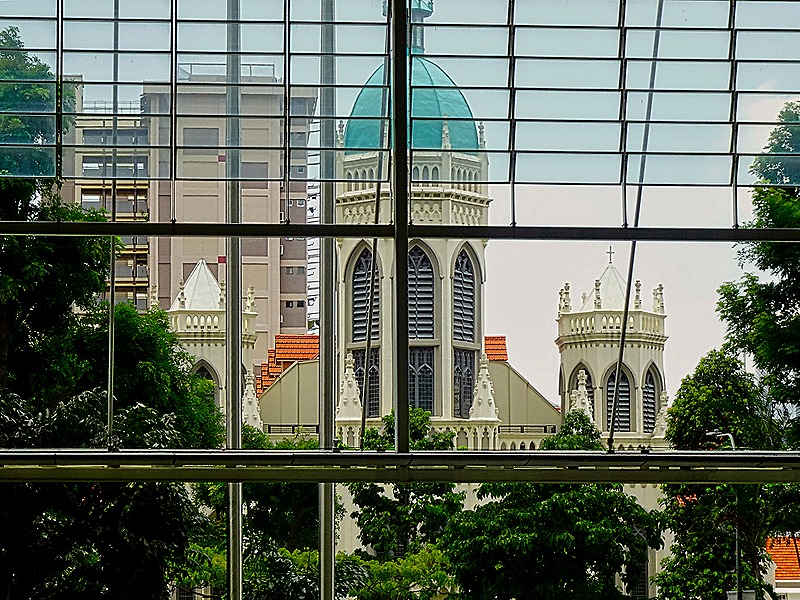
Before walking back to the ship we visited the library, one part of a large building. It wasn’t open but we rested a bit in a covered patio outside (did we mention it was REALLY hot and humid?). Through a back window of the patio we saw the blue domed tower of St Joseph’s Catholic Church, which opened in 1912 to serve the Portuguese community. On a wall of the building housing the library was a mural of children enjoying books. On the way there we passed an interesting block of old buildings painted in a variety of bright colors.

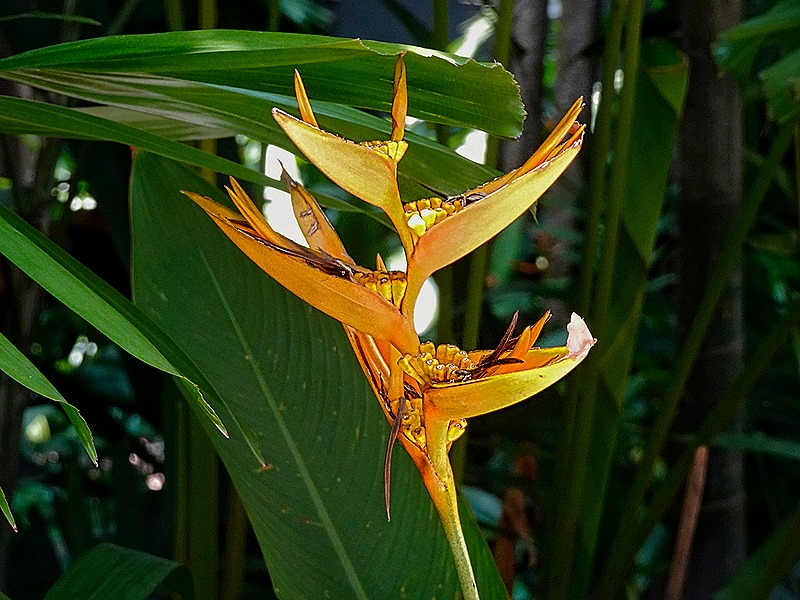
The walk back to the ship seemed much longer than the walk into town in the morning, mostly because we were tired and it was so hot and muggy. We saw some nice flowers and we stopped just before reaching the Helix Bridge for a drink and a bite to eat in a small Italian fast food restaurant. We walked back across the bridge, through all the construction and along the long covered walk parallel to the ocean front (where local folks were fishing) to the cruise terminal. If I remember correctly, we ended up walking a total of about 13 miles in these sauna-like conditions and by the time we got back we were running on fumes.
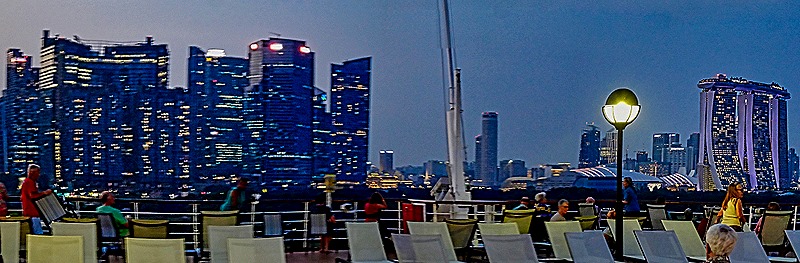
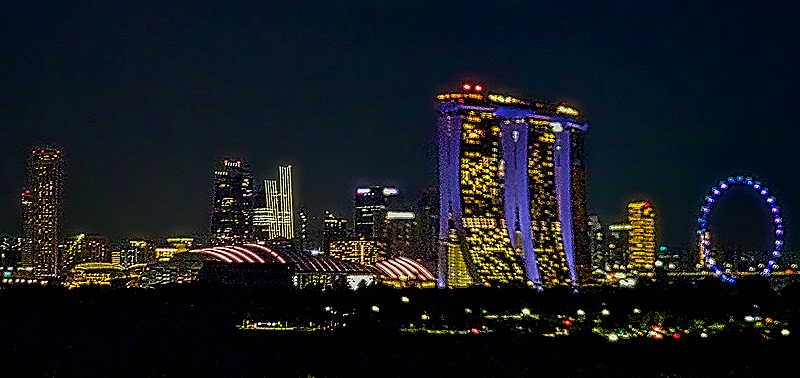
We got dinner in the Lido buffet and ate it on the aft deck, which had a great view of Singapore, looking fine as the city lights started coming on at twilight.
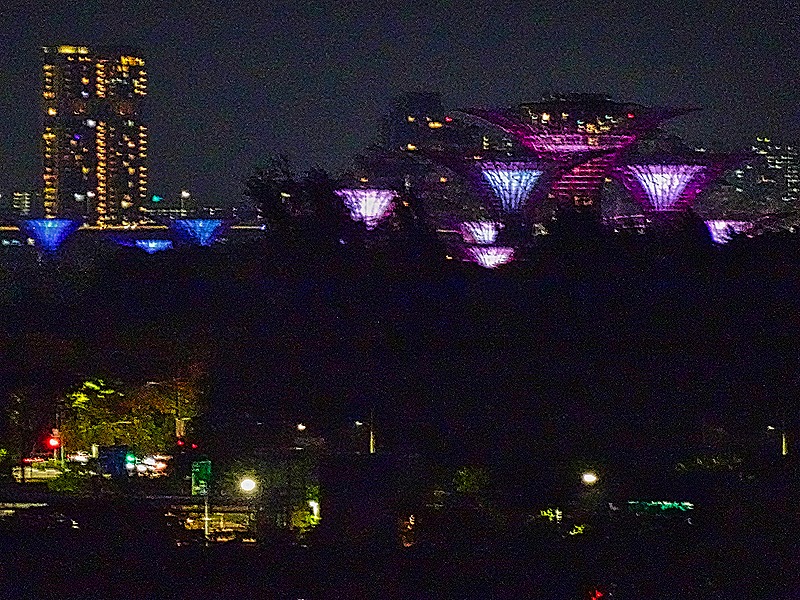
After dark the Supertrees in the Gardens by the Bay were lighted. These are more than a dozen towering structures (about the height of a 16 story building), each with an inverted cone at the top to emulate the look of a tree, and each filled with many plants filling up its trunk. At night these Supertrees are lighted in ever changing colors (with musical accompaniment we are told, although we couldn’t hear that from the ship). Quite an unusual sight, with some of Singapore’s other iconic buildings (such as the Sands hotel and the Singapore Flyer) lighted up as well.


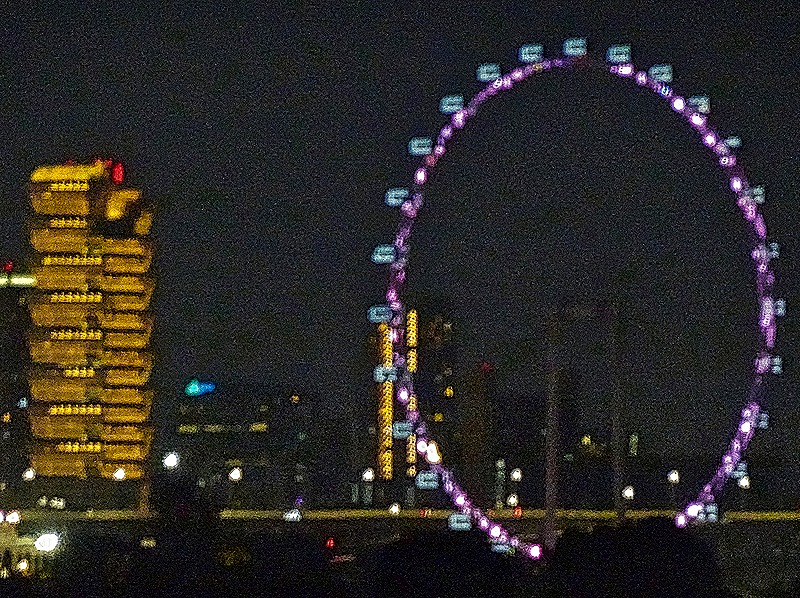
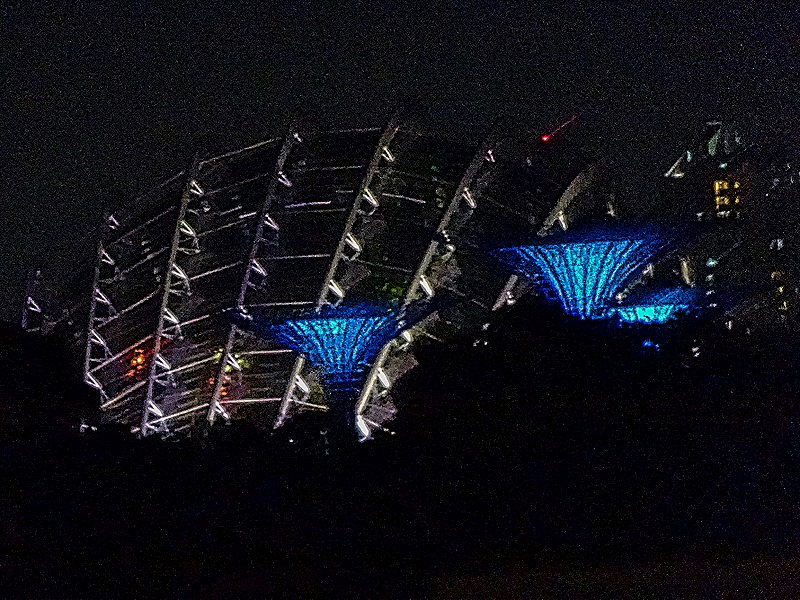
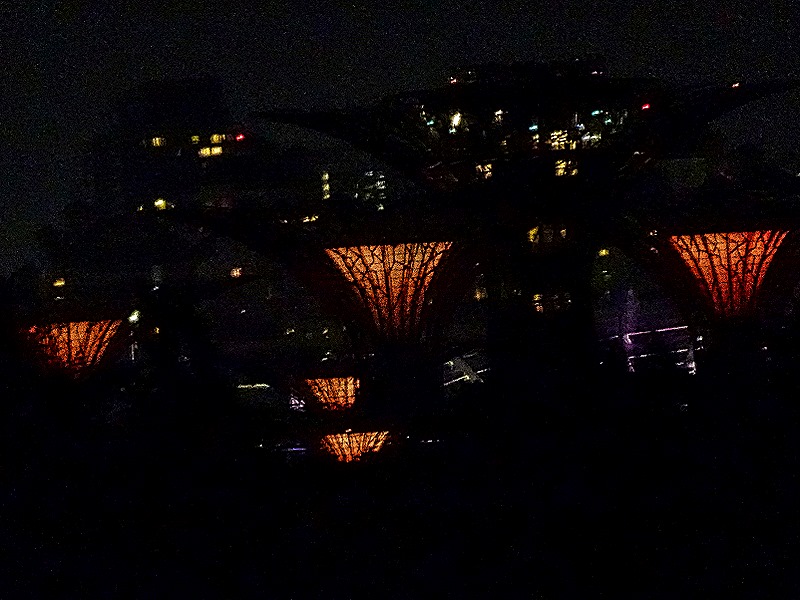
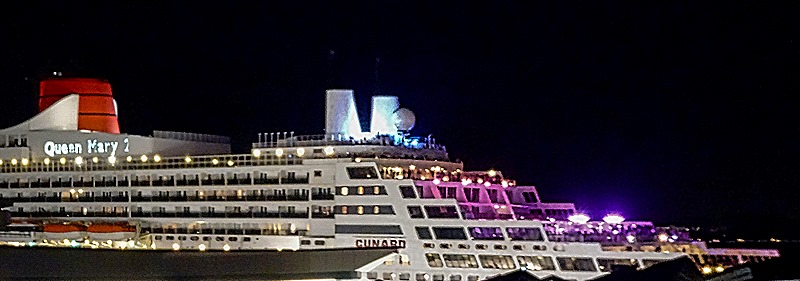
Docked next to us was the Queen Mary 2, which left before the night was over. One more look at Singapore from the Zaandam, and then to bed.
Day 2 (March 24)
There was no way we would be walking anywhere for a second day here, so it was a good thing we had booked an excursion for today with our travel agency to visit some World War II sites. Before the war Singapore was a British colony, very important because it was the hub for trade going by sea between the Indian and Pacific oceans (as it still is today). It is an island just off the southern tip of the Malay Peninsula. The peninsula to the north was largely forests, which the British thought would be impassable to an army, so the island was heavily fortified with large cannons designed to fire hull penetrating shells to stave off any attack from the sea. It was called “Fortress Singapore” and was thought to be impregnable.
Within hours of the attack on Pearl Harbor, however, the Japanese attacked the upper Malay peninsula. After destroying two of the UK’s best warships they were able to land on the peninsula and began moving south. They used bicycles and light tanks to maneuver through the woods. The British, who had more than twice as many men (though many not fully trained and poorly supplied) were convinced that they were greatly outnumbered, and retreated down the peninsula to Singapore, then blew up the causeway bridge that connected the island to the mainland. They were sure the Japanese would try to invade from the northeast and, ignoring intelligence to the contrary, concentrated their forces there. But the Japanese actually invaded in the northwest of the island and pushed the British (and Australians) back to the outskirts of Singapore city in the south. Despite Churchill’s insistence that they fight to the last man, with water, food and ammunition running out (and more than a million civilians crowded into the few square miles of the city), the British commander surrendered on February 15. What the British didn’t know at the time was that the Japanese were also at the end of their tether and were certain they would lose if it came down to street warfare in the city of Singapore.
The Japanese occupied Singapore until the end of the war in 1945, brutally suppressing all opposition (including the killing of thousands of ethnic Chinese men who were assumed to be in opposition to the Japanese). A complex of POW camps was established, with prisoners divided by sex and, sometimes, ethnicity. The central prison, which also gave its name to the whole complex of several prison camps, was in Changi. That was the first place we saw today.

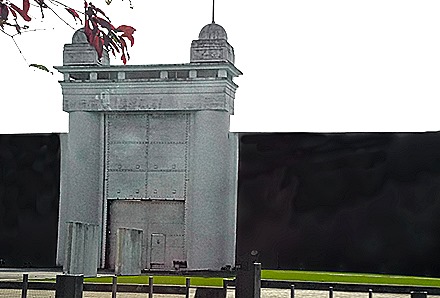
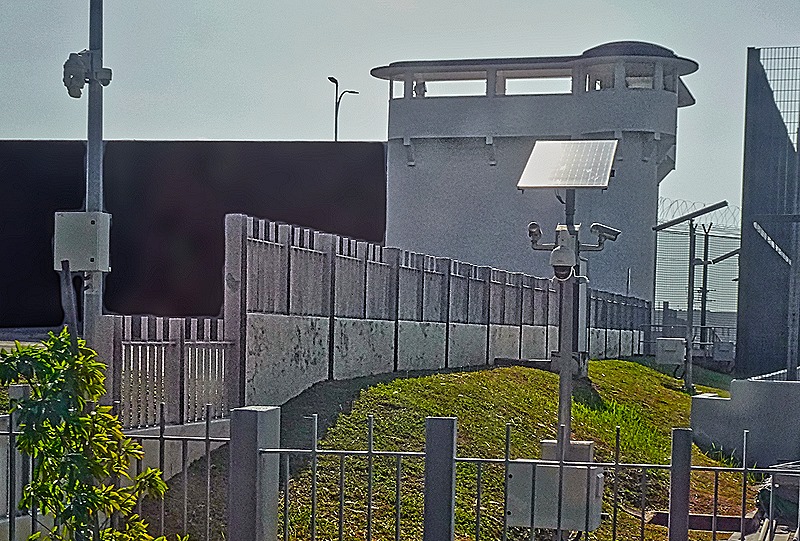
Changi prison was built by the British in 1936. It was designed to hold 600 prisoners, but during the Japanese occupation some 3,000 civilian prisoners were held there. It was a British barracks near the prison that was converted into a POW camp, holding some 50,000 mostly British and Australian soldiers. About 850 POWs died there, and more of these prisoners died after being transferred to forced labor sites (like the Burma-Thailand railroad depicted in Bridge Over The River Kwai). One of the POWs interned here was James Clavell (author of Shogun), whose first novel, King Rat, was based on his experiences as a POW. After the war Changi was used by the British to house Japanese prisoners of war, a handful of whom were executed here. Today it is part of a larger modern prison complex, although at the request of the Australians much of the original prison building has been preserved.
Since it is still a prison we were not able to visit inside the prison walls. So the pictures here were taken from the bus as we drove by it.
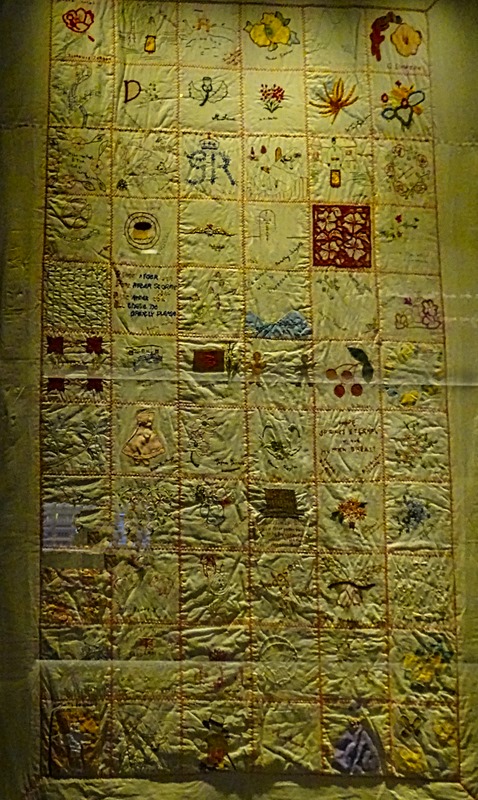
A museum has been established not far from the prison, which presents an eye opening depiction of life in the POW camp. There are a number of artifacts but the museum mainly presents wall boards with photos and written explanations. It is very well done and quite educational. Among other things, one notable artifact is a large quilt sewn by inmates of the women’s prison. A number of these were made for use in the hospital and the women concealed in their designs the names of inmates and meaningful symbols which, had the Japanese recognized them, could have resulted in serious punishment. Apparently the Japanese did not try to restrict religious observances and the prisoners built several chapels during the occupation. One of them is in a museum in Canberra and there is a reconstruction of another one, called St George’s Church, just outside this museum. On the altar sits a metal cross made by one of the inmates from a used shell casing. There is quite a bit more to this museum and it was well worth visiting.

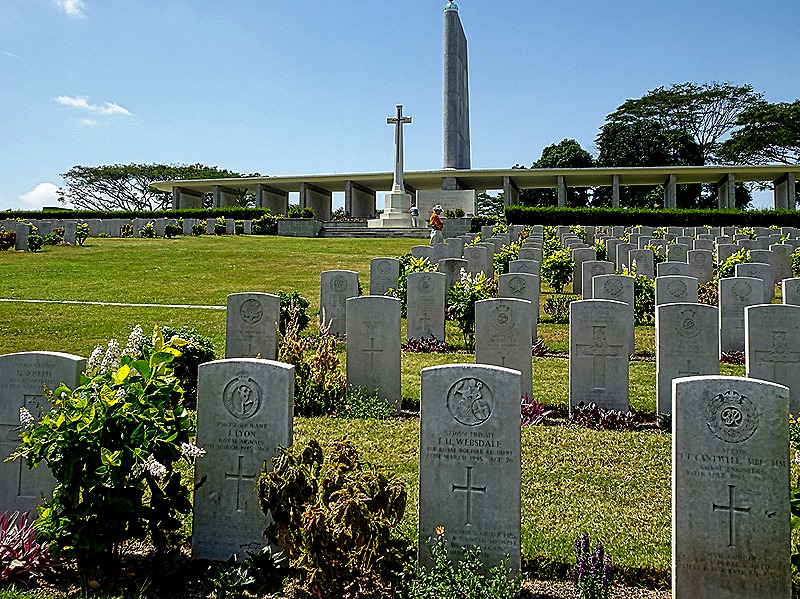
We visited the Kranji War Cemetery, which contains the remains of almost 4,500 Allied soldiers (850 unidentified) who died during the Battle of Singapore and the Japanese occupation. During the war this area held a POW camp and a hospital, and after the war Kranji was designated to be Singapore’s War Cemetery; war graves from other parts of Singapore were moved here.
At the top of the hill is the Kranji War Memorial, etched with the names of more than 24,000 service personnel for whom no remains could be identified (including a number from India who had been cremated in accord with their religious beliefs). Its columns represent soldiers standing at attention, its roof is shaped like the wings of an airplane, and the tall portion behind represents the fin of a submarine. A tall cross in front of the Memorial marks the mass grave of more than 400 wounded who died in the nearby hospital at the end of the occupation. This mass grave preceded the establishment of the War Cemetery and the cross was erected later.

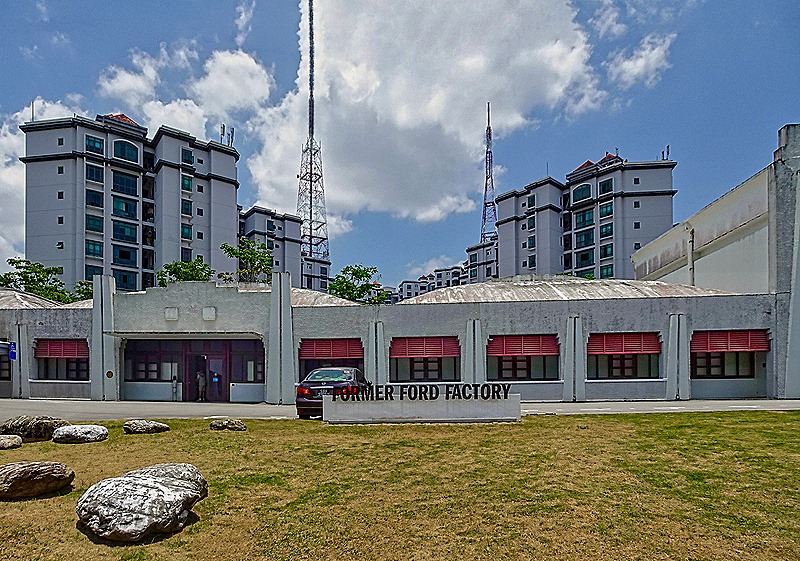
Our final stop was at the former Ford Factory, the site of the British surrender to the Japanese in 1942. Ford built the factory to serve the southeast Asian market for automobiles, but Ford’s timing was not good. The factory was completed in October of 1941 and just two months later the Royal Air Force took it over to assemble fighter planes to defend Singapore. The fighters assembled here were flown out of Singapore near the end of January, 1942, to keep them out of the hands of the advancing Japanese, and on February 15 the Japanese army took control and made the factory its temporary military headquarters. The Japanese company Nissan operated the plant during the occupation to assemble military vehicles. After the war Ford regained control of the factory and was finally able to operate it as a vehicle construction plant, which it continued to do until 1980.

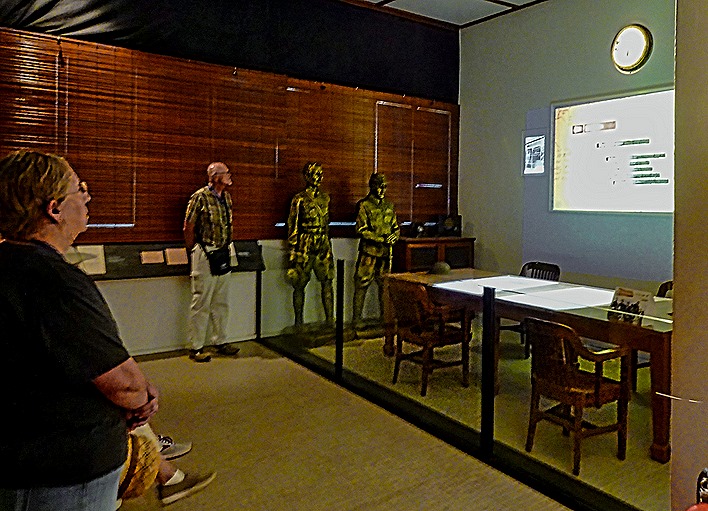
The Ford plant’s special place in history stems from its role as the site of the British surrender of Singapore. On February 15 the British commander, General Arthur Percival, surrendered Singapore unconditionally to Japanese General Yamashita Tomoyuka in the boardroom of the factory. That room is preserved much as it looked then, with a replica of the original conference table (the original is now in Australia) and a clock set to 6:40, the time of the signing. The room has full size statues of the two generals standing at one side.


After this we drove back to the ship, through this neighborhood that now has a number of high rise residential developments. We set sail before dinner time, looking forward to the three upcoming sea days to recuperate from all the exertion on our first day in Singapore.

 BADER JOURNAL

Your pictures are gorgeous! Thank for the great reporting!
October 21, 2024 at 9:39 am
That was a fantastic tour. I loved Singapore. Im home from Switzerland visiting relatives and also fun. Came home wirh a full blown (immunosuppressed) covid. 7 days starting to get better. Paxlovid yes. I’m missing a family wedding in Kentucky this weekend. But that’s ok. Kurt hasn’t gotten it yet. How are yall ? I think about you so often. Love, Karen.
😎 Karen. Sent from AOL Mobile Mail Get the new AOL app: mail.mobile.aol.com
October 24, 2024 at 5:23 pm