
Luderitz & Walvis Bay, Namibia — 2024
Namibia is a fairly large country on the southeast coast of Africa, just north of South Africa. In fact, until it obtained independence in 1990 it was governed by South Africa. From the 1880’s until World War I this area was a German colony called German South West Africa, after which it came under South African control. The driest country in Sub-Sahara Africa, Namibia is largely a desert country, located between the Namib and Kalamari deserts. It is known for its many beautiful sand dunes, some of which come right to the edge of the ocean.
Luderitz
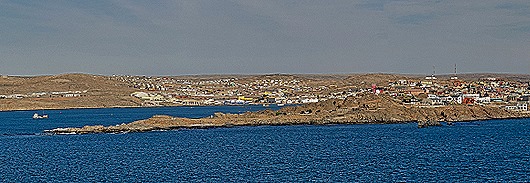
The morning of April 21 found us anchored near the town of Luderitz. Founded in 1883, Luderitz today has a population just over 16,000. Its heyday was from 1909 to World War I when there was a diamond mining boom in the area. There is a heavily German influenced ambiance thanks to its first few decades as part of a German colony. The tender ride into town was not brief, as the tender port is behind the peninsula you can see in the picture below, which is called Shark Island. You can also see in that picture what a bleak desert environment Luderitz sits in.
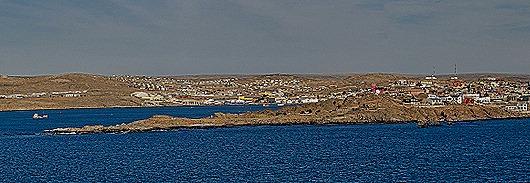
We were supposed to visit Luderitz on the Grand Africa voyage in 2022, but the weather conditions were bad enough that the Captain skipped this port (Rick was still in Covid quarantine, but because the whole ship missed this port that didn’t make any difference). So this was our first opportunity to visit Luderitz.
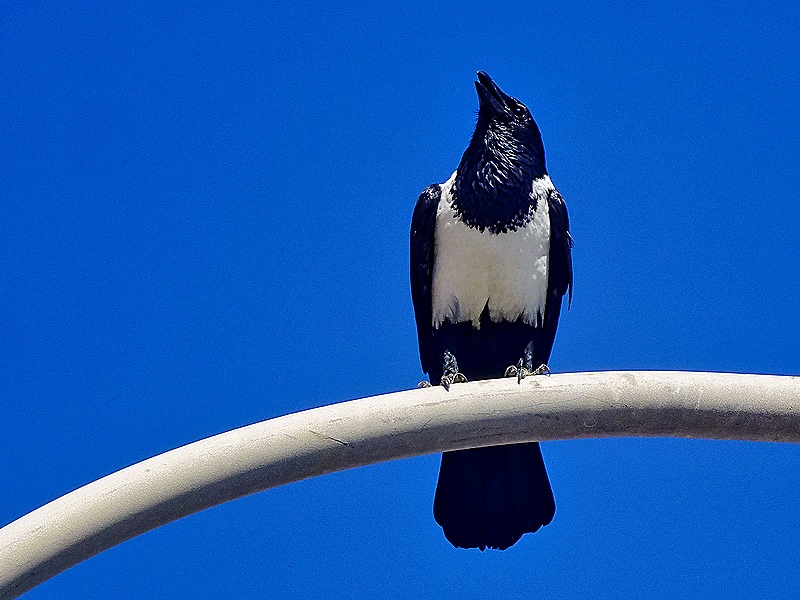
The ship’s tender let us off at a long wooden dock near the center of town. There was a view of part of the town from the dock and what looked like a type of seagull was in the water nearby. As we walked through the port we spotted an interesting black bird with a white breast perched on a metal rail above our heads.
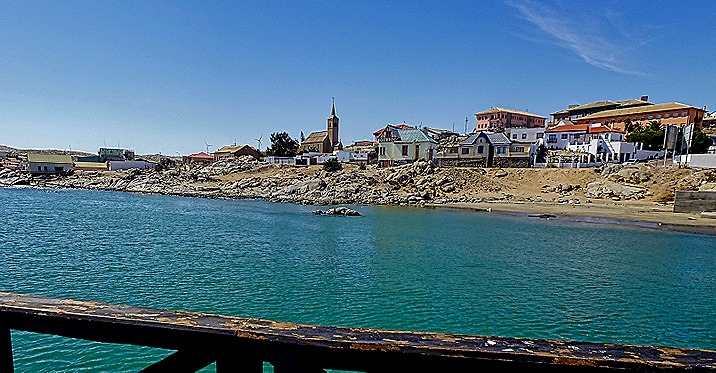

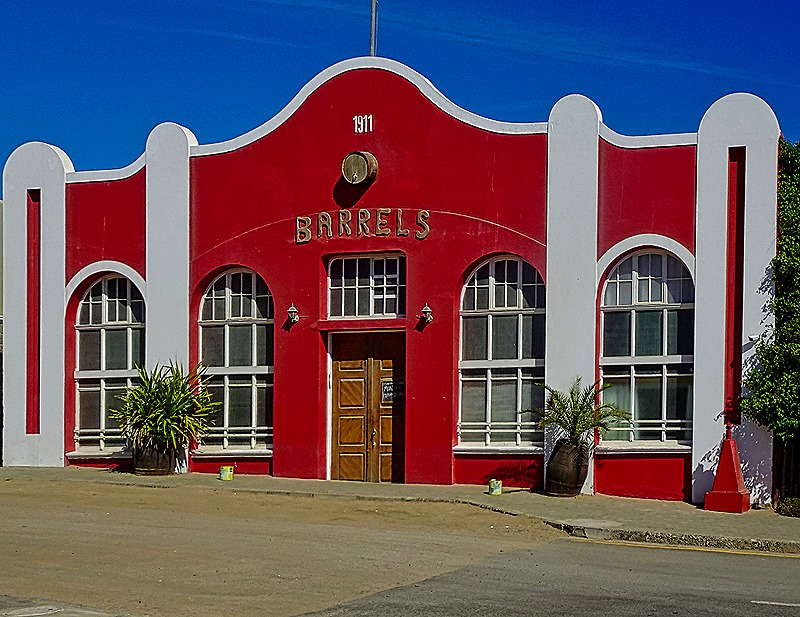
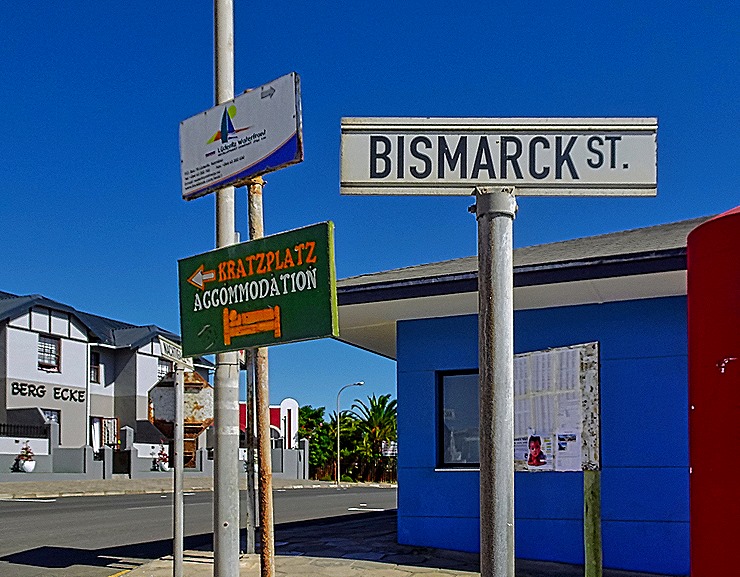
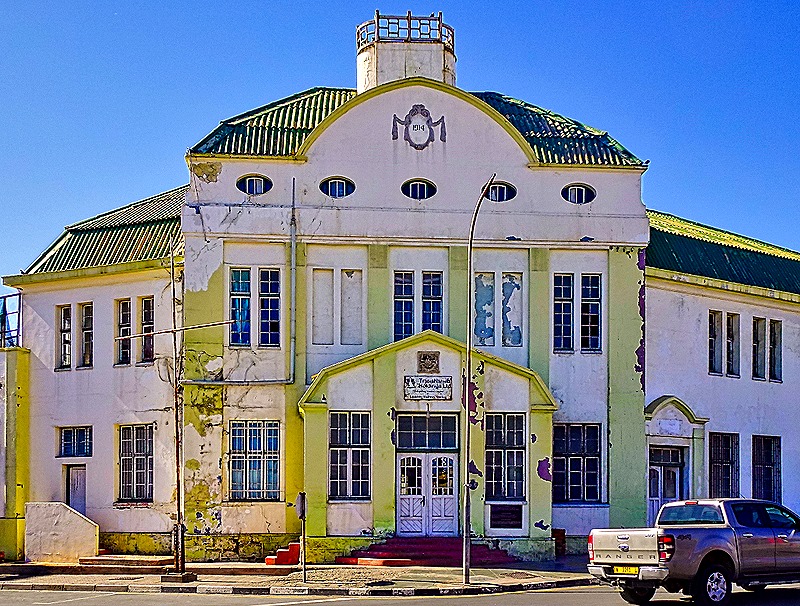
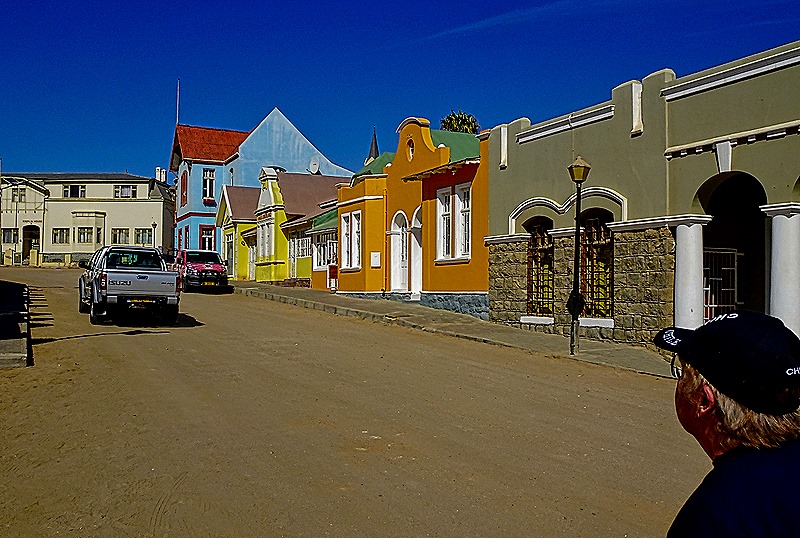
The main thing our research indicated we should see here is the Felsenkirche (church on the rocks) which is on the other side of the central town from the tender dock. So we began walking toward it and found that really the best thing about visiting Luderitz is its hundred year old German colonial architecture, heavily influenced by the Art Nouveau style that was popular at that time. Many of these buildings are painted in bright colors. Among other things we passed on our walk through town was a view of the Felsenkirche looming above the Bayview hotel and a bright red restaurant & bar called Barrels. Bismarck Street is one of the oldest streets in town, named for the German chancellor who first established the colony here. On that street was the Deutsche Afrika Bank Building, opened in 1907, in whose vaults the diamond miners kept their diamonds and where the mine workers were paid. The railway station was, as we understand it, built 1914 a few months before the start of World War I to replace a station built in 1904 that became too small during the diamond boom. This was the last building in Namibia built by the Germans and is still in use and shows its original design. It is on the corner of Bismarck Street and Bahnhof Street.



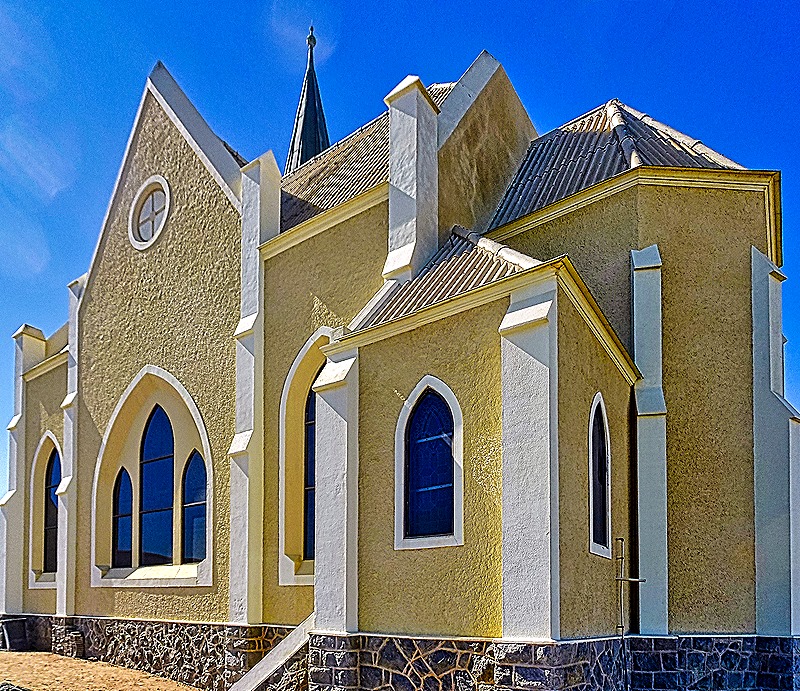
The Evangelical Lutheran Church, the official name of the Felsenkirche, sits on top of the highest hill in Luderitz. It was a very steep walk up a dirt road to the church, past some old colonial houses. Built in Victorian Gothic style, the church opened in 1912.


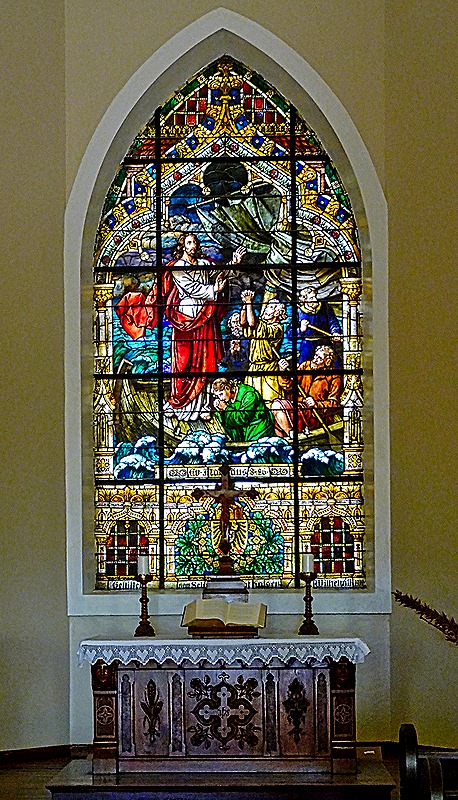
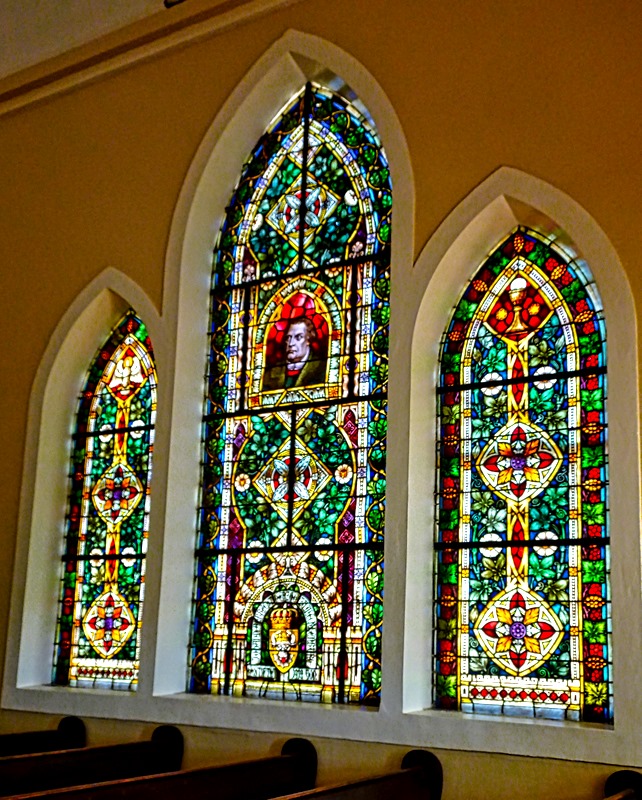
The church is fairly plain inside but has colorful stained glass windows of a quality you don’t expect in a small desert town. They were all imported from Germany, some contributed by the German Kaiser. One has a portrait of Martin Luther incorporated into its design. When asked who it was, the information person in the church said it was the German Martin Luther. We assumed he was distinguishing it from the American Martin Luther King, but it would have been hard to make that mistake from this picture.


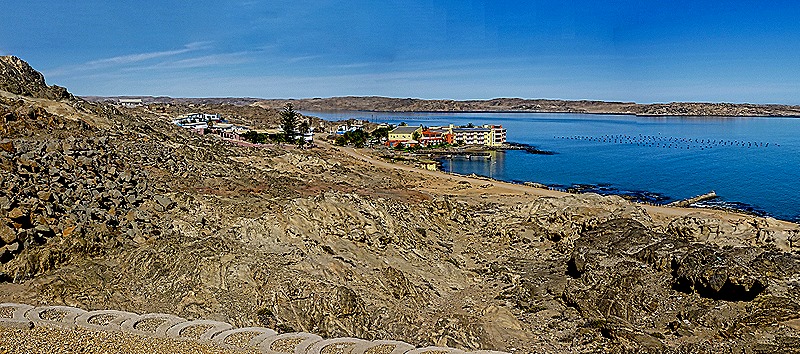
We walked around behind the church and were rewarded with a panoramic view of the bay and the modern Nest Hotel at the bottom of the hill on the water. From the front of the church was a panoramic view of Luderitz. We walked down the hill to start heading back to the tender port.

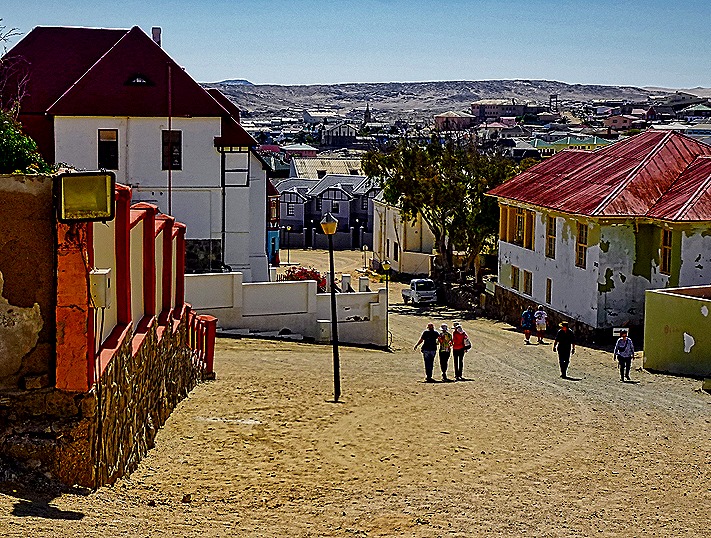
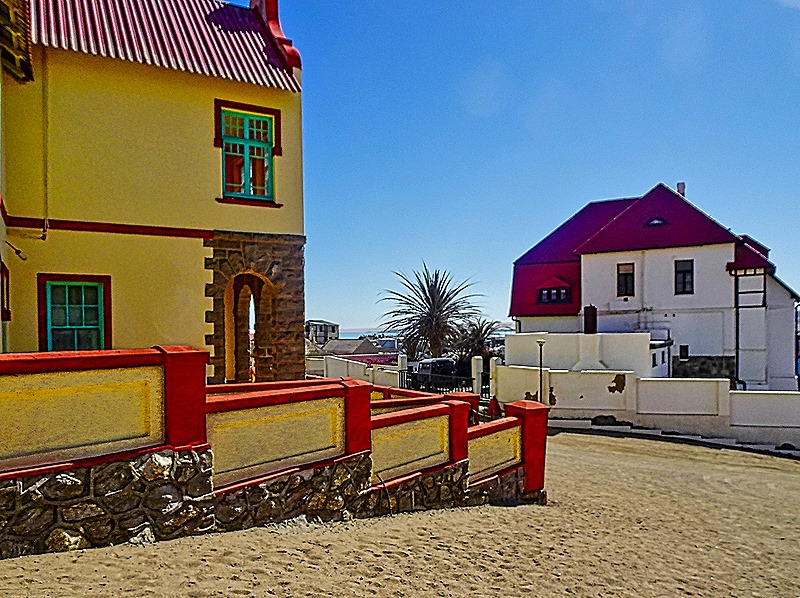

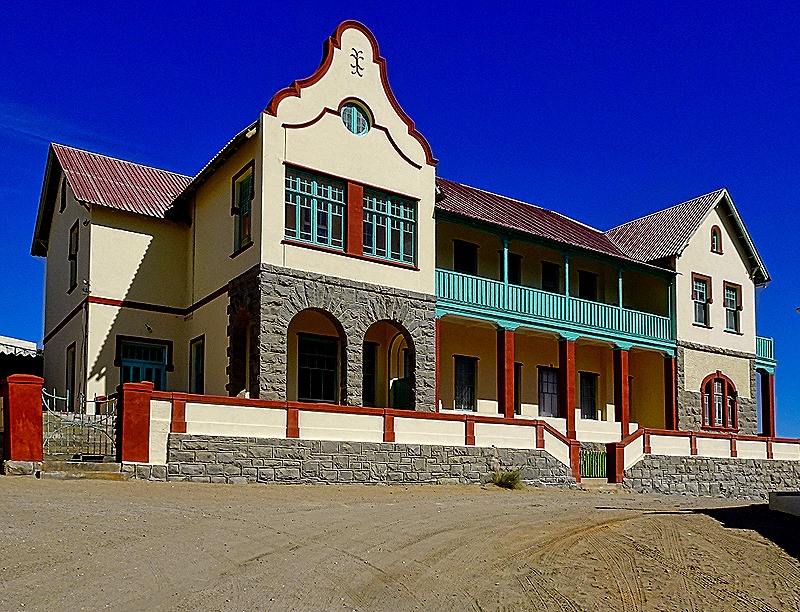
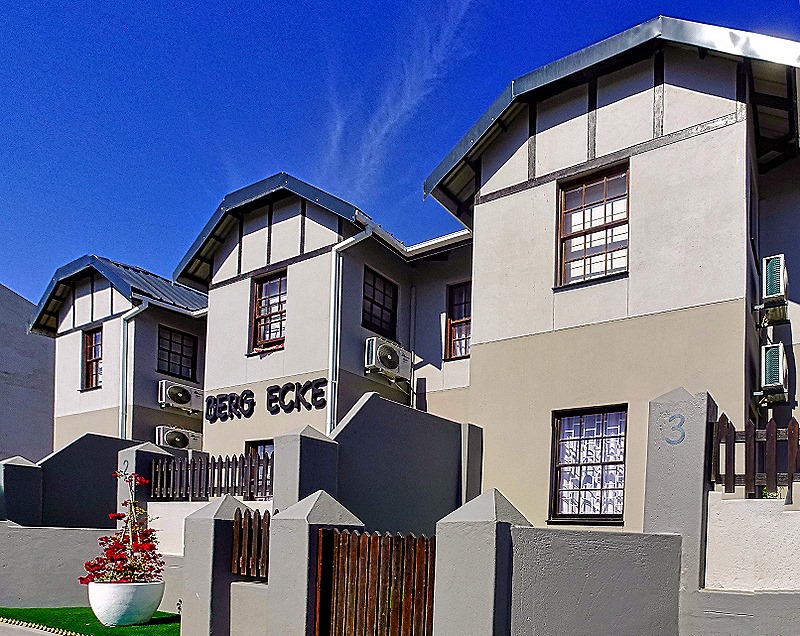
Our walk back to the tender port took us, of course, past more interesting old buildings. Berg Street is topped by the red and blue Haus Grunwald, built in 1910 for Luderitz’s first mayor.

We have some views of notable places from the ship that we took later. Two are of the town’s notable churches, one of the Felsenkirche (of course) sitting on its rock hill and another of the Saints Peter & Paul Catholic Church.


We mentioned Shark Island earlier, which protects the tender dock from the ocean. It has a notable history. The Germans conducted a brutal war from 1904 to 1908 to suppress the resistance to colonial rule by the indigenous Herero and Nama people (some call it a genocide, not without reason). From 1905 to 1907 the Germans ran a concentration camp on Shark Island in which several thousand prisoners died.
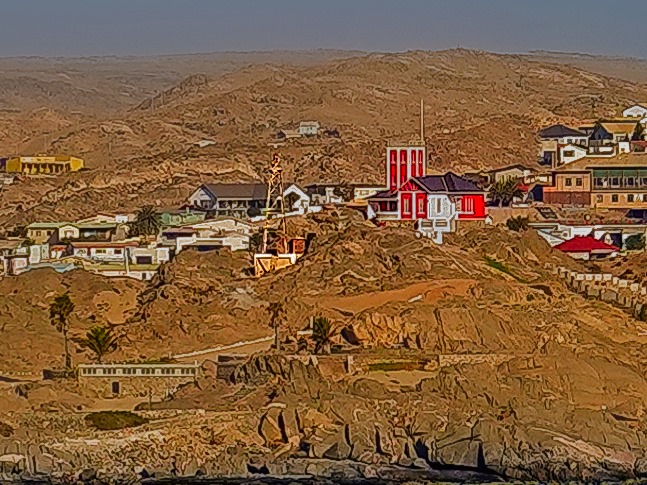
There are two lighthouses here. First is the Shark Island Lighthouse, built in 1903. It was decommissioned and the light was removed in 1910 (today this building can be rented for tourist accommodations). A new light was built very near by, on a steel skeleton tower. In the first picture below the old lighthouse is the bright red building and the newer one can be seen to the left of it rising from a yellow base.
Second is the Diaz Point Lighthouse on the opposite end of the “island.” Built in 1915, the light is 174 feet above sea level and is painted in horizontal white and red stripes. In our previous episode, driving from Cape Town to the Cape of Good Hope, we saw the padrao (cross) erected there by the Portuguese explorer Bartolomeu Dias in 1488. He erected a padrao here as well on July 25, 1488, a little way behind this lighthouse so we can’t see it in the picture. It stood for several centuries before deteriorating enough that it had to be removed to a museum. It was replaced in 1988 (500 years after Dias’s last visit) with a duplicate carefully modeled on contemporaneous pictures of the Dias cross.

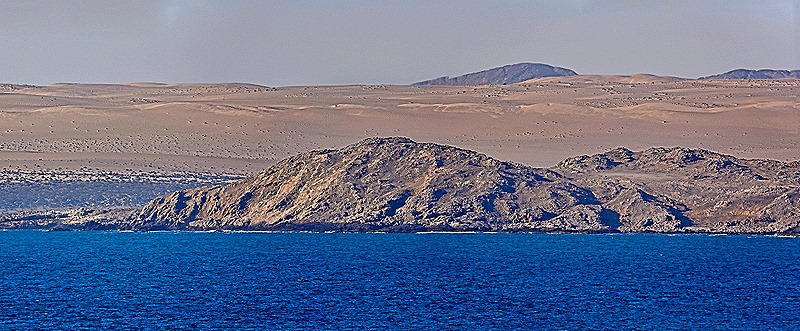
So that is Luderitz. We sailed away shortly before dinner time, passing the empty desert land on the shore outside the city.
Walvis Bay
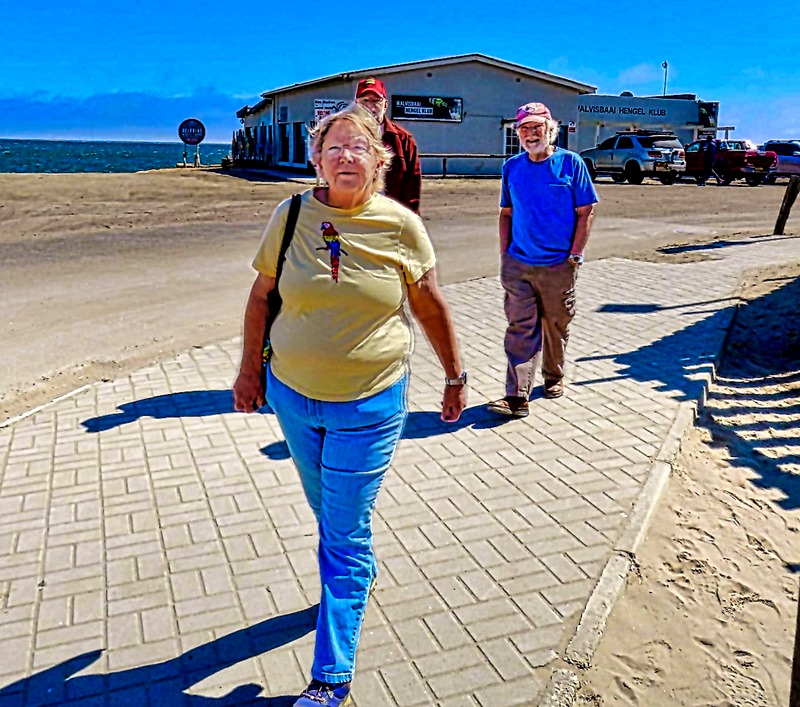
We docked in Walvis Bay the next morning, April 22. There is much of interest to see and do in Walvis Bay, particularly if you like wildlife. During the world cruise in 2018 we had an expedition that took us to the mostly desert interior of this area. https://baderjournal.com/2018/08/24/walvis-bay-namibia/ . And during the Grand Africa voyage in 2022 we had excursions through the bay and down the coast. https://baderjournal.com/2018/08/24/walvis-bay-namibia/ . By the time we reached Namibia on this voyage we were pretty tired of driving excursions, so we decided just to walk to the nearby lagoon where the pink flamingoes hang out, in the company of our friends Robert and Bill.
It was a nice sunny day and the walk was pretty easy. After leaving the port we walked past a large number of vendors with their wares spread out on blankets. Walvis Bay is famous for its many flamingoes and we were not disappointed; they were waiting for us when we arrived. You may notice they are not very pink, but it turns out that the pink color comes from what they eat and doesn’t begin to show up until they are two or three years old.

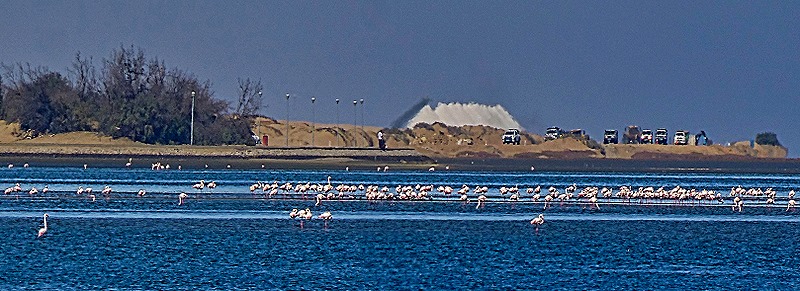


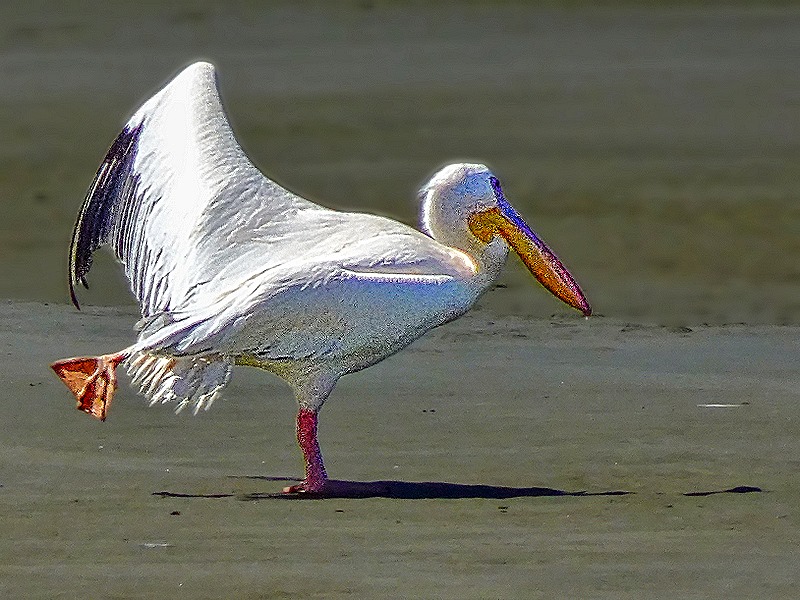
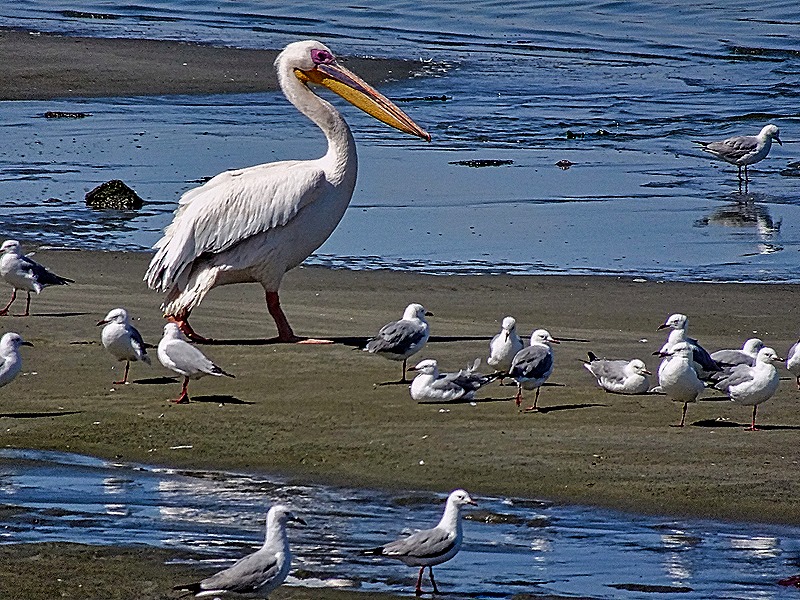
There was also a pelican cavorting on the beach among the seagulls.

We walked up along the shore toward the right in the picture above. We passed the Walvis Bay Yacht Club and The Raft, a landmark and restaurant built on stilts over the water.
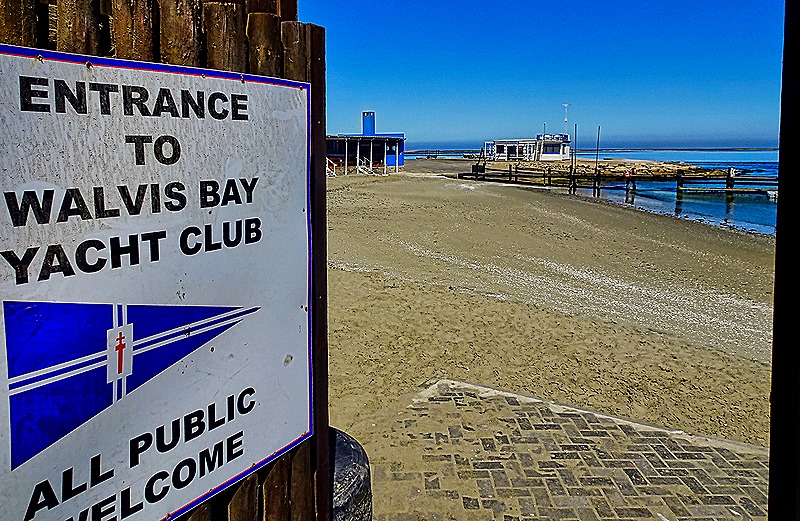
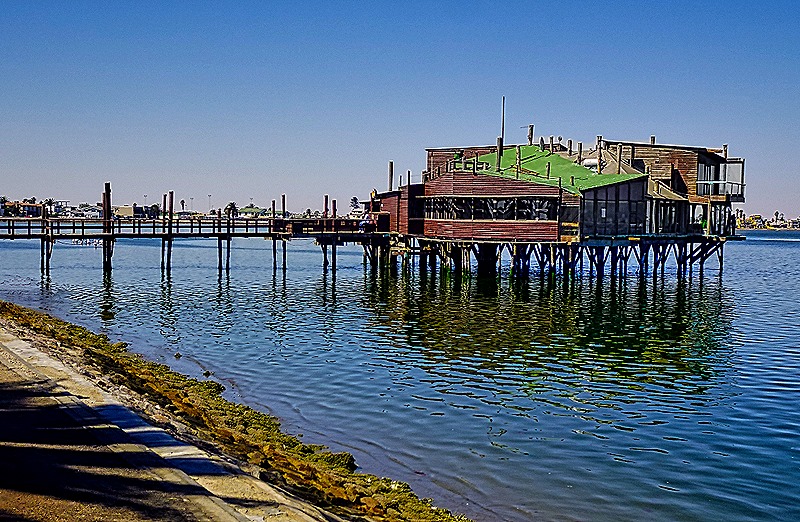
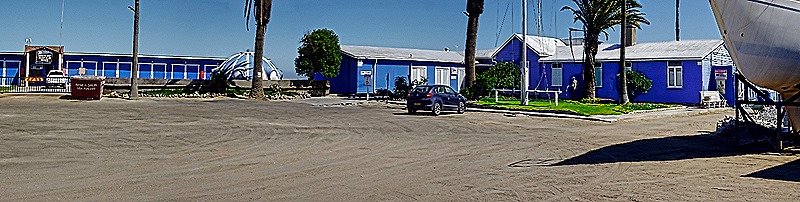
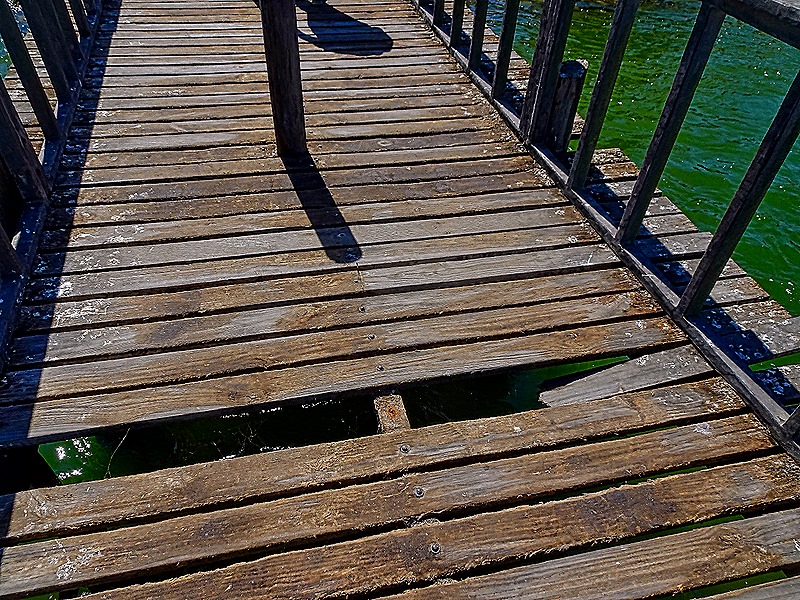
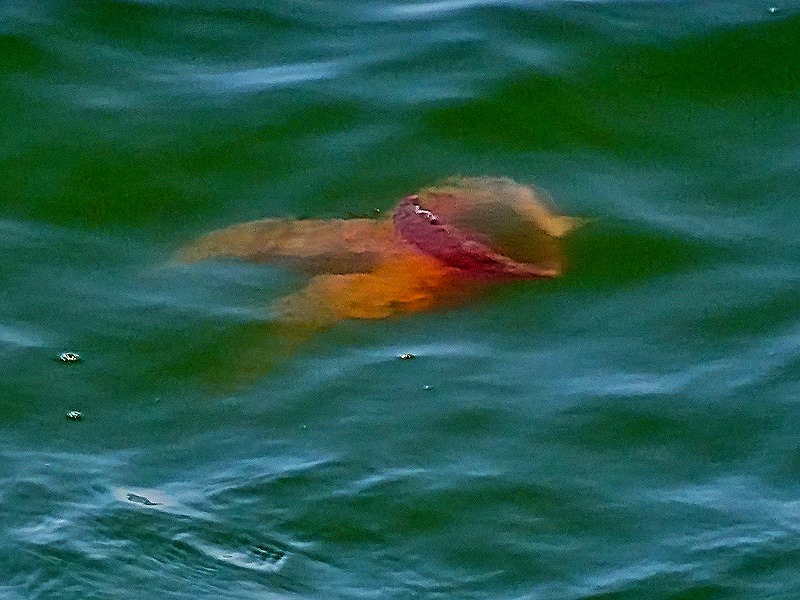
We walked out over the water on a rickety old wooden pier. Looking over the side we saw some impressive orange jellyfish.
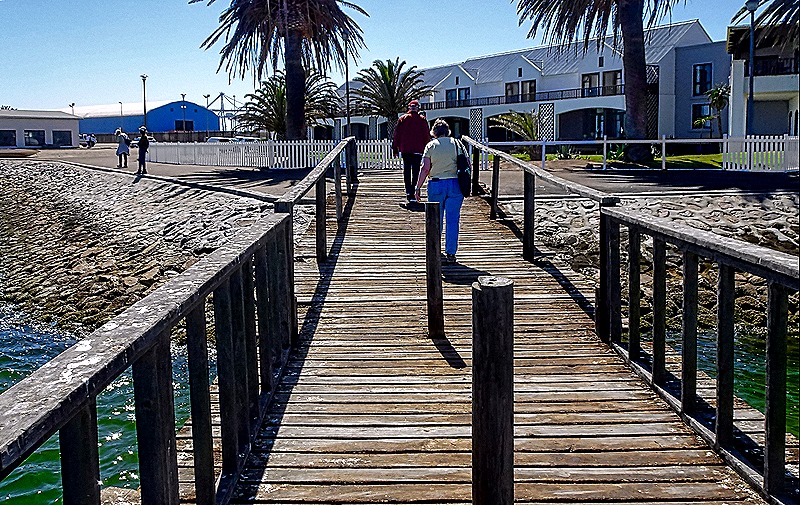
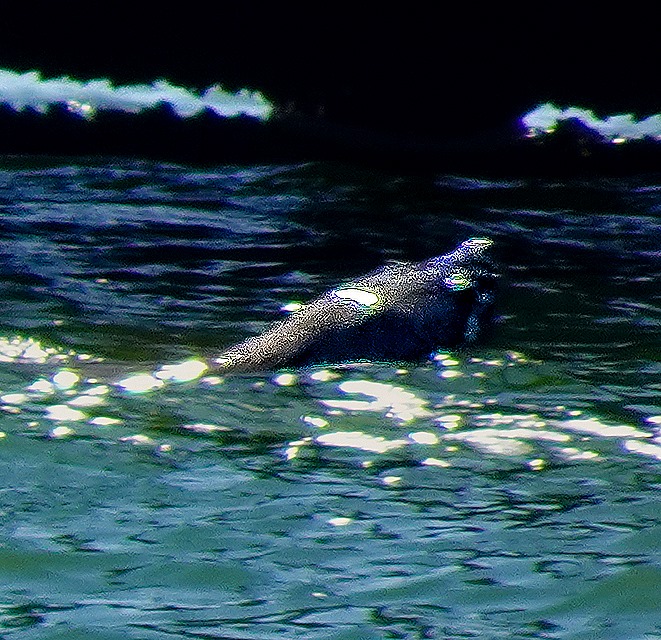
We kept walking in the same direction and, after passing an unsettlingly worded sign, came to a small waterfront shop and restaurant complex. It was lunchtime so we sat down at an umbrella table at the water’s edge and ordered a small lunch. This was the Anchor Waterside restaurant, well known in this area. It is famous for its fresh calamari, but that’s not what we ordered (that would never be what we would order). We watched the boats and sea life as we ate, highlighted by a seal swimming around a nearby pier.

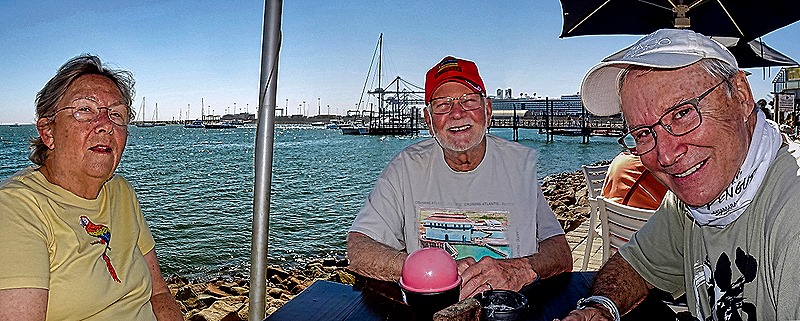
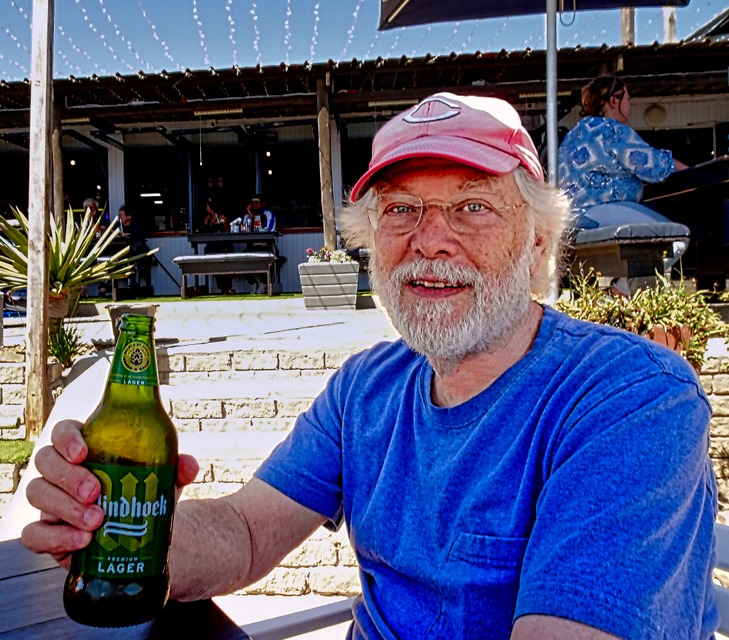
All of us except Robert had local beer, which was good. We were a little surprised at just how close to the ship our lunch spot turned out to be. After we returned to the ship we found that we could see the restaurant and our table from the veranda in our room! When it came time to pay up the waiter brought a portable credit card reader to our table. It wouldn’t register Robert’s card (which had been giving him trouble), so the waiter held his reader up in the air and waved it back and forth. We all thought this was a joke and laughed, but sure enough the card finally was recognized! Who would have expected that would work?



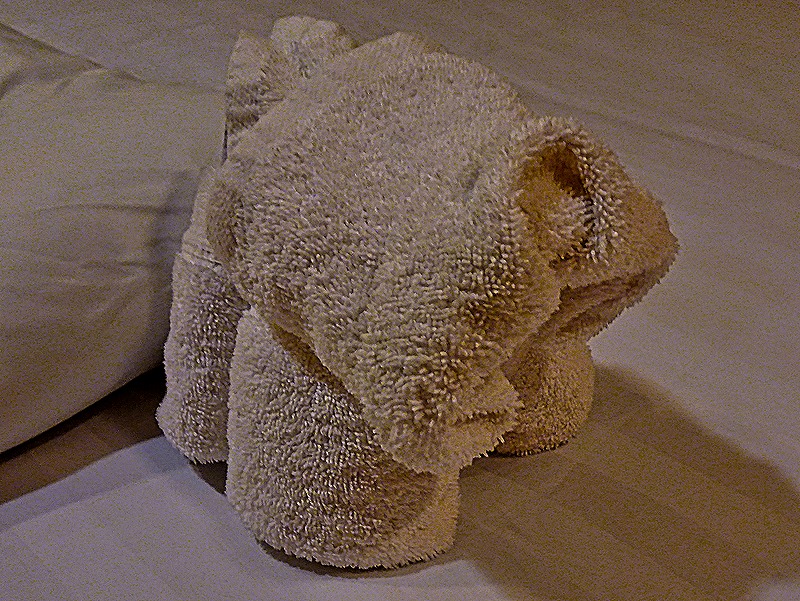
That’s it for Namibia. After this we had four sea days before our next port. We will leave you here with a picture of a towel animal that appeared on our bed during one of those sea days. We aren’t at all sure what animal it is (a pig maybe?).

 BADER JOURNAL
I remember this place so well. I can’t believe you’ve been Beck. So cool. Ah, er, so HOT!
😎 Karen. Sent from AOL Mobile Mail Get the new AOL app: mail.mobile.aol.com
December 30, 2024 at 2:10 pm