
Glacier Bay & Hubbard Glacier, Alaska 2025
Glacier Bay
By the time we got up on June 28 we were already in Glacier Bay. People have lived here for thousands of years but had to move away when the Little Ice Age caused ice to advance until it covered this entire area by the 18th century. When Captain Vancouver visited here in 1794 he did not see this bay because it was completely covered by a glacier wall 20 miles wide and 4000 feet tall, but by the time John Muir visited in 1879 the glacier had already retreated some 48 miles. Glacier Bay was designated a national monument in 1925 and became a national park in 1980. Today the Glacier Bay Park and Preserve encompasses more than 5,000 square miles and the bay itself is about 65 miles long. Since the original glacier retreated there are now more than 1,000 smaller glaciers within the park, seven of which are tidewater glaciers (meaning they terminate in the water). Most people visit Glacier Bay on a cruise ship but these ships are tightly regulated, only two permitted per day and only a handful of cruise lines permitted at all.
We had visited Glacier Bay once before, about 8 years ago. https://baderjournal.com/2017/08/14/glacier-bay-alaska/ As in 2017 the weather was chilly and overcast, with clouds often covering everything but the faces of the glaciers. Park rangers boarded the ship after we entered the bay and they would provide commentary during our visit over the ship’s speaker system.


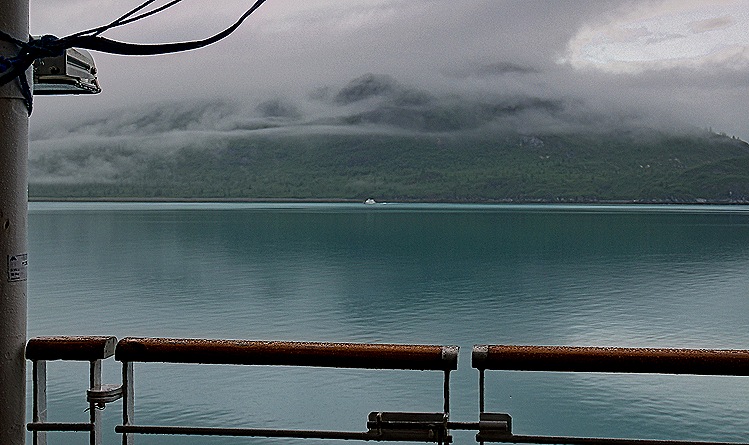
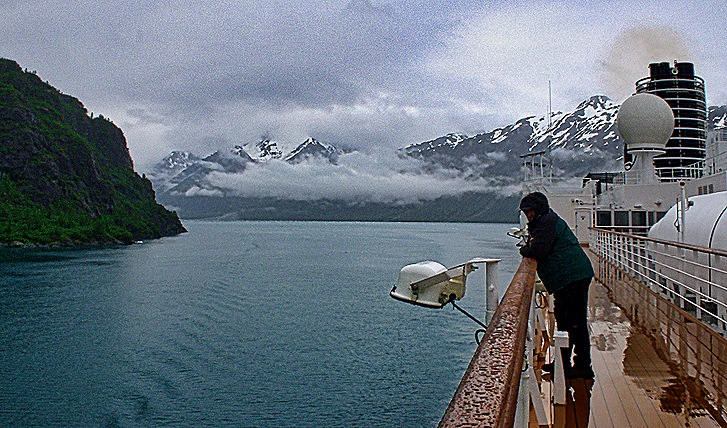
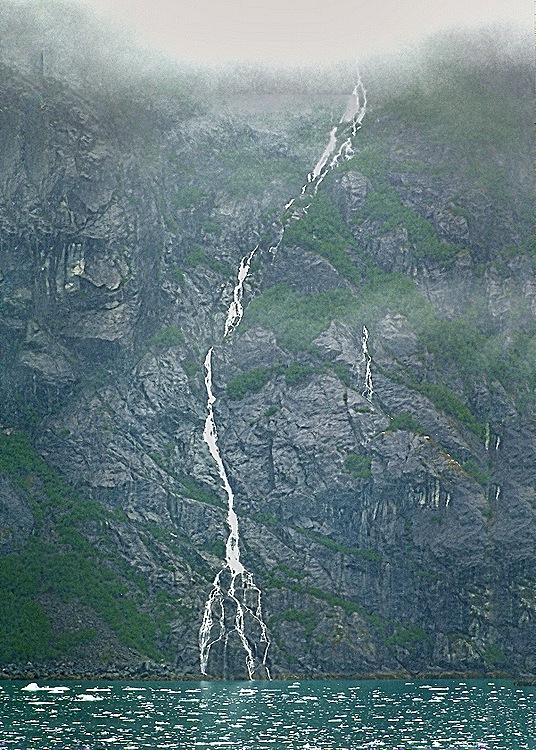
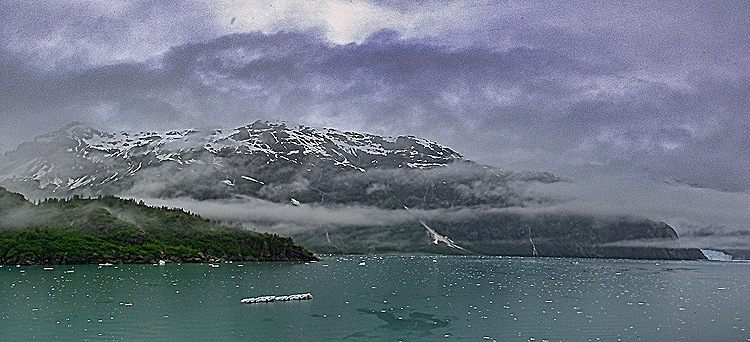
The main things to see in this area, of course, are the glaciers. But there is a lot of time spent sailing along the lengthy bay between glaciers and there is a lot of beautiful scenery to look for during that time. As mentioned, the clouds were pretty low and heavy much of the time but that just added an interesting air of mystery to the view.


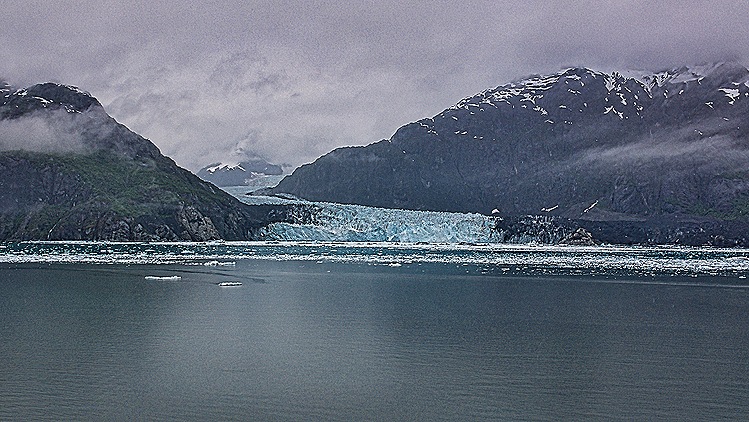
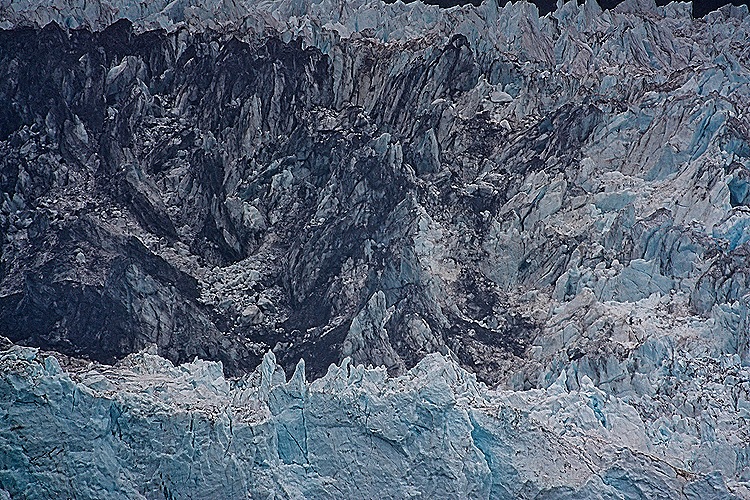
Margery Glacier is the most visited glacier in the bay. It is 21 miles long, about a mile wide at its water terminus and 250 feet tall above the water (and another 100 feet below). It is one of the most active glaciers here, known for relatively frequent calving (although we didn’t see any on this trip) and, unlike most of the glaciers in this area, it is stable and not currently receding. We sailed up Tarr Inlet to visit this glacier. We spent a good deal of time here as the captain slowly rotated the ship to give everyone a good look. In the pictures of the entire glacier face you can see a long portion on the right that is mostly black. This may be a part of the Grand Pacific Glacier which reaches the water just next to the Margery, but it is hard to tell because it is so dark, covered in dirt. The Grand Pacific Glacier is the one that covered the entire bay in the 18th century, but has since receded some 65 miles.



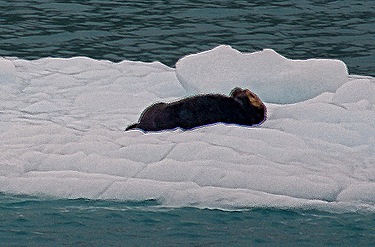
Another feature of this park is the wildlife. There is a large variety here, including whales, mountain goats, sea lions and brown bears. Sadly, we didn’t see any of those today. We found it difficult to pick out animals on shore, particularly in the gloomy weather. But we did see harbor seals relaxing on the ice floes we passed as we sailed along. Harbor seals are plentiful in Alaska. They can grow up to 6 feet long and weigh up to 350 pounds. And their lifespans extend to 25 years for males and 35 for females. We also saw a moose swimming across the bay. It was quite far away, looking almost like a dot to the naked eye, but extensive enlargement of the photo made clear that it was a moose. Like the one we saw near Anchorage, this appears to be a male moose whose horns are just starting to grow. We were told that this is a pretty rare sight for a visit to Glacier Bay.


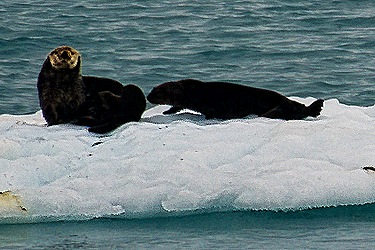
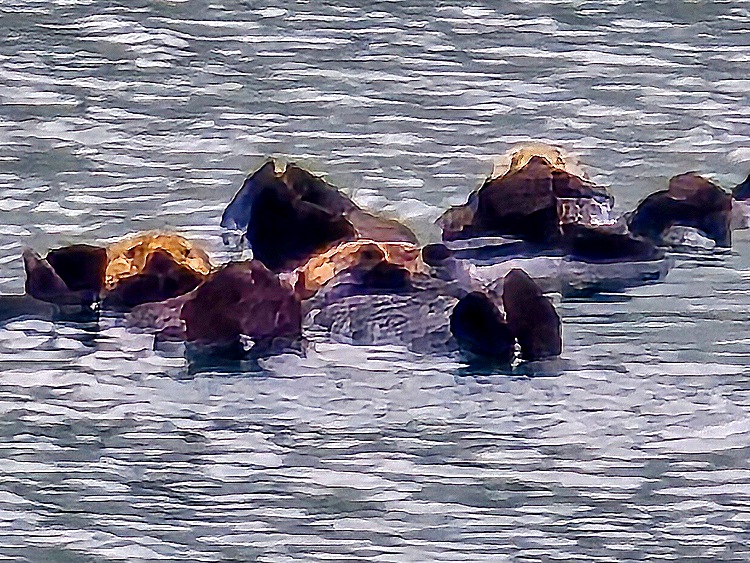
There were a lot of seagulls flying around and sitting in the water. Best of all, there were sea otters floating by on ice floes, looking like they were curious about the ship. Sea otters were once plentiful in Alaska, all the way north into the Bering Sea. But their fur became highly prized, mainly because it is the thickest fur of any animal with about a million hairs per square inch. This pelt insulates them well from the cold water, and also traps air near the skin to provide further insulation. But in the 18th and 19th centuries the Russians, and later others, hunted them almost to extinction (about 1,000 or 2,000 remained). The Russians enslaved native people and held their families hostage to force them to hunt otters for them. But sea otters are now back in Glacier Bay in large numbers and are considered one of the great success stories of conservation efforts (although apparently their numbers have fallen a good bit again in the Aleutian area). Sea otters are very interesting and attractive animals, particularly because they generally swim on their backs with their big feet sticking up out of the water and with their young (if they have any) lying on their bellies. We only saw sea otters here sitting on ice floes, but we are including here a picture taken by our friend Susie when we were near the Arctic Circle that shows several sea otters floating on their backs.


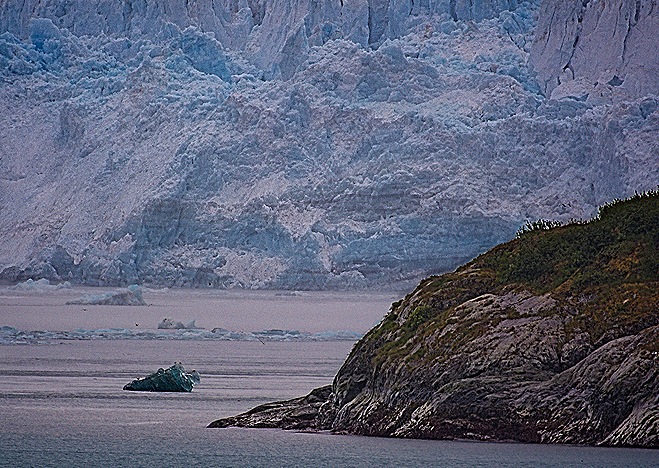
Sailing back from Tarr inlet we came upon Lamplugh Glacier at the mouth of Johns Hopkins inlet in mid afternoon. This glacier is about 19 miles long and its face is about 9 tenths of a mile wide and 165 feet high. It is known for its blue color (caused by tightly packed ice that absorbs all light colors other than blue), which looks brighter the closer you get. Much (if not all) of the dirt and debris on the ice comes from a mountainside that collapsed onto the glacier in 2016. The Johns Hopkins inlet leads further to Johns Hopkins Glacier but it was not accessible the day we were here. Lumplugh was the last glacier we visited. On our first visit to Glacier Bay we had seen an island full of sea lions on our way out of the bay, but not today.


Hubbard Glacier
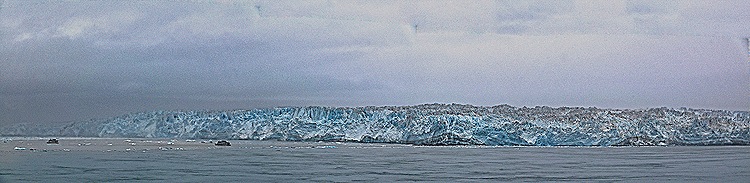
On June 29 we visited Hubbard Glacier, the largest glacier in North America. It is more than 75 miles long, 7 miles wide at its face, and rises 350 feet above the water (and another 250 below). Hubbard is an advancing glacier and often calves off icebergs as big as a 4 story building but we didn’t see that today. It is located at the end of Disenchantment Bay, a 9 mile extension of the larger Yakutat Bay. The tiny town of Yakutat is known as the surfing capital of Alaska but we sure wouldn’t want to get in the water in the kind of weather we had here.

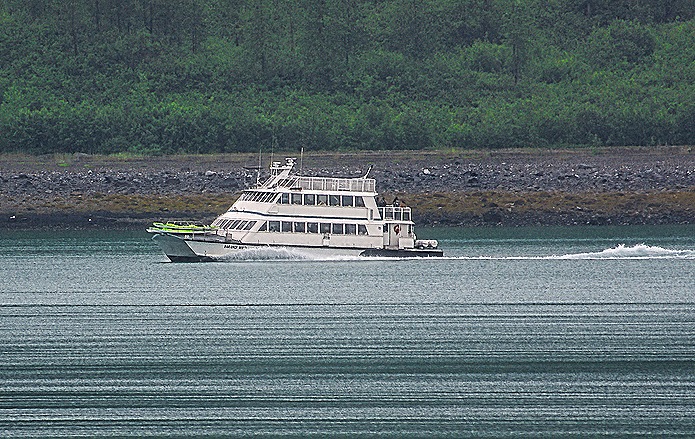
We had pretty bad weather for this visit, with clouds, choppy water and a good bit of ice floating in front of the glacier. The captain made heroic efforts to get us a good view of the glacier, approaching from the right and again from the left, and we were able to see it even though the photographs are not so great. As usual the ice patterns on the face of the glacier were most interesting thing, and a couple of small excursion boats were in the water much closer to the glacier than we could get.


So that was it for two days of glacier gazing. These glaciers are all pretty interesting and quite beautiful, but two days of them in a row was plenty. As we sailed out of Yakutat Bay and heading for an actual port we enjoyed our dinner and went to bed, with only a towel animal for company.


 BADER JOURNAL

Leave a comment