
Avatoru, Rangiroa
On the morning of January 21 the Amsterdam slid through the Tiputa Pass into the lagoon of Rangiroa. In 2016 we didn’t make it onto deck in time to see the arrival through the pass as the Captain had gone through a little earlier than we had been told, so this time Rick got up an hour before the scheduled arrival. But to no avail, as the Captain beat us again.


Rangiroa is a series of long, thin, low coral atolls surrounding the second largest enclosed lagoon in the world. The lagoon is tens of miles wide & you can’t see from one side to the other. Very few people live here & there isn’t much to do unless you are into water sports. Rick went snorkeling last time we were here at a place called “the aquarium” just inside the Tiputa pass, and you can see the photographic results here:
https://baderjournal.wordpress.com/2016/02/10/rangiroa-tuamotu-archipelago
But today was a Sunday and in Polynesia everything closes on Sunday, so there was less to do than usual. We decided to tender ashore & walk around for awhile. But before that, in the early morning we watched a storm pass by from the ocean over the atoll and off into the lagoon, hardly touching our ship. Afterward, however, there was a magnificent rainbow that dwarfed the island.


We were greeted at the dock, as is usual in these islands, by a group of singers & musicians. A tent market was set up behind the dock. As we walked up the road away from the dock we ran into our friends Robert, Bill & Lee near the local grocery.


It doesn’t take long to walk across the atoll to the Pacific Ocean. While the lagoon waters are rather calm the Pacific coast is rough, with pounding surf. Rangiroa is made up of coral atolls & a lot of the rocks along the road are coral pieces. We did pass one or two buildings, at least some of which are resorts, nestled among the palms.


As is true throughout Polynesia, this island has a great deal of colorful flora, as well as birds & fish. Most of these flowers were growing on trees or bushes, not directly out of the ground. Rangiroa also has the only vineyard in Polynesia, but we didn’t see that (it is not open for visiting).


It was really very hot & humid, & the irregular ground was something of a challenge for Mary’s new knee, so we headed back to the dock. There wasn’t much more to see anyway. On the walk back we passed whole fields of palm trees & we saw people swimming from a beach beside the dock.


We stopped for a Hinano beer at a little open air restaurant just off the dock, a great refresher on such a hot day. From our seats we could see the Windstar sailing ship that was also anchored here today (a much smaller ship than Amsterdam). There were also fish & birds to be seen from a tiny rock outcrop right beside our table. After that we tendered back to the ship.


We had heard that dolphins often play in the ship’s wake as it goes through the pass. So we went down to the second deck at the aft end of the ship for the sail away in hopes of seeing them. It was a lovely & very sunny evening as the ship circled through the lagoon in order to build up speed for the run through the pass. It didn’t reach 88 miles per hour, but then we weren’t trying go go Back to the Future.


We were pretty disappointed since we didn’t see any dolphins (or other wildlife) as we traversed the pass. We were just about to give up & leave when suddenly there they were, leaping in the ship’s wake. So cool! Well worth the wait.


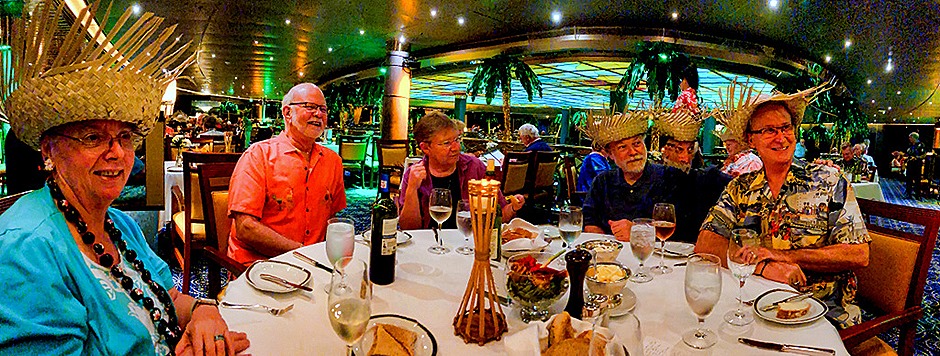
Not sure which night, but probably after Rangiroa, was Polynesian night in the dining room, with Polynesian dishes on offer & Tahitian straw hats distributed to everyone. And here is another ending with towel animals.


Taiohae, Nuku Hiva
After eight days at sea we sailed toward Taiohae bay on the island of Nuku Hiva on the morning of January 19. The last time we were here, in 2016, it was cloudy & rainy as we approached the island, but today it was beautiful and sunny.


Lots of passengers were out on the front deck as we sailed past some of the mountains & rock formations & the crew were out there too, serving coffee & “Nuku Hiva Rolls,” which tasted remarkably like Panama Canal rolls.


Nuku Hiva is the largest of the Marquesa Islands. It was famous in the 19th century as the island where Herman Melville lived for several months with a village of cannibals, which he turned into his best selling novel Typee. In 2016 we went on a very beautiful tour of the island, which you can see here:
https://baderjournal.wordpress.com/2016/02/08/taiohae-nuku-hiva
So for this visit we decided to explore Taiohae ourselves on foot. It was a very short tender ride from the ship to the dock, but three tenders went out of commission with engine issues almost immediately so we were not able to get to shore until about noon. We went up to the Lido deck where they were distributing tender tickets, then sat near the pool waiting for them to reach our number. From there we saw some local fellows in canoes following in the wake of the tenders (once they got going again). When they are able to do it correctly the tender wake pulls them along without paddling and this seems to be a popular sport in several of the islands we visited.


We finally made it onto a tender & then to the dock. We were greeted by local musicians & dancers who handed each visitor a flower bud to wear behind an ear. An impromptu market was set up behind the dock, selling everything from produce to t-shirts to wood carvings. Nuku Hiva is famous for its wood carvers; most of the Tiki sculptures for sale everywhere on the Polynesian islands are made here (and so the prices for them are much better here than elsewhere).


On a hill above the dock & clearly visible from the ship is a large tiki style statue of a woman. This is new since our last visit & reportedly very unpopular with the locals. We had to agree with their view, especially after seeing the back of the tiki that has a warrior apparently emerging from the woman.


We began the approximately 2 mile walk from the dock to the end of the road on the other side of the bay. It is a very beautiful walk, with many colorful flowers, mountain views & views across the water. While some of the mountains were green the lower areas were quite dry & the flowers much less lush than last time we were here. We were told there had been no rain for three months. Still, there was a lot of beauty.


About half way across the bay is the Catholic Cathedral of Notre Dame. Unlike any other cathedral we have seen, this one is full of wood carvings covering doors & the pulpit as well as the stations of the cross on the walls. The figures look like Polynesians rather than Europeans (the actual people depicted, of course, were Semites from the Middle East), with other Polynesian touches, such as breadfruit trees instead of olive trees in the garden. The building is constructed of stones brought from each of the Marquesas Islands. Very special.


In front of the cathedral is an arch with two towers, which may be a remnant of an earlier church. Behind the cathedral is a very colorful garden. Two interesting Jewish references. Across the courtyard from the church is a smaller building with carved wood pillars. One of them is Moses with the ten commandments. Interestingly, he is depicted with horns on his head, perhaps derived from Michelangelo’s sculpture of Moses in Rome. The horns come from a mistranslation of the Torah, which says Moses had beams of light, rather than horns, emanating from his head when he brought the tablets down. The other is a star of David carved into the inside of one of the doors. We don’t know what the inscription says or what it was intended to represent.


Continuing on, we visited the memorial to Herman Melville, a carved wood pillar. Apparently some French officials were expected to visit in a few days, so workmen were out refurbishing the thatched roof of a platform near the water. Some women were busy weaving palm fronds into mats, presumably as part of this project. Some outrigger canoes were stored near the shore as well. And we walked past a cemetery, with white concrete & stone graves similar to others we have seen in Polynesia.


This is a good place to show you some of the many brightly colored flowers that were all around. Noticeably fewer than in 2016 because of the lack of rain, but still a lot. Most of these flowers are on trees or bushes. As usual, the names of the few we know are in the pop-up captions.


We visited a very tiny museum of Nuku Hivan artifacts at the very end of the road around the bay. It had one small room of artifacts, some of which were many hundreds of years old, and the other room was a gift shop. The owner, Rose, was really friendly and helped explain what we saw. After that we walked up the hill behind the museum to a restaurant highly recommended for its food and its view of the bay. Unfortunately, after we reached the top of the hill, panting in the heat & humidity, we found that it was closed for renovation! Why couldn’t they have put a sign to that effect at the bottom of the hill?
Anyway, after admiring the view from just under the restaurant we walked back down the hill & stopped into the small restaurant in front of the museum. Our friends Peggy & Bill were still with us, the rest of the group having turned back long before. We had Hinano beer, the main Polynesian brand, and Poisson Cru. Made of raw tuna, some salad ingredients & coconut milk, it was quite delicious.


Much refreshed, we made the long walk back across the bay to the tender dock. There were several groups of families at different spots along the bay having picnics & swimming. We did a little shopping at the dock, then boarded the tender for the short ride back to the ship.


We sailed away from Nuku Hiva at sunset. It was a very dramatic sunset, which deserves more than one picture.


So as we sail away from beautiful Nuku Hiva, we will leave you with a couple of towel animals, preparatory to a good night’s sleep.


At Sea Toward Nuku Hiva
Between Panama City & Nuku Hiva we had 8 sea days in a row. That’s a lot. It gives you an appreciation for how really, really big the Pacific Ocean is. The Captain commented that with the vastness of this ocean he sometimes wonders how the opposing fleets found each other during World War II. Actually, they sometimes had difficulty doing that.
After we were all aboard in Panama City the Captain came on the loudspeaker and welcomed all our newly arrived passengers. From this we take it that all the folks who missed the boat in Ft Lauderdale made it here by Panama City. Some had caught up with us earlier, but now all are aboard for the long sail to the South Pacific.
Life on board is pretty relaxing, if that’s what you are looking for. If not, there are games, lectures, movies, shows, eating (of course) and other things to do just about every minute of the day. Often, there are sunsets, especially as you near the South Pacific.

We usually eat breakfast & dinner in the main dining room, where the food has been really very good with a lot of variety. Sometimes food on a cruise ship can get a little bland, presumably to ensure that everyone on board is able to enjoy it. But the food on this trip has often been fairly spicy. We generally eat lunch on the Lido deck near the pool. The Dive In there serves very good hamburgers & hot dogs & the Lido buffet serves a wide variety of dishes every day, including some kind of meat that is sliced to order, an Asian station that prepares foods from a rotating selection of countries, and a sandwich station where you can get a sandwich made to your specifications. All are very good. They also have a variety of pastry, pies & ice cream for dessert. We are slowly getting control of our appetites.
Outside our cabin is a deck that extends all the way around the ship, for sitting on deck chairs & walking. A mile is 3.5 laps of the ship & we walk every day, at least once. Have to keep the muscles tuned for some of the more demanding port visits! Sometimes we see birds out there, much less often sea life.


We go to the Explorer’s Lounge almost every night to listen to Adagio, the Hungarian violin & piano duo. David & Attila, the duo on this ship (same as in 2016), are really terrific, playing flawless show tunes & light classics with flair & improvising jazz, together & solo. An intimate concert before dinner every night really enhances this voyage for us.

Almost every night after dinner there is a show in the main lounge, which we attend about half the time. We generally skip the comedians & magicians, but some of the musical performances have been very enjoyable. The Amsterdam Singers & Dancers are the in-house performers (4 singers & 6 dancers). Last time the singers were very good but the choreography left a lot to be desired. This year the dancing has, at least, caught up to the singing. The dancers have been pretty spectacular & the choreography is worlds ahead of last time. Photography during shows has been difficult, so some of these are not very sharp.


A Polynesian location team has been on board since Panama City, demonstrating dances, giving music & dance classes & presenting lectures. Kainoa, who is from Hawaii, is the lecturer & his presentations have been informative & enjoyable. There are four younger people who make up the dance group. Again, pictures are not very sharp.


There have been several special nights. We had a Black & Silver Ball on one formal night. Masks were provided to everyone at their table at dinner, & some actually wore them. At the end of the ball waiters circulated with trays of various kinds of chocolate.


One night was designated Dutch Night. Dutch cuisine was on the menu, orange lights filled the dining room & Dutch hats were distributed to the diners. Below is our usual table array (front: Bob, Judy, Bill, back of table: Rick, Mary, Lee, Robert, & standing behind our friends Corinne, Kathy, Peggy). Some of these photos were by Lee.


Robert & Bill inhabit a spacious Neptune Suite & they invited the rest of us to a party after we crossed the Equator (first of four times this trip). Wine was plentiful, canapes were provided by the ship & a good time was had by all. Apparently the ship has a rule against having more than 8 people in a room; don’t tell anybody, but the eight at this party was more than the usual 8 you learned about in school (photos by Lee).


After all this time at sea most folks are looking forward to getting their feet on dry land in Nuku Hiva. Abbafab, one of the entertainment groups, had an song for that feeling, which went (to the tune of the Beatles’ Let It Be):
“Day at sea, day at sea, day at sea, day at sea. What’s on for tomorrow? Day at sea.”
To finish off this segment, here are a couple of the towel animals we received during this period.


Panama City, Panama
We were still anchored off Fuerte Amador on the morning of January 10 when the alarm went off at an ungodly hour so we could meet our tour group by 7:30. We had a room service breakfast, showered & dressed & then headed out. We had visited this city on the 2016 world voyage:
https://baderjournal.wordpress.com/2016/02/06/panama-city-panama
Today we would visit one area visited then & one area that was new to us.

We tendered to a yacht harbor on Isla Flamenco, part of Fuerte Amador, and boarded a bus for the ride all the way across the city to Panama Vieja. Established in 1519, Panama Vieja was the first European city on the Pacific coast. It was the main Pacific terminal of the Spanish gold route, where gold & silver from Peru & spices and silks from the far East were stored before being transported by mule train across the Isthmus to Portobello to be loaded onto ships bound for Spain. It was quite prosperous, with numerous warehouses & churches, along with several thousand houses. In 1671 the English privateer Henry Morgan attacked & plundered the town, which burned to the ground.
We visited the museum for this site and walked through the ruins. After the town was destroyed the inhabitants moved to a new location about 8 miles away that was easier to fortify and defend. They used Panama Vieja as a stone quarry, thus further reducing the ruins. Today efforts are being made to restore some of the buildings, but most of it still looks like a rock pile. While we can’t identify all of these ruins, some of them are of a Dominican convent.


Our guide told us that the town’s name came from the Panama tree, but a plaque in the museum said that it was the local Indians’ word for “fisherman,” which they were. Perhaps the tree was named for the local fishermen & the town was named for the tree. Near the museum was a striking Banyan tree with many trunks descending to the ground from the wide branches.

The best preserved & restored structure is the cathedral tower, situated on what was the main square of the town. They have built a modern staircase to climb up for what is supposed to be an excellent view, but our group didn’t go up there. In front of the cathedral is a stone base that once held a stone cross. This is where Africans (presumably slaves) came to pray, because they were not permitted in the cathedral. The stone cross is now in the museum. Our guide told us that it was not known that this cross was the one that had been in front of the cathedral until one of the people she was guiding showed her a picture of her great grandfather praying there.


We walked back to the bus, passing more interesting ruins. Then we headed back across town to Casco Viejo, the site where they moved after the original town was destroyed.


We crossed through the contemporary city of skyscrapers. The city is impressive from afar, but from inside it just feels massive. The most interesting one is the Revolution Tower, which twists its way up to a white pinnacle. A lot of foreign (and particularly US) businesses have outposts here, such as Hard Rock Café, & there is also a Trump Tower. Our guide told us that the Trump Tower (which bears his name but is not owned by the US President) was sold last week & the new owners intend to change its name. We passed a fishing village that the developers apparently failed to dislodge.


Casco Viejo is the new old town of Panama City, established in 1673 by the folks whose original town had been destroyed by Henry Morgan. It is full of old buildings of two or three stories with interesting balconies. The streets & sidewalks are very narrow, so it quickly became crowded & difficult to navigate, especially if you are a group of 40 people, as we were. Here are some typical street scenes.


One thing you will notice in these pictures is the very extensive renovation work in progress all over this area. In 2016 we visited the cathedral & were glad we had the opportunity to do so when we saw it this time entirely covered in construction cloth. Its good to see, however, that they are restoring these old buildings rather than tearing them down for new construction.
We visited the Iglesia de San Jose, a church transferred from the destroyed town in 1673. It contains a very impressive carved wood altar covered in gold, called the Altar de Oro. There is a story, repeated as history by our guide, that the gilded altar was saved from Henry Morgan by a friar, who either had them hidden in the Pacific or painted black. When Morgan arrived & demanded the church’s valuables, the friar told him the church was unfinished for lack of funds & requested a donation. Morgan supposedly said “you are more of a pirate than I am” & ordered that the friar be given the donation he requested. But anyone visiting the church knows this story is untrue. There is a sign right in front of the altar that not only says this never happened, but says that the style of the altar indicates it was created much later, in the 18th century, and church records say that the gilding was applied in 1915. So why does a guide leading people ?


We walked by the façade of La Compania de Jesus, the Jesuit church & school. In the late 18th century this became the first college in Panama. It functioned until 1767, when the Jesuits were expelled from all of Spain’s colonies. The pope had decreed before the Spanish reached America that Christians could not be enslaved. This was a problem, beginning with Columbus, who wanted to convert the indigenous people but also wanted to enslave them. Apparently the Jesuits became more & more adamant against keeping African & Indian Christians as slaves until the Spanish authorities had had enough & removed them on the theory of out of sight, out of mind. Our guide said that part of the section on the right may have been rented out for use as the first Synagogue in Panama. The building was later destroyed by fire & earthquake.


We passed what is left of the Iglesia y Convento de Santo Domingo, a Dominican church & convent built in 1678. It is known for its “flat arch,” visible just behind the door, which is about 30 feet high & 45 feet wide, with no keystone or external support. It was cited as evidence of Panama’s geological stability during the debates on where to build the canal. It collapsed in 2003, but has been reconstructed.


Given 30 minutes of free time, we walked through a flower covered walkway onto a street along the city’s old walls. There was a great view of downtown Panama & there were a number of Kuna indians with booths selling the molas they make. Molas are very colorful needlework, in which there are several layers of different colored fabric & pictures are made by cutting through to the various colors. There was also an artist at work next to the wall.


We returned to our bus & drove back to the yacht harbor on Fuerte Amador where our tender picked us up & took us back to the ship. Later in the afternoon we set sail for Nuku Hiva, an eight day trip with nothing but water to see beyond the ship. It will feel good to step onto land again after that.


Panama Canal
The Amsterdam entered the Panama Canal at 7:30 on the morning of January 9. This is our third time through this canal, so we were not planning to be up that early to be outside before reaching the first lock. However, the Panamanians provide guides to narrate the passage of the canal & ours began broadcasting on the ship’s loudspeaker system at about 6:30, and since one of these speakers is on the deck outside our window that was the end of sleep for us. Still, we took our usual time to shower & dress before wandering outside, so by the time we got there the ship was already inside the first lock at Gatun.

While we will post a lot of pictures here, for a much more comprehensive review of a Panama Canal transfer take a look at that episode of the blog from our 2016 world voyage here:
https://baderjournal.wordpress.com/2016/02/04/panama-canal
That posting also has a link to the episode recounting our first Panama Canal passage, on the Grand South America Voyage in 2012. So, if you are interested in the canal there is plenty to see in addition to what is set out here.
In contrast to the beautiful morning sun on our last visit, the weather was gray & overcast as we entered the Gatun locks on the Caribbean side of the canal. The weather proved highly changeable during the day, moving from cloud to sun to rain repeatedly & often very quickly, so that folks outside taking pictures had to run for the doors. We followed the Azamara Quest through the canal, passing the Gatun control building with the help of the “mules,” a sort of tractor on rails that helps keep the ship on a steady course through the tight space between the canal walls. The bow of the ship was opened to passengers for the transit of the canal & in the morning coffee & delicious “Panama Rolls” were served there. Interestingly, the massive gates between levels of the locks are all still the originals, installed more than 100 years ago.


After leaving the Gatun locks we sailed across Gatun lake, a body of water that is probably the largest segment of the canal. It passes through dense rainforest, but is pretty uneventful. So we went to breakfast, then we went up to the Crow’s Nest for most of the transit. The Crow’s Nest is a multipurpose room on the top inside deck, a venue for parties, for reading, for activities such as Zumba in the morning and a disco at night. It has a bar and a panoramic expanse of windows across the front of the ship. Many passengers seem to spend a lot of time up here.


As we sailed through the lake we passed a huge container ship coming the other way, called the Houston Bridge, we think. This is one of the world’s largest container ship with a capacity of some 11,000 containers, each of which is the size of the payload of a tractor-trailer truck. Until last year ships this size could not use the Panama Canal, but a little over a year ago they completed a new, larger set of locks on each side that can accommodate these giant “Panamax Plus” ships. These ships still use the central portion of the same old canal, but enter & exit through the new larger locks. The Panamanians charge by weight to traverse their canal; a ship the size of Amsterdam pays about a quarter of a million dollars for one passage, so these new ships must be paying a lot more. We also passed several dredges, employed to scoop muck from the bottom to ensure the canal does not fill up with silt. This is, we were told, a never ending process.


Following us through the canal was a strange looking armored ship. We were told that this is the Pentagon’s newest intelligence ship & the extra plating includes stealth technology that obscures it on radar. It is too wide for the original locks & instead passed through the new locks. We speculated that maybe it is headed for the waters off North Korea. At one point a tugboat pulled around & pushed us for awhile; no idea why. Soon we came to the Centennial Bridge, built (guess when) in 2000. This area is known as the Cut, It was blasted out of solid rock during the building of the canal, perhaps the most difficult & dangerous part of the project. The walls are terraced to help keep debris from sliding down into the canal.


On the Atlantic side the Gatun locks raised the ship three levels. On the Pacific side the Pedro Miguel locks lower it two levels & the Miraflores locks lower it one more level to reach sea level again. As we approached the Pedro Miguel locks we could see the new larger version to our right. On the left was a tree dressed in bright yellow that we were told only blooms for three days a year.


The Miraflores locks only drop one final level, but as you go through on the left is a building housing a museum that always has hundreds of people on the balconies welcoming you. They wave & take pictures of you while you wave & take pictures of them. On our right we could see a big ship going through the new channel & locks, but we couldn’t see the locks themselves because there was a hill in front. We noticed that the Panamanian flag was at half staff all day & learned later that it was a holiday. Martyr’s Day commemorates a student uprising in 1963 against the Americans for reneging on an understanding that the Panamanian flag could fly along with the American at schools in the Canal Zone (if I have this right). Some 21 students & one toddler were killed as students tried to shimmy up a flag pole with a Panamanian flag. The next day we saw a monument to these students.


After finishing with the locks we sailed on to Fuerte Amador, a group of connected islands off the coast of Panama City, near which we anchored. The islands are connected to the mainland by a causeway on top of a huge breakwater that was built with rocks & dirt removed when digging the canal. In this last part of the canal we could see some of the towers of Panama City beyond the hills, above an old American military barracks. We passed under the Bridge of the Americas, which connects North & South America, completing the Pan American Highway that extends all the way from Canada to Patagonia. And on one side was the modern ecological museum designed by noted architect Frank Gehry. It looks a little like a brightly colored building that has collapsed into a heap.


Tenders were running to Fuerte Amador during the evening, but not many went. We had a full day in Panama City in the morning (with yet another early wake-up call) so after dinner & a show we retired for the evening. We heard later that those who went found there was nothing to do, so it was just as well.

 BADER JOURNAL