Istanbul, Turkey (Day 1)
Istanbul is, of course, one of the great cities of the world, so it needs little introduction. It was founded by the Greeks in the 7th Century BC as the city of Byzantium. It was renamed Constantinople after the Roman Emperor Constantine, who moved his capital here in the 4th Century AD, and remained the capital of the Eastern Roman Empire (known as the Byzantine Empire after the name the Romans abandoned, go figure) for more than 1000 years, long after Rome fell. In the middle of the 15th Century it was finally conquered by the Ottoman Turks, who later changed the name to Istanbul. This is the only city that straddles the European & Asian continents, divided by the Bosporus, a waterway that connects the Sea of Marmara south of Istanbul to the Black Sea to the northeast of the city.
We entered the Dardanelles (the waterway connecting the Aegean Sea to the Sea of Marmara) before dawn on April 15, when all of you in the U.S. were getting ready to mail in your tax returns. We had hoped to catch a glimpse of Troy, which is now an archeological site on a hill not far from the water just before entering the Dardanelles. No such luck; we were still in bed when the ship passed that point & it was still dark then in any event, so even if Troy is visible with binoculars from a ship in daylight (which I don’t know) we couldn’t have seen it. But I was up in time to catch the lighthouses on either side of the entry to the Dardanelles.


We passed close enough to see the Turkish memorial to the battle of Gallipoli on the European side. Gallipoli was a World War I attempt by the Allies (mostly the idea of Winston Churchill, then Lord of the Admiralty) to take control of the Dardanelles, which would have given them a useful strategic inroad into Turkey. But it was a disaster for the Allies, as a huge number of ANZAC troops (Australian & New Zealander) were landed & slaughtered by the outnumbered Turks, who were dug in well on the shore. Mustafa Kemal (later given the surname Ataturk) was one of the Turkish commanders & I am told that on the monument is an unusually generous tribute from him to the allied troops who died here. The cruise through the Dardanelles in the early morning light was picturesque, with towns & ships & scenic views. We passed a 13th Century Turkish castle on the European side & another fortified point on the Asian side at a bend in the waterway. We then entered the Sea of Marmara for the remainder of the trip to Istanbul, and I went in for a shower & breakfast.


The previous night was a Turkish Dinner in the La Fontaine restaurant. The Prinsendam periodically has special nights in the restaurant, reflecting a country we are visiting or a holiday celebration, in which the restaurant is decorated, the wait staff wears costumes and sometimes the regional cuisine (or at least dishes given regional names on the menu) is served. It is a little silly but fun, so here are a couple of pictures of the Turkish dinner on April 14. Those of you acquainted with a small but adorable pooch named Ezme will be relieved to hear that she wasn’t actually on the menu.


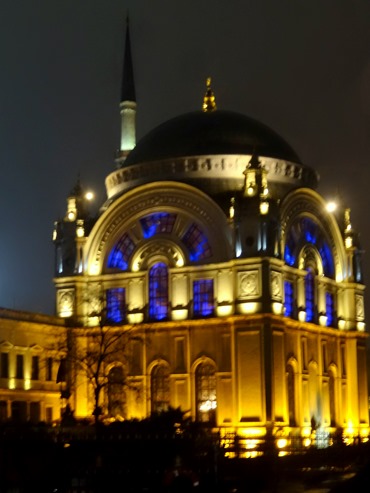
In mid-afternoon on April 15 we finally approached Istanbul. Unfortunately it was a dreary, overcast rainy day & that weather would continue for our entire visit to Istanbul (we sailed out at about the same time on April 16). We sailed right past the Sultanahmet, which is the central part of the old town of Istanbul, so here are a few images from the ship of some of the more famous buildings, many of which we would visit later.


The most important sights in the old town of Istanbul are pretty close together & we had originally planned to walk around the city by ourselves. Then we learned that our one day in Istanbul would be the day Topkapi Palace is closed to the public each week. This was, to say the least, pretty irritating & we wondered what Holland America could have been thinking when scheduling our Istanbul stop for that day. Then we found out exactly what they were thinking. It turns out that, although it is closed to the public, Topkapi is open that day exclusively to tours sponsored by cruise ships. What a boon to cruise lines, since passengers have to pay for their excursions to get into the top sight in Istanbul! Which we did. The Istanbul tour was expensive, but it was a good tour & we saw all the most important places in just 24 hours (hard to believe, really, since there was so much). One thing we learned on this tour is that tulips originated in Turkey, and the first tulip bulbs in Holland were a diplomatic gift from the Turkish Sultan. It was Spring here, of course, and we saw a huge variety of colorful tulips all over Istanbul.


We were docked just across the Golden Horn (a large inlet that divides the European side of the city in two) from the Sultanahmet (the old town area), so it did not take too long to get there by bus (although the traffic in this city is really very bad). Our first stop was the Basilica Cistern, which you may have seen playing a prominent role in the early part of the James Bond movie “From Russia With Love.” Contrary to the movie, you enter the cistern from the street, not through a trap door in the office of British Intelligence. Built by the Emperor Justinian in the 6th Century, its roof is supported by 336 columns 25 feet in height (although about a third of it is now walled off from view). It is a very impressive space, with eerie lighting of the columns in the darkness. Most of the pillars are in the water & visitors stand on wooden walkways.


Originally this entire space was filled to the top with water. After the Ottoman conquest it took about a century before they discovered the cistern, when they noticed people were getting water (and even fish) by dipping buckets through holes in the floors of their basements. The cistern contains some striking evidence of plundering of pagan temples for re-use. Two of the columns sit on huge recycled heads of Medusa placed here only for their structural value as large stones, one uside down and the other on its side. There are also a few pillars that look like they came from another structure.


Next we visited the Spice Bazaar, near the Galata Bridge over the Golden Horn. Originally built during the 17th Century as an enhancement to the “New” Mosque, also built in the 17th Century, this is known locally as the Misir Carsisi (Egyptian Bazaar) because it was financed by duties on Egyptian imports.


The Spice Bazaar is a long L-shaped building with a curved ceiling that is lined with shops. Most sell spices and/or confections (particularly various kinds of Turkish Delight), but really there is a variety of colorful goods for sale. We had a good time exploring & tasting some of the goods.


Next we drove to the waterfront near our port for a sunset cruise on the Bosporus (although since the sun wasn’t visible there was no actual sunset involved). Pictures were difficult because the boat swayed & the windows reflected the light inside, although for a little while I could stand outside on the back. Nighttime pictures from a moving boat are bound to be less than stellar, but there were a few that may be worth looking at.


Until the 1970’s the only way to go from one shore to the other was by ferry, and there are still a number of very fast ferries crossing the Bosporus. But in 1973 they built the first of two suspension bridges over the Bosporus just above Istanbul (very necessary because the population of the city has exploded since then & the Asian side is occupied mostly by residential communities & many of these people work on the European side). The bridges are lighted at night & the lights constantly change color between red & blue, making a lovely view at night.


So that was it for April 15 & we went back to the ship for dinner, with an early morning the next day. At dinner we met our new tablemates. Istanbul was a major port for passengers disembarking and others joining the cruise. Our tablemates from almost the beginning of the cruise all left in Istanbul. Drusilla and Joyce are sisters (from New Orleans & Nebraska, respectively) who travel together each year, & we had enjoyed their company most evenings & had a very good time (even though our table for 8 usually had 4 empty seats). There was another couple assigned to our table, Jacov & Arita, who had immigrated to Toronto several decades ago from Russia, & they left the ship here to go to Odessa, where they had been born. But they ate in the Lido (buffet) restaurant most nights, so we only saw them occasionally. Our new tablemates were three couples who all boarded in Istanbul & left in Rome. Mike & Ginger are from California, Al and Sandy are from North Carolina & John & Karen are from Florida. We had a great time together. A few days after they all left in Rome another passenger told us that ours had been known in the dining room as “the fun table,” and it certainly was that. Please note that these pictures were all taken on “formal night,” of which this cruise has far too many. While these people all clean up pretty nice, this is not how any of us dressed when left to our own druthers.


Well, I was planning to cover Istanbul in one post since we were there for only 24 hours, but this one is already pretty long so I have decided to save the rest for another episode. So tune in then, since this city has some pretty unbelievable stuff.
Kusadasi & Ephesus, Turkey
We arrived in Kusadasi (pronounced Koo-zhya-da-see, with the rhythm of “Who’s your daddy”) on April 14. Yet another resort town, Kusadasi has a normal population of about 50 to 60,000, but in August it swells to a million. Fortunately for us, it wasn’t near August yet.

But the action around here is about 16 miles away at the archeological site of Ephesus (pronounced with emphasis on the first syllable). Those of you who have read the New Testament will be familiar with this name, since St. Paul spent a couple of years here trying to convert Ephesus’s large Jewish community and I believe he wrote an Epistle to the Ephesians after he left. He also wrote his first Epistle to the Corinthians here. Ephesus was the second largest city in the Roman Empire in the first 200 years AD, with a peak population of about 250,000 people. It was founded around 1000 BC, according to local lore by the Amazons (our guide assured us with a straight face that this is true). More likely it was by the Greeks, who did most of the founding in this region at that time (there is a legend about this version of the founding as well, but I won’t include it here). It was also a major port located on the Meander River (from which we derive the word, reflecting the river’s twists & turns). The river slowly silted up the harbor to the point where the city was abandoned (the decline had been helped along by a barbarian sacking in 263 AD). Today Ephesus is about 3 miles from the seacoast. Buried over the centuries by earthquakes, etc., Ephesus was not rediscovered until 1860 by British, German & Austrian archeologists (and many of its early treasures are in the British Museum and the Ephesus Museum in Vienna). Mark Twain visited 7 years later and was not impressed (at that time excavation had just begun so it was mostly pieces of marble strewn around the ground). Even today only about 15% of the city has been excavated. (Note: I have to give kudos to Rick Steves here; I would never have remembered everything in these pictures more than 2 weeks later, not to mention the official names of and information about everything, without his guide).
We had arranged for a private guide, Alex, to take us through Ephesus (no more expensive than the ship tour & much more interesting and uncrowded). Alex told us that in August Ephesus often gets 250,000 visitors a day, so we were pretty glad to be here in the off season. Ephesus is on a hill so most tours start at the top and go downhill, as ours did. At the top is the State (or Upper) Agora, a large open courtyard surrounded by covered shopping arcades. At one side was the Stoa Basilica. A basilica is a building with a large central hall and narrower side halls. Today we think of a basilica as a church, but before Christianity such buildings were meeting houses or merchant houses.


Ephesus had one of the most sophisticated waterworks systems in ancient times, with water directed from the hills to cisterns at the top of the hill, then distributed through the city with clay pipes. Next to the Basilica is the Odeon, an indoor theater (it had a wood roof) seating about 1500 for plays and concerts. It also was the meeting place for the city council. When found in 1860 all but the top seats were under ground.


The Prytaneion was the seat of city administration by a committee of six priests. The remaining pillars of this building contain a lot of ancient Greek writing which I can’t read, of course (maybe some of you can). Not far away were two pillars with reliefs on them looking in different directions. This was a directional sign in polyglot Ephesus; on the left is Hermes, god of merchants (among other things) looking toward the market, and on the right Asklepios, who symbolized medicine, facing a pharmacy. I should note here that many of the statues & reliefs here are reproductions of items that have been removed to a museum, but the copies are good enough that I couldn’t tell which were real and which were not.


Soon we came to the Temple of Domitian (a Roman Emperor in the 1st Century AD). This was a huge two story temple, but little remains today beyond the two levels of two columns with statues on the top ones, although archeological work continues in this area. Across Domitian Square from the temple is a frieze of Nike giving a wreath of victory to the Romans, which once topped a gateway. There is a restored archway that once topped a public water fountain (rich folks had indoor plumbing, but ordinary people got their water from the fountain). From this area was a dramatic overview of most of Ephesus.


We passed through the Hercules Gate, with pillars on both sides displaying relief statues of Hercules. And we saw Trajan’s Fountain, which once had a large statue of the Emperor Trajan in the center. There were a lot of cats around here, including one sitting on a pedestal as if he were part of a Roman artifact.


Near the bottom of the hill were some large and elaborate mosaics that were part of a sidewalk by an upscale shopping mall.


Nearby is the Temple of Hadrian (yet another Roman Emperor, whose works we have encountered before). It has friezes of Medusa & Hadrian’s boyfriend Antinous who died young.


Remember I mentioned that ordinary people did not have indoor plumbing? Well, this is where they gathered (yes, gathered) to eliminate their bodily wastes. It was something of a social event, like gathering at a tavern, and the men were in no hurry to leave. Water constantly flowed beneath the seats to flush the waste & also flowed in the trough in front of the seats to wash with. There was a wooden roof covering the 40(!) seats, but the courtyard was open.


Now we come to the fabulous Terrace Houses. This is an active archeological dig at a block of 7 houses of relatively wealthy citizens. You walk through on a scaffolding walkway with glass floors that enable you to look at the work being done below. We were there on Sunday and no one was working (not sure why, since this isn’t a Christian country) but we could see the work that was in progress. This area is full of mosaics, frescoes & ancient rooms. There is a separate entry fee so a lot of visitors don’t go here, but it seems to us they are missing one of the best parts of Ephesus.


I think the easiest way to do this is to look at things by category. One of the most interesting things being done here is piecing back together the small pieces of marble and stone found in the various rooms. In the first house we visited there were slabs of marble on the wall that had been pieced back together & several large tables filled with pieces currently being worked on. It was like a giant jigsaw puzzle, but with no picture of the finished product to guide you. It seems impossibly complicated, but the finished pieces prove it can be done. This room was a marble dining room, and more than 120,000 fragments of marble have been found.


We saw quite a few frescoes on walls (original I think, but perhaps restored like the marble, I’m not sure). One wall with a duck & a fish was a kitchen. I will show a bunch of them here & label them with what little I know about them.


There was a large variety of floor mosaics in decorative patterns, some of which look like something you could see in a modern rug or upscale kitchen.


Even better than the patterned mosaics were the mosaics on floors and walls with pictures. I will use the same approach with these, putting them all together with information in the captions.


There was a stone table with a game board etched in the top in one of the houses. I think the guide might have said this board was for Backgammon, but Mary doesn’t think so.


Then there were several other views of rooms I thought were interesting, even if I don’t remember their importance.


Leaving the Terrace Houses we came to another big item for library fans: the Library of Celsus. It was originally built as a mausoleum to (who else?) a guy named Celsus in 123 AD by his son. It was the third largest library in the ancient world with 12,000 volumes, after the libraries of Alexandria & Pergamon (but since we learned earlier that Marc Antony gave Cleopatra the Pergamon library, perhaps that made this one number 2). The library facade was restored in the 1970’s, mostly by piecing the rubble back together again.


The columns on the first floor are 40 feet tall. There are three large doorways & 4 statues in niches surrounding them (these are copies of the originals, which are in museums). It must have been quite beautiful in its day. On one of the top steps a crude menorah is etched into the marble, now protected by a metal box frame. Ephesus had a large Jewish community that apparently lived peacefully with the Romans.


Right next to the library on its left is a triple arch gate that was once part of the library complex & led to a lecture hall (rebuilt in 1989, you can see part of this gate on the right in the first 3 pictures of the library above). It was built by Mazaeus and Mithridates, two slaves who became wealthy after being freed by their master Emperor Augustus. Their names are inscribed in bronze on the gate.


Next we come to one of the oldest structures in Ephesus (so far, since much is yet to be uncovered), the Great Theater. Originally built by the Greeks between 300 and 100 BC (and expanded much later by the Romans), this is one of the largest amphitheaters yet found, holding about 25,000 people. The acoustics are good enough that performers don’t need microphones. Many modern concerts have been held here (Pavarotti sang without a microphone) but now work is being done to protect the theater from being damaged from vibrations. The New Testament relates a story about St. Paul that takes place here (Acts 19). Next to the bottom of the stairs into the theater on the left is a fountain where theater patrons could refresh themselves.


Finally, here is the Harbor Road. This was a wide thoroughfare lined with covered sidewalks with street lamps & shops selling goods from all over the known world. This was the main thoroughfare, where processions were held & people went to see & be seen. It ran from the theater to the harbor, which was on an inlet from the sea but is now long gone as the seacoast has receded some three miles.


Leaving Ephesus, we drove to nearby Selcuk, which is essentially the spot where the Ephesians built their new town when they abandoned Ephesus. There is a museum here that contains many of the best artifacts removed from Ephesus, but sadly it was closed for renovation. But in Selcuk we saw a ruin that Alex told us was the first bathhouse built by the Turks in Anatolia (ie. the original Turkish Bath). And we also visited what is left of the ancient Temple of Artemis, one of the Seven Wonders of the ancient world. This temple, built by the Ephesians who worshipped Artemis before their conversion to Christianity, was the largest building erected by the ancient Greeks: five stories high and three times the size of the Parthenon in Athens. Built in 550 BC, this was a place of pilgrimage and a valuable source of tourist income for the Ephesians. But the temple was destroyed for good in 401 AD on the orders of Christians trying to eliminate paganism, and its marble parts were scavenged to build Christian buildings, including the Basilica of St. John that stood nearby. Scavenging finished marble pillars & stones from ancient buildings for Christian churches was pretty common in this period; we will see some of the pillars from the Temple of Artemis in Istanbul. All that is left of this once great temple is a single, lonely looking, reconstructed pillar in an open field.


We had time after returning to the dock for a pleasant walk through Kusadasi. As is usual in tourist ports, the area around the dock is full of touristy vendors & shops but if you walk even a few blocks into the town you can encounter a real city. We walked up a steep hill and on the other side of it was a more real shopping and restaurant district. Among the things we saw were the Caravanserai (now a hotel) and a statue of a “world famous” jazz trumpeter named Maffy Falay I had never heard of, who came from Kusadasi. As elsewhere in Turkey, water pipes were seen in local cafes.


And so we left Kusadasi & fascinating Ephesus & set sail for our last Turkish stop: Istanbul.
Marmaris, Turkey
Our second stop on the Turquoise Coast, was the resort town of Marmaris, where we arrived on April 13.

While it has a history extending to ancient times an earthquake in 1957 destroyed most of the old town so there is little of interest to see. Herodotus says there was a fortification here in 3000 BC, and in Greek times this was the Dorian city of Physcus. When Alexander the Great invaded, the 600 townspeople piled all their valuables in their castle, set it on fire & fled for the hills. Our old friend Suleiman the Magnificent built the current castle in the 1520’s & it is really the only interesting landmark here. The legend is that Marmaris got its name when Suleiman upon viewing the castle declared “Mimar as!” which means “Hang the architect!”

We walked around the yacht harbor (one of Turkey’s largest) to the seafront boulevard, which is lined with restaurants.


The best thing there was a huge statue of an octopus. There was also a fountain of children playing. & a statue of fishermen.


We walked around the castle, although it was closed to the public so we couldn’t go in or visit the maritime museum inside. I think Suleiman was pretty much right about the architect, although the punishment he chose seems harsh.


We saw the obligatory statue of Mustafa Kemal Ataturk (for those unacquainted with Turkey he was the founder of the modern state after World War I & is revered in this country; his statues are everywhere), & they were having a small festival nearby to celebrate the 168th anniversary of the Marmaris police force.


Then we strolled around this pleasant but not very interesting town for a while. It looks like a nice place to come on your vacation for watersports & has lots of shops & restaurants, but that’s really about it.


So, we walked back along the waterfront, where we saw some colorful boats with reflections in the very blue water, and returned to the ship, hoping for a more interesting time the next day in Kusadasi. To find out if we did, you will have to tune in to the next episode.


Antalya, Turkey
Welcome to Turkey.

Our next three ports are all resorts in the “Turquoise Coast” area of Turkey. The area is called that because of the color of the water in this part of the Mediterranean. Actually, the word “turquoise” is derived from “Turkey,” and we saw a lot of turquoise jewelry here.


Our first stop, on April 12, was Antalya. It was a beautiful day (really, the best weather we had had so far) & this city far exceeded our expectations. Antalya was founded in the 2d Century BC by a King of Pergamon called Attalus II, who named it “Attaleia.” It later came under Roman & Byzantine control until finally becoming part of the Turkish empire in the 14th Century.
It is no wonder this is a vacationer’s haven, for it is quite beautiful. Antalya is located on a curved bay surrounded by mountains. Our ship was docked at one end of this bay & the old town of Antalya, called Kaleici, is at the other end. It was way too far to walk, so it was fortunate that the ship provided a shuttle bus. Around the docking area the mountains were quite impressive.


I will show you the prime sights in town, but really the best part was just walking around the enjoyable old city section of town. Here is a picture of it taken from the ship later as we sailed away.

The first landmark was the Yivli Minare, or Fluted Minaret, dating from the 13th Century. Once decorated with turquoise tiles, it is visible everywhere in the old town. The mosque attached to it is still in use & has a roof of domes covered in tiles, the like of which we have not seen elsewhere.


We came to Hadrian’s Gate, the only remaining gate to the city, which was built in honor of Emperor Hadrian’s visit to the city in 130 AD. It had been inside the Turkish wall of the city until being uncovered & restored in the 1950’s. The tower on the left is Roman while the one on the right was built by the Turks in 1260.


After passing through the gate we strolled through the old town, enjoying the shops & the colors & the friendly people, and the absence of crowds.


We also saw the Kesik Minare (Broken Minaret), which was damaged by fire in the 1850’s. The ruins next to it have been a Greek temple, a church & a mosque.


After that we decided to walk to Antalya’s Archeological Museum. This was a pretty long walk, but it was a beautiful day & we still had plenty of time. Among other things on the way we saw a nice fountain with bird statues & an equestrian statue of the Seljuk Turkish Sultan who conquered Antalya in 1207. We have a lot of equestrian statues in Washington but most of them are pretty static, just a guy sitting on a horse. This one was interesting because it was so much more dynamic.


Outside the Archeological Museum we saw some pretty wisteria and encountered an odd bird, perhaps a peahen?


The museum was fabulous. We were very glad we made the effort to find it, but disappointed that our time there was so inadequate to see the collection. Most of the items came from nearby sites. This part of Anatolia was (if I remember correctly) part of the Greek Ionian League, so there were several prominent cities in the area, most notably Pergamon. The museum was divided into separate rooms by type of item. I will show you a few of the things that appealed to me in each room. The first room we visited was for statuary, but on the way there was an exhibit about how ancient burial sites appear.


Next we saw the mosaics room, containing mosaics recovered from Anatolia (mostly Perge & Pergamon, I think). This was our first real taste of ancient mosaics with pictures, and this whetted our appetites for more (we will see many more in future episodes). Photos were very difficult because of the way the lighting in the room reflected off the tiles, but this will give you an idea.


We saw a stone table with a game board carved into it. The exhibit says that no one has figured out how this game was played. On the wall was a picture from a vase of Greek warriors playing a board game.


Next we entered the fabulous room of sarcophagi. “Sarcophagus” in ancient greek means “flesh eating predator.” There were quite a few of them at the museum, most elaborately decorated with reliefs & even statuary (mostly of the occupants reclining atop the sarcophagus). Each sarcophagus was intricately carved from a single block of stone, and the lid was from another.


In this room there was also a sarcophagus for a dog named Stephanos. He must have been well loved for someone to spring for a sarcophagus, even a pretty plain one, since these must have been pretty expensive. There was a translation of the inscription.


Our time was running out & we didn’t want to miss the ship, so we pretty much raced through the rest on the way back to the entrance. We saw quickly some rugs that must be antiques & a featured larger than lifesize statue of Herakles (Hercules) that is said to be the finest Roman copy of a famous Greek statue in existence (copying Greek art was one of the things the Romans did best). It was pretty impressive in person.


We made it back to the ship in plenty of time, where we encountered some more fruit art before sailing away. Then, as the sun sank behind those beautiful mountains, we headed for our second resort on the Turquoise coast, Marmaris.


Israel (Day 2): Jerusalem to Haifa
We woke up in our Jerusalem hotel room with the hope that the wind would be gone & the sun out. No such luck. After breakfast we returned to the overlook point on the Mount of Olives & it was gray & drizzling. But the wind was mostly gone & with the light the view was much better. There was a guy there selling camel rides, but with the wetness he parked the camel under a tree next to our bus.


The old city of Jerusalem is surrounded by city walls, most of which were built by our old friend Suleiman (also spelled Suleyman) the Magnificent. The walls, of course, have gates, two of which could be seen from our perch on the Mount of Olives. The Lion Gate is named for the lion reliefs on either side of the opening (look closely just to the right of the upper portion above the opening). It was prophesized that the Messiah would enter Jerusalem through the Golden Gate, so the Turks sealed that gate so no one could go through it, and it is still sealed. Our guide was of the opinion that this could be corrected one day, but it seems to me that a sealed gate would not be much of a problem for the Messiah to take care of himself (or herself?).


The hillsides on the Jerusalem side & on the Mount of Olives are covered with tombs almost as far as the eye can see, many dating back to the time of the Second Temple (the time of Jesus). The story is that when Judgment Day arrives the folks buried in this area are supposed to be the first ones resurrected, so all of these people are trying to be first in line. While there is a vast number of Jewish tombs here, there are also Christian & Moslem cemeteries in this area.


We next visited the Garden of Gethsemene & the beautiful Church of All Nations that sits there. Some of the olive trees here are about 1000 years old, but none are older than that because the Crusaders cut down all the trees around Jerusalem to build siege fortifications. The Turks later cut down most of the rest of the trees in what is now Israel, partly to build railroads, and the Israelis have been planting trees for decades to try to reverse this process (I remember contributing money for trees in Israel in religious school in the 1950’s).


The church is not very old, but it has a number of striking mosaics on the walls & ceilings. The ceiling is divided into sections, each of which has a decoration reflecting one of the nations that contributed to its building. The American section features a “Jerusalem Cross,” which is characterized by a large cross with a small cross in each of its quadrants. The centerpiece of the church is the rock on which Jesus is supposed to have sat and prayed prior to his arrest. It surrounded by a wrought iron sculpture representing the crown of thorns with birds.


After leaving the Mount of Olives we drove to Bethlehem. It is close enough to Jerusalem that in this country we would probably consider it a suburb, but it is in the Palestinian Authority, so there were obstacles. To get there we had to pass through the Israeli security wall & there were guards on both sides who had to clear us. Israeli guides are not allowed to work in the Palestinian territory so we had to pick up a Palestinian guide when we crossed the border (he was very good & not at all hostile to Israel). Actually, Israeli guides (like other Israelis) are not normally allowed to enter the Palestinian territory, so they have to wait at the checkpoint for their tours to return to Israeli territory. But the Palestinian group that was working with our guide organization had arranged for our guide to accompany us in Bethlehem, although she was not allowed to talk about it while we were there. She was pretty happy about this since she hadn’t been to Bethlehem in some years, so we were happy for her too since we liked her quite a bit. She was greeted by several people she knew in Bethlehem whom she hadn’t seen for a long time. Before going to the Church of the Nativity we spent some time in a Palestinian gift shop owned by the guy who arranged our Bethlehem tour (& they did a very good job of that). It had a lot of expensive olive wood carvings (mostly religious themes), which we were told is a dying art. There was a lot of other mostly religious stuff to buy, some very expensive & some pretty cheap. They served us tea & were not very aggressive, so it was OK considering it was essentially the price for arranging the Bethlehem tour.


We were in Bethlehem, of course, to visit the Church of the Nativity, built over a cavern where it is said that Jesus was born. We are pretty skeptical about whether the builders of this church really knew where Jesus was born. St. Helena, who was the mother of Emperor Constantine, who first legalized Christianity in the Roman Empire, came to Jerusalem determined to locate the sites mentioned in the Gospels and claimed she did so. She built the first church here and also the first Church of the Holy Sepulcher, which contains the precise spot where Jesus was crucified & the tomb where he was initially buried (not to mention the tomb of Adam). She undoubtedly consulted the locals & asked around about local traditions about these places, but this was almost 400 years after the fact. Imagine someone coming to your town & asking about things that happened there in the 17th century, and not official things included in public records but things that happened to a small group unwelcome in majority society there. I don’t doubt the symbolic importance of these sites or their religious significance, and I am sure that these locations represent the best guess that could be made at the time, but their historical accuracy wouldn’t satisfy modern scientific standards.
Anyway, this church was very interesting. The old church is Greek Orthodox & attached to it is a Catholic church of more recent vintage. The Catholic church is where the worldwide broadcast of the Christmas eve mass originates. The Greek Orthodox church has paintings & mosaics on the walls and, under the current floor, a Roman era mosaic floor.


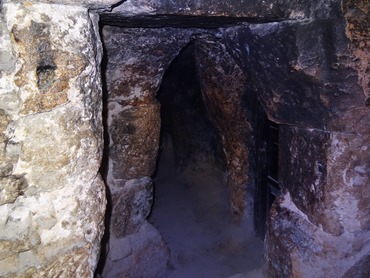
Each of these churches has a cavern under it (and I think they are connected, part of a single system of caves, but I’m not sure). Under the original Greek Orthodox church is the cavern with a marker of the spot where Jesus is supposed to have been born. Under the Catholic church is the cavern where St. Jerome lived when he wrote the first Vulgate Bible. The line for the first cavern is often 2 or 3 hours long, so we went into the other one. Our guide said that caverns like this were often used at that time for stables & guest quarters, and that the translators of the Gospels chose to use the words “stable” and “inn” because they would be more familiar to Europeans even though the original text could also have been translated as caverns. He said the cavern we visited would have been the “inn” where most of the guests stayed during the census, and that the other part where the overflow were housed was probably normally used for animals. I don’t know if that’s right or not, but as you can see below these locations are really underground caves, not what we would call an inn or a stable today.


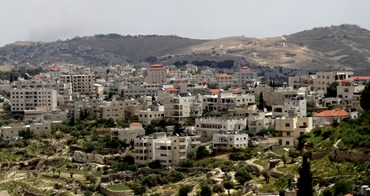
After emerging from the cavern we visited a courtyard where the Kings of the Crusader state of Jerusalem were crowned, in the center of which was a sculpture of Saint Jerome, then drove back to Jerusalem for lunch and a walking tour of the old town. So, here are a few pictures to show what the town of Bethlehem looks like.


Back in Jerusalem we abandoned the bus for a walking tour. The first place we visited was a building designated as the location of the Last Supper (only the location, not the building). This was outside the walls of the old city on (I believe) Mount Zion (which is really more of a hill than a mountain). When we entered this room, very crowded with tourists (as was Jerusalem in general, and the Church of the Nativity too for that matter) there was a group singing hymns. On the way there we saw the impressive Church of the Ascension, built (along with the Augusta Victoria hospital) by Kaiser Wilhelm II after his visit to Jerusalem around 1900.


We entered Jerusalem through the Zion Gate (named for the “mountain”) & had a very good lunch in the Armenian Quarter near a gift shop selling religious ceramics. We then walked through the Armenian Quarter to the Jewish Quarter. Old town Jerusalem has four quarters (which will not surprise anyone familiar with mathematics), named for the population distribution in the 19th century. There are Muslim & Christian Quarters as well.


We walked by the Roman Cardo, which was a shopping street in Roman times. It is on a level much lower than the street on which we were walking. We also saw the location of the hospital that was the original headquarters of the Knights of St. John, who we encountered in Malta.


We walked past the open market area to the Church of the Holy Sepulcher. The first church on this location was built by St. Helena, mother of Emperor Constantine who legalized Christianity, in the 4th Century. It was later pretty much destroyed but rebuilt by the Crusaders in the 11th Century.


This church contains what St. Helena concluded is the site of the crucifixion, the tomb in which Jesus was initially interred, the last five Stations of the Cross and the tomb of Adam. At one time it also contained the tombs of the Kings of the Crusader kingdom of Jerusalem, but those were destroyed centuries ago under Muslim rule. This church has a long history of strife among the various Christian groups competing for control, to the extent of monks killing each other in pitched battles. But an uneasy settlement was negotiated by the Turks under which the Greek Orthodox oversee most of the Church with areas set aside for Catholics, Armenians, Copts, etc. within the Church. Under the settlement nothing can be changed anywhere in the church without the unanimous agreement of all seven (I think) religions, with the result that nothing has been changed. This standoff has led to some odd things: for example, one chapel (I think it was Armenian) was damaged by fire, but they have not been able to repair it for lack of unanimous consent. And even odder, there was a ladder on the outside of the second floor at the time of the settlement, so there has been one maintained there ever since (replaced a couple of times, but never removed). Sultan Suleiman entrusted the keys to this church to two Muslim families in Jerusalem who hold the keys to this day. It is a matter of great prestige for them; one family opens the church in the morning & the other locks the church at night after the Greek Orthodox monks have secured the doors.


Inside the church are some impressive mosaics, particularly in the dome (above) & a very long one depicting the crucifixion & the interment of Jesus, all of which reputedly took place inside this church. Just inside the front door is the stone on which Jesus’s body is said to have been laid out before interment, & there was a line of people to touch this stone. Actually, every part of the Church was crowded, mostly with tourists and pilgrims I would assume.


In the next room is a small building (fairly new) that contains the Holy Sepulcher. The line is very long & very slow, since they only allow a few people in at one time & there is no limit on how long you can stay. We did not have enough time to go in there, but we did see an Armenian shrine adjacent to it that the Armenians say is where Jesus’s head was placed in the interment. We were told that there were 25 or 30 tombs here in the 4th Century but after St. Helena selected this one as having been Jesus’s they destroyed the rest. There is one left, in an adjacent room, which is really a cave that you can walk into; I assume most of the crypts in this area originally were similar caves that could be sealed by rolling a large stone in front.


Climbing a flight of steep stairs took us to the site of the Crucifixion on what was once a hill called Golgotha (or Calvary, of course). The spot is covered by what is in essence a large table that is open on one side, & there was a long line to crawl in there to pray. There were some nice paintings on the walls and archways in this area as well. Directly underneath is a spot designated as the tomb of Adam, which is basically a window on the rock which is split in accord with the story (we were told) that the earth split at the moment Jesus died.


So that was the Church of the Holy Sepulcher, which has seen so much history and is so full of religious significance. Mark Twain had a few choice observations about this church & the plethora of religious sites housed in this one building, but I am not going to repeat them here. We next walked to the Western Wall which, as I have mentioned was built as a retaining wall to support the Second Temple when Herod expanded it (on the way our guide pointed out a sign on a house indicating that the occupant had competed the Hajj, a pilgrimage to Mecca, which is a very prestigious thing). This wall is all that is left of the Second Temple and it is a very holy site to Jews, who come here to pray & insert written prayers into the masonry cracks. Jews are not permitted to pray on top of the Temple Mount, which is under the control of Muslims, who have built two of their most important mosques on this site: The Dome of the Rock, with its distinctive gold dome, contains the rock on which Abraham is supposed to have started to sacrifice his son Isaac, and the Al Aqsa Mosque, which is where Mohammed is supposed to have ascended to heaven during his lifetime. Sometimes non-Muslims are barred from ascending the Temple Mount & sometimes they are allowed to do so, although they cannot enter the mosques, but at no time is it permissible for non-Muslims to pray on the Temple Mount or even to carry a bible up there. Anyway, both mosques are clearly visible from below the Western Wall.


The Western Wall is divided in two parts: the larger area for men & a smaller one for women. Because of this segregation Mary & I could not approach the Wall together. Men must wear head coverings to approach the Wall, & white yarmulkes are available for free (& to keep). Women are restricted at the Wall, apparently they cannot wear prayer shawls or engaged in organized prayer. Some women were arrested for disturbing the peace a few days before our visit when they broke these rules, but a Magistrate threw out the charges saying that this behavior was not unlawful.


There is an intense ongoing cultural conflict in Israel & especially in Jerusalem between the ultra orthodox Jews and the more secular Jews. The ultra orthodox (like the orthodox of other religions) would like to impose their strict rules of dress & behavior on everyone else. Women have been stoned for wandering too close to Orthodox synagogues in nonreligious dress & our guide told us she was leading a busload of tourists that was stoned when it drove too close to a synagogue. The big issue right now has to do with the exemption in Israeli law for religious scholars from the otherwise universal military service. According to our guide, when this law was enacted some 60 years ago it was thought that it would apply only to a few hundred special scholars. To qualify for the exemption one must certify that he will spend his life devoted to scholarship, foregoing employment. Today there are countless numbers of ultra orthodox Jews signing this pledge, and these people also believe they have an obligation to marry (often arranged ones) & devote themselves to maximum reproduction. The result is many thousands of families with 10 or more children living in poverty on a government dole in two room apartments. They have become a burden on the remainder of the population and are increasing in numbers so quickly that our guide believes they will constitute a majority of the population of Jerusalem before long, which would give them the political power to impose their rules on everyone in the city. So the new government seems prepared to do away with the military exemption; we will see. We saw many ultra orthodox Jews in Jerusalem, who are distinctive with big black hats & suits with white shirts. There is a special section set aside in the men’s section of the Wall where there are chairs & desks for their use.


At the exit from the Wall area is what we were told is the world’s largest mezuzah (usually a very small container of tiny prayer scrolls that many Jews affix to their door frames). We left the old city through the Dung Gate (its just what you think: this is the gate through which the refuse was taken out of the city). Then we drove to Haifa to meet the ship. Unfortunately we arrived after dark, so we didn’t get to see anything of this reputedly beautiful city, but we did see the lights of the Ba’hai Gardens that flow down the side of Mount Carmel (although I couldn’t get a picture from the moving bus). I guess we will have to save that for another trip. We sure got to see an awful lot on this trip, particularly considering it was only two days, and it was even more interesting & enlightening than we had expected. Our guides did a marvelous job of enhancing our visit to this fascinating country. So, as we head for Turkey I will leave you with some towel & fruit art.


 BADER JOURNAL