Tianjin, China (Beijing) Day 2 — 2024
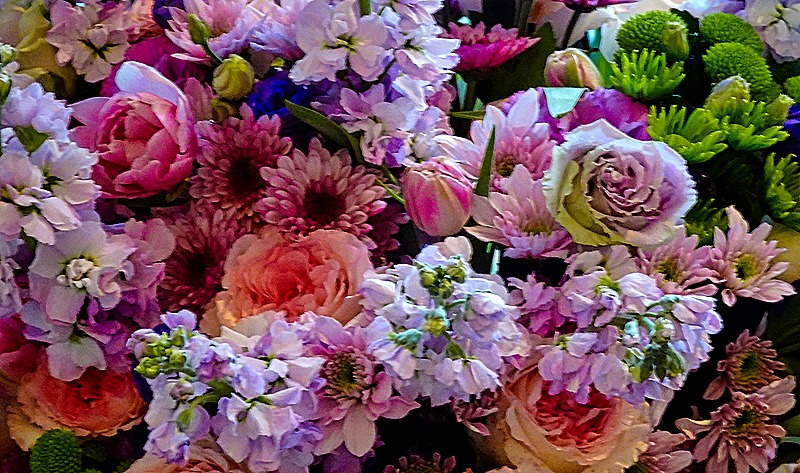
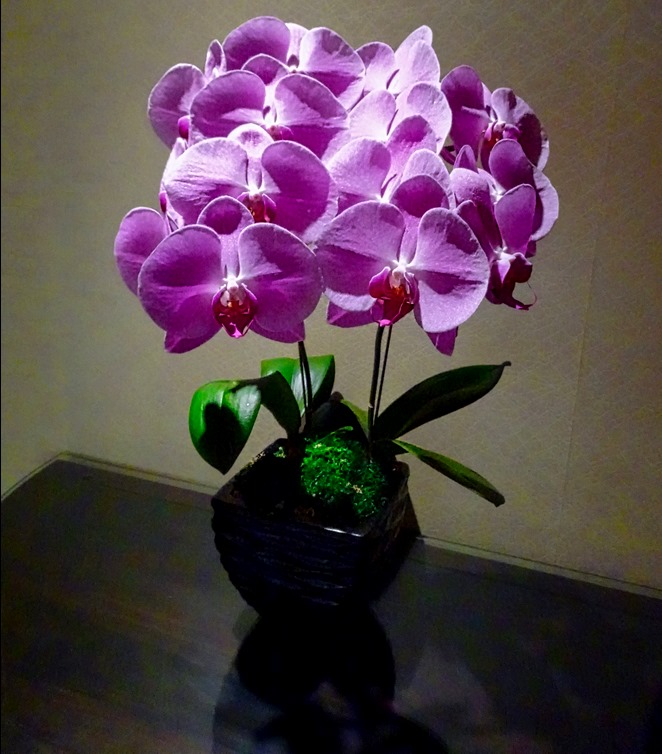
We woke up early in our hotel room on March 12. Already in Beijing, at least there would be no long bus ride to get there, but we were scheduled to check out and leave at 7:30 for the short ride to Tiananmen Square to try to beat most of the crowds that visit there every day. And before that was a vast buffet breakfast with many Chinese and Western foods, far more than anyone could even sample before a long day of walking. I was more than satisfied with a couple of croissants. We checked out of our hotel, quite beautiful inside with many flowers, and boarded the bus.

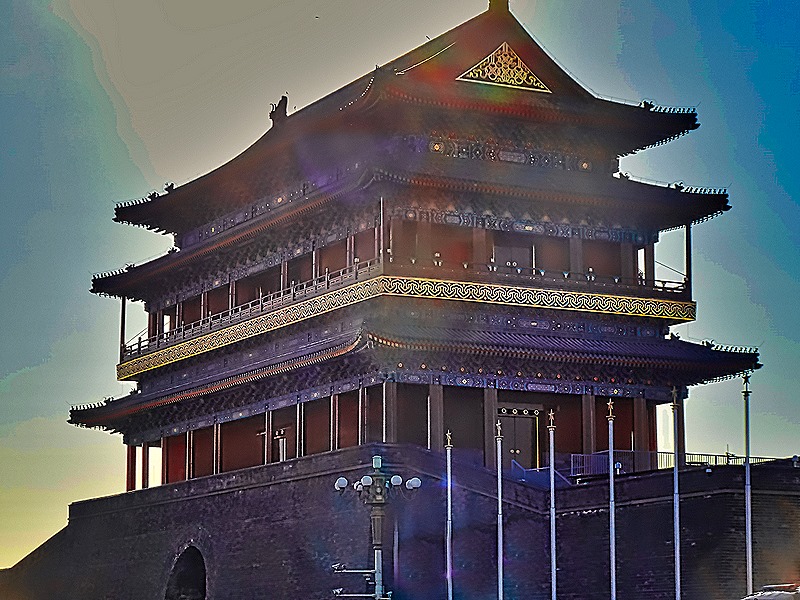
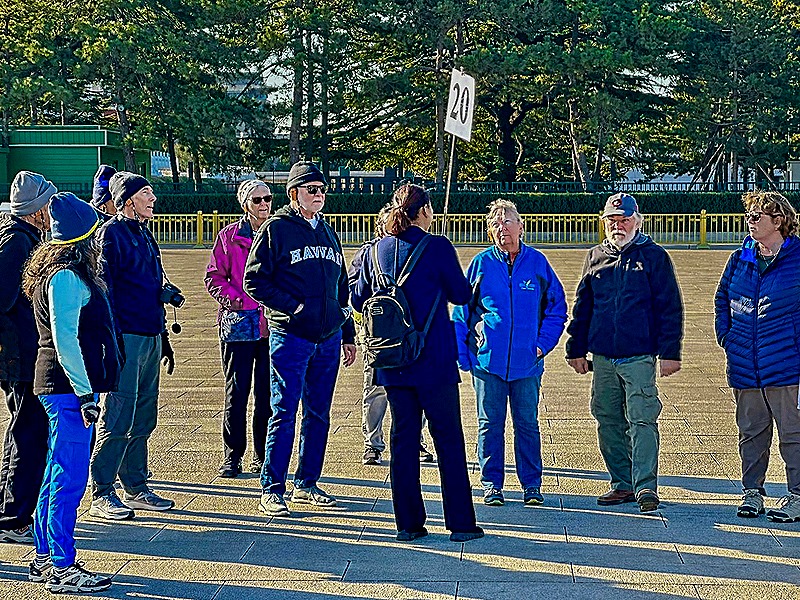
We walked from our bus to Tiananmen Square, entering from a bit to the side of the Quinmen, the huge gate at the front of the square. It is a beautiful building, which we saw from a distance all lit up the previous night, but by the time our guide pointed it out to us today the sun was directly behind it so our picture is pretty woeful. Far away on the opposite edge of the vast square we had our first view of the Tiananmen (Gate Of Heavenly Peace), with a painting of Mao Zedong above the entrance in the wall below. Tiananmen Square was first built in 1651 and greatly enlarged in the 1950’s. It measures some 835 yards long by 310 yards wide (think 8 football fields long by 3 wide) and will accommodate a crowd up to about 600,000 (thankfully not that many the day we visited).
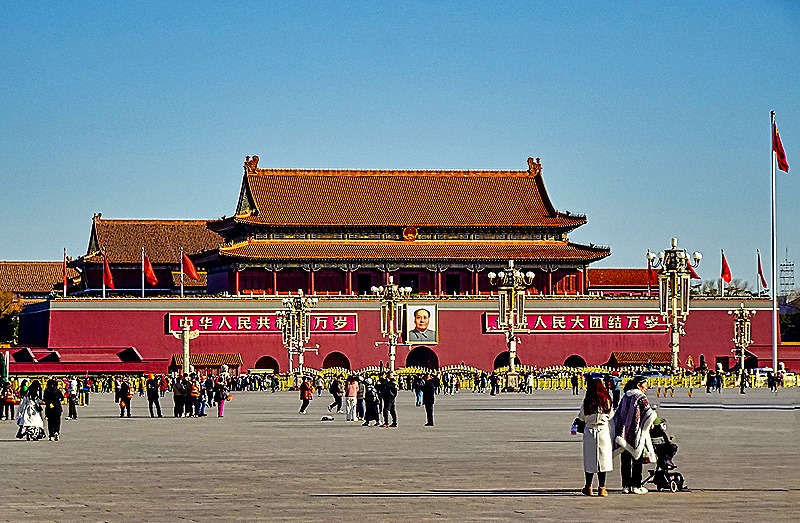
Most people reading this will probably associate this square with the violent suppression of student democracy protests in 1989, in which it is estimated that hundreds (some say thousands) were killed. In China no one speaks of this in public and most Chinese are not even aware that it happened. It is our understanding that the only public entrance to the Forbidden City requires walking across this huge square to the entrance below the painting of Chairman Mao. So that is what we did. Walking along we passed the Monument to the People’s Heroes, a 125 foot tall obelisk completed in 1958 and saw the National Museum of China behind it on the eastern side of the square. The museum, first opened in 1959, is the largest single museum building in the world. It has a vast and varied collection and it looks like one easily could spend a day or two just exploring this museum. We did not have that kind of time, so walked on by. In the center of the square just south of the Monument is Chairman Mao Memorial Hall, the mausoleum that is his final resting place. It was completed on May 24, 1977, about 8 months after Mao’s death.


Along the western edge of the square is the Great Hall of the People, meeting place of the National People’s Congress and the National Congress of the Chinese Communist Party, along with other official and ceremonial functions. Its construction was completed on September 9, 1959. A large building with a long and low profile, it is 1,168 feet long and 677 feet wide.
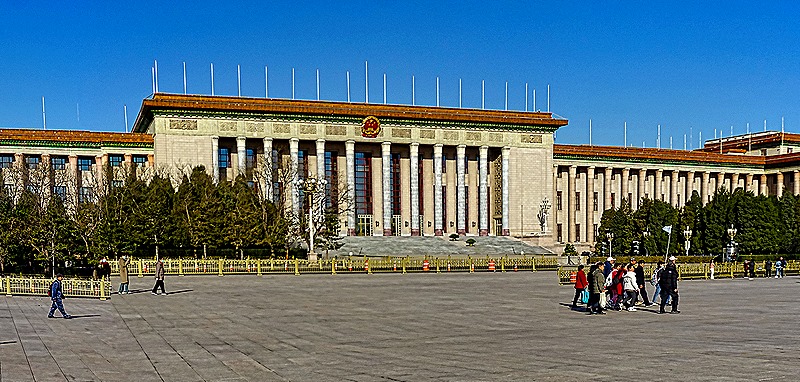
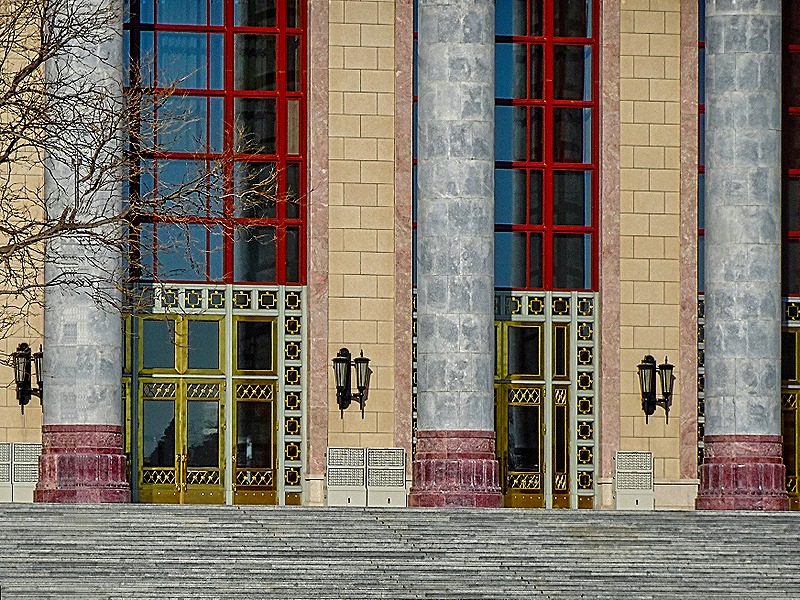
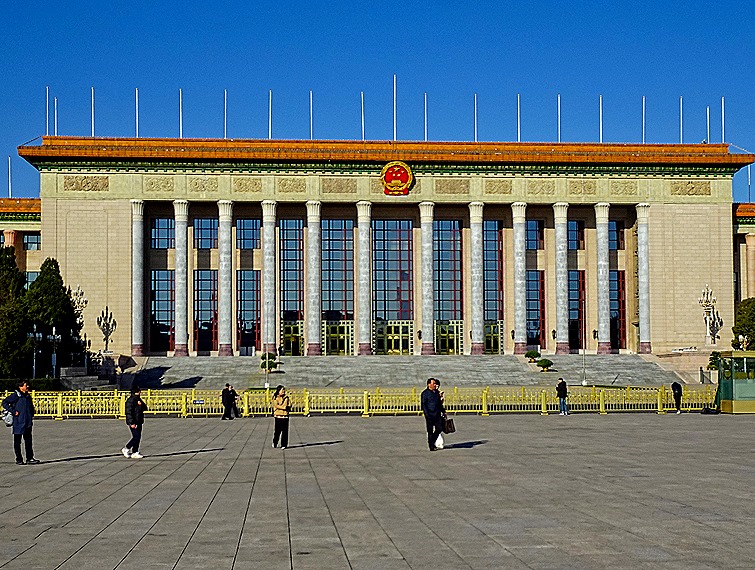
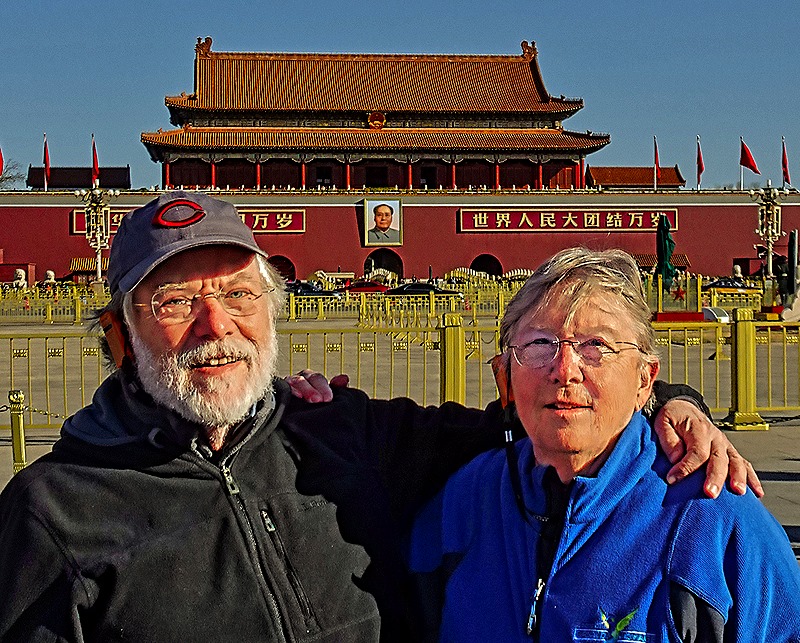
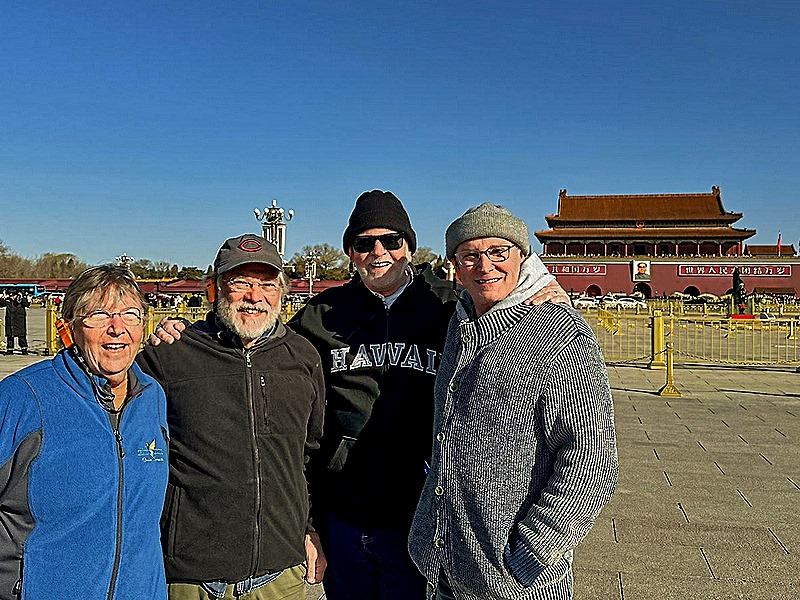
There would be more than enough time to spend in the square before we would be admitted to the Forbidden City and this apparently is a traditional place for visitors to take pictures. Well, we were visitors so here are some pictures of us and our companions with the Tiananmen as the background.


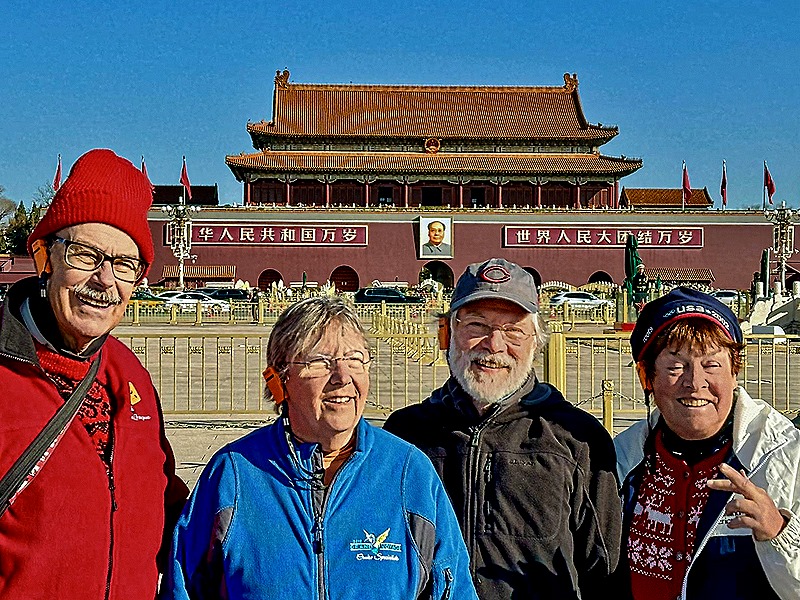
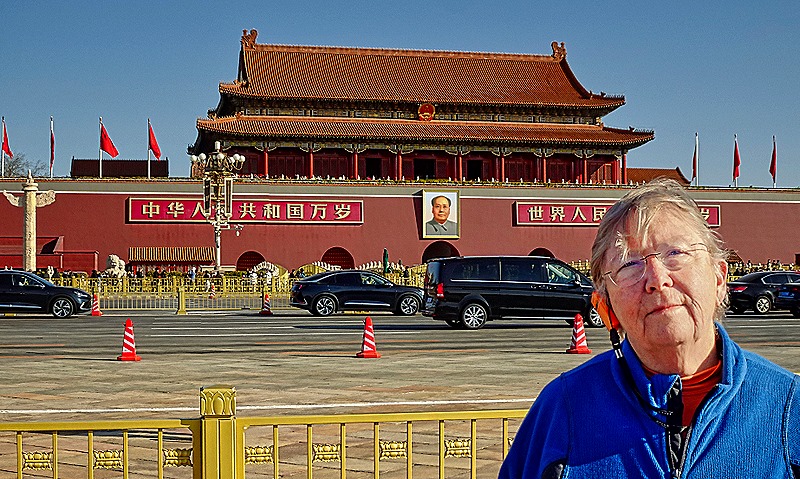
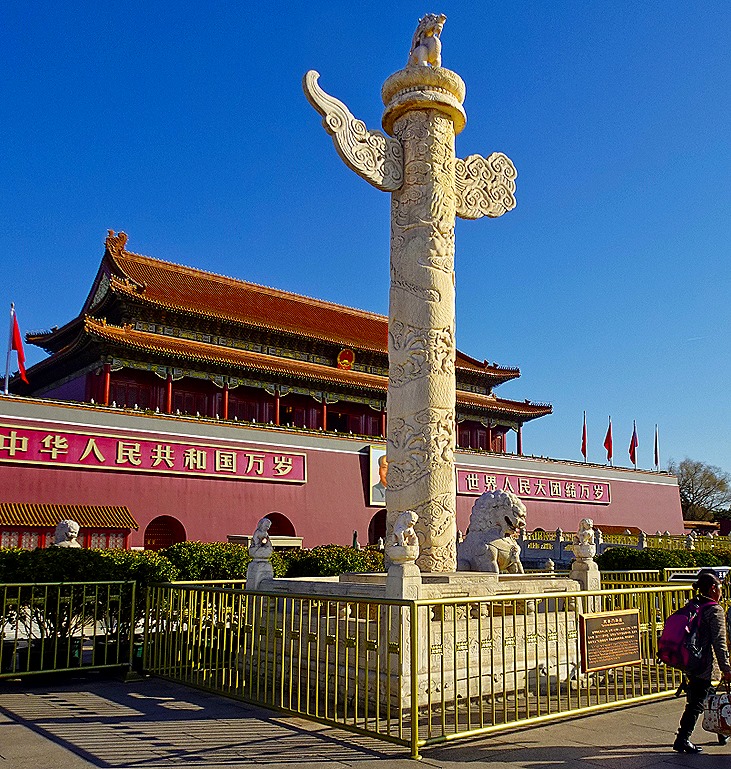
The Tiananmen itself (“Tiananmen Gate” is redundant, since “men” apparently means gate) is a widely recognized symbol of modern China. First built in 1420, this “Gate of Heavenly Peace” has been damaged or destroyed and rebuilt several times, most recently in 1970. It is 217 feet long, 121 feet wide and 105 feet tall. Across the front are two large inscriptions in Chinese: the left one means “Long Live The People’s Republic of China,” and on the right “Long Live the Great Solidarity of the World’s Peoples.” In front, between the building and the street, is part of the old Imperial moat that still surrounds the Forbidden City with carved marble bridges leading over it to the entrances. Decorative fountains shoot up from the moat on each side of the building. Over the main entry is a huge painting of Mao Zedong, which weighs 1.5 metric tons.
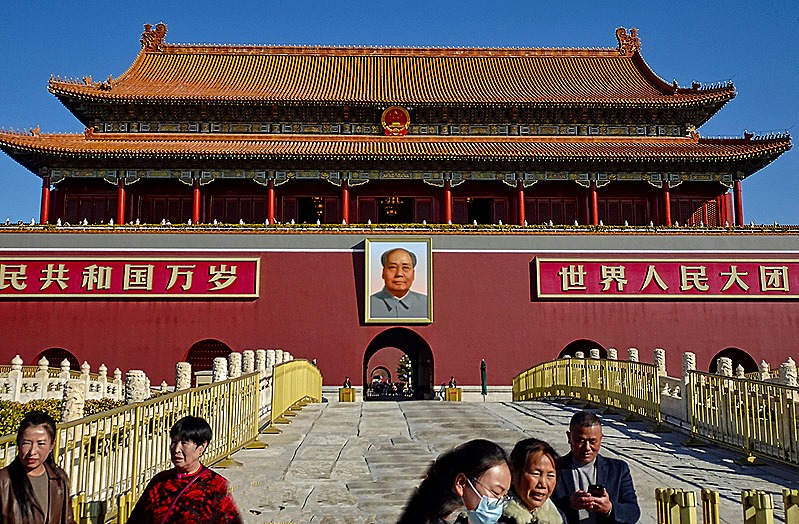


Two marble lions stand guard near the front of the building and there are two tall marble columns called “huabiao” standing just beyond each end of the building. With marble wing-like appendages near the top they look a lot like Alaskan totem poles. These date to the 15th century.

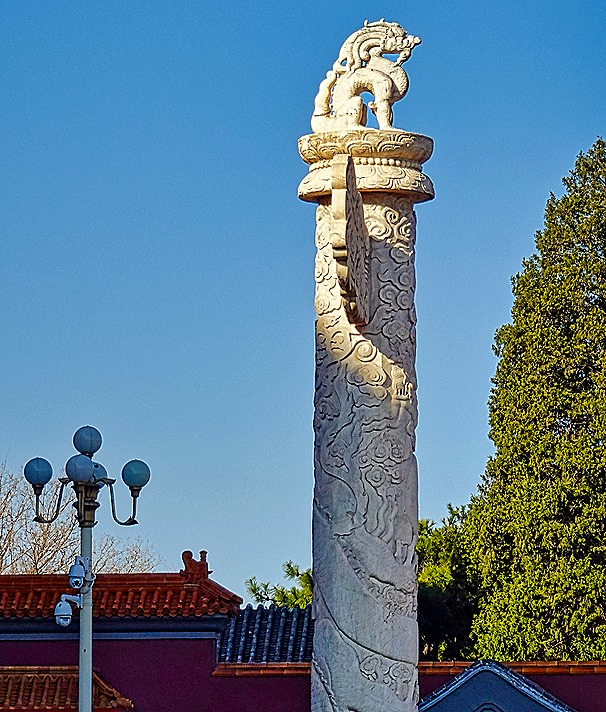

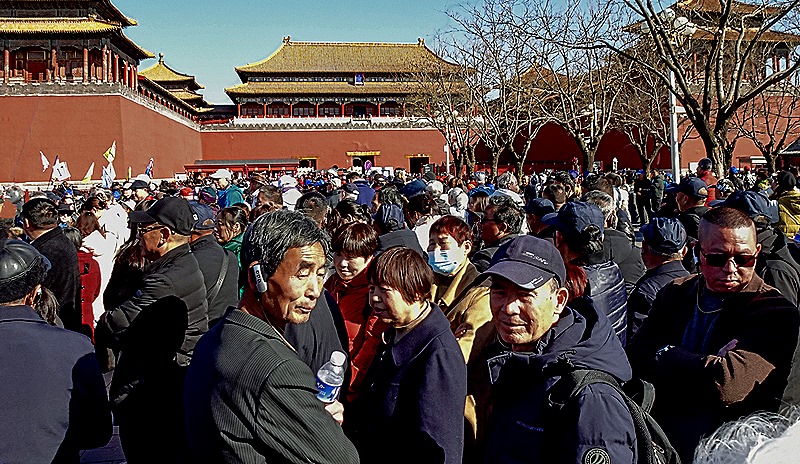
Finally it was our turn to proceed through the central front gate into a large courtyard leading to the Meridian gate, which is the actual entrance into the Forbidden City. This side of the Tiananmen is called the Upright Gate. There was quite a long wait here (just like Disney World, where you wait in line and when you finally enter you find yourself in another long line).
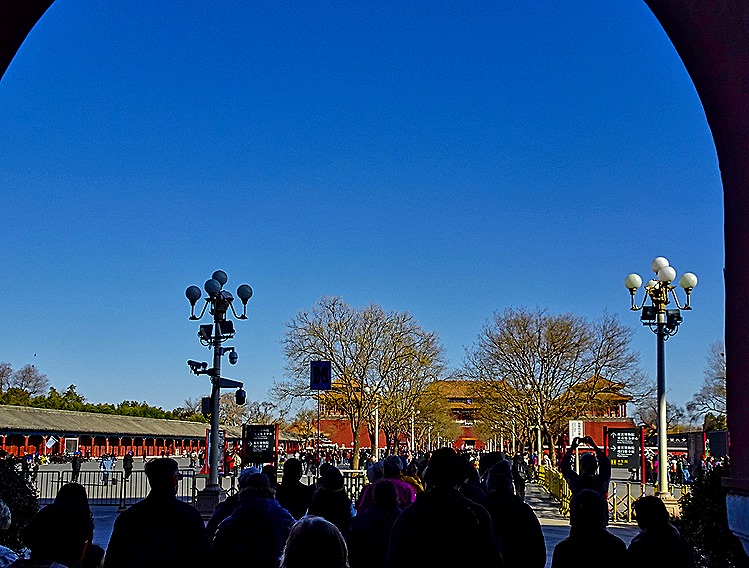

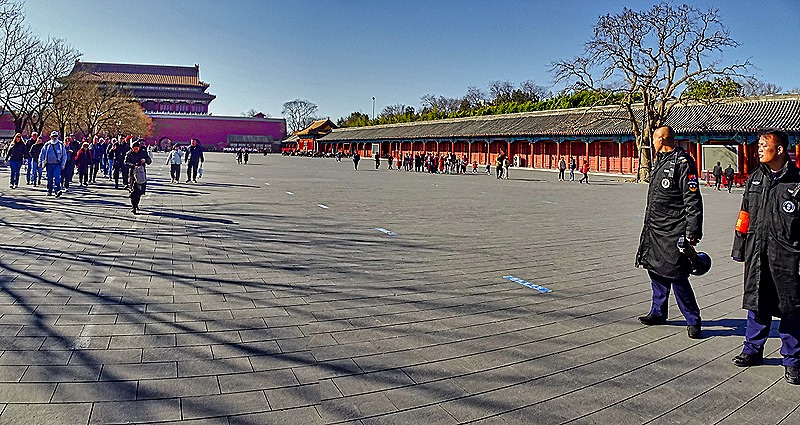
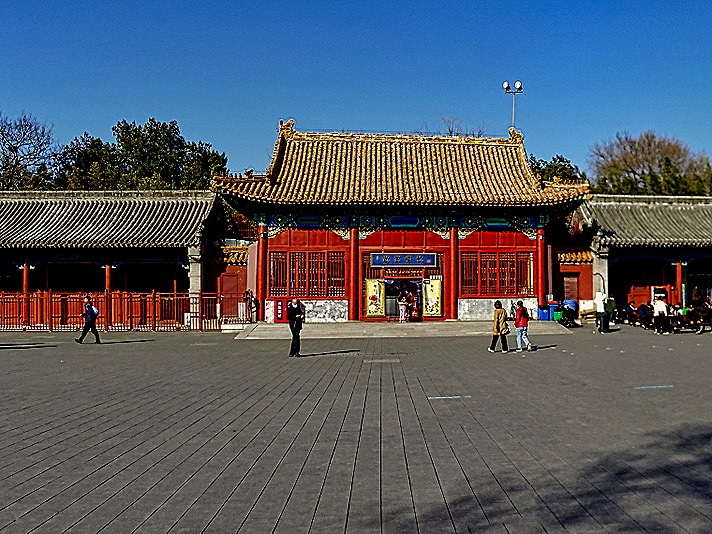
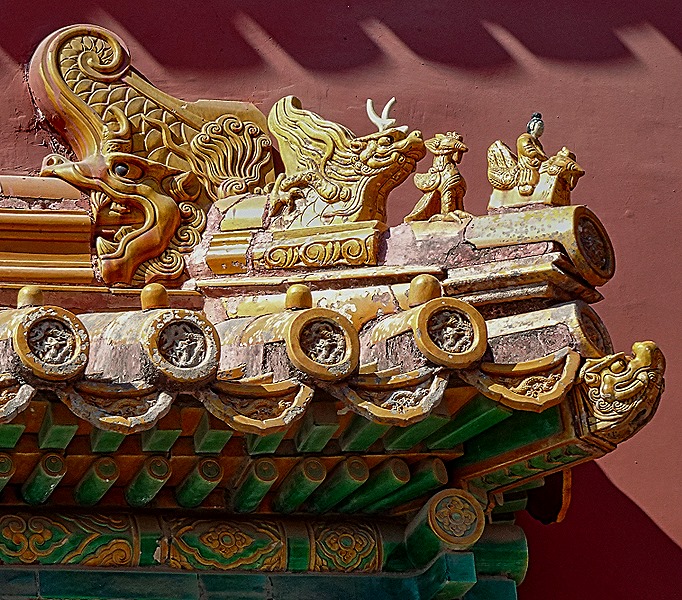
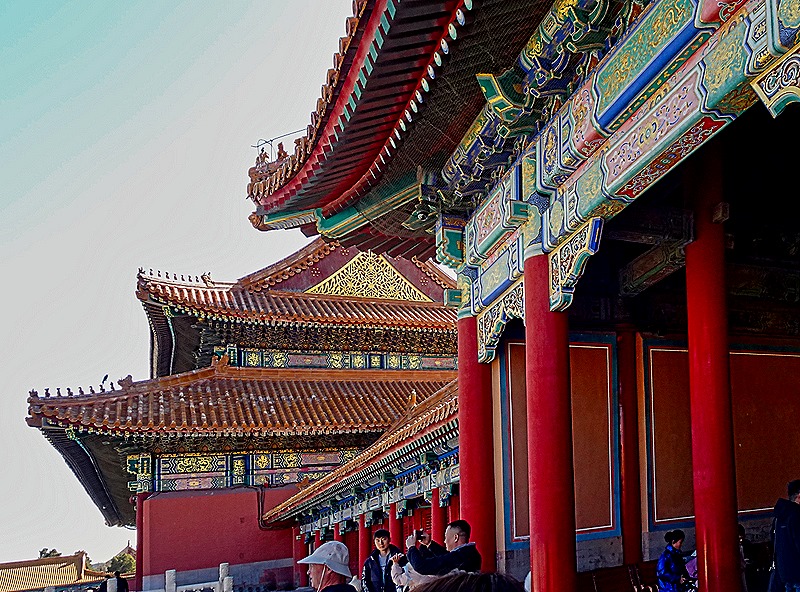
We spent quite a bit of time in this courtyard before being permitted to move on to the next one. The courtyard is surrounded by buildings in traditional Chinese style, much red, green and yellow. Yellow roofs like those seen on some of these buildings were permitted only for the Emperor’s buildings. Notable here and on other buildings are the decorations on the ends of the roof eaves, made up of a row of golden animals, including dragons, phoenixes and lions. They are quite beautiful and the number of animals indicates the importance of the building, from just a couple to as many as nine. The long rows of buildings along the sides of the square used to be administrative offices. Young men in uniform were in this courtyard to keep order, and as the courtyard got more crowded we were all required to stand in parallel lines, with each set of visitors in a different line headed by its guide carrying a numbered white sign.


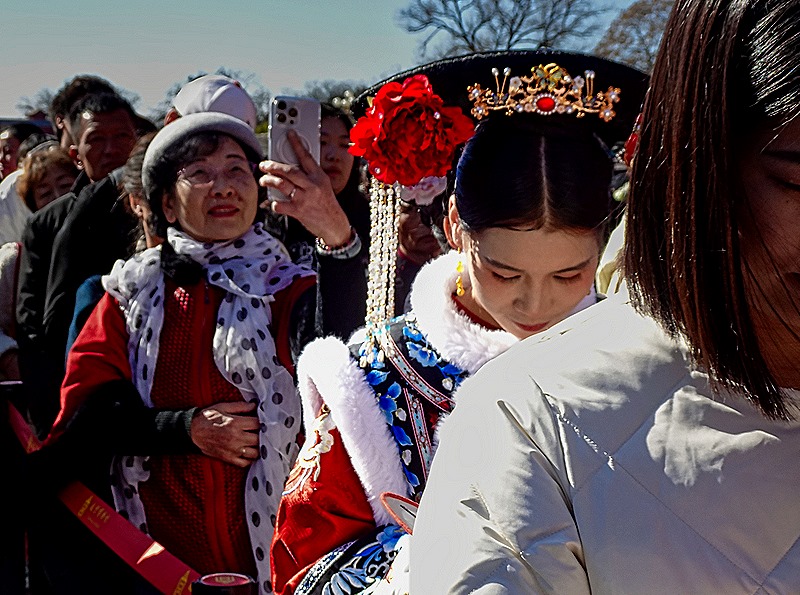
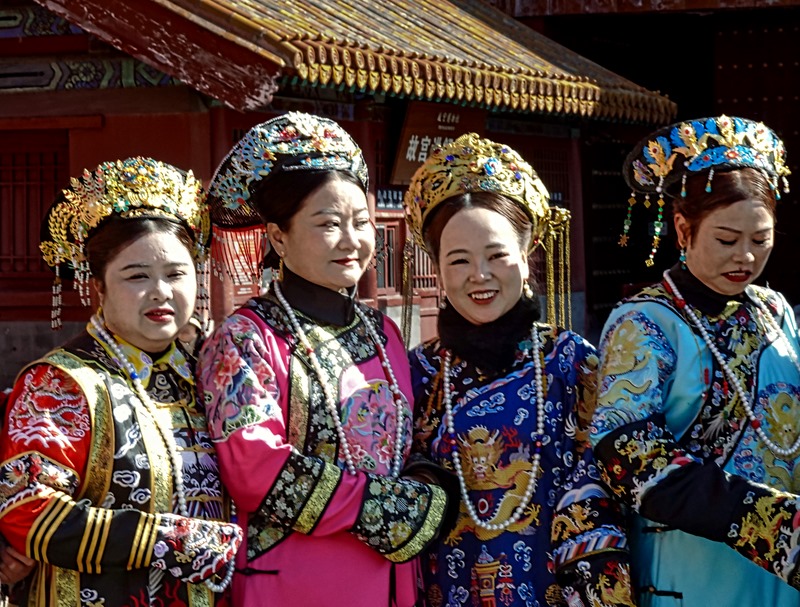
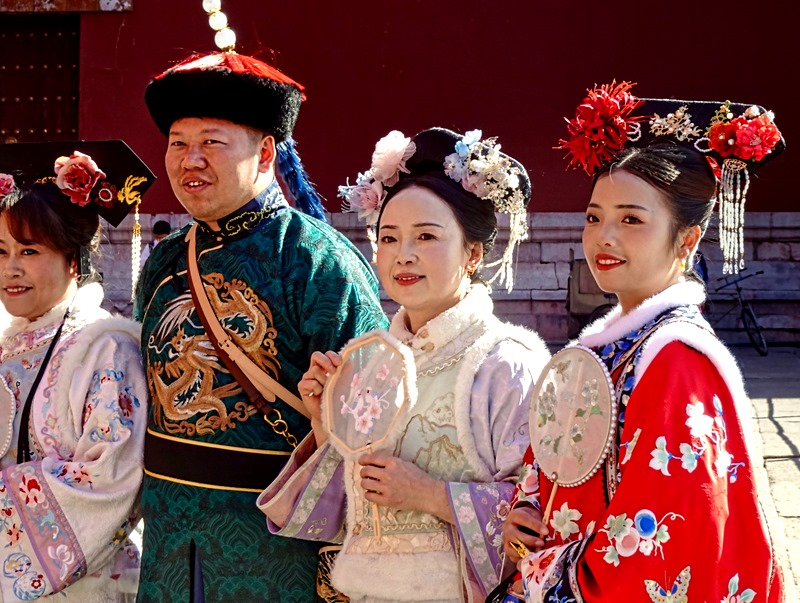
We have seen before in Japan and China that some young people like to dress up in rented period costumes when visiting historical venues. While we waited in line there was a group near us dressed in what we understand were Ming period costumes. Very colorful, and they happily posed for pictures. There was also a man with a baby in a beautifully embroidered backpack.


Of course, what we were all waiting for was our turn to go through the Meridian Gate. Unlike all the other gates in the Forbidden City, the Meridian has large side walls stretching forward along the sides of the courtyard like the arms of the Sphinx, each with a building on top. The Meridian Gate is the actual entrance to the Forbidden City proper.


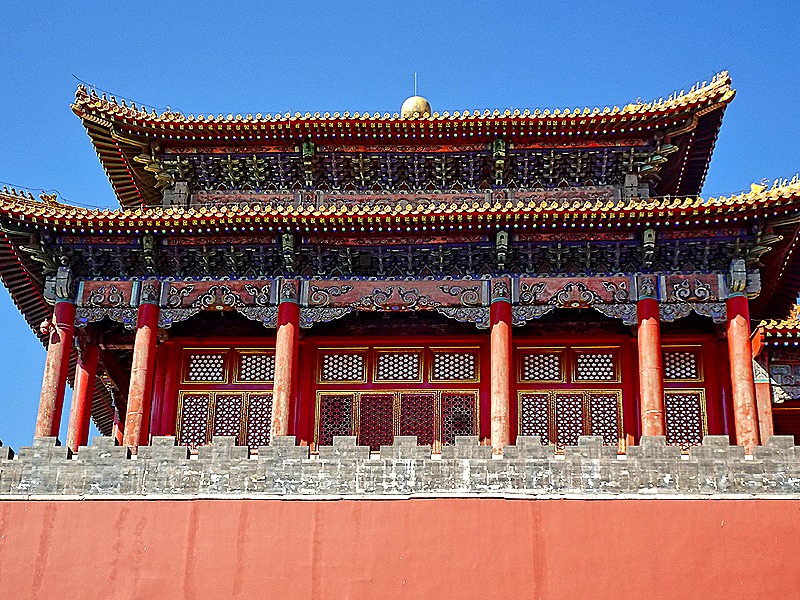
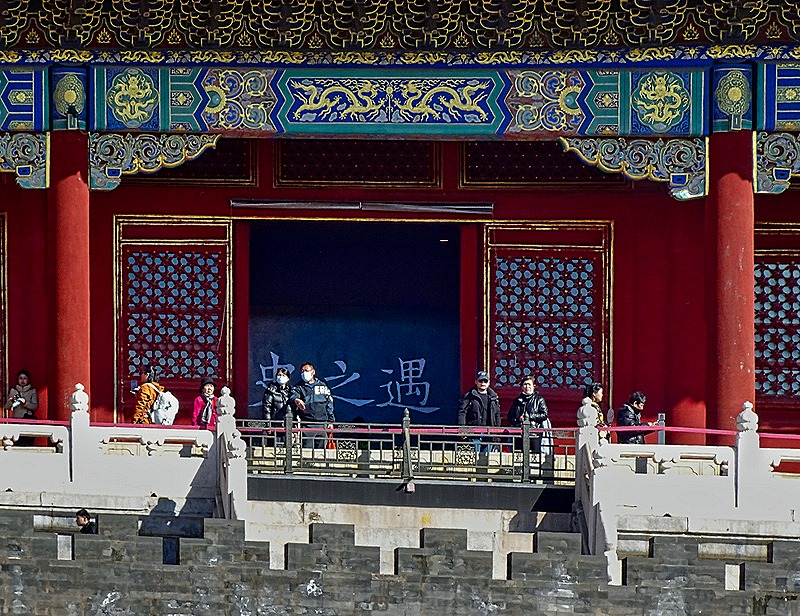


We finally walked through the Meridian Gate. There was a security check inside the gate where we had to show our passports and (if I remember correctly) walk through a metal detector. A bit irritating because there was a line, but not a big deal. Except for our travel agency’s host Susie. She was taken aside as the rest of us went on through. She was detained for about half an hour before being allowed to rejoin us, causing some concern because no one told us why. It turned out that she was carrying all our tickets for the Forbidden City and whoever had filled out a form to accompany them had miscopied one of the digits in her passport number so that they didn’t match. One of our guide’s assistants made the trip back to their office to obtain a corrected form, stepping up like a pro to fix the situation. We were all glad to see Susie finally return. Enough excitement for one day!
We emerged from the Meridian gate into another courtyard where we could see the Gate of Supreme Harmony on the opposite side. Through the middle of this courtyard runs a man made stream called the Inner River of the Golden Water, with five marble bridges over it. Green sculpted lions (perhaps old tarnished bronze) stood guard in front of it.
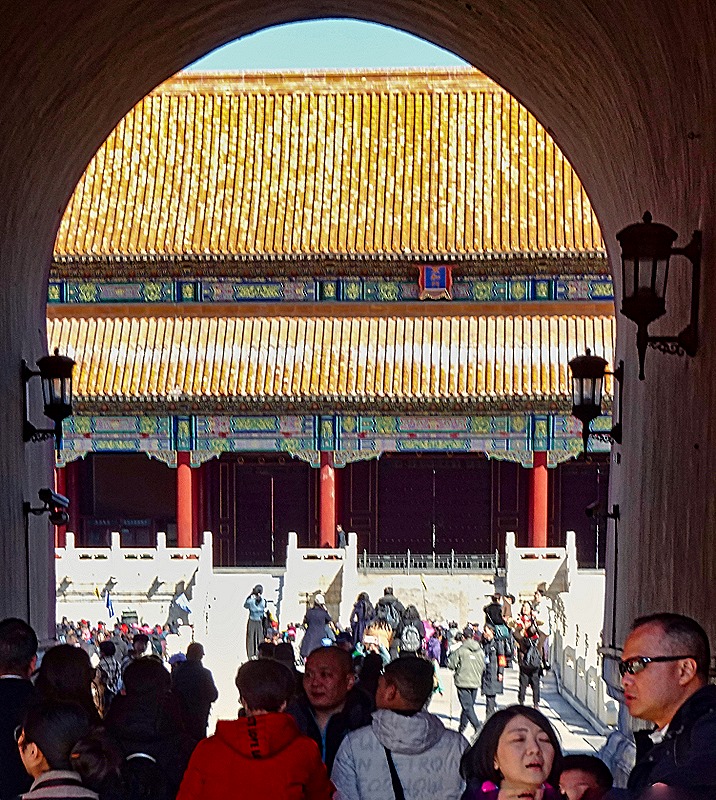

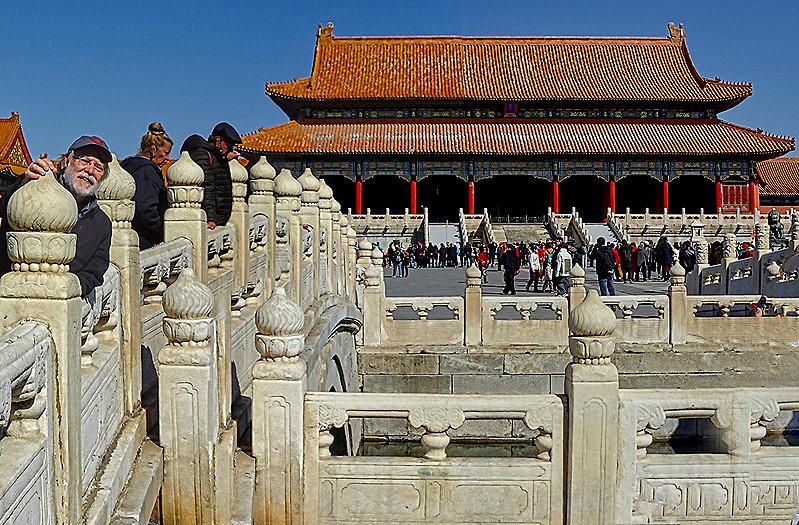


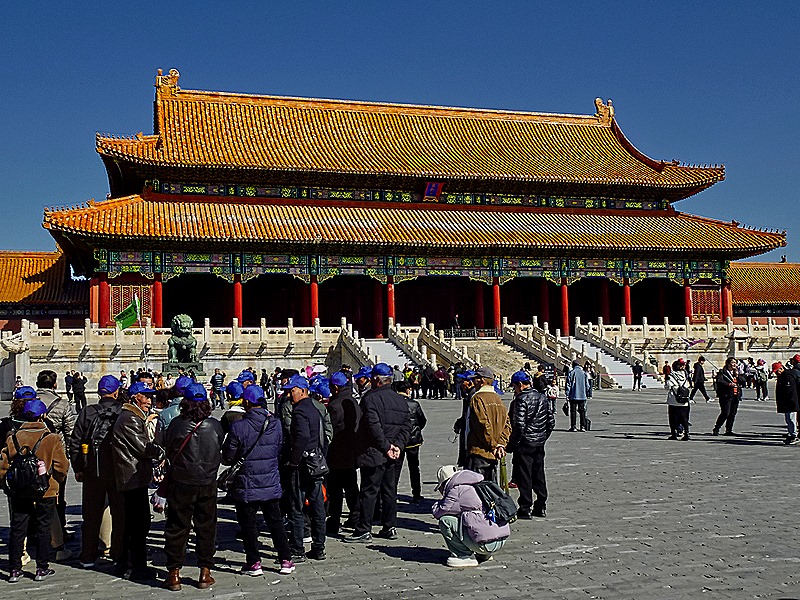
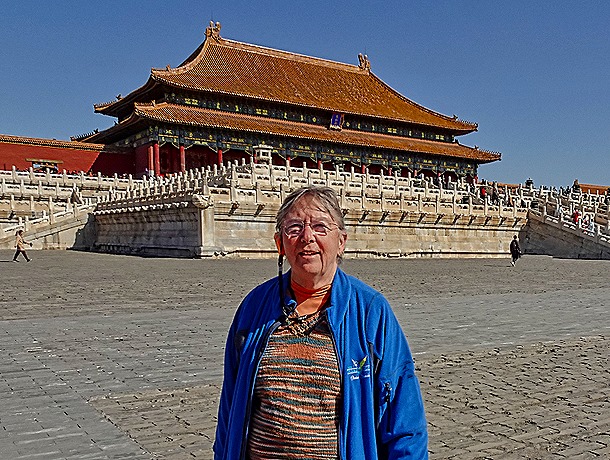
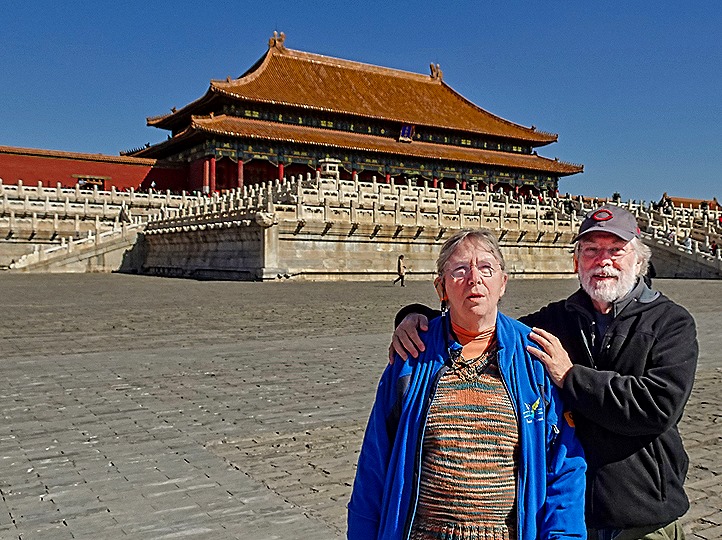
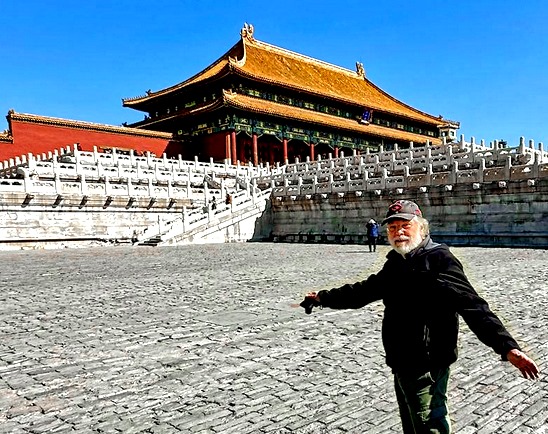
Walking through this gate (after Susie finally returned) we came out into a much larger courtyard leading to the Hall of Supreme Harmony, the largest building in the Forbidden City. This large building sits atop three levels of marble. The buildings in the Forbidden City are all made of wood, the largest collection of wooden buildings in the world. And they were constructed without nails, which were viewed as violent and non-harmonious at the time. Instead they are held together entirely by mortise and tenon joints. Large bronze cauldrons were distributed throughout the complex, which were once kept filled with water as a precaution against fires (always a danger with wooden buildings).
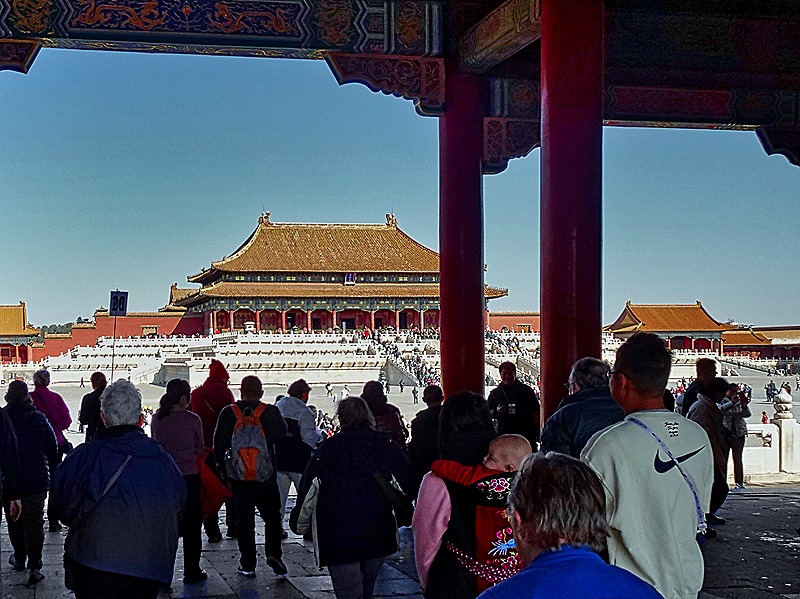


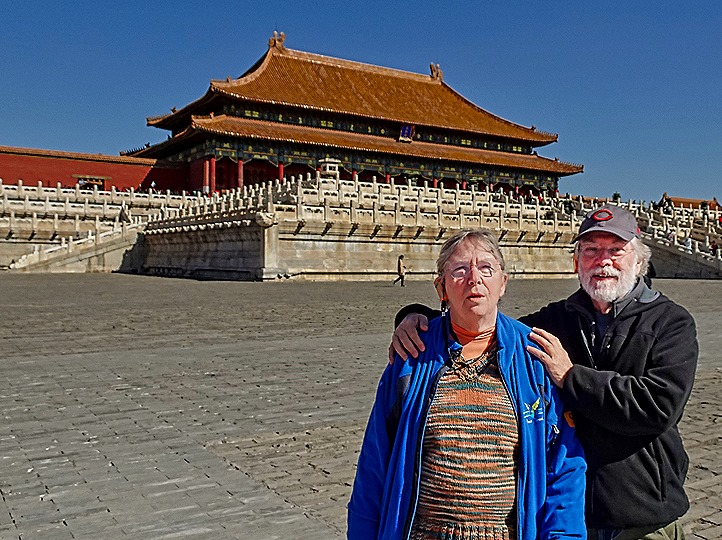


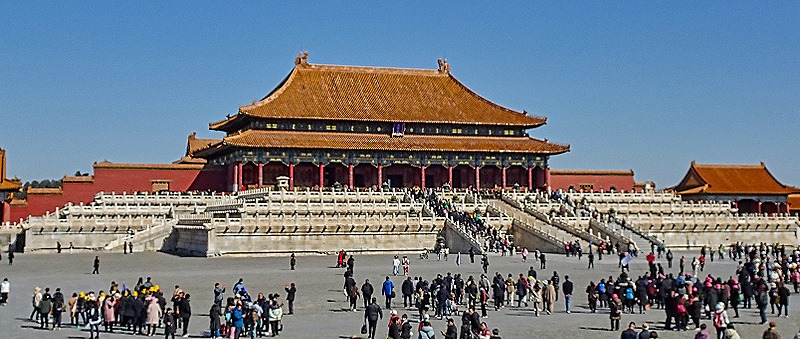
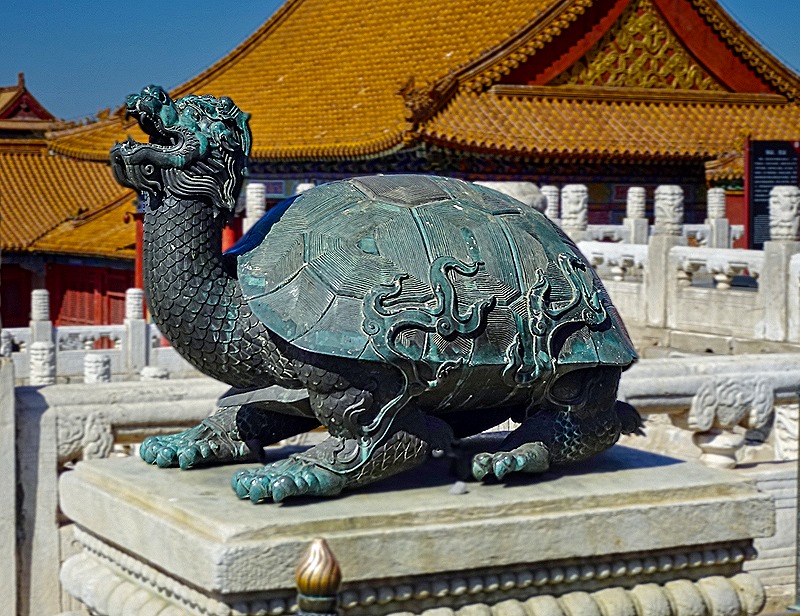
We climbed up the steps to the large stone veranda in front of the building. Bronze sculptures of animals and a large incense burner were out on the patio and inside the central entrance was the Emperor’s throne room where his Dragon Throne still sits. Unfortunately entrance to the building was not allowed and there was a big crowd of people behind a fence in front of this room angling for position to take pictures, even though the room was on a higher level. The room inside was dark and outside the sun was very bright, so we really couldn’t see anything inside the opening from where we stood behind the crowd other than some windows that were (un)helpfully backlighting the dark throne. But standing behind the crowd we raised our cameras over our heads and took some pictures blind in the hope that we could coax something out of them on the computer, because you never know. The images are there in the pictures below, but they look like they were retrieved from film that has been sitting in water a long time. Still, the throne (which actually is golden in color) must have been pretty impressive to court visitors.


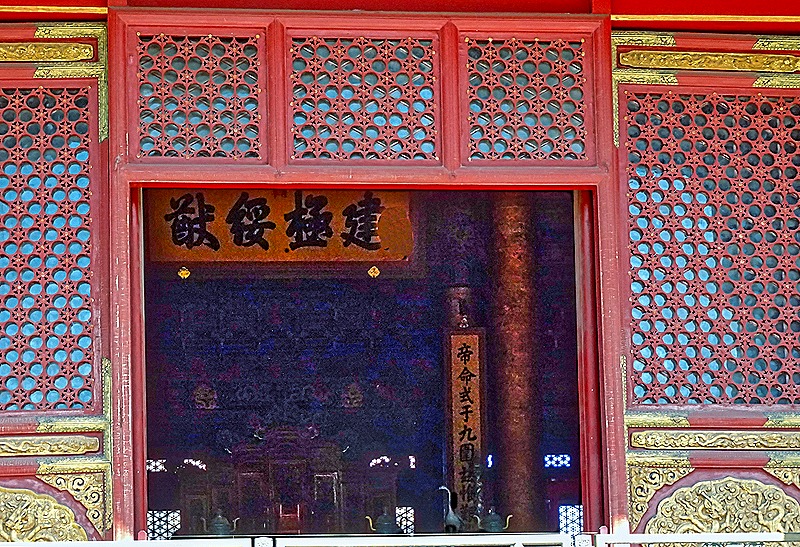
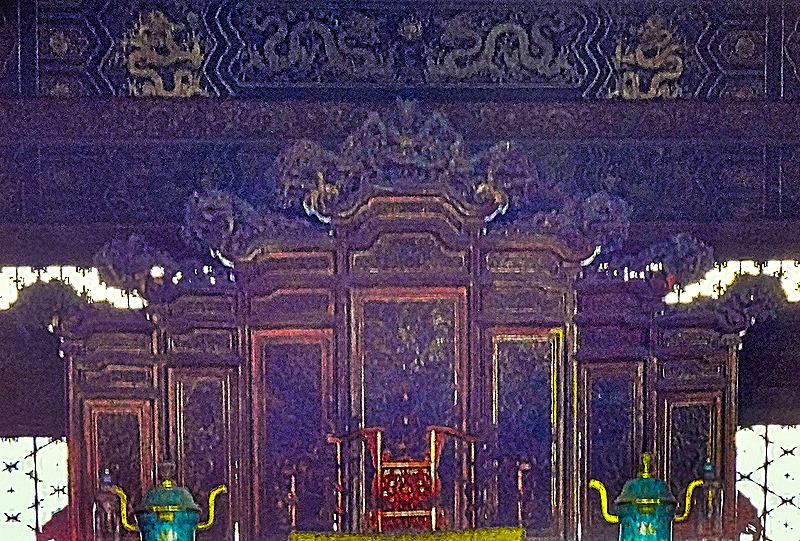
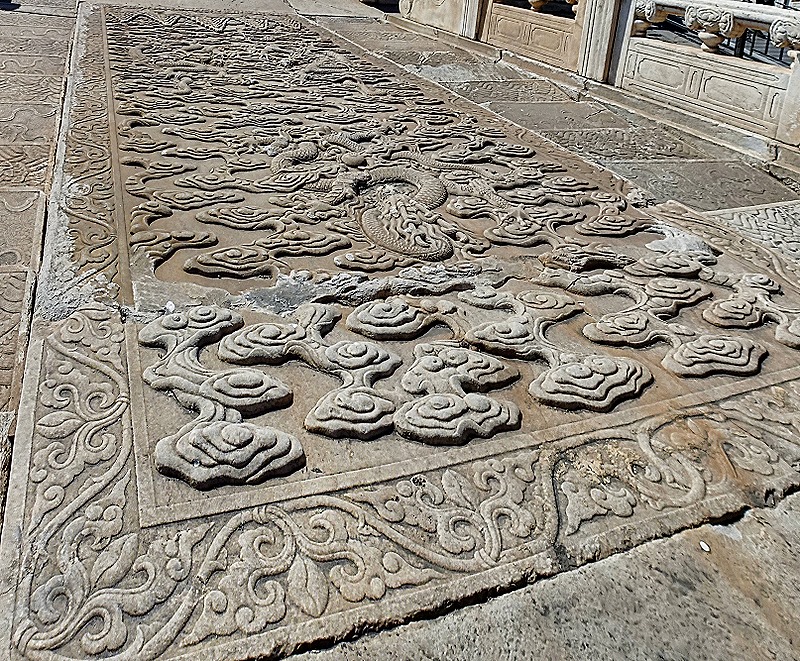
The carved marble staircases and veranda fencing were quite beautiful in themselves, with dragon heads lining the bottom at floor level serving as rainwater runoff spouts. It was quite a view from the veranda down the steps and across the courtyard to the Gate of Supreme Harmony through which we had entered. The central carriageway is covered with intricately carved marble reliefs. Back in the day, no one but the Emperor was permitted to use it.
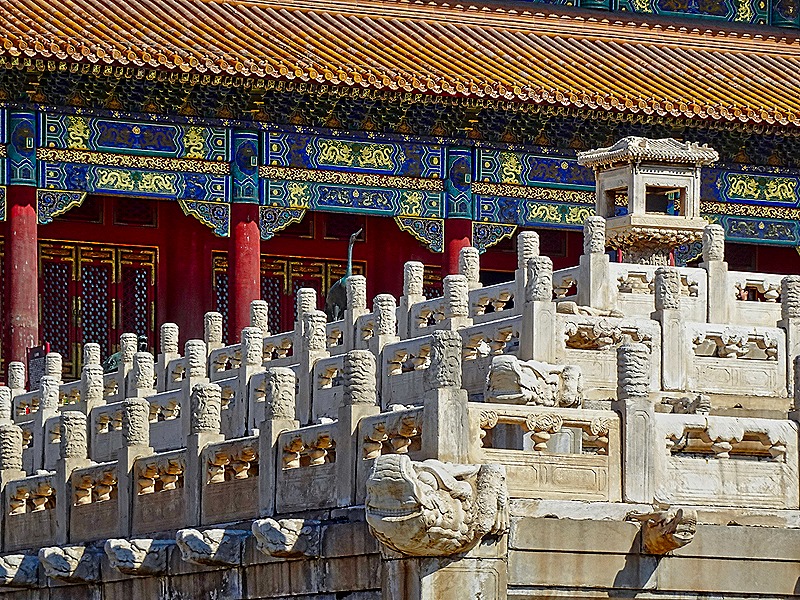
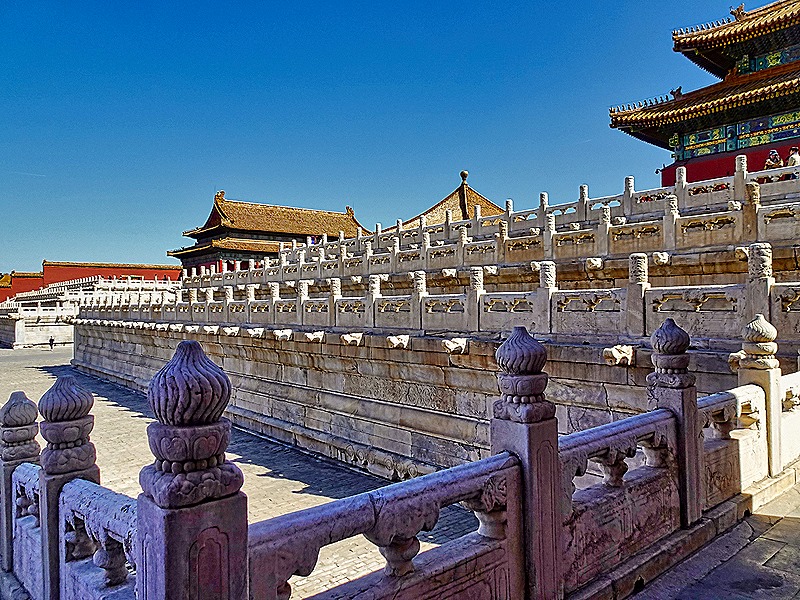
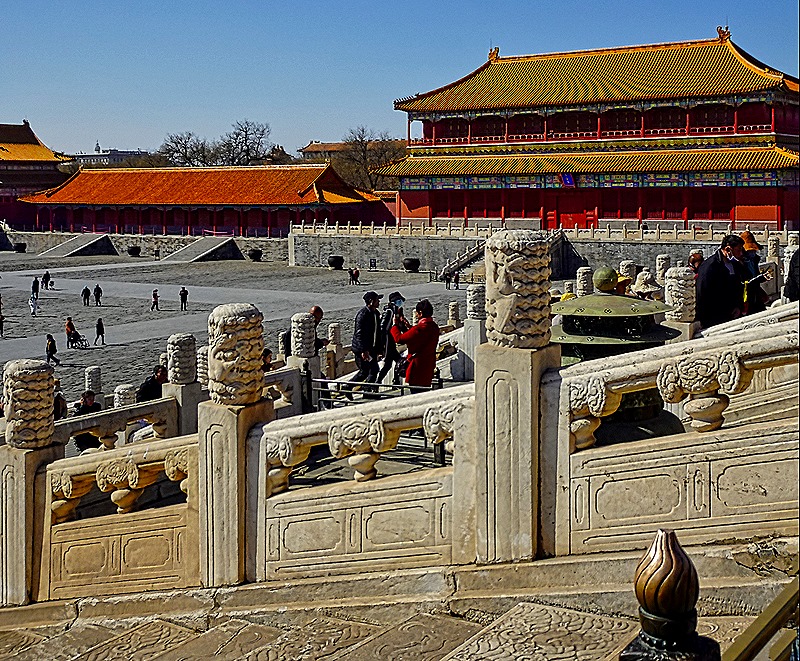

Behind the big hall is the much smaller square shaped Hall of Central Harmony. We walked through a small gate to the side of the Hall of Supreme Harmony to reach it. Walking through another gate we looked up and saw its elaborate ceiling, made of wood with mortise and tenon joints. And nearby were several side buildings with gracefully interacting eaves. Behind the Hall of Central Harmony is the larger rectangular Hall of Preserving Harmony.

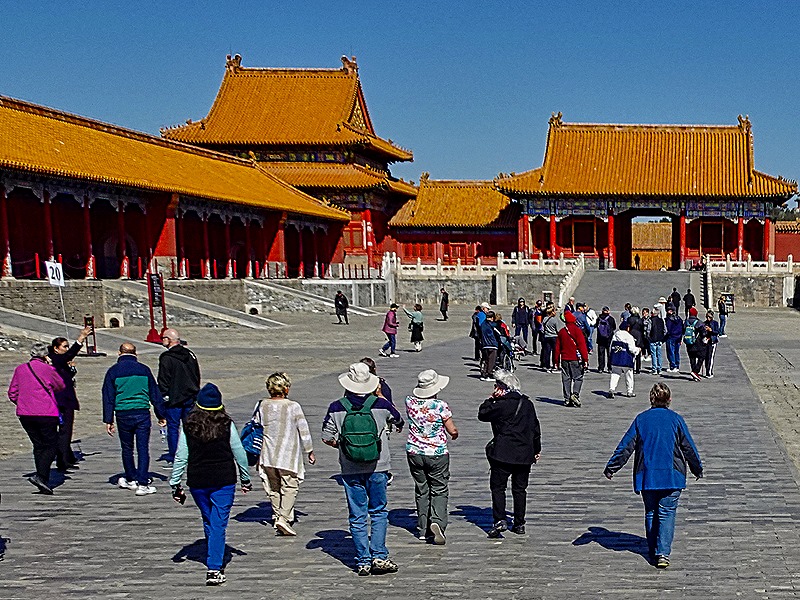
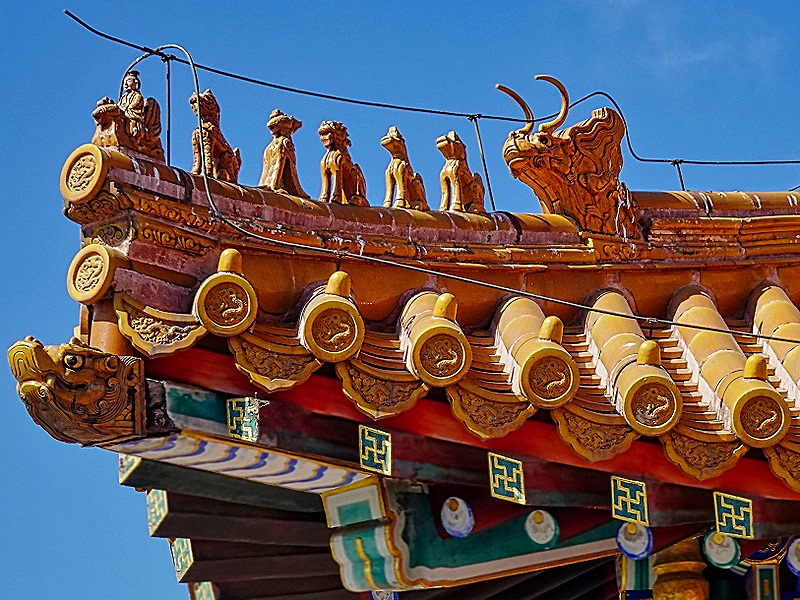

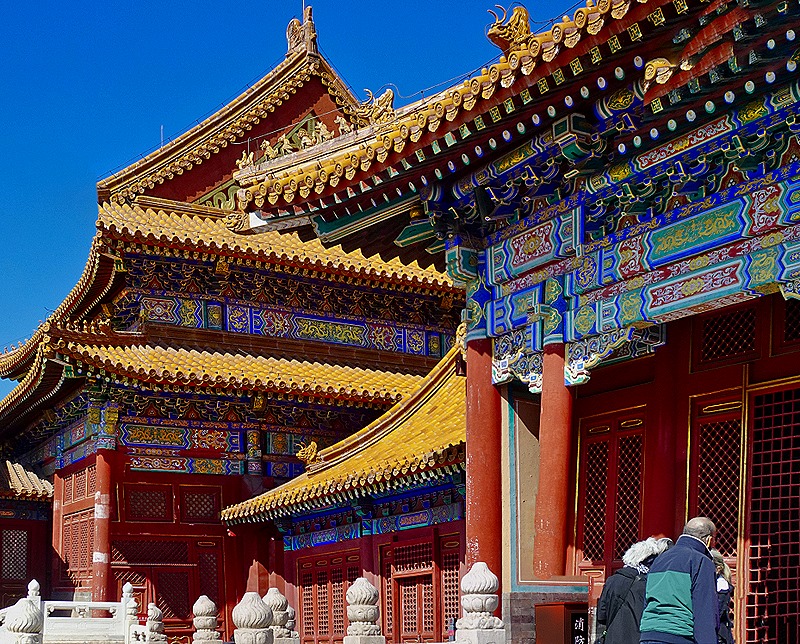
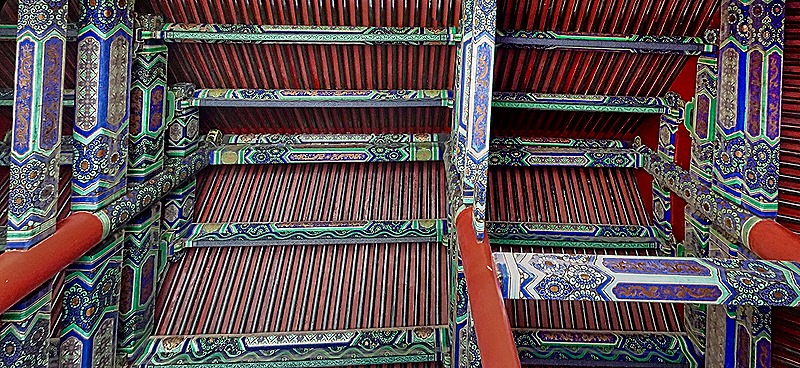

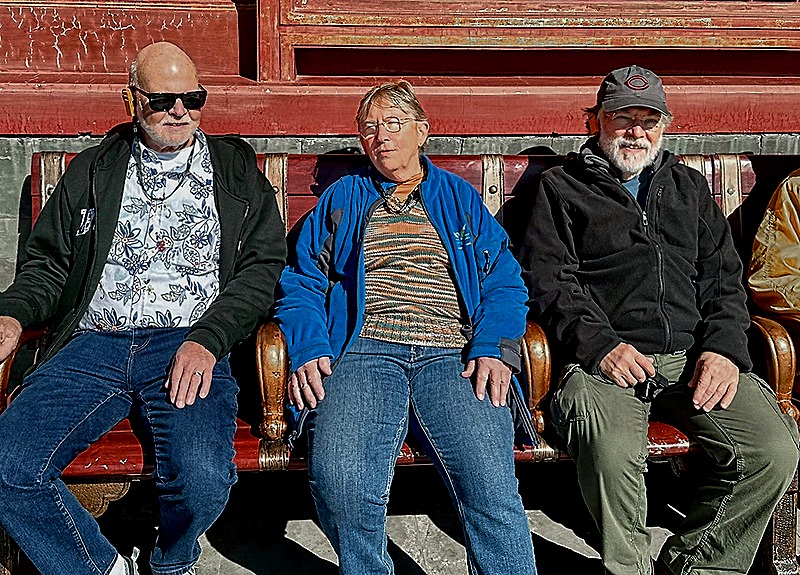
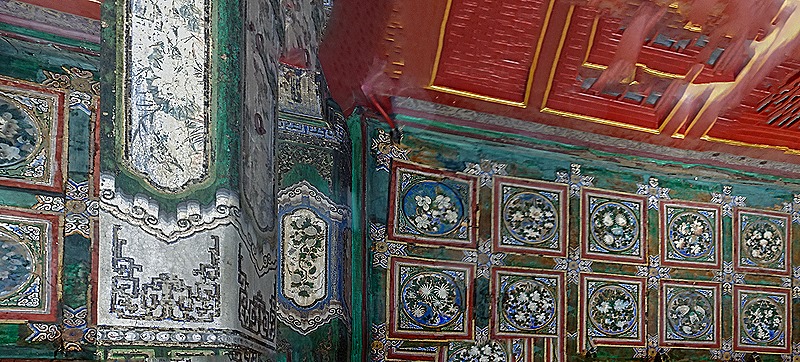
We walked further back, along a corridor between the walls enclosing the inner court on one side and the western palaces on the other. We passed gates in the wall that led to the western palaces, but we didn’t have time to go in. Several walls in this area sported glazed decorations that were quite nice. We also had a chance to rest and listen to our guide explain what we were seeing.
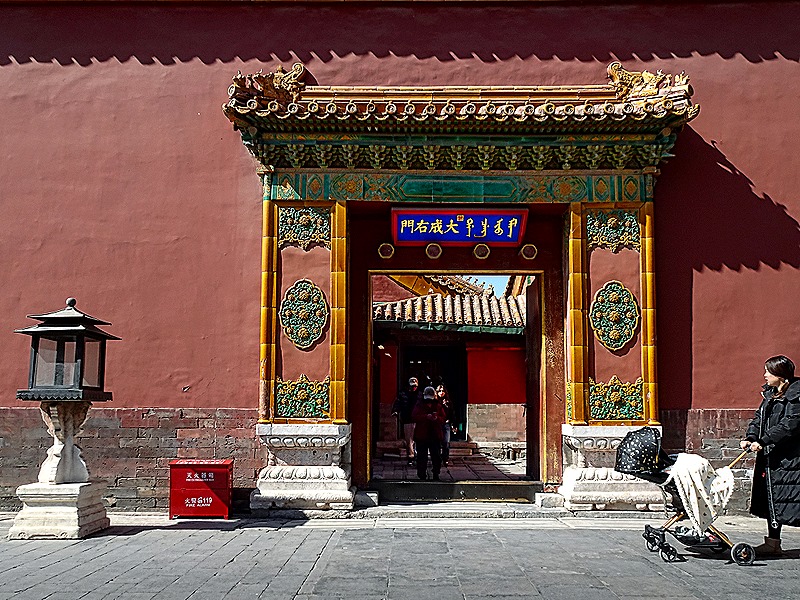


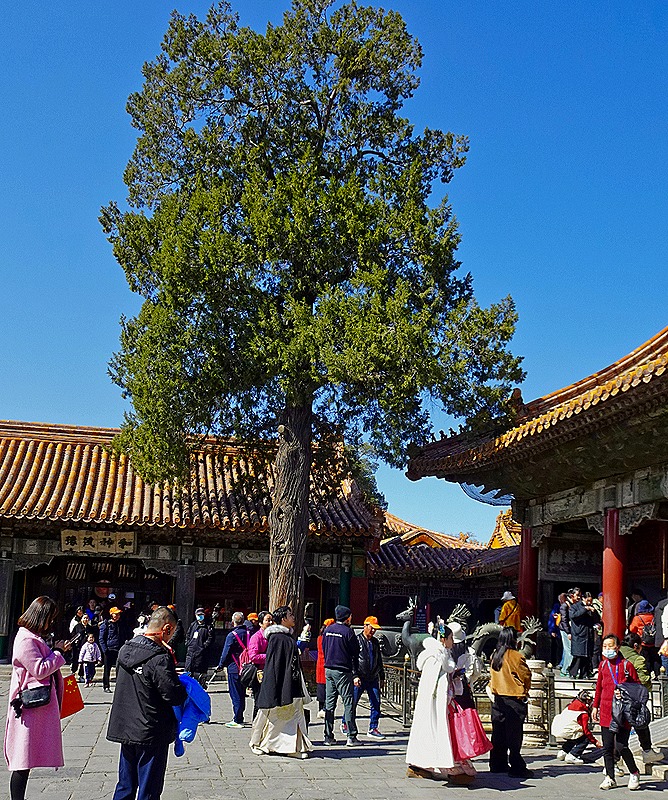
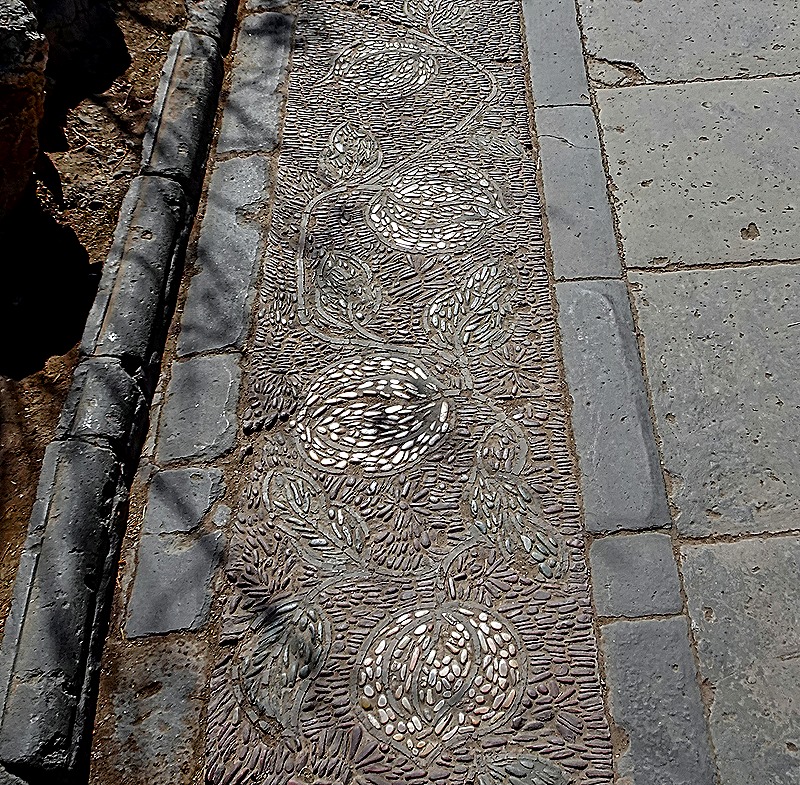
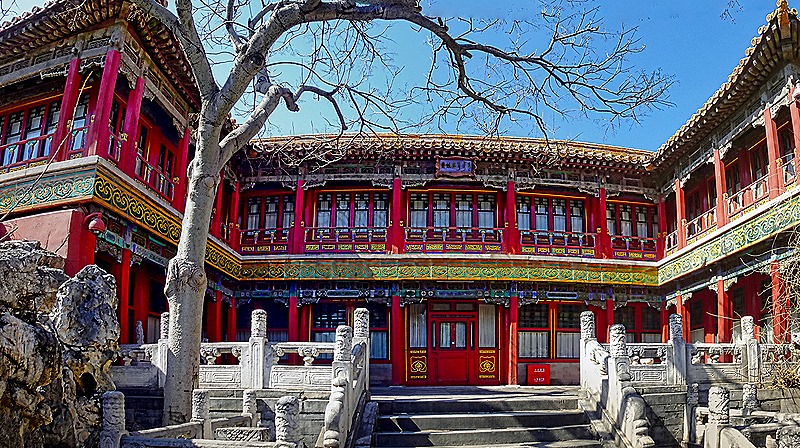
The last area inside the Forbidden City is the Imperial gardens. It has several pavilions, rock gardens and imposing trees, some we were told are well over a century old. Living quarters for the Emperor’s concubines and offspring were also located in this area. Many of the garden paths had stone mosaic designs.





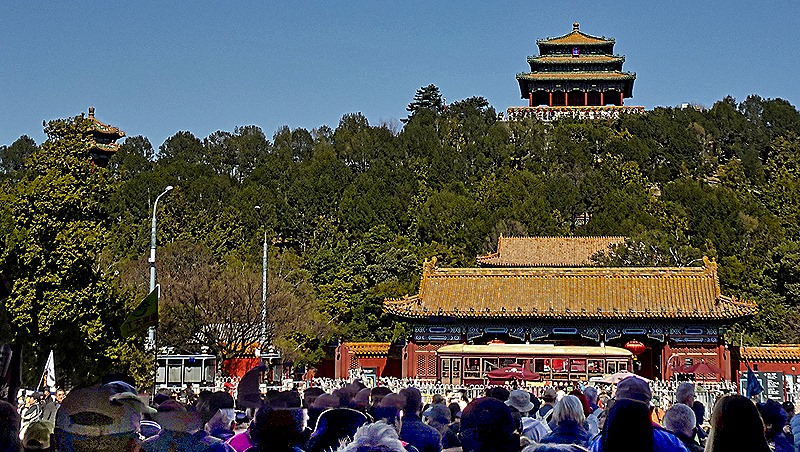
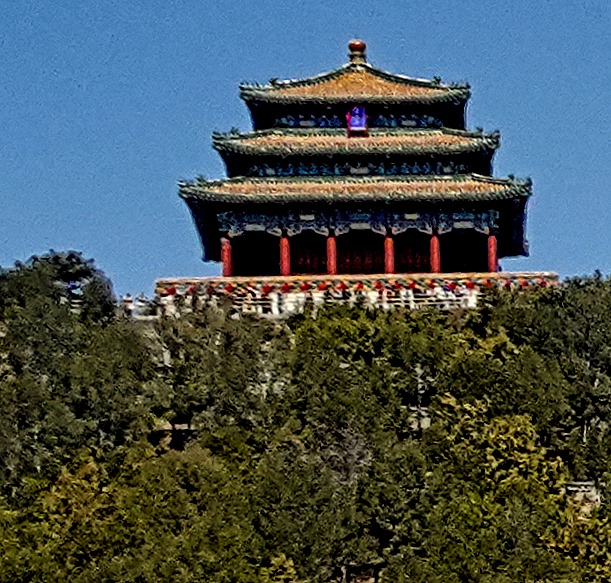
We left the Forbidden City through the Gate of Divine Might opening on a view of Jingshan Park across the street. What you see is an artificial hill (considered the highest point in Beijing) built in 1751 from soil excavated when digging the moats and canals in the Forbidden City. It was originally a private domain for the imperial family but was opened to the public in 1928. At the top of the hill, above the entry gate across the street from us, is the Wanchun Pavilion which sits on the central of five summits on the hill. To its left on another summit is Guanmiao Pavilion, which we were able to see over the roofs of the last part of the Forbidden City. From the Wanchun Pavilion on a clear day one has a panoramic view over the rooftops of the entire Forbidden City, but we didn’t have time to climb the hill to see that.

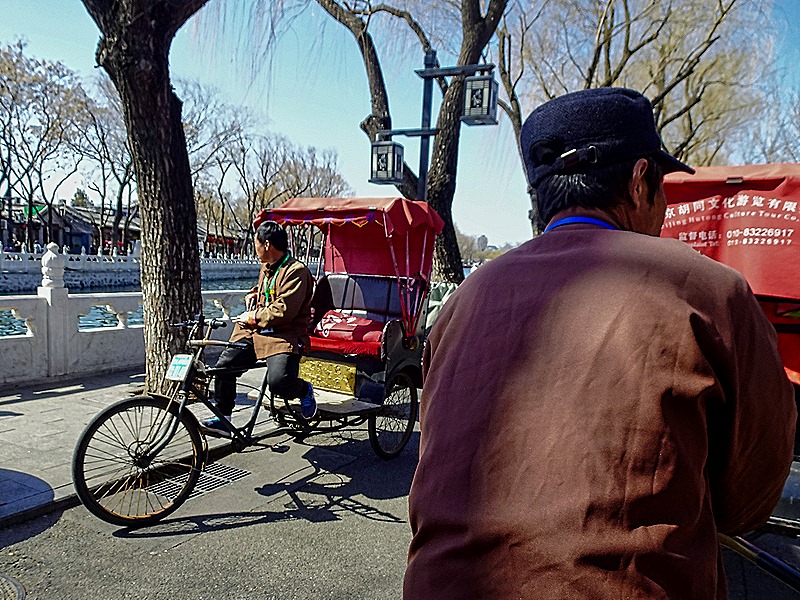
So that seemed like a pretty full day, right? It did to us. But no! There was more to come. We boarded the bus to drive to the nearby neighborhood where we would board bicycle rickshaws (pedicabs) for a driving tour of Beijing’s hutong neighborhoods. Hutongs are old Beijing neighborhoods, some up to 800 years old, populated by connected one story houses, each with a courtyard in the center. Most are built of gray brick and many of those left are hundreds of years old and lack plumbing and individual bathrooms. A courtyard house is called a Siheyuan, and a street or neighborhood of connected Siheyuan is called a Hutong. The Forbidden City was, in imperial times, surrounded by hutongs, with wealthier people living in more elaborate houses closer to the Forbidden City and less important and wealthy people living in more modest houses further out. In the mid 20th century there were thousands of hutongs in the area of Beijing surrounding the Forbidden City, but beginning in the 1990’s a majority of them have been destroyed to make way for high rise apartments and office buildings. Today there is a movement, supported by the government according to our guide, to preserve those that are left as a cultural treasure, although she also told us that many current residents are unhappy about restrictions on selling their property to developers for what can be a huge profit. We were very happy that they were still there when we visited.

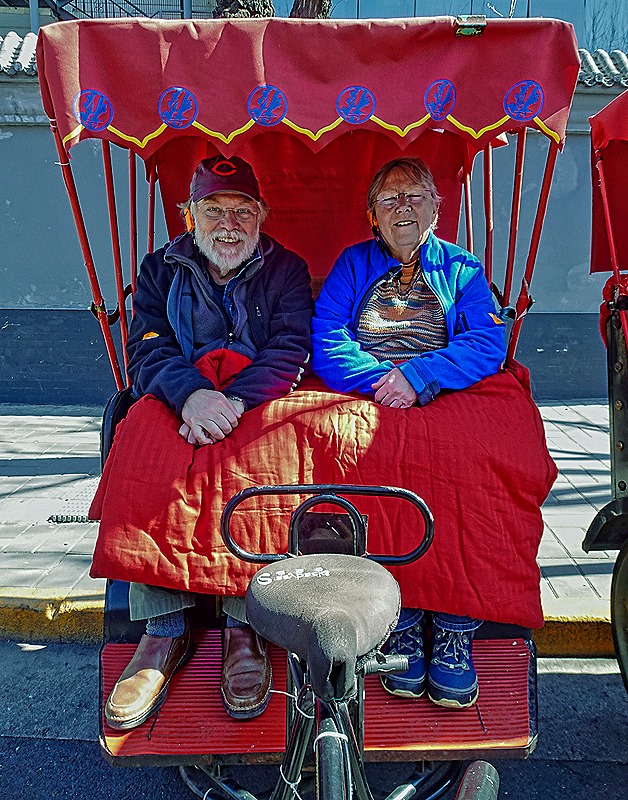
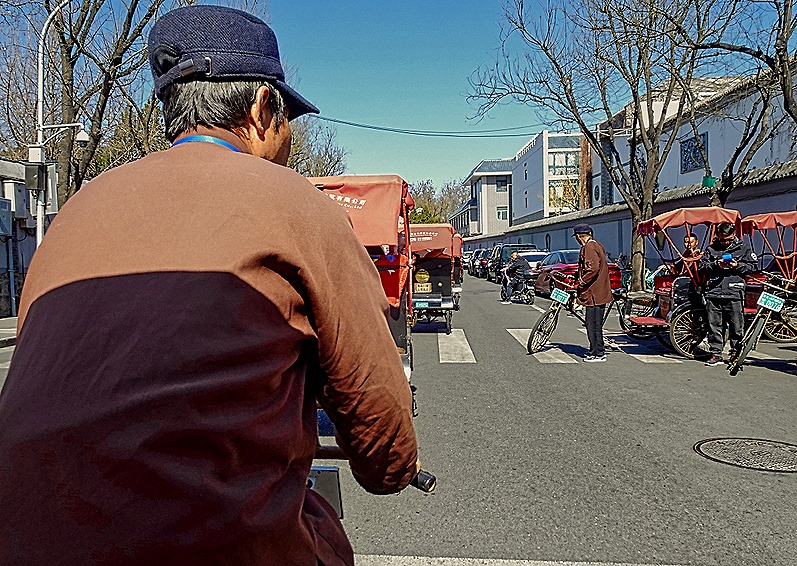
We saw several two story buildings lining the roads, mostly stores it seemed. We have read that the old Siheyuan are almost all single story buildings and the two story emulations have been built in recent years, many for commercial uses.


We can’t tell you which hutongs we visited but most of them were lined with what seemed like continuous gray walls with periodic openings or doors, mostly red. We understand that these are very tight communities (after all, most people living in them meet at the public bathrooms), with much visiting, conversation and game playing. Some are very narrow and some very wide . . . from a couple of feet to perhaps 100 feet in width.
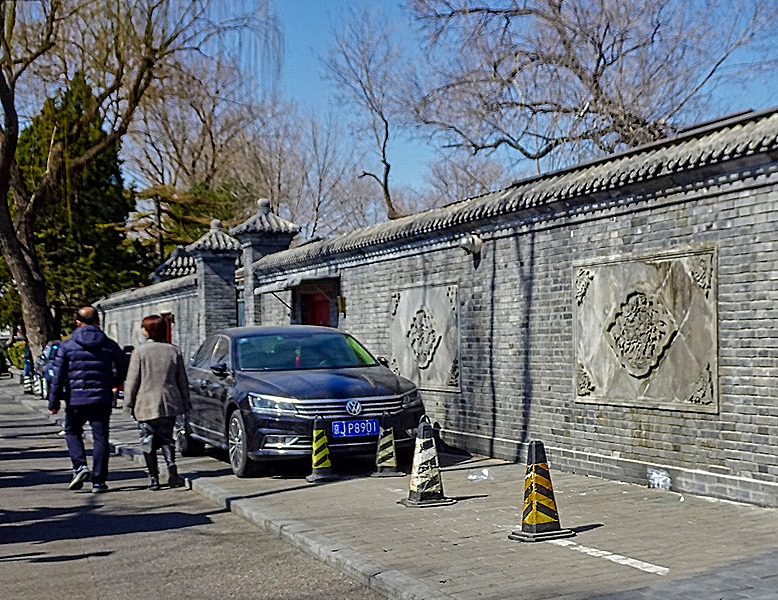

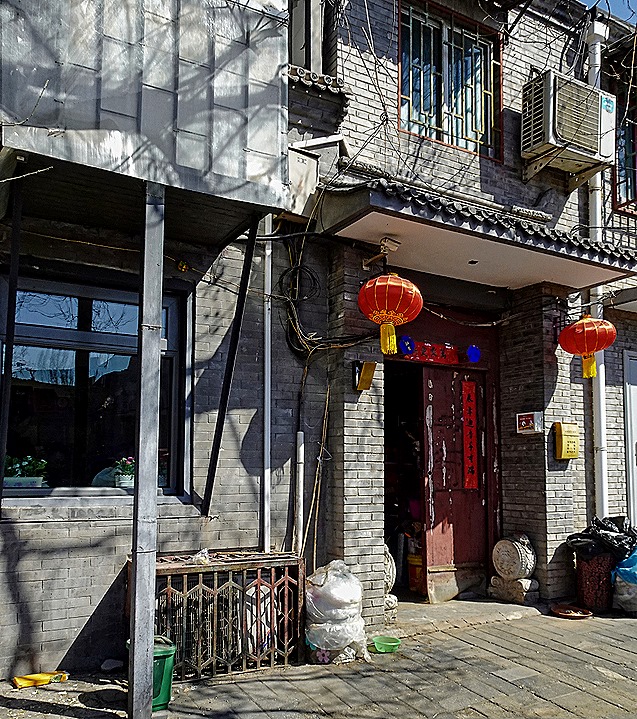

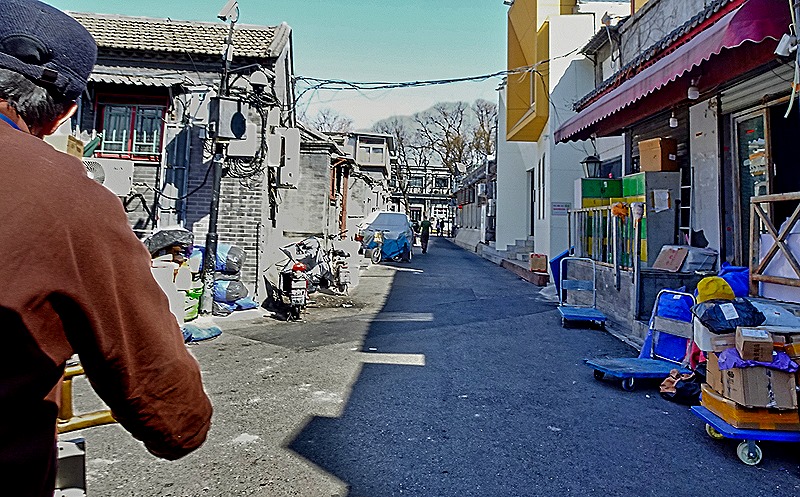
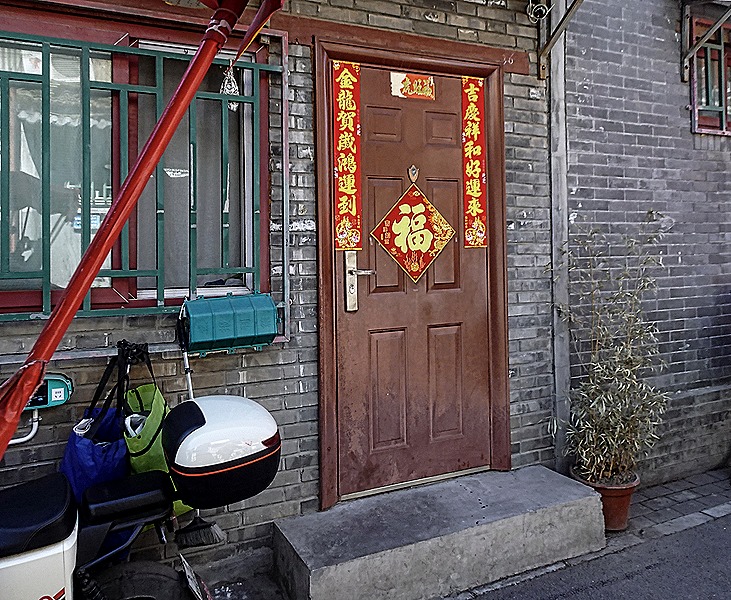
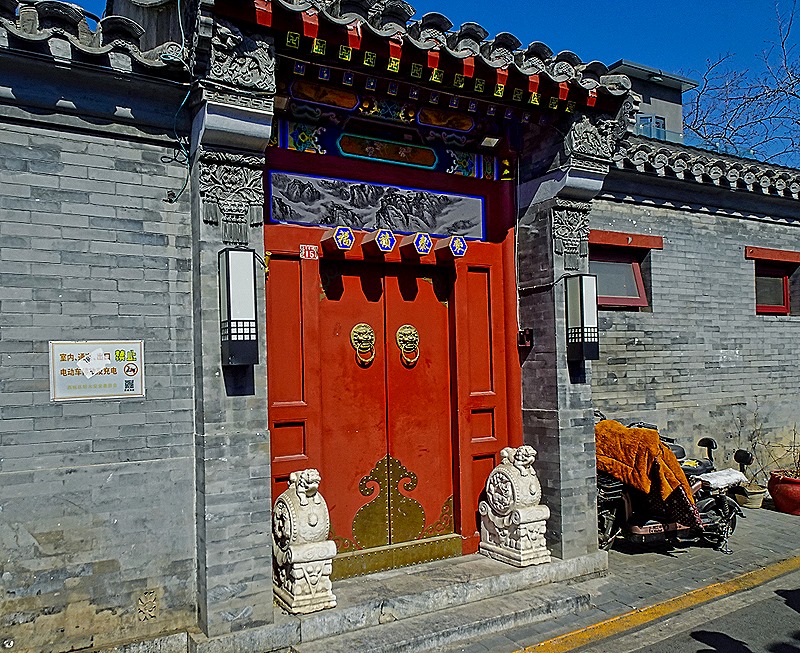
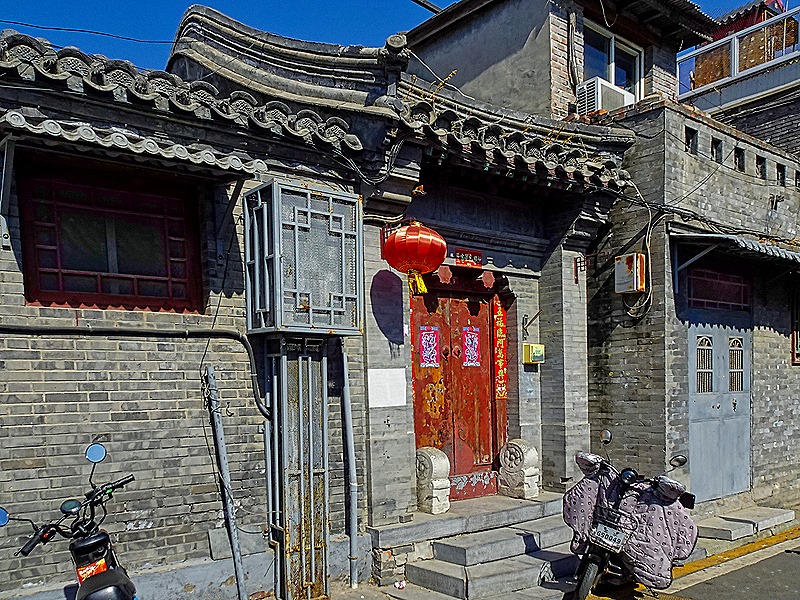

Rather than tear them down, the government has encouraged the conversion of some buildings in this area into restaurants, bars and stores. Not all of these are old single story hutong houses, but they are still part of the neighborhood.



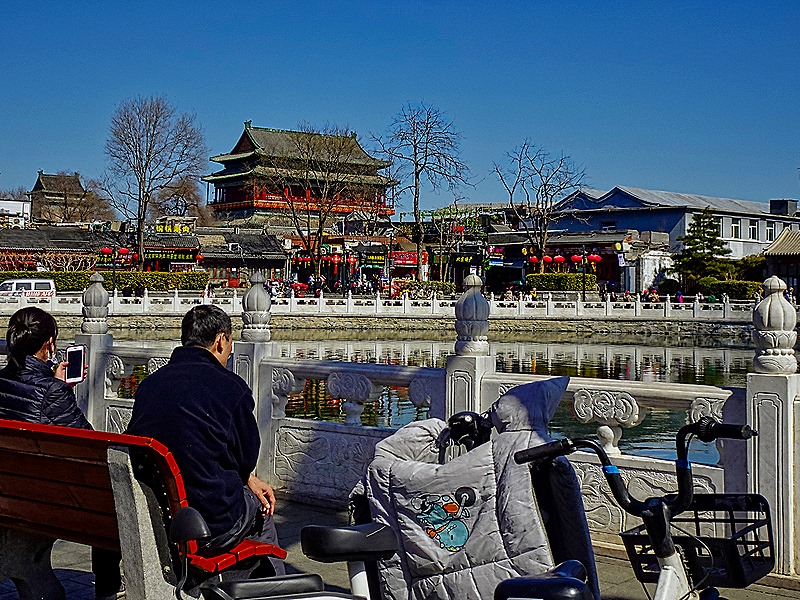
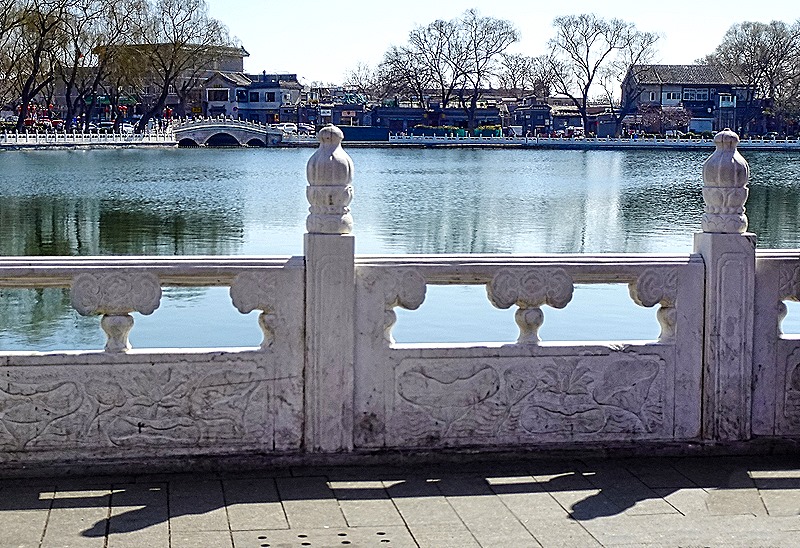
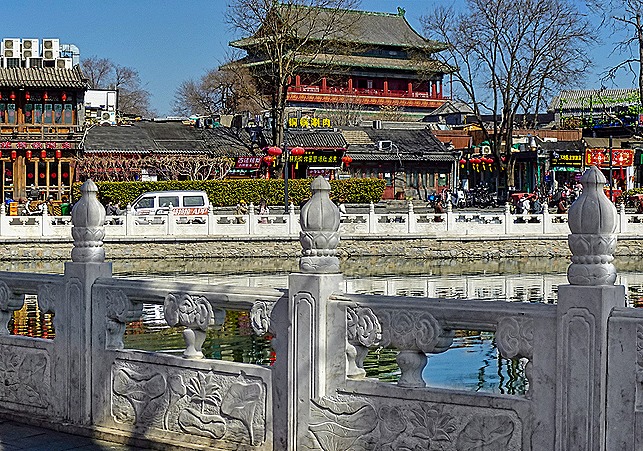
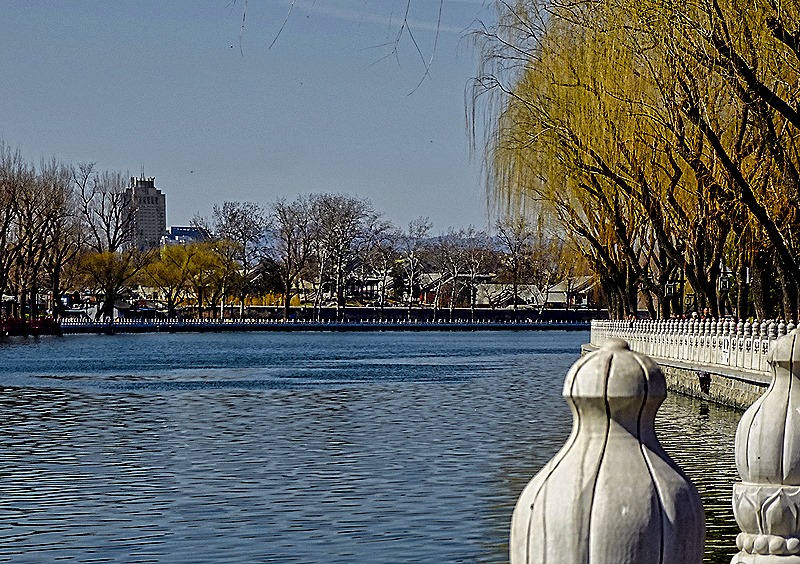
Our ride took us along Shichahai Lake. In the 13th and 14th centuries this was the northern terminus of the Grand Canal (discussed in our visit to Suzhou: https://baderjournal.com/2024/08/26/shanghai-china-day-2-suzhou-2024/) and was then a bustling commercial area. After the canal was extended to other destinations it became a noted scenic area, the largest body of water in Beijing and lined with green trees. We noticed that it is also lined with stone walls that look very similar to the ones lining the Golden Water channel running through the Forbidden City and wonder if the two are connected. Today the area is becoming a mecca for popular bars and restaurants. On the day we visited the water was still and reflective.

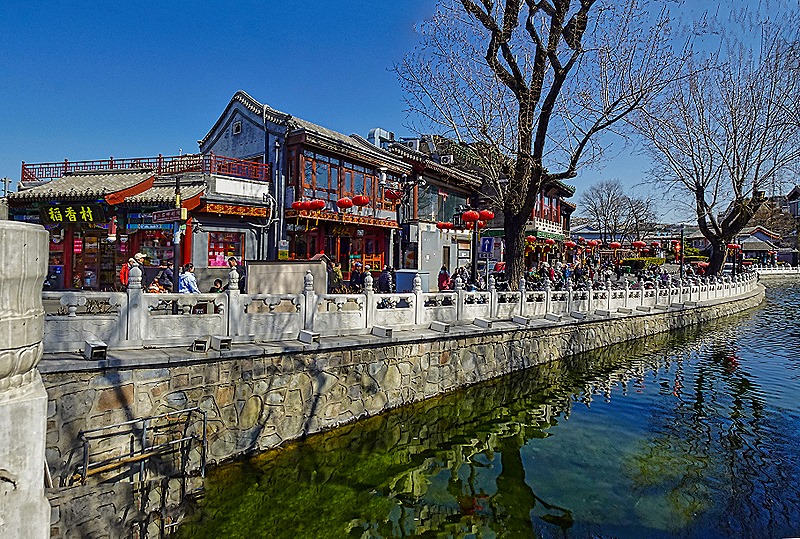

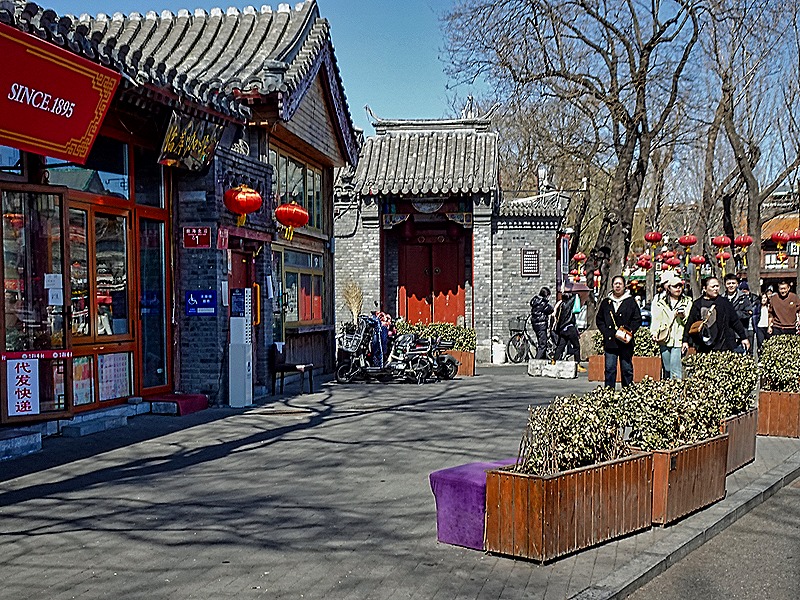
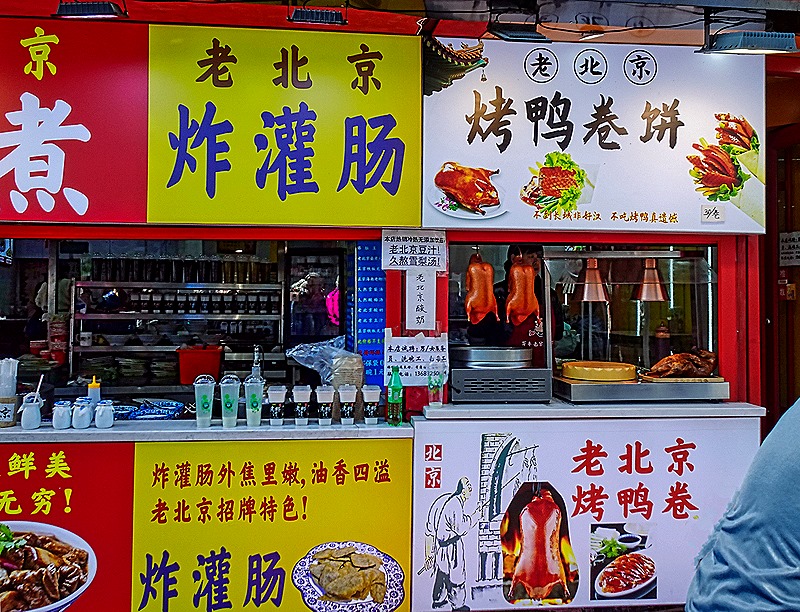
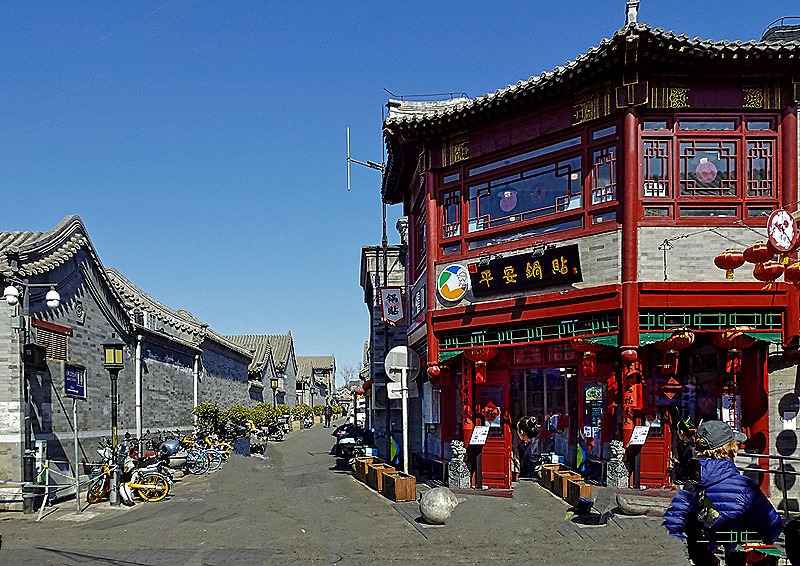
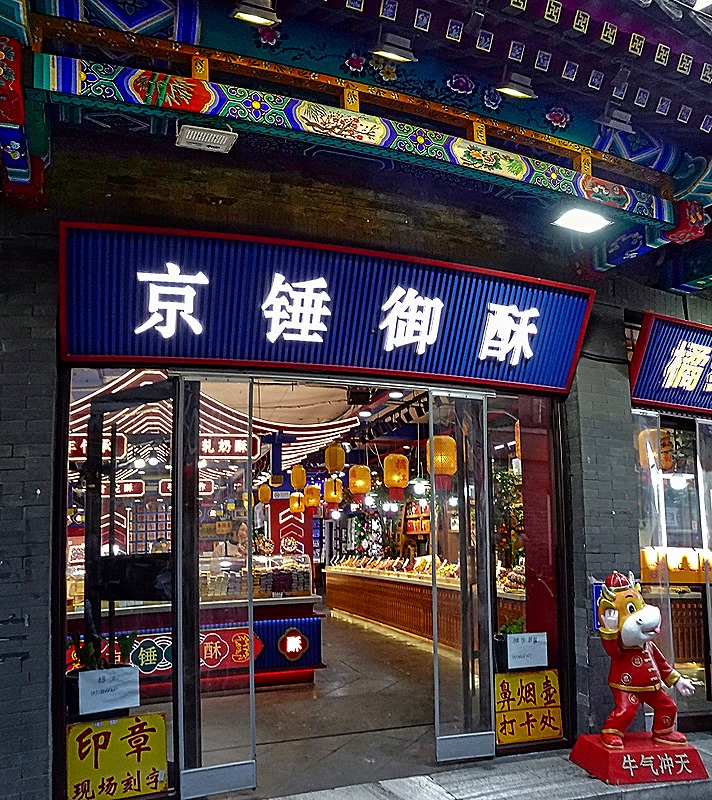
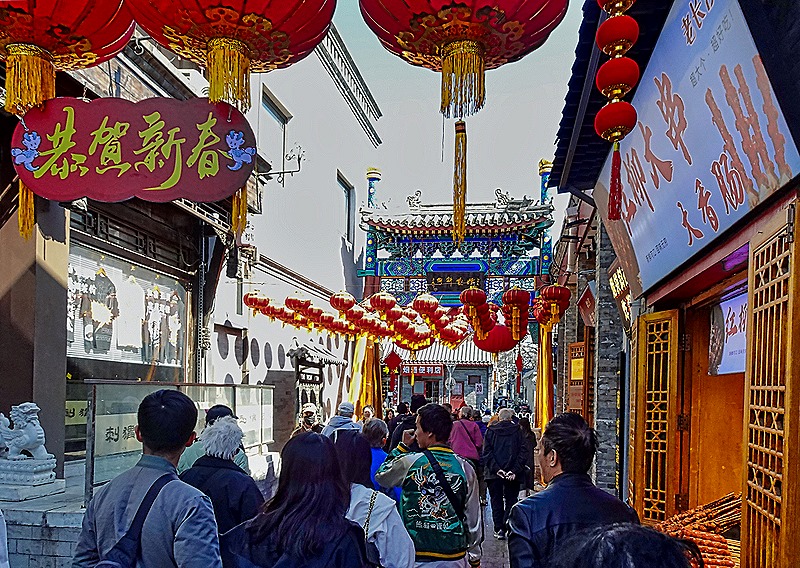
Leaving the rickshaws we had to walk back to meet the bus. Among other things, we walked down Yandaixie Street (we think). Before World War II this street was known for antiques, then in the 1950’s much of it was converted to residences. Beginning in 2007 it has been redeveloped to revive its historical appearance. This is a fairly narrow stone paved pedestrian street and many clothing, craft, pottery and souvenir stores have relocated here, along with various bars and restaurants. As we walked down the street toward a large arch at the end, festive red lanterns were strung over our heads. At one point we walked past a store advertising antiques and when one person asked about it our guide quipped “Yes, we have several antiques factories in Beijing.”


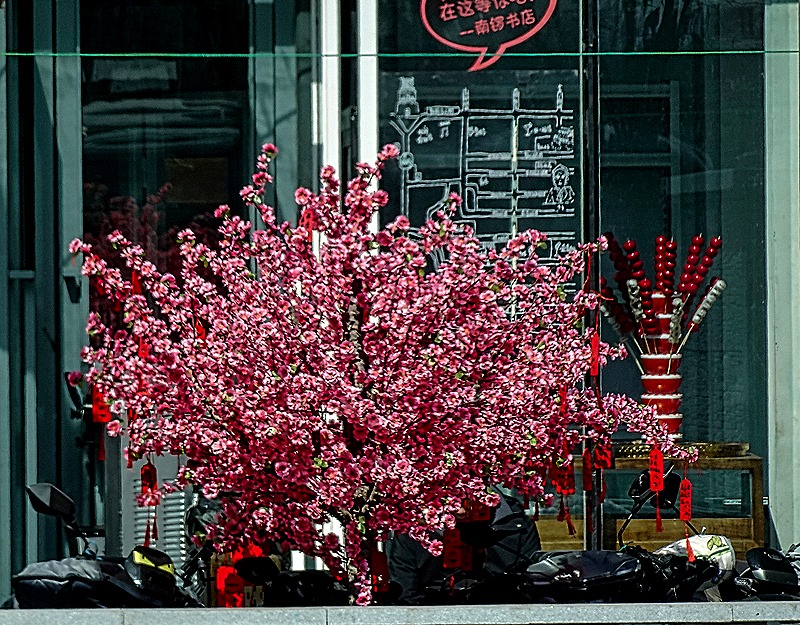

After all that we finally stopped for lunch in a restaurant serving good Chinese food. It was a bit of a rush, though, because our group was being divided here with some folks heading to the airport to begin a longer trip for several more days in China while the rest of us headed back to the port. On the way out of town we passed a guard tower on top of what we were told is a remnant of the ancient Beijing city walls. It was another very long drive and we were glad to get back on board the ship after such a full day. So ends our first visit to mainland China, where we felt we saw quite a lot but there is still much more to see if we ever get the chance.


 BADER JOURNAL





Leave a comment