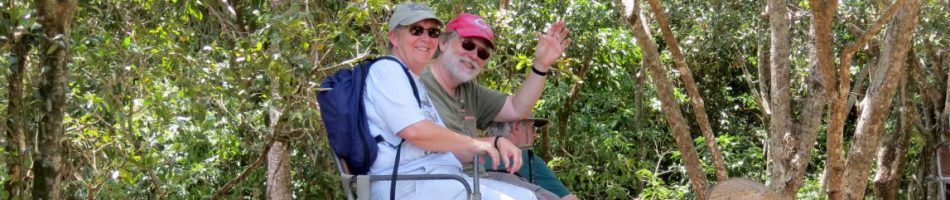
Port Said & Cairo, Egypt
On April 8 we docked in Port Said, a city at the Mediterranean entrance to the Suez Canal. Port Said was built in the 19th century to house the workers and administrators who built the canal, so there is nothing very old there. You may have read about this city over the last 6 months, during which it has witnessed a number of demonstrations that have resulted in dozens of deaths. The trouble started with a riot at a soccer match in which a number of people died. Then a couple of dozen people were sentenced to death for their roles in those riots, which stimulated demonstrations that turned violent. More people were killed during the demonstrations, and more people have been given death sentences. So Port Said has been very volatile and we were pretty convinced we wouldn’t make this stop. But we did, and we learned later that ours was the first cruise ship to stop here since January.
Well, there is little to see in Port Said (and Holland America was urging passengers not to go into town by themselves), so we opted for an excursion to Cairo to see the Pyramids & have lunch on a boat in the Nile river. It was another long & exhausting day (about 12 hours altogether, 3.5 hours each way on the bus) but well worth it. All the buses going to Cairo went together in a convoy, with police accompaniment (men with guns in each bus & trucks carrying men with rifles driving along side). Police protection of tourist groups has been standard in Egypt for some time (their police have a special tourist division), since an incident in the 90’s when several dozen foreign tourists were killed by terrorists. As we drove out of Port Said we passed soldiers & tanks posted at intersections, presumably to discourage any more violent demonstrations (or probably any demonstrations period).


We drove south parallel to the canal to Ismailiya (another city that has had a lot of unrest), then west to Cairo. Along the canal we saw villages, vendors & irrigation canals, of which there is a sophisticated system.
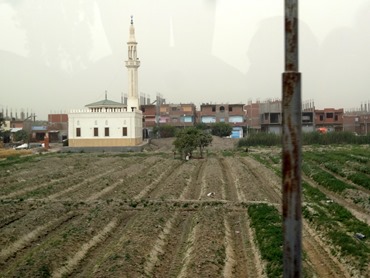


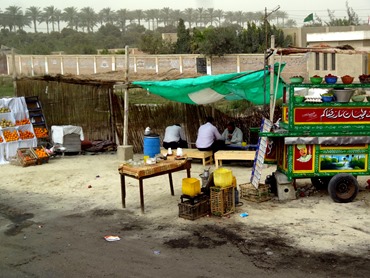
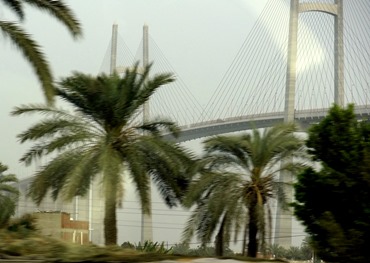
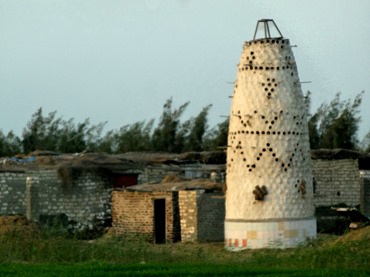
We passed the “peace bridge” (I think that’s what the guide called it) that connects most of Egypt with the Sinai Peninsula, which was financed jointly with Japan. Also interesting were the large pigeon roosts that resembled giant beehives that are kept by many farmers in this area. The Egyptians eat the pigeons (called “squab” when they appear on your plate) and they also use the pigeon guano that collects inside for fertilizer.
As I said, we were traveling on a road that paralleled the canal just a few hundred yards away, with farms and fields between. Occasionally we saw ships traversing the canal that looked like they were going through the fields because we could not actually see the canal from our vantage point. Because the land is so flat & the water levels in the Red Sea & the Mediterranean are within about 5 feet of each other, the French were able to build the Suez Canal without any locks. This made it easy for sea life in the Red Sea to migrate into the Mediterranean & thereby changed the ecology of the region. The canal is not very wide, so ships convoy south in the morning & north in the afternoon.


From Ismailiya we turned west, and the land very quickly turned to desert. More than 90% of Egypt is desert like this. We were told that the Egyptian desert is so dry (less than 2” of rain per year) that even cactus doesn’t grow in most of it.
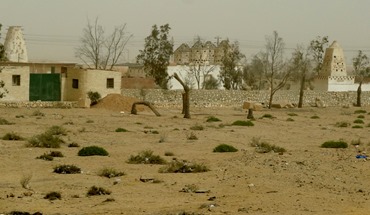
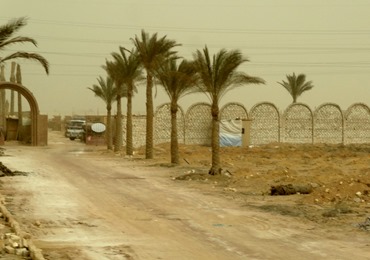

The population of Egypt has increased by several times over the last few decades, with the result that housing has become scarce & very expensive in the city. So in recent years housing developments have been going up in the desert outside Cairo, where middle class people can now afford more than a small apartment. We were told that Cairo is now the 3rd largest city in the world with some 20 million people.


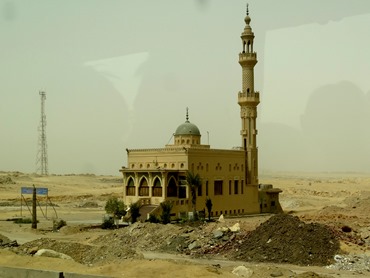
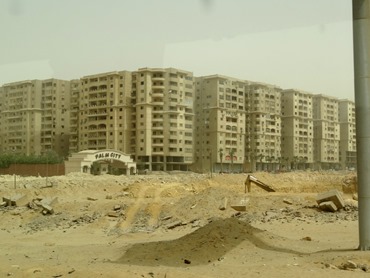
Ironically, there was a huge housing bubble in Cairo when everyone was building housing projects (that look pretty much like slums) for the expanding population with the result that it was overbuilt & contractors just stopped work in the middle of their projects. Cairo now has a large number of incomplete buildings that are nothing more than eyesores. Traditionally there has been another kind of uncompleted building, in which a family would live on one or two floors, then when the children grew up they would add floors above for their families. At one time leaving rebars sticking up from your house gave you a tax advantage because such uncompleted buildings were not subject to property tax (we saw this in Peru last year as well), but the government got wise to this & now property taxes apply once electrical service is added to a building. You will notice that these buildings all look pretty much alike, and there are huge swaths of them in the eastern part of Cairo through which we passed.


So now we came to Giza, where the Great Pyramids are. When they were built the Pyramids were on the west bank of the Nile, the opposite side from the city of Memphis. This was because the Egyptians believed that the sun died every night and was reborn in the morning, so the direction of the sunset was the place for death. For many years Giza was in the desert isolated from the city of Cairo but the city has expanded in recent years to the point where our first view of the Pyramids was while passing through nearby residential neighborhoods.


There are three large pyramids at Giza. The great pyramid of Khufu (called Cheops by the Greeks) was the largest structure in the world for many centuries and is the only one of the 7 wonders of the ancient world still standing. His son, Khafre (Khephren to the Greeks), built the second pyramid, which is smaller than Khufu’s but looks bigger because it is situated on higher land. It still has some of the outer facing of smooth stone at the top which once covered all of these pyramids but was apparently carted away at some point to build newer buildings (this is a common fate for ancient buildings in this part of the world). The third pyramid is a good bit smaller than the other two (but still pretty big). The engineering of these buildings is quite extraordinary for their time; for example, the sides of the Great Pyramid are equal in length to a tolerance of 4 centimeters!


Of course the visitor spots at the Pyramids are loaded with vendors & camel men. We were warned that they are basically crooks. One favorite ploy is to agree to let a tourist get up on a camel for a picture for a couple of dollars or a short ride for 5 dollars, then demand $50 or $100 to let them down. If you refuse they may lead the camel out into the desert where you are totally defenseless. This actually happened to a couple of men on our tour; one of them was able to negotiate the dismount price down to $5 from $100, which he paid. The other one got off (since he was back in the bus) but I don’t know how. They all crowd around you, demanding that you buy some piece of junk, or asking you to take a picture with them (after which, we were warned, they would demand compensation). It was irritating constantly having to argue with these guys (they were all guys) when you only have a short time to see the Pyramids.


So then we moved to a spot where we had a little time to get up close & personal with a pyramid. We chose Khephren’s pyramid because it was a shorter walk & looked most interesting with the stone facing still on the top part. Some of the characters in Agatha Christie’s Death On The Nile climb to the top of a pyramid, but that is not allowed any more. There is one place at Khephren’s pyramid, however, where you can climb up a couple of levels, so I did. The stones are about 4 feet high, so you have to climb just with your arms. Not easy for an old guy, but your intrepid adventurer managed it. Mark Twain says that he paid three locals to help him climb to the top of a pyramid: two of thm would pull his arms from above while the third pushed from below. He also said one of them ran down the pyramid, up another one, then back in 5 minutes on a bet, then did it again. The first story might be true, but believe me the second one is not possible!


Nearby was the Great Pyramid. You could see Cairo in the distance (Giza is high ground). Near one of the great pyramids there were three much smaller pyramids for (you guessed it) the wives. We were told that there are more than 400 pyramids in Egypt, although none of the others are this big.


Modern scholars have concluded that, contrary to popular belief, the pyramids were built by skilled volunteers rather than slaves (and certainly not by the Israelites, who came to Egypt long after they were built). Recently uncovered are a necropolis nearby for people who helped build the pyramids and a town for workers. I’m not sure whether these pictures are of those excavations or something else on the site, but for what its worth I’m including them.


Next we visited the Great Sphinx. A sphinx has the head of a man and the body of a lion, which symbolizes a combination of wisdom & strength. There are a lot of sphinxes in Egypt, but not like this one. It is not only huge but impossibly old (some think it predates the pyramids). For many centuries it was covered by sand. Originally it would have had a beard, & there is a legend (which our guide said is not true) that its nose was blown off by Napoleon’s troops taking artillery practice. Mark Twain said he saw a tourist climb out to the head of the Sphinx with a hammer & chisel to obtain a souvenir (his travelling companions seem to have taken pieces of most of the interesting sites they visited), but he was unable to chip off a piece, thus emphasizing how much this statue has survived over the centuries. Anyway, its really is interesting, and its almost impossible to take a bad picture of it, so I will burden you with several of our better ones, from all angles.


After an all too brief visit to Giza we drove to the Nile for our lunch cruise on the river. This turned out to be a very short trip up and back on a relatively uninteresting stretch of the river, on a boat full of hokey ancient Egyptian style decorations, with a buffet meal that couldn’t hold a candle to the one in Alexandria the day before. If we don’t look particularly happy in these pictures, that is why (plus the fact that we spent more time in a gift shop than we did at the Sphinx).


Notice the super tall palm tree on the side of the Nile in the next picture. Its not real: its a cell phone tower. These were all over town.


The lunch boat also provided entertainment. First a belly dancer, then a guy with a colorful getup who performed a whirling dance. He was not a whirling dervish, because they dress in white and their dance is a religious rite, while this guy was very much an entertainer. The belly dancer later posed for pictures behind diners & they tried unsuccessfully to sell those pictures to the diners.


After lunch we began the long drive back to Port Said, again in convoy with the other buses & police escort. Passing through Cairo we saw colorful fruit stands, folks sitting in cafes and a surprising variety of animals right in the city.


One thing I should mention before leaving Egypt is the way Egyptians dress. Many men (though far from a majority) dress in long robes called galabiyyas, like the shepherd above is wearing, though often in darker colors and sometimes with a small hat. We were told that, although it looks hot to us, this is actually a time tested method of keeping relatively cool. Most women wear scarves on their heads, although our guide in Alexandria told us that this is more fashion than religion. She said if she were in the United States she wouldn’t wear one; she probably doesn’t know that such scarves are now fairly common in large American cities. She told us that young women color coordinate their scarves with their more western looking clothing, and after she said that I noticed this quite a lot. So, while I’m not sure that I am entirely buying the idea that this is nothing more than fashion, I am sure it is true for many women.


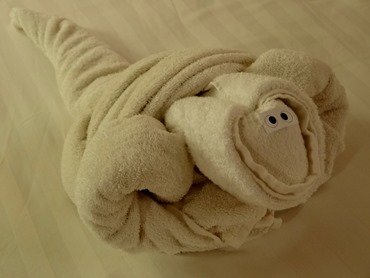
So, after the long drive your exhausted travelers arrived back at the ship. As I mentioned at the beginning, this was the first cruise ship in Port Said since January, and people were genuinely happy to see us. Many waved & smiled at us in the bus, and at no time in Egypt did we see any sign of hostility (although folks on a different tour in Alexandria said they did – must be something about them, I’m sure). The Egyptian economy is very dependent upon tourism (it is their fourth leading industry), and they are anxious that the news focus on the unrest in the country not discourage people from visiting. Anyway, our visit was enough of an occasion that there were bands there to serenade us upon arrival and before departure. But before the ship left for Israel, we had a new towel animal to accompany us.

Alexandria, Egypt
We arrived in Alexandria early on the morning of April 7. Alexandria was founded by (surprise!) Alexander the Great. It is thought that he was buried here, but archeologists have so far not been able to discover his tomb. Sounds like a job for Indiana Jones! As you may know, Alexander assigned provinces of his empire to his leading generals, & Egypt was assigned to a general named Ptolomy. The Ptolomy dynasty ruled Egypt from Alexander’s death in the last third of the 4th Century BC until it was incorporated into the Roman Empire by Augustus Caesar after he defeated Antony & Cleopatra at the battle of Action. Alexandria was one of the premiere cities of the Hellenistic world, unusually rich & cosmopolitan in its population. It had important Jewish & early Christian communities & its library was renowned as the greatest center of learning in the ancient world.
We considered it something of a triumph that we even got here, since we have been somewhat worried that all the political trouble in Egypt & Israel lately would convince Holland America to skip some or all of these ports. We actually heard a rumor after we finished all four of these ports (yes! we got to all of them) that Holland America had anticipated that we would need to cancel these stops & had made contingency plans to spend a few days in the Black Sea instead (I have no idea whether this is true; there are a lot of rumors on cruise ships). Anyway, we were very glad to get here. This was the first of four long and exhausting tour days in a row. Many passengers went to Cairo on this stop to see the Pyramids, etc., but we really wanted to see Alexandria. So, since this is a notoriously difficult city to get around on your own, we signed up for a 12 hour tour (the only one offered that visited all the places we wanted to see).
Alexandria is a city of contrasts. It has some beautiful older buildings & homes, but it also has many slums. Although it has a reputation as a sophisticated & cosmopolitan city, many of the streets are littered with trash (sometimes in huge piles). We were told that since the overthrow of the Mubarak regime two years ago the garbage men have not been paid regularly & that is why Alexandria (& Cairo & Port Said as well) is not clean. Our Alexandria guide, a young woman who has little sympathy for the Muslim Brotherhood or the Morsi government, told us that her monthly utility charge suddenly went up substantially and when she inquired about it she was told it was for trash collection, even though she still has to dispose of her own trash. As you can see, many people hang their laundry on the apartment balcony to dry; we saw this all over Alexandria & Cairo.


We also saw lots of men sitting around in cafe’s talking, drinking & smoking from large hookahs. It was Sunday, but we understand it is a common sight on any day, and we saw this in Cairo on Monday as well. If so, I don’t know how it fits in with working; maybe their wives do the working or maybe work days commonly include time for this. The hookahs are provided by the cafes (for a price) & we were told they burn a combination of tobacco, straw & molasses. This is common in Turkey as well as Egypt.


The first place we visited in Alexandria was the Catacombs. We walked down a lengthy circular staircase(original) in the ground to reach a level full of crypts (mostly holes in the wall; the bodies have long since disintegrated from moisture). There were some impressive reliefs & paintings from a couple of thousand years ago & a dining hall where friends & families bid farewell to their loved ones with a celebration of their virtues. I would show you pictures, but they don’t allow cameras inside. If you google “Alexandria catacombs” though, you should be able to find some.
Anyway, these catacombs had long been forgotten & were unknown when in 1900 a donkey fell through the ground into an underground chamber. They have been excavating ever since, but it is believed that most of the catacombs have yet to be uncovered.


I was able to get some pictures of interesting old stone works that lie around the catacomb grounds, but we were told that these were all brought here from other sites, not out of the catacombs.


Next we went to the site of Pompey’s Pillar. In fact this pillar had nothing to do with Pompey; it was built by the Emperor Diocletian and originally had a statue of him on top. I have read that the Crusaders mistakenly called it Pompey’s Pillar, and our guide said it was someone else (can’t remember who). The Roman general Pompey’s primary association with Alexandria is that he was murdered here by Cleopatra’s brother. There are sphinxes (man’s head on lion’s body) on either side of the pillar.


This pillar is unusual in that it is made of a single piece of stone, whereas most pillars are made of disk-like pieces stacked on top of each other. We were told that the pillar was made at the quarry near Luxor (I think) & then floated down the Nile. At that time there was a canal from the river to this hill, which was essentially the center of town. Also associated with that canal was the “Nile-ometer,” which measured the depth of the river by the waterline on a stairstep construction that has been excavated near the pillar. A lot of excavation was being done around this site & there were a number of large artifacts on display.


We next visited the Roman Theater of Alexandria. There was a lot to see here, and it is a very active ongoing excavation site. It seems that most of ancient Alexandria is under modern Alexandria, and so it isn’t available to archeologists. So the sites that are available are very active. This is another site near the center of ancient Alexandria. There was quite a lot to see beyond the theater, which is in remarkably good shape. On the hill above the theater a lot of artifacts were displayed, including a stone from the ancient Pharos Lighthouse (one of the 7 wonders of the ancient world) & some artifacts recovered from under the harbor, where a good part of ancient Alexandria lies. There is a plan eventually to either create a glass underwater museum for these extensive ruins, which include a good bit of the lighthouse, or to use glass-bottom boats for visitors to see them. Even today you can scuba dive among these ruins, if you are into that sort of thing.


The theater had interestingly carved pillars (or at least the remains of pillars) & sidewalk mosaics (the great granddaddies of those we have seen in Brazil, Madeira & Spain).


In addition to the theater, a Roman bathhouse & a philosophy school have been unearthed on this site. I’m not sure how they know it was a philosophy school, as opposed to, for example, computer engineering.


We next visited the Alexandria National Museum, which had a relatively small but very interesting collection of Egyptian antiquities. We saw a mummy in its case (built like a Russian doll, with one coffin inside a second inside a third) & a large head of Akhenaton (the pharaoh who adopted monotheism & was largely wiped from the records after he died and the old religion returned). There were some large sculptures of family groups (with the woman’s hand around the man’s shoulder to show that she was his support) & a lot of other interesting stuff. Unfortunately, this was another place where cameras were not allowed, so I can’t show you any of this. However, cameras could be used outside & the museum building itself is an interesting old villa for a wealthy family; this is the house in which Omar Sharif grew up. There were some unidentified artifacts on the grounds outside as well.


We had lunch at a very good restaurant on the Corniche, which is the curved promenade that runs for miles along the Alexandria waterfront. It is a fashionable area with many apartment buildings & hotels & is lined with palm trees. The restaurant served 8 kinds of hummus & other dipping sauces (one very garlicky . . . yum), then a huge plate of several different kinds of kebobs plus a barbecued chicken breast and potatoes, then an array of sweet baklava-type desserts. This was one of the best meals we have had on a shore excursion.


After lunch we paid a quick visit to Fort Quaitbey. It is built on the spot where the Lighthouse once stood, on the island of Pharos just off the Alexandria waterfront. It is connected to the mainland by a causeway built in Alexander’s time. The fort was built by the Turks in 1479, and it reputedly is constructed partly of stones from the old Lighthouse. This is also a good place to show you a few of the ubiquitous vendors who accost you everywhere in Egypt, trying to sell you junk for really low prices (10 postcards for 1 Euro!). Its probably a good deal if you like this stuff, mostly cheap trinkets & jewelry, but also watches and scarves, etc. They can be pretty aggressive & persistent, which is really irritating if you only have a few minutes to visit the site you came to see.


OK, now for all the library fans, this is the Big Kahuna. Alexandria was famed throughout the ancient world for its great library containing, of course, scrolls rather than books. There was a law that any ship docking at Alexandria had to make available for copying any scrolls onboard (sounds like the Library of Congress’s system entitling it to a copy of any book copyrighted in the United States). As a result, it accumulated a repository of much of the scholarly literature from throughout the mediterranean world and made Alexandria a center of intellectual activity. In 48 BC it was partially burned during Julius Ceasar’s invasion and later Mark Antony gave Cleopatra the library of the city of Pergamum to compensate. Some 300 years later the library was completely destroyed by Christian mobs who disapproved of all the “pagan” literature it contained. Only one scroll survived. It is now in Vienna & the Alexandria Library only has a copy of it (but you had to pay extra to see it – for a copy! – so we didn’t).
Anyway, in 2002 Alexandria opened a new great library (sponsored by UNESCO & financed with contributions from many countries) near the spot where the ancient one stood (the actual spot is now probably under water). Called colloquially “BibAlex” (short for Biblioteca Alexandrina), it contains some 8 million volumes, and has the largest indoor reading space in the world. The library is nothing short of spectacular.


The reading room is lit by all the skylights in the tilted oval roof, & there are green & blue lights in the ceiling because these colors are supposed to be conducive for study. Books in all languages are filed together on the shelves (ie. different language copies of a book are shelved together). The library is digitizing its collections, particularly its Egyptian works, & it has a number of museums & display areas for temporary installations. The Alexandria University is next to the library, & students can join for a few dollars a year (its not a free public library; we had to pay to go in). There are also a planetarium & a conference building at the library.


Well, it was a long & exhausting day in Alexandria, but well worth it. It is a fascinating city & would be worth a longer visit. I will leave you with some miscellaneous pictures that are interesting enough to include but don’t fit in anywhere else.


Larnaka, Cyprus
We arrived at Larnaka (also spelled Larnaca) on a beautiful morning on April 5. For the most part this was a fairly nondescript seaport city of about 75,000. The locals have had little interest in preserving its interesting past but have instead preferred to build new & largely uninteresting buildings. It’s too bad we didn’t have this nice of a day in Iraklion.

Before we get into Larnaka, I have to tell you about an incident at dinner during the sea day the night before. We were the first to arrive at our 8 person table for dinner, a formal night (11 nights on the cruise we have to dress for dinner) and immediately noticed that there were wine glasses at each seating. This means that a member of the ship’s staff will be at your table, a welcome occurrence because they are often interesting company, but more importantly because the ship will spring for unlimited wine for everyone at the table. Anyway, the next person to arrive was the ship staff member, a lovely Australian woman named Liza, who turned out to be in charge of acupuncture in the ship’s spa (never having been to the spa we had not met her). We had a full table (which is not usual). Because Liza was sitting next to me we got to talking. She asked where we live, & learning it was near Washington, D.C., she told me she has a niece who lives in Friendship Heights. I told her that we had worked for the federal government & she told me her niece had done so as well up until last year, so I asked what agency. She said it had to do with elections & that her niece had done something involving finances; the only other thing she remembered was that her niece’s boss was a woman. Well, I told her that would be the Federal Election Commission & that this was also the agency where I worked, and I told her a little about Tommie Duncan. She had told me her niece had only been there about 4 years, so I figured I wouldn’t know her since I retired 6 years ago, but on the assumption that some of the FEC people who might be following this blog might know her I asked her name. Her niece’s name is Claire Rajan! You could have knocked me over with a feather (for those of you not familiar with the FEC, Claire was on my staff for the last 2 or 3 years I was at the FEC). Here I was on the other side of the world, with a person from Australia randomly assigned to sit next to me, and the one person out of 300 million Americans to whom she is related worked 4 doors down from me at the FEC. These coincidences never cease to amaze me.
Anyway, I was fully recovered from this by the time we left the ship in Larnaka. A ship shuttle bus took us into town & we began to look for the archeological dig at Kition (I keep confusing this name with Kitymer, where Worf’s parents were killed, if you are familiar with Star Trek). Occupied by Greeks i the 13th Century BC, Kition was colonized by Phoenicians around 800 BC and was an important seaport in the ancient world. The island was a primary source of copper (pretty important in the Bronze Age); in fact, the island’s original name, Kypros, is the source of our word copper. Really, the whole city of Larnaka is built over ancient Kition, so it can’t be excavated (& the British didn’t help by removing much of what remained above ground as “rubble” to fill marshes). But there are a few sites that have been excavated, so we went there. On this walk we saw many beautiful flowers, interesting cacti & lemon & quince trees.


We came first to a spot called the Acropolis of Kition. This spot was fenced & there was no admittance, but it looked interesting with ancient ramps leading up to the top. This may have been the site of the Phoenician port, although it is far from the water today.


The larger site is accessible to visitors. It is a Phoenician settlement built atop a late Bronze Age foundation.

The site contains a large temple, thought to have originally been dedicated to an ancient Cypriot goddess, who was later merged into the Phoenician goddess Astarte. Astarte, in turn, may have been the basis for the Greek goddess Aphrodite, who they myths say was born here. You may recall that Aphrodite was married to the Greek god Hephaestus, who was a metalworker, and there were copper smelting buildings found by this temple. As I mentioned earlier, copper mining & smelting were important industries in Kition. I can’t tell you which rooms are which, but here are a few pictures of the structures at Kition.


After Kition we walked back into town & visited the Pierides Museum. Despite its good reputation, we were disappointed. Lots of small items, some of which may have been interesting or important but you would never know due to lack of explanation. Many items were not identified & those that were had only a useless catalogue-like description you could have written yourself after looking at them (ie. “polished white finish with a handle on the left and a spout on the right”). No pictures were allowed inside. Interestingly, the museum is sponsored by Laiki, the large Cypriot bank that was closed down last week as part of the outrageous European bailout of Cyprus’s banking system, in which money was taken (really stolen) from people’s bank accounts to give to wealthy international lenders. We spoke at some length with a vendor in town, who told us about how she is not permitted (for at least another month) to draw more than $300 Euros or so out of her own bank account, and is therefore unable to pay her bills (including her child’s school tuition) or operate her business properly. Why would anyone put their money in any EU bank after they have demonstrated their willingness to appropriate parts of bank accounts for wealthy international lenders? I sure wouldn’t.


We walked along the seaside promenade to the fort, first built in the Byzantine era and expanded in 1625 by the Ottomans.


Then we visited Agios Lazaros, the church of St. Lazarus. This is the same Lazarus that the New Testament says Jesus raised from the dead after 4 days. It seems that things got pretty hot around Jerusalem for the early Christians, so Lazarus came to Kition and became the first bishop of Cyprus. He lived here for 30 years before he died again, and from all reports this time he stayed dead. This church was erected on what is supposed to have been his burial site, although his relics were stolen and taken to Constantinople, after which they had more adventures. It is, however, a lovely church.


On the evening of April 5 we had Greek food at a special restaurant the ship set up in the Lido for 5 days. We enjoyed hummus, lamb souvlaki & baklava, among other things. Then we went to a classical guitar concert by a guitarist named Carlos Bonell, who studied with John Williams (the guitarist, not the Star Wars composer) & now teaches at the Royal College of Music in London. We were particularly interested to hear him because a few days earlier he had been seated with us at dinner & we had a very enjoyable time with him. Carlos was born in London, but both of his parents were Spanish. He is currently working with Paul McCartney (who can neither read nor write music) in composing a concerto for classical guitar & orchestra. Last year, in honor of the 50th(!) anniversary of the Beatles’ first hit record Carlos arranged 15 late Beatles tunes for classical guitar, which he recorded and played on his “Magical Mystery Guitar Tour.” One of the places he played was the church on Penny Lane where “Sir Paul” (as Carlos calls him) served as a choirboy. He said that standing in front of the church he saw the barbershop & police station mentioned in the song & was struck by how little had changed there in 50 years. To his surprise, the album was number 1 on Itunes for several days. Anyway, his playing was extraordinary, & we went back for his second concert this afternoon (April 6). He played two of his Beatles arrangements, “Classical Gas” by Mason Williams, works by Bach, Villa-Lobos, Albeniz, Vivaldi & Rodrigo (and probably some others I am not remembering).

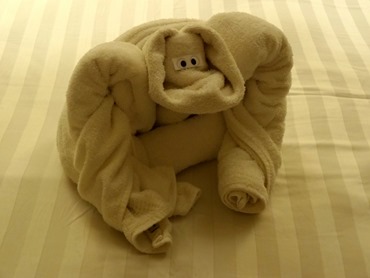
So after that we went to bed, and tomorrow we will be in Alexandria, Egypt. Right now we are told that we expect to make both of our Egyptian stops, but there are demonstrations planned in Port Said day after tomorrow, so we are keeping our fingers crossed that we will be able to dock there & take our scheduled trip to see the Pyramids. Meanwhile, here is some more fruit (& vegetable) art & some towel animals to keep you satisfied until you hear from us again (it could be awhile since we have a lot of long shore excursions coming up).


Iraklion, Crete, Greece

Iraklion (also spelled Heraklion) was named for the Greek hero Hercules. We arrived on the morning of April 3 after a particularly rough day at sea. We had thought that once we left the Atlantic & entered the Mediterranean the seas would be much calmer. But no! This was the roughest day we have had this side of Antarctica. I tried taking some pictures of the ocean, but because they are taken from such a high angle it really doesn’t convey the turbulence. So instead here are a couple of pictures of the aft swimming pool (you have seen this pool in earlier displays of ship turbulence) with the water shooting up as the ship rolls to one side. The pool was almost empty by the time I took these photos; it was even more dramatic earlier when it had more water.


It was a gray & rainy day as we set out from the ship. The two places we wanted most to see here were (1) Knossos, the archeological site of the ancient palace of the legendary King Minos and the habitation of the Minotaur, a mythical half-man half-bull that lived in the labyrinth in the palace’s lower level, & (2) the archeological museum that contains most of what was uncovered at Knossos. We didn’t need an excursion for this (yay!) since Iraklion is relatively small & Knossos is easy to reach by municipal bus.
Knossos was the seat of the Minoan civilization, one of the oldest in Europe. This site was inhabited since Neolithic times (7,000 – 3,000 BC). The first palace here was erected around 1900 BC, and after it was destroyed (probably by an earthquake, the most common cause of destruction in these parts) a larger palace was built on the site, which was destroyed around 1450 BC, which is when the Mycenaean Greeks took over.
Almost as interesting as the palace itself is the controversial story of its modern recovery. The site was discovered in the 1870’s by a local man, but in the 1890’s it was purchased by an English archeologist (who had worked with Schliemann at Troy) named Sir Arthur Evans. He led digs here from 1898 until the 1930’s. Archeology was in its infancy then, & unlike modern archeologists who carefully sift and preserve as much as possible, Evans decided to rebuild the palace as much as possible. This has been done to decent effect elsewhere in more recent times, reassembling the fallen pieces of buildings at ruins according to a broader understanding of what had been there before (we will see some of this, for example, at Ephesus). But Evens built the site according to his own imaginative “interpretation” of the site, and he used liberal amounts of cement, paint & newer stones & mortar to make it look like what he imagined. The result is that today it is difficult for the visitor to distinguish what was original from what Evans added. I know for sure that the painted parts are all added, because the original frescoes were removed to museums. There is an extensive ongoing archeological project to recover what was original and liberate it from Evans’ constructions, but it has a long way to go. So with that caveat in mind, here are some pictures.


You can see the red and black pillar above, probably erected by Evans (I think) and certainly painted by him. We are used to seeing Greek antiquities in natural white marble, which looks so elegant & “classical,” but in fact the Greeks usually painted their statuary & buildings in bright, sometimes garish, colors. Evans apparently took the colors of the pillars from a fresco (which you will see in the museum section below) thought to depict this palace and including red pillars like this. Here are some storage rooms in the palace (I don’t know if the pottery is real or new).


Visitors can no longer enter the most famous room here, which Evans called the “throne room” because it has a stone chair on one wall. It is now thought to have been a reception room rather than a throne room in the modern sense. The wall paintings are Evans’s, but still quite attractive.


And here are some visitors. The red bull’s head on the building in the background is a reproduction, but you will see the original below since it is in the museum.


We saw some archeologists at work. We were told that the current project is to repoint the original masonry with materials that would have been used at the time (Evans used modern materials, which they are now removing, along with his modern cement which turns out to be harmful to the old stone).


The palace had an elaborate water system for its time, some of which remains.


And here are some lower level rooms, which I suppose may have been the origin of the myth of the Labyrinth. You can see pillars that once held up a higher floor (I suspect these were “restored” by Evans since the outside finish looks like cement) & an interesting pattern of mortar with small stones in a wall.


Finally, here is what we were told is the oldest road in Europe.


And while we were there we saw many beautiful flowers, and a very loud & raucous peacock sitting in a tree. I had never seen that before; I didn’t even know they could fly!


Then we took the bus back to town & got off at the Museum of Archeology. This museum has been undergoing renovation for a number of years, so much of its collection is unavailable. They have been showing some of their prize possessions in a small temporary exhibit space in the basement during the renovations, but luckily for us they recently reopened two of their remodeled galleries: statuary & frescoes. We visited the temporary exhibit & both galleries.
The temporary exhibit contained a lot of figurines & pottery from Knossos, some of which I had seen pictures of before. I will just show some of it to you & put what little I know about it in the captions. I really liked this stuff; it is surprising how sophisticated (and playful) some of the artwork created this early was.


Of particular interest for the board game fans is one of the world’s oldest board games, dating from about 1,500 BC. It is called the “chess board,” although it obviously isn’t that. If anyone knows how this game was played, it sure wasn’t explained on the exhibit.

We didn’t find much of great interest in the statuary room, which mostly contained later Hellenistic & Roman-era works (although there was one statue purportedly made by Praxidiles[sp?], one of the great Athenian sculptors, but I doubt this was one of his best). But the fresco room was fascinating. Here we saw the originals of some of the reproductions we saw at Knossos. We also learned that these colorful frescoes, pictures of which I have seen in books, are actually modern elaborations upon the fragments of the originals that were found at the site. Some of these elaborations were informed by items found elsewhere, but sometimes it looks like parts of the elaborations are completely independent of anything in the fragments. (It said that one fresco fragment was originally interpreted as the body of a boy, until they found another fragment nearby with the muzzle of a monkey, and then it was re-interpreted as the body of a monkey). You can see the original fragments in the pictures, which look like raised sections, while the elaborations are the flat painted parts.


When we left the museum it was raining cats & dogs. We had brought our umbrellas, which helped keep us a little drier, but they didn’t work their usual magic (if you carry an umbrella it won’t rain). So we gave up on our plan to explore the city a little & instead headed back to the ship. It wasn’t a very long walk to the port, where there was a sign touting their expertise in servicing cruise ships. Just before we entered it the sun came out & it was beautiful for the rest of the afternoon. But we were too soggy & tired by that time to turn around & go back out, so that was the end of our visit to Iraklion. From the Lido deck on the ship (where we went for refreshments) we noticed an impressive mountain standing alone on the other side of the city (I would tell you its name, but I don’t know what it is).


OK, I owe you some towel animals & fruit art that I promised at the end of the long Malta post. And there were more here, so enjoy.


So we sailed away from Crete to make our way to Cyprus.

Valletta, Malta
And now for something completely different! We sailed into Valletta, the capital of the island (really archipelago) nation of Malta, just after sunrise on Easter Sunday, March 31. Malta has been inhabited for more than 6,000 years. The people speak a language that is Semitic in origin, but is written with Roman lettering (with lots of k’s & x’s & apostrophes). It is a very Christian country, filled with impressive churches & cathedrals.

In the early 16th Century Malta was given to the Knights of St. John by the Holy Roman Emperor Charles V (who built the eyesore palace in the Alhambra) when the Turks drove them from their previous headquarters on Rhodes. The Knights, also known as the Knights Hospitalers, were an international religious order organized during the Crusades. One story is that they originated as an order of monks dedicated to providing medical care in a Jerusalem hospital dedicated to St. John the Baptist, who expanded into military activity when they began accompanying pilgrims through the area. I have read elsewhere, though, that they were a group of crusading knights who were assigned to billet in a hospital named for St. John after Jerusalem was captured by the Christians during the First Crusade. (Similarly, the Knights Templars derived their name from having been billeted in a temple in Jerusalem). I don’t know for sure which is correct; perhaps the order developed from an amalgamation of hospital monks with the military group that was stationed there. It certainly cannot be denied that the order continued to be dedicated to caring for the sick, in addition to its martial activities. Indeed, in their hospital in Valletta (see below) they cared for the sick without regard to religion and the patients ate from silver plates & were often attended by the knights themselves, & sometimes even by the Grand Master, the head of the order.


Charles V gave Malta to the Knights in exchange for a Maltese Pergrine falcon to be provided to him each year. So this much of the story of “The Maltese Falcon” is historically accurate (the rest, not so much, even though there is a plaque in San Francisco commemorating the spot where Bridget O’Shaunessy shot Miles Archer). The Knights were from noble families throughout Europe, and consisted of 8 national groups called “Langues.” They apparently earned their living partly by preying on ships in the area, and in the 1560’s the Ottoman Sultan Suleyman the Magnificent decided to seize the islands and drive the Knights out. This led to “The Great Siege of 1565,” during which the Turks tried, but failed, to take Malta. The Knights ruled Malta until 1798 when Napoleon drove them out (Napoleon decided to invade only after the Knights refused his request to land and re-provision his troops on the way to Egypt). The Maltese asked the British to help them get rid of the French a couple of years later; the British responded and remained in control until 1964. Be careful what you ask for!

During World Ware II Malta was situated in a strategic spot controlling sea lanes the Germans needed to supply their troops in North Africa. They subjected Malta to relentless bombing and made it difficult for the Allies to resupply the islands. But the Maltese (and the British military) held out, an inspiring story during the war. King George presented them with a medal & 50 years later Queen Elizabeth built a monument with a large “siege bell” in commemoration. We watched a movie about this called “The Malta Story” starring Alec Guinness before coming on the cruise. It wasn’t a great movie, but it was interesting because it was filmed in Malta & gives an idea of the privations & terror bombing endured during this siege.


The sail in early in the morning was quite impressive (although unfortunately another cruise ship went in ahead of us). Valletta & the cities across the harbor are heavily fortified, with walls that are about 30 feet thick in some places. The buildings in the harbor & throughout the island are made of an off-white colored stone that gives it all an unusually homogeneous appearance. And the early morning sun gave a warm glow to the whole scene.


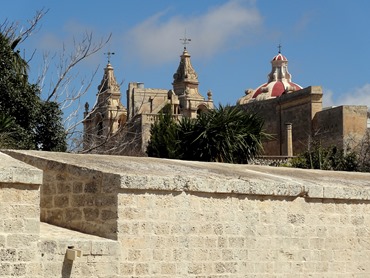
Before exploring Valletta we decided to take a HOHO (Hop On Hop Off) bus to Mdina (em-dee’-nuh), which was the old capital before the Knights arrived. HOHO buses are garishly painted open top double decker tourist buses that are available in a number of European cities. You pay one price for the full day, they drive through a set route (in this case the northern part of the island of Malta), and you can get off to visit any sites you want & then get back on the next HOHO bus (15-30 minute intervals) to continue the route. They also have narration in multiple languages through earphones. Altogether, its a pretty good deal if it is going where you want. Anyway, we got to Mdina early in the day, so it wasn’t very crowded yet. As we were leaving we saw many worshipers dressed in their church clothes departing Easter morning services. Mdina is an old city with very narrow streets that retains much of its medieval charm. It is built on a hill & has great views from its walls, where you can see Valletta & other towns in the area. It also has a large cathedral that can be seen from far away.


There is a lot of public statuary in Mdina on churches, walls & elsewhere. Mdina is also known for its variety of elaborate door knockers.


As I mentioned before, the view from the walls was spectacular.


Two more views of the red-roofed cathedral from Inside & outside the walls & then we returned to Valletta.

Holland America had carefully planned our visit to Valletta for one day on Easter Sunday when most places are closed in this very Christian city. To emphasize this stupidity they distributed a newsletter saying that the one thing not to miss in Malta is St. John’s Co-Cathedral, even though it was closed to the public on the one day we were to be there. So, on Sunday we visited what was open & walked around the walls of the city. But when we returned to the ship we learned that because the weather would prevent our anchoring & tendering in Gozo (another island of Malta that was to be our next stop) we would spend a second day in Valletta. We were sorry to miss Gozo, but on balance this was an improvement since it enabled us to visit this spectacular cathedral, among other things. We could have used our time to better effect if we had known in advance that we would have two days in Valletta, but we were happy with what we were given. Anyway, from here on I will depart from strict chronology so that each site can be fully treated in a single section.
There are three main buildings in Valletta I will cover in some depth. The first (which we toured on Sunday) is the Grand Master’s Palace. The Grand Master was the head of the Knights & seems to have had quite a lot of authority. The palace was occupied by the British governor until 1964 and is now the home of the Maltese legislature & also houses the President’s offices.


The hallways inside have marble inlay floors, elaborately painted walls & ceilings, & are lined with suits of armor (the knights left a lot of armor, much of which is in the museum).


This was, altogether, a fabulous building and would have been the highlight in most cities, but not in Valletta. As everyone had said (including Holland America), it was outshone by St. Johns Co-Cathedral, which was really over-the-top (Co-Cathedral means, as I understand it, that it shares the status of Cathedral of Malta with the one in Mdina). The Cathedral is relatively plain on the outside, and apparently it was rather unadorned on the inside as well when built by the Knights after they moved their headquarters from Vittoriosa across the harbor to Valletta after the Great Siege.


Later, however, they made it over inside in high Gothic style, with every inch covered in some kind of fabulous decoration: statuary, painting, inlaid marble, gold and silver. The effect upon entry is stunning.


The floor of the cathedral is made entirely of inlaid marble. It comprises the tombs of more than 400 of the Knights, with writing in the languages of the countries from which the knights came & dramatic pictures that often reflect death. Unfortunately, most of these tombs are covered with carpets & chairs for worshippers. I guess the carpets will help preserve them from the feet of all the visitors (high heels are not permitted inside).


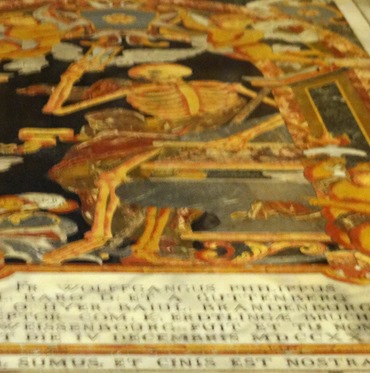


As you can tell, I really liked these. I wish more of them had been uncovered and visible. There are eight side chapels in the cathedral, one for each of the “Langues,” or regional groups of Knights. They were extremely elaborate, with beautiful paintings, reliefs, sculpture & gilded decoration. My favorite was (I think) the chapel of the Langue of Aragon, with a painting of St. James in the center. I am no longer sure whether all these pictures are from that chapel or not, but they give you an idea of how elaborate they are.


Finally, the Cathedral has an Oratory that contains two of the most famous paintings by Caravaggio, “St. Jerome” & “The Beheading Of St. John,” the only painting he ever signed. Caravaggio was, to say the least, not a nice guy. When he came to Malta in 1608 he was on the lam, having killed a man in a street brawl in Italy. He was assigned to paint a portrait of the Grand Master & then was inducted into the Knights. It wasn’t long, however, before he lost his legendary temper once again & stabbed another knight. He was imprisoned, then escaped, & they drummed him out of the order. He died shortly thereafter. These two paintings are extraordinary (really, to me most of his work is), but no pictures can be taken in the Oratory so you won’t see them here. However, in the main part of the Cathedral there is a cross with a painting of Jesus on it by Carvaggio, so I will show you that instead (although it isn’t really a fair substitution).

In a place of honor right between these two magnificent buildings is the Biblioteka Nazzionali (national library). The Knights were forbidden to destroy any of their papers, so there is a huge archive of the order’s records in this library (also an original copy of the letter in which Henry VIII declared himself the head of the Church in England, which must have shaken up the knights who were from English noble families). There was too much paperwork to gain admittance, but the outside of the building was a treat.


For the rest of the afternoon we strolled around the walls of the city. Even some of the ordinary houses we saw on the streets of Valletta & in some of the other towns as we drove by in the HOHO bus were interesting & unlike what we have seen elsewhere. Most of them come right up to the street; I don’t know whether there are courtyards inside, but it would be nice to think there are.


Fort St. Elmo is at the tip of the harbor on the Valletta side. It was captured by the Turks in 1565, but looks awfully secure to me. It is not open to the public although they are working on restoration of it.


Fort St. Anselm, on the other side of the harbor entrance, took the brunt of the Turkish attack after Ft. St. Elmo fell, but the Turks couldn’t capture it.


We also visited the Lower Barracca Gardens, which commanded fine views across the harbor (I am running out of adjectives).


By the time we got back, & found out we would have another day here, we were exhausted. So we didn’t go into town that night, as many people did. We had been scheduled to sail away at 6:00 the next morning, which would have given great views of the city lighted up at night (trust me, I have seen some pictures). But we went out on deck after dinner & there were some nice lighted views in the harbor.


I mentioned at the beginning that Malta has been inhabited for about 6,000 years, and on Monday we took a HOHO bus to visit two of the sites where archeologists are excavating neolithic settlements. Unfortunately (for us) the best items recovered from these sites are in a museum in Valletta we didn’t have time to visit, and they have been replaced at the sites with reproductions. But the reproductions are pretty good (we had a hard time distinguishing the real from the reproduced), and visiting the sites gives you a feel for their context that a museum visit would not. The bus goes all around the southern portion of the island, so we saw some other interesting sites as well.
The first neolithic site we visited is the Tarxien Temples in a town celled Paola We walked and walked through the neighborhood of the relevant bus stop following the signs for “Neolithic Temples,” only to find it finally about half way back to the bus stop after we had given up. It was mostly rocky holes in the ground, but there were some interesting round chambers & some (probably reproduced) decorative items, including the legs of a statue & some stones decorated with a spiral design.


Our bus took us through Vittoriosa on the other side of the harbor from Valletta, the city where the Knights first settled.


We also drove through the fishing village of Marsaxlokk. The fishing boats have eyes painted near the bow in the yellow sections to ward off the evil eye. We saw a fellow with a Maltese Falcon on his arm at the harbor here, but I wasn’t fast enough to get a picture before the bus pulled out (d’oh!),


We stopped at the Blue Grotto, a lovely place on the water, but we didn’t have time to leave the bus to explore.


Finally, we came to the other Neolithic site, Hagar Qim, where we left the bus to visit. This site has been dated to about 3,600 BC. These sites are all called “temples,” but we have very little idea of what they were used for.


We returned to Valletta & visited the Cathedral which you have already seen, then headed back to the ship. Here are a picture of the fountain outside the main gate of Valletta (the gate is undergoing restoration, so I couldn’t photograph it) & of Republic street, the main street of Valletta, which was a busy pedestrian walkway on Monday. And you can tell that the Maltese are civilized by the way they treat their stray animals (although supporting feral cats doesn’t seem like good policy to me).


As we sailed out of the harbor about 5:00 PM the Maltese fired a six gun salute from their guns atop the walls. This was pretty cool. And after this extra-long post (which I hope is justified by the glories of Malta I have tried to depict here) I will save the fruit & towel art for the next time. On to Crete!


 BADER JOURNAL