
Madeira (day 2), Around the Island
On our second day in Madeira we were on a private bus tour that took us throughout the western portion of this beautiful island. Madeira really has everything: seashores & fishing villages, cliffs & mountains, flowers rocks & surf. This was a long (8 hours) tour & we visited a number of places, so this post is going to be mostly made up of pictures (I’m sure you are grateful to hear that).
First we visited the picturesque fishing village of Camara de Lobos, a favorite vacation spot during the 1950’s of Winston Churchill, who liked to paint the scenery here. The town was full of beautiful plants & flowers. I wish I could name all the flowers, but I can’t (as you will see from the captions).


A little further along the coast we stopped at Cabo Girao, at 580 meters the second highest sea cliffs in the world (our guide thought the highest might be in Taiwan, but wasn’t sure). There is a glass platform to walk on extending out over the cliff.


OK, next was Ribeira Brava, a small resort town (village). They had a lot of construction going on, apparently moving rocks & rubble from the river to the shore, where they are building up the area behind their sea wall, which held off a roaring surf. There was a lovely little 16th century church, all dressed up for Lent. Mary bought a t-shirt here with an embroidered bird of paradise on it – less than half the price asked for the same shirt in Funchal.


Next we drove way up into the mountains and, after a stop for some photos & to visit a tourist store, we drove across a relatively flat, soggy high plans called Paul da Sierra. It was really foggy during this part of the trip, so very few pictures (and much sleeping). I may have mentioned that, in addition to wine, Madeira is known for its fine embroidery. Not cheap though: we saw an embroidered table cloth in a Funchal window selling for about $9000.00! And you know that if you bought it someone would spill the wine the first time you used it. In the mountaintop shop was some nice embroidery selling for hundreds rather than thousands of dollars, but we took a pass anyway.


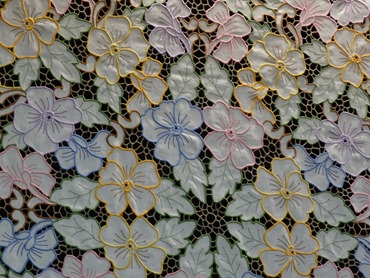
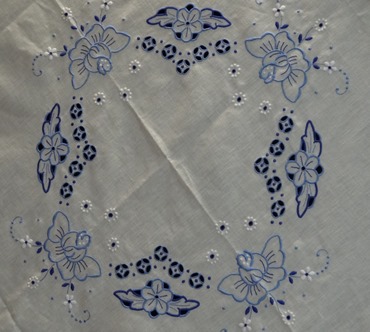


We stopped for lunch (marinated tuna for us) in the little village of Porto Moniz on the northwest tip of Madeira, about as far (47 miles) from Funchal as you can go without getting wet. About 4000 people live there. We stopped for pictures on the mountainside above the town, but the best views were at the ocean where the surf pounded some fabulous black rocks. Madeira is a volcanic island (some say it is what is left of the lost continent of Atlantis) & we saw quite a lot of volcanic rock, natural and used to build walls & buildings. I mentioned that the whole island is heavily terraced for houses and small fields, and you can see below some of the terracing above Porto Moniz with grape vines (not yet green) on some levels.


You are probably wondering by now how many more stops, but there are just two more. Seixal is a very small village with a profusion of wildflowers on the hillside, including a whole field of wild lillies.


And finally, Sao Vicente. This village was originally at the seashore, but was repeatedly pillaged by pirates. So in the 16th century they moved the whole village inland about a mile & rebuilt it in a valley behind some cliffs & rocks where it could no longer be seen from the sea.


And so back to Prinsendam, well in time to make the all aboard deadline of 4:30. But then the Captain announced that they were about to replace the capstan on one of the engines, a huge piece of metal that could prove dangerous at sea. So our departure was delayed until 8:00. And Funchal looked quite beautiful after dark.

But then departure was delayed until 10:00. Then about 1:00 in the morning the ship was filled with a loud grinding sound that lasted quite a while, which seems to have been the testing for the work that had been again delayed. So we didn’t set sail for Agadir until about 2:00 AM, but we still made it to Agadir Morocco on time early Monday morning. However, that is another story. I will close this installment with a couple of more towel animals.


Madeira (Day 1), Funchal
Land! At last! After more than a week with nothing to look at but water, the sight & feel of solid land is more than welcome. The last few days at sea were quite rough. We detoured to the south to avoid a big storm paralleling our path about 250 miles to the north. We didn’t see much rain, but the sea was very rough. Glassware was jumping off the shelves, plates were migrating across tables, chairs would move across the floor (sometimes with people in them), & wine buckets fell from their pedestals in the restaurant, spilling bottles & ice across the floor. At night doors would move if not latched & everything had to be secured. This also made walking difficult; it seemed that walking across a level floor was always an uphill climb as the ship rocked back & forth. This was a big change from the first few days when we were crossing the relatively calm Sargasso Sea, where the water was deep blue & the ship remained mostly upright.


We arrived in Funchal, Madeira at about 3:00 on the afternoon of March 22, which was about 3 hours late. This meant that most things were closed by the time we got into town. Madeira is an autonomous region of Portugal, located off the coast of Africa. It is an archipelago of several islands, the largest of which is (surprise!) Madeira. About a quarter of a million people live there. Madeira is most famous for its wine, also called Madeira, which is fortified with brandy or spirits & made with a heat process. The heat process was discovered when the wine was left in a hold during a tropical voyage, and instead of being spoiled as expected it was improved. After that discovery Madeira wine would be shipped in the holds of ships on tropical voyages just to cure it by the heat of the voyage, and later someone developed a way to duplicate the process by keeping it heated on land. They began to add spirits to the wine to preserve it during the years when its delivery to Europe was interrupted while Napoleon blockaded Madeira’s shipping. Madeira wine was often called “sack” (see Shakespeare’s Henry IV, in which Falstaff calls it that) because pirates routinely sacked the shipments. Another term is Malmsey (the American founding fathers used Malmsey to toast independence), which is a factory that produces one kind of Madeira wine. So much for drinking.
Madeira is very mountainous, and Funchal is situated on a harbor that is surrounded by high land.
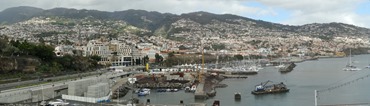
So, with little time left on the first afternoon we headed right for the cable car that takes you to Monte, a mountain overlooking the city. Its a 4 mile trip suspended high in the air; you could see the port & the ship, & also look down into people’s yards and patios. As you can see from the picture above Funchal, and in fact most of the island, is extensively terraced so just about everyone has a view of the water over the top of their neighbors’ houses.


On top of Monte is a community with a church & several formal gardens. The signature Funchal experience involves climbing into a wicker sleigh-type thing, and then a couple of Madeirans wearing white shirts & a straw boater hat push you down the hill at great speed. By the time we got to Monte they were in the process of closing up for the day & no one was actually riding in the sleighs. So, we walked around for a little bit & then caught the return cable car before they closed up at 5:30.
We then walked around the town for a while. It is a nice walking city, & we saw (inter alia) the legislature (no admittance), the cathedral (didn’t enter because they were having mass) & an interesting enclosed produce market. The buildings were mostly white stucco with red tile roofs & a number of them had tile work as well.


Among the most interesting features here were the mosaic sidewalks, similar to what we saw in Brazil last year, but very different patterns. This must be a Portuguese thing, I guess. Here are just a few of the interesting patterns we came across, along with a closeup that shows what the black & white stones look like.


Madeira was discovered in 1419 by a fellow named Zarco (sounds like a space villain). There is a statue of him and also a sidewalk mosaic tribute.


Another discoverer who lived here for a couple of years about 50 years after Zarco was Christopher Columbus. He came to Madeira, married the governor’s daughter, who died in childbirth a year or so later, after which Columbus left the island. Apparently nothing else is known about Columbus’s sojourn here, but that doesn’t stop enterprising Madeirans from maintaining a house that tourists can visit & imagine that Columbus lived there. We did not visit that one.
While walking around town we saw a fellow with a golden eagle, some swans in a park, a sparsely attended political rally near the city hall (there seems to be an election campaign going on; we saw communist party posters several places), and many beautiful flowers.


The first night there was a show on the ship by a Grupo Folclore da Ponta do Sol, a Madeiran folkdancing group from a village called Ponta do Sol not far from Funchal. Very colorful costumes & an interesting performance (although it would have trouble living up to the Samba show we saw in Rio last year).


So ended our first (short) day in Madeira, and this post is already pretty long. So I will save the second (long) day for the next posting.
Crossing the Atlantic on Prinsendam

Goodbye Ft Lauderdale! We left Ft Lauderdale at about 5:30 PM on March 14. As I write this we are in mid-Atlantic and there is nothing around but water. It has only been a few days, but I can see why Columbus’s men got spooked after a month or more of nothing but water and no reason beyond their weird Captain’s theories to think they would ever reach land. But we know we will reach land this Friday, so all is well.


Before going any further, I want to welcome those of you who don’t know us but are following this blog at the invitation of friends or relatives who are fellow passengers. These are the voyages of Rick & Mary Bader, whose continuing mission is to boldly go where no one . . . no, wait a minute, that’s not right. But it is true that this blog is about our experiences and interests and things we think our friends and relatives might find interesting. Although all of us on the Prinsendam are traveling on the same ship to the same ports, your friend’s or relative’s experiences on board and in the ports may be very different from ours. So while this blog will give you a general idea about the voyage and some of the ports we visit, don’t assume that everything you see here was part of your friend’s personal experience or that the blog covers everything that your friend saw or did. With that caveat, welcome aboard.
I also want to remind everybody of two things about reading this blog. First, the most recent blog post will always be at the top, so the chronology is from bottom to top. This means that when (like today, if all goes well) there are multiple postings on a single day you should scroll down to the earliest one if you want to read them in order. Second, if you scroll your mouse over a picture a caption will pop up. Sometimes it will just identify the picture, but often it will contain explanatory text. So if you don’t take advantage of that feature you will be missing some brilliant writing that might be illuminating.
As I have mentioned before, the Prinsendam is a very small ship by cruise industry standards. It has a capacity of 835 passengers (along with about 450 crew), but on this cruise we are told there are only between 450 and 550 passengers (estimates vary). Of course, this makes the ship even less crowded than usual, and there is generally no problem finding a table in the Lido (the buffet restaurant) or a seat in the library. I expect it also will make it easier to get off the ship in tender ports (where the ship anchors offshore and ferries passengers into port with the lifeboats, called tenders). There are many empty seats in the main dining room and they have closed the small extra dining room. So this will be a more intimate cruise than the last one, and maybe that will minimize some of the sharp elbows and frayed nerves we sometimes saw on our last cruise. So here is the Prinsendam (we didn’t take these).


In the second picture look at the deck just below the orange lifeboats, the first deck painted white, which has an outside deck on which you can walk all the way around the ship (a quarter mile). Counting from the left, the second window is our cabin (if you count 7 more windows you get to the cabin we had last year on the South America cruise). From this angle the window looks tiny, but it is actually about 5 feet wide and provides a very nice unobstructed view (mostly just water so far, of course, but we expect more later). This cabin is about 2 feet longer than the one we had last year, which makes a significant difference in using the room. It has a bathtub as well, which I think is pretty rare at sea (last year we had just a shower). It is a pretty big step up into the tub, though, and I can’t imagine how some of the older people who are plentiful on this ship are able to handle it. We actually have 2 kids on the ship this year, a 7 year old & a 3 year old. I expect them to get very bored!


The Prinsendam was in drydock for a couple of weeks in November & we were interested to see all the changes. Most are not really visible, such as a new propeller that is supposed to be quieter & more fuel efficient and upgraded air conditioning & plumbing, which had been troublesome. I am told they replaced all the verandas, but we don’t have access to those. There was a lot of talk about the Showroom at Sea being completely redone, but it looks exactly the same to us as it did last year. The primary visible change is that the open eating deck on the back of the Lido restaurant, where we spent many enjoyable hours outside looking at the ports during breakfast & lunch, has been completely enclosed. They did a nice job of it: it is surrounded by large windows, about half of which can be opened (although Gildas, the restaurant manager, told us that the engineers go nuts if they open the windows because the space is air conditioned) and large skylights that let in the sun in the afternoon. This space now becomes the new Canaletto restaurant at night, serving Italian food by reservation (happily, it is free on this cruise). This is still a nice place to sit and eat, out of the way from the often crowded buffet, with a different variety of orchid on each table. We understand why this was done (it makes the space usable in bad weather), but we still miss the outside space. The first picture below shows how this looked last year, and after that its new look.


One thing that seems to be much better this year is the coffee. Last year it was pretty dreadful, particularly in the Lido, and it was a constant source of complaint, but so far this year it seems to be pretty decent. Passenger complaints about coffee served on ship are as old as cruising, as Mark Twain memorably explained:
I am reminded, now, of one of these complaints of the cookery made by a passenger. The coffee had been steadily growing more and more execrable for the space of three weeks, till at last it had ceased to be coffee altogether and had assumed the nature of mere discolored water—so this person said. He said it was so weak that it was transparent an inch in depth around the edge of the cup. As he approached the table one morning he saw the transparent edge—by means of his extraordinary vision long before he got to his seat. He went back and complained in a high-handed way to Capt. Duncan. He said the coffee was disgraceful. The Captain showed his. It seemed tolerably good. The incipient mutineer was more outraged than ever, then, at what he denounced as the partiality shown the captain’s table over the other tables in the ship. He flourished back and got his cup and set it down triumphantly, and said: "Just try that mixture once, Captain Duncan." He smelt it—tasted it—smiled benignantly—then said: "It is inferior—for coffee—but it is pretty fair tea." The humbled mutineer smelt it, tasted it, and returned to his seat. He had made an egregious ass of himself before the whole ship. He did it no more. After that he took things as they came. That was me.
One thing we really enjoyed last year was the nightly concert by the Rosario Strings in the elegant Explorer’s Lounge before dinner. We were disappointed when boarding to see that the Rosario Strings were not listed among the entertainers & that instead there was a group called Adagio. But we went to see them before dinner our first night anyway, and were overjoyed to discover that it was the same musicians with a new name. They are now a violin/piano duo instead of a trio, but little if anything seems to have been lost in the transition. They are still playing an eclectic repertoire including popular tunes, broadway overtures, challenging classical works and a version of Orange Blossom Special that always brings down the house. We were surprised that the pianist recognized us & welcomed us back after more than a year (as did Gildas & Widi in the restaurant and Annette the Hostess, among the very few familiar faces we have seen among the crew). These people have an amazing memory for names & faces; they have seen quite a few passengers in the year since they last saw us. Here is the Explorers Lounge & Adagio/Rosario in action
 .
.


When we left Ft. Lauderdale the ocean was quite rough, and the Captain decided to detour south through the Bahamas to avoid some of the bad weather. We were seated in the main dining room at the same table as last year, but on the Starboard (right) side of the ship instead of the Port (left). Our table for eight included 4 Australians and an American couple who had emigrated from Germany about 50 years ago. We took a particular liking to the woman seated next to me, an Australian with bright blue hair in front of her head who was travelling with her father, who was not at dinner because he was feeling ill. In the middle of the night the Captain woke us all up with the announcement that one of the passengers was about to be evacuated by Coast Guard helicopter, and requested that people not take flash pictures. We heard later it was quite a moment; since there was no place on the ship for a helicopter to land they hovered over the ship and removed the passengers by rope lift (we didn’t see it from our room). As we feared when we heard the announcement, the evacuees were the woman at our table with the blue hair and her father. We have since heard that he is still in a hospital in Nassau with a bleeding ulcer. Pretty lousy to fly all the way from Australia for a 2 month cruise, only to be evacuated with a serious health problem just a few hours after sailing! I hope they had trip insurance; it would be a lot of money to lose.
Our second day at sea was Mary’s birthday, so I took her out to dinner at the Pinnacle, the gourmet restaurant on board (for which they charge an additional fee). The food was first class; Mary had the large filet & I had the 22 oz. Porterhouse steak (oink!). We had terrific crab cakes for an appetizer, Mary had chocolate soufle for dessert & I had a Volcano cake (which is made in a covered bowl). Since it was only the second day at sea, there were no other passengers in the Pinnacle while we were eating; only two other tables were occupied, one by the Captain & his party and the other by Firmin the Hotel Manager (who was supposed to be retiring when we left the Prinsendam last year, but is somehow still here). The staff had too little to do, so someone would come up to the table about every two minutes to inquire how our dinner was.


I will close this entry (finally!) with some random views around the ship, and then the first of the bread animals & towel animals produced by the artisans among the ship’s crew. Hopefully the next dispatch will be filled with pictures of Madeira.


Prelude: The First American Cruise to the Mediterranean
We usually think of cruising as a relatively recent phenomenon, but in fact the first American pleasure cruise to the Mediterranean came right after the Civil War, in 1867. Of course, ships were not as fast as they are now & the cruise lasted months longer than ours. The ship was called the Quaker City and there were 65 passengers who paid $1200 apiece to make the trip (a whole lot of money in those days). Here is the Quaker City at sea on a not very nice day:

The trip was something of a sensation in the United States. A big crowd turned out for its departure and people followed the cruisers’ exploits in the newspapers. As well they might, since the dispatches were being written by a very young Samuel Clemens writing under his byline of Mark Twain. After the trip ended Twain compiled and extended his newspaper reports into a book called “The Innocents Abroad,” which was his first best-seller. Like most of Twain’s works, it makes highly entertaining reading, both funny & enlightening. Anyone interested in Mediterranean travel, and in how much has (and hasn’t) changed in 150 years, would likely enjoy it. If you have an ereader, you can download it for free at: http://www.gutenberg.org/ebooks/3176. (A more contemporary, though in my view much less companionable, account of a trip around the Mediterranean – but mostly not by cruise ship – is “The Pillars of Hercules” by Paul Theroux, which is also available as an ebook, but not for free unless you can borrow it from your library.)
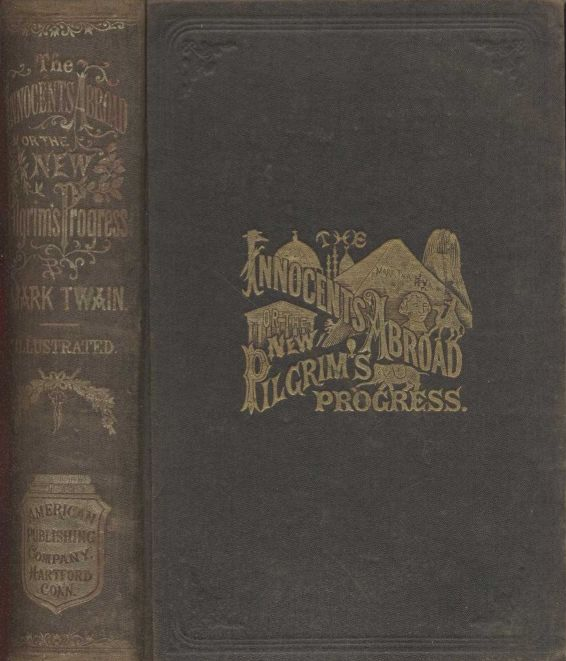
As Twain explains, this cruise was widely viewed as an exciting new kind of adventure (he makes it sound even more exciting than ours, which seems pretty exciting to us):
For months the great pleasure excursion to Europe and the Holy Land was chatted about in the newspapers everywhere in America and discussed at countless firesides. It was a novelty in the way of excursions—its like had not been thought of before, and it compelled that interest which attractive novelties always command. It was to be a picnic on a gigantic scale. The participants in it, instead of freighting an ungainly steam ferry-boat with youth and beauty and pies and doughnuts, and paddling up some obscure creek to disembark upon a grassy lawn and wear themselves out with a long summer day’s laborious frolicking under the impression that it was fun, were to sail away in a great steamship with flags flying and cannon pealing, and take a royal holiday beyond the broad ocean in many a strange clime and in many a land renowned in history! They were to sail for months over the breezy Atlantic and the sunny Mediterranean; they were to scamper about the decks by day, filling the ship with shouts and laughter—or read novels and poetry in the shade of the smokestacks, or watch for the jelly-fish and the nautilus over the side, and the shark, the whale, and other strange monsters of the deep; and at night they were to dance in the open air, on the upper deck, in the midst of a ballroom that stretched from horizon to horizon, and was domed by the bending heavens and lighted by no meaner lamps than the stars and the magnificent moon—dance, and promenade, and smoke, and sing, and make love, and search the skies for constellations that never associate with the "Big Dipper" they were so tired of; and they were to see the ships of twenty navies—the customs and costumes of twenty curious peoples—the great cities of half a world—they were to hob-nob with nobility and hold friendly converse with kings and princes, grand moguls, and the anointed lords of mighty empires! It was a brave conception; it was the offspring of a most ingenious brain. It was well advertised, but it hardly needed it: the bold originality, the extraordinary character, the seductive nature, and the vastness of the enterprise provoked comment everywhere and advertised it in every household in the land.
In the conclusion of the book, Twain looks back on the experience and eloquently expresses some of the same reasons that many people today favor this mode of travel:
And I will say, here, that I would rather travel with an excursion party of Methuselahs than have to be changing ships and comrades constantly, as people do who travel in the ordinary way. Those latter . . . have . . . that other misery of packing and unpacking trunks—of running the distressing gauntlet of custom-houses—of the anxieties attendant upon getting a mass of baggage from point to point on land in safety. I had rather sail with a whole brigade of patriarchs than suffer so. We never packed our trunks but twice—when we sailed from New York, and when we returned to it. Whenever we made a land journey, we estimated how many days we should be gone and what amount of clothing we should need, figured it down to a mathematical nicety, packed a valise or two accordingly, and left the trunks on board. We chose our comrades from among our old, tried friends, and started. We were never dependent upon strangers for companionship. We often had occasion to pity Americans whom we found traveling drearily among strangers with no friends to exchange pains and pleasures with. Whenever we were coming back from a land journey, our eyes sought one thing in the distance first—the ship—and when we saw it riding at anchor with the flag apeak, we felt as a returning wanderer feels when he sees his home. When we stepped on board, our cares vanished, our troubles were at an end—for the ship was home to us. We always had the same familiar old state-room to go to, and feel safe and at peace and comfortable again.
I have no fault to find with the manner in which our excursion was conducted. Its programme was faithfully carried out—a thing which surprised me, for great enterprises usually promise vastly more than they perform. It would be well if such an excursion could be gotten up every year and the system regularly inaugurated. Travel is fatal to prejudice, bigotry and narrow-mindedness, and many of our people need it sorely on these accounts. Broad, wholesome, charitable views of men and things can not be acquired by vegetating in one little corner of the earth all one’s lifetime.
Twain also addresses the closest 19th century equivalent to this blogging enterprise — passengers keeping journals of the trip:
Behind the long dining tables on either side of the saloon, and scattered from one end to the other of the latter, some twenty or thirty gentlemen and ladies sat them down under the swaying lamps and for two or three hours wrote diligently in their journals. Alas! that journals so voluminously begun should come to so lame and impotent a conclusion as most of them did! I doubt if there is a single pilgrim of all that host but can show a hundred fair pages of journal concerning the first twenty days’ voyaging in the Quaker City, and I am morally certain that not ten of the party can show twenty pages of journal for the succeeding twenty thousand miles of voyaging! At certain periods it becomes the dearest ambition of a man to keep a faithful record of his performances in a book; and he dashes at this work with an enthusiasm that imposes on him the notion that keeping a journal is the veriest pastime in the world, and the pleasantest. But if he only lives twenty-one days, he will find out that only those rare natures that are made up of pluck, endurance, devotion to duty for duty’s sake, and invincible determination may hope to venture upon so tremendous an enterprise as the keeping of a journal and not sustain a shameful defeat.
One of our favorite youths, Jack, a splendid young fellow with a head full of good sense, and a pair of legs that were a wonder to look upon in the way of length and straightness and slimness, used to report progress every morning in the most glowing and spirited way, and say: "Oh, I’m coming along bully!" (he was a little given to slang in his happier moods.) "I wrote ten pages in my journal last night—and you know I wrote nine the night before and twelve the night before that. Why, it’s only fun!" "What do you find to put in it, Jack?" "Oh, everything. Latitude and longitude, noon every day; and how many miles we made last twenty-four hours; and all the domino games I beat and horse billiards; and whales and sharks and porpoises; and the text of the sermon Sundays (because that’ll tell at home, you know); and the ships we saluted and what nation they were; and which way the wind was, and whether there was a heavy sea, and what sail we carried, though we don’t ever carry any, principally, going against a head wind always—wonder what is the reason of that?—and how many lies Moult has told—Oh, every thing! I’ve got everything down. My father told me to keep that journal. Father wouldn’t take a thousand dollars for it when I get it done." "No, Jack; it will be worth more than a thousand dollars—when you get it done." "Do you?—no, but do you think it will, though? "Yes, it will be worth at least as much as a thousand dollars—when you get it done. May be more." "Well, I about half think so, myself. It ain’t no slouch of a journal."
But it shortly became a most lamentable "slouch of a journal." One night in Paris, after a hard day’s toil in sightseeing, I said: "Now I’ll go and stroll around the cafes awhile, Jack, and give you a chance to write up your journal, old fellow." His countenance lost its fire. He said: "Well, no, you needn’t mind. I think I won’t run that journal anymore. It is awful tedious. Do you know—I reckon I’m as much as four thousand pages behind hand. I haven’t got any France in it at all. First I thought I’d leave France out and start fresh. But that wouldn’t do, would it? The governor would say, ‘Hello, here—didn’t see anything in France? That cat wouldn’t fight, you know. First I thought I’d copy France out of the guide-book, like old Badger in the for’rard cabin, who’s writing a book, but there’s more than three hundred pages of it. Oh, I don’t think a journal’s any use—do you? They’re only a bother, ain’t they?"
"Yes, a journal that is incomplete isn’t of much use, but a journal properly kept is worth a thousand dollars—when you’ve got it done." "A thousand!—well, I should think so. I wouldn’t finish it for a million." His experience was only the experience of the majority of that industrious night school in the cabin. If you wish to inflict a heartless and malignant punishment upon a young person, pledge him to keep a journal a year.
So Twain was apparently the only one to complete his journal of the cruise, not only because he was a professional writer but because he was financing the trip at least partly through his newspaper accounts of the journey. Unlike Twain we have no financial incentive to complete this blog, but we expect to do so anyway. Many entries will be delayed, sometimes substantially (I had hoped to post this entry earlier, but had technical difficulties), because this is a time consuming effort & our port schedule is crowded (sea days are really the only ones in which there is enough time to organize photographs & write blog posts). There is likely to be a flurry of overdue posts at the end of the trip. But stay with us; we will complete it, even if we do not finish until after we get home, and the timing really doesn’t affect how much you enjoy the blog postings, does it? Meanwhile, get a copy of The Innocents Abroad to keep you entertained and on message until our pictures of these places begin to arrive (I am pretty certain that this is the only post that will have so many words & so few pictures).

 BADER JOURNAL


