Castries, St. Lucia
On Thursday, March 8, we pulled into Castries, the main city on the island of St. Lucia. St. Lucia once had a history of rapid changes of European owners but today it is a member of the British Commonwealth. So of course they drive on the wrong side of the street (dangerous for Americans used to looking left before crossing the street).

We don’t know how many people live here but it is a pretty small town. There were three other cruise ships in this small harbor and they were big ones, so the population here today was probably only about 75% local citizens.
After breakfast we walked into town, a pleasant stroll around the bay that took about half an hour. Among other things there was a fellow selling these bird bowl carvings (many of which we saw later all around Castries), which were hanging from a tree.


We visited the local market, which mostly sold clothes, and came upon an unusual statue.


The best things we saw were around Derek Walcott Square. Derek Walcott is a poet born on St. Lucia (though he has lived mostly on Trinidad) who won the Nobel Prize for Literature in 1992. Actually St. Lucia has had two Nobel Laureates; Sir William Arthur Lewis won for Economics in 1979. That’s quite a lot for such a small island & they are quite proud of that; busts of both Nobel Laureates are displayed in the center of Derek Walcott Square.


In the park was a painted fountain & a huge tree said to be 400 years old. Most of the gates to the park are topped by cherubim, who have green grass strategically painted over their private parts.


On one side of the square is the cathedral. It looks like drab grey stone on the outside but the inside is full of color and rich in character. It was prefabricated in France and shipped here & assembled in the 1890’s; the interior ceiling buttresses & the background construction on the stage are made of cast iron, in the fashion (and perhaps by) Gustave Eiffel. Altogether one of the more delightful churches we have seen, though far from the most elaborate.


On the other side of the square is the nicest looking building in the city (from the outside), the Carnegie Central Library. We were surprised to find a Carnegie library this far from the United States. And in the children’s room was the ubiquitous cartoon character that some of you know & love.


And on a third side of the square was a block of nice older wood and lattice buildings, one of which is the Ministry of Justice.


That’s pretty much all there was of interest. I don’t have a picture, but on our walk we came across a group of kids about 10 years old playing cricket with plastic bats, ball & wickets in a small school yard. Great enthusiasm but very little skill. Cricket is pretty much a mystery to us but we’re pretty sure you aren’t supposed to pitch the ball two feet behind the batter and you aren’t supposed to throw your bat 10 feet when you swing. The rest of the island is quite lush rainforest, with a volcanic mountain in the interior and lots of nice beaches, but we didn’t see any of that (except from the ship as we pulled out). We ended the day with a nice but muted sunset.

Devil’s Island, French Guyana
On Tuesday, March 6 we anchored at this three island archipelago about 8 miles off the coast of French Guyana. French Guiana (“Guyane Francaise”) is not a colony, but actually a department of France with representation in the French legislature.
The three islands are popularly referred to as Devil’s Island, although their proper name is Iles de Salut (“Salvation Islands”). One of the island is actually Devil’s Island (Ile du Diable) and the other two are Ile Ste-Joseph & Ile Royale. All three islands in this group were part of the infamous French penal colony of Devil’s Island, but the only one that can be visited by ships is Ile Royale, the biggest of the three and the location of the prison administration.

We had to wait some time to go ashore because there was a sudden squall that made boat traffic treacherous, and then after the squall it took some time to get the ship repositioned and the tenders running smoothly again. But we did finally come ashore and from the dock area you could see that Ile Ste-Joseph was quite close (only 650 feet separates Ile Royale from the other two islands).


Walking along the path around the island, it was quite a lush tropical rainforest particularly thick with palm trees. We were told, however, that when it was a prison the French kept the forest cleared so they would have a clear shot at anyone trying to escape.


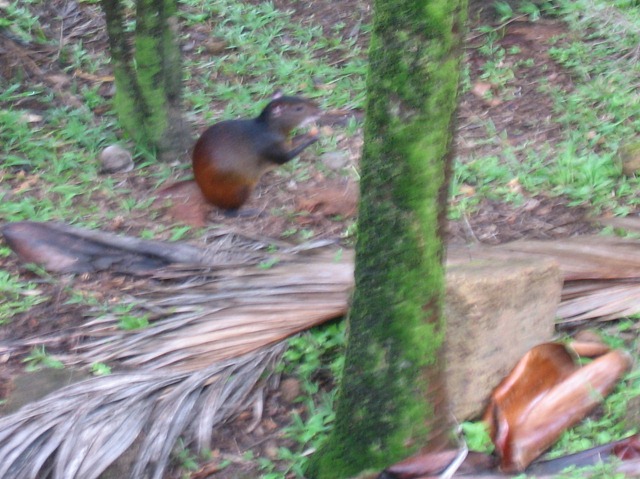
In the forest we saw spider monkeys & agoutis, which look like giant guinea pigs with longer legs. The agoutis eat coconuts, which are abundant here, among other things.



We also saw several kinds of palm trees, including coconut palms aplenty and some with red fruit that we were told were Christmas Palms.


The remains, mostly ruins, of the penal colony cover a good bit of the island. It looked pretty depressing, with tiny cells, a reservoir now full of water lilies (reportedly with an alligator in residence), a hotel (converted from the old warders’ mess hall) and a cemetery for children of the warders (not a healthy place to raise children). The prisoners who died were buried unceremoniously at sea, which helped keep the sharks around to deter escape attempts. About 50,000 of the 80,000 prisoners sent here during its 85+ years of operation died here. Those surviving prisoners sentenced to less than 8 years had to spend another 8 years in French Guiana before they could return to France (and then only if they could pay their own fare back), while those sentenced to 8 years or more had to spend the rest of their lives in Guiana. The French government did not stop transporting prisoners here until sometime between 1938 and 1946 (accounts we have heard differ) and did not close the facility until 1953. The movie Papillon is set on Devil’s Island and reportedly gives a decent portrait of life there, although its author, Henri Charriere, was never actually there, even though he framed his book as an autobiography.


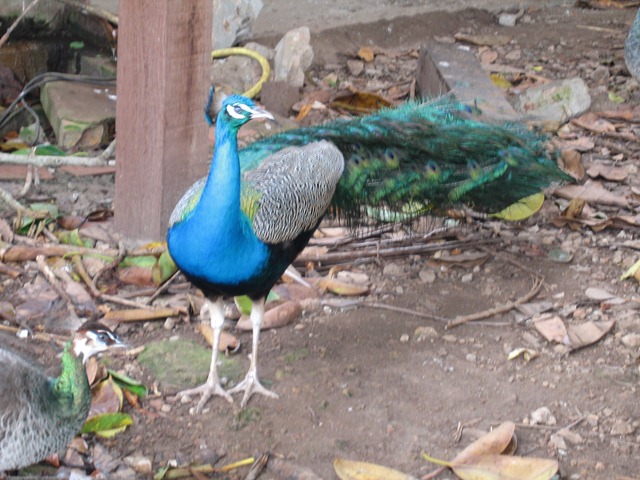
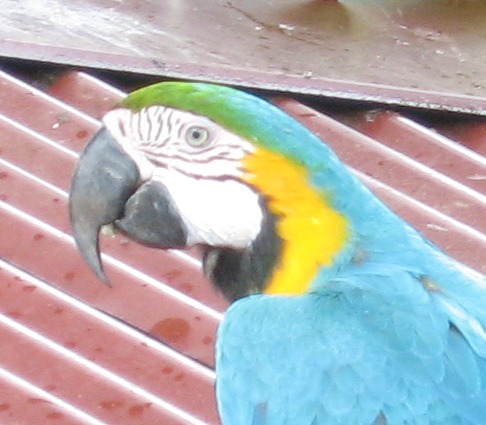
We found the idea of a hotel here a little strange, especially since there are no beaches. If your fiancee proposes spending your honeymoon at Devil’s Island it’s probably not a great omen for your marriage. Near the hotel we saw parrots & peacocks and we also saw a number of colorful roosters.





There was interesting flora as well, including the water lilies in the reservoir and some red and blue flowers near the hotel.
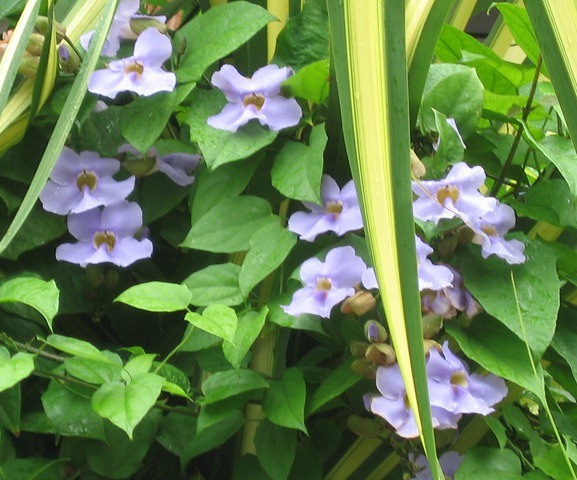


Finally we walked down around the back of Ile Royale, where we encountered a telephone booth in the rainforest (!) & some beautiful views of the surf through the palm trees.


From this side of the island you can also see the actual Ile du Diable, which is where political prisoners were kept. Captain Alfred Dreyfuss lived in a hut on this side of Devil’s Island for 5 years before the French finally admitted he was innocent of the espionage charges against him. For those who may not know, this was one of the most notorious cases of anti-semitism in the 19th century, since it is now accepted that Dreyfuss (who went on to serve with distinction in World War I) was picked by the French military to be a scapegoat in the case because he was Jewish. Today, Devil’s Island is inaccessible because of the strong currents & crashing surf.


Another interesting thing here (but I don’t have a picture) is a rocket tracking station. The French have their version of Cape Canaveral on the coast of French Guiana, not far from Ile Royale, and they have built a small station here to track the ascending rockets. We were told that the islands are evacuated when a rocket is launched because of its closeness to the launch site (except for the monkeys, who are allowed to stay).
So, that’s it from Devil’s Island. As I write this, we are on our way into the Caribbean Sea toward St. Lucia, and the seas have been quite rough. The barf bags are out in their little dispenser boxes near the elevators but we haven’t seen anyone who needed them (they are probably ensconced in their cabins). But there are only two islands & 4 days left before we reach Florida and the cruise is over. It has been a really great trip, but we are looking forward to getting home.
Parintins, Brazil
On Saturday, March 3 we arrived at Parintins, a city of about 100,000 situated some 500 miles up the Amazon, about halfway between Manaus to the ocean.

The reason we stopped here was to see the Boi Bumba (“beat the bull”) show that is unique to this town (more on that later), but we went ashore a couple of hours before showtime to look around the town. We were told that there wasn’t much here and that was correct. We saw the usual fruit & vegetable stands and a few interesting houses (not many). It seems that the primary means of transportation here is by motorcycle or bicycle, and there were a number of bicycle powered rickshaw type vehicles, which seemed to be especially for tourists (we walked).


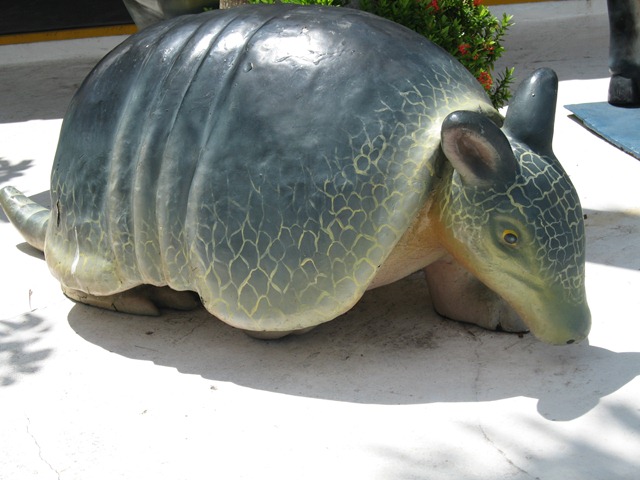
There were some unusual statues of animals (made of concrete, I think) and some phone booths shaped like the bulls that are at the center of the story of the Boi Bumba show (“oi” is what Brazilians say when they answer the phone; my grandmother would have been right at home).




There were also some interesting mosaic sidewalks, but utterly unlike the others we have seen.


Then there was the Boi Bumba show. Every June (at the end of rainy season) Parintins puts on a Boi Bumba Festival. It lasts for a week or 10 days and culminates in 3 days of performances of the Boi Bumba show. People come from all over Brazil for this festival and the population of the town about triples, with many people sleeping on hammocks in river boats crowded around the harbor.
Boi Bumba apparently grew out of a Portuguese settlers’ tradition of annually giving thanks for their new homeland, and the story (involving the killing & resurrection of a prize bull, and other stuff too complicated to follow) is based upon an old legend revived for this celebration in the 19th century. At some point prior to World War I the local Montagues & Capulets (actually named the Monteverds & the Cids) developed a rivalry in putting on this celebration and to this day the town is divided into two Boi Bumba teams, the red team and the blue team, who present competing versions of the story.
What we saw was a one hour fragment of the full show presented by the red team. It involves music and dance, a single one-hour performance with no breaks. A single singer sang for the entire hour without letup, accompanied by a percussion heavy band. The dancers were mostly young people, many appearing to be about high school age, and the show was filled with extremely colorful costumes, with lots of feathers, & floats & props. The dancing was very energetic, with lots of high stepping and arm waving. We thought the dancing had a bit of a hip-hop feel to it, but it was all highly coordinated like a Broadway musical. The whole effect was quite awesome, particularly when you remember that this is being done by the young people of a town of only 100,000. (Many beautiful young girls in this small town, which made me think of Lake Wobegon, since it appears that all the girls are prettier than average). There are a few pictures below which give you only a rough idea, since my camera didn’t do very well indoors with the lights out & the dancers moving, and it ran out of memory card about half way through. But I will start with a couple of pictures I took before the show of some costumes waiting to be worn.


After the show we returned to the ship, VERY hot & sweaty (from the dismal climate, not the show) and partook in a Brazilian Barbecue held out on deck. The town set off fireworks then, either as a farewell or as a celebration of our departure, I don’t know which. And we headed for the sea.
Before I close this off, however, on Sunday afternoon, March 4, we crossed the Equator heading out of the Amazon. This was our fourth crossing and the ship staged a pretty silly ceremony, in which crewmembers who had not crossed the Equator before this cruise were initiated before King Neptune (played by our travel guide, a proper Englishman), who required that they be covered with garbage (literally, old food) & dunked in the pool. This apparently is descended from a British naval tradition in which sailors were thrown overboard to initiate them the first time they crossed the Equator. Since I had to watch this, you do too.


Manaus, Brazil (day 2)
We got up early on Friday, March 2, because we were scheduled to take a boat trip and we had to be back before the ship left in mid afternoon. The river itself is very interesting. There is quite a bit of boat traffic (there are 70,000 boats registered in Manaus) & a lot of logs and other natural debris. In Manaus they actually have floating gas stations, and we have seen a lot of what appear to be floating lawns, large clumps of grass floating down the river to the ocean.

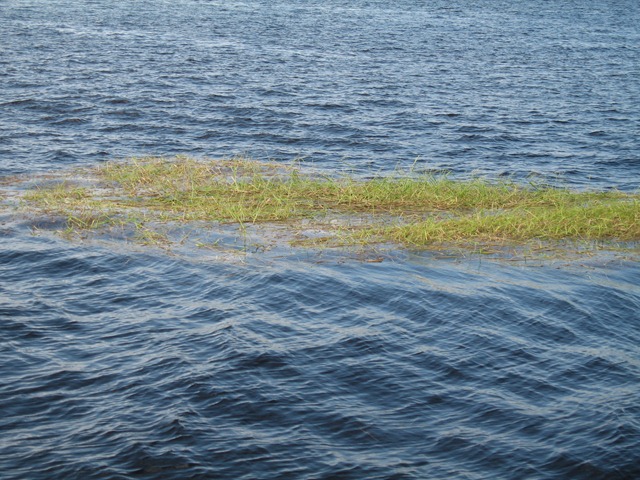
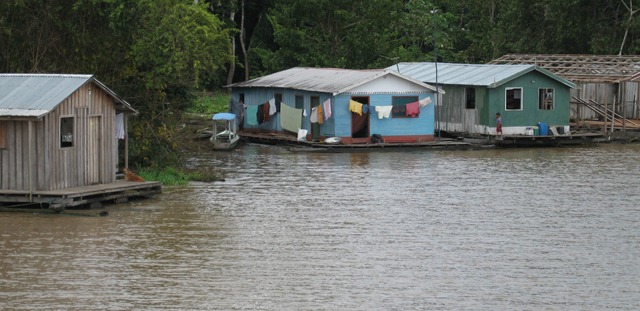
We were very lucky because the weather was quite beautiful that morning, while the people who took this trip the day before saw nothing but rain. The first part of our trip was in a two level Amazon river boat. We saw neighborhoods of Manaus with houses near the water on stilts, and some with river boats ashore (perhaps to be floated when the river rises, or else pushed into the water when needed).


We saw some villages on tributary streams built largely on stilts and others in which the houses actually float on the river. The children in these villages are picked up each morning by the school boat, which takes them to school.


At a fairly remote stop we transferred into 10 person canoes (which are actually boats with motors) for the trip to Lake January & through some of the flooded marshlands & streams.
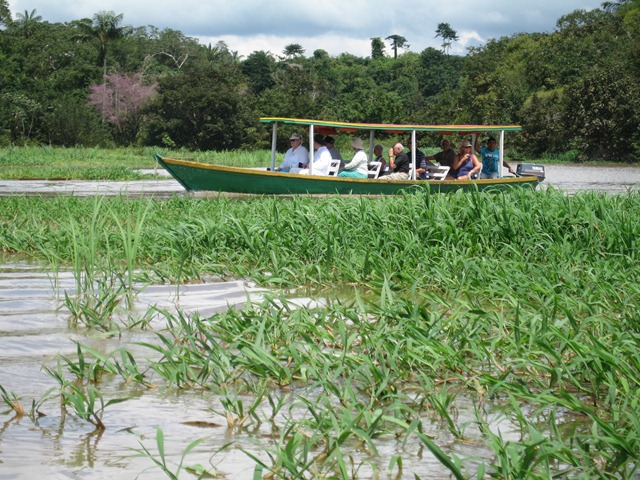


We saw a number of unusual birds on this trip, some pretty butterflies, a sloth (hanging upside down with his head away from you), a caiman and others I wasn’t able to photograph. For example, this area is home to anacondas and the guide told us that the movie of that name was actually filmed here. Another form of wildlife that lives only in the interior of the Amazon is the pink freshwater dolphin. We didn’t see any of these and although some other folks on the ship said they did we have concluded that they are like pink elephants, which can only be seen when you are inebriated. I guess that sounds like sour grapes.


On Lake January we also saw giant water lilies. The leaves of these things are about five feet in diameter and there are about a dozen leaves to each flower (although the leaves float they are connected to the bottom of the lake by stems). The flowers only open at night and only for 3 days each, changing from white the first day to purple the third. We found them very interesting.


They took our boat off the lake & river & into the already flooded rainforest (the flooding will get much deeper by June but a few months ago this entire area would have been dry land). Our guide spotted a tiny wasp’s nest on a hanging tree branch & carefully maneuvered around it. But then the second boat came barreling past us & smacked right into the nest. Needless to say, this made the wasps very angry & they swarmed out (very tiny looking wasps), but the other boat had gone so fast that we were the only ones they could see. So we hightailed it out of there. As you can see, there are a lot of trees here deep in water and there were also a lot of yucky looking termite nests.


On the way back to the river boat we saw a 400 year old tree, which had an unusual root system and was tall enough that we couldn’t see the top through the rainforest cover. We also saw a house in the rainforest with a platform by the river covered with grass.


By the time we got back to the river boat it was pouring rain (did I mention that the weather around here is amazingly changeable?). We got in the boat & they pulled down plastic sheeting all around so we couldn’t see much, then we left to go downriver to the Meeting of the Waters. Manaus isn’t actually situated on the Amazon. It is about 3 miles up the Rio Negro river from the spot where the Rio Negro & the Rio Solimoes converge to form the Amazon proper. The water of the Rio Negro is very dark (hence the name) while the water of the Solimoes is light brown, like cafe au lait. Because one of these rivers flows faster than the other (I can’t remember which) & the chemical makeup of the water is different, the rivers don’t mix together immediately but flow for several miles side by side. You saw a version of this phenomenon in the episode for Santorem (which is pronounced with an accent on the first & especially on the last syllable, so it doesn’t sound like Rick Santorum, thank goodness).
Anyway, with the pouring rain we did not expect to be able to see much at the Meeting of the Waters. However, as I mentioned before, the weather here is very changeable and we did get a very good look from close up on this relatively small river boat.


Later, as the ship passed this spot, we saw it from a larger perspective.


Then the ship took us down the Amazon toward our last Brazilian stop in Parintins.


Manaus, Brazil (day 1)
In the early morning of Thursday, March 1, we sailed into Manaus. This is a city of almost 2 million people located almost 1000 miles up the Amazon River.


I don’t know about you, but this is not what we would have expected in the interior of the Amazon. Manaus was founded in 1669 but really hit its stride in the second half of the 19th century as the center of the rubber boom, when huge amounts of money flowed through. Rubber trees are native only to the Amazon region, so this area had a monopoly on rubber (one of the essential ingredients of the industrial revolution) and there were strong laws to protect that monopoly. Natives were ruthlessly exploited as laborers to go through the rainforest where the trees were scattered & tap out the latex. However, in 1876 a fellow named Henry Wickham smuggled 70,000 rubber tree seeds to England, where they were grown into trees in Kew Gardens in London & transferred to British possessions in Asia, the source of most rubber today. Wickham was branded a criminal & traitor in Brazil, but was knighted in England.
During the height of the rubber boom local rubber barons built fabulous mansions & even an opera house. The famous Teatro Amazonas (trust me, its famous even though you and we may never have heard of it before) is an elaborate pink & white structure, all of which was imported from Europe. Even the wood floors & seats, made of Brazilian wood, were manufactured in Europe & then sent here. It took 15 years to build, was opened in 1896, and has hosted many world-class performers (there are no highways here, so the only way for performers & the components of the building to get to Manaus was by boat, & now by plane).


We took a tour of the Teatro. The orchestra was rehearsing on stage and the concert hall was quite elaborate (remember, every bit was imported from Europe & shipped up the river). It was very rainy that morning (this is a rainforest, after all), so that is why Mary looks a little soggy in these pictures.


Upstairs were several salons with inlaid wood floors, painted ceilings and a porch with statues on the corners. We had to put slippers over our shoes to protect (and help polish) the floors.


A lego model of the Teatro was on prominent display in the front corridor.


Next to the Teatro is the Palacio da Justica. The woman with the umbrella in the first picture is the orchestra’s concertmistress.


We went to see the Cathedral, officially the Nossa Senhora Conceicao Catedral, which was nice & not overly elaborate.


There were some nice mosaic sidewalks near the Teatro, reminiscent of Copacabana in Rio, and we passed the clock tower & many vendors’ stands.


We visited a building called the Palacio Rio Negro, which was originally a rubber baron’s mansion but is now a cultural center. Inside were some beautiful wooden stairs & rooms (presumably made in Europe too) & some unusual paintings, including one depicting Amazon women warriors attacking the Teatro with flights of angels descending. Another showed the first flight of a Brazilian named Dumont who, they claim, invented the airplane before the Wright Brothers (a claim not accepted by anyone outside Brazil, as far as we can tell). Just looking at that thing you can tell that it could never achieve controlled flight.


Of course, we found the Biblioteca Municipal (although it seemed too small to be the central library of such a large city) and we also walked by the old Customs House, built in England and then disassembled and transported here piece by piece.


The dock area of Manaus is particularly interesting. The river’s height varies by some 40 feet from the dry season to the wet season (we are about halfway through the wet season now so there is still quite a bit of rising yet to come). So they have built floating docks, which rise & fall with the river. Also near the dock are the ruins of a block of old buildings, reduced now to their interesting facades with vines & trees growing through the openings.


We had a beautiful sunset, then that night we had a Folklorico show on board the ship depicting Amazonian dancing from the Indians through the Samba. The pictures are pretty fuzzy but they give you an idea. After that we went to bed, having had a very full day & needing to get up early the next day.


 BADER JOURNAL