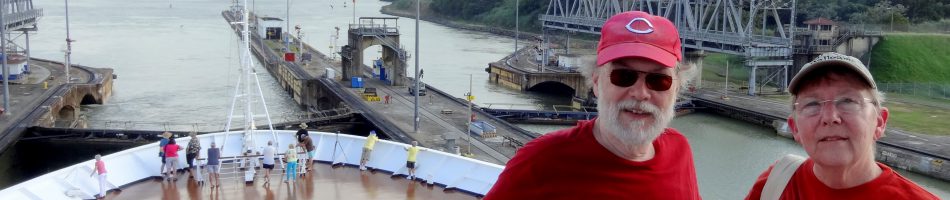
Armacao dos Buzios
Thursday, February 16 found us in Armacao dos Buzios, playground of the rich and famous (or at least the rich).

Buzios was an obscure fishing village until 1964. That year Brigitte Bardot visited her Brazilian boyfriend in Rio, but they could not leave his apartment without being hounded by paparazzi. So they secretly left Rio and came to Buzios to escape attention. They stayed only two days, but when word got out Buzios became the new hot beach destination & quickly grew into a small resort town. As a result of her two whole days in Buzios there is a lifesize bronze statue of Bardot, called the Orla Bardot (she’s the bronze colored one in the picture).

This is a beautiful little beach town but there really aren’t any other landmarks to see so we walked around for a few hours. There is, of course, a beautiful beach.


There is a picturesque harbor next to the beach.


There is a restaurant for the vegetarians in the audience and it appears this town must be the home of some people’s favorite cartoon character.


There is a wonderful sand castle. We were told that the same guy rebuilds it every day after the tide washes it away! There were some spectacular sandcastles on Copacabana beach but our bus was moving too fast to get a photo, so we were glad we could get one here.

We haven’t seen graffiti in a while on this blog but there were some interesting ones in Buzios.


We did come across some interesting sculpture, beyond Bardot. The three fishermen with their nets in the bay are really sculpture, as you can see by the second picture where there are birds sitting on their heads. There was another fisherman sitting in town mending his nets.


There was also a wild collection of very colorful & whimsical sculpture, many more than you see here.


The fauna here included sea birds and these unusual frogs.


And, of course, there were a lot of beautiful flowers, on trees and in the ground.


So, that’s pretty much it for Buzios. A nice, picturesque little beach resort community where we spent a pleasant day.
Rio de Janeiro Part II: The Saga Continues
Rio is, of course, known for its elaborate Carnaval. This year, Carnaval is next week so there were signs around for the parade & much buzz. Carnaval, by the way, is the last day of eating meat before Lent; hence the name derives from meat (carne in Spanish).


On our tours we saw the stadium where the parade will pass the viewing stands as well as the building where it is staged. In the first picture, which is one end of the stadium area, there is a huge symbol that looks a little like McDonald’s arches. This is the symbol of Rio’s Carnaval, and we were told it was actually modeled on the bottom part of a string bikini. The parade is staged by the “Samba schools,” the first of which was established in 1928, which are really clubs rather than schools. There are two levels, poetically titled A and B, and I think they said there are six schools in each level. Each school’s performance is judged each year, and the lowest scoring one in level A is demoted to level B while the highest scorer in level B is promoted to A. So there is fierce competition since there is much prestige involved in being in level A, as well as in winning a prize.


On the night of February 14 we had a Samba show on the ship. The name “Samba” has always sounded to me like a cool, relaxed, sophisticated kind of dance. We have been told that there are many genres of Samba, much as there are of American Jazz, but the version we saw (which we understand is like what is in Rio’s Carnaval parade) is nothing like that. The music is all drums & percussion, very loud with insistent rhythms. The dancers are scantily clad and/or elaborately outfitted, and the dancing is very hot and provocative. All the music was made by men, and almost all the dancers were women. It struck me as being very African. Mary found it rather tedious, because the music was all rhythm and continued incessantly for about an hour without any breaks, but I found it pretty compelling. I was told later that some of our passengers walked out early because they found the dancing offensive but there were others who got up and danced and were totally involved. I took some video, which of course I can’t post here, but here are some photos that might give you an idea.


We were told that more than 2.5 million dollars worth of Ostrich feathers are used every year at Carnaval, and you can see why in these pictures. Most of them are thrown in the garbage afterwards; only about 20% can be recycled the next year. In the fourth from the last picture, you can see that the dancer is holding the hands of the man behind her in line; apparently, he had been putting them where he shouldn’t since all the other dancers had hands on their hips. So, I guess he’s not too old to boogie!
On February 15 we were on an excursion to Corcovado, a mountain that is substantially higher than Sugarloaf. You go most of the way up on a train with tracks steep enough that we kept slipping off our seats. Then near the top there is an elevator the rest of the way. The train has been running for more than a hundred years but the statue of Cristo Redentor wasn’t built until 1931. As I mentioned yesterday, it is considered one of the 7 wonders of the modern world, although I’m not sure why; it was refurbished last year & they added a chapel in its base. Lots of people had the same clever idea to pose in front of the statue with their arms held out horizontally (so original), so we didn’t.


And of course the vistas from the top of Corcovado were outstanding.


In the last picture above you can see a canal running from the bottom center up across the beach. This is the dividing line: on the left is Ipanema & on the right is Leblond.
I have discussed earlier the Favelas and Rio is famous for them. If you have ever seen the old movie “Black Orpheus,” it is about life in the Favelas & also about Carnaval. It’s an interesting movie and includes some marvelous Brazilian music. Anyway, here are pictures of a handful of the hundreds of Favelas. The first one is one of the most famous, La Recinha (I think that’s right), one of the first to be cleaned up of drug dealers. It sits on a beautiful hillside near Leblond beach overlooking the ocean. Our guide tried to tell us how great life is in the Favelas – low taxes, beautiful views from the mountainsides, free schools – to the point where I wanted to ask her why she hadn’t moved into one (but my mother raised me to be more polite than that).


In the last picture you can see that each story of each building is a different color like a stack of colored blocks. As it was explained to us, the way many of these Favelas grow is that one person builds a one story boxy house, then sells the roof space to another person who builds a house on top of it, who then sells their roof space to a third person who builds another house on top of that. Sometimes these stack up to 5 stories. I have no idea how they access the third story (stairs?), or connect illicit electric lines (pretty haphazard, as I understand it). In many of them there is no running water so they buy water in bottles. It doesn’t sound to us like a nice way to live regardless of the view.
There was also some flora and fauna for those of you who like that sort of thing. There were some interesting birds with swallow-like tails, many of which fly around the city in strict formation, although we don’t know their names. There were also buzzards (some said black buzzards, but we don’t really know), and also some small lizards on Sugarloaf.


We saw some trees we had never heard of, including the Jackfruit & the Cannonball tree (with a fruit on the left of the tree & flowers on the right). And there were some flowers & plants whose names we don’t know.


Almost time to leave Rio, but how can I end this without some towel animals? So, for you towel animal fans, here is your daily fix:


So now we say goodbye to Rio, sailing out shortly before sunset, and I will leave you for now with one final view of Sugarloaf & one of Corcovado, just because I can’t get enough of them.


Flying (or Sailing) Down to Rio (Part I)
We sailed into Guanabera Bay at Rio de Janeiro at sunrise on Tuesday, February 14. This is a huge but really beautiful city, with mountains, rainforests & beaches everywhere. There doesn’t seem to be an accurate account of its population because there are almost a thousand Favelas in Rio (Favela is the name for the squatter communities like we saw in Lima) and the government has no way to accurately count their occupants, particularly since officially most of them don’t exist. Because Rio is to host the World Cup in 2014 & the Olympics in 2016 they are working hard right now to clean up the Favelas. They have successfully driven the drug dealers (who dominate many of the Favelas) from a few of them & somewhat regularize their use of services like water gas & electricity. But even for those few that have been cleaned up the head count is doubtful. We were told about one in which the govt. says about 75,000 people live but the electric company has 140,000 meters there, so the government clearly hasn’t yet gotten a handle on the population. The best guess we heard for the total population of greater Rio was 14 to 16 million. The people here call themselves Cariocas (I don’t know why, but I’m sure there is a reason).
Anyway, this is a city of breathtaking vistas so you will see a lot of them here. The landscape is dominated by two mountains, Sugarloaf & Corcovado (which means “hunchback”), the latter of which is topped by the Cristo Redentor (Christ the Redeemer), the huge statue of Christ that has been named one of the 7 wonders of the modern world (we have wondered who is authorized to make such a designation, and we don’t know what the other six are, although the Taj Mahal is probably on the list). We passed both of these on the sunrise sail into the harbor; and the Cristo Redentor was lit up. In the first picture Sugarloaf is on the right & Corcovado is just to the left of center in the background, with the lighted statue atop it. The second picture is Sugarloaf & the third is Corcovado.


Rio has an airport right on the water that is used just for shuttle trips to Sao Paulo every 15 minutes. The planes fly in low & look like they will land in the water. Nearby is the old customs house on an island in the bay, and there was a Favela on a hill behind the dock. Note in the upper right corner of the Favela picture a formation of birds flying by. We saw birds flying in formation over the bay & the city all the time here.


On February 14 we went on an excursion to the top of Sugarloaf mountain. To get to the top you have to ride two cable cars – not the kind you see in San Francisco but cars hanging from a cable way high in the air. First you ride up to an intermediate level mountain, then switch to another car for the trip to the top.


They have been running cable cars here for about 100 years without incident so it’s really safe. Inside it’s like being in a subway car (only with a better view). However, the car does sway a bit when you step off. The views even from the middle level of Sugarloaf are pretty spectacular; as you can imagine, pictures do not really convey the full effect of a 360 degree vista.


From the top of the mountain, the views were even better.


From Sugarloaf we could see the most famous beaches of Rio: Flamingo, Copacabana & Ipanema.


We drove along the beaches on both days. They are very long (Copacabana 1 mile, Ipanema 2 miles) with beautiful blue water & white sand. In addition to Copacabana (pictures 1 & 2) & Ipanema (pictures 3 & 4), we drove past Leblond beach (which is contiguous to Ipanema – named for a blond Frenchman who once frequented this beach) (pictures 5 & 6) & stopped at Sao Conrado beach, where hang gliders landed from the top of a mountain overlooking the beach, for a taste of Coconut. We were told that coconut water will keep you healthy & cure everything from arthritis to alzheimer’s. But I only had one, so it will probably only stave off alzheimer’s for a couple of weeks.


Brazil has no private beaches so access to these is open to all. However there are sections recognized as areas where particular groups congregate: Copacabana is primarily for families we were told & there are sections of Ipanema for gays & lesbians, for young people, for children, for topless bathing. We passed the Copacabana Palace, the best known hotel on the beaches. Sound like a nice place to retire? Forget it; we were told that the condos in the high-rises on the street bordering Ipanema start at $20 million. And to shatter yet another illusion, contrary to popular understanding not everyone on these beaches is “tall and tan and young and lovely,” although that doesn’t stop them from wearing bikinis.


One thing we found interesting is the sidewalk mosaics in Rio, and really throughout Brazil so far (we have seen them in two other cities visited since). In addition to the famous undulating sidewalk design at Copacabana beach, there was a different pattern at Ipanema & Leblond, and several others around town. All of them are made from white & black (& sometimes red) stones about 2 to 3 inches in diameter; it must have been a lot of work. Below are a clos-up showing how the individual tiles fit together & then the sidewalks of Copacabana, then Ipanema, then a few others with mouse-over labels (you can also see these in the beach pictures above).


In the afternoon we walked down the Rio Branco, the main street of the central section of Rio. Much of it consisted of boxy modern office buildings but the sidewalks were mosaic and there were some interesting older buildings. This was a very modern, busy thoroughfare with heavy traffic on foot & in cars. Yet on the afternoon of the second day, our tablemate Bing was attacked there in broad daylight by a couple of guys who tried to tear a gold chain from his neck & run off. Bing is an older guy (early 70’s), but fortunately our other tablemate Steve, a retired fireman, was with him. He chased off one of the attackers & got the other in a headlock; Bing had grabbed his chain & managed to hold on. The second attacker then ran off & Bing still has his gold chain, though it is broken. The lesson here is that in foreign cities (really any big city) you should never wear jewelry or carry a camera or purse that looks worth stealing. We have been warned about this several times; Mary & I (of course) always look like we don’t have anything worth stealing & my camera fits in my pocket (a surprising number of the passengers on this cruise carry big cameras with very long lenses that look like they must weigh about 30 pounds).
Anyway, we didn’t run into any trouble on Rio Branco. We saw a nice old church, built a few hundred years ago by a fellow who survived a shipwreck, with a nautical theme. I only got a partial picture of the outside while driving by in a bus and it is not one of the important churches in Rio, but looking at the interior would make you think it was a major cathedral.


Further down the street is a square with several of the main buildings in Rio. With the World Cup & the Olympics coming up, it seemed like every building in town was surrounded by fences and scaffolding as they work to restore & beautify the city for the world stage. But we saw their beautiful opera house with its eye catching gold roof decorations.


And of course we saw (or rather sought out) the Biblioteca Nacional, which is a little less spectacular.


OK, I was planning to do all of Rio in one posting but this is already quite long and there is quite a bit yet to go. So I am going to stop now, even though we aren’t really through day 1, and finish up in a second posting.
Montevideo, Uruguay
On Saturday, February 11, we arrived at Montevideo, Uruguay. It is much smaller than Buenos Aires, but still a big city at about 1.8 million people (including suburbs). It had a much more relaxed and friendly ambiance than Buenos Aires (of course, it was a weekend, but still . . .), and we liked it very much.

We were supposed to arrive at 8:00 AM. Since Montevideo is just about 150 miles down the Rio Plata from Buenos Aires you would think we would have no trouble arriving on time. But you would be wrong. Because of the problems with the river traffic I explained yesterday we didn’t arrive until noon. But we still had plenty of time to explore this city on foot before the ship left that evening.
Montevideo is a very walkable city (at least the old town & the main part of the new town, where we went). Leaving the ship, we passed the anchor from the Graf Spee, a German warship sunk in the harbor here in 1939 in an incident that was famous at the time. It seems the ship was chased into this harbor by several British ships. Uruguay was neutral, and the rules were that ships of belligerents could only stay 3 days, so the British ships just waited outside the harbor for the Graf Spee to come out. Instead the captain scuttled the ship in the harbor, where it still resides (they say you can see the top if its conning tower above the water if you go close enough), and the captain committed suicide rather than being sent back to face Hitler’s wrath. It’s still a big deal around here. Just outside the harbor area is the Mercado de Puerto, an open air craft & souvenir market next to a very large warehouse type building housing a plethora of open restaurants. Even on Saturday it was bustling.


We walked through several streets & plazas up the hill from the harbor (Montevideo means something like Mountain View, although you would hardly call this gentle hill a mountain). The streets of Montevideo are interesting, with old & new buildings interspersed. The streets were pretty quiet on Saturday, presumably they are more crowded on business days but nothing like Buenos Aires I am sure.


At Plaza Constitucion there was a Saturday flea market being held. It is a very pleasant tree covered square, with an elaborate marble fountain in the middle (commemorating the establishment of the city’s water system) and a number of interesting buildings and the Catedral Matriz around the perimeter. At the flea market they were selling everything from antique cameras & cameos to old victrolas & glassware.


We walked on to the much larger & more impressive Plaza Independencia, which is essentially the center of the city. To get there we walked along a pedestrian-only street with vendor stalls and through a gate which is a restoration of one of the original gates to the city.


Plaza Independencia was surrounded by interesting buildings. The Palacio Salvo, with its bizarre tower section, is the tallest building in Uruguay and was the tallest in South America when it was built in the 1920’s (you can see it on the right in the city skyline at the top of this blog entry). The Palacio Estavez was the center of government until 1985. And the lovely Teatro Solis, the opera house, is on a corner of the Plaza called (at least on our map; we couldn’t find any sign at the site) “Plaza Golda Meir.” I’m not sure what Golda Meir might have had to do with Uruguay, but there it is.


One of the biggest pleasures of exploring Montevideo is the beautiful old architecture you find all over, often mixed in with more modern or even pedestrian buildings. Below is a selection of some of the architectural details on the buildings, which includes a variety of sculpture, balconies, mosaic decorations and old ornate buildings reflected in a modern glass building (a photographic cliche, I know, but still pretty).


And so, as the sun sinks slowly in the west, we bid a fond farewell to beautiful Montevideo. Last night was the Valentine’s Day Ball aboard Prinsendam (even though it was February 12, which ought to have involved Lincoln’s birthday instead). I have no pictures of the Ball (Cinderella didn’t make it this time) but below I have included the latest towel animals. As I write this, we will be arriving in Rio de Janeiro early (6:30 AM) tomorrow morning for a two day stay, then two days in small resort towns with little to do but look at the sand & sky & sun (assuming the sun is actually out) so it may be a few more days before there is another posting. And happy birthday to Linda, if you are still following this.


Buenos Aires
Buenos Aires is a huge, crowded, loud city, which reminded us in many ways of New York. There are about 3.5 million living in the city & about 14 million (!) if you include the suburbs. It is sometimes called the “Paris of South America” & many seasoned travelers say it is their favorite city, but we couldn’t see why. Of course, we didn’t eat in its restaurants, which are supposed to be outstanding if you like steak (and lots of it), and we didn’t stay in any of its hotels, some of which looked pretty fancy. But still: big, loud, crowded; not our cup of tea.

We arrived on Thursday, February 9 for an overnight stay. We were supposed to be able to go ashore about 8:30 AM, which would have given 2 full days (& 1 night) there, but we actually didn’t arrive until after 2:00 in the afternoon. Buenos Aires is not on the ocean, but a 9 hour cruise up the La Plata river. It seems that the La Plata river is pretty shallow so you have to take ocean going ships through a channel, and to make matters worse there was a disabled ship halfway up the channel. As a result, river navigation was only one way at a time so they were scheduling ships for convoys each way, kind of like when one direction on a two-way road is under construction so that one line of cars travels in one direction while the other direction is stopped. Well we were two hours late leaving the Falkland Islands so we missed our place in a convoy going up the river, resulting in our arriving about 6 or 7 hours late.
We had booked a private tour that would have taken all day and involved walking around in a number of areas of the city & lunch in a restaurant. However, that tour was cancelled because of our late arrival so we scrambled to get on a “Buenos Aires Highlights” bus tour (it was too late to do any worthwhile exploring on our own since it took about half an hour to get downtown from the port, involving two shuttle bus rides). This was a 4 hour trip around town by bus with a guide, including two stops, at the Recoleta cemetery (where Evita Peron is buried) & at the La Boca neighborhood.
The Recoleta neighborhood is an old, wealthy part of town. The cemetery there is old & is for the wealthy aristocracy of Buenos Aires. Apparently Buenos Aires has historically had a very haughty aristocracy. Anyway, this cemetery is a creepy city of above-ground mausoleums, many with grand statues & architecture (and thus very expensive). Seventy of the mausoleums are national monuments!


But today this cemetery is famous, and a mandatory stop on all tours, because Evita Peron is buried there. Our guide told us that before the musical Evita! came out (and it has never been performed in Argentina), none of the tourists were interested in Evita & most had never heard of her. But now, she says, she would be killed by the tourists if she skipped this spot. Evita was an illegitimate child in a poor family but her mother claimed (I don’t know if its true) that a wealthy aristocrat named Duarte was actually her father. When Evita died of cancer in 1952 she was buried in the Duarte family mausoleum in Recoleta, over their objections (since they didn’t recognize her as part of their family) because her husband was President (and she was really the power behind the throne because of her extraordinary popularity). But when Juan Peron died in the 1990’s, no longer holding that power, he was buried elsewhere (for a while outside the country) because the aristocrats wouldn’t have him in their cemetery. At least this is the story we were told. Anyway, here is the Duarte mausoleum (it’s one of the less conspicuous ones, on a small side street in the cemetery) with one of several plaques outside honoring Evita. We were told that there are fresh flowers placed on the door every day.


There is also a statue of Evita in the Recolleta district, erected (we think) in 2002 on the 50th anniversary of her death.

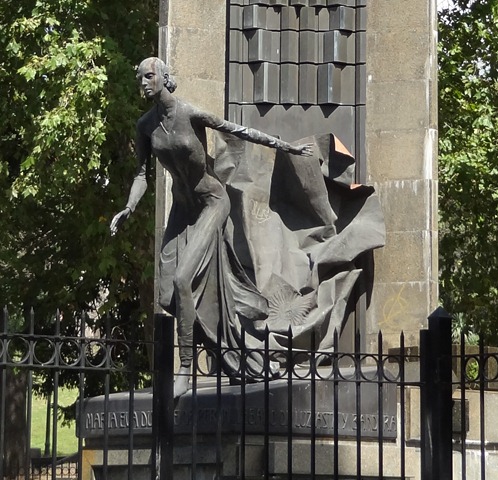
La Boca is the Italian neighborhood of Buenos Aires. It was also the location of the original port (the new one is much bigger). It has a mixture of bohemian, poor and tourist ambiance, but I think the last one probably predominates. But it is colorful and enjoyable and some of its features look like they would be at home in Disney World.


Buenos Aires is, of course, famous for the Tango. There are tango shows all over town & people even dance it on street corners in La Boca (although we missed one that was going on near where we were). It is an interesting & a sexy dance, but the cult is really a bit overblown. Still, here are a few tango paintings that were for sale in La Boca that I thought were interesting.


That night there was an Argentine folk dancing show on the ship. We thought it was quite good (except for the lame narrator, who kept injecting himself into the middle of the music). Notable was a tango (of course), performed by a couple who we were told were the tango champions of Argentina 5 years in a row. The pictures aren’t very good, since the light was low & they were moving fairly fast, but you get the idea.


Also there were some interesting gaucho dances, with guys in balloon pants & gaucho hats acting very macho. Particularly good was one in which a guy (the same one who did the tango) danced with bolas swinging in intersecting circles in each hand, and finally with him holding them between his teeth. I’m guessing there were some some nasty bumps raised on his head while he was learning how to do that!


On our second day in Buenos Aires, Friday, February 10, we walked around town by ourselves. As I said, it’s a loud & crowded city & we walked quite a way. There are many beautiful old buildings in the city, many with lovely wrought iron balconies, often right next to boring modern ones.


We walked by the Teatro Colon, a huge & ostentatious opera house, which appears to be made of marble. Nearby is the Obelisco (which looks like the Washington monument) in the Plaza de la Republica, erected in 1936 on the city’s 400th anniversary.


The Avenida 9 de Julio is one of the widest boulevards in the world. Not far from it we saw the impressive Ministry of Justice (we think), for you lawyers out there.


We walked up to see the Congresso Israel, which we think is the oldest synagogue in the city. Buenos Aires has a large Jewish community, the second largest religious community in the city (far behind Catholics, of course). There is a Jewish museum nearby.


Then we walked all the way back to the Recoleta area to find the Biblioteca National (national library) so that the librarians in the viewing audience won’t feel left out. It was quite a long walk and we had a lot of trouble finding it. In the end, it was impressive, but I sure wouldn’t say beautiful (particularly in a city full of beautiful public buildings). The sign in the second picture, which is probably too small for you to read, says that this is the library’s 200th anniversary.


Finally, we didn’t see any notable fauna here, but there were some interesting trees. In the first picture the slim attractive tree in the foreground with the pink blossoms is the male & the ones with the white blossoms and fat tummies are the females (this seems to be how nature works in all species but humans). I didn’t catch the names of these trees. Also in a park we saw these trees with massive root systems above ground that looked interesting. And last (and probably least) is another clock tower reputed to resemble Big Ben in London that really doesn’t. Maybe no Latin Americans have actually seen Big Ben.


So ends what was supposed to be 2 days in Buenos Aires but turned out to be only one day plus 2 hours. The full 2 days would have been plenty to see this city, huge as it is, but we thought we did pretty well given the time limit. Amazingly, this is not the biggest city we will have seen by the end of our trip.

 BADER JOURNAL