Latest

Benoa, Bali, Indonesia

     We reached Bali, our first stop in Indonesia, on the morning of February 23.  Indonesia is a vast country, spread over many islands with a total population that is the 4th largest in the world (after China, India & the USA).  Situated on the line between two tectonic plates, Indonesia is littered with volcanoes, some still active, two of which are on Bali.  Formerly the Dutch East Indies, Indonesia obtained its independence after World War II.  Indonesia includes the Spice Islands, which are what Columbus was trying to reach when he discovered America (he never got anywhere close, of course).  At that time spices were among the most valuable articles in Europe (whose food at that time before effective preservation was often less than appetizing by itself) because the Turks’ capture of Constantinople had largely cut off the overland trade in spices from the East.

     Bali is one of the smaller populated islands in Indonesia; it is shaped like a chicken that has just laid an egg.  Its population is largely Hindu & it seems that just about every family has its own temple in its courtyard surrounded by walls.  We saw many shops selling carved stone, which must be a thriving business since everyone has to have some for their family temples.  Bali is also known for its woodworking artisans.  And the favored method of transportation seems to be by motorbike (really, this is true of all of our Indonesia stops), with crowds of them in the city & whole families of four people riding one bike in the nether regions.

223. Bali, Indonesia216. Bali, Indonesia220. Bali, Indonesia301. Bali, Indonesia

     We were met on the pier by a group of women performing a welcoming dance, with an indigenous band to accompany them.  February 10, before we arrived, was Indonesian Victory Day (independence from the Dutch), and throughout Bali large bamboo poles with decorations hanging from them used to mark that day were still in evidence.

1. Bali, Indonesia3. Bali, Indonesia143. Bali, Indonesia177. Bali, Indonesia

     Our first visit in Bali was Klungkung, the site of the court of the last kingdom of Bali.  This complex contains several buildings, or pavilions. In the traffic circle outside is a sculpture called Kanda Pat Sari, guarding the four directions of the compass.

89. Bali, Indonesia34. Bali, Indonesia

     Upon emerging from the bus we had our first encounter with the persistent, but not aggressive, street vendors we would see throughout Indonesia.  They offer their goods for “one dollar,” but as our guide explained, it would turn out that the one dollar was just for looking and the purchase price would be much more.  Often the vendors were small children.  It is best to just say “no thank you” and walk on; if you engage them at all they will follow you a long way.

11. Bali, Indonesia12. Bali, Indonesia

     The Kertha Gosa Pavilion was the hall of justice, the highest forum for resolving the most intractable cases.  It is notable for its intricately painted ceilings, many depicting punishments in the after life.  Originally painted most likely in the mid 19th century, they have been restored several times by local artists and in the 1940’s the original paintings on cloth were so badly worn that they were replaced by copies on asbestos sheeting, made by local artists.  Each panel is a beautiful painting in itself, and the combined effect is stunning.

31. Bali, Indonesia16. Bali, Indonesia26b. Bali, Indonesia_stitch_ShiftN19. Bali, Indonesia20. Bali, Indonesia

     The building itself is also quite beautiful, set in a pond of water lilies.

33. Bali, Indonesia13. Bali, Indonesia15. Bali, Indonesia

    I am a little confused about which pictures pertain to which buildings as they were very similar, but I think this next group is of the Bale Kambung (Floating Pavilion), where the royal tooth-filing ceremonies (you read that right) were held.  Our guide told us he had undergone this ceremony & it was (as you might expect) rather painful.  Anyway, this building is in a lotus pond, with ceiling paintings depicting Balinese astrology & notable stories. Inside there were artists working in a traditional style that our guide said is dying out.

55. Bali, Indonesia38. Bali, Indonesia40. Bali, Indonesia47. Bali, Indonesia45. Bali, Indonesia41a. Bali, Indonesia_stitch48a. Bali, Indonesia_stitch39. Bali, Indonesia60. Bali, Indonesia44. Bali, Indonesia85. Bali, Indonesia

     In 1908 the Dutch invaded Bali.  It was a fair fight (the Balians had knives while the Dutch used rifles) and Bali was added to the Dutch East Indies.  The king & court in Klungkung came out to face the Dutch with no hope of success.  They were all slaughtered, including women & children, and the palace was burned to the ground.  Only one gate to the palace remains.

57. Bali, Indonesia77. Bali, Indonesia

     There was quite a lot of interesting sculpture on the grounds & around the small museum there.  A couple of men were playing on an instrument similar to a xylophone.  And the water lilies were quite lovely.

74. Bali, Indonesia70. Bali, Indonesia69. Bali, Indonesia76. Bali, Indonesia81. Bali, Indonesia86. Bali, Indonesia

     Our next stop was Pura Besakih, the “mother temple” of Bali.  It is really a complex of 23 related temples, made of dark lava rock.  This is the largest & holiest Hindu temple in Bali.  The origin of the temple is lost in the mists of prehistory, but it has been in use at least in the 13th century and probably much longer.

116a. Bali, Indonesia_stitch102a. Bali, Indonesia_stitch119. Bali, Indonesia111. Bali, Indonesia121. Bali, Indonesia169. Bali, Indonesia

     To enter the temple grounds one had to wear a sarong (or if you had long pants, sometimes just a sash). The inside of the temples is reserved for worshippers, so tourists are relegated to exploring the outside.  But we could see into one courtyard where religious services were being held.

127a. Bali, Indonesia_stitch127. Bali, Indonesia135. Bali, Indonesia132. Bali, Indonesia134. Bali, Indonesia

   You might have noticed that these buildings have thatched roofs.  Our guide told us that these roofs have lasted 75 years without rethatching. The pagodas, some thatched & some stone, are generally topped with gold covered capstones, as are many of the other roofs.

106a. Bali, Indonesia_stitch109. Bali, Indonesia158. Bali, Indonesia159. Bali, Indonesia

     Besakih is located about 3000 feet up the side of Gunung Agung, at about 9000 feet the largest volcano in Bali.  Its last serious eruption in 1963 killed some 1700 people and the lava flow missed the temple by only a few yards.  The sparing of the temple is considered by the Balinese to be a miracle.

167. Bali, Indonesia171. Bali, Indonesia

     Looking down from the temple in clear weather you can see all the way to the sea.  Our weather wasn’t all that clear, but you could still see quite a distance to some mountains many miles away.

150a. Bali, Indonesia123. Bali, Indonesia

     More than 70 festivals are celebrated at this temple each year & offerings are left for the gods.  Actually, Balians leave such offerings at temples all over the island quite often.  Most are small trays of fruits, which are left to deteriorate in the weather.  We saw quite a few while we were there.

149. Bali, Indonesia154. Bali, Indonesia

      Enough discussion; here are some miscellaneous other views of the temple complex.

122. Bali, Indonesia - Copy124. Bali, Indonesia - Copy138. Bali, Indonesia - Copy139. Bali, Indonesia - Copy142. Bali, Indonesia - Copy155. Bali, Indonesia156. Bali, Indonesia164. Bali, Indonesia165. Bali, Indonesia

     After leaving Besakih we went to a town called Rendang for an Indonesian lunch in a restaurant on the side of a mountain with a breathtaking view of terraced rice paddies in the valley.  Unfortunately it rained while we were there, so the pictures do not convey its real power.

192a. Bali, Indonesia_stitch201a. Bali, Indonesia202a. Bali, Indonesia

     In addition to some unusual flowers (& good food), the restaurant had some interesting sculptures.

205. Bali, Indonesia206. Bali, Indonesia207. Bali, Indonesia208. Bali, Indonesia

   One thing we noticed but didn’t understand was that many sculptures were dressed in sarongs & sometimes headdresses.  Perhaps this is about a particular festival or maybe it is always this way.  We saw this at Besakih as well as at our last stop, Puri Agung Karangasem

113. Bali, Indonesia229. Bali, Indonesia

     The palace at Karangasem was built in the 19th century & is said to incorporate Balinese, European & Chinese elements.  In the back was a large veranda overlooking a vast valley in which was a settlement of people from Lombok.  They are Muslim and there is a mosque there, but our guide explained that they practice a different kind of Islam, praying only three times a day instead of the usual five.  We heard a call to prayer as we looked out on the valley.

227. Bali, Indonesia232. Bali, Indonesia242ab. Bali, Indonesia_edited243. Bali, Indonesia252. Bali, Indonesia281. Bali, Indonesia257a. Bali, Indonesia_stitch254. Bali, Indonesia004 Rick and Mary at Puri Agung Karangasem273. Bali, Indonesia253. Bali, Indonesia282. Bali, Indonesia278. Bali, Indonesia283. Bali, Indonesia288. Bali, Indonesia

     After that there was a long bus ride back to the port.  We passed what appeared to be small family rice paddies & lots of traffic. We will also include here some of the flora we saw today that hasn’t been shown above. Bali has a profusion of colorful & interesting flowers. We reached the port & then sailed on to continue our Indonesian sojourn.

293. Bali, Indonesia299. Bali, Indonesia180. Bali, Indonesia244. Bali, Indonesia277. Bali, Indonesia245. Bali, Indonesia271. Bali, Indonesia225. Bali, Indonesia246. Bali, Indonesia182. Bali, Indonesia296. Bali, Indonesia297. Bali, Indonesia

Darwin, Australia

      In the morning on February 20 we pulled into Darwin, Australia, a small city on the northern coast.

1. Darwin, Australia

     To reach Darwin we sailed up the eastern coast of Australia through the Great Barrier Reef area, then through the shallow Torres Strait between Australia & New Guinea.  We had a pilot on board the whole time, more to protect the reef than the ship.  The Great Barrier Reef is, at 1200 miles long and 50 miles wide, the largest living thing on Earth, visible from space.  It consists of many islands and submerged reefs of living coral populated by thousands of varieties of fish.  Captain Cook discovered it by accident.  He thought he had clear sailing a few miles after leaving shore when suddenly he ran aground & the reef tore a large hole in his hull.  Fortunately one of his sailors knew how to stretch a sail around the ship like a bandage to allow them to sail to shore in a place just north of Cairns now called Cooktown, where they spent a long time repairing it.

     If you really want to see the reef (without getting into the water), perhaps an orbiting space station is the best place to go (or a helicopter).  A ship, which provides little elevation and cannot sail anywhere near a reef without endangering both the ship & the reef, doesn’t really give you much of a view.  Even from the top deck all you could see were shadows caused by the otherwise invisible submerged reefs, although the islands were obviously in view.

95. At Sea toward Darwin (Great Barrier Reer)_stitch97. At Sea toward Darwin (Great Barrier Reer)_stitch98. At Sea toward Darwin (Great Barrier Reer)a_stitch100. At Sea toward Darwin (Great Barrier Reer)_stitch

66. At Sea toward Darwin (Great Barrier Reer)

    Our itinerary included an “anchorage” at Sherrod Island overnight, with no landings.  The Captain decided that it would be dark when we arrived & we would be leaving before sunrise, so there was no reason to stop there.  So we didn’t, & sailed on toward Darwin.

     With a population of about 125,000, Darwin is the capital of the Northern Territories. It was founded in 1869 as Palmerston & renamed in 1911 in recognition of a visit by Charles Darwin & the Beagle in 1839.  Darwin Harbor is much larger than Sydney’s.  The town has been destroyed several times in recent decades.  First, the Japanese bombed Darwin 64 times during World War II. The first two, on February 19, 1942, were launched by the same task force that had attacked Pearl Harbor two months earlier, but more than twice as many bombs were dropped on Darwin.  Almost 300 people were killed & 21 ships anchored in Darwin Harbor, which was on the front lines of Australian defense against the Japanese, were sunk. The movie Australia, with Hugh Jackman & Nicole Kidman, ends with a depiction of the bombing of Darwin.

     The town was rebuilt after the war, but on Christmas Eve in 1974, Cyclone Tracy hit with winds that reached 175 mph before the measuring instruments broke.  66 people were killed, 30,000 were airlifted out & 95 percent of the buildings were flattened.  The city was rebuilt again, with laws requiring stronger construction & other safety precautions that are now being loosened for some reason, so the city is mostly contemporary buildings with little in the way of old world charm.

     What it does have, as evidenced by our visit, is very hot & humid weather.  This is the closest Australian city to the Equator, & you can really feel it.  While waiting in line for a bus we heard one fellow say “Darwin is Australian for hot,” and that seemed pretty much on target. Of course we were only here one day & it may be better at some other time of year.

     Anyway, after leaving the ship we took a shuttle bus into town (walkable, but not an attractive option in the heat).  Our first objective was the public library, inside of the Civic Center. This is located in what used to be Chinatown, & just outside is a large Banyan tree growing since the 19th century called “the Tree of Knowledge,” where Chinese youth would sit & learn from their elders.  The Aboriginal people call it Galamarrma.  It has surprisingly survived when almost everything else in town was destroyed by the war & the cyclone.

4. Darwin, Australia5a. Darwin, Australia_stitch19. Darwin, Australia

     We mentioned that Darwin was named in honor of the visit of the Beagle to this area in 1839.  In 2009, for Darwin’s 200th birthday, a set of bronze sculptures was erected in the park next to the Civic Center.  Darwin was apparently enthralled by the number of parrot species he found in Australia, so this installation consists of a semicircle of various sized ship bells, each with a different parrot species or the Beagle on top, and a bust of the young Darwin in the center on top of a replica of the ship’s bell of the Beagle.  It was quite interesting.

9. Darwin, Australia13. Darwin, Australia14a. Darwin, Australia_stitch17b. Darwin, Australia

     We took a local bus to the Museum of the Northern Territories, where we saw an extensive and sobering exhibit on Cyclone Tracy & what is considered the best gallery of Aboriginal art in the world.  Although the first exhibition of Aboriginal art took place in 1888, most of the gallery’s works date from the last half century.  That may be because art collectors only became interested in Aboriginal art in recent decades, & before that it was mostly created on impermanent materials like bark & skins. Today many Aboriginal artists work with canvas and acrylic paints, although some still use traditional materials, and their works are highly collectible and well cared for.  We have seen galleries of often very expensive Aboriginal art in other cities in Australia, but Darwin has by far the most.  Apparently about half of all Aboriginal artists are located in the Northern Territories.

     The distinctive dot & circle designs associated with Aboriginal art only came into wide use in the 1970’s.  They often represent maps, with the circles as locations and the dots as tracks.  The old sacred designs are not shared with the public through art, but the techniques have been adapted to produce similar designs for public display.  It seems that the cross-hatched technique may be older than the dot & circle.

     The didgeridoo (shown below) is a wind instrument that produces a very low vibrating tone.  It was originally used only by Aboriginal people in the northern area, and has been adopted by others in the last 50 years or so.  It was originally used only to accompany singing, but now there are musicians who use it as a solo instrument (one was on board Amsterdam teaching how to play it, but an injury to his eardrum required cancelling his public performance).  They are widely available in galleries & souvenir stores throughout Australia with colorful Aboriginal designs painted on them.

24a. Darwin, Australia_stitch55a. Darwin, Australia_stitch_ShiftN27. Darwin, Australia29. Darwin, Australia34a. Darwin, Australia_stitch43. Darwin, Australia30a. Darwin, Australia_stitch44a. Darwin, Australia_stitch52. Darwin, Australia49. Darwin, Australia

     Before walking back to the bus stop we took a look at the nearby shore.  We passed the Darwin Bowls Club, where people were out playing despite the oppressive heat.  And there was also a Eucalyptus grove nearby.

61. Darwin, Australia62. Darwin, Australia66. Darwin, Australia64. Darwin, Australia60. Darwin, Australia57. Darwin, Australia

     Back in town we visited a couple of buildings.  The old Town Hall, built in 1882 & destroyed in 1974 by Cyclone Tracy, is preserved as a ruin.  The Legislative Offices of the Northern Territory was built in 1955 on the site of the 19th century post office & telegraph office, both of which were destroyed in the Japanese air raids.  Called the Wedding Cake by locals because of its appearance, this building houses the Northern Territory Library (which, of course, was why we sought it out).  In the library was an exhibit about the incarceration of Aboriginal people in camps for much of the 20th century, and the forced separation of mixed race children from their families, an abominable policy.  The library had one wall preserved from the old post office as well.

67. Darwin, Australia90a. Darwin, Australia_stitch_ShiftN78. Darwin, Australia_ShiftN83. Darwin, Australia85a. Darwin, Australia_stitch87a. Darwin, Australia_stitch

     We spent some time exploring the shops & galleries lining both sides of The Mall at the center of town. While there we happened upon an Aboriginal movie star!  You may have seen David Guilipil, who had important parts in such Australian located movies as  Walkabout, Rabbit Proof Fence, Priscilla The Queen Of The Desert, and the earlier mentioned Australia.  He was standing outside an Aboriginal art gallery at a table selling his artwork (expensive!).  He is very thin & now has grey hair under his Australian style hat.  I would show you a picture, but there was a sign requesting that pictures not be taken of him.  After that we took the shuttle back to the dock, where we had to undergo metal detection before getting back to the ship.  There was a sign indicating the kinds of weapons that could not be carried into the dock (including missiles & bazookas); I wonder if anyone read that sign & felt they had to turn back?  We didn’t have any of those, so we were able to reboard the ship & set sail away from our last stop in the Antipodes toward an entirely different culture in Indonesia.

77. Darwin, Australia96. Darwin, Australia

Cairns, Australia

    February 16 found us in Cairns (pronounced “Cans,” for some reason), Australia.  It is a small city of some 130,000.  Captain Cook visited here in 1770 & he named the bay Trinity, but the first settlement was in the 1870’s after gold was discovered nearby.  Today the town is most famous as the gateway to the Great Barrier Reef, which is about a 2 hour boat ride away.  Some of our passengers spent the day going out there for snorkeling, diving & watching through glass bottom boats.

     We walked into town from the ship past some bronze wildlife sculptures.

42. Cairns, Australia235. Cairns, Australia

     Our first destination was an unusual wildlife dome on top of the local casino. Inside was a surprisingly large number of animals, including snakes, lizards, koalas & wallabies.

236. Cairns, Australia144. Cairns, Australia19. Cairns, Australia61. Cairns, Australia127. Cairns, Australia92. Cairns, Australia138. Cairns, Australia119. Cairns, Australia90. Cairns, Australia120. Cairns, Australia

     But the best part was the birds, some in cages but many flying freely through the dome. 

81. Cairns, Australia66. Cairns, Australia69. Cairns, Australia107. Cairns, Australia73. Cairns, Australia54. Cairns, Australia99. Cairns, Australia86. Cairns, Australia93. Cairns, Australia131. Cairns, Australia97. Cairns, Australia126. Cairns, Australia

    We walked along the Esplanade, a street & park running along the waterfront.  As usual around here, you can’t swim in the ocean, but they have built a freshwater “lagoon” for swimming, complete with large fish sculptures.  This area also had a craft market; the most notable thing there was an Aussie vendor who knew Rick’s hat was for Cincinnati rather than Chicago (her husband was American). This area was also decorated for Chinese New Year. Also in this park was yet another ANZAC memorial, this one originally built in 1926 and moved here later.

157. Cairns, Australia155. Cairns, Australia152. Cairns, Australia156. Cairns, Australia160. Cairns, Australia159. Cairns, Australia

     We found the library, which was nice but obviously couldn’t hold a candle to the ones we saw in Melbourne & Sydney, and then walked under the bats. 

180a. Cairns, Australia_stitch183. Cairns, Australia184. Cairns, Australia

     In an area near the library thousands of Spectacled Flying Fox bats hang from the trees during the day.  At dusk they all fly away at once, filling the sky (but we were gone by then, unfortunately).  They are not asleep as they hang; the whole tree seems to vibrate with their sound & constant movement (yes, it’s a little creepy).  These bats feed on flower nectar rather than mosquitoes.  The sidewalk under the trees is covered in bat guano, & we were wondering how they do that hanging upside down without it getting all over them.  The answer is that they turn around & hang by their thumbs when defecating . . . so tidy!

203. Cairns, Australia200. Cairns, Australia195a. Cairns, Australia

     Our next objective was St Monica’s Cathedral, which had been recommended by Barbara, the Amsterdam’s location guide.  The tourist information assistant on the pier had never heard of it & the person she asked about it gave us a location on the map that turned out to be a huge construction hole (we were afraid that maybe it had been torn down).  A librarian gave us new directions, but that took us to St Monica convent school.  Finally, someone on the convent grounds was able to direct us to the right spot.  And it was well worth all the effort to find!  This is a small contemporary church, built to commemorate the Battle of the Coral Sea which could be seen on the horizon from Cairns. It really doesn’t look like much from the outside but the stained glass windows inside are fabulous.  Along the two long walls inside are a series of stained glass windows that show a continuous diorama of a scientific view of the creation, beginning to the left of the altar with views of outer space modeled on NASA’s Hubble telescope photos, including volcanoes, & continuing on the wall leading back to the altar with depictions of trees, Australian animals & people. Quite an artistic triumph, the photos do not begin to convey their impact in person.

218a. Cairns, Australia_stitch212a. Cairns, Australia_stitch

223. Cairns, Australia221a. Cairns, Australia_stitch225. Cairns, Australia228. Cairns, Australia

   Surrounding the front entrance on the wall opposite the altar are the Peace Windows, created for the 50th anniversary of the end of World War II, which started 50 years of peace in the Pacific. The windows above the entrance include not only a cross, but also a rainbow & a dove of peace & fish playing in the water below.  The window to the right of the door is the Chaos window, including destroyed instruments of war lying on the seabed, along with three helmets for the Americans, Japanese & Australians who fought here. To the left of the door is the Rest window, with a more peaceful view of war machinery lying on the ocean floor, including the USS Lexington at top, an American Wildcat plane in the middle & part of a Japanese bomber at the bottom.  The Battle of the Coral Sea was the first naval battle in which the ships were too far apart to fire on each other, the battle being fought entirely with planes launched from aircraft carriers. There is a lot more symbolism in these windows, but I will spare you all that.

226. Cairns, Australia211. Cairns, Australia214a. Cairns, Australia_stitch

     We headed back to the ship, but before we get there we have to show you the flowers.  In addition to many interesting flowers, we saw palm-like trees with bright red trunks, a new one for us.

96. Cairns, Australia208. Cairns, Australia169. Cairns, Australia170. Cairns, Australia145. Cairns, Australia209. Cairns, Australia194. Cairns, Australia230. Cairns, Australia

     Finally it was time to sail away from Cairns & head for the Great Barrier Reef.  Later, at sea, there was a dramatic sunset.

241a. Cairns, Australia_stitch238. Cairns, Australia239. Cairns, Australia285a. Cairns, Australia_stitch

Townsville, Australia

     On the morning of February 15 we docked in Townsville, Australia.  “What’s that?” you are asking.  “I have never heard of Townsville & it wasn’t on the itinerary” (which I know you studied carefully in reading the first post of this voyage).  Well, of course you are correct & we hadn’t heard of Townsville before either.  We were scheduled to stop in the unlikely named Mooloolaba, but that is a tender port & the seas were rough & it was gray & raining, so the harbor master closed the port.  Just as well, since it is a beach community and about the only thing to do would have been to walk on the beach, which wouldn’t have been much fun in the rain.  So now, the next time a HAL ship stops there it will be HAL’s maiden visit, again.

     To compensate for the missed port they arranged for us to stop for a day in Townsville, where it was not rainy but was extremely hot & humid.  But before we get to Townsville, there were the days at sea getting there.  From Sydney to Cairns we were joined on board by several top executives of HAL and its parent corporation, Carnival.  They were ostensibly here to meet the World Cruise passengers, explain their plans for the future & respond to questions and complaints.  While they were on board the alcohol flowed, free of charge, beginning with the Sydney sail-away party & including several receptions and parties the next few days.  HAL President Orlando Ashford had a presentation (really mostly a commercial for their newest ship, Koningsdam) and a Q & A, during which the answer to most questions was “We are working on that.”  Among the good news, however, he announced that the Asia & Pacific Grand Voyage will be reinstated next year & that a pilot program has begun on Noordam toward eliminating smoking on cabin balconies.  He invited people to approach him at dinner with any further issues, but the HAL contingent mostly dined in a separate room by themselves, with about 15 staff who normally waited on passengers culled out so each of them could have an individual server (Downton Abbey style, I guess).  Despite their generosity with alcohol, it was somewhat of a relief when they left & the ship could get back to normal.

     The night after we left Sydney there was a “beach party” by the Lido pool.  We had taken on board some of the famous lifeguards from Bondi beach in Sydney, apparently just to give this party more flavor.  The pool was filled with beach balls & there was a very good Australian band called “Hipnosis.”  There was a lot of dancing & drinking, and there was even a conga line at one point.  But really, it was just a party on deck and not the Major Event that the HAL execs seemed to think it was.

6. At Sea Toward Townsville, Australia3. At Sea Toward Townsville, Australia13. At Sea Toward Townsville, Australia25. At Sea Toward Townsville, Australia21. At Sea Toward Townsville, Australia

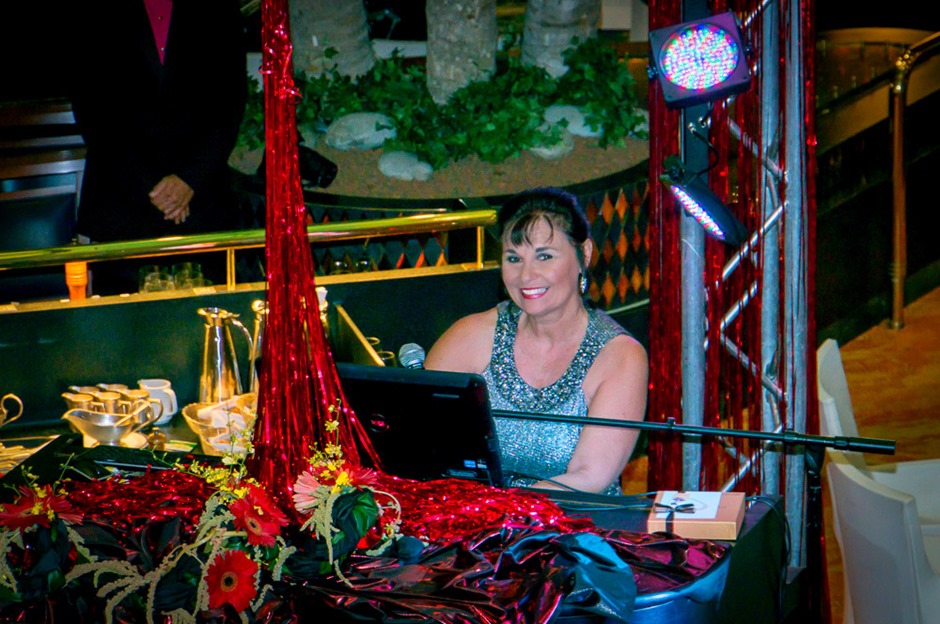
     On February 14 there was a Valentines Ball.  First there was a reception in the Queen’s Lounge, then a formal dinner, then the Ball, all with free drinks.  They really went all out in decorating & Debbie Bacon serenaded us from the piano on the first floor.

29. At Sea Toward Townsville, Australia35. At Sea Toward Townsville, Australia2016 02 14  Valentine's Day-72016 02 14  Valentine's Day-344. At Sea Toward Townsville, Australia46. At Sea Toward Townsville, Australia2016 02 14  Valentine's Day-12a2016 02 14  Valentine's Day-11

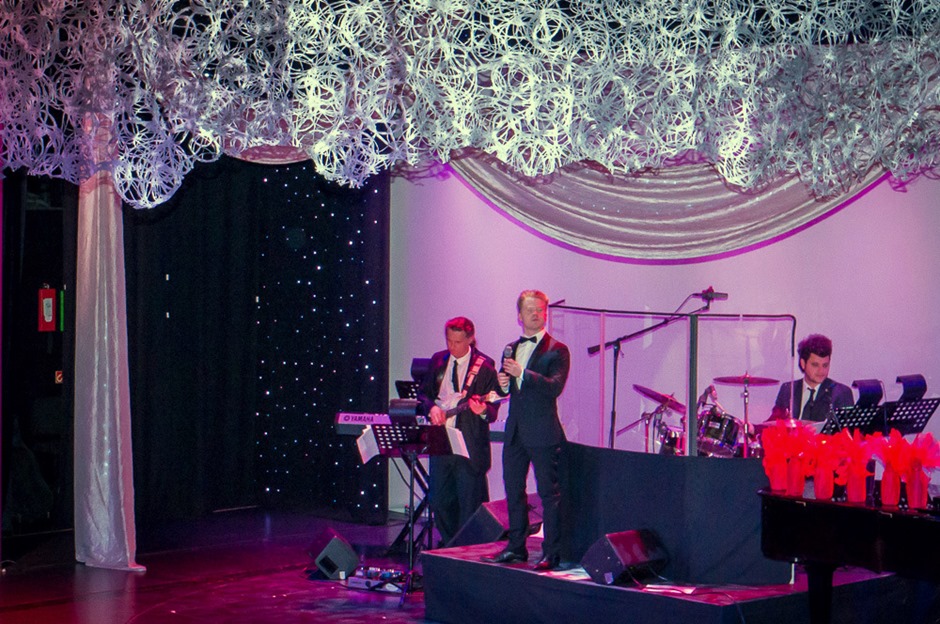
     At the ball the excellent 5 piece “Amsterdam Orchestra” played along with two very good young singers brought aboard for the occasion, Liam John Burrows & Darcy Jones.  Liam was in the Sinatra mold & did it very well.  We saw him sit in with the Neptunes in the Ocean Bar a few days later & he was particularly enjoyable in this more informal setting (many of the featured acts are).

51. At Sea Toward Townsville, Australia40. At Sea Toward Townsville, Australia2016 02 14  Valentine's Day-172016 02 14  Valentine's Day-16

     Since it was a last minute replacement port, we had little information about Townsville.  It dates to the early 19th Century & has about 200,000 residents.  In the second half of the 19th century it was the port for several gold mines during the gold rush.  We know that today it is a port for, among other things, cattle because there was a cattle ship being loaded next to us in the commercial dock area where we were moored. 

     We took the mandatory shuttle into town & walked down Flinders Street to the Reef Headquarters & Aquarium.  Flinders Street has a lot of small buildings from the 1800’s but most of them seemed to be closed up.  This is near the beginning of the Great Barrier Reef & the Reef administration seems to be situated here.  The Aquarium in the same building was wonderful: the largest living coral reef aquarium in the world.

1a. At Sea Toward Townsville, Australia4. At Sea Toward Townsville, Australia

     A very large “predator tank” contained several different kinds of sharks along with other fish & even a giant clam.  There was a talk here by a diver inside the tank.  To keep the coral alive these tanks are open to the sun & air outside.  This means they have to constantly replenish the water that evaporates & also must constantly clean the inside of the tanks.

7. At Sea Toward Townsville, Australia13. At Sea Toward Townsville, Australia9. At Sea Toward Townsville, Australia22. At Sea Toward Townsville, Australia58. At Sea Toward Townsville, Australia

     For fans of Finding Nemo, we are in Australia so both Nemo & Dorrie were here.  Clownfish are born male & when the dominant female dies one of the males becomes female (no operation needed).  We learned that there are several kinds of fish that can change sex & the giant clam above can change on a yearly basis, emitting sperm one year & eggs the next.

29. At Sea Toward Townsville, Australia73. At Sea Toward Townsville, Australia53. At Sea Toward Townsville, Australia

     The Crown of Thorns starfish has become a menace to the Great Barrier Reef.  They eat the coral polyps & have spread alarmingly in recent decades, partly because they can regenerate like worms so that when machetes were used in early eradication efforts the pieces would each become a new starfish.  Today the inject a toxic solution into them, which ensures they are truly dead.  There were other more benign (and prettier) starfish as well.  We learned that starfish have eyes at the end of each of their arms.

40. At Sea Toward Townsville, Australia39. At Sea Toward Townsville, Australia28. At Sea Toward Townsville, Australia

     We saw a creepy Moray Eel & a Bluespot Lagoon Ray that looked like something from outer space. There was a Lionfish – beautiful but deadly – and some Razorfish, which swim vertically. Also a beautiful Semicircle Angelfish (which looks more blue than the purple color in the picture).

38. At Sea Toward Townsville, Australia20. At Sea Toward Townsville, Australia31. At Sea Toward Townsville, Australia34. At Sea Toward Townsville, Australia50. At Sea Toward Townsville, Australia17. At Sea Toward Townsville, Australia

     In the background there were many types of living coral & some stationary animals, like anemonies & sea urchins.

24. At Sea Toward Townsville, Australia57. At Sea Toward Townsville, Australia61. At Sea Toward Townsville, Australia65. At Sea Toward Townsville, Australia

     Finally, we visited the turtle hospital.  Wounded or disabled sea turtles are bought here and nursed back to health, then released back into the ocean.  There were a couple of hawksbill turtles here, a couple of flatback turtles, and one huge 200 pound green turtle.  “Green turtles” are actually brown, not green, as you can see below.  Turtles are sea animals with flippers instead of legs, while tortoises are land animals with legs & feet.

86. At Sea Toward Townsville, Australia91. At Sea Toward Townsville, Australia83. At Sea Toward Townsville, Australia103. At Sea Toward Townsville, Australia96. At Sea Toward Townsville, Australia105. At Sea Toward Townsville, Australia

     Leaving the Aquarium, we walked along the Strand, a road that borders the waterfront ANZAC Park.  Known as Strand Park since the 1880’s, it was renamed in the 1930’s to memorialize the soldiers from Townsville killed in World War I.  It is a lovely, very long park with banyan trees and many flowers in addition to the ANZAC memorial & another memorial with a fountain commemorating the WWII Battle of the Coral Sea fought near here.  Townsville had the largest allied naval base in the South Pacific & played an important support role in this battle.

112. At Sea Toward Townsville, Australia120. At Sea Toward Townsville, Australia128. At Sea Toward Townsville, Australia130. At Sea Toward Townsville, Australia124b. At Sea Toward Townsville, Australia_stitch134. At Sea Toward Townsville, Australia138. At Sea Toward Townsville, Australia136. At Sea Toward Townsville, Australia121. At Sea Toward Townsville, Australia122. At Sea Toward Townsville, Australia139a. At Sea Toward Townsville, Australia_stitch

     In the park and elsewhere in town we saw a number of interesting public sculptures.  Most, but not all, were of wildlife.

151. At Sea Toward Townsville, Australia165. At Sea Toward Townsville, Australia154. At Sea Toward Townsville, Australia160. At Sea Toward Townsville, Australia3. At Sea Toward Townsville, Australia

     There is a lot of seashore in northeastern Australia, but you can’t swim in the ocean.  Some places there are crocodiles & most places there are Box Jellyfish, which are blue and about the size of your thumb with tentacles that can reach 20 feet in length.  Both are deadly.  As Bill Bryson pointed out in his book about Australia: of the ten most toxic animals in the world, ten live in Australia.  This includes spiders and snakes as well as jellyfish, so Australia can be a dangerous place if you are not on your toes.  A few places along the waterfront in the park have been enclosed in jellyfish-proof netting to allow some swimming.  We saw some genuine wildlife in the park too, including black cockatoos & a little red-beaked gull that looked like it was laughing.

162. At Sea Toward Townsville, Australia161. At Sea Toward Townsville, Australia    

158a. At Sea Toward Townsville, Australia164. At Sea Toward Townsville, Australia

     We ended our walk along the park at the end of the shore, where we climbed up a hill to a lookout point called Kissing Point.  This area had been fortified since the 1880’s.  In July, 1942, a couple of Japanese planes bombed Townsville, but most of the bombs fell into the water or the bush outside the town. Only one caused any damage, and that was to the racetrack.  Today this is a park that provides a nice view over the harbor & of the reddish colored mountain that overlooks the town.  We walked back to the ship.  It was a couple of miles & it was VERY hot & humid, so we wilted pretty badly before making it back.  Later we learned that there was a free shuttle bus going back & forth to Kissing Point.  We wished we had known about it, as that would have made a big difference for us. 

173. At Sea Toward Townsville, Australia187. At Sea Toward Townsville, Australia

     And so we sailed on up the eastern coast of Australia, into the Great Barrier Reef area.  But that’s a story for another day.  For now we will leave you with a couple of towel animals (I have lost track, so if you have already seen these, never mind).

2. At Sea in South Pacific5. At Sea in South Pacific

Sydney, Australia (Day 2)

     Sydney is the largest city in Australia & was also the first settlement here.  This area was first visited by Captain Cook around 1770.  He sailed past Sydney harbor without entering & anchored a little way to the South in a place he named Botany Bay (now the location of Sydney’s airport).  He submitted glowing reports about Botany Bay.  Meanwhile, some 17 years later, Great Britain had a growing problem with its criminal underclass.  The Enclosure movement had driven many peasants off the land and into the cities where they had no way to earn a living.  This led to large growth in petty crime.  At that time any theft worth 40 shillings was a hanging offense, and the prisons filled up with people convicted (usually in very summary trials) of petty theft.  Criminal overcrowding had for many years been eased by deportation to the American colonies where the convicts were sold into indentured servitude, usually for seven years.  But the American Revolution cut off deportation there, and overcrowded prisons were supplemented by “hulks,” ships denuded of masts anchored in the Thames & at Plymouth where prisoners rotted away in the unrelieved filth with little fresh air or food.

     Something had to be done, so ultimately the government decided to begin transporting convicts to Botany Bay, which was as far from England as it was possible to go & which Cook had assured them would be a good place to live.  Many convicts were given a choice between the gallows and transport to Botany Bay, so you can imagine how many “volunteers” there were for transport.  The “First Fleet,” headed by Arthur Phillip, arrived in Botany Bay at the beginning of 1788, but it quickly became apparent that Cook had been wrong about the living conditions, particularly because of the lack of a source of fresh water.  After a few days Phillip set out to explore the other bay to the North & found it to be extraordinarily good for settlement.  He wrote that it was the best harbor in the world, in which the entire British navy could be harbored with room to spare.  So the fleet moved there & they began to build a settlement at a place near where the Opera House now sits that is called “the Rocks.” 

     The Aboriginals at Botany Bay were glad to see them go.  When Cook had been there, they had gathered on the shore and shouted to him to “go away.”  Of course, Cook had no idea what they were saying but he did go away.  So when the First Fleet arrived there the Aboriginals again told them to “go away,” and they had every hope that this tactic would work again.  But when the British began building a settlement on their land, and catching their fish to eat, they began to realize that this was a lot more serious.  This led to a lot of strife.

     Our plan for Day 2 was to explore the Rocks area, the oldest section of the city situated between the Harbor Bridge & the Opera House.  It is a very interesting area, with old buildings, some built by the original convicts, intermingled with glass skyscrapers.  The old Victorian buildings had a lot of interesting architectural detail of the kind not seen anymore (too expensive I guess).

9. Sydney, Australia  (Day 2)_ShiftN8. Sydney, Australia  (Day 2)_ShiftN120. Sydney, Australia  (Day 2)125. Sydney, Australia  (Day 2)121. Sydney, Australia  (Day 2)10. Sydney, Australia  (Day 2)102. Sydney, Australia  (Day 2)_ShiftN13. Sydney, Australia  (Day 2)122a. Sydney, Australia  (Day 2)

     Our first target was the State Library built in 1906, which was quite magnificent with a domed reading room.  The floor in the entrance was an amazing stone inlay copy of a map of this part of the world drawn by the Dutch explorer Abel Tasman in the middle of the 17th century.  I think he was the first to reach this part of the world, which is why it was known as New Holland into the 19th century.  The island of Tasmania (which he called Van Damien’s Land) is named for him, as is the Tasman Sea between Australia & New Zealand.  There is a tunnel leading to a modern library building that is mostly glass and very light & airy.

77a. Sydney, Australia  (Day 2)_stitch27b. Sydney, Australia  (Day 2)_stitch44a. Sydney, Australia  (Day 2)_stitch53a. Sydney, Australia  (Day 2)_stitch15a. Sydney, Australia  (Day 2)_stitch65. Sydney, Australia  (Day 2)69. Sydney, Australia  (Day 2)50a. Sydney, Australia  (Day 2)_stitch

     Outside the library is a statue of Matthew Flinders who we met before in Melbourne, the first circumnavigator of Australia at the beginning of the 19th century.  On his way back to England he was detained in Mauritius, a French territory that was at war with England at the time.  It seems he had obtained a pass, but it was in the name of his ship rather than his own name.  He had lost his original ship and was returning on a different one, so the officials on Mauritius refused to recognize it and imprisoned him as a spy.  He spent several years locked up there before clearing up the matter and obtaining his release.  In England he wrote a book about his exploits, but he died on the very day it was published.  Through all of this he was accompanied by his cat, Trim, who even stayed with him in prison on Mauritius.  But when they were freed, Trim was nowhere to be found as he prepared for departure.  It turned out that a group of ravenous locals had eaten him.  Behind the Flinders statue out side the library is a separate statue of Trim, the first cat to circumnavigate Australia

71. Sydney, Australia  (Day 2)74. Sydney, Australia  (Day 2)

     We walked past Sydney Hospital, built in 1814.  In front is Il Porcellino, a bronze copy of a well known statue in Florence, donated by the Florentines in 1968.  Its nose is rubbed shiny & there is a plethora of small animals sculpted into its base.

83. Sydney, Australia  (Day 2)85. Sydney, Australia  (Day 2)87. Sydney, Australia  (Day 2)91. Sydney, Australia  (Day 2)

     Next we came to the Hyde Park Barracks, built in 1819 and designed by a convict turned architect, Francis Greenway.  This was built to house convicts, not soldiers.

93. Sydney, Australia  (Day 2)94. Sydney, Australia  (Day 2)

     We walked through Hyde Park, lush with trees & flowers.  In the center is a very elaborate fountain built in 1932, on one side is St Mary’s Cathedral and at the end is the ANZAC Memorial (but we didn’t walk that far).  There was a sign warning to watch out after a rain for “failing trees.”  The park is also home to a large number of Ibis, an awkward looking bird with a long beak that we were told are considered pests hereabouts.

100. Sydney, Australia  (Day 2)96. Sydney, Australia  (Day 2)97. Sydney, Australia  (Day 2)95. Sydney, Australia  (Day 2)101a. Sydney, Australia  (Day 2)98. Sydney, Australia  (Day 2)

    The Queen Victoria Building was erected in 1898 as a market hall & after years of neglect it was restored in the 1980’s into a really glorious indoor mall.  It has four stories with a large variety of stores & kiosks, and a huge hanging clock on which, when it strikes the hour, small figures emerge and behead Charles I (or so we have read . . . sadly, we didn’t see this happen).  We rode down from the upper floor in an old fashioned cage elevator, & in front of the building is a large statue of Queen Victoria.

104. Sydney, Australia  (Day 2)109. Sydney, Australia  (Day 2)111. Sydney, Australia  (Day 2)110. Sydney, Australia  (Day 2)115. Sydney, Australia  (Day 2)116. Sydney, Australia  (Day 2)112. Sydney, Australia  (Day 2)118. Sydney, Australia  (Day 2)105. Sydney, Australia  (Day 2)

     Over the last few decades Sydney has developed into a cosmopolitan & ethnically diverse city (it has only been a few decades since Australia abandoned its narrow racial immigration restrictions).  This month it is celebrating Chinese New Year over a period of several weeks & the city was decorated with some delightful displays.  Our favorite was the rabbits in front of the old Customs House, built in 1845 & remodeled in 1885, whose first three floors house the city’s public library (which we didn’t visit because we only learned about it later).  We also passed a fellow playing the Digeridoo; not just for Chinese New Year, he looked pretty permanent (and other passengers mentioned they had seen him on previous visits).  We have had a digeridoo player on board since we left New Zealand, teaching passengers how to play.  His scheduled performance was, unfortunately, canceled because he injured his eardrum shortly after boarding the ship.127. Sydney, Australia  (Day 2)129. Sydney, Australia  (Day 2)82. Sydney, Australia  (Day 2)130. Sydney, Australia  (Day 2)324. Sydney, Australia  (Day 1)124. Sydney, Australia  (Day 2)131. Sydney, Australia  (Day 2)227. Sydney, Australia  (Day 1)

      Well, after seeing all this, doing some shopping & consuming huge cones of gelato it was time to return to the ship for the sail-away.  It had been a sunny & warm day, but at sail-away it turned cloudy & overcast, so the views were not as great as they could have been.  Pretty good still, though.  There was a big party on the aft deck as we left & HAL provided free wine & food so everyone was feeling happy, including moi.  We passed by all the icons one last time: the Opera House, the Harbor Bridge & Luna Park.  There was a group of bridge climbers on top as we passed under the bridge & there were shouted greetings on both sides. We had to wait about an hour at the mouth of the harbor for a boat to come out and pick up two passengers with medical issues that required hospital care, then we sailed up the Eastern coast of Australia. This was too short a stay in this special city, which left quite a lot to do and see next time.

135. Sydney, Australia  (Day 2)152. Sydney, Australia  (Day 2)177. Sydney, Australia  (Day 2)11  Sydney Sailaway 1149. Sydney, Australia  (Day 2)150. Sydney, Australia  (Day 2)134. Sydney, Australia  (Day 2)166. Sydney, Australia  (Day 2)155. Sydney, Australia  (Day 2)172. Sydney, Australia  (Day 2)174. Sydney, Australia  (Day 2)175. Sydney, Australia  (Day 2)176. Sydney, Australia  (Day 2)178. Sydney, Australia  (Day 2)11  Sydney Sailaway 2154. Sydney, Australia  (Day 2)