
Fortaleza, Brazil
We arrived in Fortaleza (Fortress) on Friday, February 24. It is another big city (about 3 million) with skyscrapers lining its beachfront like Miami Beach.

I could think of only two reasons for stopping here: (1) its on the way, and (2) its our last docking port until we leave the Amazon, so we needed to fill up on water. A shuttle bus took us to the older part of town, but really it wasn’t much fun to walk around. Narrow, crowded sidewalks, lots of traffic, people set up all over the sidewalk selling stuff (and not interesting stuff) – altogether it was not a very pleasant city.
We saw two buildings of note. First was the Metropolitan Cathedral, a 20th century building that is the 3rd largest cathedral in Brazil. It is in a European style, with flying buttresses no less, and we were told it was inspired by the cathedral of Cologne (I have seen the cathedral of Cologne, & it is much more elaborate & beautiful than this one).


The other building was the Teatro Jose de Alencar (named after a 19th century Fortalezan writer). Approaching it on the street you see an ornate but fairly conventional Italianate (we were told) building.


But when you walk through to the inner courtyard you come upon the actual theater, which is made largely of iron in an Art Nouveau style.


It was a whimsical combination, which we enjoyed.

On our way back to the shuttle bus we walked through the Praca Jose de Alencar, where so-called comedians pass the hat and if you don’t put something in it you become the butt of some nasty jokes. Since we don’t speak Portuguese we decided to skip this entertainment, and we walked on through the Praca dos Martires (park of the martyrs) where there was statuary, fountains and a cooling canopy of trees (have I mentioned that in this part of the world it is HOT?).


___________________________-
UPDATE on Vitoria: You may recall (you can look back if you don’t) that we showed you a church in Vitoria dedicated to Our Lady Of The Good Death & speculated that there might be an interesting story behind that title. Since then, our friend Rita Reimer found the story & sent it to us to share with you:
The Sisterhood of Our Lady of the Good Death (Irmandade da Nossa Senhora da Boa Morte) is a small but renowned Afro-Catholic religious group in the state of Bahia, Brazil. Founded in the early 19th century as a Church-sponsored beneficent Sisterhood for female African slaves and former slaves, it became one of the oldest and most respected worship groups for Candomblé, the major African-based religion in Brazil. Presently reduced to about thirty members (from 200 or so at its height), most of them over fifty, it still attracts worshipers every year, especially at its August festival.
Cabedelo & Joao Pessoa
On Wednesday, February 22, we came to the port of Cabedelo, whose main claim to fame is that it is the starting point of the Amazon highway (several decades in the making but still far from complete). A fort was established here in 1589 to keep out the Dutch (not entirely successful). This is, as I understand it, the easternmost city in the Americas; it is closer to Africa than to southern Brazil, which we found a little mind-boggling.


Only two cruise ships a year stop at Cabedelo, which explains why we were greeted by a band at the dock as we left the ship. Cabedelo has some decent beaches.


Up the river, about a 40 minute bus ride, is the city of Joao Pessoa (John Person), another Brazilian city of a couple million people, established in 1585.

Fortunately, the old part of the city, which we visited, is not among these skyscrapers. It is a small area, but I don’t think I have ever seen so many churches per square yard. They were not needed to serve multiple denominations,since just about everyone here was Catholic, so it is puzzling that such a small town needed to be divided among so many churches. Some of them are very pretty, although with the damp climate there was a lot of mold. We were told that fighting the mold is a never ending battle. The one that seems predominant is the Convento Sao Francisco de Assis (not actually a church), which has a large courtyard and is supposed to have a beautiful ceiling inside, but we didn’t go in to see it (churches are not exactly novelties on this trip).


There were some colorful streets in the old town, but everything was closed up since it was still the morning after Carnaval. Of course it was also Ash Wednesday so we thought it odd that the churches weren’t open, but apparently religion isn’t really the central object of Carnaval any more.


We did find the Biblioteca (after much searching) but like everything else it was closed.


There were some mosaic sidewalks, but the design was much smaller than in Rio & it was done the easy way, with square tiles embossed with the wavy pattern. There was also some nice tile work on a number of the buildings.


As you saw earlier, however, most of the city was high-rise buildings. The highrise apartment buildings in this area are different from what you normally see in North America, in that they often have patterns of bright color & many of the windows are much smaller, presumably to help keep out the heat.


To end this post here is the last towel animal we have gotten (one of the best, though). We were told there would be water issues for the trip through the Amazon so they are trying to cut down on laundry and the first thing to go is the towel animals. You may recall this happened in Antarctica as well.


Recife & Olinda (day 2)
Tuesday, February 21, was the final day of Carnaval 2012. It was also the one day we were originally scheduled to be in Recife, and we had signed up for an excursion to Olinda, which is right next to Recife. While Recife is a large city of several million people Olinda is a small city with brightly painted buildings only a few stories high. It has been designated a UNESCO World Heritage sight.
We spent several hours walking around Olinda and although it was still late morning, already there were crowds in the street and the city was filled with costumed revelers. We saw several buildings of interest, but mostly we took in the city scenery & the people. Remember you can call up a label for a picture by moving your mouse over it; some labels are descriptive & some aren’t. Of course, there were churches.


There were colorful streets & marching bands.


A variety of people were dressed in costume, some of whom did performances (like the weird boxing pastiche in pictures 4 & 5).


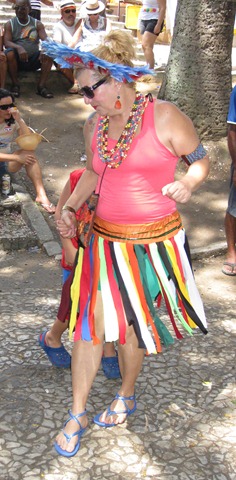
We were told that in a neighboring town inland all the men wear costumes like the ones below so that the women of the town can’t tell who is who. It sounded pretty strange to us – obviously an opportunity for hanky panky – but then most of this stuff is at least a little strange to us.


Houses were decorated in a variety of colorful ways & people watched the passing show from their windows.


We saw some nice views of Olinda & Recife from the top of the hill near the Cathedral.


The Olinda Carnaval is known for its giant puppets, some of which are worn by people & some of which are used as decorations. I’m not sure what the story is behind them, but they are different. The first picture shows a person putting on the puppet costume of a popular Brazilian singer, and there is another puppet sitting in the window.


Now some miscellaneous pictures of Olinda for which I am too tired to think of categories. But the first one is here because Mary & I happened to be in it (just a little bit, on the lower right), & the second one is of an Olinda street the night before taken from the hill (we weren’t there, but its a nice picture).


Around noon we left Olinda & drove to Itamaraca Island where we were to have lunch near a beach. It took forever to get there because of snarled Carnaval traffic and it turned out that neither the lunch nor the visit was worth the lengthy bus ride. Anyway, here we are eating lunch (we are the last ones at the table, so look closely) & a view of the beach.


On the way back we passed through the fateful town where my camera was stolen. Here are a few pictures of the parade there, which I could have done without.


When we got back from the ill-fated trip we decided to walk over to the Recife Carnaval before dinner so that we would at least have a few pictures of Recife (we didn’t know yet that generous friends Patrice & Jeff would supply many more pictures). So the rest of the pictures here were taken by us; most are a little blurry because they were taken at night but it gives you an idea of what Carnaval in Recife was like. First we wanted to be sure to replace our pictures of the synagogue in the first blog posting and the Biblioteca in Recife (which were, of course, a little different because they are taken at night with a swirling Carnaval crowd):


Here is the main Carnaval stage, with a show going on.


Here is the secondary stage at the Recife Carnaval & the square in front of it.


There was a marching band & crowds, often in costume, everywhere.


One of the giant street decorations that we particularly liked was called Belle de Jour, and there was also one of the anonymous men like we saw in Olinda.


That evening there was a Carnaval celebration in the ship’s restaurant, in which all the waiters and other ship personnel dressed in special costumes (they do this often, for a variety of special & not-so-special occasions), as did some of the passengers. Then there was a show about Frevo, the local dance tradition (you may have seen the multicolored parasols used in this dance in several of the pictures). It wasn’t as good as the Samba shows (not even close), but it was interesting nonetheless. While I don’t have a picture of the waiters, there is a picture here of the cruise director in the Carnaval costume acting as host for the show.


And so ended a memorable visit to Recife & Olinda – it was the best of times and the worst of times. But we have gotten over the bad part by now and are just relieved that we still have all the pre-Recife pictures & movies and still have a camera with which to finish out the trip.
Recife (day 1)
We arrived in Recife on Monday, February 20, a day earlier than originally planned. This was because the Prinsendam folks decided to skip our scheduled stop in Salvador de Bahia, which I had anticipated to be one of the highlights because it is a special city in a number of ways, particularly in music. However, there was (as I understand it) a police strike, which had resulted in 50 or more murders & the city was occupied by troops (although I’m not sure any of that was still true by February 19, when we were supposed to arrive). So, with a lot of older people aboard they decided to skip Salvador, with the result that we spent two days, Monday and Tuesday, in Recife. The positive side of this was that Monday & Tuesday were the last two days of Carnaval (this is the Portuguese spelling, which is used down here), & Recife is reputed to have one of the best Carnavals outside of Rio. Rio’s Carnaval is, they say, a spectator event, highlighted by a parade put on by the Samba schools in which everyone else stands by & watches (I saw a little bit on a TV near Recife), while Recife’s Carnaval is more participatory, with large crowds joining in. This is consistent with our experience.
On Monday we walked through Recife & took pictures of the important buildings, the Carnaval decorations & the people out & about. That night we took a canal tour (Recife is called the “Venice of South America” because it is built on 3 islands and has a number of bridges over a few rivers & canals, but I have been to Venice & Recife is no Venice; its only advantage over Venice in my opinion is its dearth of mosquitoes, which are more than plentiful in Venice). We took many pictures during the canal tour of the bridges and Carnaval decorations lighted after dark. On Tuesday we went on a trip to Olinda, a beautiful picturesque town with its own unique Carnaval atmosphere, & took a number of interesting pictures there as well.
However, you will not see any of those pictures here because on our way back from the tour of Olinda (& an island called Itamaraca) my camera was stolen. We were in a tour bus that was slowed to a crawl in a small town near Itamaraca because the locals were having a Carnaval parade, consisting of a band on a truck & a large crowd of locals, many of whom were dressed up for the occasion. We were on the wrong side of the bus to see the crowd but another passenger offered me her seat to take a picture. As I slid the camera slightly out the window to take a picture, three young men apparently ran over, leaped in the air, & grabbed my camera (I say apparently because I never saw them). Before I even knew what was happening the camera was gone & all that was left was the strap around my wrist (the strap didn’t break; the metal bar on the camera to which it was attached broke off). They were gone & there was nothing to be done. It was an empty feeling, to say the least.
Fortunately, I had already downloaded all the pictures prior to Recife, but I lost all the pictures I had taken there & in Olinda. And we do have our old camera with us so we will be able to continue providing pictures of our trip (although they won’t be as good, since the old camera’s capabilities are far less). So, you will see pictures of Recife & Olinda here, but most of them were not taken by us (we did go out that evening to the Recife Carnaval, which was centered about a 10 minute walk from our ship, so some of these pictures are ours). A couple of the people on the Olinda tour with us graciously offered to share their pictures with us, so we have quite a few pictures, many of which are of the same things we had photographed (although not with us in them, and our pictures of the Olinda library couldn’t be replaced). So, with the understanding that unless otherwise indicated these pictures were not taken by us, we can proceed to a tour of Recife & Olinda.
As I said before, Recife is built on 3 islands and our ship was docked a short walk from the old part of the city, which dates back to the 16th century. Recife is a city of several million people, and its high-rise buildings stretch out seemingly forever, as in so many of these cities on the east coast of South America.

On Monday, February 20, we spent the late morning & early afternoon walking around the old part of the city, across the bridges & around the government square. Everything was closed for Carnaval so we didn’t get to go into any buildings; in fact most buildings were boarded up & had temporary plywood fences (sometimes brightly painted) erected around them, presumably to protect them from revelers. But everything in the city was also dressed up for Carnaval, including buildings, streets & bridges. Early in the day, when we were out, there were not very many people around (I guess they were still sleeping off the night before) & the lights were off, but it was interesting to see.


You can see these huge images all over town. They are flat & painted, and about 8 inches thick between the painted panels. There was an amazing variety of them everywhere. We walked by the main Carnaval stage on the water’s edge in Recife old town, & a secondary stage that was set up in a square a few blocks away. There is a huge open square in front of the main stage that fills with people at night (you will see later what these stages looked like at night).


One of the more interesting buildings in the old town is the first synagogue built in the Western Hemisphere. It was established during the period the Dutch held Recife (1580 – 1640). The Dutch were very tolerant of Jews at that time but when the Portuguese took back Recife they were no longer welcome. The Recife Jews left, settling in other Dutch territories such as the island of St. Maarten (which we will visit later in this trip) & New Amsterdam, where they founded the first Jewish community in what is now New York. The building is no longer a synagogue (although Recife does currently have a relatively small Jewish community). I think its now some kind of cultural center, but it does still have the synagogue name on it and the street sign still indicates that it was called Rua Dos Judeus from 1630 to 1654 (these are my pictures, taken at night during Carnaval on Feb. 21).


We walked across one of the bridges into the middle island where the center of government is located. We saw the Palacio do Campo das Princesas (Governor’s Palace), the Palacio de Justica & the Praca de Republica, a lovely park between these buildings, which was locked & boarded up for Carnaval; notice the egret walking by the pond.


We crossed another bridge, the highlight of which was a giant rooster, the symbol of Recife’s Carnaval, and there were some interesting old Dutch houses along the river in this area. On the way back we saw a building with unusual images painted on its shutters.


After sunset on Monday evening we went on a boat tour of the canals & bridges. By this time Carnaval had begun for the night & there were quite a few revelers out & about, many in costumes of a bewildering variety (although this was quite early yet, & the crowds become much bigger & more boisterous by 2:00 or 3:00 AM). The nighttime perspective is quite different from daytime, so here are nighttime views of some of the same sights set out above.


The bridges were lit up, including the rooster.


There were a number of buildings on which were projected animations. The best one we saw was a frog, which eventually stuck out its tongue to grab a morsel shaped like one of the windows on the building.


This was very early in the evening, around 7:00 PM, but there were already quite a few revelers about on the bridges & along the riverside.


So, having had a full day of festivities & sightseeing in Recife, we returned to the ship to rest up for Tuesday’s trip to Olinda (while 10 minutes from the ship, Carnaval continued well into the night).
Vitoria, Brazil
Friday, February 17 we spent in Vitoria, another sizeable South American city we had never heard of before. There are 2 or 3 million people in Vitoria & the 3 other cities that are virtually contiguous to it (estimates vary). Founded in the 16th century, Vitoria is the capital of the Brazilian state of Espirito Santo. The ship had to go up a river and under a bridge, so I think few cruise ships visit here. Oh, yes: we are now nearing the Equator, where days and nights are of equal length all year long & it is very HOT! Its hard to believe we were freezing in Antarctica less than two weeks ago.
Vitoria is a mixture of modern & historic, mostly modern. The upper city is above the port area,and you reach it by climbing, mostly stairs.

We toured the Palacio de Anchieta, which started out as a church in the 16th century but has been substantially rebuilt into what is today the Governor’s Mansion. Padre Anchieta, who is buried inside, was one of the founders of Sao Paulo, which originally grew around a chapel he built there. However, he was driven out of Sao Paulo because he was a staunch defender of Indian rights, and ended up in Vitoria where he died in 1597. In fact, the whole Jesuit order was notable for its defense of Indian rights and opposition to slavery, for which it was driven from the Portuguese empire. Inside the Palacio we saw, among other things, an original 16th century wall & an interesting painting showing the Iberians’ idealistic notion of colonization: an Indian bowing deferentially before a priest who is converting him to Christianity. Of course, the reality was that the typical Indian of that period was either dead or enslaved.


We visited a church called Igreja Sao Goncalo, built in 1766, that is dedicated to “Our Lady Of The Good Death.” I don’t know the story behind that one, but it must be an interesting one. Of note, the color of the church was actually more purple than blue, but this is what my camera saw. And then we walked by the Catedral Metropolitano, which was a good bit more imposing.


Finally, we saw the Teatro Carlos Gomes, an old Italianate theater, and the Praca (Park) Costa Pereira in front of it, which had some interesting trees in it.


Vitoria also had some mosaic sidewalks, similar to Rio but with different designs. Note that in the first picture the sidewalk actually is completely flat, contrary to appearances.


In the afternoon we had a performance on board by a local Samba school. This was really a school, not just a club, for kids age 8 through 16. It was similar to the Samba show we saw in Rio; all percussion music, played by boys, and all the dancing by girls. They told us that the purpose of this school was to keep the kids off the street & teach them the traditional dance & music & have fun. And they were very good. But I must admit it was a little disconcerting to see young girls like this participating in this sexually suggestive kind of dancing. The adults went out of their way to assure us this was all in fun, presumably because they were aware of how Americans were likely to react. Anyway, here are some pictures of this colorful performance.


Our next stop after Vitoria was Recife, where we spent 2 days during Carnaval. We were supposed to stop in Salvador de Bahia, but they decided to skip that port because of “civil unrest” resulting from a police strike. This was a big disappointment for me, because Salvador is a very unusual city, populated mostly be the descendants of slaves and a center for the development of Brazilian music. The Washington Post travel section ran a full page article about it 6 or 7 months ago. But it was most interesting to have two days in Recife (and its neighbor Olinda) during their spectacular carnaval. However, owing to some extenuating circumstances I will tell you about later, it will be a few days before I can post a Recife entry. Meanwhile, I will leave you with the beautiful sunset as we sailed away from Vitoria.


 BADER JOURNAL