Latest

Santa Marta, Colombia (2019)

     On January 7, after two sea days, we reached our first port on this voyage, Santa Marta, Colombia.  This is the oldest city in Colombia, founded in 1525, and is most famous as the place where Simon Bolivar died.  It is a busy container and coal port & something of a seaside resort for Colombians.

4a. Santa Marta, Colombia_stitch

     Under our veranda this morning some crew were working on top of one of the tenders, a job I don’t think I would want.

6. Santa Marta, Colombia (RX10)7. Santa Marta, Colombia (RX10)

     After breakfast in the dining room (they make particularly good french toast) we left the ship.  As we have often seen, there was a group of Colombian dancers to greet us on the pier.

8. Santa Marta, Colombia9. Santa Marta, Colombia11. Santa Marta, Colombia

     Walking through industrial ports is often forbidden, so we boarded a shuttle to take us through the maze of stacked containers to the port gate.  A madonna statue (the original, not the singer) watches over the port.

20a. Santa Marta, Colombia (RX10)_stitch21. Santa Marta, Colombia (RX10)40. Santa Marta, Colombia (RX10)

     Leaving the port, we walked a little way up the Malecon, a road that follows the shore.  We came upon a notable 1928 sculpture of the Spanish Conquistador Rodrigo de Bastidas, who discovered the Bay of Santa Marta in 1501 & founded the city in 1524.  He stands atop a tall pedestal with a small plaza below surrounded by stone balustrades.

15. Santa Marta, Colombia16. Santa Marta, Colombia18. Santa Marta, Colombia19. Santa Marta, Colombia21. Santa Marta, Colombia

     Across the street we found the Biblioteca Gabriel Garcia Marquez (sponsored by Colombia’s Central Bank).  Nobel laureate Garcia Marquez was a local boy, having been born about 50 miles away in a small town called Aracataca that was the inspiration for Macondo in his masterpiece, “One Hundred Years Of Solitude.”  A timeline of his life is painted on the wall under the name of the building.

14. Santa Marta, Colombia54. Santa Marta, Colombia (RX10)23. Santa Marta, Colombia

     In front of the library is the Plaza de Bolivar.  It is lush with trees, with an equestrian statue of Simon Bolivar in the center.  Unfortunately he is looking away from the sun (what poor planning), so it is tough to get a decent picture of him.  At the end of the plaza is a white fountain with heads whose mouths would spout water if it were working, which it wasn’t.

24. Santa Marta, Colombia25. Santa Marta, Colombia

     Nearby is the Antiguo Palacio Consistorial, originally built in the 17th century but restored and updated several times since.  Apparently most of the old buildings along the west coast of South America have been rebuilt several times over the years because of earthquake damage.  The western edge of the volcanic Ring of Fire follows the coast of South America, leading to relatively frequent earthquakes.  Anyway, today this impressive building serves as the city hall of Santa Marta.

28a. Santa Marta, Colombia_stitch - Copy31. Santa Marta, Colombia - Copy76. Santa Marta, Colombia

     We walked on to the Cathedral, a rather plain whitewashed building, small for a cathedral.  Originally built in the second half of the 18th century, it is the oldest cathedral in South America.  The Christmas display was still there, complete with a lamp post carrying a sign “Let it snow.”  Since it is January and it was 88 degrees out, it seems doubtful that snow has ever been part of the Christmas celebration here.

56. Santa Marta, Colombia37. Santa Marta, Colombia35. Santa Marta, Colombia36. Santa Marta, Colombia51. Santa Marta, Colombia49a. Santa Marta, Colombia_stitch53. Santa Marta, Colombia (RX10)     Gabriel Garcia Marquez’s parents were married in this church.  When Simon Bolivar died in Santa Marta in 1830 he was interred here until 1842, when his remains were moved to his home town of Caracas, Venezuela.  Legend has it that his heart was left somewhere in the walls here.  We saw three plaques dedicated to Bolivar in the cathedral, but they were in Spanish so we aren’t sure which one marks the spot where he was interred.  Also here is the tomb of Rodrigo de Bastidas, who died in Cuba in 1827, just two years after founding Santa Marta.  His remains were brought here in the 1950’s and placed in an elaborate tomb.

45. Santa Marta, Colombia46. Santa Marta, Colombia32. Santa Marta, Colombia34. Santa Marta, Colombia

     Across the plaza is the 18th century building that was originally the Episcopal Palace, and is now back in the hands of the church after serving in several different secular roles.

58a. Santa Marta, Colombia_stitch61. Santa Marta, Colombia60. Santa Marta, Colombia62. Santa Marta, Colombia

     We walked on to the Parque de los Novios (Park of the Newlyweds) whose official name is Parque Santander.  Francisco Paulo de Santander, whose statue graces the park, was an important associate (and sometimes antagonist) of Simon Bolivar. The area around the park must be jumping after dark as it is full of clubs and restaurants with outdoor seating among the flowers.  A town festival had just ended and we saw colorful signs for it in this park and elsewhere.

63. Santa Marta, Colombia64. Santa Marta, Colombia65. Santa Marta, Colombia67. Santa Marta, Colombia67a. Santa Marta, Colombia68. Santa Marta, Colombia

     We walked over to visit one more church, the Iglesias de San Francisco de Asis, passing a very impressive piece of wall art.  Originally completed at the end of the 16th century, it was used in the mid 17th century as a jail by pirates (apparently Santa Marta was subject to a number of pirate attacks in that period).  It has been rebuilt several times after disasters, most recently in the 1960’s.  Only the façade remains of the colonial structure.  A mass was in progress when we visited, accompanied by a singer playing a guitar, although since we could not see him it might have been a recording.

70a. Santa Marta, Colombia_stitch74. Santa Marta, Colombia75. Santa Marta, Colombia82. Santa Marta, Colombia80. Santa Marta, Colombia81. Santa Marta, Colombia

     We saved for last the Casa de la Aduana, which is also the Museo del Oro (gold museum).  The oldest building in town, this is where Simon Bolivar lay in state after he died in Santa Marta in 1830.  It also houses a very fine collection of pre-Columbian art and artifacts from the Tairona and other indigenous tribes that lived in the area.  Unfortunately, visiting this last proved a poor strategy, because we had barely looked at the first two rooms of artifacts before they began to close the museum.  The museum is normally closed on Mondays but they had opened it just for the morning presumably because of the presence of a cruise ship.  So we would have been better off visiting here first.  Live and learn.

84. Santa Marta, Colombia

     It was mid day so we walked all the way up the Malecon looking for a likely place to eat, but we didn’t find anything enticing.  So we crossed the street and walked back toward the port on the bay side.  There were a number of public statues of Indians, interesting if not great art.  There was a row of cabanas and a lot of people swimming by the beach.  We probably wouldn’t want to swim there since it is part of a commercial port, so how clean can the water be?  Then there was a long row of vendors’ tents, mostly selling souvenir knick knacks.

94. Santa Marta, Colombia87. Santa Marta, Colombia88. Santa Marta, Colombia91. Santa Marta, Colombia89. Santa Marta, Colombia93. Santa Marta, Colombia15a. Santa Marta, Colombia (RX10)_stitch

     Back on the ship as we waited to sail away there was much to see.  The nearby hills were covered with cactus as big as the trees.

11a. Santa Marta, Colombia (RX10)_stitch9. Santa Marta, Colombia (RX10)33a. Santa Marta, Colombia (RX10)34. Santa Marta, Colombia (RX10)

    A lot of pelicans were flying and floating in the area.  A large flock of them was perched in some trees on a hillside.

32a. Santa Marta, Colombia (RX10)29. Santa Marta, Colombia (RX10)30a. Santa Marta, Colombia (RX10)32b. Santa Marta, Colombia (RX10)25. Santa Marta, Colombia (RX10)23. Santa Marta, Colombia (RX10)45. Santa Marta, Colombia (RX10)46. Santa Marta, Colombia (RX10)46b. Santa Marta, Colombia (RX10)

     Meanwhile, up by the Lido pool there was a Colombian dancing performance.  A group of Colombian “ambassadors” had been on board since we left, giving cultural classes and demonstrations.  Mary came down to tell Rick about it, but he only made it up for the tail end of their dance.  More about them in a future episode.

36. Santa Marta, Colombia (RX10)38. Santa Marta, Colombia (RX10)37. Santa Marta, Colombia (RX10)

     So as the sun set we sailed away from Santa Marta, our first port in South America.

41a. Santa Marta, Colombia (RX10)_stitch

61. Santa Marta, Colombia (RX10)DSC00116

Once More Around The Horn: South America & Antarctica 2019

     We left home early on New Year’s Day to drive to Ft Lauderdale, to set sail on January 4 on the MS Prinsendam.  As in 2012, we are circumventing South America, with several days in Antarctica & a trip up the Amazon River as far as Manaus.  Prinsendam is the first Holland America ship we sailed on and is our favorite, mostly because of its small size (about 850 passenger capacity) & particularly attentive crew.

Holland America ocean cruise ship

     Sadly, this will be Prinsendam’s last Grand Voyage for Holland America since it has been sold and will leave the fleet this summer.  We had been thinking about traveling this itinerary again sometime, since it was our first long voyage in 2012 and we really weren’t properly prepared to take full advantage of it.  But when we heard that Prinsendam had been sold we signed up immediately for this cruise because doing it on another ship wouldn’t have been the same.  This time around we will have a balcony room (we got a bargain offer on an upsell offer from our original oceanview cabin).  In the picture above, our cabin is near the center of the ship just above the orange tops of the tenders/lifeboats.  Here is our planned itinerary, in both graphic and written form.  [As many of you know, planned ports are sometimes changed or missed because of local conditions; we have already lost a planned stop on Margerita Island in Venezuela, presumably because of political instability.]

Grand South America 2019 map

Daily Itinerary

Date

Port

Arrival Time

Departure Time

Jan 4, 2019

Fort Lauderdale (Port Everglades)

6:00 pm

Jan 5, 2019

Cruising

Jan 6, 2019

Cruising

Jan 7, 2019

Santa Marta, Colombia

8:00 am

5:00 pm

Jan 8, 2019

San Blas Islands, Panama

12:00 pm

6:00 pm

Jan 9, 2019

Panama Canal, Panama

5:00 am

5:00 am

Jan 9, 2019

Fuerte Amador, Panama

8:00 pm

Jan 10, 2019

Fuerte Amador, Panama

6:00 pm

Jan 11, 2019

Cruising

Jan 12, 2019

Manta (Quito), Ecuador

5:00 am

8:00 pm

Jan 13, 2019

Cruising

Jan 14, 2019

Salaverry (Trujillo), Peru

6:00 am

6:00 pm

Jan 15, 2019

Callao (Lima), Peru

11:00 am

Jan 16, 2019

Callao (Lima), Peru

6:00 pm

Jan 17, 2019

Cruising

Jan 18, 2019

Matarani, Peru

8:00 am

5:00 pm

Jan 19, 2019

Iquique, Chile

8:00 am

5:00 pm

Jan 20, 2019

Antofagasta, Chile

8:00 am

5:00 pm

Jan 21, 2019

Cruising

Jan 22, 2019

San Antonio, Santiago, Chile

8:00 am

5:00 pm

Jan 23, 2019

Cruising

Jan 24, 2019

Robinson Crusoe Island, Chile

8:00 am

5:00 pm

Jan 25, 2019

Cruising

Jan 26, 2019

Castro, Chile

8:00 am

5:00 pm

Jan 27, 2019

Puerto Chacabuco, Chile

8:00 am

5:00 pm

Jan 28, 2019

Cruising

Jan 29, 2019

Cruising to Amalia (Skua) Glacier, Chile

Jan 30, 2019

Punta Arenas, Chile

7:00 am

8:00 pm

Jan 31, 2019

Cruising Glacier Alley & Cape Horn

Feb 1, 2019

Ushuaia, Argentina

6:00 am

8:00 pm

Feb 2, 2019

Cruising

Feb 3, 2019

Cruising Antarctica

8:00 am

6:00 pm

Feb 4, 2019

Cruising Antarctica

8:00 am

6:00 pm

Feb 5, 2019

Cruising Antarctica

8:00 am

6:00 pm

Feb 6, 2019

Cruising Antarctica

8:00 am

6:00 pm

Feb 7, 2019

Cruising

Feb 8, 2019

Cruising

Feb 9, 2019

Grytviken, South Georgia Island

8:00 am

6:00 pm

Feb 10, 2019

Cruising

Feb 11, 2019

Cruising

Feb 12, 2019

Stanley, Falkland Islands

7:00 am

5:00 pm

Feb 13, 2019

Cruising

Feb 14, 2019

Puerto Madryn, Argentina

8:00 am

5:00 pm

Feb 15, 2019

Cruising

Feb 16, 2019

Punta del Este, Uruguay

8:00 am

3:00 pm

Feb 17, 2019

Montevideo, Uruguay

8:00 am

6:00 pm

Feb 18, 2019

Buenos Aires, Argentina

8:00 am

Feb 19, 2019

Buenos Aires, Argentina

5:00 pm

Feb 20, 2019

Cruising

Feb 21, 2019

Cruising

Feb 22, 2019

Santos (Sao Paulo), Brazil

8:00 am

11:00 pm

Feb 23, 2019

Ilhabela, Brazil

8:00 am

5:00 pm

Feb 24, 2019

Rio de Janeiro, Brazil

8:00 am

Feb 25, 2019

Rio de Janeiro, Brazil

6:00 pm

Feb 26, 2019

Cruising

Feb 27, 2019

Ilheus (Bahia), Brazil

8:00 am

5:00 pm

Feb 28, 2019

Cruising

Mar 1, 2019

Recife, Brazil

8:00 am

5:00 pm

Mar 2, 2019

Cruising

Mar 3, 2019

Fortaleza, Brazil

8:00 am

2:00 pm

Mar 4, 2019

Cruising

Mar 5, 2019

Belem, Brazil

8:00 am

6:00 pm

Mar 6, 2019

Cruising

Mar 7, 2019

Cruising

Mar 8, 2019

Santarem, Brazil

8:00 am

6:00 pm

Mar 9, 2019

Boca da Valeria, Brazil

8:00 am

2:00 pm

Mar 10, 2019

Manaus, Brazil

10:00 am

Mar 11, 2019

Manaus, Brazil

5:00 pm

Mar 12, 2019

Parintins, Brazil

8:00 am

2:00 pm

Mar 13, 2019

Alter do Chao, Brazil

8:00 am

2:00 pm

Mar 14, 2019

Cruising

Mar 15, 2019

Cruising

Mar 16, 2019

Devils Island, French Guiana

8:00 am

5:00 pm

Mar 17, 2019

Cruising

Mar 18, 2019

Bridgetown, Barbados

8:00 am

6:00 pm

Mar 19, 2019

Port Elizabeth, Saint Vincent

8:00 am

5:00 pm

Mar 20, 2019

Cruising

Mar 21, 2019

Willemstad, Curacao

8:00 am

11:59 pm

Mar 22, 2019

Port of Oranjestad, Aruba, Caribbean

8:00 am

5:00 pm

Mar 23, 2019

Cruising

Mar 24, 2019

Cruising

Mar 25, 2019

Fort Lauderdale (Port Everglades)

7:00 am

     The internet is set up differently this year.  Minute by minute charges are gone, and internet access is purchased once for 24 hours a day for the whole trip.  Expensive still, but at least you don’t sit there watching the minutes & $ rolling away as you wait for something to upload or download.  So we are going to try to post the blog as we go along and see how it goes, because we still don’t know how slow it will be this time and uploading lots of pictures takes a lot of bandwidth.  If you see this page it means we were successful in uploading the first time, and will probably try to continue doing it during the trip, although the other episodes will have a lot more pictures & thus may not upload as well. 

      Even so, we will inevitably get further and further behind because episodes can only be written on sea days and they take a while to complete.  If you want to know where we are in real time there is a button at the top called “M/S Prinsendam’s Current Position” that will tell you where we are & what the weather is like there.  Next to it is a button titled “About This Blog” that will call up a page that will tell you more than you want to know about this blog & how to use it.  And one final tip:  the pictures have captions but they are not visible unless you hover your mouse over the picture.  That probably won’t work on a phone or tablet or any other device that doesn’t have a mouse, so if you care about that look at the blog on a computer if you can.

     Those of you who are familiar with our blog may notice a few differences.  The picture above the title will rotate randomly among pictures of the authors in various travel locations; be aware that those pictures have nothing to do with the content of the episode that will appear below them.  The background has been upgraded slightly to a more colorful and dynamic view of the ocean.  And we have a new, simpler web address – www.baderjournal.com – although anyone using the old address will automatically be redirected to the new one.

      So this promises to be a varied, enlightening and fun voyage:  Penguins, Llamas, Whales & Dolphins.  Samba, Calypso & Tango.  Glaciers, Desert, Mountains, Rainforest, Icebergs. From freezing in the Antarctic to baking in the Amazon just two weeks later.  While you never know what will happen over the course of almost three months travelling in foreign parts, we anticipate enjoying every minute of it.  See you South of the Border.


Epilogue: Blacksburg, Virginia

     On May 7, less than a week after getting home from the World Voyage, we set off again to drive to Blacksburg, Virginia for a memorial service for our friend and world travel companion, Lee Wolfle.  His lovely family had delayed the service so that his friends on the world cruise would have an opportunity to attend.  Some others would have liked to attend but for logistic obstacles, but Robert drove down with us and Karen drove up from her home in North Carolina.

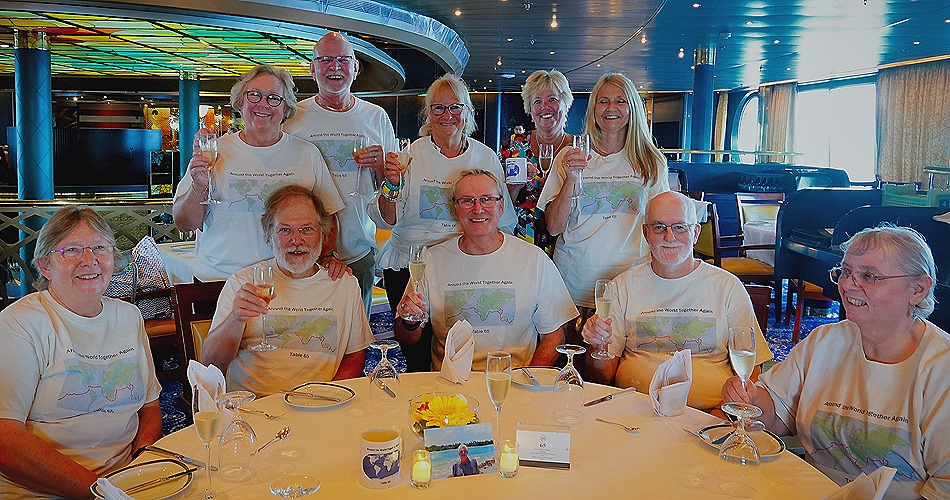
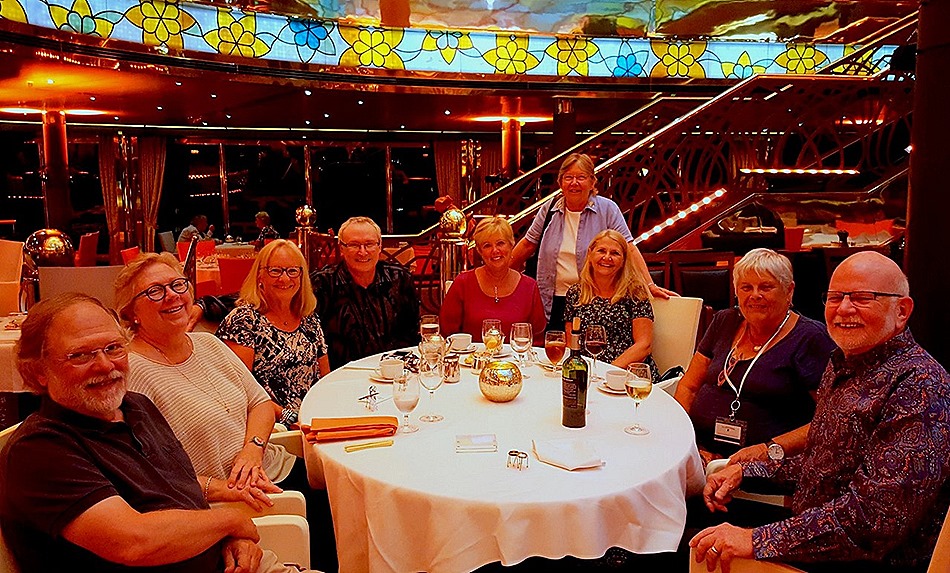
    You may recall in our first post about this cruise, back on January 4, we mentioned that this voyage was a reunion of sorts for the seven people who sat at our table in 2016.  We were all back at the same table for the 2018 cruise, picking up where we left off as a happy & compatible group of travelling friends.  None of us was more enthusiastic about that prospect than Lee Wolfle, who had tee shirts made for all of us showing the itinerary and titled “Around The World Together Again . . . Table 65.”

Cappuccno-bomb-Composit_thumb9DSC03603

Table 65

     Like the first world circumnavigator, Ferdinand Magellan, Lee didn’t make it back from the trip.  He began feeling poorly probably in New Zealand, was never able to get his strength back & had to leave the ship in Singapore.  He was diagnosed with leukemia in Singapore and was flown as far as Los Angeles, where he entered Cedars Sinai hospital for treatment.  But that didn’t work out & he died there in the middle of April as we were approaching Banjul.

IMG_5145_thumb10497-M--R-with-Lee-at-Bali-Hai-Moorea90.  Alofi,NuieIMG_2215-1_thumb1IMG_4116_thumb5IMG_2381_thumb7IMG_2444_thumb14IMG_3380_thumb3

     All of Lee’s friends on the ship were shocked at the speed of his demise. Many of us were walking on the beach with him in the South Pacific just six weeks before he went into the hospital and at that time he seemed hale & hearty. Lee was a very big man, about 6’7”, and very active (he took an expedition to Antarctica last year) so it was hard to picture him as being so seriously ill.  Needless to say, his ordeal cast a pall over the remainder of the voyage for all of us.

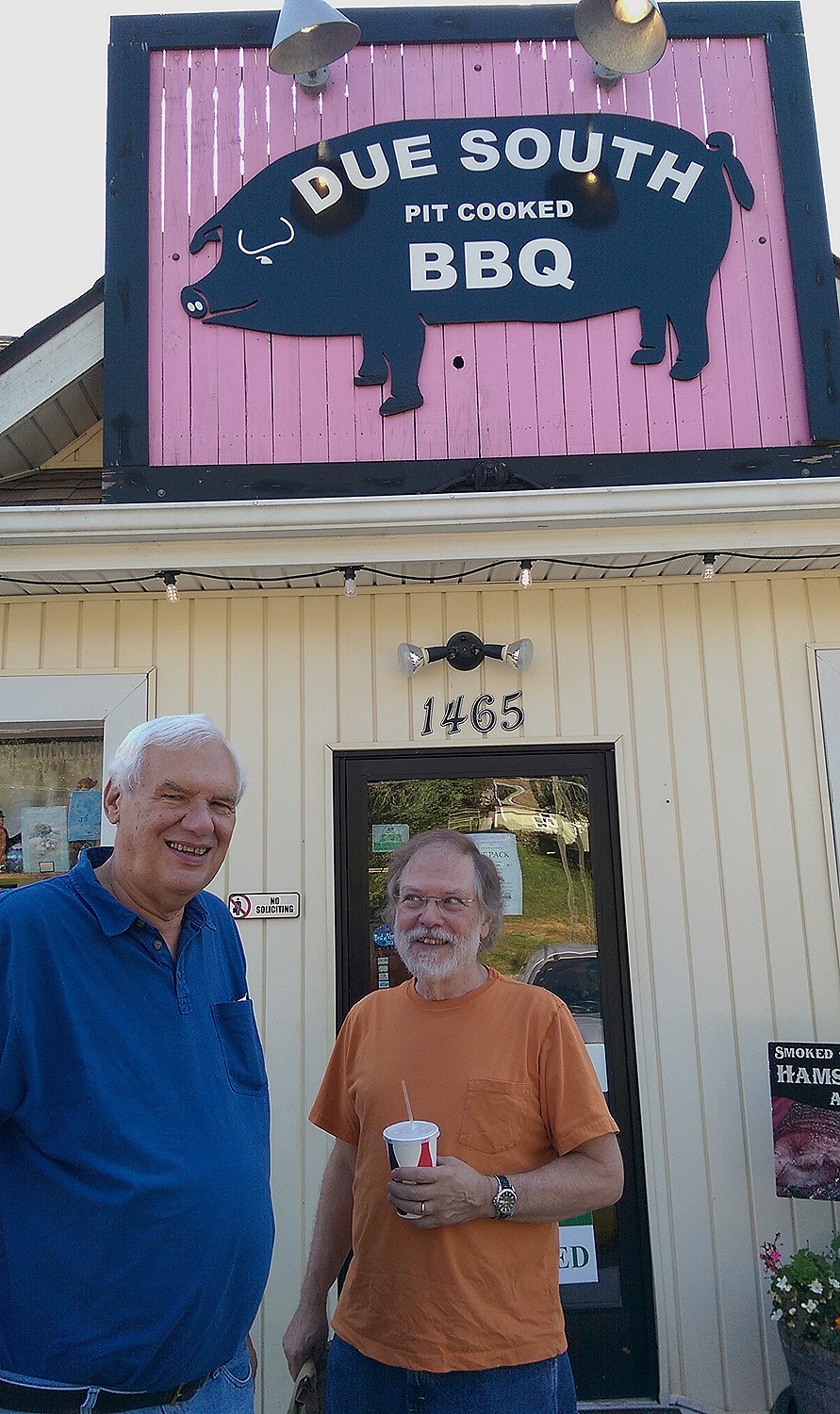
     The memorial service in Blacksburg was not a somber affair.  It was more a celebration of Lee’s life, with friends and relatives taking turns recounting memories and anecdotes about him.  We were happy to meet Lee’s family, about whom he talked a lot.  We spent two nights in Blacksburg and had an opportunity to see some of the town.  It is the home of Virginia Tech university where Lee had been a professor and he was an avid fan of their football team.  Statues of their mascot, the “Hokie” (a turkey we think), were all over town dressed up in varying painting styles.  We found a street named for Lee (probably originally named for Robert E Lee, but not while we were there) and visited the local library (of course) which had an interesting exhibit of quilts.  We would have enjoyed having Lee there to show it all to us, but the closest we ever got to Blacksburg with Lee was the Due South restaurant, where we shared barbecue lunches a couple of times.

IMAG0242DSC08605DSC08600DSC08602DSC08608DSC08610

    We only knew Lee for about two years.  But he was a good friend & the nicest guy you will ever meet.  We all miss you, big guy.

163.-Nuku-Hiva_thumb14

Wrappin’ it up

     On a voyage around the world there is no avoiding a lot of sea days at the end crossing the Atlantic Ocean.  On this trip there were seven sea days between the Cape Verde Islands and Fort Lauderdale, broken only by the day in San Juan that was the subject of the previous episode.  That doesn’t mean that everyone is napping in the sun the whole way though, since there is always plenty to do.  This included the crew shows by the Indonesian & Filipino crews, a goodbye assembly featuring the officers and crew, and good-byes to all your friends on board (not to mention packing, which we won’t).

         The crew shows are always entertaining, colorful and very well attended.  The crew members put a lot of work into these shows, rehearsing in the little spare time they have away from their jobs. The Indonesian crew show was on April 24, the day before we reached Puerto Rico.  It started with a sort of glove dance, involving interactive movements by crew members lined up and wearing white gloves.

DSC03517DSC03523DSC03527DSC03525DSC03526DSC03524

     Next up was a group of three singers, then a very impressive Indonesian dancer (who had been our waitress in the Pinnacle the day before).  Note how expressive her hand gestures are; our hands won’t bend in that way at all.

DSC03535DSC03530DSC03532DSC03534DSC03529DSC03549DSC03542DSC03545DSC03543DSC03552DSC03553

DSC03551

     A group of crew supervisors performed in sunglasses and glittery costumes, then two women danced wearing long yellow scarves.

DSC03555DSC03558DSC03560DSC03559DSC03564DSC03562

     Next was the monkey dance, depicting a story from Hindu mythology.  The guys sitting on the floor are all monkeys, an evil spirit comes to take away the queen & the good king shows up in the end to make everything come out right (we may well have the story garbled).  One of the guys sitting on the floor was our assistant waiter, Leo.

DSC03570DSC03568DSC03567DSC03573DSC03575DSC03576DSC03579DSC03580

     Then for the finale many of the performers came back on stage to play a couple of songs on sets of tuned sticks, each of which makes a note when shaken.

DSC03583b_stitchDSC03592DSC03593DSC03594

     The Filipino crew show was on April 26, the day after our stop in San Juan.  It started with a rousing full cast number then, in contrast, a solo guitar set from a very good guitarist.

DSC03620DSC03616DSC03623DSC03628DSC03626DSC03630

     After an appearance between acts of an angel (played by Kaye, our wine steward), a group of women with straw hats performed a hat dance, with hats moving from head to head.

DSC03632DSC03634DSC03635DSC03636DSC03637DSC03638

    Another group of women did a dance using large scarves, which they later folded into turbans.  Then Nestor, another wine steward who works near our table and produces the show, sang a solo song.  The song was not in English, but he was dressed half as a man and half as a woman.  We don’t know what that was about, but Nestor is a very good singer.

DSC03640DSC03642DSC03643DSC03645DSC03646DSC03649

     The last performance involved a large group wearing white gloves that glowed in the dark.  They put their gloves together to form different pictures and messages.  It was quite impressive and showed a lot of work.  Unfortunately, we weren’t able to get a decent picture until after the lights went back on.  Then everyone was back on stage for the Finale.

DSC03650DSC03653

     On April 27, the day before we arrived in Ft Lauderdale, there was a final assembly in the Queen’s Lounge for summing up and farewells.  Captain Mercer and Hamish the cruise director both addressed the assembled passengers and there was a special moment as they celebrated the retirement of Barbara the location guide after some 25 years and countless voyages.  She was very good and will surely be missed.

DSC08580DSC08578DSC03619

     On April 24 we had a good-bye lunch in the Pinnacle with the usual crew and later a group picture at Kathy, Corinne, Kay and Karen’s table downstairs in the main dining room

IMG_635432267185_10216242731886941_5867770412691095552_o

      Amsterdam was headed for a weeklong dry dock after it dropped us off in Ft Lauderdale and they began preparing for that work as we crossed the Atlantic.  Outside our window workers were putting down a plywood covering over the teak deck.  Meanwhile, inside our cabin our suitcases were being packed with what seemed like a lot more stuff than we started out with.

DSC08595DSC08591DSC08589

     Our last sea day was dark and wet.  During the afternoon the Captain came on the loudspeakers to inform us that a waterspout had been spotted off our starboard bow.  A waterspout is basically a tornado occurring over water rather than land.  We had never seen that before so we went out on deck to see it.  There were actually two waterspouts, one of which moved toward and then past the other.  Quite a sendoff from the ocean!

DSC03662DSC03664bDSC03666DSC03669DSC03670DSC03671

     We had our final night on board then disembarked the next day, April 28.  We picked up our car and drove to St Petersburg where we spent three delightful days with Mary’s aunt & uncle, Irene and Michael.  Then home, where we began posting all the episodes of this amazing voyage to the blog, where you are reading them.  Ending an epic voyage like this one and saying good-bye to all your friends and acquaintances is sad, but getting home after four months away is always a good feeling (even if you do have to start cooking and cleaning for yourself again).  Hopefully we will get to do this again one day.

DSC08572DSC08575DSC08597

San Juan, Puerto Rico (USA)

     April 25 found us docked in San Juan after five sea days.  This was the last port visited on this voyage and we were looking forward to getting home.

125a. San Juan, Puerto Rico_stitch

     Maybe we were just tired, but for whatever reason we did not get up early enough to see the sail in, which is a good one (we did see it once, about 10 years ago).  We decided to spend the day walking around Old San Juan, the original settlement here in 1509.  It is situated on an island joined to the rest of Puerto Rico by several bridges and it is also the location of the cruise ship port.  So after breakfast we left the ship to walk up to one of the two great fortresses here.

    On the way we walked through Plaza de Colon, named for Christopher Columbus whose statue dominates the square.  Although the square is much older, the statue of Columbus was erected in 1893 to commemorate the 400th anniversary of his (European) discovery of the island in 1493.  The square is lively a little later in the day; when we were there the vendors were just setting up all around the plaza.  On the downhill edge of the plaza is the Teatro Alejandro Tapia y Rivera, built in 1824, which hosts ballet and other cultural events.  A number of old trees were blown down in this square by Hurricane Maria in September, 2017, about seven and a half months before our arrival but the plaza seemed in pretty good shape when we were there.

10. San Juan, Puerto Rico11. San Juan, Puerto Rico57. San Juan, Puerto Rico56. San Juan, Puerto Rico13. San Juan, Puerto Rico

     We walked on to the Castillo San Cristóbal, completed in 1783, the largest fortification built by the Spanish in the New World.  This is one of two fortresses in San Juan: San Cristobal was designed to defend against land attacks and El Morro to defend against attacks by sea.  Today they are both under the jurisdiction of the US National Parks Service, which sells a ticket that admits you to both forts.  US citizens of a certain age can buy a lifetime pass that gets you into all American national parks.  We bought ours a few years ago when it was $10, an incredible bargain, but recently the price has been raised substantially (still a bargain if you want to visit a number of parks, as you should because they are wonderful).  Anyway, we had to pay for admission to the fort;  we had left our lifetime passes at home because we would be travelling abroad where they would be of no use, forgetting that our last port would be on US territory.  Never again!

117a. San Juan, Puerto Rico_stitch

     The fort has upper and lower courtyards connected by a labyrinth of tunnels that enabled soldiers to rush from one rampart to another without being exposed to enemy fire.  In the tunnels was a chamber that was used as a dungeon.  It had drawings on the walls that were made by a prisoner in the 19th century.

18. San Juan, Puerto Rico15a. San Juan, Puerto Rico_stitch20. San Juan, Puerto Rico19. San Juan, Puerto Rico22. San Juan, Puerto Rico23a. San Juan, Puerto Rico_stitch

     In 1942 pillboxes were added to enhance the defenses. Through the narrow opening facing the sea is quite a view of the coastline in both directions.

25a. San Juan, Puerto Rico_stitch27. San Juan, Puerto Rico30. San Juan, Puerto Rico

     From the ramparts one has a nice view of the upper courtyard and of the city beyond.  The domed building is the Puerto Rico capitol, completed in 1929.

33a. San Juan, Puerto Rico_stitch35. San Juan, Puerto Rico50a. San Juan, Puerto Rico37a. San Juan, Puerto Rico_stitch

   Three ships were in port this day and you could see them lined up from the ramparts of the fort.  Amsterdam seems pretty big when you are standing next to it but you can see from the picture how small it is by modern cruise ship standards.  On the right is a Royal Caribbean ship, the Something (behemoth?) Of The Seas, in the middle is the Carnival Magic, and the little guy on the left is the Amsterdam.  We like the smaller ones the best.

47a. San Juan, Puerto Rico_stitch

     The Spanish built five huge cisterns under the fort, holding a total of more than 850,000 gallons of water, with an elaborate system to direct rainwater into them from all over the fort.  When the US Army occupied the fort in 1898 it shut down the cisterns out of concern that the retreating Spanish might have poisoned the water.  They were reopened in 2011 by the National Parks Service to provide only non-potable water to the fort’s facilities.  Amusingly, Rick found a sign in a restroom that contained only a toilet warning not to drink the water because it wasn’t potable (people don’t drink from toilets and dogs can’t read the sign).  The Spanish accessed the water in the cisterns from wells dug in the floor of the fort that were surrounded by masonry cylinders.  Above the wall overlooking the lower courtyard fly the flags of the United States, Puerto Rico and the Spanish Empire.

51a. San Juan, Puerto Rico_stitch54. San Juan, Puerto Rico50. San Juan, Puerto Rico

     We didn’t come across a library in San Juan but we did visit La Casa del Libro, a tiny book museum.  For some 10 years it had been without a permanent home but about a year and a half before our visit it was re-established in the house that had been its original home.  It has an extensive collection of antique books dating to the 15th century but most of the permanent displays were not open when we were there.  We did visit a temporary exhibit of very tiny printed books.

65a. San Juan, Puerto Rico_stitch_ShiftN62. San Juan, Puerto Rico59. San Juan, Puerto Rico61. San Juan, Puerto Rico

     We walked over to the Cathedral of San Juan Bautista.  Completed in 1540 on the site of an earlier church, it is the oldest Catholic cathedral in the Americas (there is an older one in the Dominican Republic but it wasn’t always a cathedral).  Inside is the tomb of the Spanish explorer Juan Ponce de Leon, founder of the city.

79. San Juan, Puerto Rico67. San Juan, Puerto Rico68. San Juan, Puerto Rico70. San Juan, Puerto Rico

     Across the street from the cathedral is a very nice park called the Plaza de la Catedral.  This has been maintained as an open space since 1521.  A whimsical nautical sculpture sits in the park.  The street between the cathedral and the park is paved with cobblestones in the shape of bricks.  What is unusual is that the bricks are shiny blue, as can be seen throughout Old San Juan.  These bricks were made from slag discarded by Spanish iron foundries and brought to Puerto Rico as ballast in Spanish ships.  An early example of efficient recycling!

80. San Juan, Puerto Rico81. San Juan, Puerto Rico72. San Juan, Puerto Rico82. San Juan, Puerto Rico8. San Juan, Puerto Rico

     By now it was mid afternoon and we were hot and tired, so we continued up the street to find a place to sit down and have something to eat.  Because of the hour few restaurants were open,but we finally found one called Ostra Cosa.  The food was good and the beer was refreshing, sitting in a long room open to the outside.  We had a view across the street of San Jose Plaza, named for the church of the same name that sits on the plaza’s east side (left in the picture below).  The church was built from 1532 to 1735 and Ponce de Leon was interred there until 1836 when his remains were moved to the cathedral.  After eating (a long time because the service was exceedingly slow) we walked over to see the statue. We couldn’t visit the church because it was undergoing renovation.

91a. San Juan, Puerto Rico_stitch92. San Juan, Puerto Rico95. San Juan, Puerto Rico

     We walked back toward the ocean and the city walls and first came to the Plaza del Quintro Centenario, built in 1992 to commemorate the 500th anniversary of Columbus’ first voyage to America.  It is pretty impressive, if a little sterile. The plaza is dominated by the 40 foot high Totem Telurico, a sculptured column made of clay gathered from across the Americas, representing the origins of the indigenous peoples of America.

96. San Juan, Puerto Rico85a. San Juan, Puerto Rico_stitch86. San Juan, Puerto Rico

     We walked toward the Castillo San Felipe del Morro, the fort guarding the entrance to the bay. It is an impressive structure, built in the 16th century.  The National Parks ticket we bought to enter San Cristobol would also have admitted us to this fort but it was getting late, we were hot and tired and we had been to El Morro once before.  So we just walked by it.  In front of El Morro by the water is the Santa Maria Magdalena de Pazzis Cemetery, opened in the mid 19th century.  It is filled with above-ground stone tombs and has a nice stone gateway to the older section of the cemetery.

29. San Juan, Puerto RicoGuarita, or sentry box, at the end of a wall of the fort100. San Juan, Puerto Rico97. San Juan, Puerto Rico90. San Juan, Puerto Rico

     We walked along the old city walls toward San Cristobal.  At the end of the 18th century these thick walls completely surrounded the city but some inland ones were taken down in the1890’s to permit the city to grow toward the east.  Outside the wall on the water’s edge is La Perla, which has been a shanty town housing poor people since the late 19th century.  The buildings are painted in very bright colors but many were badly damaged or destroyed by Hurricane Maria in 2017.  On the whole San Juan appears to have cleaned itself up nicely, at least on the surface, but we did see a few instances of what looked like hurricane damage.  Situated outside the walls and exposed to the sea La Perla didn’t have much of a chance when the hurricane arrived.

101a. San Juan, Puerto Rico_stitch101. San Juan, Puerto Rico104. San Juan, Puerto Rico105. San Juan, Puerto Rico111. San Juan, Puerto Rico113. San Juan, Puerto Rico112. San Juan, Puerto Rico114. San Juan, Puerto Rico115. San Juan, Puerto Rico

     There is an inclined road over a retaining wall running parallel to the city wall built by the Spanish in the 1760’s.  It was paved in 1960 for automobile traffic.  Somehow the 18th century Spanish engineers didn’t anticipate modern cars and the wall collapsed in 2004, probably from traffic vibration and air pollution.  The original façade of the wall has since been restored and strengthened, but we’re not sure we would want to drive over it.

110. San Juan, Puerto Rico

     After this we visited a few shops as we walked back to the ship.  Actually, walking the streets of San Juan is one of the best things here, for they are lined with different colored colonial era buildings.  As we walk back to the ship, here is just a small sample.28. San Juan, Puerto Rico58. San Juan, Puerto Rico83. San Juan, Puerto Rico

     And so we took our leave of San Juan, the last port on this world wide voyage before disembarkation.