Townsville, Australia
On the morning of February 15 we docked in Townsville, Australia. “What’s that?” you are asking. “I have never heard of Townsville & it wasn’t on the itinerary” (which I know you studied carefully in reading the first post of this voyage). Well, of course you are correct & we hadn’t heard of Townsville before either. We were scheduled to stop in the unlikely named Mooloolaba, but that is a tender port & the seas were rough & it was gray & raining, so the harbor master closed the port. Just as well, since it is a beach community and about the only thing to do would have been to walk on the beach, which wouldn’t have been much fun in the rain. So now, the next time a HAL ship stops there it will be HAL’s maiden visit, again.
To compensate for the missed port they arranged for us to stop for a day in Townsville, where it was not rainy but was extremely hot & humid. But before we get to Townsville, there were the days at sea getting there. From Sydney to Cairns we were joined on board by several top executives of HAL and its parent corporation, Carnival. They were ostensibly here to meet the World Cruise passengers, explain their plans for the future & respond to questions and complaints. While they were on board the alcohol flowed, free of charge, beginning with the Sydney sail-away party & including several receptions and parties the next few days. HAL President Orlando Ashford had a presentation (really mostly a commercial for their newest ship, Koningsdam) and a Q & A, during which the answer to most questions was “We are working on that.” Among the good news, however, he announced that the Asia & Pacific Grand Voyage will be reinstated next year & that a pilot program has begun on Noordam toward eliminating smoking on cabin balconies. He invited people to approach him at dinner with any further issues, but the HAL contingent mostly dined in a separate room by themselves, with about 15 staff who normally waited on passengers culled out so each of them could have an individual server (Downton Abbey style, I guess). Despite their generosity with alcohol, it was somewhat of a relief when they left & the ship could get back to normal.
The night after we left Sydney there was a “beach party” by the Lido pool. We had taken on board some of the famous lifeguards from Bondi beach in Sydney, apparently just to give this party more flavor. The pool was filled with beach balls & there was a very good Australian band called “Hipnosis.” There was a lot of dancing & drinking, and there was even a conga line at one point. But really, it was just a party on deck and not the Major Event that the HAL execs seemed to think it was.


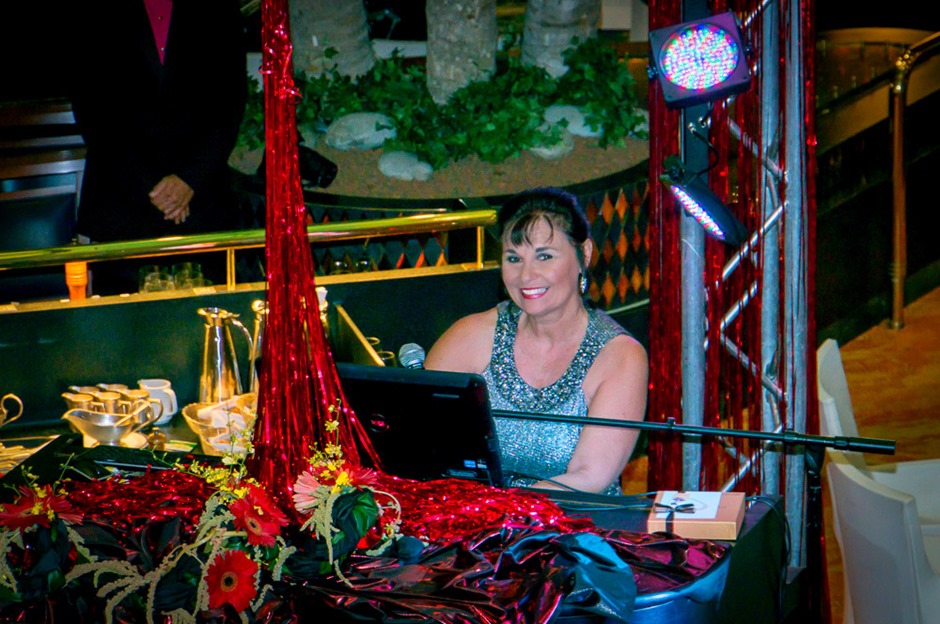
On February 14 there was a Valentines Ball. First there was a reception in the Queen’s Lounge, then a formal dinner, then the Ball, all with free drinks. They really went all out in decorating & Debbie Bacon serenaded us from the piano on the first floor.


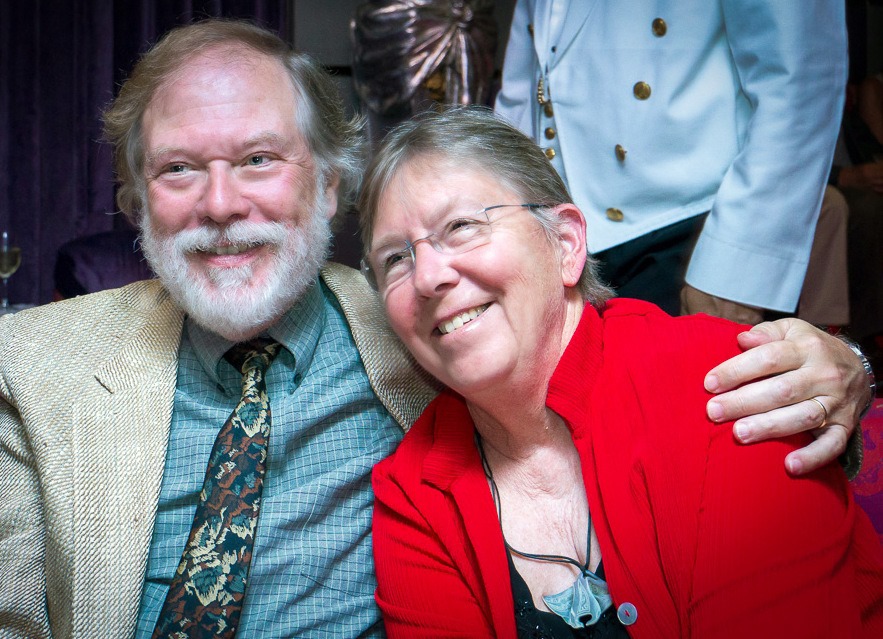


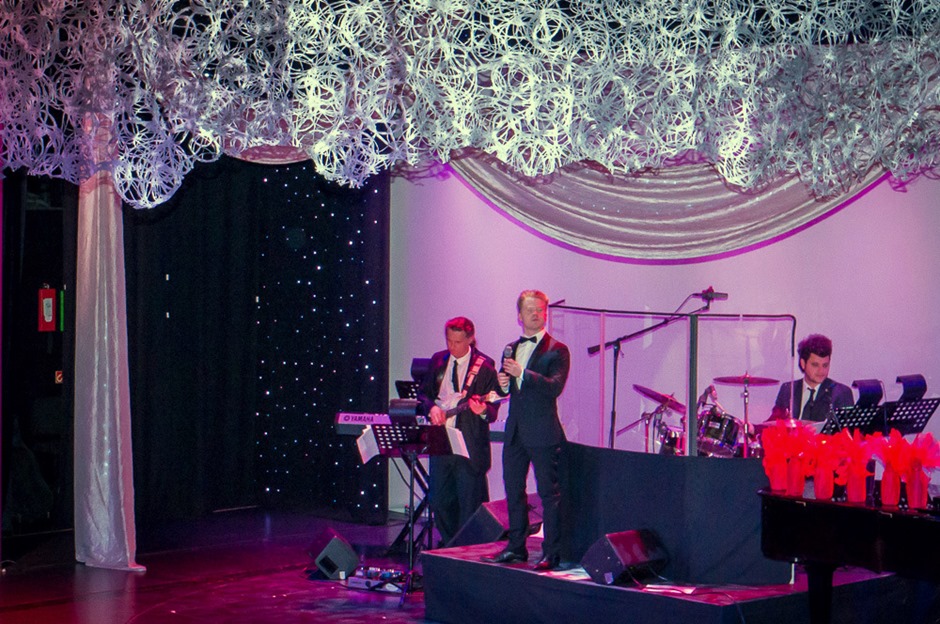
At the ball the excellent 5 piece “Amsterdam Orchestra” played along with two very good young singers brought aboard for the occasion, Liam John Burrows & Darcy Jones. Liam was in the Sinatra mold & did it very well. We saw him sit in with the Neptunes in the Ocean Bar a few days later & he was particularly enjoyable in this more informal setting (many of the featured acts are).


Since it was a last minute replacement port, we had little information about Townsville. It dates to the early 19th Century & has about 200,000 residents. In the second half of the 19th century it was the port for several gold mines during the gold rush. We know that today it is a port for, among other things, cattle because there was a cattle ship being loaded next to us in the commercial dock area where we were moored.
We took the mandatory shuttle into town & walked down Flinders Street to the Reef Headquarters & Aquarium. Flinders Street has a lot of small buildings from the 1800’s but most of them seemed to be closed up. This is near the beginning of the Great Barrier Reef & the Reef administration seems to be situated here. The Aquarium in the same building was wonderful: the largest living coral reef aquarium in the world.


A very large “predator tank” contained several different kinds of sharks along with other fish & even a giant clam. There was a talk here by a diver inside the tank. To keep the coral alive these tanks are open to the sun & air outside. This means they have to constantly replenish the water that evaporates & also must constantly clean the inside of the tanks.


For fans of Finding Nemo, we are in Australia so both Nemo & Dorrie were here. Clownfish are born male & when the dominant female dies one of the males becomes female (no operation needed). We learned that there are several kinds of fish that can change sex & the giant clam above can change on a yearly basis, emitting sperm one year & eggs the next.


The Crown of Thorns starfish has become a menace to the Great Barrier Reef. They eat the coral polyps & have spread alarmingly in recent decades, partly because they can regenerate like worms so that when machetes were used in early eradication efforts the pieces would each become a new starfish. Today the inject a toxic solution into them, which ensures they are truly dead. There were other more benign (and prettier) starfish as well. We learned that starfish have eyes at the end of each of their arms.


We saw a creepy Moray Eel & a Bluespot Lagoon Ray that looked like something from outer space. There was a Lionfish – beautiful but deadly – and some Razorfish, which swim vertically. Also a beautiful Semicircle Angelfish (which looks more blue than the purple color in the picture).


In the background there were many types of living coral & some stationary animals, like anemonies & sea urchins.


Finally, we visited the turtle hospital. Wounded or disabled sea turtles are bought here and nursed back to health, then released back into the ocean. There were a couple of hawksbill turtles here, a couple of flatback turtles, and one huge 200 pound green turtle. “Green turtles” are actually brown, not green, as you can see below. Turtles are sea animals with flippers instead of legs, while tortoises are land animals with legs & feet.


Leaving the Aquarium, we walked along the Strand, a road that borders the waterfront ANZAC Park. Known as Strand Park since the 1880’s, it was renamed in the 1930’s to memorialize the soldiers from Townsville killed in World War I. It is a lovely, very long park with banyan trees and many flowers in addition to the ANZAC memorial & another memorial with a fountain commemorating the WWII Battle of the Coral Sea fought near here. Townsville had the largest allied naval base in the South Pacific & played an important support role in this battle.


In the park and elsewhere in town we saw a number of interesting public sculptures. Most, but not all, were of wildlife.


There is a lot of seashore in northeastern Australia, but you can’t swim in the ocean. Some places there are crocodiles & most places there are Box Jellyfish, which are blue and about the size of your thumb with tentacles that can reach 20 feet in length. Both are deadly. As Bill Bryson pointed out in his book about Australia: of the ten most toxic animals in the world, ten live in Australia. This includes spiders and snakes as well as jellyfish, so Australia can be a dangerous place if you are not on your toes. A few places along the waterfront in the park have been enclosed in jellyfish-proof netting to allow some swimming. We saw some genuine wildlife in the park too, including black cockatoos & a little red-beaked gull that looked like it was laughing.


We ended our walk along the park at the end of the shore, where we climbed up a hill to a lookout point called Kissing Point. This area had been fortified since the 1880’s. In July, 1942, a couple of Japanese planes bombed Townsville, but most of the bombs fell into the water or the bush outside the town. Only one caused any damage, and that was to the racetrack. Today this is a park that provides a nice view over the harbor & of the reddish colored mountain that overlooks the town. We walked back to the ship. It was a couple of miles & it was VERY hot & humid, so we wilted pretty badly before making it back. Later we learned that there was a free shuttle bus going back & forth to Kissing Point. We wished we had known about it, as that would have made a big difference for us.


And so we sailed on up the eastern coast of Australia, into the Great Barrier Reef area. But that’s a story for another day. For now we will leave you with a couple of towel animals (I have lost track, so if you have already seen these, never mind).


Sydney, Australia (Day 2)
Sydney is the largest city in Australia & was also the first settlement here. This area was first visited by Captain Cook around 1770. He sailed past Sydney harbor without entering & anchored a little way to the South in a place he named Botany Bay (now the location of Sydney’s airport). He submitted glowing reports about Botany Bay. Meanwhile, some 17 years later, Great Britain had a growing problem with its criminal underclass. The Enclosure movement had driven many peasants off the land and into the cities where they had no way to earn a living. This led to large growth in petty crime. At that time any theft worth 40 shillings was a hanging offense, and the prisons filled up with people convicted (usually in very summary trials) of petty theft. Criminal overcrowding had for many years been eased by deportation to the American colonies where the convicts were sold into indentured servitude, usually for seven years. But the American Revolution cut off deportation there, and overcrowded prisons were supplemented by “hulks,” ships denuded of masts anchored in the Thames & at Plymouth where prisoners rotted away in the unrelieved filth with little fresh air or food.
Something had to be done, so ultimately the government decided to begin transporting convicts to Botany Bay, which was as far from England as it was possible to go & which Cook had assured them would be a good place to live. Many convicts were given a choice between the gallows and transport to Botany Bay, so you can imagine how many “volunteers” there were for transport. The “First Fleet,” headed by Arthur Phillip, arrived in Botany Bay at the beginning of 1788, but it quickly became apparent that Cook had been wrong about the living conditions, particularly because of the lack of a source of fresh water. After a few days Phillip set out to explore the other bay to the North & found it to be extraordinarily good for settlement. He wrote that it was the best harbor in the world, in which the entire British navy could be harbored with room to spare. So the fleet moved there & they began to build a settlement at a place near where the Opera House now sits that is called “the Rocks.”
The Aboriginals at Botany Bay were glad to see them go. When Cook had been there, they had gathered on the shore and shouted to him to “go away.” Of course, Cook had no idea what they were saying but he did go away. So when the First Fleet arrived there the Aboriginals again told them to “go away,” and they had every hope that this tactic would work again. But when the British began building a settlement on their land, and catching their fish to eat, they began to realize that this was a lot more serious. This led to a lot of strife.
Our plan for Day 2 was to explore the Rocks area, the oldest section of the city situated between the Harbor Bridge & the Opera House. It is a very interesting area, with old buildings, some built by the original convicts, intermingled with glass skyscrapers. The old Victorian buildings had a lot of interesting architectural detail of the kind not seen anymore (too expensive I guess).


Our first target was the State Library built in 1906, which was quite magnificent with a domed reading room. The floor in the entrance was an amazing stone inlay copy of a map of this part of the world drawn by the Dutch explorer Abel Tasman in the middle of the 17th century. I think he was the first to reach this part of the world, which is why it was known as New Holland into the 19th century. The island of Tasmania (which he called Van Damien’s Land) is named for him, as is the Tasman Sea between Australia & New Zealand. There is a tunnel leading to a modern library building that is mostly glass and very light & airy.


Outside the library is a statue of Matthew Flinders who we met before in Melbourne, the first circumnavigator of Australia at the beginning of the 19th century. On his way back to England he was detained in Mauritius, a French territory that was at war with England at the time. It seems he had obtained a pass, but it was in the name of his ship rather than his own name. He had lost his original ship and was returning on a different one, so the officials on Mauritius refused to recognize it and imprisoned him as a spy. He spent several years locked up there before clearing up the matter and obtaining his release. In England he wrote a book about his exploits, but he died on the very day it was published. Through all of this he was accompanied by his cat, Trim, who even stayed with him in prison on Mauritius. But when they were freed, Trim was nowhere to be found as he prepared for departure. It turned out that a group of ravenous locals had eaten him. Behind the Flinders statue out side the library is a separate statue of Trim, the first cat to circumnavigate Australia


We walked past Sydney Hospital, built in 1814. In front is Il Porcellino, a bronze copy of a well known statue in Florence, donated by the Florentines in 1968. Its nose is rubbed shiny & there is a plethora of small animals sculpted into its base.


Next we came to the Hyde Park Barracks, built in 1819 and designed by a convict turned architect, Francis Greenway. This was built to house convicts, not soldiers.


We walked through Hyde Park, lush with trees & flowers. In the center is a very elaborate fountain built in 1932, on one side is St Mary’s Cathedral and at the end is the ANZAC Memorial (but we didn’t walk that far). There was a sign warning to watch out after a rain for “failing trees.” The park is also home to a large number of Ibis, an awkward looking bird with a long beak that we were told are considered pests hereabouts.


The Queen Victoria Building was erected in 1898 as a market hall & after years of neglect it was restored in the 1980’s into a really glorious indoor mall. It has four stories with a large variety of stores & kiosks, and a huge hanging clock on which, when it strikes the hour, small figures emerge and behead Charles I (or so we have read . . . sadly, we didn’t see this happen). We rode down from the upper floor in an old fashioned cage elevator, & in front of the building is a large statue of Queen Victoria.


Over the last few decades Sydney has developed into a cosmopolitan & ethnically diverse city (it has only been a few decades since Australia abandoned its narrow racial immigration restrictions). This month it is celebrating Chinese New Year over a period of several weeks & the city was decorated with some delightful displays. Our favorite was the rabbits in front of the old Customs House, built in 1845 & remodeled in 1885, whose first three floors house the city’s public library (which we didn’t visit because we only learned about it later). We also passed a fellow playing the Digeridoo; not just for Chinese New Year, he looked pretty permanent (and other passengers mentioned they had seen him on previous visits). We have had a digeridoo player on board since we left New Zealand, teaching passengers how to play. His scheduled performance was, unfortunately, canceled because he injured his eardrum shortly after boarding the ship.


Well, after seeing all this, doing some shopping & consuming huge cones of gelato it was time to return to the ship for the sail-away. It had been a sunny & warm day, but at sail-away it turned cloudy & overcast, so the views were not as great as they could have been. Pretty good still, though. There was a big party on the aft deck as we left & HAL provided free wine & food so everyone was feeling happy, including moi. We passed by all the icons one last time: the Opera House, the Harbor Bridge & Luna Park. There was a group of bridge climbers on top as we passed under the bridge & there were shouted greetings on both sides. We had to wait about an hour at the mouth of the harbor for a boat to come out and pick up two passengers with medical issues that required hospital care, then we sailed up the Eastern coast of Australia. This was too short a stay in this special city, which left quite a lot to do and see next time.


Sydney, Australia (Day 1)
We got up very early on February 10 to see the sail-in to the legendary harbor of Sydney, Australia, thought by many to be the best harbor in the world. We got our first view from the ocean threshold before sunrise & it became more beautiful as we sailed in. We had our first view of the famous Opera House and the Harbor Bridge.


We sailed under the bridge and on to our berth at White Bay, within view of the bridge but about 45 minutes drive by shuttle bus. Last year the world cruise docked at Circular Quay, right next to the Opera House, but when there are larger ships in town that can’t fit under the bridge, smaller ships like Amsterdam are banished to White Bay. It seemed to us that the site must have been selected by someone trying to find the most inconvenient spot for cruise passengers & little has been done to provide efficient transportation (our cab driver that night had been driving here for 5 years and had never been to White Bay). But despite this, we were very happy to be here.


After breakfast we set out on an excursion that took us first to Koala Park, an animal park (ie. glorified zoo). After all, you can’t go to Australia & not see koalas and kangaroos! Despite its name, the park only had one koala. Koalas sleep about 20 hours a day because the eucalyptus they eat gives them very little energy, so this little guy must spend all his waking time on duty. In Queensland it’s permissible to have your picture taken holding a Koala, but here in New South Wales it is illegal to touch a koala. But people lined up to have their picture taken standing in front of the koala anyway. It looked like a hard way to earn a living.


While there was only one koala, there were a lot of other interesting animals. We have been told that 90% of the species of animals and insects In Australia are found nowhere else, so Australian zoos are pretty exotic to Americans & Europeans. Among the birds we saw here were the Laughing Kookaburra, the Blue Peafowl, the Double-Wattled Cassowary, a White Cockatoo & the Emu. There were also some creepy looking bats called Grey Headed Flying Foxes.


We saw Dingoes, which looked a lot like our son’s Australian Cattle Dog but for their yellow color, and seemed much nicer than portrayed by Rudyard Kipling in the Just So Stories, oh best beloved. We even got to pet one that was being walked on a leash. There were some Blue Tongued Lizards, although we didn’t get to see their tongues. We saw part of an Echidna (a spiny ant-eater and egg laying mammal), who was hiding with only its back showing. And there was a Wombat, but it took one look at the approaching tourists and retreated into a barrel & covered itself in straw. I am including a picture of its face taken while it was inside the dark barrel, even though it is pretty hard to discern.


And finally, the Kangaroos & their smaller cousins, the Wallabies. There were two species of Wallaby in this park, Wallaroos & Red Necked Wallabies. They seemed very active, hopping here & there, very suddenly and very fast.


The kangaroos were in a sort of corral which visitors could enter to interact with the kangaroos. You could feed them (they eat grass & leaves) or pet them, and they were quite used to people & very friendly. One was a mother with a joey in her pouch; all you could see of him or her was the long legs sticking out of the pouch. We were told that kangaroos are born very tiny & somehow manage to climb into the mother’s pouch, where they latch onto a nipple & stay attached until ready to emerge many months later.


The flora here was interesting as well, including very large-leafed ferny plants & a variety of Eucalyptus whose bark appears to fall off, leaving a white trunk.


The next thing on the advertised agenda was lunch at the top of the Sydney tower. But it turned out that our guide hadn’t made reservations ahead of time & the restaurant wouldn’t take us until 2:00. So we had to drive around town for a couple of hours, seeing some of the city but mostly to waste time. This was a problem for a few of us who had opera tickets for that night & were relying on the published return time of 5:00 to make it to the show. We made it back only 15 minutes late despite all this delay, but it made the rest of the excursion a little nerve-wracking for us. Our first stop was in a park on the opposite side of the Harbor Bridge from the Opera House.


We drove through the Royal Botanic Gardens to its furthest point, where there was a nice view of the Opera House & the bridge (I hope you aren’t sick of them yet, there is more to come). We also saw Mrs MacQuarie’s Chair, a bench cut into the stone wall in 1816 by convicts at the behest of the Governor’s wife, who liked to sit here and enjoy the view. There was a group of tourists on the very top of the bridge. For about $250 you can join a bridge climb to the top, dressed in a special suit of overalls and tethered to the bridge so you can’t fall (you can’t bring a camera either, since it could be dropped & hurt someone below). We didn’t do that.


We finally made it to the Sydney Tower at about 2:00 for lunch. This is similar to the tower in Auckland, prominent on the skyline from many areas of town. We had lunch here in a revolving restaurant: the windows & central kitchen area are stable while the table area rotates at about one revolution every 1.5 hours. The buffet had quite a lot of foods available, & Rick had crocodile & emu sausage, and a sort of kangaroo stew. Not all that great, so fortunately there was other food available too. The views were very far-reaching.


Our last stop was for a tour of the Sydney Opera House. The story of its building is long and complicated, but basically this design was chosen from a worldwide competition after initially being rejected. No one knew how to make a building with this design actually stand up, but after a lot of experimentation the original architect hit on the idea of using sections of a sphere for the sail-like structures & that turned out to be the breakthrough. It ran way over budget (doesn’t everything?) which led to the original architect being ousted from the project, & he never saw the building in person, though there was some reconciliation before he died.


We visited the major performance spaces. Best was the Concert Hall, huge & beautiful with outstanding acoustics. Our guide said there are no bad seats here, so you may as well buy the cheapest ones. There are also seats behind the orchestra on stage. Above the stage is a series of large hanging discs. These are raised and lowered to improve the acoustics for the performers: low for a string quartet & high for an orchestra, for example. And in the middle is a huge pipe organ, with several thousand more pipes behind that you cannot see, from small enough to hold in your hand to several stories tall. Quite impressive.


That night we went with another couple to an opera in the Opera House. Originally operas were expected to be staged in the concert hall, but that didn’t work out (can’t remember why), so another smaller space was converted into an opera stage. The orchestra is beneath the stage with the conductor standing up through an open space in front; there are TV monitors so that orchestra members can see what he is doing above his knees. The opera was Rossini’s Barber of Seville, and it was fabulous. They played it for laughs, & the biggest joke was all of these magnificent voices in the service of low comedy. In the other performance venue was a show called Blanc en Blanc. A number of other passengers attended this cabaret style show, complete with hot tub & full frontal nudity. Sadly, there was no nudity in Barber of Seville.


We made it back to the ship late, but it was a lovely night so we went up to the top deck for some final photos from a very full day. And we weren’t through with Sydney yet.


Melbourne, Australia
After three days at sea we arrived at Melbourne, Australia on February 8. Melbourne (pronounced “Mel’-bun,” to our surprise) is the capital of the province of Victoria & the second largest city in Australia with a population in excess of 4 million. It was founded in 1835. Of course, Aboriginal people had populated the area for 30 or 40 thousand years before that, having mostly walked from Southeast Asia because the oceans were much lower then. The Aborigines were progressively dispossessed of their land in the region over the first 5 to 10 years after settlement by Europeans.
In 1851 there was a gold rush in Victoria & by the 1880’s Melbourne was one of the largest & richest cities in the world. In 1901 it became the temporary capital of the new Australian federation, but after years of competition with Sydney for that role the capital was moved to Canberra in the 1920’s, halfway between Sydney & Melbourne.
The harbor is a few miles from downtown so we took the bus in ($14 Australian to ride all day). The bus let us off just across the Yarra River from the central business district, so we walked across the bridge into town. The weather was gray & overcast, but we hoped it would improve at it has done many times on this trip.


Perhaps the most distinctive characteristic of Melbourne is the combination of soaring glass skyscrapers and elaborate Victorian stone buildings of the late 19th century. The proliferation of monumental Victorian buildings in the 1880s and 90s was a direct result of the excessive flow of money into the city from the gold rush. We came upon three of the best examples immediately upon crossing the bridge. First, Flinders Street Station was built in 1909 and was the busiest commuter rail station in the world during the 1920’s. It is still bustling and “under the clocks” at the station is one of the commonest meeting places in the city.


Second, across the street from the station is St. Paul’s (Anglican) Cathedral, with soaring steeples and a beautiful interior of alternating colored stone stripes. It was built in 1891.


Next to the cathedral is the Town Hall, a massive building completed in 1870. Its entrance doors display the four images on the city coat of arms . . . a whale, a ship, a bull & a sheep, representing the area’s economy. Across the street was an imposing building of a later vintage that is part of Victoria University.


We walked on to the State Library of Victoria. Built in 1856, it is one of the oldest cultural institutions in Australia and has more than 2 million books in its collection. Its domed, multi-story main reading room is quite impressive.


There was another reading room with skylight & lots of glass & a separate chess room with chess tables & one of the world’s most extensive collections of chess books. Also here are some architectural details.


The museum we most wanted to see is closed on Mondays (naturally), so we decided to walk up to the Melbourne Museum, a very modern building of recent vintage said to be the largest museum in the Southern Hemisphere. It has a vast collection, but we mostly just wanted to see their Aboriginal collection, so we were happy that they waived the $14 per person admission for seniors, even if you aren’t Australian. This made us feel better about the limited time we had to spend there. There was a lot of interest in the Aboriginal collection, both artifacts and narration. On the way out we noticed hanging from the ceiling an important old airplane, which may have been the first one built in Australia (we can’t remember).


Near the museum is the Royal Exhibition Building, erected for the International Exhibition of 1880. This is also where Australia’s first parliament met in 1901. There was a big sign on one side advertising that you could rent it for your wedding or other function, and there were similar signs on other grand old buildings, like the Town Hall. It seemed strange to us, but I guess business is business. It’s not as bad as naming baseball stadiums after the corporation that bids the most.

We walked back downtown to the Supreme Court to see our second library of the day. It seemed to take forever to get though the metal detectors at the entrance, only to find that we were required to leave our cameras with the guard. This we duly did, & walked in and looked around the lovely round domed library inside the court. When we came back the guard told us that only cameras were forbidden & it was OK to photograph with your phone! So back we went and made the photograph below. When we returned to take our leave it appeared that lunchtime was over because there was a line of people waiting to enter the court. Rick was the only barrister there who wasn’t wearing the British style black uniform with a fluffy white collar (actually, they probably wouldn’t have believed Rick was a lawyer, dressed in his t-shirt, cargo pants & baseball hat).

There were some other miscellaneous things. On Flinders Street were a number of tall poles with designs on them, some Aboriginal and some not. They didn’t seem to have lights at the top, or any other obvious function, so maybe they are just decorative. On the same street was a statue of (surprise) Matthew Flinders. While he is not well known outside of Australia, here he is a hero somewhat akin to the Founders in the U.S. He was the first to circumnavigate Australia, mapping much of its coastline for the first time, and he was also the first to call it Australia (it had been called New Holland up to that time). More on him in a future episode. We walked through the Royal Arcade, a shopping mall built in 1869 and Melbourne’s oldest existing arcade.


By now it was getting late (& we were getting hot & tired), so we walked back across the river to catch the bus back to the port. It was much sunnier now & the river and the newer development along its shore were brightly lit.


We sailed away from Melbourne in late afternoon, feeling that we had seen quite a lot in only one day but that there was still quite a lot of interesting places to see on our (hopefully) next visit.

Picton, New Zealand
The Amsterdam was easing into its dock when we opened the window on the morning of Thursday, February 4. Picton is a nice little town in a beautiful setting, Queen Charlotte Sound. It is at the north end of the south island of New Zealand & is the terminal for the ferry across the Cook Strait that connects the two islands. This province is called Marlborough & is New Zealand’s top wine country. The first European settlement here was a whaling station set up in 1827, but the town was established in 1848.
This bay was one of Captain Cook’s favorite anchorages & he spent almost half a year here spread out over his three voyages. During his second voyage he was separated from his second ship in fog near Antarctica & this bay was the designated meeting place. So he brought his ship here & waited a number of days before giving up and sailing on. The other ship arrived just a few days later & sent ashore a provisioning party. When it did not return they sent another party to find them. The second party found them, but only some recognizable parts of their bodies & they concluded the first party had been killed & eaten by the local Maori. So they returned to the ship, which hightailed it back to England.
We were anchored almost in the center of town, so after breakfast we walked in. Like a lot of days on this voyage, it was very cloudy & looked like rain but later turned brightly sunny.

Our first stop was to see the Edwin Fox, what remains of an old ship built in India in 1853. Its first service was to transport troops for the Crimean War. Its primary significance is as the only remaining ship to transport prisoners to Australia & settlers to New Zealand. If you have seen the movie “The Great Train Robbery,” the characters played by Sean Connery and Donald Sutherland were later transported to Freemantle, Australia on the Edwin Fox’s one voyage in 1858 as a prisoner transport. The ship served as a commercial vessel for a number of years, carrying tea from India to England, then after its sailing days were over it was made into a giant refrigerator for storing preserved meat before transport to England. After arriving in Picton in 1897, It languished for a number of years, subject to plundering, before being purchased and towed to its permanent display location in Picton in1999. It’s not in very good condition & they lack the money for any refurbishment (at least so far), but its historical significance is substantial.


We walked over to the Picton Foreshore, the beach area at the center of town. The weather was still threatening, but the bay was beautiful. There were also colorful flowers in extensive flower beds.


Passing through the Anzac memorial serving as a gate between the Foreshore & the town, we walked up the main street. Not much beyond a few uninteresting stores & restaurants, but in a lovely setting surrounded by mountains. Then we found the library, always a primary objective for us. We discovered recently that Steve & Wendy, two of our Cruise Specialists hosts, also collect library pictures for their son, who is a librarian in Louisville, Kentucky. We thought we were the only ones, but apparently not.


We decided to take a walk on one of the trails along the harbor, so we headed over to what the locals call the Coathanger Bridge, passing a lot of sailboats at anchor. From the bridge we followed the road straight ahead, which turned out to be a mistake. After hiking about a mile we (finally) happened upon a sign that told us we were on the wrong path. The one we wanted required turning left after the bridge (but there was no sign at the bridge to tell you that). So our best recourse was to take the “Scout’s Track” over the mountain ridge to the path overlooking the harbor. It was very steep, but we made it. We decided that the name referred to boy or girl scouts, who would be much younger than we are!


At the top we were rewarded with great views of the Sound (and the prospect that the rest of the trip would be downhill!).


As we came down the trail on the harbor side of the ridge of mountains there were more nice views & some interesting flowers.


After this hike we were ready to walk back to the ship. We passed a playground with a Donald Duck statue (does Disney, Inc. know about this?) & some acrobats busking in the Foreshore area. They announced that they thought their act was worth at least 10 or 20 dollars, but since we only saw the ending as we passed by we just continued on. You can see from this view of the harbor that the weather had greatly improved (yay).


So that’s it from Picton & from New Zealand. The sailaway was quite beautiful, as you might imagine, & the Sound was much longer than we had anticipated. We were looking forward to some relaxing sea days as we crossed the Tasman Sea to Australia.


 BADER JOURNAL