Latest

Third Voyage Around The World, in 2024

    On January 3, 2024, we set sail from Ft Lauderdale on an epic 128 day voyage around the world, scheduled to return to Ft Lauderdale on May 11.  We are sailing on the Holland America ship Zuiderdam which has a passenger capacity of more than 1900.  This is much larger than any ship on which we have taken a long voyage before, but we are told that only a little more than 1200 passengers are actually on board.  This will certainly make the ship less crowded but it’s still pretty big for our tastes and we are still trying to remember where everything is located two days later as I write this. 

zuiderdam_hal.jpg-topaz-enhance-6x-sharpen     We joined this voyage primarily because its itinerary was so good for us, sailing to a number of interesting places we have never been, including Japan, China, India & Hawaii.  So far we have had two itinerary changes before sailing, with three Israeli ports cancelled after war broke out there on October 7, and a reversal of our port stops in China that would enable many of us to visit those cities without obtaining a Chinese visa.  As of today, here is our scheduled itinerary, first a map and then a list of port stops (the flaming round map icons denote overnight stops and the moon icons denote late night departures):2024 World Cruise map (revised 11-18-2023)   

 Day         Date          Itinerary                                                Arrival      Departure


 WED         03JAN24          Sail from Fort Lauderdale, Florida, US                         5:00pm


 SUN         07JAN24          Scarborough, Trinidad and Tobago        8:00am           5:00pm


 TUE         09JAN24          Devils Island, French Guiana                  8:00am           5:00pm


 THU        11JAN24          Macapa, Brazil                                       6:00am           11:00am


 FRI         12JAN24          Alter Do Chao, Brazil                              11:00am          6:00pm


 SAT        13JAN24          Boca da Valeria, Brazil                             7:00am           2:00pm 


  SUN      14JAN24          Manaus, Brazil                                         8:00am           5:00pm


  MON     15JAN24          Parintins, Brazil                                       10:00am          6:00pm


 TUE       16JAN24          Santarem, Brazil                                       8:00am           5:00pm


 SAT        20JAN24          Saint Georges, Grenada                           8:00am           5:00pm


 MON      22JAN24          Willemstad, Curacao                                8:00am           6:00pm


 WED      24JAN24          Panama Canal                                           5:00am           5:00pm


 FRI        26JAN24         Quepos, Costa Rica                                    7:00am          4:00pm


 MON     29JAN24         Manzanillo, Mexico                                   12:00n          9:00pm


 TUE      30JAN24         Puerto Vallarta, Mexico                               8:00am          5:00pm


 TUE      06FEB24         Kona, Hawaii, US                                         10:00am         8:00pm


 WED     07FEB24         Hilo, Hawaii, US                                            8:00am          5:00pm


 THU     08FEB24         Honolulu, Hawaii, US                                    7:00am          11:00pm


SUN      18FEB24         Guam (US Territory), Guam                           8:00am          5:00pm


MON     19FEB24         Saipan, Northern Mariana Islands                  8:00am          5:00pm


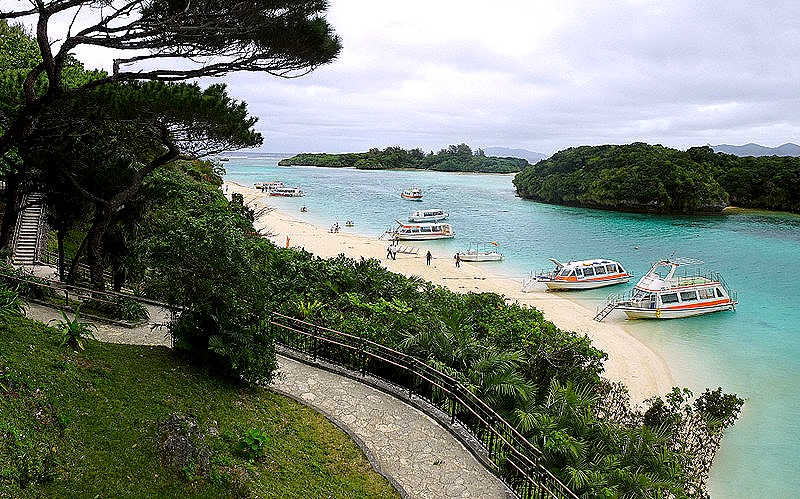
 FRI       23FEB24         Ishigaki Island, Japan                                    7:00am          5:00pm


SAT       24FEB24         Naha, Japan                                                  7:00am


SUN       25FEB24         Naha, Japan                                                                        11:00pm


 WED      28FEB24         Tokyo, Japan                                                  8:00am

 THU      29FEB24         Tokyo, Japan                                                                       6:00pm


 FRI       01MAR24         Omaezaki, Japan                                          7:00am          5:00pm


SAT      02MAR24         Kobe, Japan                                                    9:00am


SUN      03MAR24         Kobe, Japan                                                                        5:00pm

 MON    04MAR24          Scenic Cruising Kanmon Strait


 TUE      05MAR24          Fukuoka (Hakata), Japan                               7:00am          4:00pm

THU      07MAR24          Shanghai, China                                            8:00am

 FRI       08MAR24          Shanghai, China                                                                 5:00pm


 SUN     10MAR24          Dalian, China                                                  8:00am          5:00pm


 MON    11MAR24          Tianjin (Beijing), China                                    8:00am


 TUE     12MAR24          Tianjin (Beijing), China                                                         6:00pm


 SAT     16MAR24          Hong Kong, China                                           8:00am


 SUN     17MAR24          Hong Kong, China                                                                3:30pm


 TUE     19MAR24          Da Nang (Hue), Vietnam                                 8:00am             11:00pm


 THU     21MAR24          Phu My, Vietnam                                           6:00am               6:00pm

 SAT     23MAR24          Singapore                                                       8:00am


 SUN     24MAR24          Singapore                                                                                5:00pm

 THU    28MAR24          Colombo, Sri Lanka                                         8:00am              11:00pm


 SUN    31MAR24          Mumbai (Bombay), India                                  6:00am


 MON   01APR24          Mumbai (Bombay), India                                                             5:00pm


 THU    04APR24          Fujairah, United Arab Emirates                        8:00am                6:00pm


 FRI      05APR24          Dubai, United Arab Emirates                           7:00am                11:00pm


 SAT    06APR24          Abu Dhabi, United Arab Emirates                    8:00am                 11:00pm


 MON   08APR24          Muscat, Oman                                               8:00am                    6:00pm

 WED    10APR24          Salalah, Oman                                               8:00am                    5:00pm

 MON    15APR24          Sharm el Sheikh, Egypt                                7:00am                    8:00pm


TUE      16APR24          Aqaba (for Petra), Jordan                               6:00am                  8:00pm

 THU     18APR24          Suez Canal                                                   6:00am                  6:00pm


 SAT      20APR24          Rhodes, Greece                                            8:00am                   9:00pm


 SUN      21APR24          Bodrum, Turkey                                           8:00am                   6:00pm


 MON     22APR24          Kusadasi (Ephesus), Turkey                         8:00am                    6:00pm


 TUE       23APR24          Cruising The Dardanelles


 TUE       23APR24          Istanbul, Turkey                                          4:00pm


 WED      24APR24          Istanbul, Turkey                                                                        4:00pm


 THU      25APR24          Mykonos, Greece                                      11:00am                   11:00pm


 FRI        26APR24          Piraeus (Athens), Greece                            7:00am                     5:00pm


 SUN      28APR24          Naples (Pompeii/Amalfi), Italy                    8:00am                    7:00pm


 WED      01MAY24          Malaga, Spain                                           7:00am                    5:00pm

 SAT      04MAY24          Ponta Delgada, Sao Miguel, Azores,           8:00am                    5:00pm


SAT      11MAY24         Debark Ship Fort Lauderdale                        7:00am

     The itinerary for this voyage has been uncertain from the beginning and we are still not sure how it will turn out. Notably:

Brazil:  When we first visited Brazil in 2012 we purchased a visa that lasted 10 years.  We visited again in 2019, when our visa would still have been good but Brazil had eliminated visas for US citizens.  Earlier this year they announced they were reinstating a visa requirement for Americans at the beginning of 2014, about a year after our old visa, unused since 2012, ran out.  The new visa requirement was to start for people entering Brazil on January 11, 2024 . . . the day we would arrive (coincidence? We wonder).

     The date on which they would accept visa applications was delayed from early October until about a week into December, less than a month before we were to depart.   This created a lot of pressure on passengers because we were told, repeatedly, that no one would be permitted to board the ship on January 3 without a Brazilian visa, thus putting the entire voyage in doubt for anyone who didn’t obtain a visa by then.  And, of course, obtaining a visa turned out to be excruciatingly difficult.  After filling out their form each of us had to upload a picture of ourself and of our picture passport page, in specified format with vague sizing requirements.  We had to upload a copy of our Airline itinerary to and from Brazil (they later agreed to accept our ship itinerary) and a bank statement showing the names of the bank and the account holder and transactions for the last month demonstrating that we have at least $2,000 (ie. enough to get home again).  The reviewing process was very slow (sometimes more than a week or even two) and arbitrary, since different demands for reuploading unaccepted documents were issued.  Often no explanation was given about what was wrong with the initial document provided and there was no one you could contact for explanation or assistance.  And remember, with the departure date fast approaching, the entire cruise was in jeopardy.

       Was anybody nervous?  You bet!  Shortly before Christmas Holland America announced that no one would be denied boarding for lack of a visa after all and if Brazil wouldn’t accommodate us they would change the itinerary to skip Brazil.  Then about a week later, as we were preparing to leave, HAL announced that Brazil had agreed that the ship could sail up the Amazon so long as passengers without a visa did not leave the ship.  So at least no one was going to miss the entire cruise.  Rick’s evisa finally arrived in his inbox the day before we sailed and Mary’s came today, three days into the voyage.  We understand that about half the passengers hadn’t received visas by the time we sailed.  Then yesterday Brazil announced that they were postponing the visa requirement for three months (what they should have done in the first place).  So now everyone is free to visit the Brazilian ports (assuming we will be able to sail up the Amazon, which is suffering from a historic drought that kept some ships from visiting it a month or so ago).  All we are out, therefore, is the $160 we paid for a Brazilian visa we probably will never need (no refunds, at least so far).  That is not counting any health effects of a month of unnecessary tension for a bunch of people who are no longer as young as they once were.

The Red Sea:   As I mentioned above, we originally had three stops in Israel that were changed in October.  But we have no idea what may happen when we arrive at the southern entry to the Red Sea in April.  The war in Israel continues, ships are avoiding the Red Sea and Suez Canal because some are being attacked with missiles and drones from Yemen, the US is threatening the Houthis in Yemen with military force if they don’t stop doing that, and Iran has reportedly sent war ships to the Red Sea and the Mediterranean.  By April this may all be over, or it may have spread into a wider conflict shutting down the Red Sea.  If the Red Sea is not open for cruise ships it seems we will have to be redirected around Africa, missing the Mediterranean portion of this itinerary.  That would be pretty drastic and disappointing to us, first because it would mean more and wider suffering for the people in the region, but also because we visited most of the ports in Africa last year and were looking forward to some of the stops in the Mediterranean.  Still, such a drastic alteration of a world cruise is not unprecedented:  in 2020 HAL’s world cruise was aborted in Australia at the beginning of the COVID pandemic and passengers had to leave the ship in Perth and find a flight home from there.  It was more than half a year before they saw their luggage again.  So detouring around Africa wouldn’t be the worst that can happen (while being hit by a missile in the Red Sea would be).  Obviously, we are hoping it doesn’t come to that.

     Anyway, however it goes we intend to enjoy this voyage.  We have a lot of great experiences planned and life aboard the ship is also enjoyable (unless you really enjoy washing dishes, making beds and doing laundry, which is all done for us here).  Some people post to their blogs every day, it seems, but we don’t know how they do it.  Blog writing can only be done on sea days and each episode seems to take us a long time to compose.  Our main goal in this blog is to create a record of what we have done and seen on our travels that will serve as a diary/photo album, allowing us to look back on them and remember what we have experienced.  So the permanent product is more important to us than keeping up with daily events.  The result is that our postings will fall further and further behind the ship’s actual progress and we will not finish blogging this journey until months after we return. 

     If you are interested in following where we and the Zuiderdam are at any particular time you can see it on this page:

https://www.seascanner.com/ships-position-zuiderdamr

    If you would like to receive an email when a new episode is posted to this blog there is a link where you can subscribe at the very bottom of this page.  Because episodes will, at best, be posted intermittently on fairly random dates (on Grand Africa nothing was posted before we returned), and this blog is old-fashioned and not well indexed, subscribing is probably the easiest way to follow it.  If you have subscribed in the past I don’t think you have to do it again (unless your email has changed).

     If you click the “About” button at the top of this page you will learn more about this blog than you probably want to, including past voyages that are included here.

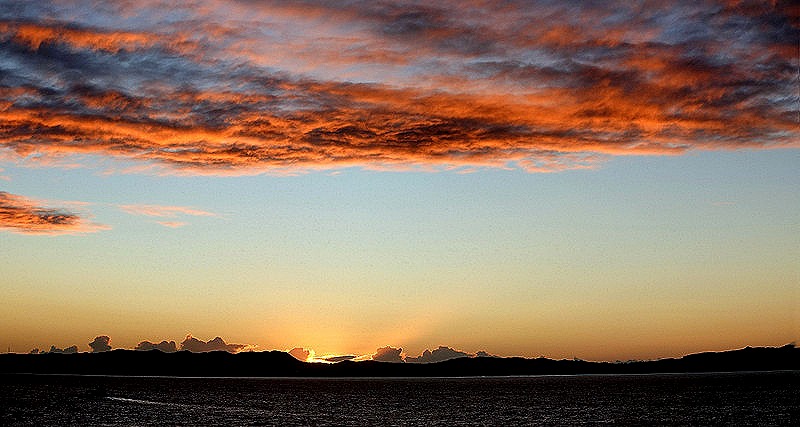
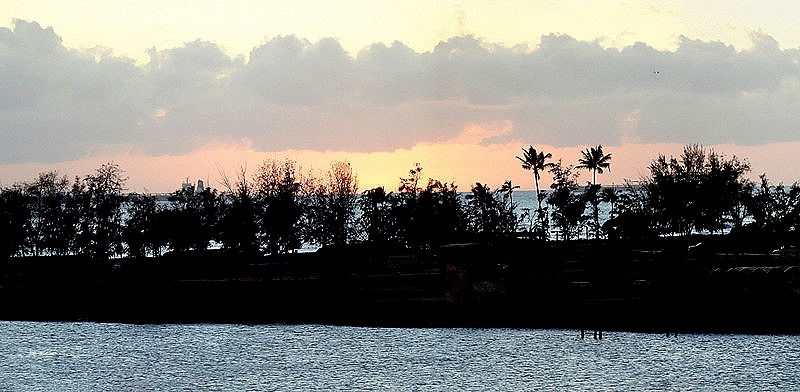
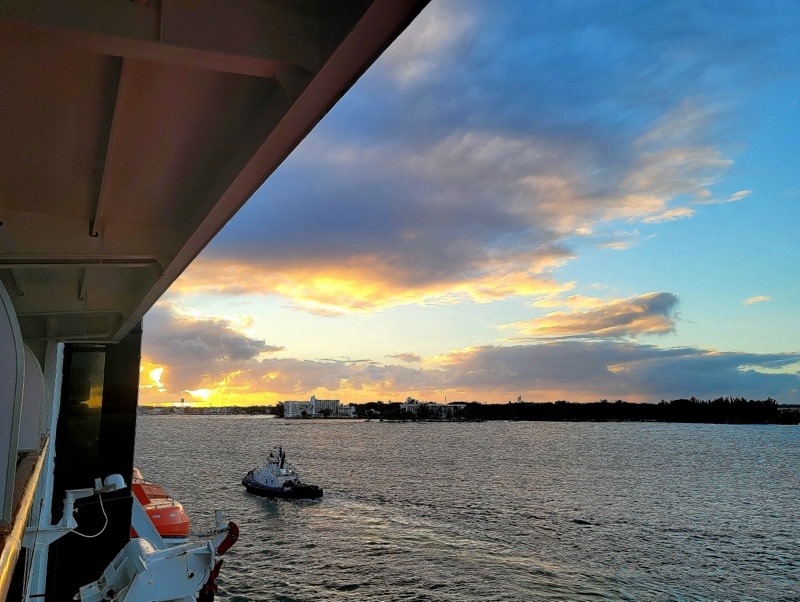
     So that’s it for now.  If you see this you will know that we were able to upload to our blog site (this didn’t work at all on our Grand Africa voyage last year).  If you don’t, then nothing I say here will matter.  We will leave you with two pictures.  The first is us (on the left) with our friends Bill, Robert, Judy and Bob at dinner on the first night of the cruise.  We all met during our first world cruise in 2016 when HAL threw us together to share a dining table, along with our friend Lee.  All seven of us travelled together again on a world cruise in 2018.  Only six of us are together this time, but only because Lee died during the 2018 voyage; otherwise we are sure he would have been here.  The second picture is our first glorious Caribbean sunset.  See you next time.

IMG_7755

DSC03270_stitch

San Juan, Puerto Rico (USA) 2022

     “It was a dark and stormy night . . . .”  How many works of fiction start like that?  Well, this isn’t a work of fiction and it was morning rather than night when we sailed into San Juan’s harbor on December 17, but the rest of that phrase applied.  We got up early in the hope of seeing the sail in past the fort of El Morro that is supposed to be a good one.  But the captain double-crossed us by arriving about a half hour before the scheduled time.  So we missed it, getting out on deck only after we were well into the harbor.  It was pretty dark still and rainy and overcast, so we probably wouldn’t have seen much anyway (those grapes were probably sour anyway, right?).

     We have been to San Juan a few times, most recently on the 2018 world cruise.  On that occasion we were docked right by the old town, where you could step off the ship and walk into town.  You can see that visit, and read more about San Juan, here:

https://baderjournal.com/2018/09/12/san-juan-puerto-rico-usa/

This time we were docked quite a distance away so that we had to take a shuttle bus to get into town.  Here is what it looked like from there.

13a.  San Juan, Puerto Rico_stitch-topaz-enhance-faceai10a.  San Juan, Puerto Rico_stitch-topaz-sharpen

     It rained off and on for most of the morning and a lot of passengers decided to spend the day on the ship.  But not us!  Carrying our umbrellas we ran through the rain to the shuttle bus and boarded for the lengthy trip into old town.  The old town is built on a fairly steep hill up from the waterfront and the shuttle dropped us off in Columbus Square, a little way up.  We walked around that delightful neighborhood for awhile, uncharacteristically gray from rain and overcast, and had to run for cover several times.

19.  San Juan, Puerto Rico-topaz-enhance17.  San Juan, Puerto Rico-topaz-enhance

18.  San Juan, Puerto Rico-topaz-enhance

     We walked over to the Parque de las Palomas (Park of the Pigeons).  The park sits on top of the old city walls where it was originally built in the second half of the 18th century as a gun emplacement.  Its name comes from all the pigeons that can usually be seen here (but not on the rainy day we visited) and the fact that part of this park is the only place were it is legal to feed pigeons in San Juan.  The park was closed for renovation in 2015 and after being damaged by Hurricane Maria in 2017 it did not reopen until May of 2022, about 7 months before we arrived.  A brick and stone wall lining the city side of the park has holes, like a dovecote, where the pigeons hang out.  There are some old gnarled looking trees, colorful decorations and a killer view of the bay over the top of the city wall that must be even more spectacular when the sun is out.  There were pigeons in residence but nothing like the huge crowds of birds that can be seen here on nice days when local folks are out spreading corn meal for them to eat.  An arch was above the walkway in the park with a blue sign next to it:  “Please do not feed the birds beyond this point.”

22.  San Juan, Puerto Rico-topaz-enhance20.  San Juan, Puerto Rico-topaz-enhance23.  San Juan, Puerto Rico-topaz-enhance24a.  San Juan, Puerto Rico_stitch-topaz-enhance33.  San Juan, Puerto Rico-topaz-enhance26.  San Juan, Puerto Rico-topaz-enhance28.  San Juan, Puerto Rico-topaz-enhance29.  San Juan, Puerto Rico-topaz-enhance-faceai30a.  San Juan, Puerto Rico_stitch-topaz-enhance-sharpen

     Leaving the park we headed up to the top of the hill where we walked along the cobblestone street past the Cathedral of San Juan Bautista (the city’s namesake) to the statue of the conquistador Ponce de Leon, who founded the city in the early 16th century.  The statue is in a park next to a church called Iglesia de San Jose, built shortly after the city was founded, where Ponce de Leon’s body was interred for almost 300 years before being moved to the cathedral.

38.  San Juan, Puerto Rico-topaz-enhance40.  San Juan, Puerto Rico-topaz-enhance-sharpen32b.  San Juan, Puerto Rico_stitch-topaz-enhance

     Finally getting our bearings we realized that El Castillo San Felipe del Morro, the fort we primarily wanted to visit today, was actually in the opposite direction.  So we walked back along the soggy streets a good way until we finally spotted it.

42a.  San Juan, Puerto Rico_stitch-topaz-enhance

    San Juan was a very valuable city for the Spanish, known as the “key to the Antilles.”  So they built several fortifications to defend it from attack.  The two largest forts in old San Juan are Fort San Cristobal, built in the 16th and 17th centuries, and El Morro, first constructed in 1540.  We explored San Cristobal when we were last here in 2018 so this time we decided to visit El Morro, which we had once visited many years ago.

     El Morro is built on an imposing spot, on a high rocky promontory (which is what el morro means) at the entrance to the bay.  It was originally just a round tower with four cannon, but by the end of the 18th century it looked pretty much as it does today.  It held off repeated attacks by the British and Dutch and in 1898 the Americans attacked the fort three times, but took over only after Spain ceded Puerto Rico to the US at the end of the Spanish American War.  It was transferred from the military to the National Park Service in 1961 and restored mostly to its appearance during Spanish rule.

     We entered through the front gate passing what used to be a moat and were given a booklet with our free admission.  Admission to this fort is $10 for each adult, but if you have a National Parks Service Senior Pass it is free, so we saved $20.  We learned about this on our last visit to Puerto Rico when we had to pay full admission to Fort San Cristobal because we had left our Senior passes at home, forgetting that the last stop on our world cruise was actually in the United States where that pass would be honored.  I guess we are not yet too old to learn a new trick.

47a.  San Juan, Puerto Rico_stitch-topaz-enhance

    We walked around the main courtyard and looked at the museum exhibits inside the rooms there.  Then we climbed up to the top of the walls, which are some 18 feet thick.  At the corners of the walls are turrets called garitas that were used as sentry posts and sea watchtowers.  From the walls was a nice view of the city beyond the large grassy open space in front of the fort.  This open space had been a defensive feature, providing a vast area without shelter that any enemy attacking by land would have to cross under heavy fire from the fort.  When the American military occupied the fort after the Spanish American war they built recreation facilities there, including a baseball field and a golf course.

50.  San Juan, Puerto Rico-topaz-enhance-sharpen72.  San Juan, Puerto Rico63.  San Juan, Puerto Rico62.  San Juan, Puerto Rico69a.  San Juan, Puerto Rico_stitch

     The gray tower visible over the top of the fort’s walls is a lighthouse.  It was first built in 1846, making it the oldest lighthouse in Puerto Rico, but it became unusable after American naval bombardment in May of 1898 during the Spanish American War.  The Americans had it up and running less than a year later but in 1905 it developed a dangerous crack and had to be replaced with the current tower.   When we visited the lighthouse was closed and fenced off, perhaps for more repair and renovation.

75a.  San Juan, Puerto Rico_stitch66.  San Juan, Puerto Rico20221217_141124-topaz-enhance-faceai

     On the ocean side of the fort was a triangular extension on a lower level that once contained cannon emplacements (I’m pretty sure each of the circular markings was for one cannon).  This must have been a formidable barrier for any hostile ship trying to turn this corner to enter the bay.  The surf was vigorous on the rocky promontory and there was a long island with palm trees in the distance.

55a.  San Juan, Puerto Rico_stitch-topaz-enhance60.  San Juan, Puerto Rico-topaz-enhance61.  San Juan, Puerto Rico77a.  San Juan, Puerto Rico_stitch83.  San Juan, Puerto Rico65.  San Juan, Puerto Rico

     We left the fort and headed back into town to find somewhere for a late lunch.  Because of the intermittent rain we wanted to eat and, more importantly, sit down inside.  We ended up having two generous plates full of delicious empanadas at a small place called La Danza.  We were seated at a nice table in an open doorway on a side street, which was blocked off for some reason and guarded by police.  With the rain outside not quite hitting our table it was a very pleasant place to eat and relax after a lot of walking on wet and uneven surfaces. 

     Then, a bonus!  looking across the side street from our seats in the open door we spotted a sign on the wall for Anita’s gelato place.  Jeremy, our cruise and travel director, had raved about this gelato place during his port talk so we decided to have dessert there.  And boy was Jeremy right!  We have had gelato in a lot of cities around the world but this was certainly one of the best.  Not only was the gelato really good but they dished it out very generously.  Only in New Zealand can we recall them packing more gelato into a single scoop.  Its fun to watch them keep adding more after your cup or cone already looks more than full.  We have never seen anything like that in the US before.

20221217_121756-topaz-enhance88.  San Juan, Puerto Rico84a.  San Juan, Puerto Rico_stitch87.  San Juan, Puerto Rico90.  San Juan, Puerto Rico91a.  San Juan, Puerto Rico_stitch

     It turned out we had inadvertently come full circle.  At the end of the street our restaurant was on we saw the Capilla del Cristo, a small chapel built in the 18th century.  Legend has it that during a horse race one rider lost control and went over the wall.  A bystander invoked the deity to save him and although the horse died the rider lived.  This chapel was reputedly built as a monument to this miracle.  The chapel is only open one day a week and it wasn’t the day we were there, so we weren’t able to see the inside.  But the left side of the chapel in the picture below is also one side of the Parque de las Palomas we had visited in the morning and a number of the park’s denizens were perched on top under a dull gray sky.  We walked on toward the shuttle bus stop, stopping for a while in a small park full of flowers where we talked to our daughter on the phone (easy since this was in the US).  The bus was waiting when we arrived and took us back to the ship.

96.  San Juan, Puerto Rico97.  San Juan, Puerto Rico98.  San Juan, Puerto Rico102.  San Juan, Puerto Rico99.  San Juan, Puerto Rico103.  San Juan, Puerto Rico105.  San Juan, Puerto Rico

101.  San Juan, Puerto Rico

     Thus ended our voyage around Africa, since San Juan was our last port before disembarking in Ft Lauderdale on December 20.  It was a fascinating and eye opening journey with many new and different areas and peoples to see and meet.  It had its downside (particularly the time in quarantine) but overall it was well worth doing, with many experiences we will long remember.

     But before we leave it should be recalled that one of the downsides to this trip was the timing, getting us home (after a two day drive) on December 22, just two nights before Christmas Eve, with no time to prepare our usual family activities.  The ship’s crew began decorating the ship for Christmas shortly before we left the continent of Africa, however.  There were decorations all over, but Christmas Central was in the atrium with a large display that took about four days for them to complete.  And when we arrived home we still had the best part of the Christmas season, spending several days with our family and watching our usual Christmas fare together on TV, primarily that old Christmas favorite the original Star Wars trilogy on Christmas day.  So we will leave this episode of the blog and the entire voyage with a few Christmas pictures from the ship’s atrium.
95a.  Mindelo, Cabo Verde_stitch-topaz-enhance98.  Mindelo, Cabo Verde-topaz-enhance-sharpen99.  Mindelo, Cabo Verde-topaz-enhance91.  Mindelo, Cabo Verde-topaz-enhance-faceai100.  Mindelo, Cabo Verde-topaz-enhance-sharpen91a.  Mindelo, Cabo Verde_stitch-topaz-enhance-faceai

Mindelo, Cabo Verde 2022

     The morning of December 11 dawned for us in Porto Grande Bay in Mindelo, another city in Cabo Verde.  Founded in 1793 by the Portuguese, the town was named Mindelo in 1838 to commemorate a successful military landing near Porto during the Portuguese Liberal War.  Its population is around 70,000, accounting for most of the population of the island of São Vicente.  As a long voyage starts coming to an end one begins to tire of long excursions (particularly on a bus) so unless there is something we really want to see we tend toward just walking around the port city on our own.  We had never been to Mindelo so this seemed a good plan here, a relaxing walk around the town.  We set out on the shuttle bus with our friends Robert and Bill to get a feel for the city. 

IMG_8853-topaz-enhance-faceai-gigapixel-very_compressed-scale-6_00xIMG_8855-topaz-enhance-faceai-gigapixel-very_compressed-scale-6_00x1.  Mindelo, Cabo Verde-topaz-enhance-faceai

     The Portuguese discovered this island around 1460 and its discovery is attributed to Diogo Afonso, one of the explorers sponsored by Henry the Navigator.  A large statue of him sits on the waterfront facing the bay.  Also near the waterfront, located in a traffic circle, is a tall sculpture of an eagle on top of what looks like a tower of rocks.  In 1922 the aviators Sacadura Cabral and Gago Coutinho made the first air crossing of the South Atlantic, flying in several stages (with 3 different planes) from Lisbon to Rio de Janeiro. The trip, to commemorate the 100th anniversary of Brazil’s declaration of independence, took almost 3 months because of having to ditch and replace their plane several times on the way,  Their last stops before crossing the ocean were in Mindelo and Praia, Cabo Verde.  The eagle sculpture was erected on the 76th anniversary of their flight, which would have been 1998.

11.  Mindelo, Cabo Verde-topaz-enhance-sharpen44.  Mindelo, Cabo Verde-topaz-enhance45.  Mindelo, Cabo Verde-topaz-enhance23.  Mindelo, Cabo Verde-topaz-enhance

     We visited a souvenir store in an art gallery down the way where we learned about Cabo Verde’s favorite folk singer, Cesária Évora, known as the “Barefoot Diva.”  A native of Mindelo, the airport is named after her.  We walked further down the street to where the library was located, according to Mary’s research.  The three story building was there but it was closed up tight and it took us a while to find a small sign, not on the front.  We hope it wasn’t closed for good.  On the back was a building sized wall painting of Cesaria Evora (photo rather blurred but you get the idea).

2a.  Mindelo, Cabo Verde_stitch-topaz-enhance4.  Mindelo, Cabo Verde-topaz-enhance5.  Mindelo, Cabo Verde-topaz-enhance-sharpen

     The Tower of Belem was built in Lisbon in the late 16th century on the Tagus River to defend the city, and it also served as the departure and return port for Portuguese explorers.  A three story replica of that tower sits on the waterfront in Mindelo.  Opened in 1921, it now houses Mindelo’s sea museum and has a nice view from the top.  We didn’t know about that when we visited, but here are some pictures of the outside.

63.  Mindelo, Cabo Verde-topaz-enhance7.  Mindelo, Cabo Verde-topaz-enhanceIMG_8862-topaz-enhance-faceai-gigapixel-very_compressed-scale-6_00x

     The Pro-Cathedral of Our Lady of the Light was built in 1862 and is one of the oldest buildings in town.  As we understand it, a pro-cathedral is a parish church that temporarily plays the role of a cathedral in a diocese that doesn’t have one.  It is smaller than most actual cathedrals but was expanded in recent years so that only the facade is original.

40a.  Mindelo, Cabo Verde_stitch-topaz-enhance20.  Mindelo, Cabo Verde-topaz-enhance41.  Mindelo, Cabo Verde-topaz-enhance

     Not far from the church was a delightful souvenir store, brightly painted inside and out, called IstanBlue.  Another building had an interesting painted door and there were trees and flowers in the neighborhood as well.

38a.  Mindelo, Cabo Verde_stitch-topaz-enhance19.  Mindelo, Cabo Verde-topaz-enhance-faceai42c.  Mindelo, Cabo Verde-topaz-enhance-faceai_stitch17.  Mindelo, Cabo Verde-topaz-enhance24a.  Mindelo, Cabo Verde_stitch-topaz-enhance27.  Mindelo, Cabo Verde-topaz-enhance18.  Mindelo, Cabo Verde-topaz-enhance-faceai32.  Mindelo, Cabo Verde-topaz-enhance33.  Mindelo, Cabo Verde-topaz-enhance

    Originally opened in 1874, with a second floor added in 1934, is the bright pink Palacio do Povo (People’s Palace).  Originally intended to house the government if the capital of Cabo Verde was moved to Mindelo (it wasn’t), this striking building now contains a museum space.

28a.  Mindelo, Cabo Verde_stitch-topaz-enhance34a.  Mindelo, Cabo Verde_stitch-topaz-enhance

     Our last stop was at an open air market where vendors were selling clothes, crafts and souvenirs.  Some were set up inside a covered area and others had their wares spread out on the ground.  There were interesting items to be had and at very reasonable prices.  After that we walked back to the shuttle bus stop to return to the ship.  All in all we really hadn’t strayed too far from the waterfront where the bus let us off.

  15.  Mindelo, Cabo Verde-topaz-enhanceIMG_8868-topaz-enhance-faceai-gigapixel-very_compressed-scale-6_00x

     This being our last African port there was a sail away party on the aft deck with the very good Ocean Bar band playing rock music.  It was nice out except for a very strong wind.  To our left in the port was what looked like a huge rock emerging from the water to form an island called Ilheu dos Passaros.  On top of the dark rock island was a white structure leading from the top to half way down.  This turned out to be the Farol de D. Luis, a lighthouse.  We were gone by the time the sun set so we didn’t see it lighted up but we understand that the light is right at the top of the rock with a small 15 foot tower and a white stairway down to the keeper’s house halfway down.  The lighthouse was built in the early 1880’s and named for the then king of Portugal.  Also to our left on top of a tall hill was the Fortim d’El Rei, a fort built in 1852 to defend the Porto Grande Bay and the city.  Its military use ended in 1930 and it has since fallen into disrepair from neglect.  We saw this fort from the shore in town as well.

76.  Mindelo, Cabo Verde-topaz-enhance-faceai80.  Mindelo, Cabo Verde-topaz-enhance-faceai56.  Mindelo, Cabo Verde-topaz-enhance84.  Mindelo, Cabo Verde-topaz-enhance-sharpen10.  Mindelo, Cabo Verde-topaz-enhance50a.  Mindelo, Cabo Verde_stitch-topaz-enhance-sharpen

     Very near our ship on our left was the Mein Schiff Herz, a German cruise ship.  We waved back & forth.  We had some very nice views of the harbor and the city as we prepared to leave.

52a.  Mindelo, Cabo Verde_stitch-topaz-enhance-sharpen66.  Mindelo, Cabo Verde-topaz-enhance57a.  Mindelo, Cabo Verde_stitch-topaz-enhance-sharpen67a.  Mindelo, Cabo Verde_stitch-topaz-enhance

     As we sailed away from Mindelo after a very nice day in our last foreign port there were some memorable vistas in the fading sunlight.

85a.  Mindelo, Cabo Verde_stitch-topaz-enhance87.  Mindelo, Cabo Verde-topaz-enhance88.  Mindelo, Cabo Verde-topaz-enhance

Praia, Cabo Verde 2022

     December 10 found us docked across the bay from Praia, the capital of Cabo Verde (Cape Verde Islands) since 1770.  It was founded by Portuguese settlers in 1615 at the location of an earlier settlement destroyed by Sir Frances Drake in 1585.  We visited here in 2018 when we walked through the city and took a bus tour around this mostly dry and barren island.  You can see that here:

https://baderjournal.com/2018/09/10/praia-cabo-verde/

     Since we had toured the island before and had seen much of this small city of around 160,000 (about a third of the population of Cabo Verde), we decided just to take the shuttle into town and wander around on our own with some of our tablemates.  We saw much we had seen before, had a beer and a bite to eat, and found the national library (our only new objective).

1a.  Praia, Cabo Verde_stitch-topaz-enhance

     The Avenida 5 De Julho (date of independence in 1975) is a pedestrian street lined with trees on both sides that have been pruned to form a sort of canopy over the street.  When we were here last in 2018 this was just getting started and none extended over the street but there has been notable progress since then and the street is now completely covered.  It looks very nice and provides important shade to walkers.  On this street we visited the Municipal Market, a covered building full of stalls on two floors.  It was early so the market was not yet crowded.

10.  Praia, Cabo Verde-topaz-enhance-faceai11.  Praia, Cabo Verde-topaz-denoise-enhance-faceai-sharpenIMG_8800-topaz-enhance-gigapixel-very_compressed-scale-4_00x15a.  Praia, Cabo Verde_stitch-topaz-enhance-faceai12.  Praia, Cabo Verde-topaz-enhance-faceai

     We walked out the back of the market and along a small street to reach a road that ran along the edge of a cliff with an extensive view across a valley containing another part of the city.  We walked to the right and passed a wall with some interesting graffiti.

18a.  Praia, Cabo Verde_stitch-topaz-enhance13a.  Praia, Cabo Verde-topaz-enhance-faceai_stitch23.  Praia, Cabo Verde-topaz-enhance22.  Praia, Cabo Verde-topaz-enhance21.  Praia, Cabo Verde-topaz-enhance

     Mary had located the national library on a map, but it turned out to be in the valley, a long walk down old stone steps that had been brightly painted in rainbow colors.  So we walked back across the town and walked down these stairs.  Robert, Mary and I walked all the way down to the library while the others waited on the stairs about half way to the top.  The library turned out to be closed (hopefully not permanently), so we weren’t able to see the inside.

29.  Praia, Cabo Verde-topaz-enhance-faceaiIMG_8811-topaz-enhance-gigapixel-very_compressed-scale-4_00x26a.  Praia, Cabo Verde_stitch-topaz-enhance28.  Praia, Cabo Verde-topaz-enhance-faceaiIMG_8814-topaz-enhance-faceai-gigapixel-very_compressed-scale-4_00x30.  Praia, Cabo Verde-topaz-enhance-faceai24a.  Praia, Cabo Verde_stitch-topaz-enhance

     Having trudged back to the top we explored for a while.  The Palace of the Presidency of the Republic was built in 1894 as the residence of the Portuguese governor.  After independence in 1975 it became the presidential palace.  It is a fairly stolid looking building though not unattractive and has an excellent garden to one side (the guard made me stop taking pictures after I got this one).

31.  Praia, Cabo Verde-topaz-enhance32a.  Praia, Cabo Verde_stitch-topaz-enhance

     We stopped by the large 1956 monument to Diogo Gomes, one of the men who discovered this island in 1460.  It stands near a corner of the plateau that houses the center of the city and from the walls here we could see in two directions.  To the left we could see Zaandam docked across the bay.  To the right we looked over the beach of Gamboa and an island to the left not too far from shore called Santa Maria Island.  This island was the first stop on Charles Darwin’s 1832 voyage on the Beagle, and where he made his first geological observations.  It is now connected to the shore by a bridge about the length of a US football field.  In the distance on a jetty you can see between the island and the shore is the Farol de Dona Maria Pio, a lighthouse built in 1881 on  the southernmost tip of the island.  It was named after the Portuguese queen at that time.  Its tower is octagonal and is about 60 feet tall.

35.  Praia, Cabo Verde-topaz-enhance34.  Praia, Cabo Verde-topaz-enhance41.  Praia, Cabo Verde-topaz-enhance-faceai42.  Praia, Cabo Verde-topaz-enhance

     The large green square at the center of the city is called Praca Alexandre Albuguerque, named after a Portuguese governor of Cabo Verde.  Along its side is the Pro-catedral Nossa Senhora d Graca (Pro-Cathedral of Our Lady of Grace).  It opened in 1902 and is the seat of the Catholic Diocese of the island that dates back to 1533.  Facing the square on another side is the Quartel Jaime Mota, which opened in 1826 as a military barracks.  The current building dates back to 1872 and has been modified since.  Jaime Mota was a Cape Verdean revolutionary killed by the Portuguese before independence, after which this building was named for him.  It is unclear to us whether today it is used by the military or the police.

8.  Praia, Cabo Verde-topaz-enhance9.  Praia, Cabo Verde-topaz-denoise-enhance-sharpen56.  Praia, Cabo Verde-topaz-enhance6a.  Praia, Cabo Verde_stitch-topaz-enhance-faceai3.  Praia, Cabo Verde-topaz-enhance-faceai49a.  Praia, Cabo Verde_stitch-topaz-enhance47a.  Praia, Cabo Verde-topaz-enhance-faceai_stitch45a.  Praia, Cabo Verde_stitch-topaz-enhance

     It was a hot day and we had done a lot of walking so we stopped at a place called Esplanada Morabeza in the square for a beer and a bite to eat.  It had a shaded outdoor patio to relax on.  We had a Strela beer and also ordered hamburgers.  The beer was cold and good but the hamburgers were all but inedible.  People who know Rick will realize how unusual it is for him to leave most of a hamburger on the plate, so you know it wasn’t good.

53.  Praia, Cabo Verde-topaz-enhance-faceai51.  Praia, Cabo Verde-topaz-enhance-faceai52a.  Praia, Cabo Verde_stitch-topaz-enhance-faceai

     On our way back to the shuttle stop we passed the Supremo Tribunal de Justica (Supreme Court of Justice of Cabo Verde).  It was established after independence in 1975 and has changed names since then but is till the highest court in Cabo Verde.

     Back on the ship at dinner we had a modest celebration of a significant event.  Three quarters of a century ago, on this date, Rick was born.  Wow, three quarters of a century!  Who could imagine that someone who looks so young could be so old?  As usual on birthdays the restaurant staff brought us a small birthday cake and sang the Indonesian birthday song.  A good time was had by all.

57.  Praia, Cabo Verde-topaz-enhanceIMG_1576-topaz-enhance-faceai

Dakar, Senegal 2022

     On December 8 we were in Dakar, Senegal.  We were supposed to be in Banjul, Gambia, but were informed a few days earlier that the stop had been changed because tidal conditions in Gambia, where we would have to sail up a river to the port, would not permit more than a brief stop there.  We previously visited Dakar in 2018 and if you want to read more about this area you can see it here:

https://baderjournal.com/2018/09/07/dakar-senegal/

As you can read in that post, in 2018 the stop in Dakar was problematic, mainly because passengers were harassed in town and some crew members were robbed of their phones (as far as we know none of this happened during this visit).  We had a bus tour of the highlights of Dakar on that visit along with a very interesting morning on Goree island.  So we decided to spend this visit at the Bandia nature reserve visiting a variety of African animals.

     Located about 40 miles south of Dakar, Bandia has some 2500 acres, soon to be expanded to 8500 we read in 2018 and again this year, of natural habitat surrounded by a fence.  Since it was established in 1997 they have been bringing back many native species that had gone extinct in this area over the last several hundred years from hunting and the loss of habitat due to encroaching human settlement.  We rode in safari vehicles through the reserve’s dirt roads with a guide to help spot animals and tell us about them (although her English was a little hard to understand).  We left early in the morning, passing the Dakar railroad station on the way out, then boarded the safari vehicles, open but with a bright green canopy on top, and set out into the woods.

1.  Dakar, Senegal-topaz-enhance-sharpen6.  Dakar, Senegal-topaz-enhance-faceai

      The absence of large predators is clear from the relaxed way the animals stand around, mostly eating, and from the fact that monkeys and birds can be seen walking around on the ground.  We have read that there are some lions and hyenas here but they are kept in separate fenced areas so they can’t bother (by which we mean eat) the other animals.  We did not see them.

20.  Dakar, Senegal-topaz-enhance

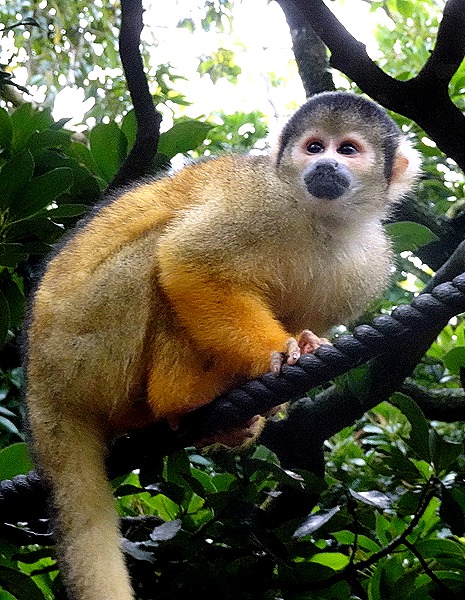
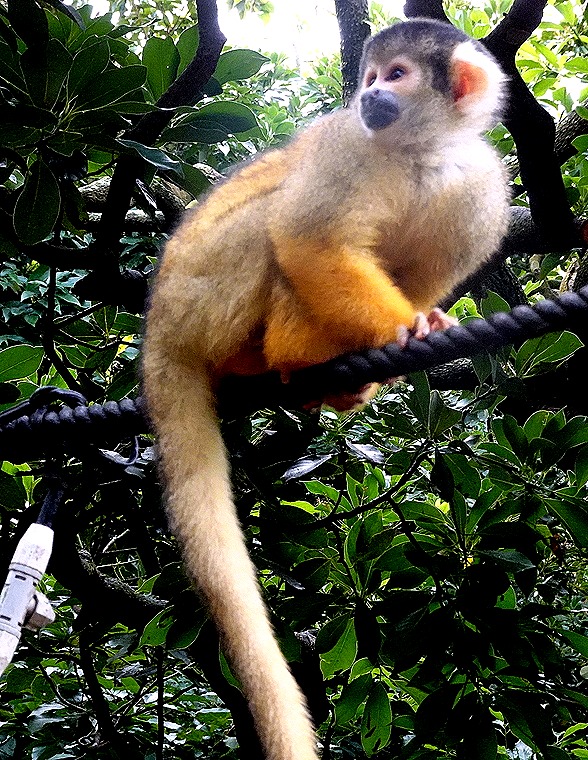
     We don’t know the names of all the animals we saw but will do our best.  Our first encounter was with a Green Vervet Monkey, which seem to be plentiful in the reserve.  They have black faces with orange, white and black fur, with very long tails.  They are found as far afield as the Caribbean, where we saw one once in Barbados.

9.  Dakar, Senegal-topaz-enhance15.  Dakar, Senegal-topaz-enhance-sharpen16.  Dakar, Senegal-topaz-enhance-sharpen171.  Dakar, Senegal-topaz-enhance-sharpen

     We saw several kinds of antelope.  The Roan Antelope is striking for its black and white face and curved horns, resembling an Oryx with shorter horns.  The Eland has straight horns and a clear beige face.  We saw a group of them in some woods.  Impalas were also there.  We had seen them in herds during our 2018 South Africa safari, but here it looked like just a family group.  In South Africa they provide food for the big cats and other predators, but there was none of that here.

141.  Dakar, Senegal-topaz-enhance115.  Dakar, Senegal-topaz-enhance40.  Dakar, Senegal-topaz-enhance136a.  Dakar, Senegal_stitch-topaz-enhance85.  Dakar, Senegal-topaz-enhance87.  Dakar, Senegal-topaz-enhance

67.  Dakar, Senegal-topaz-enhance-sharpen77.  Dakar, Senegal-topaz-enhance

     We stopped near a lake where some birds were standing on the shore.  We don’t have identifications but the tall one may be a heron.

107.  Dakar, Senegal-topaz-enhance106.  Dakar, Senegal-topaz-enhance-sharpen-gigapixel-very_compressed-scale-2_00x

    We saw some Patas monkeys on the ground and sitting on logs.  These are ground dwelling monkeys and they are the world’s fastest primates, able to run more than 30 miles per hour.  I guess that comes in handy if you want to stay alive while living on the ground, although there doesn’t seem to be any danger in this area.

28.  Dakar, Senegal-topaz-enhance-faceai56.  Dakar, Senegal-topaz-enhance

     We came upon what turned out to be a young buffalo, sans horns, hurrying through the grass looking like some kind of strange dog or pig from a distance.  Then it caught up to its mother who was grazing in the grass, which gave away its identification.  If you look closely there is an Oxpicker bird perched on the mother’s side, just above and to the right of the calf.  These little birds (6 or 7 inches) spend their time on the hide of buffalo, giraffes, rhinos and other large animals in Africa where they dine on ticks and other insects (as well as the animal’s blood sometimes if there is a sore spot).  Most of the large animals don’t seem to mind them; perhaps they are happy to have their parasites removed.

149.  Dakar, Senegal-topaz-enhance150a.  Dakar, Senegal-topaz-enhance-topaz-enhance151.  Dakar, Senegal-topaz-enhance

      Several giraffes were munching on some trees.  And a couple of zebras were lazing in the grass.  This is what you see when you do a game drive in the middle of the day, since most wild animals take it easy then and are more active in the evening and the early morning.

36.  Dakar, Senegal-topaz-enhance33.  Dakar, Senegal-topaz-enhance65.  Dakar, Senegal-topaz-enhance

     A couple of showy types of bird were around too.  We saw two Western Red-Billed Hornbills sitting on a branch.  Elsewhere on the ground we saw what is probably a Long-tailed Glossy Starling.  It’s back was a shiny metallic looking blue-green and it had round yellow eyes that looked a little freaky.  A startling starling!

126.  Dakar, Senegal-topaz-enhance118.  Dakar, Senegal-topaz-enhance-sharpen

     Speaking of birds, we saw two ostriches, both males (black and white feathers).  Ostriches are the biggest birds on Earth and the fastest two legged runners, peaking at about 40 miles per hour.  Each of the ones we saw was by itself.  With their large bodies and tiny heads they looked like something out of the movie Yellow Submarine.

101.  Dakar, Senegal-topaz-enhance135.  Dakar, Senegal-topaz-enhance-sharpen97.  Dakar, Senegal-topaz-enhance-sharpen100.  Dakar, Senegal-topaz-enhance

     Bandia Reserve has a large number of Beobab trees scattered throughout.  These large trees can live a thousand years or more and have very fat trunks with a lot of water in them.  They stood out from other trees during our drive because they were very white and mostly leafless (in addition to being big).  Near the end of our drive we stopped by a particularly large one and our guide explained that inside this living thousand year old tree is where the indigenous people of the area bury their Griots when they die.  Griots are African storytellers who preserve the local history through oral performance, with or without instrumental accompaniment.  This is similar to Homer, the somewhat legendary blind troubadour of ancient Greece credited with authorship of the Iliad and the Odyssey even though he would not have been able to read or write.  Griots are prominent people in their societies, often important advisors to the local headmen.  Our guide told us that after several generations the local people decided to stop burying their griots in this tree, but then they were hit by several years of drought.  This convinced them to resume the practice, after which the drought ended.  On the other side of the tree from where we were parked there is apparently a large hole in the bottom of the tree with a metal fence, behind which can be seen a couple of skulls.

32.  Dakar, Senegal-topaz-enhance46.  Dakar, Senegal-topaz-enhance156.  Dakar, Senegal-topaz-enhance155.  Dakar, Senegal-topaz-enhance

    After our drive was finished we walked to the outdoor cafeteria.  We passed a fenced area on the way in which were several giant tortoises.  The cafeteria has a view down to a lake that is full of crocodiles.  Happily, they weren’t too close and the overlook was well beyond their reach.

158.  Dakar, Senegal-topaz-enhance166.  Dakar, Senegal-topaz-enhance167.  Dakar, Senegal-topaz-enhance169.  Dakar, Senegal-topaz-enhance-sharpen

    So ends the good part of this excursion.  It was a nice drive and we saw quite a few animals, considering the time spent and the time of day.  But of course this was nothing like the 4 day safari we had in South Africa in 2018.  Still, it was our only opportunity to drive into the woods to visit animals in their natural habitat, so we were happy to have done it.
     We returned to the bus at the appointed time and had to wait . . . and wait, because there are often some people who think they are entitled to take as long as they want, here to eat and shop, before joining the others at the bus.  Then as we finally left the reserve one of the passengers asked the guide if he could have something to drink.  They didn’t have anything (some people bring their own water if this is important to them) so the whole bus full of people pulled over at what looked like a sort of drug store and we all waited while he went inside and bought some soda.  We were irritated because the last time we were here there was a great impromptu market spread out on the dock and since we had missed shopping (and everything else) in Cape Town we were hoping to do some here.  But as we got back into town, already much later than advertised, the guide announced we were going to stop at a large local market at the request of a couple of passengers who wanted to shop there.  This was met by a loud chorus of “No, take us to the dock” from most of the other passengers but that made no difference.  The bus pulled into an alley through traffic and the guide and about three people got off the bus and went into the market while the other 40 or so people just sat on the warm bus waiting for them.  After about 25 minutes (I think) they finally returned, having purchased . . . nothing. 

     When we finally returned to the dock we discovered that this time there was no market there!  We don’t know why but this was quite disappointing for us.   Before dinner we sailed away from Dakar and from the continent of Africa, heading west with only two more stops before reaching the US.